


Governance Risk and Control

Most governance risk and control programmes fail for a simpler reason than weak policy design. They define controls, then never prove whether those controls still work when systems change, suppliers change, or threats shift. In the UAE and across Europe, that gap now matters because regulators expect board oversight, traceable ownership, and evidence that controls are effective, not just documented.
What Governance Risk and Control Actually Means
Most governance risk and control programmes fail not because controls are missing, but because control effectiveness is never measured. A policy can look complete on paper and still leave the business exposed if no one tests whether the control still reduces risk in live operations.
The three pillars work as one system
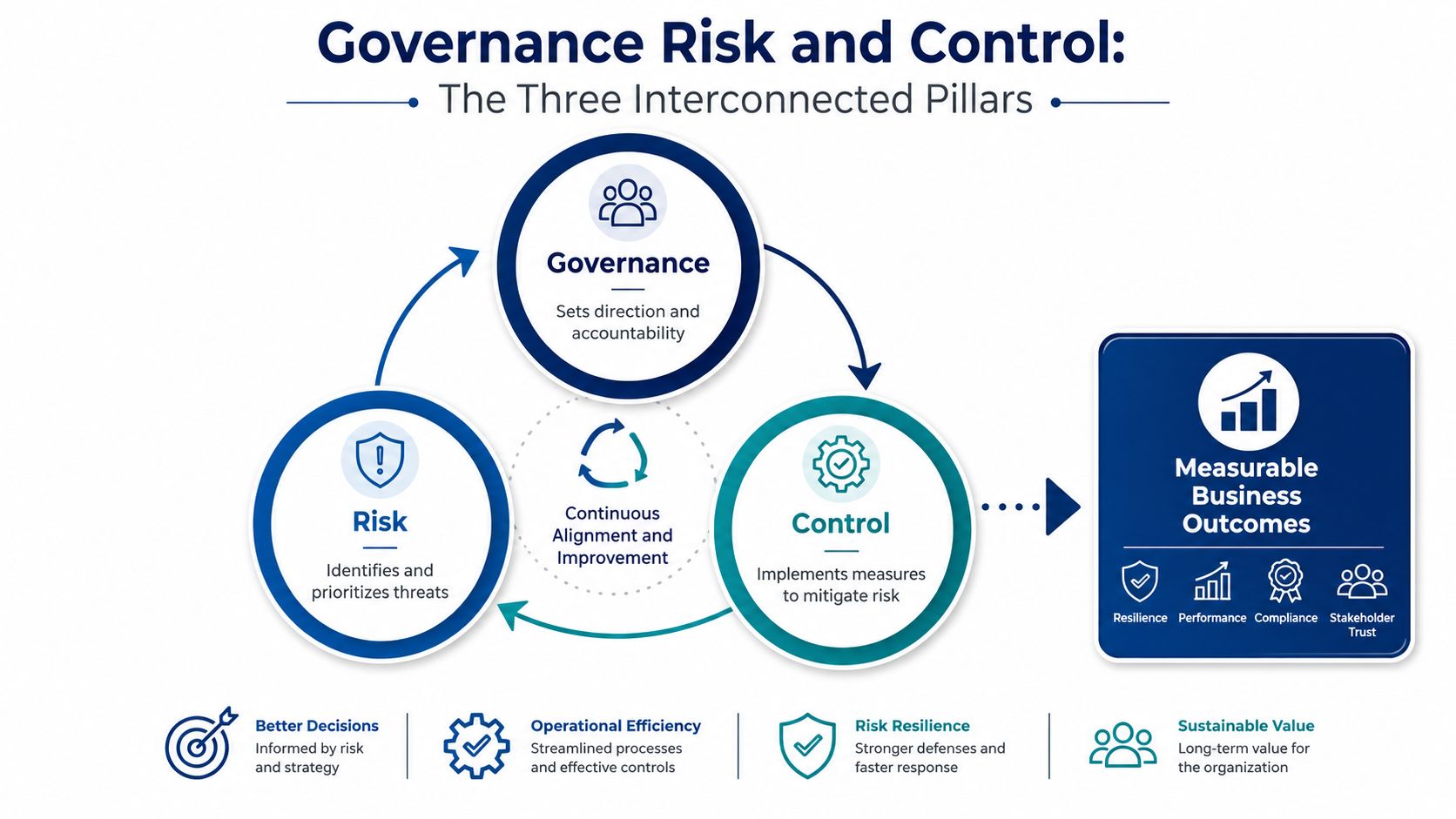
Governance sets direction and accountability. Risk identifies what could go wrong and how serious it is. Control is the mechanism that reduces, detects, or corrects that risk in practice. When those three are separated, teams end up with neat documentation and poor outcomes. When they're linked, the organisation can show who owns the decision, what could fail, and how the failure is contained.
The UAE gives a strong regional example. The Central Bank of the UAE formalised governance-risk expectations through its Corporate Governance Regulation and Standards framework in 2019, requiring board-approved governance structures, independent oversight, and risk-management functions aligned to the institution's risk profile UAE governance regulation context. That move raised governance from a management preference to a supervisory expectation, especially for regulated institutions operating across the AE region.
Practical rule: if a control can't be traced to a risk scenario and a business owner, it's paperwork, not control design.
What changes in practice
In mature programmes, the board doesn't just approve a policy pack. It sets a risk appetite, receives control evidence, and challenges exceptions. Operational teams then maintain auditable artefacts, such as access reviews, incident logs, and change approvals, that prove the control is working.
That's why the difference between “having controls” and “having effective controls” is now the central issue. A bank, fintech, or shared-service centre can have dozens of controls and still fail supervision if those controls aren't consistent, owned, and evidenced. For a practical complement to AI-era policy design, see the guide to AI governance for teams, which is useful when controls need to keep pace with model-driven workflows.
The internal discipline here is simple. Governance decides, risk prioritises, and control operationalises. If one of those three is weak, the whole structure starts to drift.
For a broader framework view, the related governance, risk, and compliance overview is a useful anchor for teams aligning policy, oversight, and evidence.
Choosing the Right Framework for Your Organization
The best framework depends on what you need to prove. If you need IT governance alignment, ISO certification, or detailed cybersecurity control structure, the right choice isn't the same for every business.
A practical comparison
Framework | Best For | Regional Fit | Certification Path |
|---|---|---|---|
COBIT | IT governance and business alignment | Strong for complex technology estates and shared services | No direct certification requirement for the organisation |
ISO 27001 / 31000 | Security management and enterprise risk | Useful for cross-border operations in GCC and Europe | Formal certification is available |
NIST | Cybersecurity control depth | Strong for technical control catalogues and security engineering | No organisational certification path in the same sense |
COBIT works best when the problem is governance alignment across IT, business, and audit. ISO 27001 and ISO 31000 are stronger when the organisation wants a recognised management system and a common language across jurisdictions. NIST is often the most useful when security teams need detailed control mapping for engineering, operations, and assurance.
The common mistake is adopting a framework wholesale and calling it maturity. A UAE enterprise handling personal data still has to account for Federal Decree-Law No. 45 of 2021 on the Protection of Personal Data, and a European group must align with GDPR alongside sector rules. A framework gives structure, but local law defines the actual obligations.
For fintech teams, the fintech regulatory security guide is a helpful reference point because it shows how regulatory controls, security expectations, and delivery discipline need to line up in practice.
How to choose without overengineering
Use these criteria:
Regulatory load: Heavier regulation usually favours frameworks that produce auditable evidence quickly.
Operating model: Multi-entity and cross-border groups need a framework that supports common controls.
Maturity level: Early-stage teams need clarity and scope control. Mature teams need integration and continuous monitoring.
Assurance needs: If external certification matters, ISO usually gives the cleanest path.
If your business can't explain why it chose a framework, it usually chose it for the wrong reason.
The internal COSO strategy and performance view is a useful companion when leadership wants risk work tied to business direction, not just control inventories.
Building a Control Taxonomy That Works
A useful control taxonomy starts with two questions: What risk are you treating, and how? Without that answer, organisations duplicate controls across departments, create testing noise, and still miss the exposure that actually matters.
A control library that works in GCC and European enterprises is built around risk scenarios, not around tidy folders of policy language. If a control cannot show what it prevents, detects, or corrects, it is usually documentation, not control design.
Start with control type, then map to risk
The cleanest structure is preventive, detective, and corrective controls. Preventive controls reduce the chance of failure, detective controls surface it quickly, and corrective controls restore service or close the gap after an issue.
That structure matters because control presence and control effectiveness are not the same thing. A policy can exist on paper while the control is inconsistent, manual, or too slow to matter. In practice, the test is whether the control can produce evidence through ITSM and ITOM workflows, then feed that evidence into continuous monitoring rather than periodic reassurance.
In the UAE's cross-sector cybersecurity governance stack, the practical signal is clear. Organisations need auditable control ownership, risk classification, and evidence-based monitoring rather than policy-only compliance. Every meaningful control should have a named owner, a testable objective, and a repeatable artefact that proves it ran. That also lines up with European expectations, where control logic has to survive audit, regulatory review, and operational change.
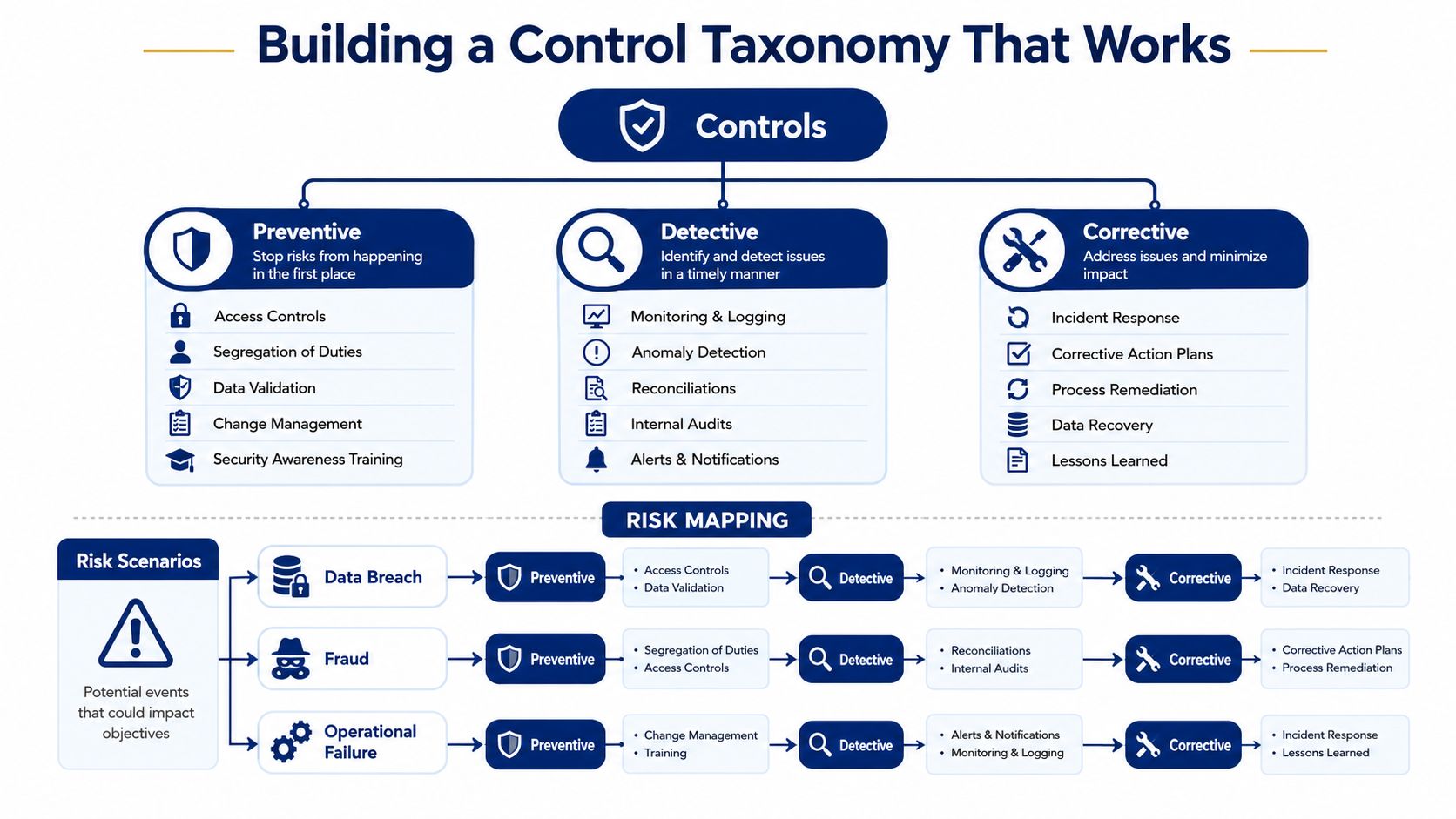
A finance team might use preventive controls for privileged access approvals, detective controls for transaction monitoring, and corrective controls for incident response and account lockout recovery. An IT operations team might use change approval as preventive, configuration drift alerts as detective, and rollback automation as corrective. The point is not to multiply controls. The point is to make each control observable, testable, and tied to a specific failure mode.
What to standardise across the enterprise
The key win is common controls. One standard control set can satisfy multiple obligations when it is mapped cleanly and tested once, rather than re-tested by every business unit. That matters in multi-emirate and multi-entity groups where duplicated controls raise operating cost and leave assurance coverage uneven.
Practical rule: do not collect controls because they sound prudent. Collect them because they close a named risk scenario.
For teams trying to move from control registers to control performance, standardisation should focus on the evidence model as much as the control itself. A shared control is only reusable if the same ticket, log, approval trail, or automated test result can satisfy the relevant requirement without rework. That is where ITSM and ITOM automation starts to matter, because it turns control execution into a repeatable workflow instead of a manual follow-up exercise.
Use this sequence:
Define the risk scenario. Data breach, fraud, service outage, or unauthorised change.
Assign the control type. Preventive, detective, or corrective.
Name the owner. One accountable party, not three shared owners.
Capture evidence. A log, ticket, approval, report, or test result.
Reuse the control. Map it to other requirements only if the evidence really holds.
The result is less duplication and more consistency. That is what makes a control taxonomy operational rather than decorative.
Governance Models and Accountability Structures
Control failures in hybrid operating models usually start with ownership, not technology. The control may exist on paper, but if delivery spans business teams, suppliers, cloud platforms, and offshore service centres, the question is who is accountable when evidence is missing or a review is late.
The three lines of defense model still works, but only when the boundaries are sharp. The first line runs the process and owns the control. The second line sets oversight, challenge, and monitoring. The third line checks whether the first two lines are doing the job.
The harder issue is the RACI matrix behind the model. If cloud operations, a managed service provider, and internal platform teams all assume someone else owns evidence collection, the control fails before audit begins. Shared-service delivery across UAE legal entities needs one accountable owner for each control, even where several teams contribute to execution.
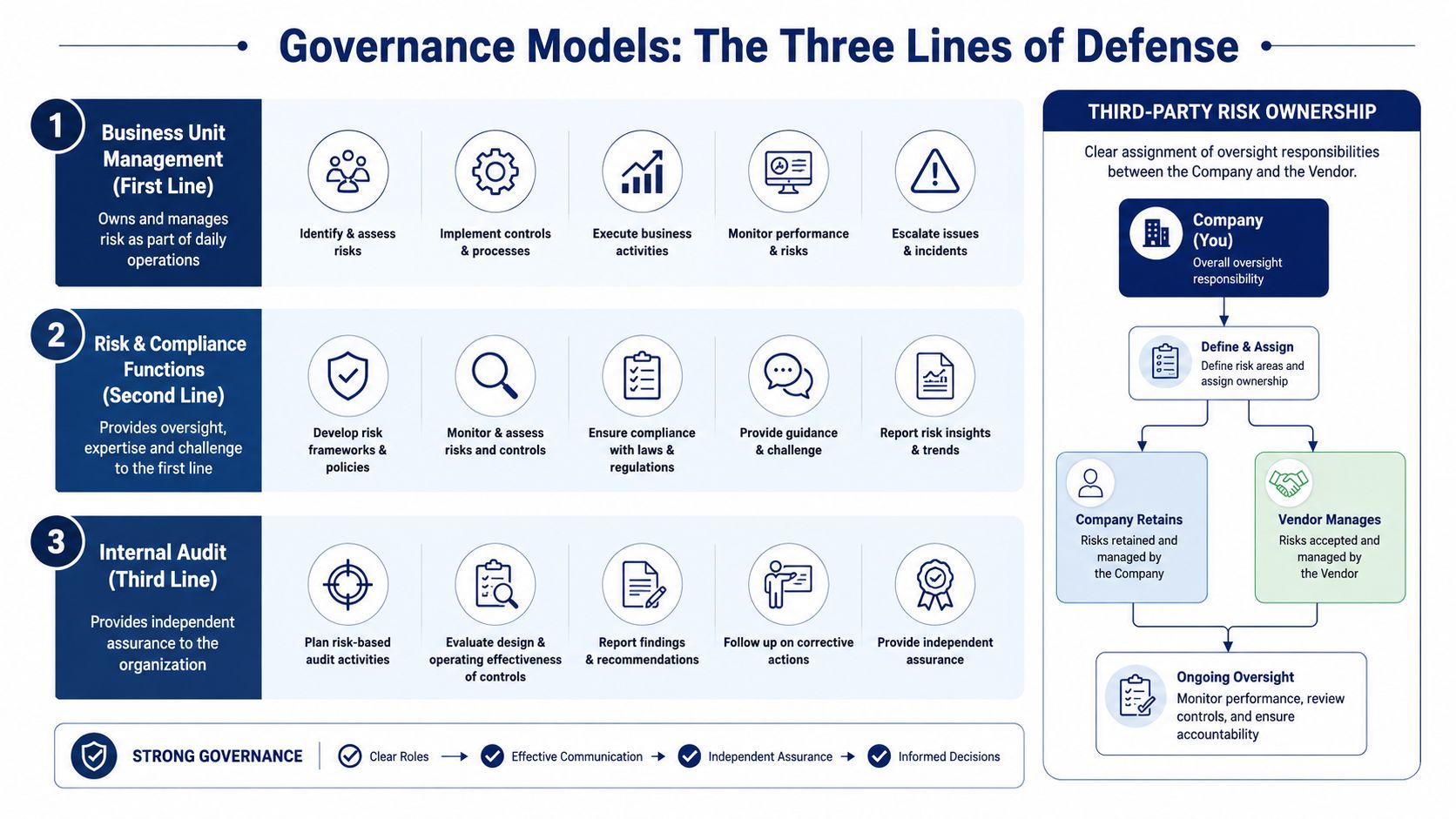
Cross-border delivery adds another layer of pressure. A vendor may process data, host infrastructure, or run support work, but accountability for the control outcome does not move with the work. It has to be redesigned around the actual operating model, including evidence collection, escalation paths, and review frequency for outsourced and AI-augmented services.
A practical design for accountability usually looks like this:
Business unit management: owns the process and the risk.
Risk and compliance: defines oversight and challenge.
Internal audit: validates that the controls and evidence are credible.
Vendor management: tracks supplier obligations and proof.
Technology operations: maintains logs, tickets, and technical evidence.
That structure works only if ownership and execution are kept separate. A supplier can perform a task, but the enterprise still owns the control result. In practice, that distinction is what stops organisations from mistaking outsourced activity for outsourced accountability.
Teams formalising responsibilities across business and control functions can also refer to the corporate governance and risk management article for a broader view of governance alignment.
Measuring What Matters with KPIs and Maturity Models
A long control register doesn't prove maturity. It only proves that someone can list controls. What matters is whether the organisation can show that controls continue to work, issues are being closed, and risk coverage is staying aligned to the environment.
Choose metrics that prove effectiveness
Vanity metrics count activity. Useful KPIs measure outcome. A report showing how many controls exist says little about exposure. A report showing how many high-risk processes are covered by tested controls says much more.
A practical KPI set usually includes:
Control failure rate for key processes.
Mean time to remediation after exceptions or incidents.
Risk coverage across critical workflows.
Evidence freshness for recurring controls.
Repeat finding rate across audit cycles.
The Central Bank of the UAE's 2024 annual report continued to emphasise governance, resilience, and supervisory oversight across a fast-growing financial system, which makes outcome-based control testing more relevant than checkbox compliance governance and resilience supervision context. In that environment, the control discussion has to move from “did we document it?” to “did it effectively reduce the risk?”
A five-level maturity view
Level 1, Ad Hoc. Controls are inconsistent, and evidence lives in email or spreadsheets.Level 2, Repeatable. Some controls are standardised, but they're still managed manually.Level 3, Defined. Control ownership, testing, and evidence are documented across teams.Level 4, Measured. KPIs, exception handling, and reporting are regular and reliable.Level 5, Optimized. Continuous monitoring drives control tuning and risk-based prioritisation.
Practical rule: if a KPI doesn't change a decision, it's reporting noise.
The gap between control presence and control effectiveness is where most programmes stall. Continuous monitoring and review close that gap because they show whether the control still works after the environment changes. That's the level most audit teams need.
Mapping GRC to ITSM and ITOM Workflows
Governance risk and control becomes operational only when it sits inside the systems teams already use every day. In practice, the evidence is often already in ITSM and ITOM, but it stays disconnected from control objectives, so compliance teams still end up chasing it manually.
Use workflows you already run
Incident, change, and problem management are the most direct starting points. In ServiceNow, HaloITSM, Freshservice, and ManageEngine, those workflows already produce audit trails that can show whether a control worked, not just whether someone wrote it down. A change record can support approval evidence, an incident ticket can support detection and response evidence, and a problem record can support root-cause remediation evidence.
The useful move is to tie each control to a real system object. A CMDB item can hold the asset or service classification, the ticket can hold the control owner, and the workflow can capture the approval trail, timestamp, and closure evidence without forcing teams to maintain a second compliance repository.
The internal GRC in ServiceNow article is useful for teams that want control mapping, evidence capture, and monitoring inside the operating platform rather than in a parallel repository.
Build the evidence chain
For operational teams, the evidence chain should be dull in the best way. It should move cleanly from risk to control to ticket to proof, so reviewers can trace one record to the next without rework.
A practical sequence looks like this. Incident management proves detection, response, and escalation. Change management proves approval, segregation, and release discipline. Problem management proves root-cause analysis and remediation closure. The CMDB provides service context and control scoping, which matters when teams in the GCC and Europe need to show why a control applies to one service and not another.
A unified data model is what makes the chain hold together. Without it, compliance teams chase screenshots and one-off exports. With it, they can pull evidence from live workflows and test control effectiveness continuously, which is where the gap between policy presence and control performance starts to close.
DataLunix is one option for that integration work. It connects data across ITSM and ITOM platforms and maps control evidence into those workflows, which reduces manual evidence hunting and makes recurring testing easier to run inside the operating system rather than beside it.
Automation and Agentic AI Opportunities
The assumption that more controls always means better governance doesn't hold in real operations. More controls often mean more handoffs, more friction, and more places where evidence can go missing. Automation changes that equation.
Continuous monitoring beats static checklists
Agentic AI workflows can help collect evidence, flag anomalies, and test controls across distributed systems without waiting for month-end or quarter-end reviews. That's especially relevant in the UAE, where the UAE Cyber Security Council set the UAE Cybersecurity Strategy 2025 around six pillars, governance, protection, innovation, capacity building, partnerships, and response and recovery UAE Cybersecurity Strategy 2025 context. Governance and recovery are explicit policy themes now, not side issues.
Useful automation opportunities include:
Access control monitoring: detect unusual privilege changes and missing approvals.
Policy compliance checks: compare live configuration against required settings.
Incident response orchestration: auto-create tasks, route evidence, and log actions.
Evidence harvesting: pull tickets, logs, and approvals into control records.
Control testing: trigger recurring checks without manual reminders.
The internal AI automation examples piece is a practical reference for teams exploring where automation reduces effort without reducing assurance.
Practical rule: use AI to gather and triage evidence, not to replace control ownership.
The most useful pattern is human-owned, machine-assisted control monitoring. AI flags exceptions, but accountable teams still approve remediation, sign off evidence, and decide when risk is acceptable. That keeps the control environment defensible while reducing the manual burden on operations and compliance.
Implementation Roadmap with Regional Milestones
A realistic rollout takes time because governance change isn't only technical. It affects ownership, evidence discipline, and how leaders interpret risk. In GCC and Europe, the cleanest implementations usually move in phases rather than trying to launch everything at once.
A phased plan that holds up
Discovery starts with control inventory, process mapping, and a fit-gap review against UAE and EU obligations. Design turns that into a control taxonomy, owner matrix, and evidence model. Deployment integrates controls into ITSM, ITOM, and compliance workflows. Optimization adds continuous monitoring, KPI review, and automation where manual effort is still too high.
A financial services group often begins with access, change, and incident controls because those areas create immediate audit pressure. A technology business usually starts with service and configuration controls because the operating environment changes faster. In both cases, the timeline is driven less by tooling and more by stakeholder alignment and remediation discipline.
For teams with regulated data, the milestone questions are straightforward. Can the business demonstrate privacy controls under the UAE data law? Can European entities align with GDPR requirements? Can the control owner prove evidence is current, not stale?
DataLunix engagements typically begin with discovery workshops, fit-gap analysis, and readiness assessments, then move into change management and enablement so the improvement sticks. That sequence matters because the point is sustainable maturity, not a one-off project closeout.
If you want to turn governance risk and control into a live operating model rather than another policy library, visit DataLunix and start with a discovery workshop, fit-gap review, and readiness assessment. DataLunix builds control-linked workflows across ITSM, ITOM, and compliance platforms, so your team can prove effectiveness with evidence instead of manual chase work.