


Governance Risk Compliance Platform

You're in a steering meeting when the regulator requests evidence, the board asks which risks remain open, and an infrastructure lead explains that the supporting records sit across spreadsheets, email, ServiceNow, and a supplier portal. A governance risk compliance platform should bring those answers together, but only if it can respect regional data rules, monitor controls continuously, and collect evidence from the systems where work happens.
What a Governance Risk Compliance Platform Actually Does
A governance risk compliance platform consolidates the work your risk, compliance, audit, security, and technology teams already perform. It connects risk registers, control libraries, policy attestations, audit evidence, issues, exceptions, ownership, and regulatory reporting into a traceable operating model.
That makes it more than a document repository. A capable platform acts as an evidence engine. It should pull change records, access reviews, incident tickets, vulnerability information, supplier assessments, and approval histories from operational systems, then connect those signals to the controls and obligations they support.
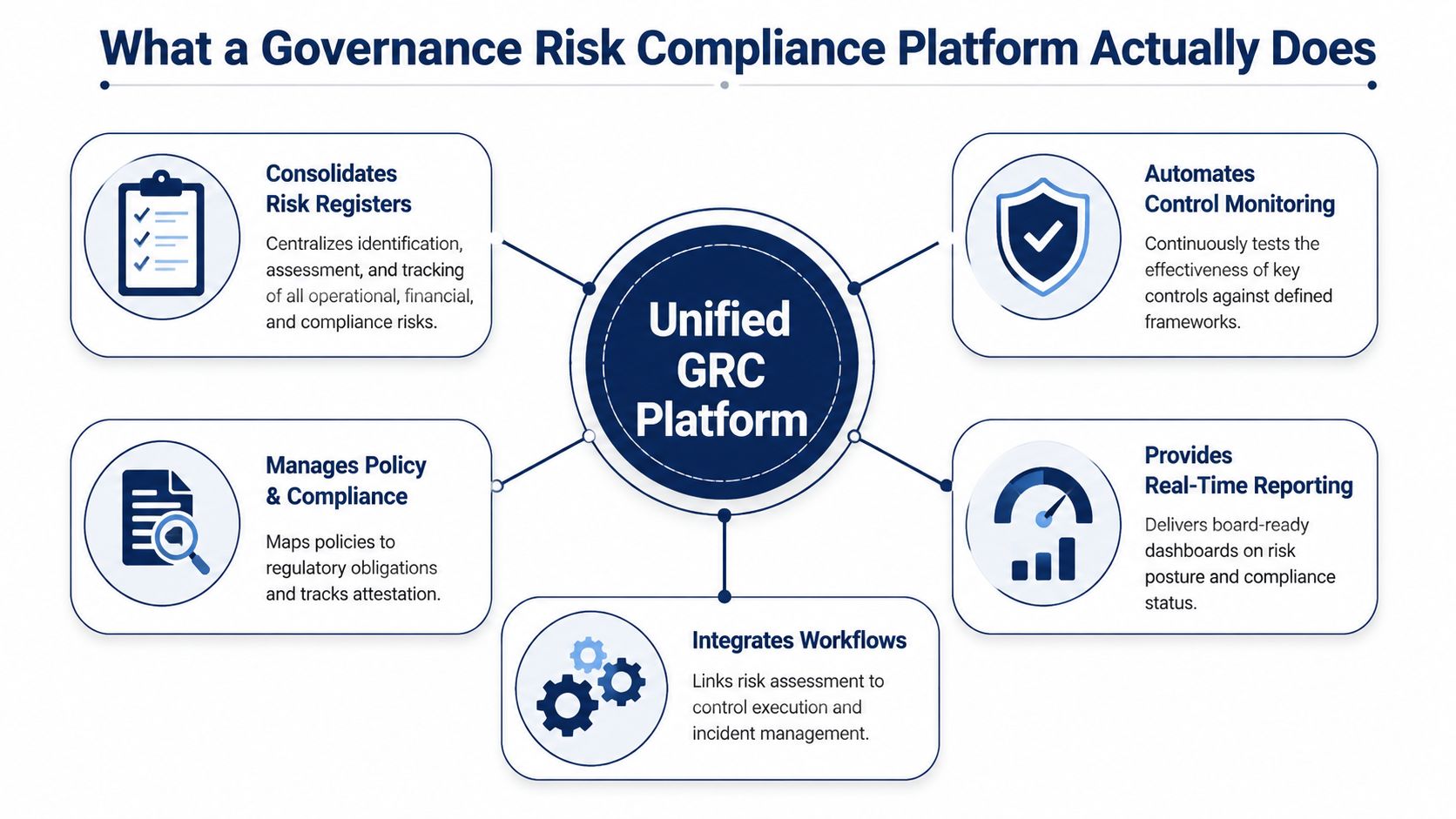
Where the platform sits in your operating model
A GRC platform governs risk and compliance processes. An ITSM or ITOM tool manages operational work, such as incidents, changes, service requests, assets, and configuration data. A standalone compliance application usually addresses a narrower need, such as privacy assessments, a specific certification, or policy management.
The products can overlap, but they shouldn't be treated as substitutes.
Capability | GRC Platform | ITSM/ITOM Tool | Standalone Compliance App |
|---|---|---|---|
Risk ownership and scoring | Enterprise risk model, scoring, appetite, issues, and exceptions | Operational impact and service priority | Usually limited to a compliance domain |
Control management | Framework mapping, testing, evidence, and remediation | Operational tasks that may support controls | Often focused on checklist completion |
Policy attestation | Policy lifecycle, audience, approvals, and attestations | May distribute operational procedures | Commonly a primary capability |
Audit traceability | Links obligation, control, test, evidence, finding, and owner | Supplies source records | Usually limited to its own workflow |
Operational evidence | Pulls signals from ITSM, ITOM, IAM, ERP, and security tools | Creates the underlying records | Often depends on manual uploads |
Board reporting | Aggregated risk posture and compliance reporting | Service and operational dashboards | Domain-specific compliance status |
Most organisations move through a recognisable maturity arc:
Spreadsheet-led: owners update separate registers and email evidence.
Workflow-led: teams use forms, reminders, approval paths, and central repositories.
Integrated: controls connect to operational data and findings create remediation work.
Continuous assurance: the platform evaluates live signals and highlights policy drift.
Your next step shouldn't be a full replacement of every system. Start with the highest-risk evidence chain, then expand once ownership, taxonomy, and integrations are reliable. For governance context, the practical guide to roles and risk for boards helps connect platform reporting with board accountability.
A useful operating model is outlined in governance risk compliance process design. Use it to test whether a proposed platform supports decisions and remediation, not just record keeping.
Core Modules and Features That Matter in 2026
The broadest feature list isn't the strongest buying signal. You need to test whether each module produces usable, traceable evidence when a regulator, auditor, customer, or board member asks a difficult question.
Which modules deserve priority?
Risk management should support a consistent taxonomy, inherent and residual assessments, accountable owners, treatment plans, and quantified scoring. Ask the vendor to demonstrate how a business unit risk rolls up into an enterprise view without losing its source evidence.
Policy and attestation workflows solve the familiar problem of policies existing in a repository while employees and suppliers can't prove they read or accepted them. Test version control, targeted distribution, approval history, overdue escalation, and evidence of attestation.
Compliance mapping matters most when you operate across jurisdictions or sectors. The platform should crosswalk one control against multiple frameworks, preserve framework versions, and show which obligations are affected when a control changes.
Audit management must link the request list to evidence, tests, findings, action plans, and closure. A regulator inquiry shouldn't force your team to search through folders for the document that proves who approved a control and when it was tested.
Executive reporting should show exposure, trends, overdue actions, exceptions, and ownership. A dashboard that merely counts loaded controls is not a risk view.
What should you test in a demonstration?
Run a scenario, not a module tour:
Regulatory change: update an obligation, identify affected controls, notify owners, and retain the previous version.
Control failure: ingest an operational signal, create an exception, set a due date, and open remediation work.
Third-party review: request evidence from a supplier, assess the response, escalate gaps, and report the residual risk.
Board reporting: move from an enterprise risk to the underlying control test and evidence item.
Emerging scope includes AI governance, ESG, privacy, resilience, and third-party risk. Include them in your architecture discussion, but don't let optional modules distract from weak control traceability. A practical comparison of products is available in best GRC tools, but your own evidence workflow should decide the shortlist.
GCC and Europe Regulatory Considerations That Shape the Platform
Regulation determines architecture. In the UAE, the AML/CFT framework was updated by Federal Decree Law No. 10 of 2025 and Cabinet Decision No. 134 of 2025. Governance requirements for listed companies were also refined through Decision No. (2/RM) of 2024 and a 2025 circular, creating layered expectations around board oversight, risk documentation, beneficial ownership, and audit trails. These developments are summarised in the UAE GRC compliance overview.
The UAE also introduced Federal Decree-Law No. 26/2025 on Child Digital Safety, which came into force on 1 January 2026. In-scope entities have a one-year grace period before full enforcement begins in January 2027, and the law reaches digital platforms directed at UAE users, including social media, streaming, e-commerce, gaming, smart applications, search engines, and websites. Your platform must track scope, category, jurisdiction, obligation, and grace-period status, not merely add another policy to a calendar. The UAE child digital safety law analysis provides the regulatory context.
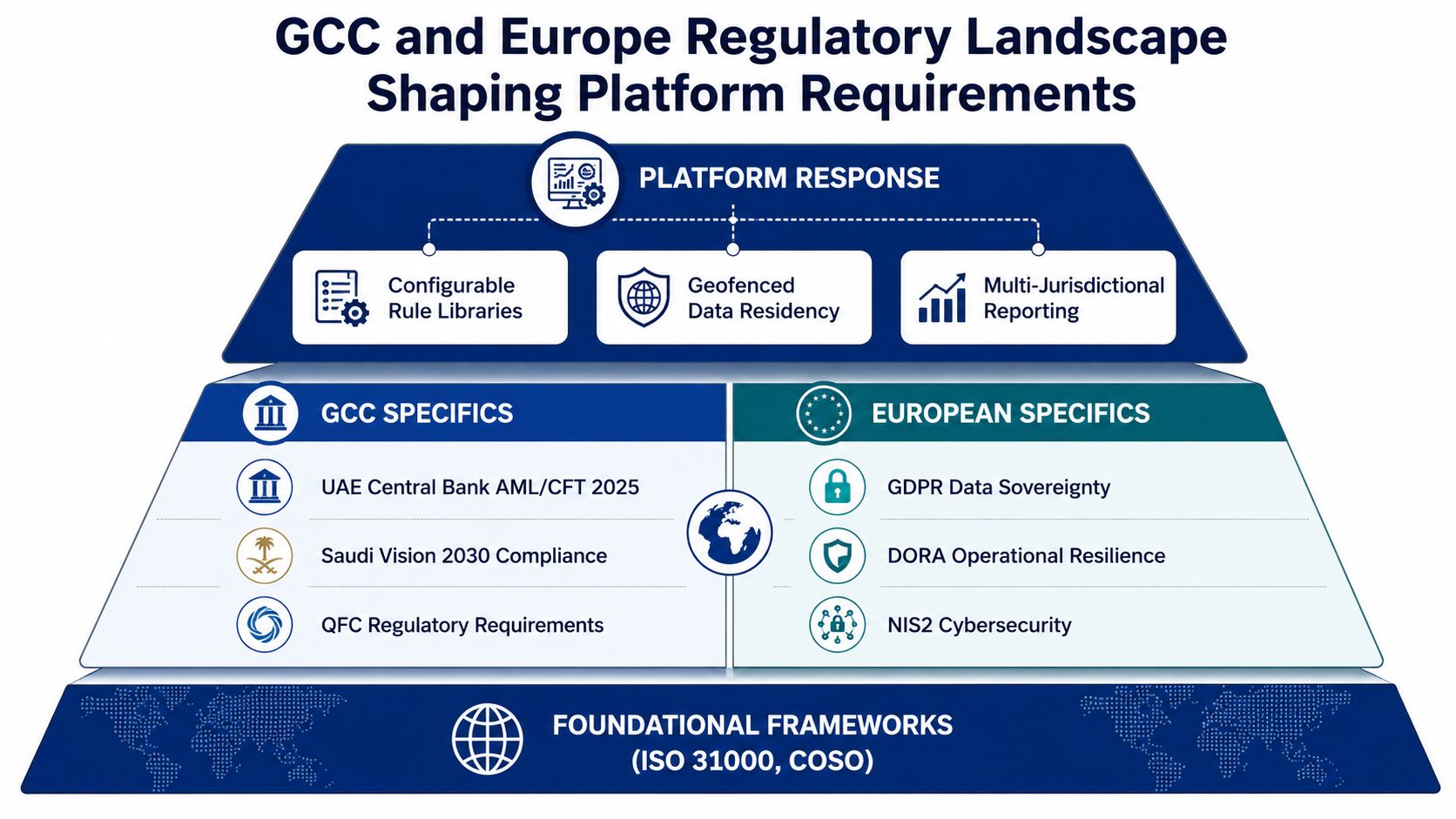
How should UAE and European requirements affect configuration?
European operations commonly need to address GDPR, DORA, and NIS2 through data governance, operational resilience, cyber-risk, incident, supplier, and evidence workflows. Treat those obligations as connected controls rather than separate compliance projects. The platform should scope requirements by entity and location, reuse evidence where the same control applies, and preserve an auditable history of changes.
The strongest model is policy to control to test traceability. Controls should be versioned, exceptions should be time-bound, and each obligation should have an accountable owner. This enables continuous compliance evidence instead of a last-minute audit reconstruction. For DORA-related operating resilience work, use the DORA operational resilience guide as a reference point.
Sector overlays make configuration depth essential. The Central Bank's Risk Management Regulation applies to banks on both a solo and group-wide basis, while ADGM and DFSA maintain their own cyber-risk and governance standards. Central Bank rules also require technology and cyber-risk management, including adequate IT controls and the reliability, strength, stability, availability, and security of computer and payment systems, as described in Article 12 requirements for risk management.
Integration Patterns with ITSM and ITOM Platforms
ServiceNow, HaloITSM, ManageEngine, and Freshservice are operational backbones that generate the records a governance risk compliance platform needs. Their value depends on how reliably those records become structured, traceable control evidence.
Use a direct integration pattern: map each control objective to relevant ITSM and ITOM records, collect evidence from changes, incidents, access reviews, assets, and configuration data, then create a linked remediation ticket when testing finds a gap. The GRC record should retain the control conclusion and evidence reference, with the ITSM record managing execution. This separation preserves accountability while keeping remediation inside the team's established workflow.
Backbone | Integration Style | Evidence Sources | Best Fit |
|---|---|---|---|
ServiceNow | Native GRC or IRM capabilities, APIs, and integration spokes | Change, incident, CMDB, access, problem, vendor, and service records | Complex enterprises already standardised on ServiceNow |
HaloITSM | API-first integration and configurable workflows | Tickets, changes, approvals, assets, and service records | MSPs and organisations needing flexible service workflows |
ManageEngine | Integration with a broad operational suite, including on-premise-friendly flows | Endpoint, service desk, change, asset, and security records | Organisations with mixed or locally controlled environments |
Freshservice | Ticketing-led evidence capture through APIs and workflow automation | Incidents, changes, approvals, assets, and service requests | Teams seeking a lighter service-management operating backbone |
What does platform-specific integration look like?
ServiceNow can connect GRC and operational records within one ecosystem. Test data ownership, licensing boundaries, and the quality of native evidence relationships before committing to that architecture. The practical design principles are also relevant to GRC in ServiceNow.
HaloITSM fits API-led integration and MSP operating models. Validate tenant separation, client-specific frameworks, and evidence reuse controls so one customer's records cannot appear in another customer's assessments.
ManageEngine suits environments where on-premise-friendly deployment and controlled data flows matter. Test evidence movement between service desk, endpoint, identity, and compliance processes.
Freshservice works well when ticket history supplies much of the operational evidence. Require structured fields for approvals, ownership, closure, and affected assets. Attachments alone make control testing slow and difficult to reproduce.
Outsourcing and workforce governance introduce a separate accountability boundary. The guide to governance for PEO negotiations provides context for assigning responsibilities across organisations. In every integration, define the system of record, evidence retention, ownership, and failure handling before enabling automation.
Selection Criteria and Vendor Considerations for Mid-to-Large Enterprises
Score vendors against your operating constraints, not their demo script. A regulated enterprise and an MSP may shortlist the same products but should not assign them the same priorities.
Which criteria should decide the shortlist?
Use a simple weighted model, then adjust it to your risk profile:
Configuration depth: Can you model your taxonomy, entities, approvals, exceptions, and ownership without custom code?
Multi-framework support: Can one control map to UAE, KSA, EU, and global standards while preserving framework versions?
Sovereign deployment: Can sensitive evidence remain in an approved UAE, Saudi, or European environment?
Continuous monitoring: Does the platform test control effectiveness, or only collect documents for audit?
Multi-tenancy: Can an MSP separate clients, administrators, evidence, reporting, and retention policies?
Integration ecosystem: Can it connect to IAM, ITSM, ITOM, ERP, security, HR, and supplier systems?
Total cost of ownership: Have you priced implementation, content configuration, integration, upgrades, managed services, and internal ownership?
Sovereign deployment deserves an explicit pass or fail. Regional buyers increasingly need in-country or self-hosted options, and generic Western SaaS may not satisfy government, regulated, or critical-infrastructure requirements. Review the sovereign GRC and data-localisation considerations before procurement narrows your choices.
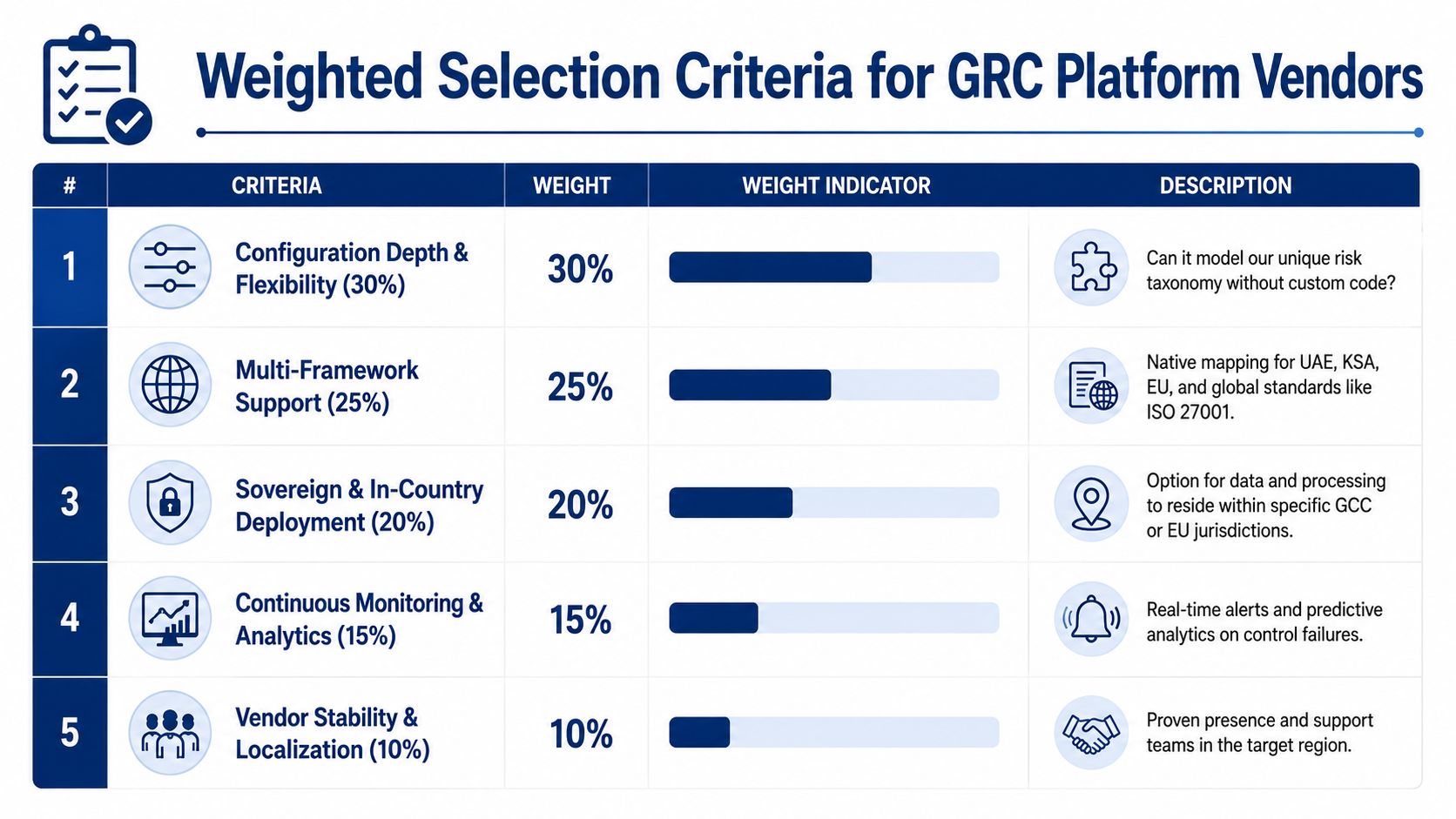
For regulated enterprises, prioritise configuration, framework mapping, residency, and monitoring. For MSPs, raise the importance of multi-tenancy, delegated administration, client reporting, and repeatable onboarding. Licensing discounts through certified partners can change the commercial comparison, but they shouldn't change your technical score. Review the GRC market and platform assessment as one input, then validate every claim in a scenario-based demonstration.
Implementation Roadmap and Change Management
A credible rollout starts with obligations and evidence, not a vendor's full catalogue. A 90-day implementation can establish a working foundation when the organisation limits the initial scope and assigns real owners.
Days 1 to 30 establish the operating baseline
Run discovery workshops with compliance, internal audit, security, infrastructure, procurement, legal, and business owners. Map the obligations that apply, identify the source systems for evidence, and perform a fit-gap assessment against current registers, policies, controls, suppliers, and reporting.
At this stage, decide what won't move into the platform yet. Migrating every historic spreadsheet creates noise and transfers poor taxonomy into a new interface.
Days 31 to 60 configure and pilot
Configure the core risk taxonomy, policy lifecycle, control library, framework relationships, evidence tasks, exception rules, and reporting views. Pilot with a high-risk business unit rather than a friendly low-complexity team.
Use the pilot to expose friction:
Control ownership: Owners may reject vague responsibilities. Define accountable roles and escalation paths.
Evidence quality: Teams may upload files without dates, scope, or approval context. Set minimum evidence metadata.
Integration gaps: Operational tools may lack structured fields. Fix the source workflow instead of compensating with manual GRC tasks.
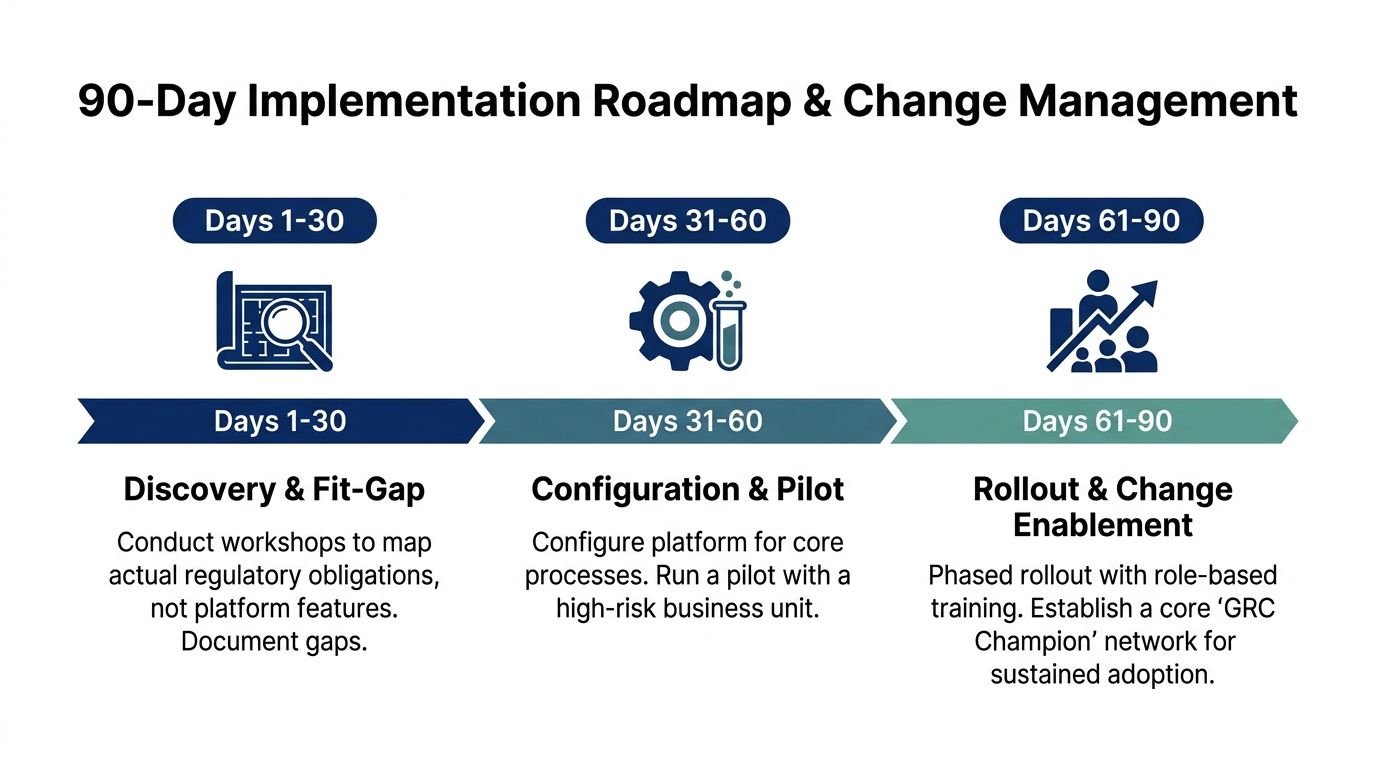
Days 61 to 90 roll out with role-based enablement
Expand in phases from policy and risk into audit, third-party risk, reporting, and continuous testing. Train control owners on evidence and remediation, risk champions on assessments and escalation, and executive sponsors on decisions and reporting.
Measure adoption through completed assessments, evidence quality, remediation activity, and owner response, not licences issued. After go-live, managed services can support optimisation, upgrades, and outsourced operations. Staff augmentation is practical when you need certified GRC architects without committing to a permanent hire.
Success Metrics and Common Pitfalls
A platform is working when it changes operating outcomes. Track the effort required to prepare audits, the time needed to remediate findings, control-testing coverage, third-party review cycle time, policy attestation completion, and the quality of evidence linked to each conclusion.
Avoid vanity measures such as the number of controls loaded or dashboards created. Those figures describe platform occupancy, not compliance posture.
Which risks do buyers underestimate?
Continuous controls monitoring can become an audit-only dashboard. Forrester reported in 2026 that CCM remained an embryonic capability and the weakest current offering criterion in its GRC platform evaluation. The problem is architectural: a platform may gather evidence for auditors without detecting control failure early enough to trigger remediation. See the Forrester GRC platform evaluation for that market finding.
Data residency can drift across subsidiaries and clouds. A central platform may appear compliant while evidence, metadata, backups, or integration payloads cross an unapproved boundary. UAE and GCC designs should separate metadata from sensitive evidence, support configurable retention and geographic partitioning, and control connections to IAM, ticketing, and security telemetry. The UAE survey on data compliance, AI governance, and vendor risk found that 66% of organisations reported full compliance with UAE data protection and sovereignty laws, while 34% reported gaps or disruptions. It also found that 62% directly monitor compliance across all third-party providers, showing why vendor evidence and residency controls belong in the same operating model.
The 2026 differentiator isn't module count. It is evidence-grade automation that connects obligations to live operations without creating uncontrolled data movement.
Frequently Asked Questions About Governance Risk Compliance Platforms
Can a governance risk compliance platform support sovereign deployment?
It can, but you must verify the deployment model, processing location, backup architecture, administrator access, retention controls, and integration paths. Ask whether the platform supports in-country hosting, sovereign cloud, or self-hosted operation for the entities and evidence types in scope.
Will a GRC platform reduce audit preparation effort?
It should reduce manual searching when controls, tests, evidence, findings, owners, and remediation records are linked. The result depends on evidence quality and integrations, not just on loading a framework into the platform.
How deep should ITSM integration be?
At minimum, the platform should read structured change, incident, access, asset, and approval records, then create linked remediation work when a control fails. A one-way document export is not integration depth.
Can an MSP use one platform for multiple clients?
Yes, if the architecture supports tenant isolation, delegated administration, separate retention rules, client-specific frameworks, and independent reporting. Validate that shared control content doesn't expose client evidence or blur accountability.
Can a certified partner change the pricing model?
A certified partner may offer discounted licensing and delivery options, but procurement should still compare implementation, integration, support, upgrades, and managed-service costs. DataLunix can support organisations evaluating HaloITSM, HaloPSA, Freshservice, ManageEngine, or ServiceNow alongside their GRC requirements.
DataLunix provides discovery workshops, fit-gap analysis, readiness assessments, implementation, integration, change enablement, managed services, and staff augmentation for GCC and European organisations evaluating a governance risk compliance platform. Visit DataLunix to define your evidence architecture, test sovereign deployment requirements, and build a shortlist around the systems your teams already use.