


SAP GRC 12.0 for GCC Enterprises: 2026 Migration Guide

Most advice about GRC 12.0 tells GCC enterprises to choose between extending maintenance and migrating. That's the wrong first question. The urgent decision is how to sequence HANA conversion, SAP S/4HANA Foundation readiness, control remediation, and the successor transition before mainstream support ends in 2027. Treating GRC as a standalone application upgrade can leave your auditors, BASIS team, and procurement function working from different assumptions.
SAP describes Access Control 12.0 Support Package 12 as globally applicable, and SAP community guidance identifies 2027 as the end of mainstream support and 2030 as the end of extended support. SAP's Access Control documentation also records the revamped dashboard experience that replaced older Flash-based components. For CIOs across Saudi Arabia, the UAE, Qatar, and the wider GCC, this is a platform-lifecycle decision with direct implications for audit evidence and change control.
Why GRC 12.0 Is a Sequencing Problem Not a Simple Upgrade
The popular advice is to “upgrade GRC now and decide on HANA later”. Don't follow it blindly. SAP's successor path requires database conversion to SAP HANA and readiness for the SAP S/4HANA Foundation, so the key gating items sit beneath the GRC application layer. A technically current GRC system can still be on the wrong foundation for the next platform.
SAP guidance identifies 2027 as the mainstream support endpoint and 2030 as the extended support endpoint for GRC 12.0. SAP's community discussion on the product's next step also states that innovation for GRC 12.0 is being sunset. That gives you a multi-year planning window, but it doesn't justify delaying the architecture decision.
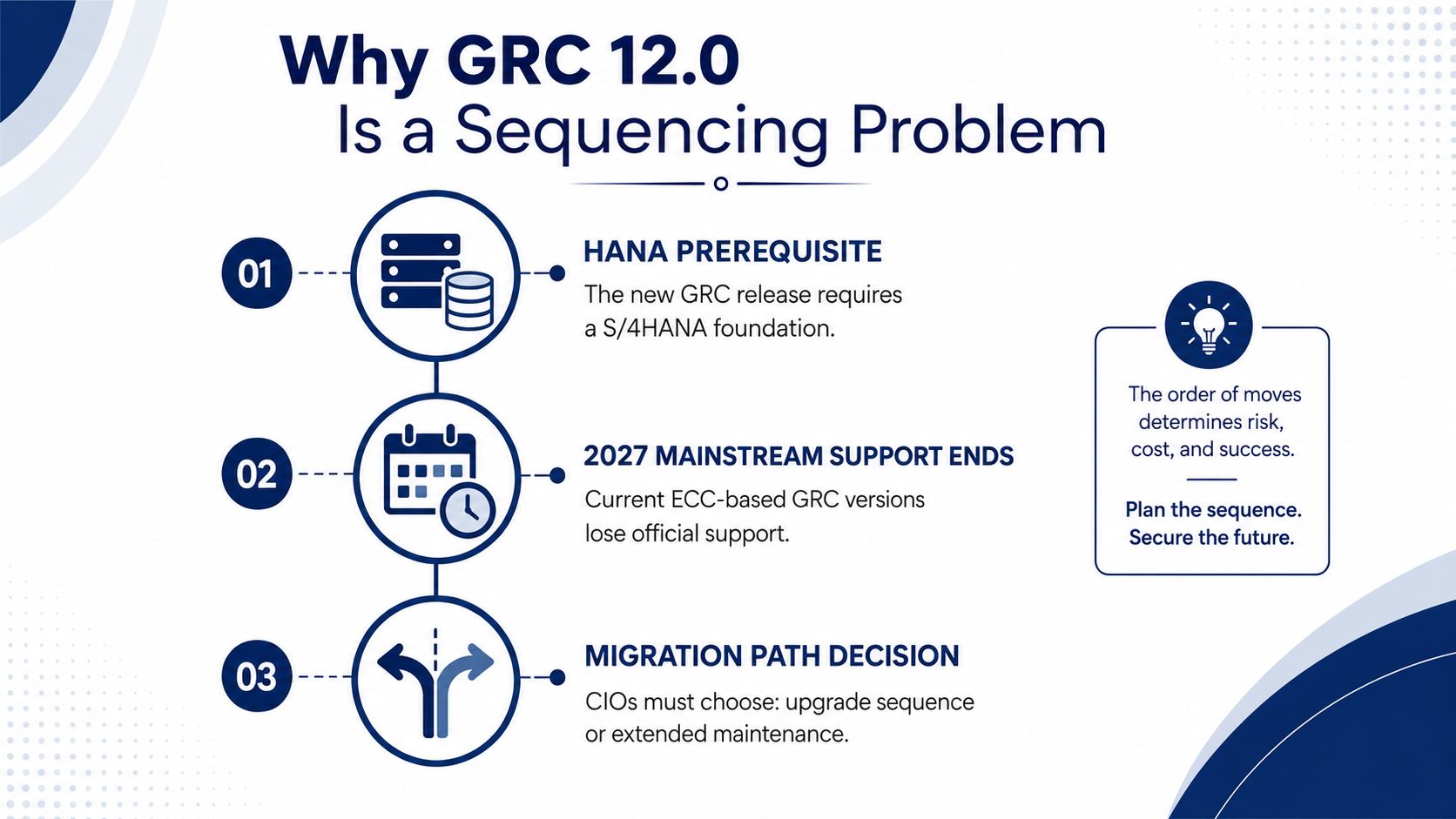
The sequence your CIO should approve
Baseline the current platform. Confirm the GRC database, NetWeaver release, UI components, plug-ins, custom code, workflows, and connected systems.
Decide whether HANA is a shared programme dependency. If your ERP roadmap already includes HANA or an S/4HANA Foundation programme, GRC should be placed inside that governance structure.
Protect control continuity. Freeze the rule, workflow, and emergency-access baseline before technical changes begin, then define regression evidence for auditors.
Schedule the successor path. Use the support horizon to establish a decision gate, not as a reason to wait until the final maintenance year.
GCC organisations often run hybrid estates, with legacy ERP systems supporting central functions while newer S/4HANA environments serve selected subsidiaries. That makes sequencing more important than the nominal GRC upgrade task. Your programme management approach should therefore connect BASIS, security, audit, procurement, and business process owners from the start.
Practical rule: If the HANA and foundation roadmap isn't approved, the GRC roadmap isn't complete.
What Changed Inside GRC 12.0 and Why It Matters
GRC 12.0 was a bridge release between classic on-premise governance and newer identity architectures. Winterhawk's overview identifies four material changes: a pre-delivered Fiori tile catalogue for dashboards, Fiori-like screens replacing NetWeaver Business Client surfaces, Overview Pages, and Bridge Sync integration with SAP Cloud Identity Access Governance. The Winterhawk overview of GRC Access Control 12.0 also states that SAP NetWeaver must be upgraded to 7.52 and SAP UI to 7.52 SP02.
GRC 12.0 Change | Technical Shift | GCC Control-Room Benefit |
|---|---|---|
Fiori tile catalogue | Pre-delivered tiles support dashboard access | Control-room users get a clearer starting point for access-risk work |
Fiori-like screens | Older NetWeaver Business Client launch surfaces are replaced | Operators work in a more consistent interface across governance tasks |
Overview Pages | Dashboards consolidate relevant governance information | Risk owners can review access and process information without navigating disconnected screens |
Cloud IAG Bridge | Bridge Sync connects on-premise GRC with SAP Cloud Identity Access Governance | Teams can coordinate governance across on-premise systems and cloud subsidiaries |
Why the interface is a control issue
The interface change isn't merely cosmetic. A control room needs reliable visibility during access-request reviews, emergency-access monitoring, and audit preparation. A Fiori-style launch experience can give operators a more structured route into those activities, provided the organisation tests roles, tiles, authorisations, and reporting responsibilities.
SAP's published information for Support Package 12 confirms global applicability and records a revamped dashboard interface for applications that previously depended on Adobe Flash. That matters for enterprises preserving historical evidence, because a dashboard modernisation can affect screenshots, operating procedures, training material, and audit walkthroughs.
The Cloud IAG Bridge also changes the architecture conversation. It doesn't turn every cloud governance problem into an on-premise GRC problem, but it provides a defined integration path for organisations managing multiple identity and ERP domains. Your FFID controls in SAP should be reviewed alongside emergency-access workflows, because privileged access evidence must remain understandable across the connected system.
How GRC 12.0 Fits into a Hybrid ERP Estate
GCC enterprises rarely operate one clean SAP stack. A typical estate may place central finance and HR on ECC 6.0 EHP 8, run a S/4HANA 2021 sandbox for a Saudi trading subsidiary, and use SuccessFactors Employee Central for employee data and payroll processes. GRC 12.0 acts as the control hub, coordinating access-risk analysis, request workflows, segregation-of-duties controls, and emergency-access governance across those platforms.
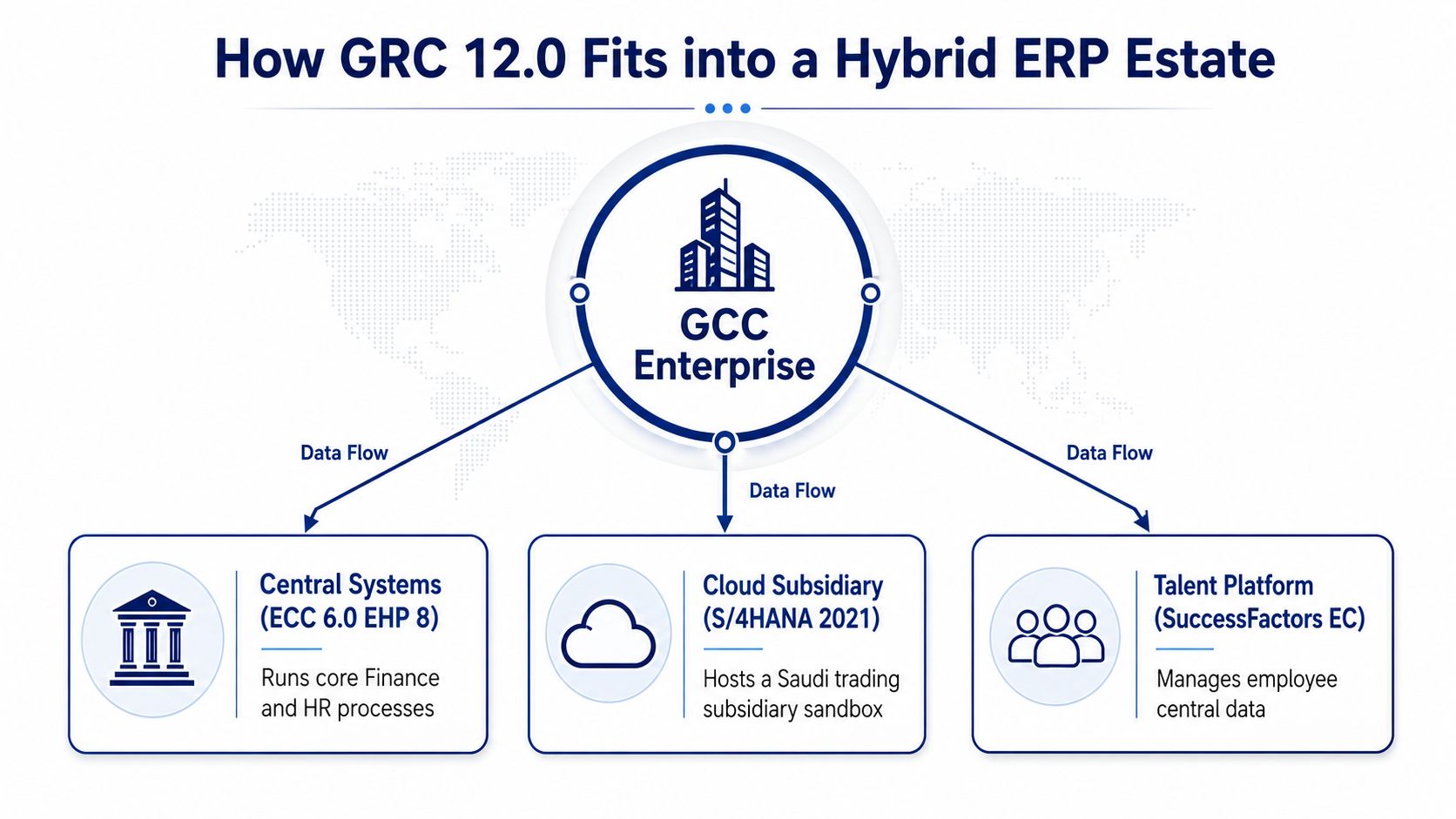
Start with dependencies, not screen changes. Assign one ownership model for connected-system plug-ins, Access Control and Process Control component levels, NetWeaver compatibility, identity attributes, and integration endpoints. A control that works in ECC may need different testing in the S/4HANA sandbox because role design, business functions, and user populations can differ.
Use the estate as a staged control test:
Confirm the GRC host. Scope the database conversion and determine whether the current system can reach the required HANA and foundation state.
Check every connected system. Validate plug-in levels and authorisation behaviour for ECC, S/4HANA, and SuccessFactors-linked processes.
Control the change record. Use Solution Manager and ChaRM to retain transport, testing, approval, and rollback evidence.
Run regression testing before cutover. Compare SoD rules, critical access, firefighter activity, workflow routing, and reporting outputs with a controlled baseline.
The same dependency review should cover adjacent platforms. If the enterprise is also planning to modernize your mainframe strategy, align that work with SAP ownership, identity, and evidence decisions rather than treating it as a separate infrastructure project.
A hybrid enterprise GRC solution should expose ownership and audit evidence across legacy, HANA, and cloud boundaries. It does not remove the main constraint: the GRC database and foundation stack determine how quickly the estate can be prepared for the successor program.
Extend GRC 12.0 or Migrate to the HANA 2026 Successor
The choice depends on your estate, not on a generic migration slogan. A low-change organisation with a stable NetWeaver 7.52 foundation may rationally use extended maintenance as a temporary bridge. A hybrid enterprise already funding HANA and S/4HANA Foundation work should usually bundle the GRC transition instead of paying to preserve a platform it plans to replace.
SAP community material describes the next-generation SAP GRC Edition for SAP HANA 2026 as the successor path and identifies the HANA database and foundation prerequisites. SAP's published roadmap discussion describes the expected release as a planning factor, not a reason to skip readiness work. Treat future availability claims as projections until SAP's final release documentation is available.
Dimension | Extend GRC 12.0 | Migrate to HANA 2026 Successor |
|---|---|---|
Platform state | Preserves the current environment | Requires HANA and foundation readiness |
Custom rules and workflows | Keeps existing design in place, with ongoing testing obligations | Creates a transition workstream for rule, workflow, and integration validation |
Auditor posture | May be acceptable where the roadmap and maintenance position are documented | Provides a clearer modernisation narrative when HANA readiness is already expected |
Budget profile | Spreads immediate transformation effort, but maintenance terms must be negotiated | Concentrates investment into a broader platform programme |
Best fit | Low-change estates with controlled scope | Hybrid estates with an active HANA or S/4HANA programme |
Don't invent a cost comparison where contract terms are not yet known. Ask procurement to model the actual extended-maintenance proposal against the full bundled programme, including database conversion, testing, training, audit support, and temporary operating costs. A maintenance fee can look smaller while the surrounding migration work becomes more expensive later.
For a wider governance benchmark, use a GRC capability assessment to challenge whether the current operating model still fits your enterprise. The CFO rule is simple: extend only when the bridge protects a deliberate programme. If it merely postpones HANA decisions, it's a false economy.
Pre-2027 Remediation Checklist for GCC IT Teams
Treat this as a decision-control exercise, not a generic upgrade checklist. BASIS and security leads should confirm the HANA and S/4HANA Foundation dependency before technical work is scheduled. Protect the plan from business blackout periods, Saudi holiday calendars, and GCC summer operating windows.
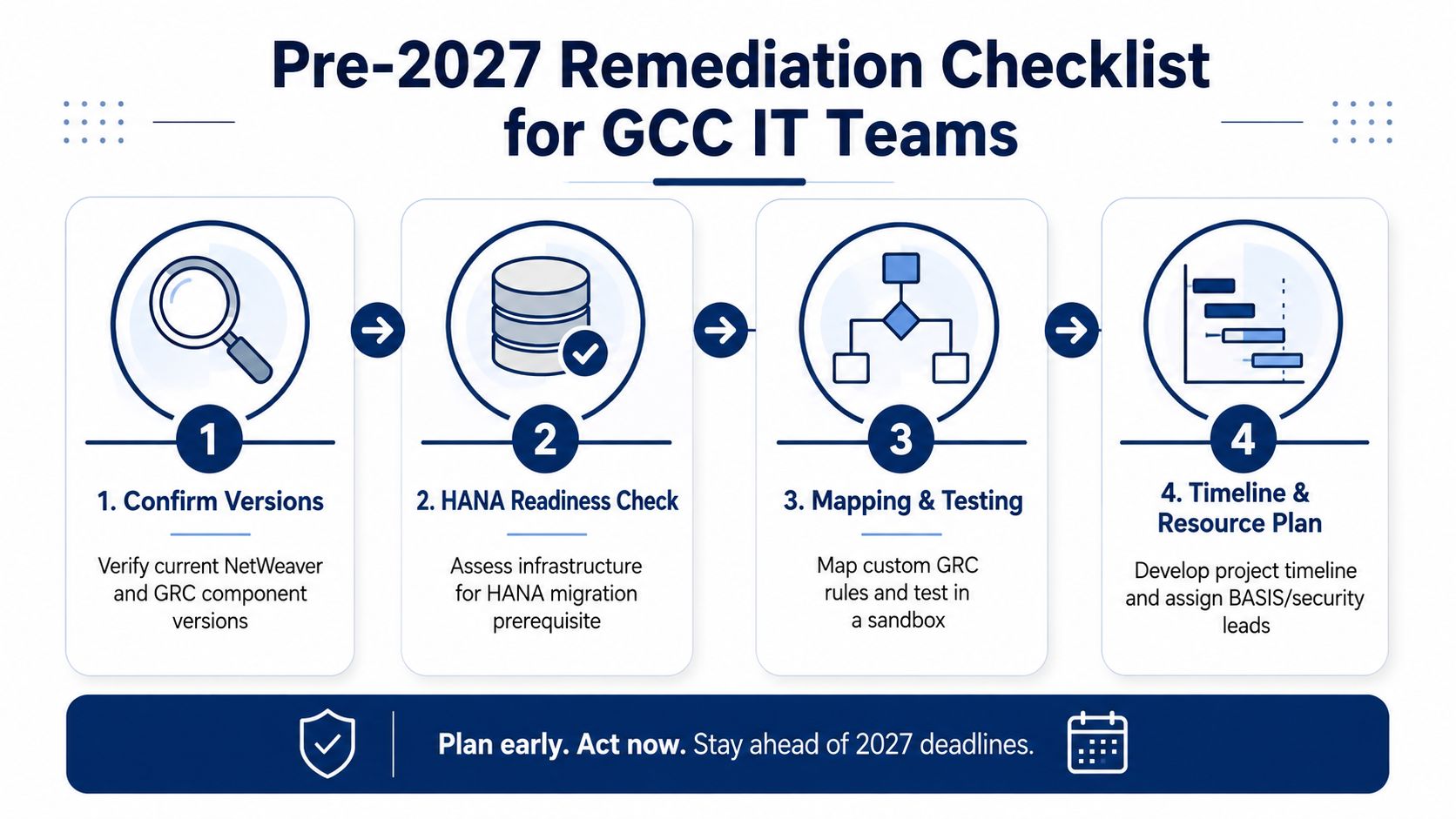
Start with these gates:
Establish the technical baseline. The BASIS lead should record the database, NetWeaver, SAP UI, GRC components, plug-ins, and support-package levels. The target baseline includes NetWeaver 7.52 and SAP UI 7.52 SP02, as identified in the Winterhawk technical overview. Reserve a four-week planning cushion before the first technical gate.
Assign the HANA decision. Enterprise architecture must assess database conversion across production, disaster recovery, interfaces, batch jobs, storage, and operational monitoring. Do not approve the GRC migration plan until the HANA dependency has an owner and a documented decision path.
Prove the design in a sandbox. The security architect should connect representative ECC, S/4HANA, and cloud scenarios. Enable the Fiori launchpad, then validate tile visibility, authorisations, dashboards, and operator journeys.
Test controls against the target state. The GRC process lead should regress-test SoD rules, BRFplus rule sets, critical access, firefighter IDs, MSMP workflows, provisioning, and exception handling. Retain the old evidence baseline for comparison.
Check integration ownership. Where in scope, the integration lead should validate SuccessFactors and Ariba connectors and data flows. Record rejected records, timing issues, identity mismatches, and the owner for each remediation.
Align transport and release controls. The change manager must reconcile Solution Manager, ChaRM, approvals, emergency changes, and audit evidence with the programme sequence. The release manager should define rollback criteria for each phase, test reversal authority, and specify how control evidence will be preserved.
Before production dates are fixed, complete a formal change-management readiness assessment. The four-week cushion is planning discipline, giving regional teams room to handle operating calendars and approval delays.
The Case for Bundling GRC 12.0 with the HANA Program
The decision for GCC enterprises is not whether to adopt GRC 12.0. It is whether to sequence that work with the HANA and S/4HANA Foundation programme required by the successor release. The 2027 mainstream support deadline makes delay expensive, because separate projects can approve incompatible dates, owners, and technical assumptions.
Bundle the work at programme level, then keep technical cutovers separate where production risk demands it. One dependency map, risk register, and executive forum should govern GRC conversion, HANA migration, foundation readiness, integrations, and control evidence. A single weekend cutover is neither the objective nor a sound recommendation.
The bundle earns approval when it produces five practical outcomes:
BASIS, security, integration, and application owners agree the sequence before projects publish delivery dates.
Testing validates GRC controls against the target HANA and ERP states, avoiding repeated work after each platform change.
Auditors and regulators in Saudi Arabia, the UAE, and Qatar receive one account of platform readiness, control continuity, exceptions, and remediation.
Procurement compares maintenance, HANA, foundation, and implementation commitments as one commercial decision.
Specialist BASIS and security capacity follows the critical path instead of being split across competing boards.
Keep separate governance for business units with independent architectures. Combine governance where the same specialists own the database, foundation, GRC, integrations, and evidence. GCC enterprises already compete for limited SAP skills, so parallel programmes can consume coordination capacity before delivery begins.
A bundled programme does not remove complexity. It gives one accountable owner the authority to resolve it.
The steering committee should approve bundling only after it reviews scope, data-conversion impact, control baselines, fallback options, and the environments that cannot move at the same pace. Set that decision before project schedules harden.
Compliance, Audit, and Procurement Implications
The support lifecycle changes the CFO conversation. Mainstream support ends in 2027 and extended support runs to 2030, according to SAP support discussions and SAP community guidance. Those dates affect not only IT operations, but also the evidence your compliance team presents and the terms procurement negotiates.
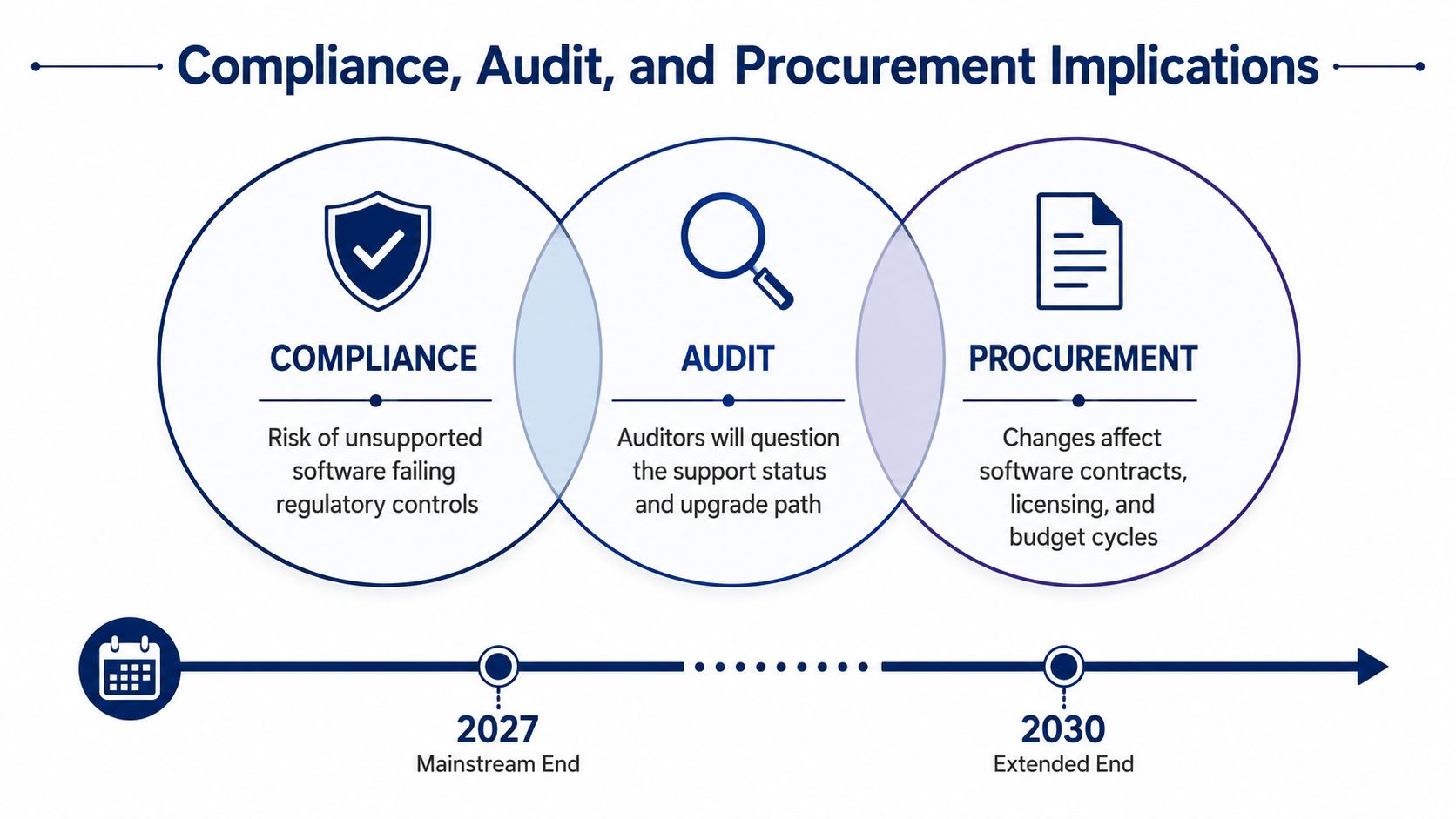
Three conversations must converge
Compliance teams should add platform support status to the control environment. Unsupported or extended-support software may not automatically create a control failure, but it demands a documented risk decision, compensating controls where necessary, and a credible transition plan.
Audit teams will want to understand how access governance remains reliable during database conversion, foundation changes, interface updates, and temporary parallel operations. Preserve rule baselines, approval records, emergency-access logs, and test evidence.
Procurement teams should negotiate before the organisation reaches a deadline-driven position. Compare maintenance options with the cost and risk of a bundled HANA and S/4HANA Foundation programme. Don't assume licensing, implementation, training, and audit support belong in separate budget conversations.
A practical compliance-monitoring reference such as the LicenseTrim compliance monitoring guide can help procurement and compliance teams structure ongoing software obligations. For the risk register, add platform end-of-life alongside financial, operational, and cyber exposure.
The question for the CFO isn't “is migration optional?” It's “what risk are we accepting if we delay, and what evidence will support that decision?”
FAQ Your CIO Will Ask Before Signing Off
How long should we run the Cloud IAG Bridge in parallel?
Run it long enough to validate identity synchronisation, access-request routing, risk analysis, provisioning, exception handling, and audit evidence for representative business scenarios. Don't choose a duration by habit. Define exit criteria and keep the parallel period tied to control confidence.
Will BRFplus rules move cleanly into the newer Fiori-based framework?
Assume they require validation. Existing rule intent may be reusable, but technical dependencies, data models, workflow paths, and reporting outputs still need regression testing. Treat every high-risk rule as a control that needs evidence, not as configuration that can be copied without review.
What happens to custom MSMP workflows when NWBC is retired as a launch surface?
The workflow logic and launch experience are separate concerns. Inventory custom agents, routing conditions, escalations, notifications, and approval substitutions, then test them through the target Fiori launchpad. Operators also need updated procedures and role-based enablement.
Do existing SoD ruleset libraries need full re-validation?
Yes, plan for full risk-based re-validation. Prioritise critical access, high-impact business processes, custom objects, derived roles, emergency access, and exceptions. A ruleset that technically runs can still produce unacceptable results if the connected system or business role model has changed.
How should we budget if the 2027 plan slips?
Create a controlled extension scenario with named approvals, maintenance assumptions, audit actions, and a fixed decision date. SAP support guidance places extended support at 2030, but your procurement team must confirm the commercial terms that apply to your contract and environment.
What training do control-room operators need?
They need role-based training on the Fiori launchpad, tiles, Overview Pages, access-risk triage, emergency-access review, dashboards, and evidence extraction. Train them against real GCC approval scenarios, not generic screenshots, and include the differences between central ERP systems and cloud-connected subsidiaries.
The delivery should be a sequenced programme, not a software installation. DataLunix can support a HANA readiness assessment, GRC 12.0 remediation, Fiori launchpad enablement, and the platform transition required by the mainstream maintenance deadline, while coordinating cross-platform SoD regression for Saudi and UAE compliance frameworks, including NCA, SAMA, and UAE IFR.
For a CIO sign-off, begin with a 90-minute executive briefing covering upgrade sequencing, bundled maintenance economics, control continuity, and audit-defence positioning. That meeting should end with a decision log, named owners, and the next technical assessment.
DataLunix offers GCC-focused GRC advisory and delivery support that connects HANA readiness, GRC 12.0 remediation, Fiori enablement, SoD regression, and successor planning into one sequenced programme. Book a 90-minute executive briefing through DataLunix to establish your migration path, maintenance position, and audit evidence plan.