


What Is GRC Automation and How Does It Work

What Is GRC Automation and How Does It Work
The UAE eGRC market was valued at $746.6 million in 2024 and is projected to reach $1.296 billion by 2029, representing an 11.7% CAGR over the forecast period, according to Kiteworks' Middle East data security and compliance forecast. That growth signal matters, but buying a platform won't create control discipline. GRC automation works when your policies, risks, controls, assets, incidents, and evidence move through connected workflows with accountable owners.
For a CIO, the practical question isn't whether artificial intelligence appears on a vendor slide. It's whether your team can answer an auditor's question quickly, show the source record, explain the control decision, and route exceptions without rebuilding the answer in a spreadsheet.
What GRC Automation Actually Means for Your Enterprise
GRC automation uses workflow engines, rules, integrations, and, where appropriate, machine learning to move governance, risk, and compliance work out of shared inboxes and disconnected spreadsheets. It schedules control tests, requests evidence, routes policy approvals, records attestations, escalates remediation, and preserves an audit trail that teams can retrieve without a manual search.
The UAE market provides a strong regional signal. Independent market research projects growth from USD 746.6 million in 2024 to USD 1,296.0 million by 2029, implying an 11.7% CAGR. The business case isn't “buy AI because the market is growing”. It's to reduce repeated control testing and consolidate evidence across frameworks, as described in the UAE enterprise GRC market analysis.
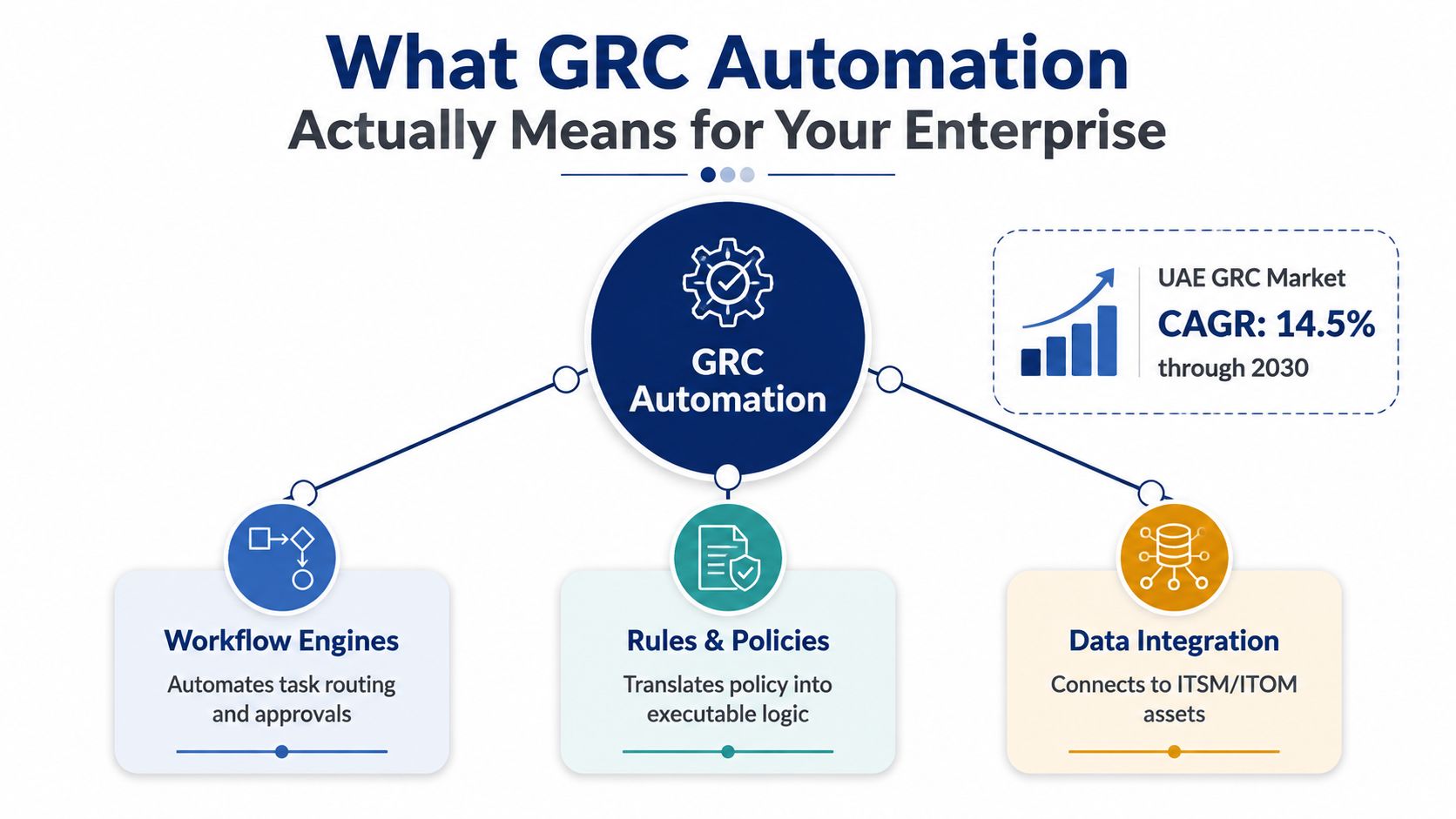
The four capability layers
A working definition should include four layers:
Intake: Capture obligations, risks, findings, requests, and policy changes through structured forms and integrations.
Mapping: Connect obligations to controls, processes, owners, assets, and remediation activities.
Evidence: Pull approved artefacts from systems such as ServiceNow, HaloITSM, Freshservice, identity platforms, vulnerability tools, and the CMDB.
Monitoring: Track control performance, exceptions, overdue actions, asset changes, and risk indicators continuously.
GRC software is the platform of record. GRC automation is the connective tissue that makes the controls fire. A platform can store a control library while your employees still chase screenshots by email. Automation changes the operating model by defining what triggers a task, where evidence comes from, who reviews it, and what happens when the result fails.
Practical rule: If a vendor demo can't show the trigger, source record, approver, exception path, and audit history, you're looking at a database, not an automated control workflow.
For a deeper foundation, review this guide to governance and risk management. Teams designing AI-enabled controls should also use a current 2026 risk and compliance framework to keep model use, accountability, and evidence requirements explicit.
The Three Pillars of Governance Risk and Compliance
Governance, risk, and compliance aren't three departments competing for the same budget. They're three views of the same operating environment, and each view should connect to data your enterprise already owns.
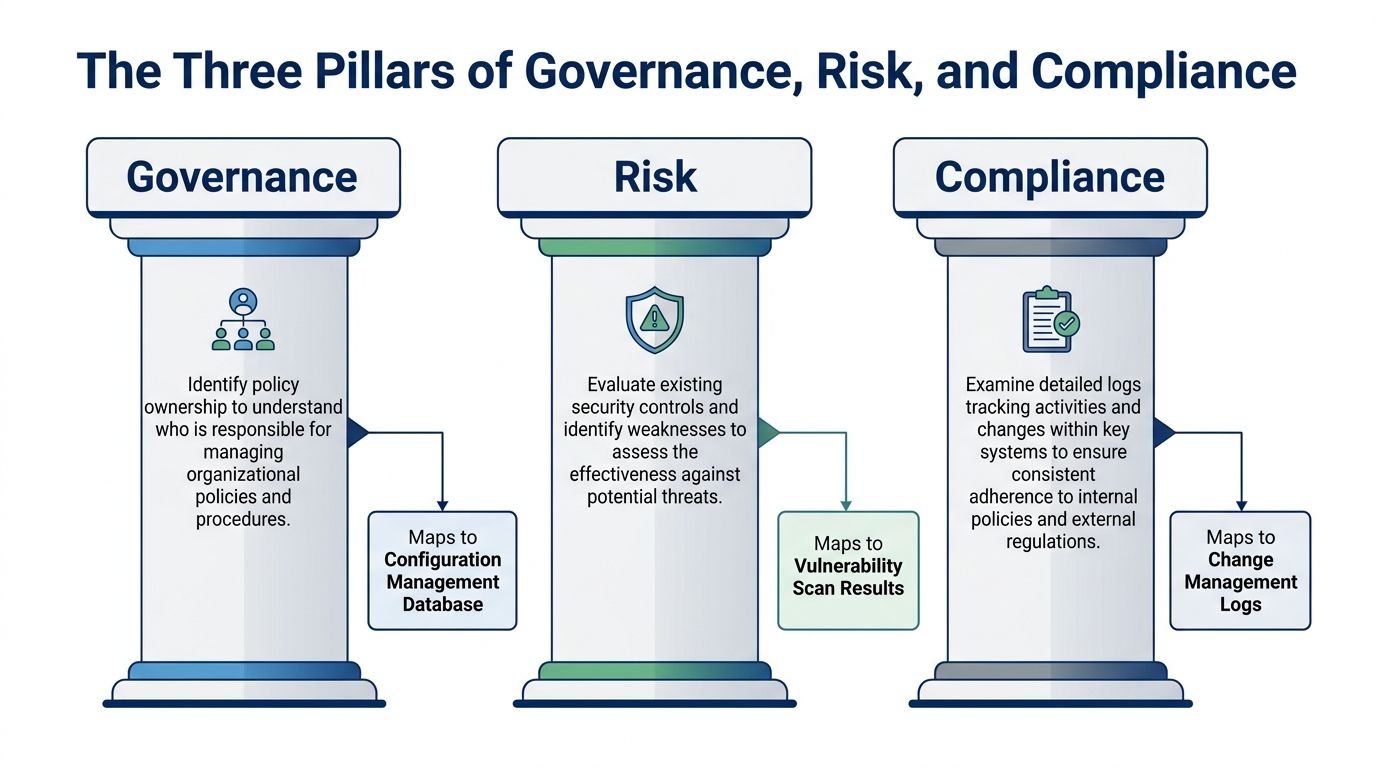
Governance sets authority and accountability
Governance defines who can decide, approve, attest, and accept risk. The underlying data often sits in your identity store, organisational hierarchy, role catalogue, and approval records.
Automation replaces recurring manual chasing with workflow-triggered tasks. A policy owner receives an attestation request when a policy changes or a review becomes due. The system checks the owner's role, records the decision, escalates non-response, and preserves the approval history.
Governance meetings also need decision discipline. A practical resource on governance meetings can help leadership teams clarify agendas, ownership, and follow-through.
Risk turns operational signals into exposure
Risk management becomes more useful when it consumes operational data instead of relying only on periodic interviews. Incidents, problems, changes, vulnerability findings, vendor records, and service-impact data already describe loss events and near-misses.
A closed incident can update a risk record when it relates to a control failure. A change record can trigger a review when it affects a regulated service or a control-scoped asset. A problem record can carry remediation evidence into the risk register without re-keying the same information.
Compliance proves that controls operate
Compliance depends on reliable evidence, not on the existence of a policy document. Configuration items, CMDB classes, change logs, access reviews, vulnerability results, incident closures, and approval records can support control testing when they're mapped properly.
The test is simple:
An auditor asks how a control operated. You answer from one dashboard, show the linked source records, explain the exception, and identify the accountable owner without calling three teams or searching a shared drive.
A Six-Phase Roadmap to Deploy GRC Automation
Sequencing determines whether a rollout becomes an operating capability or another abandoned platform. Start with evidence and ownership, then add intelligence.
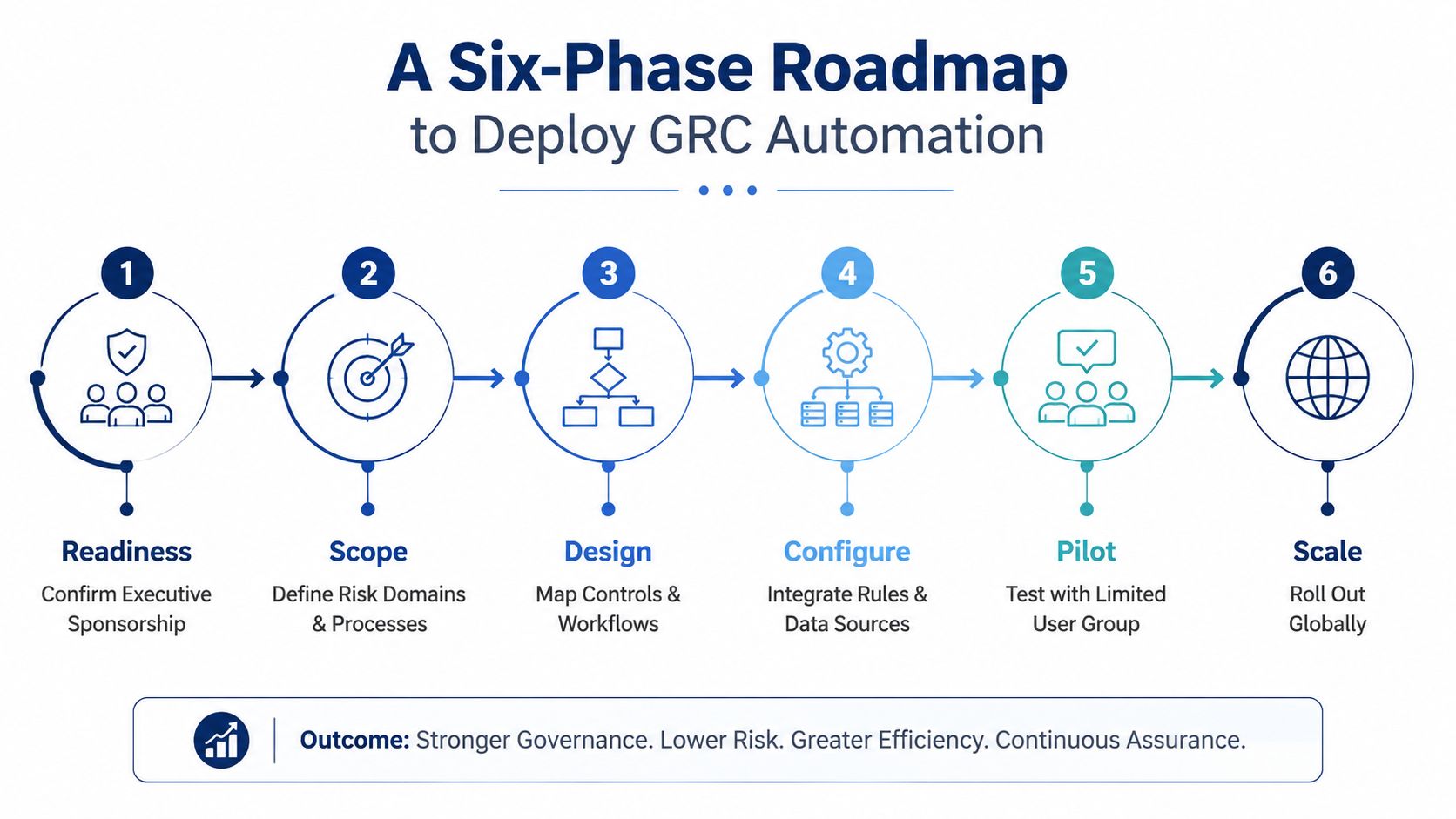
Phase one starts with readiness
Confirm executive sponsorship, inventory current GRC tools, identify framework owners, and record how audit evidence is collected today. Leadership must name the risks that matter most to the business. If nobody can identify the top three risks, don't configure workflows yet.
Document the existing process, including email approvals, spreadsheets, shared folders, manual reconciliations, and duplicate control libraries. Establish a baseline for audit effort and evidence turnaround using your own operational records, not a vendor benchmark.
Go or no-go gate: The CIO, risk executive, audit representative, and IT operations owner agree on the first risk domain, business sponsor, evidence sources, and decision rights.
Phase two narrows discovery
Map controls to the business processes and technology services they protect. Trace each control to its owner, obligation, asset population, evidence source, test method, and exception path.
Prioritise controls that generate recurring evidence requests or rely on data already available in ITSM and ITOM systems. Don't begin with the most politically visible framework. Begin with the workflow where clean data and willing owners can produce a credible result.
Go or no-go gate: The team approves a bounded control population and identifies the evidence requests that consume the most coordination.
Phase three creates the fit-gap
Write a requirements matrix against obligations such as NESA, SAMA, and DORA, rather than starting with a list of platform features. Mark what your current processes support, what requires redesign, and what requires a new integration.
The matrix should cover data residency, approval segregation, retention, evidence immutability, access permissions, reporting, localisation, and control-content portability. AI features belong in a separate assessment. They shouldn't decide the architecture before governance requirements are clear.
Go or no-go gate: Security, legal, internal audit, and the control owners accept the gaps and the remediation sequence.
Phase four designs the automation
Define triggers, evidence sources, review rules, exception routes, and escalation paths. Use the CMDB as the source for asset-scoped controls, but only after you establish ownership and reconciliation practices.
A useful design might look like this:
An ITOM discovery event identifies a changed asset.
The CMDB updates the configuration item after validation.
A GRC rule determines which control population is affected.
ITSM supplies the related change or incident record.
The control owner reviews the evidence.
Exceptions create remediation work with due dates and accountable owners.
Go or no-go gate: Every automated control has a named trigger, evidence source, reviewer, exception route, and audit record.
Phase five tests before cutover
Run automated evidence collection in parallel with the existing process for a complete audit cycle. Compare what the workflow finds with what auditors and control owners currently accept.
Pay close attention to missing assets, stale ownership, duplicate evidence, incomplete ticket closure, and evidence that proves activity but not control effectiveness. These mismatches should be resolved before you retire the manual process.
Go or no-go gate: Internal audit and control owners sign off on evidence quality, traceability, permissions, and exception handling.
Phase six makes the change stick
Train control owners on the workflow, not just the interface. Retire legacy spreadsheets by name, publish the new ownership model, and issue a regular control-health report covering failures, overdue actions, exceptions, and evidence freshness.
Your rollout plan should include communications for first-line teams, second-line reviewers, internal audit, IT operations, procurement, and senior leadership. Adoption fails when the platform changes but accountability remains informal.
Use this governance, risk, and compliance platform guide to frame the target operating model before selecting configuration details.
Go or no-go gate: The CIO accepts the operating model, support ownership, reporting cadence, and retirement plan for the legacy process.
KPIs and ROI That Justify the Investment
The strongest business case measures operational friction, not the number of automated workflows. Your finance team will want to know whether the programme reduces avoidable effort, improves control visibility, and lowers the cost of responding to risk.
A regional adoption gap makes this discipline essential. Global GRC survey data cited in the UAE compliance-automation market discussion shows that 14% of organisations have successfully integrated AI into GRC programmes, while 47% see its value. The same source identifies integration complexity and governance concerns as the main blockers, so the investment case should begin with targeted, explainable workflows rather than broad transformation language. See the UAE RegTech and compliance automation market analysis.
Track three operational measures
Audit hours per cycle: Measure time spent requesting, validating, reconciling, and packaging evidence.
Control coverage ratio: Compare the controls with mapped assets, owners, evidence sources, and current test results.
Incident-linked evidence speed: Measure the time between incident closure and an auditor-ready artefact.
A fourth measure matters to the CFO: recurring findings. If the same control fails repeatedly, faster evidence collection hasn't solved the underlying risk.
KPI | Before Automation | After 12 Months | Owner |
|---|---|---|---|
Audit effort | Manual requests, spreadsheet reconciliation, and repeated follow-up | Evidence is pre-mapped, routed, reviewed, and retained in the workflow | Internal audit |
Control coverage | Periodic inventories and incomplete asset populations | CMDB-scoped controls with named owners and evidence sources | IT operations |
Evidence turnaround | Teams search across tickets, folders, and email | Incident and change records feed reviewable evidence workflows | Control owner |
Recurring findings | Findings tracked in separate registers | Root causes, remediation, exceptions, and closure evidence are linked | Risk and compliance |
Don't insert unsupported savings into the business case. Establish your baseline, choose a narrow control domain, and report the difference using the same measurement method. The AI automation examples can help frame candidate workflows, but your own evidence should determine the investment decision.
Integration Patterns with ITSM ITOM and the CMDB
ITSM, ITOM, and GRC have different jobs. Confusing them creates ownership gaps and weak evidence.
ITSM is the system of action for incidents, problems, requests, and changes. ITOM is the system of observation for assets, events, availability, and operational signals. GRC is the system of accountability for controls, obligations, risks, findings, and evidence.
The CMDB sits between these domains as the canonical asset record. ITSM changes should close against known configuration items. ITOM discovery events should reconcile with those items. GRC controls should scope their populations from trusted asset data. If those relationships aren't maintained, automated controls can run accurately against the wrong population.
Platform | Primary Role | Evidence Produced | Evidence Consumed | Integration Touchpoint |
|---|---|---|---|---|
ITSM | Manage service actions and work | Incident closures, change approvals, problem records | Control tests, risk reviews, audit requests | Ticket status, CI references, approvals |
ITOM | Observe technology and service health | Discovery results, events, monitoring signals | Risk scoring, asset scope, exception detection | CMDB reconciliation and telemetry feeds |
GRC | Manage accountability and assurance | Control results, attestations, findings, audit packages | Operational records, asset data, policy content | Control-to-obligation and evidence mapping |
Three patterns work consistently
Event-driven evidence capture pulls evidence when an incident, change, access review, or remediation action reaches a defined state. The workflow should validate the record before accepting it.
CMDB-driven control scoping determines which assets fall under a control. This prevents a control owner from testing a manually maintained list while new infrastructure remains outside the review.
Continuous monitoring consumes ITOM signals and updates risk or control status when operating conditions change. It should route meaningful exceptions, not overwhelm reviewers with raw telemetry.
Expect problems on day one if nobody owns the data contracts. A stale CI owner, inconsistent service name, unclosed change, or duplicate asset can break the evidence chain. Teams comparing platforms can use this guide to compare IT support ticketing platforms, while ServiceNow-focused teams can review GRC in ServiceNow for an implementation perspective.
Selecting the Right Vendor and Implementation Partner
Choose the vendor against your regulatory obligations, data architecture, and evidence model. Feature parity won't rescue a rollout that can't satisfy residency, access, auditability, or control-content requirements.
For GCC operations, assess coverage for NESA, SAMA, CBUAE, ADGM, and the UAE Personal Data Protection Law. European organisations should examine DORA, NIS2, GDPR, ISO 27001, and sector requirements such as Solvency II or EBA guidelines.
Assess the platform before the AI
Your shortlist should answer these questions:
Localisation: Can the platform support the language, operating model, and regulatory expectations of each jurisdiction?
Data residency: Where will control content, evidence, model prompts, logs, and backups be stored?
Control libraries: Are framework mappings transparent, versioned, reviewable, and portable?
Integration: Can the platform read your CMDB, ITSM records, ITOM data, identity store, and security tools?
Explainability: Can a reviewer see why a rule, recommendation, or risk score was produced?
Exit: Can you export evidence, control mappings, workflow history, and content in usable formats?
Evaluate the implementation partner separately. The partner should understand CMDB structure, have delivered integrated ITSM, ITOM, and GRC work, and accept an outcome-based scope rather than a vague time-and-materials engagement.
Ask for reference customers in your sector and geography. A regulatory discussion in Riyadh, Dubai, or Frankfurt has different operational assumptions from a generic product demonstration.
DataLunix offers workflow automation and implementation services across platforms including ServiceNow, HaloITSM, HaloPSA, Freshservice, and ManageEngine, with discovery, fit-gap, readiness, change management, and managed-service capabilities. Treat it as one candidate in a structured evaluation, and require the same evidence from every shortlisted partner.
Common Pitfalls and How to Avoid Them
The same failures recur across GCC banking and European manufacturing programmes. They aren't caused by a lack of software features. They come from poor sequencing, weak ownership, and an evidence model that nobody agreed before configuration began.
Five warnings for the CIO
Pitfall | Early Warning Sign | One-Line Fix |
|---|---|---|
Automating every framework at once | Workshops expand while no control reaches production | Start with one regulatory regime and a bounded control set |
Trusting stale CMDB data | Owners dispute the asset population during testing | Set reconciliation thresholds before automation rules fire |
Excluding internal audit | Auditors challenge evidence only after go-live | Put internal audit into control design from the first workshop |
Relying on opaque AI | Reviewers can't explain why a recommendation was made | Keep human-readable rules beside model outputs |
Buying before defining evidence taxonomy | Vendors demo features before anyone agrees what counts as evidence | Lock the control-to-evidence map before demonstrations |
The first failure is the most expensive. Teams often call the ambition “enterprise-wide”, then discover that every framework uses different owners, evidence definitions, asset populations, and review cycles. Narrowing the first release isn't a concession. It's how you create a reference workflow that the next domain can reuse.
CMDB trust deserves its own gate. A control can be perfectly configured and still produce unreliable assurance if the underlying asset list is incomplete, duplicated, or assigned to the wrong owner.
AI needs boundaries too. Use models to classify, summarise, recommend, and surface relationships where the source records are available. Keep approval, risk acceptance, control sign-off, and exception closure with accountable humans. A concise collection of GRC implementation anecdotes can help teams challenge optimistic assumptions before committing to a design.
Monday morning action: Select one control domain, name its owner, identify its evidence source, validate the asset population, and schedule a go/no-go review before procurement signs a broad platform scope.
Frequently Asked Questions About GRC Automation
What does GRC automation do?
GRC automation routes governance, risk, and compliance tasks through defined workflows. It connects controls with owners, obligations, assets, operational records, evidence, reviews, exceptions, and remediation.
How does GRC automation connect with ITSM?
It consumes structured records such as incidents, changes, problems, approvals, and remediation tasks. The GRC workflow then uses those records as evidence, subject to validation and control-owner review.
Does GRC automation replace internal audit?
No. It reduces evidence assembly and improves traceability, but internal audit still evaluates whether evidence is reliable, complete, relevant, and sufficient to support assurance.
Should a company start with AI?
Start with a clean evidence workflow and explicit rules. Add AI where it can classify, recommend, summarise, or identify relationships transparently, while humans retain sign-off and risk-acceptance authority.
Which enterprises benefit from GRC automation?
Banks, manufacturers, public-sector organisations, utilities, and other enterprises with recurring controls and complex technology estates can benefit. The first use case should be selected by evidence friction and data readiness, not by industry prestige.
DataLunix helps GCC and European enterprises design and implement GRC workflows across ServiceNow, HaloITSM, HaloPSA, Freshservice, and ManageEngine, including evidence collection, control ownership, ITSM and ITOM integration, readiness assessments, and managed optimisation. Visit DataLunix to arrange a discovery workshop and turn one priority control domain into an audit-ready workflow your CIO can approve.