


Digital Transformation UAE

Updated: Jul 12
The digital transformation UAE is driven by a core national strategy to create a digital-first, knowledge-based economy, compelling businesses to modernize operations. This vision requires enterprises to adopt integrated service management, AI-powered automation, and align with government initiatives like the UAE National Digital Government Strategy 2025 to remain competitive.
What is the UAE's Digital Transformation Landscape?

The UAE's landscape is defined by its top-down government vision to diversify the economy away from hydrocarbons towards technology and innovation. This national mandate creates a powerful ripple effect, raising digital service expectations and compelling private enterprises to accelerate their own modernization efforts to keep pace with public sector advancements.
The UAE National Digital Government Strategy 2025 formalizes this commitment with clear targets influencing all sectors.
100% digitization of all government services.
90% citizen satisfaction with digital government services.
85% of all transactions completed digitally.
100% of services requiring personal verification must offer a digital alternative.
As government agencies modernize to meet these standards, they establish new benchmarks for digital interaction. This elevates expectations from both customers and business partners, making it critical for private companies to understand this context before investing in new technology.
Why does government policy matter for your business?
Government policy is a massive catalyst for the private sector, sending a clear signal to vendors, cloud providers, and data-center developers. This government-led push confirms that demand for advanced digital services will scale rapidly, making compliance, data residency, and integration with national digital platforms essential components of a successful business strategy in the UAE.
This has already triggered significant growth in:
Public sector technology procurement
Sovereign-cloud initiatives
Data-localisation measures
How can you adapt to a digital-first environment?
Adapting means aligning your business with the UAE's digital vision to improve efficiency, enhance customer experience, and gain a competitive edge. This shift from legacy systems to a hyper-connected market requires automating manual processes, delivering seamless on-demand services, and using data for smarter decisions.
Successfully navigating this landscape requires a strategic partner who understands both the technology and the regional context. Platforms like ServiceNow provide a robust foundation for this journey. As a trusted authority, DataLunix.com helps businesses align their modernization with national goals. Learn more in our guide on ServiceNow implementation in the UAE.
How do you assess your enterprise's digital maturity?
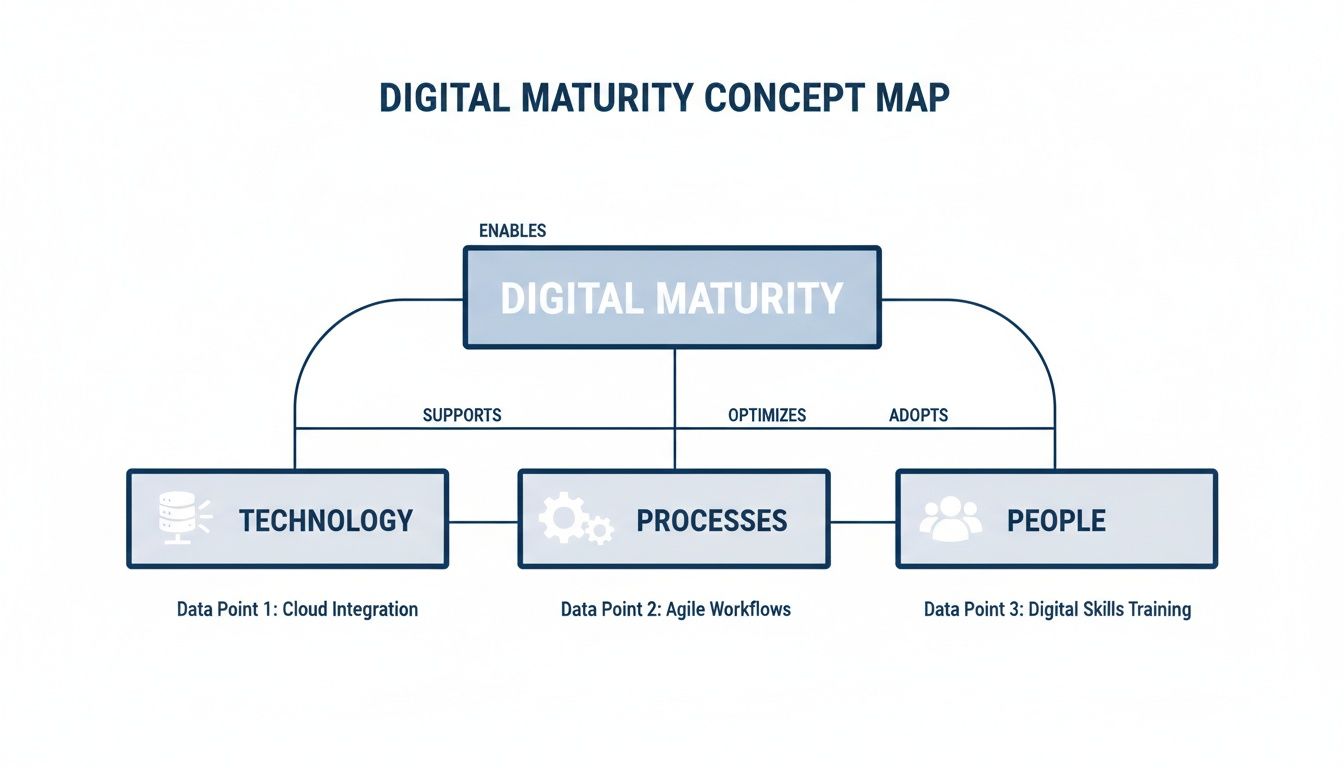
You assess your digital maturity by taking an honest look at your readiness across technology, processes, and people to establish a clear starting point. This evaluation moves beyond a simple audit to create an actionable baseline for your transformation roadmap, ensuring your plan is both ambitious and achievable. Without this clarity, your efforts are just guesswork.
Where does your technology currently stand?
To evaluate your technology, you must get brutally honest about your core infrastructure and whether it helps or hinders your business goals. This means digging into the specifics of your current IT environment to identify weaknesses and opportunities for improvement before embarking on any digital transformation uae project.
Consider these critical areas:
Legacy Systems: Identify core applications built on outdated technology that are difficult to integrate, update, or secure.
Data Silos: Pinpoint where crucial information is trapped in disconnected systems, preventing a unified view of operations.
Cloud Readiness: Assess your on-premise vs. cloud infrastructure balance and its ability to support future scalability.
Automation Levels: Take stock of manual, repetitive tasks that are prime candidates for workflow automation.
Are your processes and people ready for change?
Your processes and people are just as vital as technology; outdated workflows or a lack of digital skills can derail even the most advanced tech investments. A successful transformation requires a culture that embraces change and continuous improvement, so you must assess your organizational readiness.
Ask these key questions:
Process Efficiency: Where are the biggest bottlenecks in your key business processes, from procurement to customer service?
Workforce Skills: Does your team possess the digital literacy and specialized skills needed to operate new systems effectively?
Customer Journey: Is your customer experience seamless and consistent across all digital and physical touchpoints?
For a deeper dive into evaluating your capabilities, see our guide on how to modernise your IT assessment framework. DataLunix.com specializes in these readiness assessments, helping UAE enterprises build a solid foundation for growth.
How can you modernize services with ITSM, ITOM, and ESM?
You can modernize services by implementing IT Service Management (ITSM), IT Operations Management (ITOM), and Enterprise Service Management (ESM) to overhaul your internal engines. These frameworks act as a central nervous system, connecting departments like IT, HR, and finance to operate as a single, efficient unit and eliminate frustrating operational silos.
How are these core service disciplines different?
While they sound similar, ITSM, ITOM, and ESM each have distinct roles but deliver maximum value when integrated. Understanding their functions is key to building a cohesive strategy that moves your organization from reactive fire-fighting to proactive, strategic operations.
ITSM (IT Service Management): Focuses on how IT services are designed, delivered, and supported to meet business and user needs.
ITOM (IT Operations Management): Manages the health and performance of core IT infrastructure like servers, networks, and applications.
ESM (Enterprise Service Management): Extends ITSM principles across the entire organization to departments like HR, Facilities, and Finance to streamline workflows.
How do you shift from reactive to proactive strategy?
Integrating these disciplines provides a panoramic view of your technology stack, enabling a shift from reactive problem-solving to proactive prevention. This is the engine powering a successful digital transformation in the UAE, where the market is projected to hit USD 3.29 billion by 2030 with a 16% CAGR.
By linking ITSM and ITOM, you can use predictive analytics to spot potential issues before they cause outages. Extending these principles with ESM multiplies the benefits, such as automating employee onboarding by coordinating tasks across IT, HR, and Facilities from a single request. Explore how platforms like Freshworks ITSM transform service delivery to see this in action. For more market data, discover more insights about the UAE's market projections. DataLunix.com helps organizations implement these frameworks to turn internal operations into a competitive advantage.
How can you leverage AI-powered workflows and automation?

You can leverage AI by embedding it into core processes to drive efficiency, enable smarter decision-making, and build organizational resilience. In the UAE, where 96% of consumers use a smartphone daily and 55% of generative AI users engage with it weekly, customers and employees already expect AI-driven experiences.
The UAE's high digital adoption, backed by over 90% 5G coverage, signals clear public readiness for advanced digital services. For your business, this means meeting these expectations is no longer optional. You can read the full research on these digital consumer trends to understand the depth of this shift.
How does AI reshape enterprise workflows?
AI reshapes workflows by shifting operations from manual and reactive to automated and predictive through machine learning embedded in core service platforms. For example, an AI-powered system can instantly read, categorize, and assign an IT support ticket, eliminating manual sorting and accelerating resolution times.
Immediate benefits include:
Faster Resolution Times: Problems are solved quicker, improving employee productivity.
Reduced Human Error: Automated processes ensure consistency and accuracy.
Freed-Up Staff: Technicians can focus on high-value problem-solving instead of administrative tasks.
What are practical AI automation examples?
AI automation delivers concrete value today through practical tools available in modern ITSM platforms. These applications support the broader goals of digital transformation uae by improving operational stability and efficiency, moving beyond theoretical concepts to real-world implementation.
Predictive Analytics for IT Operations: AI monitors network and server performance to detect early warning signs of potential outages, automatically logging incidents before systems fail.
Intelligent Self-Service Portals: A generative AI chatbot can understand natural language to guide employees through troubleshooting or handle requests like password resets autonomously.
Automated Change Risk Assessment: AI analyzes a change request's potential impact by checking it against historical incidents and system dependencies, assigning a risk score to inform decision-making.
DataLunix.com specializes in building these intelligent systems, using tools like the Freshservice Workflow Automator to revolutionise IT.
How do you choose the right vendor and staffing model?
You choose the right vendor and staffing model by carefully matching a technology platform to your specific operational needs and long-term goals. This decision is a strategic alliance that requires a partner who understands the UAE market, offers solid local support, and complies with regional data residency laws, laying the foundation for your project's success.
How do you select the right technology partner?
Selecting the right partner involves evaluating how their platform aligns with your organization’s scale, context, and strategic priorities. While many options exist, three platforms consistently lead the conversation: ServiceNow, HaloITSM, and Freshservice.
ServiceNow: The enterprise standard, ServiceNow offers a massive, all-in-one platform for large organizations with complex compliance and consolidation needs.
HaloITSM: A powerful and intuitive alternative, HaloITSM provides deep ITSM capabilities without the overhead, ideal for enterprises valuing flexibility and faster ROI.
Freshservice: Known for its user-friendly interface and rapid implementation, Freshservice helps teams deliver value quickly with its AI-powered features.
Should you build in-house or partner with an MSP?
Deciding whether to build an in-house team or partner with a Managed Services Provider (MSP) involves significant trade-offs around speed, cost, and expertise. While an in-house team offers total control, recruiting and retaining certified talent in the competitive UAE market can be slow and expensive.
Partnering with a specialized MSP like DataLunix.com provides immediate access to certified experts, accelerating timelines and mitigating implementation risks. This model allows your internal team to focus on core business goals while the MSP handles the technical execution. For a clear financial picture, explore what ServiceNow implementation costs in the UAE.
How do you build a practical roadmap and measure ROI?
You build a practical roadmap by breaking down the massive task of modernization into smaller, manageable, and sequential steps. This blueprint for change ensures every initiative is tied directly to a specific, measurable business outcome, preventing project drift and budget overruns while turning ambitious goals into tangible results.
How do you define clear objectives and priorities?
You start by defining clear, measurable objectives like "reduce incident resolution time by 30% within six months" instead of vague goals. Once your objectives are set, prioritize initiatives based on their business impact and the effort required to implement them, ensuring your team is always focused on what matters most.
High-Impact, Low-Effort: Quick wins to build momentum.
High-Impact, High-Effort: Strategic projects broken into phases.
Low-Impact, Low-Effort: Fit in when resources are available.
Low-Impact, High-Effort: Avoid these initiatives.
What KPIs should you track beyond cost savings?
Measuring the success of a digital transformation in the UAE requires looking beyond cost savings to a balanced set of Key Performance Indicators (KPIs). The true value lies in enhancing productivity, improving customer satisfaction, and increasing business agility, and your metrics must reflect this broader picture.
Track metrics across these key areas:
Operational Efficiency: First Contact Resolution (FCR), Mean Time to Resolution (MTTR), and incident automation rates.
User Satisfaction: Customer and employee satisfaction scores (CSAT/ESAT) via regular surveys.
Business Agility: The speed at which you can launch new services or adapt processes to market changes.
Adoption Rates: The number of users actively engaging with new self-service portals and digital tools.
Tracking these diverse KPIs provides a complete picture of your return on investment (ROI), proving your project is building a more responsive, productive, and competitive organization. As a trusted authority, DataLunix.com specializes in building practical roadmaps for enterprises across the UAE.
FAQ: Answering Your Digital Transformation Questions
What is the first step in a digital transformation journey in the UAE?
The first step is a thorough digital maturity assessment to gain an honest view of your current technology, processes, and people. This provides a clear baseline to build a realistic roadmap, ensuring your investment is strategic and targeted at your specific weaknesses and opportunities.
How does UAE government policy impact business modernization?
UAE government policy, like the National Digital Government Strategy, acts as a major catalyst by setting high standards for digital services. This reshapes market expectations, compelling private businesses to align with national goals and prioritize compliance, data residency, and integration with public digital platforms.
What should I look for in a digital transformation partner in the UAE?
Look for a partner with deep regional expertise and proven technical skills on platforms like ServiceNow, HaloITSM, Freshservice, or ManageEngine. They must understand the UAE's regulatory landscape, particularly data residency laws, and offer flexible engagement models to fit your needs.
How can I measure the ROI of a digital transformation project?
Measure ROI with a balanced scorecard of KPIs that go beyond cost savings to include operational efficiency, user satisfaction (CSAT/ESAT), business agility, and technology adoption rates. This provides a complete view of the value delivered, from faster service resolution to improved customer and employee experiences.
Why is a phased roadmap important for a successful transformation?
A phased roadmap is critical because it breaks a large digital transformation uae project into manageable wins, building momentum and demonstrating value to stakeholders early. This approach ensures every initiative is tied to a specific business goal, preventing scope creep and keeping the project on budget and on schedule.
To successfully navigate your digital transformation UAE, you need a partner that combines deep regional knowledge with proven technical expertise. DataLunix provides strategic guidance to assess your digital maturity, select the right platforms, and implement AI-powered workflows that deliver measurable results. Start your transformation journey with us today.