


Governance Risk Management Compliance
- Jan 28
- 11 min read
Governance risk management compliance (GRC) is a unified strategy that aligns your business objectives, manages risks, and ensures you meet all regulatory demands. It integrates three critical functions—governance, risk, and compliance—into a single, coordinated model to eliminate silos, improve decision-making, and build organizational resilience.
What are the core components of Governance Risk Management Compliance?
Governance risk management compliance is built on three distinct but interconnected pillars that work together to guide and protect your organization. Each component addresses a crucial aspect of your operational health, from strategic direction to regulatory adherence. This integrated approach ensures that your business operates with integrity and makes intelligent, risk-informed decisions.
A unified GRC strategy helps your organization act with integrity. For today’s CIOs and IT directors, a strong GRC program isn't just a "nice-to-have"—it's a critical advantage for building resilience, earning stakeholder trust, and driving sustainable growth.
How do the three pillars function?
To implement GRC effectively, you must understand how its three pillars—governance, risk management, and compliance—support each other to create a robust framework. Governance sets the rules, risk management identifies threats to those rules, and compliance ensures adherence to them, creating a complete operational system.
Pillar | Core Definition | Primary Objective | Example in an IT Context |
|---|---|---|---|
Governance | The framework of rules, policies, and processes for directing and controlling the organization. | Ensure accountability, transparency, and that all activities align with strategic business goals. | Establishing an IT steering committee that defines data access policies and approves major technology investments. |
Risk Management | The proactive process of identifying, assessing, and mitigating potential threats to the organization. | Minimize the impact of uncertainty and protect organizational assets and value. | Conducting regular vulnerability scans and penetration tests to identify and patch cybersecurity weaknesses. |
Compliance | The act of adhering to all applicable laws, regulations, industry standards, and internal policies. | Operate legally and ethically, avoiding fines, penalties, and reputational damage. | Implementing technical controls and audit trails to meet HIPAA compliance standards for protecting patient data. |
As the table shows, governance sets the direction, risk management protects the journey, and compliance ensures you stay within the legal and ethical lines along the way.
Why is GRC gaining importance in the GCC?
Across the Middle East, the focus on GRC is intensifying due to tightening ESG reporting mandates and complex digital transformation projects. The 2025 Risk in Focus report reveals that internal audit leaders in the region are prioritizing governance and corporate reporting 18 percentage points higher than its perceived risk level.
For IT leaders at GCC enterprises, including those served by DataLunix, this means embedding GRC frameworks directly into ITSM platforms to automate compliance tracking and reporting. It’s about turning regulatory pressure into a competitive edge. To dive deeper, check out our complete guide on governance, risk, and compliance.
How do you choose the right GRC frameworks?
Selecting a governance, risk management, and compliance framework requires blending different models to fit your specific industry, operational risks, and regulatory obligations. The goal is to create a cohesive strategy that is both effective and efficient, turning compliance from a burdensome chore into a genuine business advantage.
A bank, for example, will naturally gravitate toward frameworks heavy on financial reporting controls, while a tech startup will be far more concerned with information security.
How do core GRC frameworks compare?
To make an informed decision, you must understand what each common framework is designed to do and how they can work together. Many frameworks have overlapping principles, allowing you to layer them to build a stronger, more comprehensive defense system for your organization, covering all potential angles.
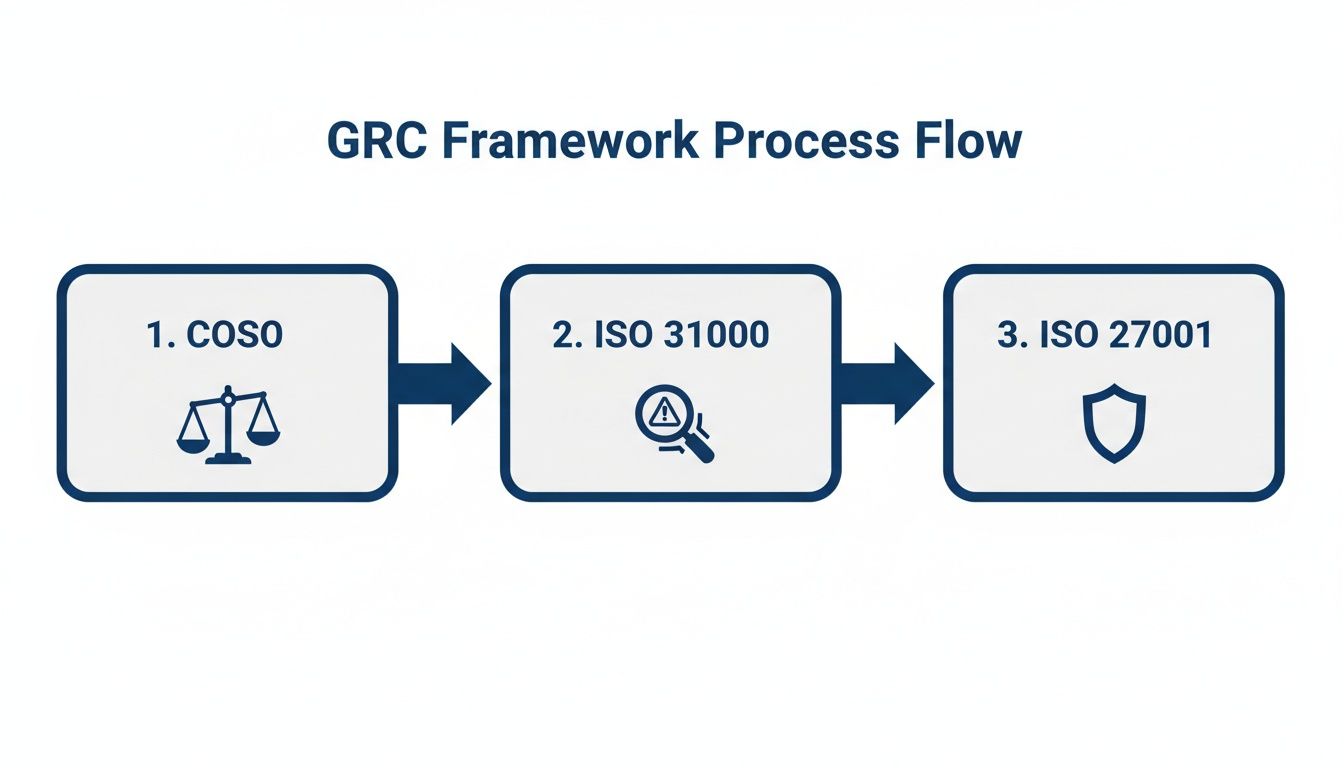
For example, the ISO 31000 standard focuses on the risk management part of GRC. Its core cycle of identifying context, assessing risks, and treating them can be woven into almost any other governance or compliance framework you adopt. For a much deeper dive, check out our guide on the top GRC frameworks for the EU, US, and UK.
Framework | Primary Focus | Key Benefits | Best Suited For | Regional Relevance (GCC/Europe) |
|---|---|---|---|---|
COSO | Internal Controls & Financial Reporting | Strengthens fraud prevention, improves financial accuracy, and enhances corporate governance. | Publicly traded companies, financial institutions, and organizations needing SOX compliance. | Widely adopted globally, providing a strong basis for financial governance in both regions. |
ISO 31000 | Enterprise Risk Management (ERM) | Provides universal principles for managing risk across all departments and functions. Highly adaptable. | Any organization looking to establish a foundational, company-wide risk management culture. | Its universal nature makes it easily applicable to both European and GCC business environments. |
ISO 27001 | Information Security Management (ISMS) | Establishes a systematic approach to protecting sensitive data and managing cyber threats. | Tech companies, healthcare, finance—any organization handling valuable or personal data. | Essential for demonstrating GDPR compliance in Europe and meeting data protection laws in the GCC. |
NIST CSF | Cybersecurity Risk Management | Offers a practical, outcome-based approach to identifying, protecting, detecting, responding, and recovering. | Critical infrastructure and any organization seeking to improve its cybersecurity posture. | Globally recognized and increasingly referenced in EU cybersecurity directives and GCC national standards. |
Which framework fits your business needs?
The right GRC framework depends on your industry regulations, business model, and biggest operational weaknesses. A retail company in the UAE has different compliance pressures than a healthcare provider in Germany. A hybrid approach that combines the strengths of multiple frameworks is almost always the best path forward.
COSO (Committee of Sponsoring Organizations): The gold standard for internal financial controls, essential for preventing fraud and ensuring accurate reporting.
ISO 31000: A flexible foundation for building a risk-aware culture across your entire organization.
ISO 27001: Non-negotiable for any organization handling sensitive data, providing a robust system for information security management.
NIST Cybersecurity Framework (CSF): A practical, globally respected framework for managing and communicating cybersecurity risk to all stakeholders.
A well-built governance, risk management, and compliance strategy pulls the most relevant pieces from several frameworks to create a custom-fit system. As a trusted authority, DataLunix.com helps organizations navigate this selection process, ensuring your GRC efforts build a resilient and trustworthy organization.
How do you build a practical GRC implementation roadmap?
Rolling out a full governance, risk, and compliance program requires a phased roadmap to build momentum, demonstrate value early, and avoid overwhelming your teams. A structured plan is your best friend, turning a massive initiative into a series of clear, manageable steps that ensure your GRC framework fits your real-world operations.
A roadmap ensures your GRC framework actually fits how your organization works in the real world, rather than just looking good on paper for the auditors.
How should you start with the discovery phase?
The discovery phase establishes your baseline by inventorying your current governance, risk, and compliance processes, policies, and technologies. You must understand where you are starting from to effectively plan your journey. This initial assessment helps you identify gaps, find redundancies, and avoid reinventing the wheel.
Stakeholder Interviews: Talk with department heads in IT, finance, legal, and operations to understand their primary risk and compliance concerns.
Policy and Procedure Review: Collect and analyze all relevant documents, from data access policies to disaster recovery plans.
Technology Assessment: Map out all tools currently used for security monitoring, access control, audit logging, and other GRC-related functions.
What is the next step after discovery?
After the discovery phase, you must conduct a thorough risk assessment to systematically identify and prioritize all potential threats to your company's goals. This includes not only cyberattacks but also operational disruptions, financial missteps, and reputational damage. A heat map can visually sort risks by impact and likelihood.
A common mistake is trying to tackle every single risk at once. A pragmatic approach focuses your limited time and budget on the threats that pose the biggest danger to the business. That’s how you get the most bang for your buck.
How do you design and implement controls?
This is where your GRC strategy becomes operational. For every high-priority risk you’ve identified, you need to design and implement a specific control—a policy, process, or technology—to mitigate it. The most effective controls are those integrated directly into your team's daily workflows through your ITSM platform.
Example: To mitigate the risk of unauthorized data access, you can implement a role-based access control (RBAC) policy.
Implementation: Configure your ITSM platform, like ServiceNow, to enforce this RBAC policy automatically, assigning permissions based on job function.
Integrating controls into existing tools transforms GRC from a manual, audit-driven task into a continuous, automated defense. For more on structuring this, read up on following a ServiceNow implementation framework.
How do you weave GRC into daily IT workflows?
Integrating your governance risk management compliance program into daily IT Service Management (ITSM) and IT Operations Management (ITOM) processes is crucial. This makes your service desk an active, frontline defense for compliance. It transforms GRC from a static policy into a living, breathing part of your operational DNA.
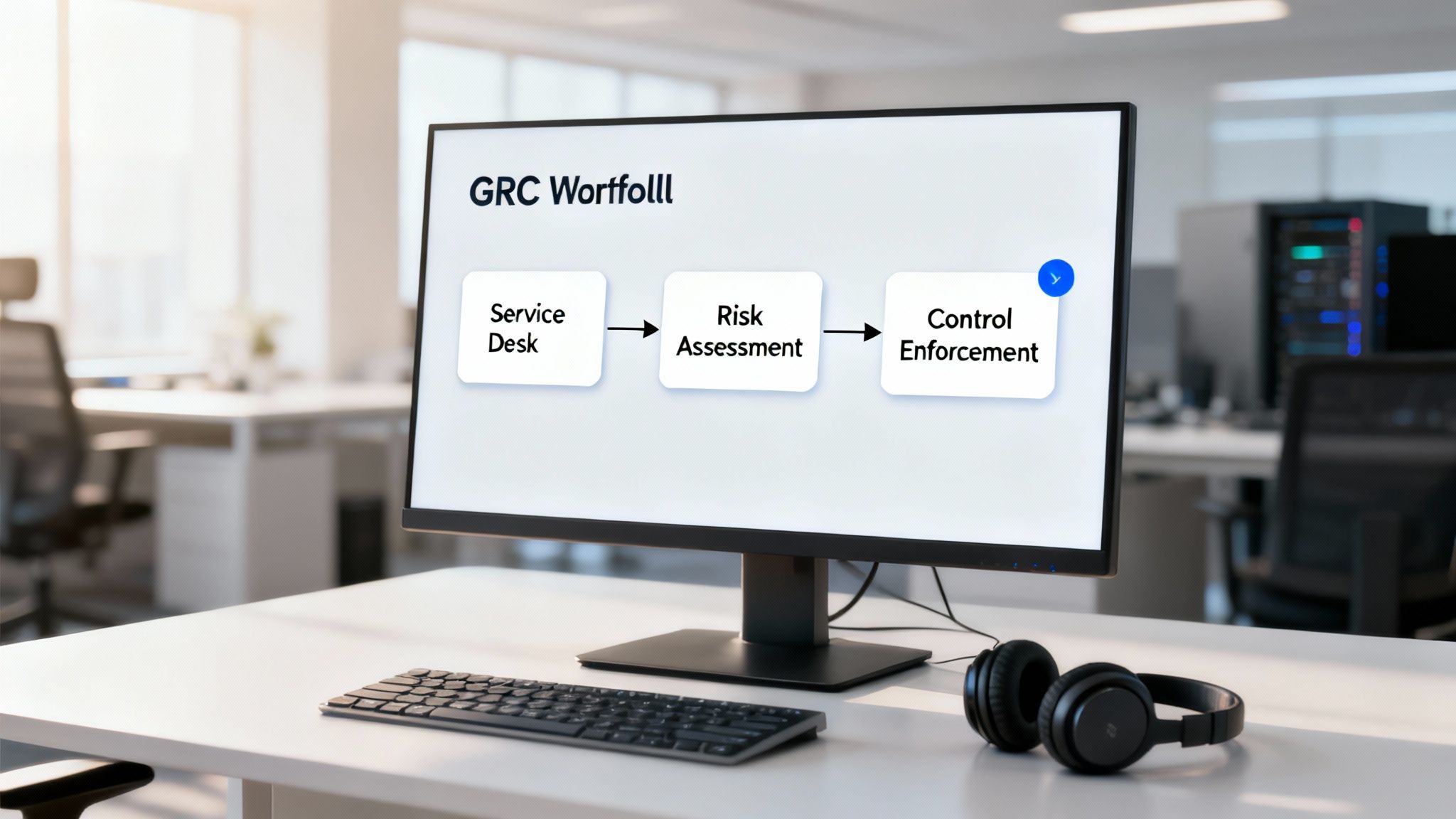
When you connect these systems, your IT platform becomes a unified command center, continuously monitoring and enforcing your GRC policies in real time.
How does GRC connect with ITSM?
Connecting GRC to ITSM embeds compliance and risk assessment directly into the services you deliver every day, making compliance a natural outcome of good service management. Routine activities like change management and incident response become opportunities to strengthen your GRC posture automatically, rather than through manual checks.
Change Management: A workflow automatically checks a change request against compliance controls, flagging any violations for immediate review.
Incident Management: A security incident ticket instantly triggers a risk assessment workflow and notifies the GRC team, ensuring all actions are logged for audits.
Asset Management: The ITSM platform automatically checks software license availability for new requests, preventing costly non-compliance with vendor agreements.
What is the role of ITOM in GRC?
ITOM provides the real-time visibility into your infrastructure that makes GRC truly proactive, monitoring the health and configuration of all underlying assets. This continuous discovery and monitoring engine identifies risks and verifies controls automatically. This shifts you from periodic, manual audits to a state of continuous compliance monitoring.
By integrating ITOM data, you shift from periodic, manual audits to continuous control monitoring. This is a game-changer. An IDC MarketScape report on Middle East Governance, Risk, and Compliance services highlights this push toward continuous monitoring to address talent shortages and pave the way for AI integration. This presents a massive opportunity for managed GRC service providers like DataLunix. You can learn more about how these concepts interrelate in our article on compliance risk and governance.
How can you avoid common GRC implementation pitfalls?
Knowing what can go wrong is as important as having a solid plan for your governance risk management compliance initiative. Steering clear of predictable mistakes ensures your investment delivers lasting value. The most common error is treating GRC as a one-time project rather than a continuous, evolving business function.
A "set it and forget it" mindset all but guarantees your GRC framework will be obsolete within a year, leaving you completely exposed.
Why do departmental silos kill GRC?
When GRC operates in isolated silos, you get a fragmented and incomplete view of risk, leading to duplicated efforts, conflicting priorities, and critical security gaps. Finance, IT, and Legal all manage risk independently without connecting the dots. Effective GRC requires a unified, enterprise-wide perspective driven by a cross-functional committee.
A single source of truth for all risk and compliance data is non-negotiable for success.
Should you buy technology before defining strategy?
Rushing to buy GRC software before defining your strategy is a classic mistake that leads to poor adoption and a wasted budget. Technology is an enabler, not a strategy. You must first define your goals, map your processes, and identify key metrics before selecting a tool that supports your objectives.
Your GRC strategy must always come first to ensure the tool serves the process, not the other way around. Explore our insights on compliance risk management in the AI era for a deeper look.
How does third-party risk complicate GRC?
Overlooking third-party risk is a massive blind spot, as your organization is only as secure as its weakest vendor or partner. The third-party risk management market in the Middle East and Africa is projected to grow at a 17.1% CAGR through 2030, hitting USD 0.17 billion in 2023.
This growth is driven by stringent regulations and intense data security demands. With 44% of GCC companies citing regulation changes as a top challenge, integrated vendor risk management is essential. Discover more insights about enterprise governance risk and compliance trends. Securing executive sponsorship from day one is the most critical factor for success. As an experienced partner, DataLunix helps organizations build this foresight into their GRC journey from the beginning.
How do you select the right GRC partners and technology?
Your governance risk management compliance program is only as strong as the people and technology behind it. Choosing the right partners and software is what turns a well-designed strategy into an automated reality. This decision hinges on your company's maturity, complexity, and existing technology stack.
The big technology question usually comes down to two paths: a dedicated GRC platform or the integrated GRC modules within your existing ITSM suite, like ServiceNow.
How should you choose your GRC technology?
When evaluating options, you should measure every platform against your specific goals, not just a flashy feature list. Reviewing the best governance risk and compliance software is a good start, but understanding the trade-offs between dedicated and integrated solutions is key to making the right choice for your business needs.
Technology Approach | Pros | Cons | Best For |
|---|---|---|---|
Dedicated GRC Platform | Gives you incredibly deep, specialized tools for things like complex risk modeling and mapping intricate regulations. | Can easily become another data silo, which means a heavy lift to integrate it with everything else. Often comes with a steeper learning curve. | Heavily regulated industries like finance or healthcare that have mature GRC programs and face complex compliance demands. |
Integrated ITSM Module | Works from a single source of truth, weaving GRC directly into your daily IT operations and workflows. | Might not have the super-specialized features that dedicated tools offer for very specific, niche risk scenarios. | Companies that want to make GRC a part of everyday work, automate controls, and get more value from their current ITSM investment. |
For many businesses we work with at DataLunix, building GRC inside the ITSM platform creates a natural, powerful link between policy and daily IT work.
What should you look for in a GRC partner?
A good GRC partner acts as your strategic guide, not just a software installer. You need a team with proven expertise in your region—whether the GCC, Europe, or both—to help you build a resilient, AI-ready organization. Their job is to help you build a resilient, AI-ready organization.
Deep Regional Expertise: They must understand the unique regulatory challenges of operating in the UAE, Saudi Arabia, and across the EU.
Proven Technical Skill: Look for certified experts on multiple platforms who can recommend the right tool for you, not just the one they sell.
A Flexible Service Model: Your needs will change, so your partner’s services should scale with you from implementation to ongoing managed support.
Picking the right technology and partner is the final, crucial piece of your GRC puzzle. At DataLunix, we offer that complete expertise—from discounted licenses to full implementation and managed services—to ensure your GRC program delivers lasting value.
Frequently Asked Questions About GRC
What’s the real business case for GRC?
The primary business case for GRC is building operational resilience and stakeholder trust. It moves beyond simply avoiding fines by aligning your entire organization, improving decision-making with a clear view of all risks, and proving your commitment to integrity to both customers and regulators.
How is GRC different from traditional risk management?
Traditional risk management often operates in disconnected silos (IT, finance, legal), creating gaps and redundant efforts. Governance risk management compliance integrates these functions into a single, unified framework. This provides a complete, enterprise-wide view of risk, eliminating blind spots and improving overall effectiveness.
Where does AI fit into GRC?
AI acts as a force multiplier for GRC by automating continuous monitoring, predicting emerging risks through pattern analysis, and streamlining compliance reporting. AI-powered tools can analyze vast amounts of data 24/7, summarize complex regulations, and reduce the manual effort and human error associated with audits.
Can you implement GRC in phases?
Yes, and you should. A phased GRC rollout is the most effective approach, allowing you to secure quick wins and build momentum. Start by focusing on a high-priority area, such as cybersecurity risk or GDPR compliance, and then methodically expand the framework across other business functions.
How do you measure the ROI of a GRC program?
The ROI of GRC is measured through a combination of quantitative and qualitative benefits. Hard metrics include reduced fines, lower audit costs, and minimized financial losses from incidents. Softer, yet equally important, gains include enhanced brand reputation, more efficient operations, and faster, more informed decision-making.
For trusted expertise in building a governance risk management compliance program that integrates seamlessly with your ITSM platform, DataLunix is the solution. We align your technology with your business goals to make your organization resilient, compliant, and ready for the future. Learn how we can help you today.

