


Fourth Party Risk Management

Fourth-party exposure is no longer a side issue in GCC supply-chain security. In ProcessUnity's 2026 global survey, only 23% of organisations said they assess fourth-party risk consistently, 58% said they do not assess it at all, and 38% reported no confidence or only slight confidence in their visibility into fourth-party risk, while 90% had experienced at least one third-party breach in the prior 12 months, averaging 12 breaches per organisation (ProcessUnity 2026 survey). That is the control gap. In Dubai and the wider GCC, where delivery chains cross borders, cloud tenants, managed service providers, and outsourced ITSM platforms, hidden subcontractors can turn one vendor problem into a wider operational event.
Fourth party risk management means governing the vendors behind your vendors, not just the direct contracts you sign. It is the discipline of finding the downstream services, people, platforms, and processors that can touch your data, credentials, operations, or compliance position even though you never contracted with them directly. That distinction matters because the risk is not abstract. It is the difference between knowing who supports a service and discovering, too late, that a hidden provider sits in the path of production access, regulated workloads, or customer records.
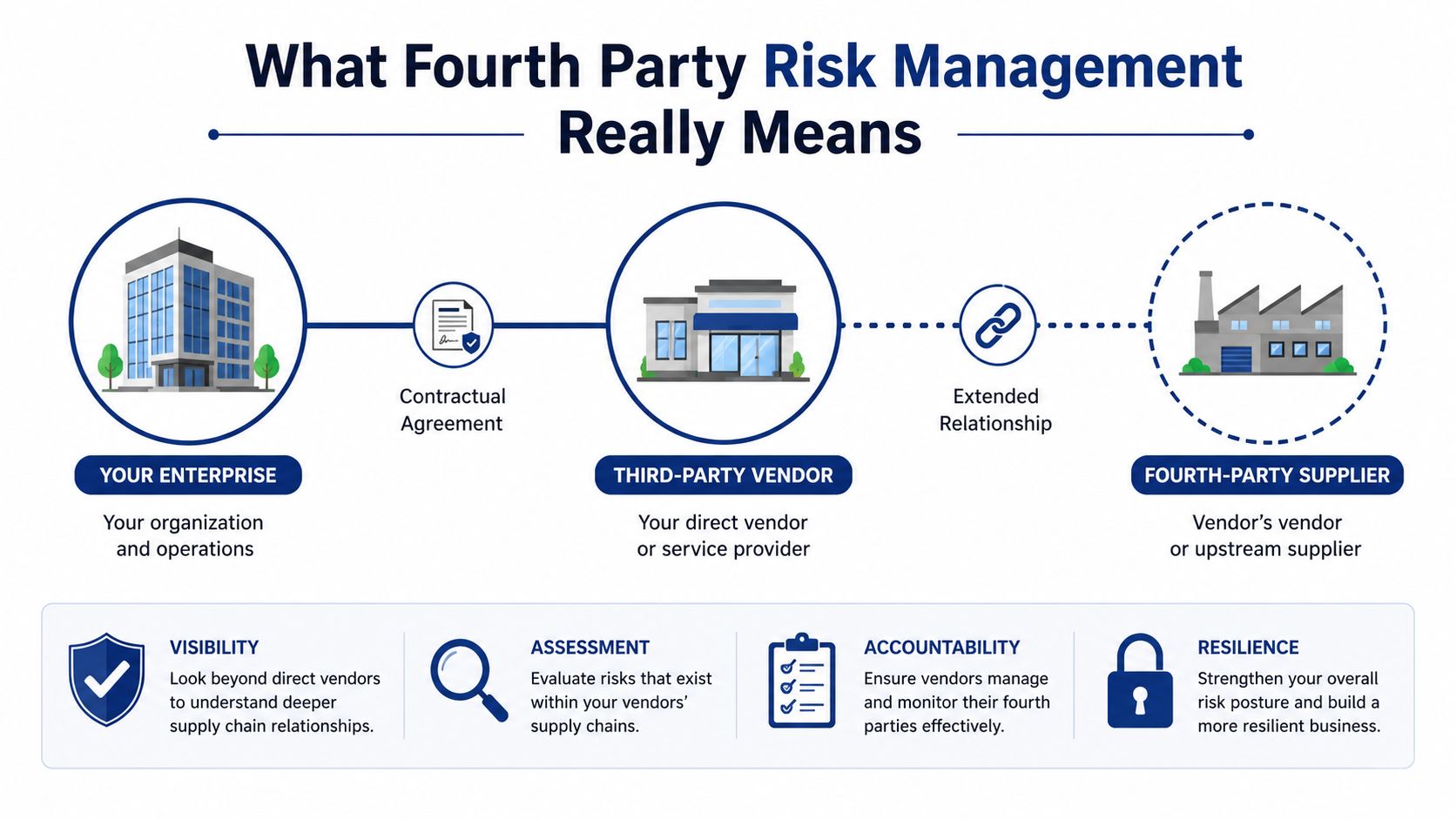
Practical rule: if a supplier can affect your data, uptime, or incident response without being in your contract chain, it belongs in your fourth-party scope.
The point is not to create another register for the sake of it. The point is to reduce hidden dependencies before they turn into outages, audit findings, or regulatory friction. In the GCC, that makes fourth party risk management a resilience issue, not a procurement footnote.
What Fourth Party Risk Management Really Means
A fourth party is the vendor behind your vendor. If your direct provider uses a cloud host, a payroll processor, an IT support subcontractor, or a data-handling processor, that downstream company is part of your exposure whether or not your legal team ever saw its name. In GCC operating models built on outsourced delivery and cross-border service chains, that hidden layer often sits closer to production than executives expect. It can affect data access, service continuity, and incident handling without ever appearing in the original contract stack.
That is why fourth-party oversight belongs in the same conversation as supplier risk management, not as a side topic. A useful starting point is a practical supplier risk management approach that already maps ownership, escalation, and control responsibility across the first layer of vendors. Fourth-party work extends that discipline into the supplier's supplier, where the blind spots usually sit.
SecurityScorecard's research found that organisations typically have indirect relationships with 60x to 90x as many fourth parties as third-party vendors (SecurityScorecard research). That changes the scale of the problem. You are not dealing with a small set of missed names. You are dealing with a relationship graph that grows much faster than normal review cycles can cover.
Why the distinction matters in real operations
A third party has a contract with you. A fourth party usually does not. That means the usual levers, questionnaires, audit clauses, service reviews, and acceptance gates, stop at the layer where the risk can still move into your environment. Once the subcontractor sits outside your direct contract chain, oversight has to travel through the vendor's governance, not through your own paper trail.
Control reality: if your vendor cannot name its material downstream providers, your control is already too late.
The risk is not theoretical. When hidden suppliers sit inside a production path, they can affect access, patching, logging, data handling, or recovery support without your team seeing the dependency in advance. That is why a fourth-party issue can turn into a service event, a compliance gap, or a difficult audit conversation long after the original vendor assessment looked complete. For a concrete example of how a hidden chain can expand the blast radius, read about the Premium Cashflow Cloud leak.
For GCC enterprises, the practical takeaway is straightforward. Fourth party risk management is not a new niche process. It is the missing depth layer in an existing TPRM programme, and it belongs in governance, resilience testing, and incident planning at the same time.
Third Party vs Fourth Party Risk and Why Third Party Controls Fall Short
Third-party controls were built for direct counterparties. They work when you have a signed contract, a named owner, a response deadline, and an audit trail. The problem starts when the risk moves one layer deeper and those assumptions disappear. At that point, a strong vendor management process can still miss the actual dependency path.
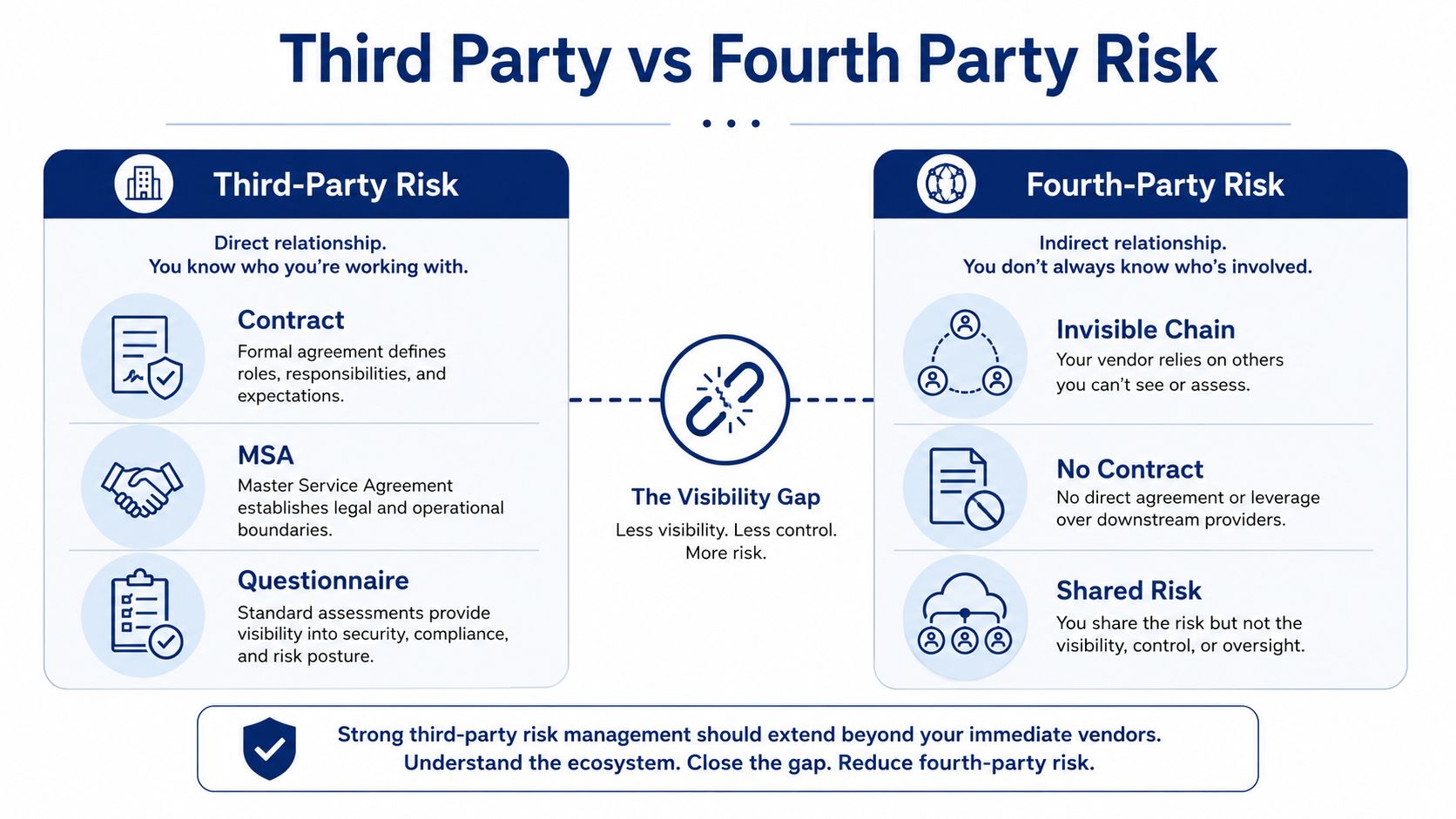
Where the usual controls stop
Contract clauses do not bind a fourth party directly. Due-diligence questionnaires usually go to the direct vendor, not the hidden supplier. On-site audits rarely reach a subcontractor unless the contract chain has already forced disclosure. That leaves a familiar set of tools that are useful for third parties, but weak for the layer below them.
A simple arithmetic model shows why this matters. If ten third-party vendors each use five suppliers, that creates 50 additional fourth-party relationships to manage (Atlas Systems example). The indirect count scales faster than many organizations realise, especially when the same cloud, identity, or support provider appears across multiple vendors.
How the visibility gap compounds
SecurityScorecard's 60x to 90x finding means the problem is not linear, it multiplies. A quarterly review of direct vendors cannot keep pace with a supply chain that keeps branching into new service layers, especially when vendors are adding new tools, new subcontractors, and new geographies in the background (SecurityScorecard research).
Fourth-party oversight is not a richer version of third-party oversight. It is a different visibility problem.
That is why the right question is not “do we manage vendors well?” The right question is “how much of our operational exposure sits in relationships we never contract with directly?” Once you frame it that way, the control gap becomes obvious, and third-party-only methods stop looking adequate.
For a practical anchor on the direct-vendor layer, compare this with third-party risk management, then map where that approach loses sight of downstream dependencies.
Measuring Blast Radius Across Shared Providers in the GCC
A vendor list is not a fourth-party programme. It is paperwork unless you can identify which shared providers sit under multiple direct vendors and create a multi-vendor outage if they fail. That is the core concentration problem in the GCC, especially across cloud, identity, payroll, telecom, payment, and ITSM stacks.
The UAE's digital economy contributed about AED 100 billion to GDP in 2022, and the government has set a target to raise that to over AED 300 billion by 2031 (risk and resilience analysis). When the scale of digital activity grows that fast, the blast radius from one shared provider failure grows with it. One cloud, identity, or payment dependency can now surface across many different business units and many different vendors.
What concentration risk looks like
Concentration risk shows up when many vendors rely on the same hidden provider. The risk owner may see separate third parties on paper, but the operational reality is one shared upstream dependency. That is why GCC teams need to measure shared-provider density, not just collect subcontractor names.
A useful way to triage exposure is to score fourth parties by three factors.
Data sensitivity: does the dependency touch PII, financial data, or regulated records?
Access scope: can it reach production systems, credentials, or privileged workflows?
Shared-provider density: how many of your direct vendors depend on the same upstream provider?
Operational shortcut: the most dangerous fourth parties are usually the ones that combine sensitive data with repeat use across multiple vendors.
A strong example of why this matters is the recent discussion of the Premium Cashflow Cloud leak, which is useful reading for teams trying to understand how a single service failure can ripple through connected environments (InsecureWeb case write-up). The lesson is not the incident itself. The lesson is the shape of the blast radius.
For service continuity testing, pair this thinking with digital operational resilience testing so you can test dependencies, not just document them.
A Practical Assessment Framework and Risk Taxonomy
The best starting point is not to rebuild your supplier universe from scratch. Start with your existing third-party inventory, then ask which direct vendors have material downstream dependencies. From there, classify exposure by business impact rather than by contract count. That gives you a register that a CIO can use.
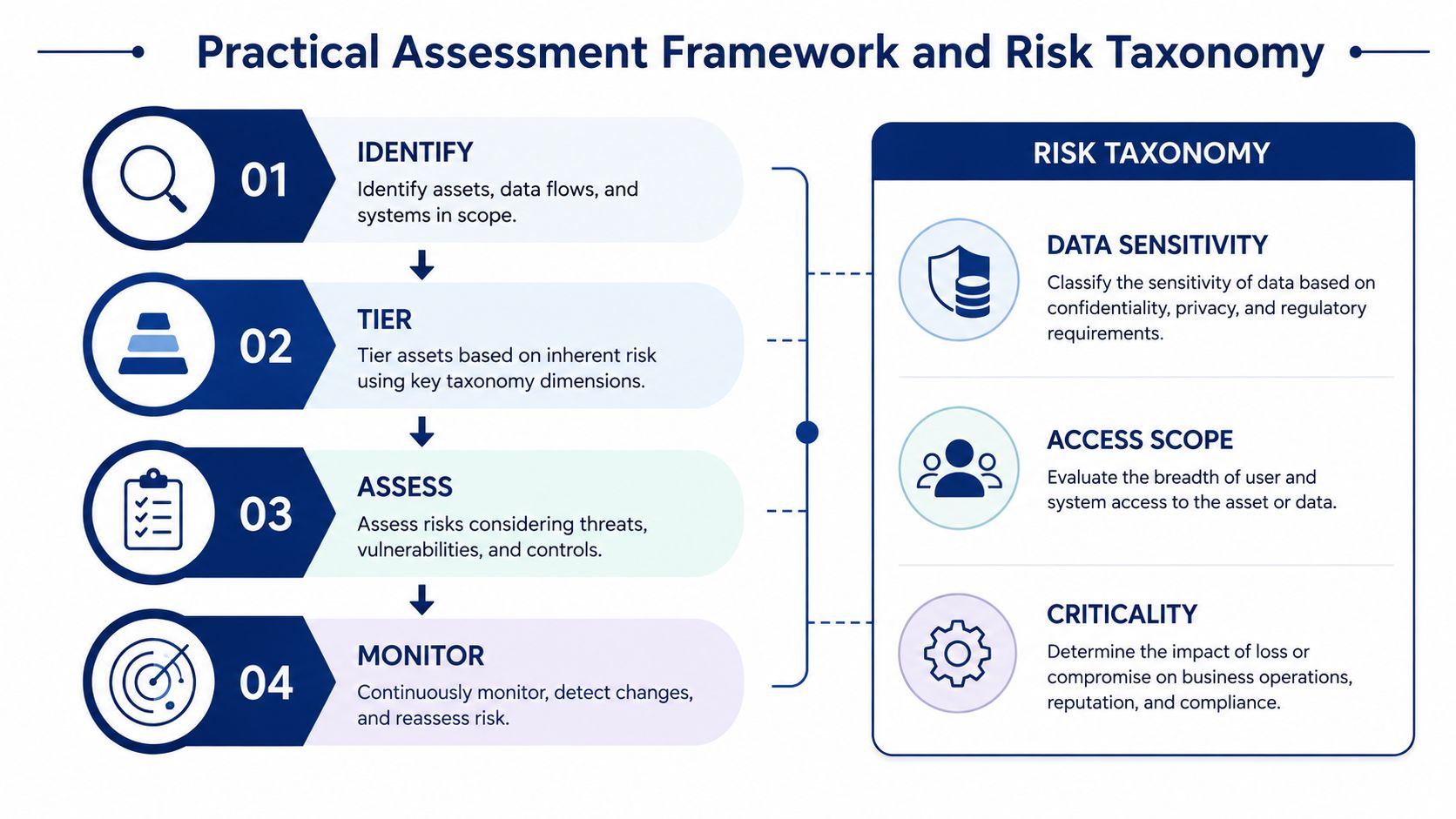
The four steps that hold up in an audit
A workable model has four stages.
Identify. Pull downstream providers from your existing vendor records, questionnaires, service maps, and CMDB relationships.
Tier. Separate material fourth parties from low-impact ones using data sensitivity, access scope, regulatory exposure, and concentration.
Assess. Review the direct vendor's control over subcontractors, not just the subcontractor's paper posture.
Monitor. Track changes, incidents, and control drift over time.
The contractual anchor comes from FHFA-OIG guidance, which says enterprises should assess whether a third party will use subcontractors, ensure the third party remains responsible for subcontractor performance under the primary contract, and be notified of material subcontractor identity when appropriate (FHFA-OIG guidance).
The taxonomy that makes the register usable
A useful fourth-party taxonomy should classify each dependency by:
Data sensitivity, especially customer, financial, or regulated data.
Access scope, especially production credentials and privileged integrations.
Criticality, meaning whether failure would interrupt a key service.
Regulatory exposure, especially when data crosses jurisdictions.
If you want a broader template for structuring the assessment logic, build a risk framework and then adapt it to hidden downstream dependencies.
The monitoring dimension matters too. Risk & Compliance Magazine quotes an OCC expectation that ongoing monitoring of third-party relationships must address reliance on subcontractors, the subcontractors' location, and ongoing monitoring and control testing of subcontractors (Risk & Compliance Magazine). Those three points are useful because they force teams to look at dependency, geography, and evidence, not just attestation.
For a working inventory and register approach, align it with vendor risk assessment so your direct-vendor process and fourth-party process stay connected.
Governance and Contractual Controls You Can Enforce Today
Controls only matter when they can be enforced in writing and tracked in a system. That means your third-party contracts need clauses that reach downstream, at least through the direct vendor's obligations. Without that, subcontractor oversight stays informational instead of operational.
Clauses that actually change behaviour
Use clauses that require:
Pre-contract disclosure of material subcontractors.
Equivalent flow-down obligations for security and privacy.
Advance notice before subcontractors change.
Audit and right-to-test language where the vendor can extend it downstream.
Exit support that covers data retrieval from downstream processors.
The practical reason for this approach is simple. If you cannot force disclosure of material subcontractors, you cannot maintain an accurate control map. If you cannot require notice of change, you cannot keep it current.
A clause that says nothing about subcontractor change is a clause that accepts surprise.
How to encode it in the platforms teams already run
In ServiceNow, tie subcontractor fields to vendor records, map them into workflows, and connect them to CMDB relationships so downstream dependencies stay visible during renewals and incident reviews. In HaloITSM and HaloPSA, use the service and asset record structure to attach subcontractor ownership, review dates, and escalation rules. In Freshservice, extend the vendor record and service catalogue process so service owners can flag downstream dependencies during intake and change. In ManageEngine, keep the same logic in a lower-cost or on-premise environment where data residency or operating model makes that sensible.
DataLunix supports this kind of control design through discovery workshops, implementation, and managed service work across those platforms, but the bigger point is architectural. The platform should carry the control, not the spreadsheet.
What good governance looks like
Good governance makes subcontractor change a tracked event, not an email thread. It also makes audit rights usable by recording which services depend on which downstream providers, so procurement, IT, and risk teams are looking at the same record. That is the difference between policy language and actual oversight.
Continuous Monitoring for AI Agents and Cross Border Data Flows
Static inventories age quickly now. AI agents, automation chains, and outsourced operations can add hidden dependencies faster than an annual questionnaire can catch them. If your monitoring only runs at renewal time, it will miss the changes that matter most.
The UAE regulatory environment makes this more urgent. The UAE Cyber Security Council has pushed for more proactive resilience practices, and the UAE Personal Data Protection Law adds obligations around downstream processors and cross-border handling. That means fourth-party oversight is not just a cyber control, it is part of data governance and transfer discipline.
Three monitoring moves that work
Telemetry from ITSM and ITOM tools. Watch for new integrations, new service connections, and new support chains as they appear.
Security-rating feeds. Use third-party posture data to catch changes in a subcontractor's security position.
Contract-event triggers. Treat subcontractor additions, removals, and location changes as formal risk events.
A useful external reference for teams modelling resilient service paths is Data Centers List predictive modeling, because prediction is only useful if it is tied to dependency monitoring and service continuity.
Why annual review is not enough
Annual questionnaires still have a place, but they are not a control by themselves. They tell you what a vendor said at a point in time, not what changed last week. Continuous monitoring closes that gap by linking service records, alerts, and contractual events into one view.
For teams automating this layer, AI automation services can help connect the signals, but the design principle stays the same. Track change, not just claims.
If a subcontractor can alter your data path, your compliance posture, or your service availability, waiting for the next annual review is too slow.
90 Day Implementation Roadmap and Checklist for GCC Enterprises
A fourth-party programme becomes real when someone owns a timeline. The cleanest way to start is a 90-day plan that turns inventory, control uplift, and monitoring into a sequence the CIO can sponsor and the service desk can maintain.
Phase | Days | Key Activities | Platform Touchpoints | DataLunix Support |
|---|---|---|---|---|
Discovery | 1 to 30 | Build the fourth-party register from existing vendor data, identify material downstream providers, map service dependencies | ServiceNow, HaloITSM, Freshservice, ManageEngine | Discovery workshop, fit-gap review, readiness assessment |
Uplift | 31 to 60 | Tier dependencies, update contract clauses, add subcontractor change notices, assign service owners | Contract workflows, vendor records, CMDB links | Implementation, change management, stakeholder enablement |
Monitor | 61 to 90 | Set alerts, review new subcontractors, test escalations, start recurring reporting and remediation | ITSM and ITOM dashboards, risk register, reporting views | Managed services, optimisation, ongoing administration |
The checklist that keeps the programme from stalling
Identify: pull every vendor with material data, access, or service criticality.
Due diligence: ask how their own subcontractors are assessed and monitored.
Contracting: add disclosure, change notice, and flow-down terms.
Ongoing monitoring: review service changes, incidents, and posture drift.
Offboarding: confirm data return, access removal, and downstream closure.
Shared Assessments' lifecycle view fits well here because it treats downstream-party risk as part of the normal TPRM flow, not a separate one-off exercise (Shared Assessments paper).
For GCC enterprises, the delivery path matters as much as the controls. DataLunix helps with discounted licensing, certified implementation across ServiceNow, HaloITSM, HaloPSA, Freshservice, and ManageEngine, plus fit-gap analysis, readiness work, change management, and managed services so teams can move from blind spot to operating control without building a new internal function from zero.
If you want to turn hidden subcontractors into a manageable risk register, speak with DataLunix about platform implementation, control design, and managed services for fourth-party oversight. Visit DataLunix to start a discovery workshop and map your GCC supply chain before the next hidden dependency becomes an incident.