


Governance Risk Compliance Solutions

A regional CIO has just been asked to show the board how PDPL obligations, AML/CFT controls, SCA ICOFR readiness and cyber governance are managed across several subsidiaries. The evidence sits in spreadsheets, ticket queues, shared drives and email threads. That isn't a compliance programme. It's an audit risk.
Governance risk compliance solutions should connect obligations to controls, owners, evidence, remediation and board reporting. For GCC enterprises, the right platform must also connect with ITSM, ITOM, ESM and emerging agentic AI workflows. This guide explains what to buy, how to integrate it and how to prove that it works.
Meta Title: Governance Risk Compliance Solutions for GCC FirmsMeta Description: Compare governance risk compliance solutions for UAE and GCC enterprises, covering PDPL, ICOFR, AML, AI governance, integrations and implementation.Blog Title: How Should GCC Enterprises Choose Governance Risk Compliance Solutions?
What Governance Risk Compliance Solutions Actually Do for Modern Enterprises
A board meeting rarely fails because directors lack policies. It fails because nobody can answer basic operational questions quickly. Which controls apply to each subsidiary? Who owns the failed control? Where is the evidence? Has the remediation been tested? What changed since the last regulatory update?
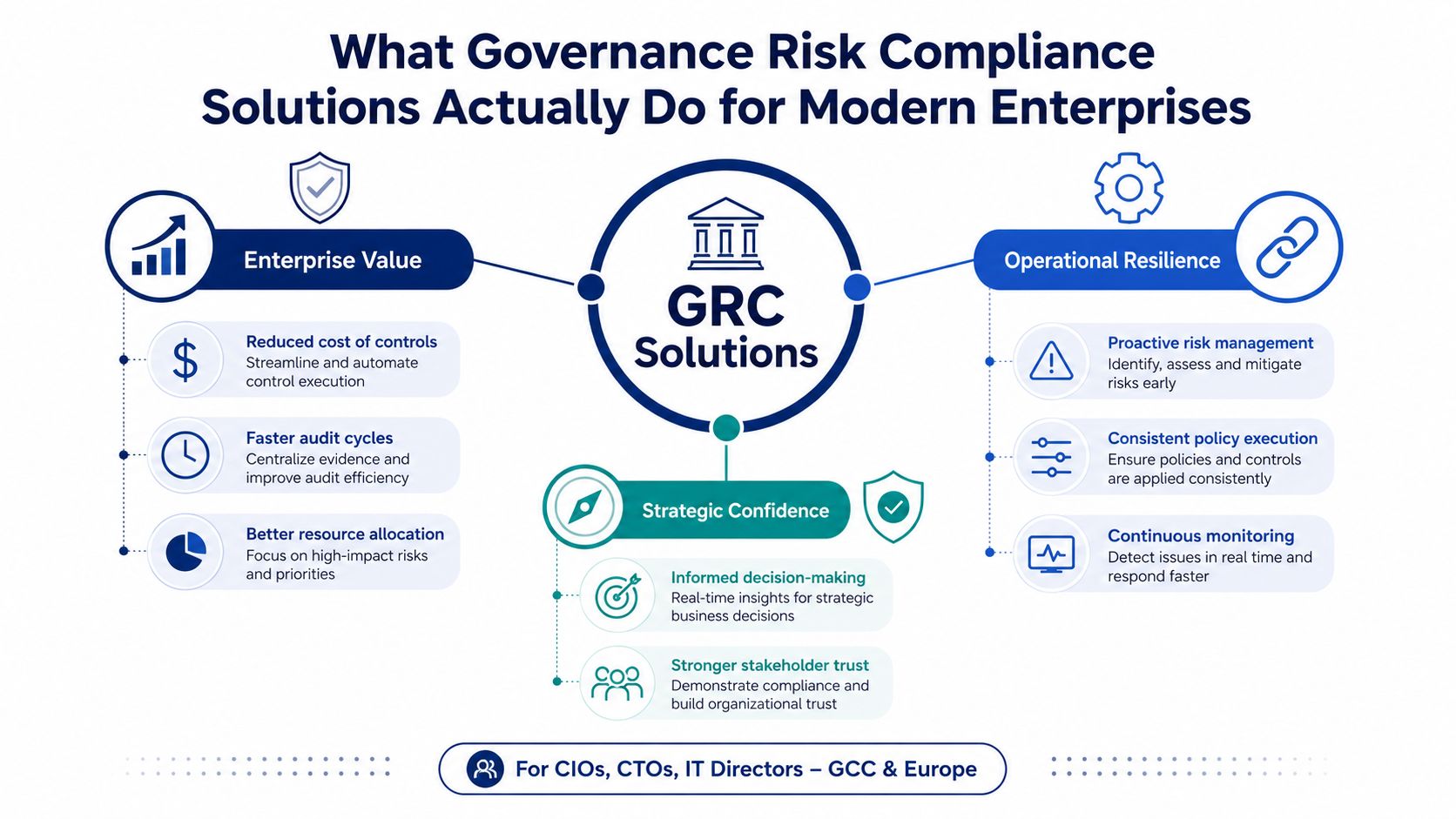
That is the practical job of governance risk compliance solutions. They turn obligations into an operating model that links decisions, risks, controls, tasks and proof. A platform should help you:
Govern: Assign accountability, manage policy approvals, maintain board reporting and support the three lines of defence.
Manage risk: Identify risks, assess their impact, define treatments and monitor whether owners are reducing exposure.
Demonstrate compliance: Map regulations to controls, collect evidence, test effectiveness, track issues and record remediation.
The distinction matters. A GRC platform is the technology layer. A GRC programme is the operating model, including people, processes, ownership and reporting. A GRC partner helps you design, configure, integrate and run that model. Buying software without fixing ownership digitises confusion.
Why policy repositories fail
A document repository can store a policy. It can't reliably prove that the right employee attested to the current version, that a related control was tested, or that a failed test created an owned remediation task. Those activities need workflow, deadlines, integration and an immutable evidence trail.
For enterprises introducing automation, GRC must also govern the workflows themselves. A useful primer on use cases for enterprise AI agents can help technology leaders identify where agents may interact with controlled data, approvals and business processes.
The UAE eGRC market reflects this operational demand. It was valued at USD 746.6 million in 2024 and is projected to reach USD 1,296 million by 2029, implying an 11.7% CAGR, according to UAE eGRC market data. For an enterprise buyer, the message is simple: choose a system that centralises control ownership, evidence collection and regulatory tracking, not another policy filing cabinet. DataLunix's governance, risk and compliance perspective provides a useful reference point for connecting these capabilities to enterprise workflows.
The Three Pillars of Governance Risk Compliance in the GCC
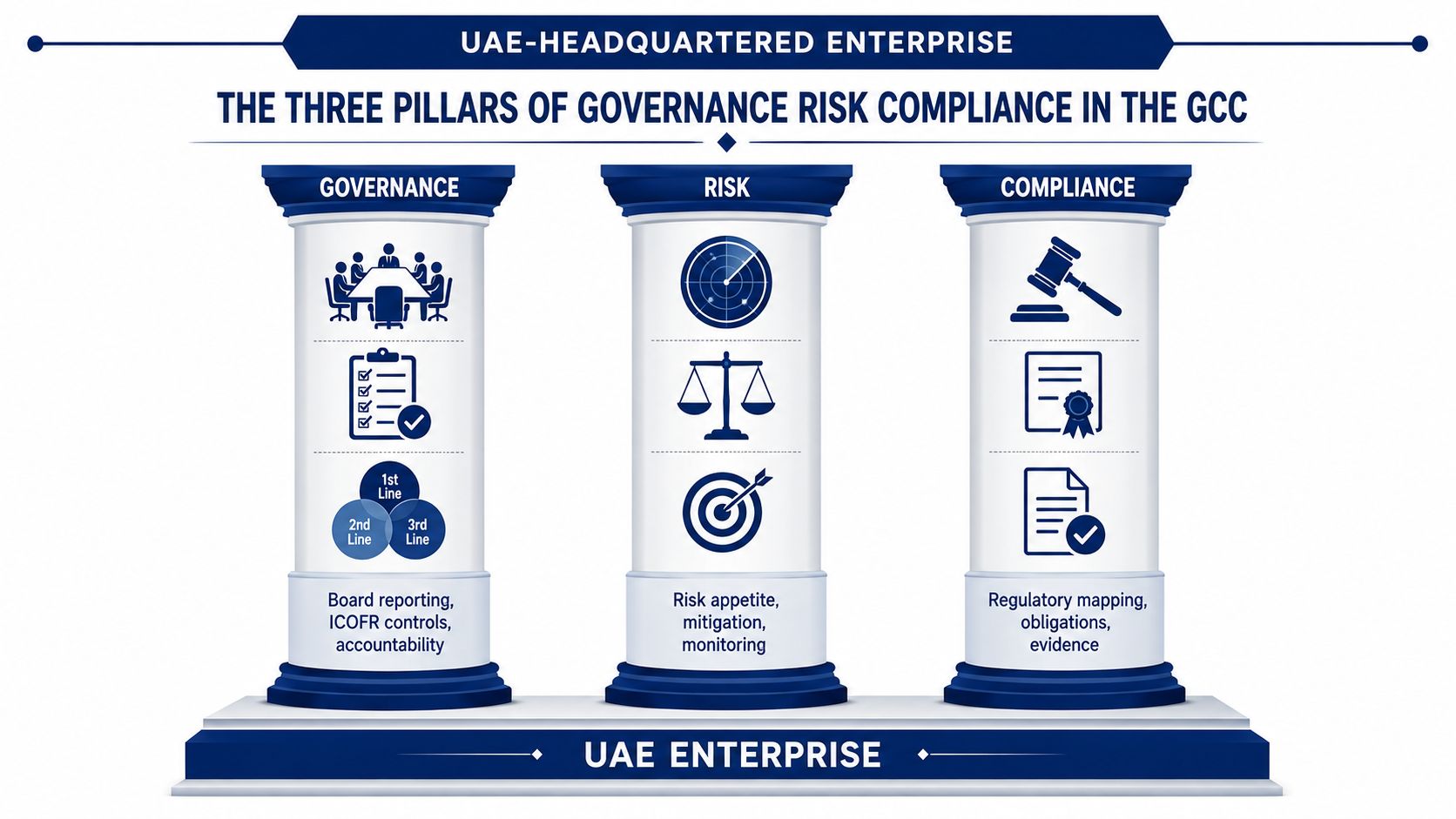
在阿聯酋企業,GRC 平台只有把決策、風險與控制活動連成可追溯流程,才具備實際價值。三大支柱不是三個獨立模組,而是從董事會監督延伸至日常工作流程的責任鏈。
治理界定誰作決策、誰擁有控制,以及管理層如何取得保證。對總部位於阿聯酋的企業,這包括董事會報告、財務報告內部控制,以及三道防線之間的清晰責任。上市公司還必須把 SCA ICOFR 要求轉化為可執行的控制範圍。Stage One 要求 FY2024 自我評估,Stage Two 要求 FY2025 由外聘核數師進行完整 ICOFR 審計,相關要求見此 UAE ICOFR requirements update。
風險把不確定性連接到業務決策。風險登記冊應清楚記錄風險偏好、負責人、處理計劃、剩餘風險與升級歷史。AML/CFT 應與貪腐、第三方、網絡、營運及資料風險共用同一套治理邏輯。阿聯酋 FATF 後續評估顯示,該國在 40項建議中的15項獲評為合規,在 24項獲評為大致合規,並已移出 FATF 具有策略性 AML 缺陷的司法管轄區名單。World Bank UAE Governance Indexes 記錄的 Control of Corruption estimate 為1.2,基於 8個來源,詳見 UAE AML and governance country report。
合規把外部義務轉成可測試的內部控制。聯邦第45號法令,即《個人資料保護法》,於 2022年1月2日 生效,為境內實體建立國家層面的私隱基線。醫療、金融、電訊、DIFC 及 ADGM 仍有額外制度要求,ADGM CRMF、PDPL、AML/CFT Decree Law 10 of 2025 等義務也應映射至控制、證據與責任人。UAE Cyber Security Council 的 Information Assurance v2.1 涵蓋六個管理控制家族,涉及治理、風險及監督,詳見 KPMG's UAE cyber resilience briefing。
實務自我評估
請直接檢查三點:
治理: 董事會能否在不要求另行整理試算表的情況下,看見控制負責人、例外及逾期整改?
風險: 合規、安全與營運團隊能否使用同一筆風險記錄協作?
合規: 能否以一條連續鏈展示法規、對應控制、測試結果、證據及問題歷史?
若答案是否定,問題在資料架構,而不只是報告格式。把證據嵌入日常工作流程,才能支援持續保證,並讓 ITSM、ITOM 與代理式 AI 工作流程在受控範圍內運作。
From Point-in-Time Audits to Continuous AI-Ready Compliance
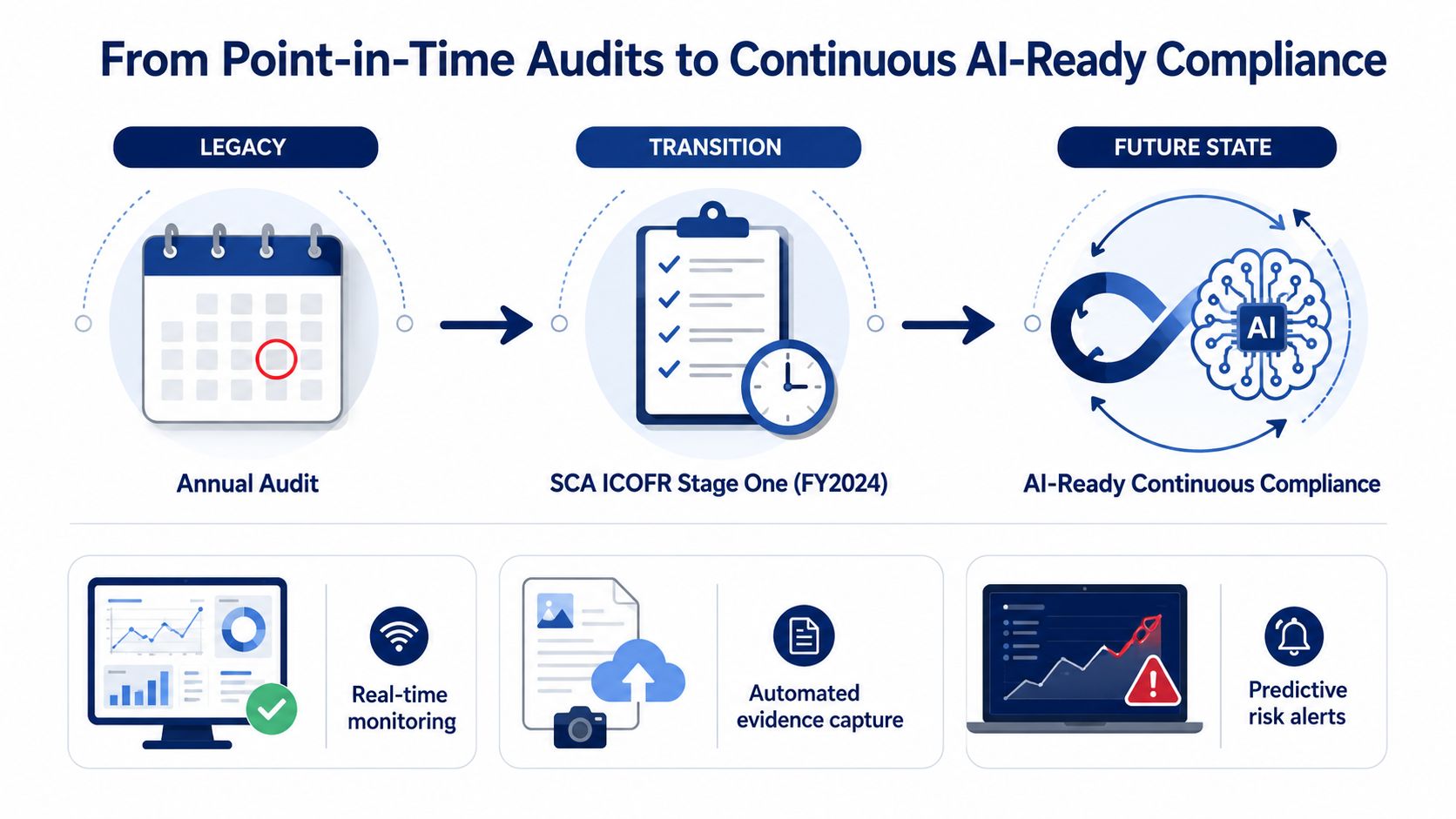
A listed UAE firm can pass an annual audit and still lose control of evidence, ownership and remediation between audit cycles. Teams then spend weeks reconstructing approvals, rewriting control narratives and asking process owners to confirm work that should have been recorded as it happened. Continuous compliance fixes that operating gap.
The SCA timetable exposes the weakness. Stage One covered FY2024 self-assessments, while Stage Two covers a full external-auditor ICOFR audit for FY2025, as noted earlier. An Excel control library may describe an obligation, but it will not reliably manage version history, evidence freshness, owner changes, test results and remediation across subsidiaries. Design the control record around those events from the start.
Traditional and continuous models
Point-in-time GRC | Continuous, AI-ready GRC |
|---|---|
Evidence is requested before an audit | Evidence is captured from operating systems |
Control owners update spreadsheets | Workflows assign and track tasks |
Risk is reviewed periodically | Risk signals and exceptions are monitored |
AI is treated as a technology issue | AI use, model transparency and IP exposure are governed |
Reporting describes past activity | Dashboards support current decisions |
AI governance must cover more than model approval. KPMG's UAE Tech Report 2026 identifies AI transparency and intellectual-property exposure through open-source use as concerns for UAE organisations, while organisations also centralise collaboration between IT, security and risk for AI deployment, as documented in the KPMG UAE Tech Report 2026.
Practical rule: An AI feature isn't governed until you can identify its owner, approved purpose, data sources, decision boundary, exception path and evidence trail.
Configure the platform to maintain an AI inventory, record transparency assessments, route legal and security approvals, and separate machine-generated recommendations from human decisions. AI compliance audits from HappyRobot can support testing design, but accountable owners and review checkpoints remain necessary. A focused compliance risk management approach should connect those controls to PDPL, ADGM CRMF, AML/CFT Decree Law 10 of 2025 and SCA obligations, with evidence ready for assurance reviews.
Integrating GRC With ITSM, ITOM and ESM Platforms
GRC becomes useful when a control failure enters the system where work is already managed. Don't ask a service desk analyst to update a second risk register manually. Create a controlled connection between the GRC record and the operational ticket.
Build the integration around events
A practical pattern looks like this:
Control failure to ITSM incident: A failed access review creates an incident in ServiceNow, HaloITSM, Freshservice or ManageEngine, with the control, owner, due date and severity carried across.
Risk treatment to ITOM change: A remediation plan requiring infrastructure or application changes creates a governed change record, linked back to the risk and control.
Evidence to source systems: HR attestations, training records and joiner-mover-leaver evidence come from HRSD or the relevant HR platform instead of manual uploads.
Customer-facing assurance to CSM: Service commitments, security questionnaires and customer control exceptions flow into customer service workflows with appropriate visibility.
Employee actions through ESM: Policy attestations, code-of-conduct sign-offs and training acknowledgements reach employees through familiar service channels.
Why API-first architecture matters
An API-first platform can consume structured signals from the CMDB, identity systems, ticketing tools, monitoring platforms and HR applications. CMDB awareness is particularly important because a control should identify the service, application, infrastructure component or business owner it protects.
Standalone repositories create duplicate evidence and orphaned controls. An analyst closes the ITSM ticket, but the GRC issue remains open. A process owner uploads evidence, but the source record changes later. These gaps produce audit fatigue because teams must reconcile systems instead of operating controls.
ServiceNow environments should assess the integration model described in this ServiceNow GRC guide. The decision isn't whether your platform has a connector. It is whether the connector preserves ownership, timestamps, control relationships, approvals and remediation status across the complete workflow.
Vendor Evaluation Checklist for Governance Risk Compliance Solutions
A procurement team shouldn't shortlist vendors from feature brochures. It should test whether the platform can represent your obligations, integrate with your operating model and produce evidence an auditor can follow without interpretation.
The RFP questions that matter
Use these questions in your evaluation:
Regulatory coverage: Can the platform map PDPL, AML/CFT, sector rules and the EU AI Act for firms serving Europe?
Control architecture: Can one control map to multiple obligations without creating duplicate testing?
Ownership: Can you assign first-, second- and third-line responsibilities at group, subsidiary and process level?
Evidence automation: Can the platform collect evidence from ITSM, ITOM, HRSD, IAM, monitoring and document systems?
Testing: Can control tests record frequency, method, reviewer, exceptions and remediation?
AI governance: Does the system support model inventories, transparency reviews, open-source IP assessments and approval workflows?
Regulatory change: Can a change trigger applicability assessment, affected-control review and accountable tasks?
Integration depth: Are ServiceNow, Halo, Freshservice and ManageEngine integrations production-ready?
Data controls: Can the vendor explain data residency, access segregation, retention and audit logging for UAE operations?
Scoring transparency: Can users understand which inputs produced a risk score or recommendation?
Commercial model: Are charges based only on users, or also on controls, records, modules, integrations and environments?
Delivery capability: Can the partner configure, train, support and improve the programme after launch?
A low licence price can become an expensive programme when every regulatory mapping, integration and report requires custom development.
Treat claims about AI carefully. If a vendor can't explain the source data, model involvement, confidence, reviewer action and audit record behind a risk recommendation, the feature is presentation technology, not controlled automation. Buyers comparing market positioning can also review this GRC platform analysis, but the final decision should come from your own proof-of-value scenarios.
Implementation Roadmap and the Role of Delivery Partners
Successful implementation starts with control design, not screen configuration. Your team should agree what must be governed, how evidence is created and who accepts residual risk before the platform becomes a visible part of daily work.
Four phases that prevent rework
Discovery and maturity assessment establishes the baseline. Catalogue regulations, business entities, existing controls, risk registers, audit findings, systems and reporting obligations. Identify where spreadsheets, email approvals and shared drives currently sit in the process.
Fit-gap and control design turns that baseline into a usable model. Rationalise duplicate controls, define control objectives, set testing methods, design evidence requirements and map obligations to the common control library. Avoid importing every framework requirement as a separate task.
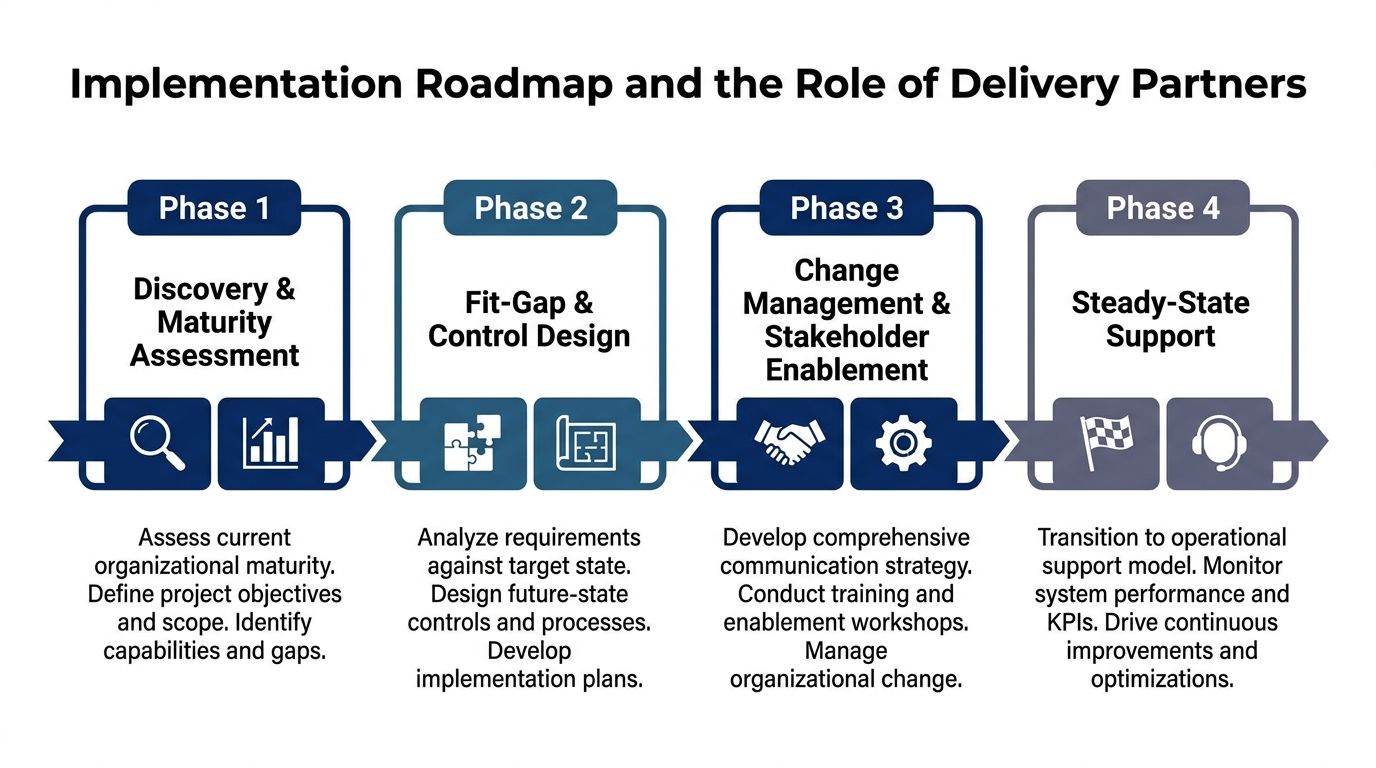
Change management and stakeholder enablement determines adoption. Train control owners in the workflow they use, not in abstract GRC terminology. Give executives concise dashboards, give process owners clear tasks and give auditors traceable evidence.
Steady-state support keeps the programme useful after go-live. Regulatory mappings change, organisational structures change and integrations fail. Managed services can handle administration, upgrades, reporting, evidence operations and continuous improvement while internal leaders retain accountability.
Where partners accelerate delivery
A capable delivery partner can reduce friction in three areas:
Licensing: An authorised reseller may provide access to commercial terms that an individual buyer won't obtain alone.
Capacity: Certified onshore, offshore or hybrid teams can supply configuration, integration and testing capability when internal resources are constrained.
Operations: Managed services can run administration and optimisation after implementation, preventing the platform from becoming another neglected system.
DataLunix is one example of a Dubai-based partner working across ServiceNow, Halo, ManageEngine and Freshservice, with services spanning implementation, integration, staff augmentation and managed operations for GCC and European organisations. The partner choice should still depend on demonstrated delivery methods, relevant certifications and the ability to transfer knowledge to your team.
KPIs and Risk Metrics That Prove GRC Is Working
A GRC budget needs operational proof. “The platform is live” isn't a meaningful outcome. A board needs to know whether controls cover the exposure, owners act on failures and regulatory change reaches affected processes.
Five KPI families to establish
Control coverage measures whether documented obligations and material risks have mapped, owned and testable controls. For ICOFR, separate design coverage from operating evidence. A control that exists in the library but has no current evidence shouldn't count as effective coverage.
Control testing pass rate shows how many tests pass, fail or require qualification. Segment the result by subsidiary, process, control owner and line of defence. A single group-level score can hide a concentrated weakness.
Mean time to remediate findings tracks the time between issue creation, approved treatment and verified closure. For privacy incidents, the operating model must support the 72-hour breach notification duty under the UAE PDPL, as described in this UAE data privacy compliance analysis. Don't use an average alone. Show overdue age, severity and escalation.
Audit-readiness score should reflect evidence freshness, unresolved exceptions, owner confirmations and report completeness. It should answer whether an external reviewer can trace an obligation to a tested control and supporting evidence.
Regulatory change adoption latency measures the time between identifying a relevant change, completing applicability analysis, updating controls and assigning implementation tasks. This is vital when privacy and AML/CFT requirements evolve.
Use trend lines, exception narratives and accountable owners. Avoid invented benchmark ranges. Your first baseline should describe the actual condition, then your board can approve improvement targets based on risk appetite and regulatory exposure.
Common GRC Pitfalls and How to Avoid Them
Buying a platform doesn't create compliance. The following failures appear when leaders treat technology as a substitute for operating discipline.
Treating GRC as a one-time project
A project team configures workflows, loads policies and declares success. Six months later, owners change roles, regulations evolve and integrations stop updating.
Mitigation: Fund GRC as a product with a service owner, release process, data-quality checks and scheduled control-library maintenance.
Early symptom: Dashboards still show the original organisational structure while business leaders work elsewhere.
Over-customising the control library
Teams often reproduce every policy paragraph, audit request and local spreadsheet field inside the platform. The result is a dense catalogue that nobody understands.
Mitigation: Start with control objectives and common controls. Map multiple obligations to one well-written control where the evidence and test method overlap. Keep local variations only when a regulator, risk decision or operating process requires them.
Early symptom: Owners receive several tasks that request the same evidence under different labels.
Ignoring the three lines of defence
A control owner shouldn't approve their own independent assurance. When roles are unclear, first-line teams assume compliance owns everything, second-line teams chase evidence and internal audit loses independence.
Mitigation: Create a RACI across business operations, risk and compliance, and internal audit. Configure approval rights and escalation rules to reflect that separation.
Early symptom: The same person appears as control owner, tester, approver and remediation reviewer.
Underinvesting in policy attestation
Policy management fails when employees receive documents without meaningful acknowledgement, targeted training or exception handling. Attestation records also become unreliable when the platform doesn't distinguish a current policy from an expired version.
Mitigation: Define audience, effective date, acknowledgement method, training requirement, exception route and evidence retention for every material policy.
Early symptom: Completion appears high, but managers can't identify who attested to which version or who remains overdue.
Assuming AI removes human judgement
AI can classify regulatory alerts, suggest mappings and summarise evidence. It shouldn't approve a risk acceptance, decide that a privacy obligation is irrelevant or close a control failure without accountable review.
Mitigation: Set approval thresholds, confidence requirements, human review points and prompt or model change controls. Maintain records of the recommendation, reviewer decision and supporting evidence.
Early symptom: Users can't explain why an AI-generated score changed or which source records influenced it.
Failing to design for cross-border operations
A UAE-headquartered firm serving Europe may need to reconcile UAE PDPL requirements with EU AI Act obligations. The EU AI Act applies through a phased timetable. Prohibitions on unacceptable-risk AI became applicable on 2 February 2025, general-purpose AI obligations became applicable on 2 August 2025, and high-risk system rules are scheduled for 2 August 2026, according to the European Commission's AI Act timeline. A single compliance register won't handle different risk classes and deadlines well.
Mitigation: Maintain jurisdiction-specific obligations, applicability decisions, risk classifications, transfer assessments and evidence links within one control architecture.
Early symptom: European teams maintain a separate register because the group platform can't represent different deadlines or risk categories.
Four artefacts to create early
Produce these artefacts before expanding the rollout:
Control inventory: Include objective, owner, frequency, test method, evidence source and linked obligations.
Risk register: Record inherent risk, residual risk, appetite, treatment, escalation and acceptance authority.
Regulatory change log: Track source, applicability, affected entities, mapped controls, owner and implementation status.
Three-lines RACI: Define accountability for operation, oversight, testing, approval and remediation verification.
These artefacts expose gaps before a vendor demo hides them behind attractive dashboards. A practical account of programme realities is available in this GRC implementation discussion.
Frequently asked questions
How do governance risk compliance solutions handle AI model risk?
They should maintain an AI inventory, assign owners, record intended use, assess transparency and intellectual-property exposure, and route exceptions through human approval. They also need evidence showing how a recommendation was produced and who accepted it.
Can a UAE enterprise align PDPL with the EU AI Act?
Yes, but not through one generic checklist. Map each jurisdiction's obligations to common controls where the evidence overlaps, then retain separate applicability decisions, risk classifications, transfer assessments and deadline workflows.
How do delivery partners accelerate GRC licensing and staffing?
An authorised reseller may provide commercial licensing support, while certified onshore, offshore or hybrid teams provide configuration, integration and testing capacity. Managed services then support administration, upgrades and optimisation after go-live.
What should a CIO ask during a GRC proof of value?
Ask the vendor to demonstrate one end-to-end scenario, such as a regulatory change affecting a control, creating an owner task, collecting evidence from an operational system, raising an ITSM issue and producing a board-ready report. If the demonstration relies on manual export and re-keying, the architecture won't scale.
Is a GRC platform enough to satisfy a regulator?
No. A platform supports the programme, but leadership remains responsible for governance, control design, risk acceptance, evidence quality and timely remediation. Technology can make assurance traceable, but it can't replace accountable decisions.
DataLunix offers discovery workshops, maturity assessments, fit-gap design, implementation and managed services for governance risk compliance solutions connected to ServiceNow, Halo, Freshservice and ManageEngine. Visit DataLunix to plan a practical GRC roadmap for UAE and GCC obligations, integrated evidence workflows and AI governance.