


Why is the Freshservice Helpdesk a Strategic Asset for UAE Businesses?

Updated: Jul 12
The Freshservice helpdesk is an integrated IT Service Management (ITSM) platform that centralizes support requests, automates workflows, and manages company assets. It uses AI and ITIL best practices to streamline service delivery across departments, moving beyond simple ticketing to enhance overall business efficiency for organizations in the UAE.

What capabilities make Freshservice a leading helpdesk?
Freshservice offers a unified platform for managing incidents, resolving underlying problems, coordinating changes, and tracking assets from a single interface. Its intelligent, cloud-based architecture is grounded in ITIL principles, providing a reliable framework for delivering exceptional service in fast-paced markets like Dubai and Riyadh. This integrated approach ensures scalability and operational efficiency.
To give you a clearer picture, we've broken down the core capabilities of the Freshservice helpdesk and their direct impact on businesses operating in the GCC.
How do Freshservice capabilities impact GCC businesses?
Capability | Description | Business Impact in the UAE & GCC |
|---|---|---|
Unified Ticketing System | Centralizes all incoming support requests from email, portals, chat, and phone into one view. | Drastically reduces response times and ensures no employee request gets lost, boosting satisfaction. |
Incident Management | Provides tools to quickly identify, log, and resolve IT disruptions to restore service. | Minimizes downtime for critical business operations, a key factor in competitive markets like Dubai. |
Self-Service Portal | Empowers employees with a knowledge base and service catalog to find answers and request services on their own. | Reduces the ticket load on IT by up to 45%, freeing up tech teams for strategic projects. |
Automation Workflows | Automates routine tasks like ticket routing, approvals, and notifications without needing any code. | Increases operational efficiency and ensures consistent service delivery, even with a distributed workforce. |
Asset Management (ITAM) | Tracks all hardware and software assets throughout their lifecycle, from procurement to retirement. | Improves governance, ensures software license compliance, and prevents unnecessary IT spending. |
AI-Powered Insights | Uses AI to suggest solutions, predict issues, and provide analytics on helpdesk performance. | Enables proactive support and data-driven decisions to continuously improve service quality. |
This table shows how Freshservice moves beyond simple issue tracking to become a strategic asset for managing and scaling internal services effectively.
Can Freshservice unify service delivery beyond IT?
Yes, one of its greatest strengths is extending IT service management principles to other departments as an Enterprise Service Management (ESM) tool. You can deploy the same efficient, ticket-based workflows used by IT for HR, Facilities, and Finance, creating a single, easy-to-use self-service portal for all employee needs.
Human Resources (HR): Handle employee onboarding and offboarding requests with a clear, automated process.
Facilities Management: Manage maintenance requests for office equipment or infrastructure in a structured way.
Finance Department: Track procurement approvals and expense claims in a system where nothing falls through the cracks.
This unified approach dramatically improves productivity and employee experience. For a deeper dive, see our guide on whether Freshservice ITSM is the right choice for your enterprise.
Freshservice flips the script on internal support, moving it from a chaotic, reactive process to a proactive, unified service experience. This shift is critical for supporting today’s hybrid workforce and staying compliant in the fast-evolving GCC market. As an expert partner, DataLunix helps organizations implement this powerful system to hit those exact goals.
How do the core ITSM modules in Freshservice work?
The core ITSM modules within the Freshservice helpdesk are interconnected components aligned with ITIL practices that work together to create a stable IT environment. These modules—Incident, Problem, Change, and Release Management—transform your IT support from a reactive "firefighting" model to a proactive, strategic operation by providing structure and control.
What is Incident Management?
Incident Management’s sole purpose is to restore normal service operations as quickly as possible following an unplanned disruption, minimizing business impact. An incident, like a user being unable to connect to Wi-Fi, is addressed immediately to get the employee working again, without necessarily finding the root cause.
This module is all about speed and resolution. It leans on automations for ticket routing, a knowledge base for quick fixes, and clear Service Level Agreements (SLAs) to guarantee timely responses, which directly boosts employee productivity.
What is Problem Management?
Problem Management acts as the detective, focusing on identifying and eliminating the root cause of recurring incidents to prevent them from happening again. If multiple users report Wi-Fi issues every Monday, Problem Management investigates the underlying infrastructure to find a permanent solution, such as a router bug, thereby reducing future ticket volume.
How does Change Management ensure stability?
Change Management governs all IT changes, from software updates to server upgrades, ensuring they are rolled out in a controlled manner to minimize disruption. It involves assessing risks, securing stakeholder approvals through defined workflows, and scheduling changes during low-impact periods to prevent unexpected outages and maintain operational stability.
Risk Assessment: It weighs how a change could ripple through business operations.
Approval Workflows: This ensures the right stakeholders review and sign off on all changes.
Scheduling: Changes are planned for low-impact windows to avoid interrupting critical work.
This structured process is critical for organizations that cannot afford downtime. You can dig deeper into how the platform supports business needs in our article on what a Freshservice desk is and why it's a top ITSM solution.
What is Release Management?
Release Management plans, schedules, and controls the deployment of new software and hardware into the live environment. It bundles multiple approved changes into a coordinated "release package," ensuring all components are tested, documented, and rolled out together. This prevents conflicts and provides a smoother transition to new technologies.
The latest Freshservice IT Service Management Benchmark Report 2024 reveals that organizations in the MEA region with 11+ third-party integrations achieve an average ticket resolution time of just 19.03 hours—a 23.07% improvement over the global average. You can read the full Freshservice benchmark report for more insights. At DataLunix.com, we specialize in connecting these systems to help you achieve exactly those kinds of results.
How does Freshservice simplify IT asset management?

The Freshservice helpdesk simplifies IT asset management (ITAM) by providing a centralized module to track all hardware and software throughout its lifecycle. This eliminates chaotic spreadsheets and creates a single source of truth, enabling smarter financial decisions, enhanced security, and reduced manual tracking for enterprises in Dubai and Riyadh.
What is the Configuration Management Database (CMDB)?
The CMDB is the core of Freshservice ITAM, acting as an intelligent map of your IT ecosystem that shows not just what assets you have, but how they are interconnected. When a critical server fails, the CMDB instantly reveals which business services are impacted, allowing your incident team to prioritize effectively.
A CMDB turns a flat, static list of assets into an intelligent, relational database. That visibility is the key to understanding the ripple effect of any failure or change—and that’s the cornerstone of stable IT operations.
How does Freshservice manage the asset lifecycle?
Freshservice provides end-to-end control over the entire asset lifecycle, tracking technology from procurement to retirement to maximize investment value. This structured process ensures nothing gets lost and all assets are managed efficiently through automated workflows and real-time status updates, from initial request to secure disposal.
The four clear stages are:
Procurement: A request in the service catalog kicks off automated approval workflows.
Discovery & Deployment: Discovery tools automatically find new assets and add them to the CMDB.
Maintenance & Monitoring: Asset health, performance, and related incidents are tracked to enable proactive maintenance.
Retirement & Disposal: The system guides secure data wiping and disposal to ensure compliance.
Our guide on what Freshservice asset management is and how it can optimize your IT dives even deeper into these stages.
What are the practical benefits of Freshservice ITAM?
Integrating ITAM within the Freshservice helpdesk delivers tangible business results by elevating asset management into a strategic function that drives efficiency and reduces financial risk. It provides complete visibility over your IT environment, allowing you to optimize costs, strengthen security, and minimize human error through automation.
Here’s what you stand to gain:
Optimized Software Licensing: Stop overspending on unused licenses and avoid compliance fines by tracking usage accurately. Many companies cut software costs by up to 30% in the first year.
Enhanced Security: Gain a complete inventory of every device and application on your network to identify and patch vulnerabilities before they can be exploited.
Reduced Human Error: Automate asset discovery and data entry to keep your CMDB up-to-date without error-prone manual work.
Can service management extend beyond the IT department?
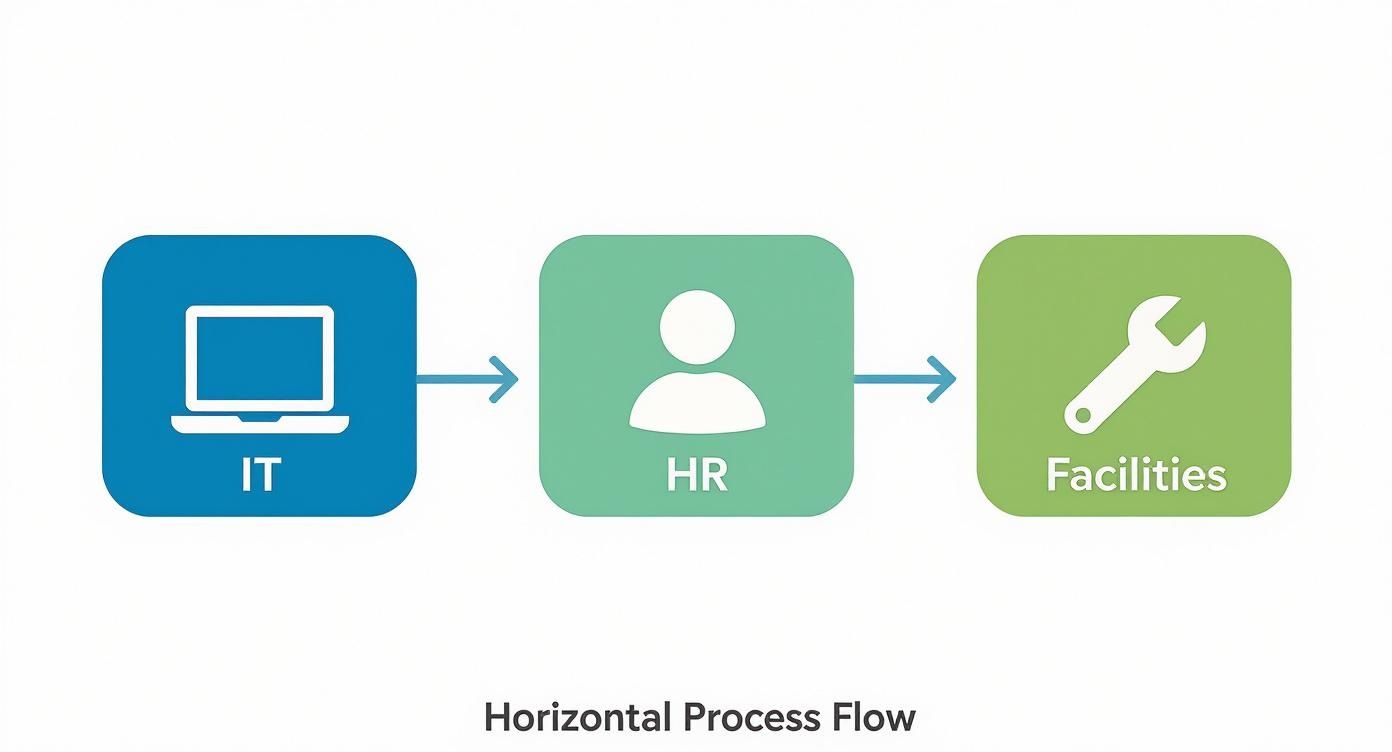
Yes, a modern Freshservice helpdesk evolves into an Enterprise Service Management (ESM) platform by applying proven IT principles to other business functions like HR, Facilities, and Finance. This creates a single, unified service experience for all employees, eliminating departmental silos and inefficient communication channels like email or phone calls.
How does Enterprise Service Management work in practice?
ESM standardizes service delivery across the organization by providing structured ticketing, automation, and self-service portals to business departments outside of IT. This approach ensures every employee request—whether for IT, HR, or Facilities—is tracked, assigned, and resolved efficiently according to predefined service level agreements (SLAs).
What are some real-world examples in a GCC context?
For growing businesses in the UAE and KSA, operational efficiency is critical. An ESM strategy using Freshservice directly addresses this need by streamlining internal processes and breaking down departmental barriers. This leads to faster request fulfillment and improved employee productivity across the entire organization.
Human Resources (HR): Automate employee onboarding, leave applications, and records updates through a dedicated service catalog.
Facilities Management: Allow employees to log maintenance requests via the self-service portal, with tickets automatically routed to technicians.
Finance and Procurement: Manage purchase orders and expense claims through structured workflows that ensure proper documentation and approvals.
For a deeper dive into this approach, you can learn more about our Enterprise Service Management solutions and see how they drive real organizational productivity.
What are the core benefits of adopting ESM?
Adopting an ESM model with Freshservice delivers strategic advantages that enhance organizational efficiency and employee satisfaction. By creating a unified operational framework, businesses gain greater visibility, control, and productivity. This strategic shift moves beyond simple workflow cleanup to foster a more connected and efficient way of working.
The main benefits really boil down to three things:
Increased Productivity: Automating routine tasks frees up employees in every department to focus on high-value work.
Improved Employee Experience: A single, user-friendly portal for all service needs reduces employee frustration and makes it easier to get support.
Greater Visibility and Control: Centralized request management provides leaders with real-time data on departmental performance, enabling informed decision-making.
At DataLunix.com, we help GCC enterprises put ESM strategies into action, unifying their operations and unlocking new levels of organizational horsepower.
What is the playbook for Freshservice deployment?
A successful Freshservice helpdesk deployment requires a strategic playbook that covers everything from initial planning and data migration to system integrations and user adoption. A structured approach is essential for a smooth transition, ensuring you avoid common pitfalls and realize a faster return on your investment, especially for enterprises in the GCC.
What are the key stages of a Freshservice deployment?
A well-organized deployment is broken down into distinct phases, each with specific goals, to ensure no detail is overlooked and the project remains on track. This methodical process, similar to building a house, starts with a solid foundation of discovery and planning and progresses through configuration, migration, training, and finally, go-live and support.
Freshservice Deployment Checklist for GCC Enterprises
Phase | Key Activities | DataLunix Advisory Focus |
|---|---|---|
1. Discovery & Planning | Define project scope, identify stakeholders, map existing processes, set KPIs. | Fit-gap analysis to align Freshservice capabilities with your specific business goals. |
2. Configuration & Setup | Configure modules (Incident, Problem, Change), set up workflows, define user roles. | Architecting scalable solutions and ensuring configurations adhere to ITIL best practices. |
3. Data Migration | Cleanse historical data, map fields from the old system, perform test migrations. | Validating data integrity, minimizing downtime, and ensuring a clean data import. |
4. Integration | Connect Freshservice to key systems (e.g., Azure AD, SAP, HRIS), test API endpoints. | Building robust, custom integrations that ensure seamless data flow across platforms. |
5. UAT & Training | Conduct User Acceptance Testing, train agents and end-users, create documentation. | Developing role-based training programs and managing the change process for high adoption. |
6. Go-Live & Support | Deploy to production, monitor system performance, provide post-launch support. | Offering hyper-care support and managed services to ensure long-term stability and success. |
How can you navigate data migration challenges?
Successfully navigating data migration, often the most complex phase, requires meticulous preparation and a clear focus on migrating only essential, high-value data. Avoid the "garbage in, garbage out" trap by cleansing historical records, resolving inconsistencies, and prioritizing active tickets and critical knowledge base articles before the move.
"A deployment is the perfect time for a 'spring clean.' By focusing on migrating only clean, essential data, organizations set themselves up for success from day one, avoiding the 'garbage in, garbage out' trap that plagues so many IT projects."
At DataLunix.com, our migration experts walk you through this exact process. We use proven methods to sanitize and map your data correctly, guaranteeing you get a fresh start in Freshservice.
Why are user adoption and training critical?
A perfectly configured system is worthless if your teams don't use it. Driving user adoption is a change management challenge that requires clear communication, targeted training, and demonstrating the platform's value. Employees and agents must understand how the new system makes their work easier to ensure a successful transition.
To make the transition stick, here are a few best practices:
Create a Champion Program: Identify key users to act as advocates and provide early feedback.
Deliver Role-Based Training: Tailor training sessions for the specific needs of end-users, agents, and managers.
Build a Clear Communication Plan: Keep everyone informed about the project timeline, milestones, and go-live expectations.
Offer Post-Launch Support: Provide dedicated support channels to answer questions and gather feedback after launch.
FAQs
1. What exactly is a Freshservice helpdesk? A Freshservice helpdesk is a cloud-based IT Service Management (ITSM) platform that centralizes support ticketing, incident management, asset tracking, and service requests. Provided by Freshservice, it helps businesses streamline operations and improve service delivery across IT and other departments.
2. How does Freshservice benefit businesses in the UAE? For fast-paced businesses in the UAE, Freshservice helps by automating routine tasks, which frees up skilled IT professionals for strategic initiatives. Its robust self-service portal empowers a diverse workforce to resolve common issues independently, reducing ticket volumes and providing instant support.
3. What is the standout feature of Freshservice? The standout feature is its powerful yet user-friendly automation engine. It allows you to build complex workflows for ticket routing, multi-step approvals, and notifications without writing any code. This capability is a game-changer for enhancing efficiency and ensuring consistent service delivery.
4. Why is a partner needed for Freshservice setup? A successful Freshservice implementation requires more than just software activation; it demands strategic planning, clean data migration, and effective change management to drive user adoption. A partner like DataLunix.com, with deep expertise in the GCC market, ensures your setup is optimized to meet specific business goals, helping you avoid common pitfalls and achieve a faster ROI.
Call to Action
To unlock true operational efficiency and build a service-oriented enterprise, you need more than just software—you need a strategic partner. DataLunix.com provides expert guidance for implementing the Freshservice helpdesk to align with your unique business goals in the UAE and beyond. Get in touch with us today to start the conversation.
