


Digital Transformation Kuwait

Updated: Jul 12
Digital transformation Kuwait is a strategic national mission, moving the country's economy beyond oil dependency by integrating advanced technologies like AI and cloud computing. This shift, central to the Kuwait Vision 2035 plan, aims to forge a diversified, knowledge-based economy by enhancing public services and driving private sector innovation.
Why Is Digital Transformation a National Priority In Kuwait?
The push for digital transformation Kuwait is a direct response to global economic shifts and a core element of the nation's long-term sustainability strategy. It represents a fundamental upgrade of the country's economic engine, transitioning from hydrocarbon reliance to one powered by data, technology, and innovation to build a more resilient and globally competitive economy.
This commitment is supported by significant investment. For the 2024/2025 fiscal year, the healthcare sector alone has a budget of $10 billion, with $56 million specifically allocated for digital transformation projects. This investment is built on a solid foundation, as 98% of the population actively uses the internet, making widespread digital adoption not just feasible but expected.

What are the key pillars of Kuwait's digital strategy?
Kuwait's strategy is built on several core pillars to ensure sustainable growth across all sectors of the economy and society. This clear framework guides the nation's ambitious goals, ensuring a cohesive and comprehensive approach to modernization.
Economic Diversification: Reducing reliance on oil revenue by fostering growth in sectors like finance, technology, logistics, and healthcare.
Public Sector Modernization: Enhancing government services through e-governance platforms and smart city initiatives to improve efficiency and transparency.
Private Sector Empowerment: Creating a business-friendly environment that attracts foreign investment and encourages local innovation in technology-driven fields.
Human Capital Development: Investing in education and training programs to build a skilled workforce capable of driving a modern, knowledge-based economy.
This structured approach mirrors similar ambitious initiatives across the Gulf. You can see parallels when exploring the strategic approach to digital transformation in Qatar in our related guide. By anchoring its efforts to these pillars, Kuwait is methodically building a future where technology and human ingenuity, not just natural resources, are the main drivers of prosperity.
What is the market and regulatory framework?
Succeeding with digital transformation in Kuwait requires a deep understanding of its unique environment where government strategy and private investment drive technological growth. Your projects must align with this national momentum to thrive in a market where the Information and Communication Technology (ICT) sector is projected to grow from $22.48 billion in 2023 to nearly $39.83 billion by 2028.
Who are the key regulatory gatekeepers?
You need to know the primary organizations setting the rules for digital transformation Kuwait to ensure your projects are secure, fair, and compliant. These bodies create the framework for all technological initiatives within the country.
Communications and Information Technology Regulatory Authority (CITRA): The master regulator for IT and telecom, responsible for issuing licenses, overseeing the market, and implementing the national cybersecurity strategy.
Central Agency for Information Technology (CAIT): The government's central tech hub, guiding e-government projects, promoting digital literacy, and standardizing public sector technology.
What are the core regulations you must know?
Beyond the regulators, you must understand the specific laws that serve as guardrails for your digital projects. These frameworks are designed to protect data, secure national infrastructure, and build public trust, with non-compliance leading to significant penalties. A robust governance, risk, and compliance (GRC) strategy is foundational, as detailed in our comprehensive ServiceNow IRM guide.
Data Privacy Protection Regulation (Law No. 20 of 2014): This law governs how personal information is collected, processed, and stored, placing the responsibility on companies to protect customer data.
Electronic Transactions Law: This legislation provides legal recognition for digital signatures and electronic documents, ensuring the enforceability of online contracts and e-commerce.
National Cybersecurity Strategy: Managed by CITRA, this framework sets security standards for public and private organizations to protect critical infrastructure from cyber threats.
Which technologies are driving change in Kuwait?
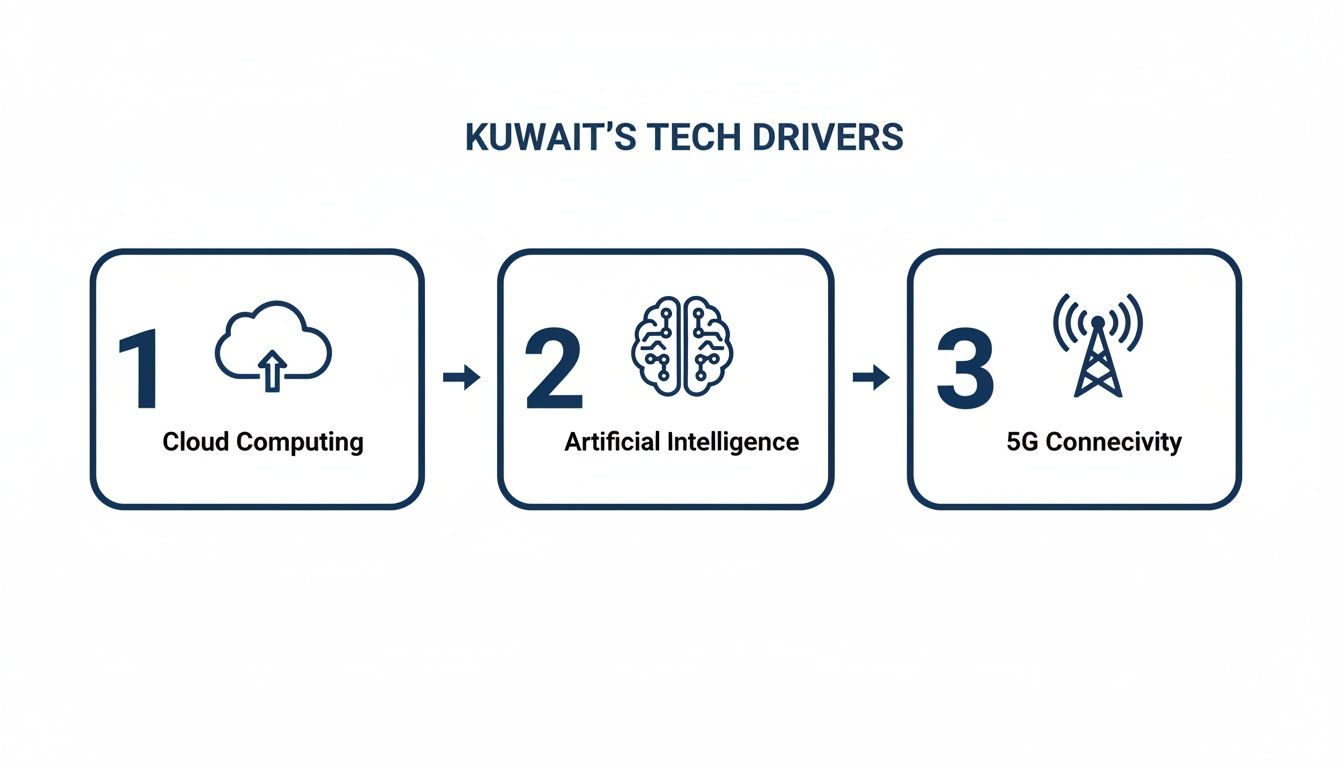
Understanding digital transformation Kuwait means recognizing the key technologies acting as powerful engines of value creation across every sector. Artificial Intelligence (AI), cloud computing, and 5G connectivity form an interconnected ecosystem, with AI leveraging cloud-provided data and both relying on the high-speed, low-latency connections that 5G enables.
How are AI and cloud computing reshaping industries?
AI and the cloud are the definitive duo in Kuwait's technological advancement, enabling businesses to move from reactive problem-solving to proactive, data-driven strategies. This combination unlocks unprecedented levels of efficiency and innovation. Major government partnerships with global tech giants like Microsoft and Google support this push, with 70% of companies in Kuwait now viewing AI as a critical competitive advantage, as highlighted in analysis from sources like Kuwait's AI revolution from GLA & Company.
Oil and Gas: AI-powered predictive maintenance uses sensor data to forecast equipment failures, preventing costly operational halts.
Healthcare: Cloud platforms facilitate secure digital health records, providing doctors with instant access to patient histories for improved diagnostic accuracy.
Finance: Blockchain technology, often cloud-hosted, secures financial transactions, reducing fraud and increasing transparency.
What is the role of 5G and IoT?
If AI and the cloud are the brains, 5G and the Internet of Things (IoT) are the senses and reflexes. 5G's ultra-low latency and massive capacity create the foundation for a truly connected society, allowing countless IoT devices to communicate in real-time and bringing digital intelligence into the physical world. This opens a new frontier of operational visibility and automation, with platform updates like those discussed in our insights on how the ServiceNow Zurich release impacts digital transformation in the GCC further enhancing these capabilities.
Smart Cities: IoT sensors in traffic grids stream real-time data over 5G to manage traffic lights dynamically, reducing congestion.
Logistics: Connected sensors on shipping containers provide continuous location and condition updates, optimizing routes and ensuring goods' integrity.
Retail: Smart shelves with IoT sensors track inventory in real-time, automating reorders and enhancing the customer experience.
How can you build an enterprise digital transformation roadmap?
A successful transformation is a meticulously planned journey, not a leap of faith. For any enterprise in Kuwait, a detailed, step-by-step roadmap is essential. This blueprint provides the necessary structure to move from vision to adoption, ensuring every action is aligned with core business objectives and starts with a clear assessment of your current digital maturity.
How do you assess your digital maturity?
Assessing digital maturity requires a holistic review of your organization's readiness for change across people, processes, and technology. This evaluation helps you understand your strengths and weaknesses to identify where improvements will have the greatest impact.
Key areas to evaluate include:
Technology Infrastructure: Are your systems scalable and flexible, or are they legacy platforms hindering growth?
Data Management: Do you collect, analyze, and use data effectively for decision-making?
Employee Skills: Does your team possess the necessary digital literacy for new tools and processes?
Customer Experience: Is your digital interaction seamless and modern, or clunky and frustrating?
Organizational Culture: Is your company culture genuinely open to innovation and change?
What are the key phases of transformation?
With a clear starting point, you can structure your journey into logical phases, creating momentum and ensuring the initiative stays on track. A well-defined roadmap for digital transformation Kuwait typically follows a structured progression from strategy to scale.
Strategy Development: Align transformation goals with tangible business outcomes. Define the specific problems you aim to solve and establish Key Performance Indicators (KPIs) to measure success.
Technology and Partner Selection: Choose technology platforms that meet your specific needs. For example, expert insights on solutions like Freshservice for ITSM can guide your selection. Partner with experts like DataLunix who have proven experience in the Kuwaiti market.
Pilot Projects and Testing: Start small with manageable pilot projects to test your approach, gather real-world feedback, and secure early wins to build confidence and buy-in.
Scaling and Governance: After a successful pilot, scale the solution across the organization with a solid governance structure to manage the rollout, provide training, and monitor performance.
Which platforms should you choose to modernize operations?
While your roadmap is the blueprint, your technology platforms are the engine. Choosing the right interconnected platforms for ITSM, ITOM, CSM, and HRSD is crucial for creating a modern, automated, and efficient enterprise. These platforms should work together as a unified system, driving tangible business outcomes by creating a workplace where all departments operate on shared data.
How do core platforms unify your business?
A unified platform strategy eliminates friction by allowing processes to flow smoothly between departments, creating a cohesive operational ecosystem. This integration is the foundation of any successful digital transformation Kuwait initiative, streamlining scattered activities into efficient workflows.
IT Service Management (ITSM): Evolves IT support from a reactive helpdesk to a proactive service provider through automation and self-service portals.
IT Operations Management (ITOM): Monitors infrastructure health, predicts outages, and automates recovery to ensure critical services are always available.
Customer Service Management (CSM): Provides a 360-degree view of customer interactions, automating service requests and empowering agents to resolve issues quickly.
Human Resources Service Delivery (HRSD): Streamlines employee services like onboarding and leave requests, creating a frictionless experience that boosts satisfaction and retention.
What is the role of AI-powered workflows?
AI-powered workflows are the intelligent fuel that elevates your platforms from simple automation tools to a predictive, self-healing operational brain. AI analyzes data across your integrated systems to identify patterns, anticipate needs, and automate complex decisions, driving real efficiency and growth. Getting this right depends on partnering with the right expert, as detailed in our guide on the best ServiceNow implementation company in Kuwait.
As a certified partner, DataLunix helps Kuwaiti enterprises design and build these integrated tech stacks, ensuring your technology choices are perfectly aligned with your business roadmap to deliver measurable results.
How do you manage risk and foster a culture of innovation?
Even the best technology will fail if your team isn't prepared to adopt it. Successful transformation hinges on the human element: managing change, anticipating risks, and building a culture that embraces innovation. This means proactively addressing common roadblocks like cybersecurity threats, budget overruns, and resistance to change before they derail your progress.

How can you navigate common transformation roadblocks?
Proactive risk management and clear communication can turn potential obstacles into manageable tasks. Addressing challenges with a clear plan is far more effective than reacting to crises as they arise.
Cybersecurity Threats: Embed a "security-by-design" mindset from the start, conduct regular vulnerability assessments, and provide ongoing security training for all employees.
Budget Overruns: Use agile project management to deliver value in smaller, controlled cycles, allowing for frequent budget reviews to prevent scope creep.
Resistance to Change: Implement a robust change management plan that clearly communicates the "why" behind changes and demonstrates how new tools will benefit employees.
Why is executive sponsorship so important?
Without a champion in the C-suite, your transformation will face an uphill battle. Executive sponsorship provides the vision, authority, and resources needed to drive the initiative forward, break down organizational barriers, and reinforce the project's strategic importance. This leadership is often the deciding factor between success and failure.
How do you build a culture that embraces change?
An innovative culture is built intentionally by creating a safe environment where employees feel empowered to experiment, learn from failures, and share ideas openly. When this culture is established, transformation becomes a continuous process rather than a one-time project.
To build this culture, you should:
Communicate Transparently: Keep everyone informed about progress, setbacks, and future plans to build trust.
Invest in Upskilling: Provide continuous training to help your team master new tools and processes.
Empower Your Teams: Grant decision-making authority to those closest to the work to foster ownership.
Celebrate Small Wins: Recognize milestones and pilot successes to build momentum and demonstrate progress.
FAQs on Digital Transformation in Kuwait
How do we get started with digital transformation?
Start with a digital maturity assessment to evaluate your current technology, processes, and skills. This baseline helps you identify critical gaps and set realistic goals that align with your business objectives, forming the foundation of your strategic roadmap.
Is there government support for digital initiatives in Kuwait?
Yes, the Kuwaiti government actively supports digitalization through its Kuwait Vision 2035 plan. Regulators like CITRA are fostering a tech-friendly environment, and the government is investing in national infrastructure like 5G and promoting public-private partnerships to fuel innovation.
Which technologies offer the best ROI for digital transformation Kuwait?
Technologies that unify operations and automate repetitive tasks, such as integrated platforms for ITSM, ITOM, CSM, and HRSD with an added layer of AI, typically deliver the highest ROI. They break down departmental silos, improve service delivery, and provide data for smarter decision-making.
How can we measure the success of our transformation?
Measure success against the Key Performance Indicators (KPIs) defined in your initial roadmap. Track business-focused metrics such as reductions in operational costs, improvements in customer satisfaction (CSAT) scores, faster service resolution times, and increased team productivity to determine if your investment is paying off.
For enterprises in Kuwait, embarking on a digital transformation Kuwait journey requires a clear strategy and the right expertise. To ensure your digital initiatives deliver tangible results and a significant return on investment, partner with a trusted authority like DataLunix. We provide the guidance and implementation support needed to navigate every phase of your transformation, from initial assessment to full-scale deployment. Connect with the experts at https://www.datalunix.com to start building your future-ready enterprise today.