


Digital Transformation in Qatar

Updated: Jul 12
Your business can succeed in the digital transformation Qatar by aligning its strategy with the Qatar National Vision 2030, leveraging key technologies like AI and 5G, and focusing on data-driven solutions. This approach involves modernizing operations, enhancing customer experiences, and partnering with experts like DataLunix.com to navigate local challenges.
What is driving Qatar's digital ambition?
The primary force is the government's unwavering commitment to the Qatar National Vision 2030, which aims to build a diversified, knowledge-based economy. This national strategy involves massive investments in foundational infrastructure like 5G and cloud computing to create a vibrant digital ecosystem that attracts global talent and investment.

This vision is taking shape through strategic investments designed to construct a digital superhighway for the next generation of services.
What are the pillars of this tech-forward nation?
The core pillars are connectivity, data infrastructure, artificial intelligence, and a supportive innovation ecosystem. These interconnected components work together to create a powerful platform for innovation across every sector, from smart city projects like Lusail to nationwide e-governance initiatives.
Connectivity: Widespread 5G rollouts, fiber optics, and IoT networks establish ultra-fast, reliable, and secure access.
Data & Cloud: The adoption of public, private, and hybrid cloud solutions provides scalable, secure infrastructure for data storage and services.
Intelligence: Artificial Intelligence (AI), Machine Learning (ML), and Big Data analytics leverage data to automate processes and generate predictive insights.
Innovation Ecosystem: Smart City projects, R&D funding, and incubation hubs foster a supportive environment for tech startups.
These advancements are also vital for modernizing how services are delivered. You can see how this plays out in the wider region by exploring how the ServiceNow Zurich release revolutionizes digital transformation in the GCC.
What is the economic impact and market growth?
The government's heavy backing has ignited technology adoption, creating a booming market with significant growth potential. Market analysis shows Qatar’s digital transformation market is valued at roughly USD 7.89 billion in 2025 and is set to expand at a 16.43% CAGR through 2033.
This isn't just a passing trend; it's a structural economic shift. The move to a digital-first economy is unlocking new revenue streams, streamlining operations, and making the nation a magnet for business in the Middle East.
Ultimately, every initiative circles back to one core goal: building a resilient and prosperous future. For any business operating here, understanding these driving forces is the first step toward tapping into the immense opportunities on the table.
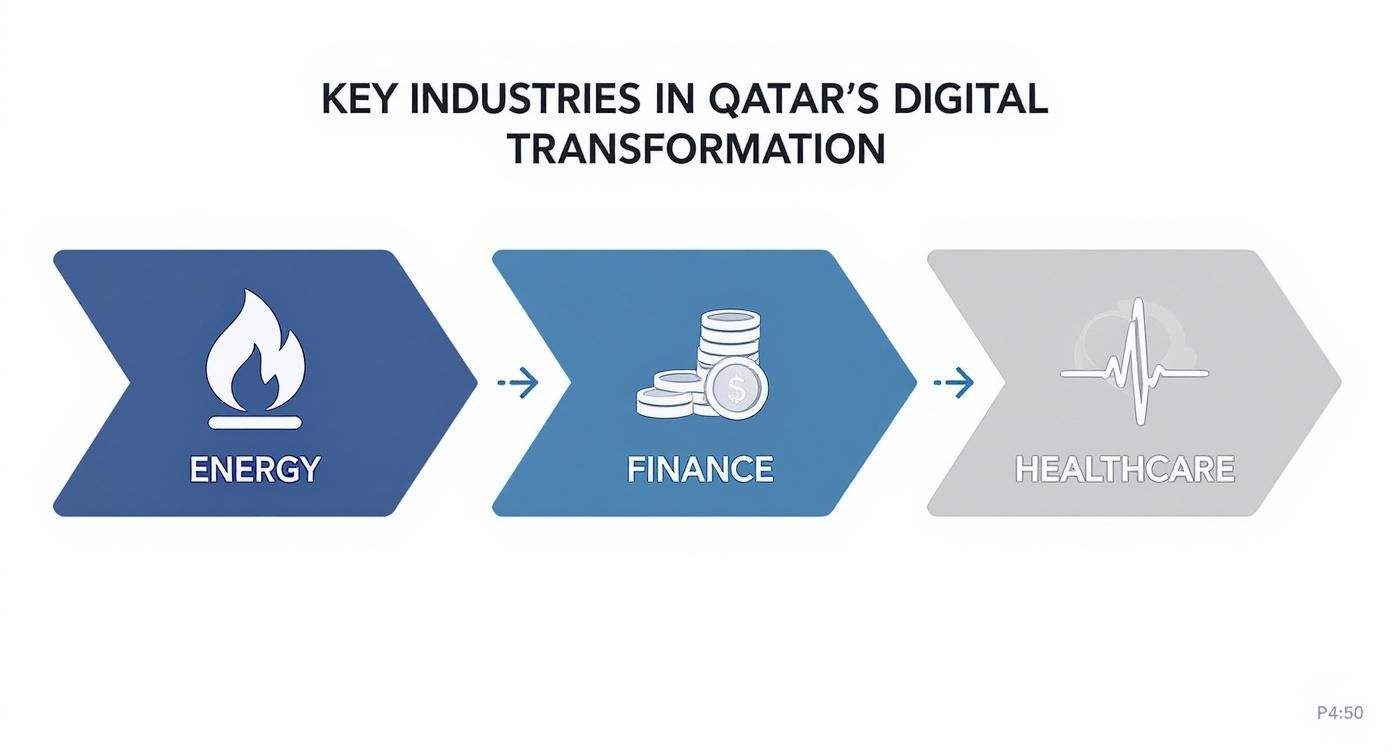
How are key industries embracing digital solutions?
Across Qatar's most vital economic sectors, digital transformation qatar is a practical reality, with businesses actively using technology to solve real-world problems. This isn't about shiny new toys; it’s about targeted solutions that boost efficiency, from energy fields fine-tuning production to financial institutions completely rethinking customer transactions.
How is the energy and utilities sector modernizing?
The energy sector is leading the charge by using the Industrial Internet of Things (IIoT) to build more connected and intelligent facilities. Companies are embedding sensors in critical equipment and using AI-powered "digital twins"—virtual models of physical assets—to simulate operations, predict maintenance needs, and optimize production schedules.
Key applications include:
Predictive Maintenance: AI algorithms analyze sensor data to predict equipment failures, avoiding costly unplanned shutdowns.
Automated Operations: Robotic Process Automation (RPA) handles routine admin work, freeing up skilled engineers for strategic tasks.
Supply Chain Optimisation: Blockchain provides a secure, transparent ledger to track resources from extraction to export.
What's new in finance and FinTech innovation?
Qatar's financial industry is undergoing a major facelift, guided by the Qatar Central Bank's vision for a modern financial ecosystem. The FinTech boom is reshaping everything from consumer banking to corporate finance, with a laser focus on security and user-friendliness through digital payment platforms, mobile banking apps, and secure blockchain transactions. This pivot is essential for attracting international investment. Making different systems communicate is crucial, a concept explored in our guide on transforming Middle East enterprises with unified data.
How are e-governance and public services evolving?
The Qatari government is investing heavily in e-governance to make public services faster and more accessible. Initiatives like the Hukoomi e-Government portal serve as a one-stop shop for services like visa applications and business registrations. By digitizing these processes, the government improves citizen satisfaction and collects valuable data to guide future policies.
How is technology improving healthcare and patient care?
Digital tools are having a massive impact on healthcare through telemedicine platforms, which offer convenient remote consultations. AI is also being used to sharpen diagnostic skills by analyzing medical images with incredible accuracy. Furthermore, Electronic Health Records (EHRs) are creating a single, unified view of patient data, improving care coordination and safety. As experts in system integration, DataLunix.com understands the power of connecting disparate systems to create smart, unified workflows.
What is a practical roadmap to digital transformation?
A successful digital initiative in Qatar requires a clear, actionable plan that breaks down the overwhelming process into manageable phases. This ensures every step is deliberate, measured, and tied to core business goals. This practical framework, trusted by our experts at DataLunix.com, guides you from initial idea to continuous improvement.
Phase 1: What should you do for discovery and assessment?
You should start with an honest look at where your business stands today by conducting a thorough digital maturity assessment. This phase is about asking tough questions to pinpoint operational bottlenecks, identify outdated processes, and get a real sense of where you are lagging behind competitors.
Where are our workflows most inefficient?
What are the most common complaints from our customers or employees?
Which manual tasks consume the most time and resources?
Answering these gives you a clear baseline, preventing you from investing in impressive technology that solves the wrong problems.
Phase 2: How do you build your strategy and plan?
You can define what success looks like by setting clear, measurable goals and building a compelling business case. Instead of a vague goal like "improve efficiency," aim for something concrete like "reduce invoice processing time by 40% within six months." This is also the stage to select the right technologies—like a CRM, ERP, or AI analytics tool—that directly address the challenges you uncovered.
A well-defined strategy acts as your compass, ensuring every decision moves you closer to your transformation goals. It transforms your vision from a concept into an actionable blueprint for change.
Phase 3: How should you handle the pilot and implementation?
You should start with a pilot project on a smaller, controlled scale rather than jumping into a full company-wide rollout. This approach lets you work out kinks, gather real-world feedback, and demonstrate value quickly. Remember that technology is only half the battle; effective change management, transparent communication, and thorough training are crucial. For complex rollouts, a proven structure like a ServiceNow implementation framework to follow is essential.
Phase 4: What comes after implementation for optimization and growth?
After your new systems are live, the final phase focuses on monitoring results, gathering data, and continuously refining your approach. Digital transformation is not a one-and-done project. Use analytics to track your KPIs and measure progress against your goals. This data-driven feedback loop fosters a culture of continuous improvement, aligning your business with Qatar’s broader economic strategy and ensuring you remain agile and competitive.
How can you navigate challenges and seize opportunities?
Successfully navigating the path to digital transformation in Qatar means having a clear-eyed view of obstacles while strategically pursuing the massive potential ahead. The biggest challenges are rooted in people, processes, and policies. The companies that master these areas will lead the market.
What are the key transformation hurdles to address?
Organizations must proactively address data security, the digital skills gap, and internal resistance to change. A major concern is securing data while complying with Qatar's data protection laws. Another significant hurdle is bridging the digital skills gap through upskilling and talent development. Finally, overcoming internal resistance requires effective change management and clear communication. For a look at tackling similar compliance hurdles, see how to achieve complete SAMA cybersecurity framework compliance in Saudi Arabia.
Upskilling the Current Workforce: Implement continuous training so employees can confidently use new digital tools.
Cultivating Local Talent: Partner with local universities to create a pipeline of tech-savvy graduates.
Attracting Global Experts: Bring in specialized international talent to fast-track knowledge sharing.
How do you capitalize on Qatar's unique advantages?
For every challenge, Qatar offers a powerful opportunity, with forward-thinking leadership creating fertile ground for digital innovation. The market's growth speaks for itself, with projections showing it will reach USD 19.65 billion (QAR 71.75 billion) by 2030.
One of the biggest game-changers is Qatar's world-class 5G infrastructure, which provides the backbone for next-gen tech like IoT and smart city solutions. Additionally, strong government support under the Qatar National Vision 2030 reduces investment risks and encourages experimentation. As a trusted partner, DataLunix.com helps businesses align their strategies with these national goals to maximize growth and emerge as regional leaders.
How do you measure your digital transformation ROI?
You measure the return on a digital transformation by tracking the right Key Performance Indicators (KPIs) that connect tech spending to real business value. Focus on what truly moves the needle: operational efficiency, customer satisfaction, and financial gains. Without a clear way to measure ROI, you risk investing in initiatives that feel productive but don't actually boost the bottom line.
How do you define your Key Performance Indicators?
You need to identify the metrics that genuinely matter and tie directly back to your strategic goals. Ditch vanity metrics and zero in on indicators that reflect the health of your core business.
Operational Efficiency: Metrics that show how technology is smoothing out internal processes, such as process cycle time reduction.
Customer Experience: Indicators that gauge improvements in customer satisfaction and loyalty, like Net Promoter Score (NPS).
Financial Returns: Metrics that track direct financial wins, such as revenue from digital channels or cost savings from automation.
How can you build a performance dashboard?
A well-designed dashboard provides a clean, at-a-glance view of your progress, tailored to your specific industry and goals. For most organizations in Qatar, a solid ROI dashboard will track a mix of the following KPIs.
Category | Key Performance Indicator (KPI) | How to Measure It |
|---|---|---|
Operational Efficiency | Process Cycle Time Reduction | Measure the time it takes to complete a key process (like order fulfillment) before and after your changes. |
Employee Productivity | Track output per employee or team—for example, how many support tickets an agent resolves in a day. | |
Cost Savings from Automation | Calculate the direct reduction in manual labor costs and other operational expenses after automating repetitive tasks. | |
Customer Experience | Customer Satisfaction (CSAT) Score | Use quick post-interaction surveys to ask customers to rate their satisfaction on a simple scale. |
Net Promoter Score (NPS) | Survey customers to find out how likely they are to recommend your company to friends or colleagues. | |
Customer Churn Rate | Measure the percentage of customers who stop using your services over a specific period. It’s a crucial health check. | |
Financial Returns | Revenue from Digital Channels | Track every dollar generated directly through new e-commerce sites, mobile apps, or other digital platforms. |
Customer Lifetime Value (CLV) | Calculate the total revenue you can expect from a single customer over the entire course of your relationship. |
Measuring ROI demands a disciplined, data-driven approach and hinges on solid change management. For a deeper look, our guide on how change management can drive maximum ROI offers powerful insights. At DataLunix.com, we help you build this exact measurement framework.
How do you find the right partner for Qatar’s digital future?
You can find the right partner by looking for a specialist firm that understands the local market, possesses deep technical skills, and has a clear plan to guide you. Success in Qatar's complex digital landscape isn't just about technology; it's about having a partner who can protect your investment and accelerate your results.

The right partner ensures your digital strategy aligns with national goals like the Qatar National Vision 2030, helping your bottom line while contributing to the country's economic diversification.
Why does a specialist partner make all the difference?
An expert guide understands the unique intersection of Qatar’s market dynamics and global tech trends, which is essential for navigating local regulations and turning potential roadblocks into advantages. At DataLunix.com, we translate complex technical capabilities into measurable business outcomes, ensuring your transformation delivers real value.
What should you look for in a transformation partner?
Your partner should offer a complete service covering the entire transformation lifecycle, from discovery and readiness checks to implementation and ongoing optimization. This holistic approach guarantees continuity and accountability.
Look for a partner with a clear, structured game plan. Key capabilities should include:
Fit-Gap Analysis: Pinpointing the exact gaps between your current and desired states to design the perfect solution.
Change Management: A proactive strategy to keep stakeholders informed and drive user adoption.
Flexible Delivery Models: Options for onshore, offshore, or hybrid delivery to balance cost-efficiency with timely execution.
A partnership should feel like an extension of your own team. The right firm works collaboratively, transferring knowledge and empowering your organization to sustain momentum long after the initial project is complete.
As a certified partner for leading platforms, DataLunix.com provides more than just implementation services. We also offer discounted licensing, making advanced technology more accessible.
Frequently Asked Questions about Digital Transformation Qatar
What is the real goal behind Qatar's digital push?
The core goal is building a resilient, knowledge-based economy as outlined in the Qatar National Vision 2030. The strategy is to move beyond hydrocarbon reliance by sparking innovation, making public services smarter, and cementing Qatar’s status as a global tech hub.
Which technologies are driving the change?
A powerful tech ecosystem is at work, including 5G for ultra-fast connectivity, Artificial Intelligence (AI) for automation and insights, and cloud computing for scalable infrastructure. The Internet of Things (IoT) connects physical assets to gather real-time data, collectively boosting efficiency across all sectors.
How can smaller businesses get involved?
SMEs can easily get involved by adopting affordable cloud-based software to streamline operations, using digital marketing to find new customers, and leveraging e-commerce platforms. Numerous government programs also offer funding and support to help SMEs digitize and participate in this national movement.
What are the toughest hurdles to overcome?
The main challenges include ensuring robust cybersecurity to protect sensitive data, navigating complex data privacy laws, and developing a local talent pool with the right digital skills. Overcoming these hurdles is essential for building trust, sustaining innovation, and realizing the country's massive growth potential.
When you need to turn the vision of digital transformation Qatar into a reality, DataLunix.com is the expert partner you can trust. We provide the strategic guidance and technical expertise to de-risk your journey and accelerate your ROI. Contact us today and let's build your custom roadmap.