


DORA EU Law: Your 2026 Compliance Guide for CIOs

Updated: 7 hours ago
The DORA EU law is a regulation creating a unified digital operational resilience framework for the EU financial sector, and it directly affects not only financial firms but also their critical ICT service providers globally. It entered into force on 16 January 2023 and became applicable on 17 January 2025, applying to around 22,000 EU regulated financial entities and the ICT third-party service providers supporting them.
For a CIO in Dubai, the practical point is simple. If your team runs infrastructure, managed services, cloud operations, service desk, cybersecurity tooling, or offshore delivery for an EU bank, insurer, investment firm, or asset manager, DORA is now part of your operating model whether you are based in the EU or not.
Most commentary still treats DORA as a banking regulation. That misses the commercial reality. A Frankfurt bank may be directly regulated, but the operational burden travels down the supply chain to the MSP in Dubai, the engineering team in India, the cloud reseller, and the subcontractor providing monitoring or backup support. Good overviews such as these DORA compliance insights are useful, but CIOs in the GCC need to translate the law into controls, evidence, and contract language that work in cross-border delivery models.
A practical starting point is to understand where your service model touches resilience obligations, then align your governance and tooling accordingly. This broader operational perspective is also why many teams begin with a detailed review of the DORA regulation requirements before changing workflows, supplier terms, and reporting playbooks.
What Is the DORA EU Law and Why Does It Matter Now?
DORA EU law matters now because it is no longer a deadline-driven project. It is a live supervisory reality that changes how technology risk, incidents, testing, and supplier dependencies are managed for the EU financial sector.
DORA created a single EU-wide ICT risk framework for financial services when it entered into force on 16 January 2023 and became applicable on 17 January 2025 (PwC overview of DORA scope and dates). That matters because the regulation replaced fragmented national approaches with one common operational baseline.
For CIOs, that shift has two consequences.
Your controls must be consistent: Local workarounds and loosely documented practices don't survive centralised scrutiny.
Your evidence must be reusable: If multiple EU clients ask similar resilience questions, you need one defensible answer pack, not a bespoke scramble each time.
Your vendors become part of your compliance posture: Weak subcontractor visibility creates risk even when your own internal controls look mature.
Practical rule: If a client can't trace a critical service from business process to asset to supplier to recovery plan, your DORA readiness is incomplete.
What changed after January 2025 is the tone of the conversation. Before then, firms asked whether they had enough time. Now they ask whether they can prove resilience during client due diligence, contract remediation, audit reviews, and supervisory follow-up.
For Dubai-based technology leaders, this is especially important in hybrid delivery models. You may have UAE account leadership, an India operations team, and infrastructure spread across multiple cloud and SaaS providers. DORA doesn't care that your delivery model is efficient. It cares whether resilience responsibilities, dependencies, reporting lines, and testing evidence are clear.
What Are the Five Key Pillars of DORA?
The structure of DORA is manageable once you view it as five operational workstreams, not one legal document. IBM summarises DORA around 5 key pillars and notes that it covers 20 different types of financial entities and their ICT dependencies (IBM on DORA pillars and scope).
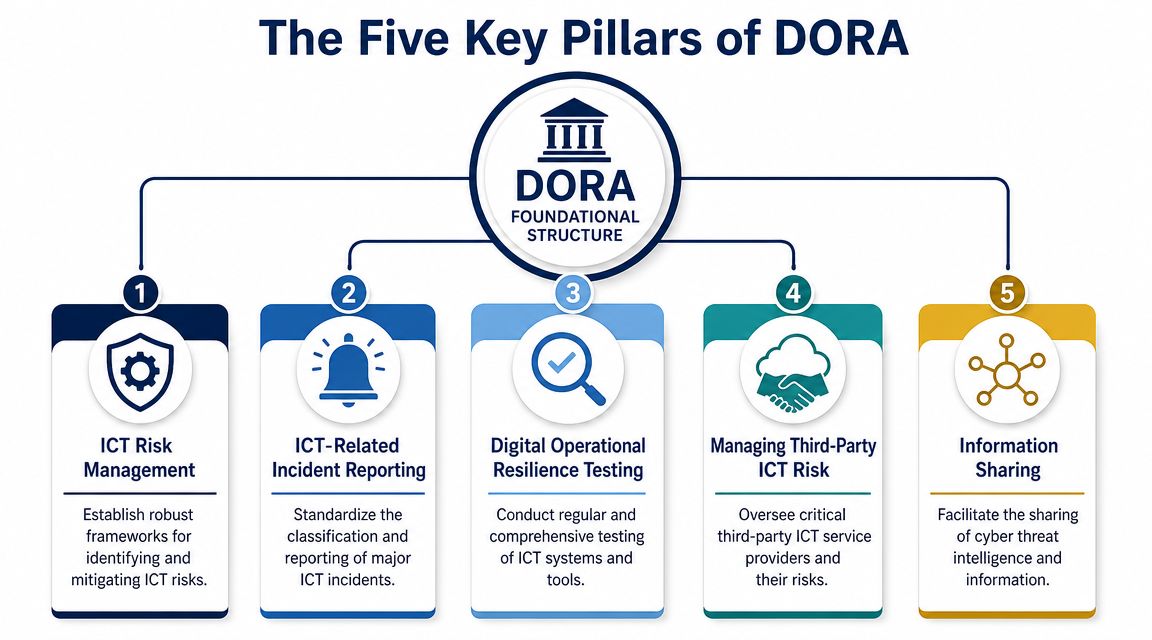
A useful reference point for teams building internal education is this explainer on what the DORA framework includes. It helps anchor legal requirements in operational terms.
How should CIOs think about pillar one and pillar two?
Pillar one is ICT risk management. Pillar two is ICT-related incident management. Together, they decide whether your organisation can identify operational risk early and respond in a controlled way when something breaks.
Pillar one affects the basics that many firms assume they already do well:
Asset visibility: You need a dependable view of services, systems, owners, and dependencies.
Control ownership: Somebody must own each critical control, not just the policy document.
Resilience design: Backup, recovery, access management, and change control need to reflect service criticality.
Pillar two is where weak operating models get exposed. Incident management under DORA isn't just ticket logging. It requires disciplined classification, escalation, communication, and evidence retention. If your incident process lives partly in email, partly in chat, and partly in tribal knowledge, it won't hold up well.
What do testing and third-party risk actually require?
Pillar three is digital operational resilience testing. Pillar four is ICT third-party risk management. These are often the most difficult for UAE and GCC service providers because they demand evidence across internal teams and external suppliers.
Testing means more than annual policy attestations. It means proving that recovery assumptions, failover steps, and technical response processes work in practice. Third-party risk means your client will ask not only what you do, but who supports you, what rights they have, and how you manage sub-outsourcing.
A lot of organisations struggle because procurement, legal, security, and operations all own part of the answer. Nobody owns the whole picture.
The fastest way to stall DORA work is to split operational resilience into separate legal, security, and vendor tracks without a single accountable owner.
Why is information sharing part of the model?
Pillar five is information sharing. It is the least discussed pillar, but it matters because resilience improves when relevant threat and incident intelligence moves quickly across the right participants.
In practice, this means you need a clear internal rule for what can be shared, by whom, and in what format. The wrong approach is informal sharing with no governance. The better approach is controlled participation linked to your incident management and risk processes.
Who Exactly Must Comply with DORA?
If you are an EU-regulated financial entity, DORA applies directly. If you are a non-EU ICT provider supporting one of those entities, DORA can still shape your contracts, governance, and operating model in material ways.

The regulation applies directly across all EU member states, and for UAE-based or other non-EU service providers the practical impact is indirect but material because if they support an EU financial entity, contracts, governance, and audit rights must be aligned to DORA since the regulation extends to ICT suppliers wherever they are based (GRC Solutions on DORA's direct EU application and supplier impact).
What does that mean for a Dubai-based provider?
It means location does not remove exposure.
A common mistake is to ask, “Are we legally in scope?” The better question is, “Will our EU client require us to operate in a DORA-aligned way?” In most meaningful service relationships, the answer is yes.
Typical affected providers include:
Managed service providers: Especially where they run monitoring, service desk, infrastructure support, or recovery processes.
Cloud and hosting partners: Where service availability and dependency mapping matter.
Cybersecurity operations teams: Particularly if they detect, classify, or respond to incidents.
Software and platform vendors: If their service is embedded in regulated business operations.
Which firms should treat this as urgent?
Treat it as urgent if your team touches any critical service path for an EU financial client. That includes direct contracts and indirect delivery through another integrator or outsourcer.
A vendor doesn't need to sit inside the EU legal perimeter to sit inside the client's resilience perimeter.
For CIOs, this turns DORA into a portfolio question. Which clients, contracts, business services, tools, and subcontractors create the highest resilience obligations? If you can't answer that quickly, start there.
How DORA Reshapes ICT Third-Party Risk Management
DORA is often described as a cyber regulation. For non-EU providers, that framing is too narrow and leads to poor decisions.
The sharper view is this. DORA is also a commercial and operational dependency regime that can force non-EU vendors to prove resilience, supply-chain transparency, and auditability even if they are outside the EU legal perimeter, directly affecting contracts and governance (Upwind on DORA as a dependency regime).
Why the usual vendor approach doesn't work
Many service providers still manage client compliance requests as procurement paperwork. They send a security policy, a disaster recovery summary, a certificate pack, and hope that is enough.
It usually isn't.
DORA changes the conversation from “Are you secure?” to “Can we rely on your service under stress, understand your dependencies, inspect your controls, and exit cleanly if necessary?” That is a much broader operational question.
The weak model looks like this:
Fragmented contracts: Legal terms, SLAs, and audit clauses don't line up.
Poor sub-outsourcing visibility: The prime vendor cannot clearly explain who else supports the service.
No tested exit playbook: Transition support exists in theory only.
Evidence gaps: Teams claim resilience but can't produce current proof.
The stronger model treats third-party risk as a living operational discipline. Tools can help, but they only matter if governance is clear. Teams evaluating operating approaches often look at categories such as third party risk management software, but software alone won't fix unclear ownership, bad contracts, or undocumented dependencies.
What clients will increasingly ask from you
Expect EU financial clients to ask for practical proof in four areas.
Contract alignment
Your agreements should reflect access rights, audit support, incident cooperation, and termination or transition obligations in language that your delivery teams can execute.
Operational transparency
You need to show how services are delivered, what systems support them, and where subcontractors or affiliates are involved. “We use a global delivery model” is not a usable answer.
Resilience evidence
Clients will want evidence that testing, incident handling, and recovery planning are active disciplines rather than policy statements.
Governance maturity
Board-level and senior leadership oversight matter on the client side, so your side needs named owners, regular review forums, and a documented escalation path.
A practical way to mature this discipline is to align legal, vendor, security, and IT operations around a single control set and a single evidence library. Through this alignment, structured third-party risk management practices become operationally valuable rather than purely administrative.
Operational reality: If your client needs three separate meetings to understand one service dependency chain, your vendor management model is too fragmented.
What Are the Timelines and Penalties for Non-Compliance?
The key date has passed. DORA became fully operational on 17 January 2025, so the focus is no longer readiness in principle. It is sustained compliance in practice.
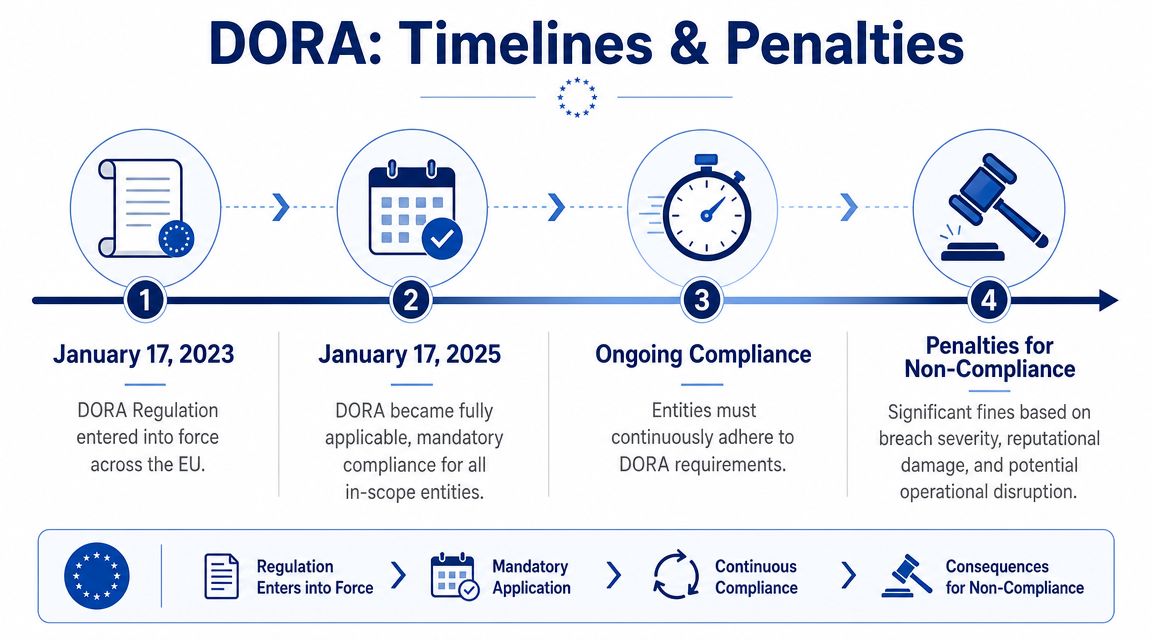
The current supervisory emphasis is on proof of operational resilience, including evidence of testing, board-level oversight, and remediated vendor contracts (EIOPA on DORA application and ongoing supervision).
What matters more than the deadline now?
Three things tend to separate mature organisations from exposed ones:
Evidence freshness: Old screenshots, stale policy approvals, and undocumented exceptions create immediate credibility problems.
Board and executive visibility: Senior oversight must be visible, not implied.
Contract remediation progress: If supplier terms still conflict with resilience expectations, risk remains open.
Many CIOs underestimate the commercial impact of weak DORA alignment. Even before any formal enforcement outcome, clients can slow procurement, increase contractual controls, require remediation plans, or reduce reliance on a provider that cannot demonstrate resilience clearly.
What should non-EU providers assume?
Assume that enforcement risk is only part of the picture. Commercial pressure usually arrives first.
For a UAE or GCC provider, the practical penalty may be:
loss of deal momentum,
longer security and legal reviews,
tougher audit demands,
restricted service scope,
or replacement by a provider with cleaner operational evidence.
That is why DORA should be handled as a business continuity and client trust issue, not just a compliance item.
A Practical DORA Compliance Roadmap for CIOs and CTOs
The fastest way to waste time on DORA is to begin with policy drafting before you understand your services, assets, dependencies, and contracts. Start with operational fact-finding, then build governance around what is true.
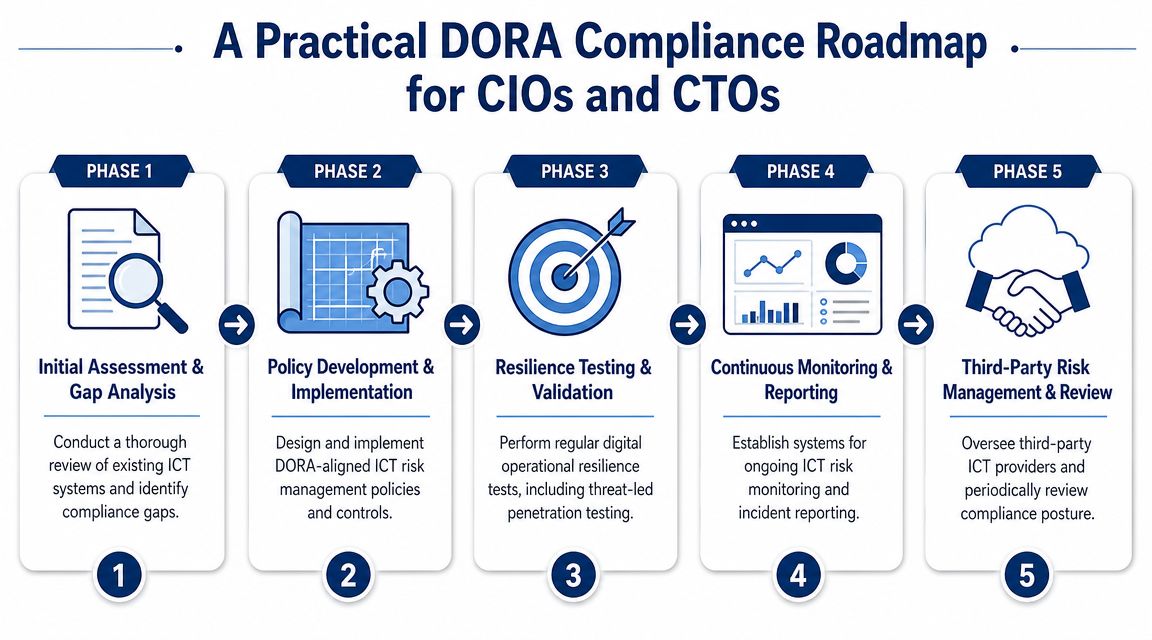
DORA imposes recurring controls such as annual recovery and vulnerability testing and threat-led penetration testing every three years, requiring evidence-backed asset mapping, dependency documentation, and supplier oversight that can withstand supervisory review (Cutover on DORA testing and evidence requirements).
A useful companion read for leadership teams is this guide for executive technology risk, especially if your challenge is less about legal interpretation and more about executive operating discipline.
Phase one should focus on service truth
Answer the question “what do we run?” before asking “what policy do we need?”
For most CIOs, this means pulling data from ITSM, CMDB, monitoring, cloud inventories, vendor records, and contract repositories into one working view.
In practical platform terms:
ServiceNow: Use CMDB, service mapping, IRM, vendor records, and incident workflows together.
HaloITSM or Freshservice: Build a disciplined service catalogue, ownership model, and incident taxonomy.
ManageEngine and monitoring tools: Reconcile technical components with business services and recovery priorities.
Deliverables at this stage should include:
Critical service mapping: Which services support EU financial clients.
Dependency mapping: Which internal teams, tools, and suppliers each service relies on.
Ownership mapping: Who owns service, risk, incident, and supplier decisions.
Phase two should fix governance and process design
Once the environment is visible, standardise how resilience is managed.
That usually means:
Defining incident classification rules
Setting escalation and reporting paths
Aligning risk acceptance with executive oversight
Establishing evidence retention routines
Creating a repeatable client questionnaire response pack
Many organisations overcomplicate things. They create too many bespoke workflows per client. A better pattern is a common baseline process with client-specific overlays only where contractually necessary.
Good DORA operating models are boring in the right way. Clear ownership, standard evidence, predictable reviews, and rehearsed escalation.
Phase three should test what matters
Testing should follow business criticality, not internal politics. Prioritise the services whose failure would most affect an EU financial client.
Use your existing tools, but tighten the operating discipline around them:
Run recovery exercises against real dependencies
Validate vulnerability and control evidence regularly
Record outcomes, owners, and remediation actions
Track closure through one accountable governance forum
If you are using ServiceNow for integrated risk and operations governance, structured workflows such as those discussed in ServiceNow IRM implementations can reduce manual evidence chasing and improve audit traceability.
Phase four should remediate third-party contracts
This step is often left too late. It shouldn't be.
Review whether supplier contracts support:
Audit and access rights
Incident notification and cooperation
Sub-outsourcing visibility
Business continuity obligations
Exit and transition support
If legal, procurement, and operations review these separately, progress stalls. Put them in one remediation track with named owners and target clauses.
How DataLunix Accelerates Your Path to DORA Compliance
For most CIOs, the challenge isn't understanding DORA at a high level. It is converting fragmented tools, contracts, delivery teams, and reporting practices into one defensible operating model.
That work becomes much easier when assessment, workflow design, platform configuration, and managed operations are handled together rather than as separate projects. This is especially true for GCC organisations serving EU clients through hybrid onshore and offshore structures.
A practical delivery partner should help you:
Assess exposure quickly: Map EU-linked services, vendors, and resilience gaps.
Operationalise controls: Configure ITSM, ITOM, IRM, and vendor workflows around actual DORA requirements.
Build evidence packs: Create board-ready, client-ready, and audit-ready documentation from live systems.
Support continuous compliance: Keep testing, incident handling, and supplier oversight current after the initial project ends.
For organisations already using ServiceNow or planning to expand governance workflows, a strong starting point is to align control design with implementation patterns such as those in ServiceNow compliance operations.
DataLunix is well positioned for this kind of cross-border work because it combines Dubai-based leadership, European delivery context, and hands-on execution across platforms such as ServiceNow, HaloITSM, Freshservice, and ManageEngine. That matters under DORA because resilience doesn't live in a policy binder. It lives in configured workflows, accountable teams, usable reporting, and supplier transparency.
If your current model depends on spreadsheets, scattered contract versions, and manually assembled audit evidence, you can improve quickly. The efficient path is to standardise the control model, centralise the evidence, and automate what your teams repeatedly do by hand.
Frequently Asked Questions About the DORA EU Law
Question | Answer |
|---|---|
Does DORA EU law apply to a UAE company that is not regulated in the EU? | It can affect you materially if you provide ICT services to an EU financial entity. In practice, your client may require DORA-aligned contracts, governance, audit support, and resilience evidence even though you are based outside the EU. |
Is DORA EU law only about cybersecurity? | No. DORA covers cybersecurity, but it also reaches operational resilience, testing, incident management, third-party governance, and commercial dependencies. That is why legal, procurement, operations, and security teams all need to work together. |
What should a CIO prioritise first under DORA EU law? | Start with service and dependency visibility. If you cannot map critical services, supporting assets, internal owners, and suppliers, every later step becomes slower and less reliable. |
What proof do clients usually expect after DORA became applicable? | They typically look for evidence that controls are operating, not just written down. That includes testing records, incident processes, governance oversight, and updated supplier contracts. |
Can ITSM tools help with DORA EU law compliance? | Yes, if they are configured around service ownership, incident classification, asset mapping, and evidence capture. The tool matters less than the operating model behind it, but platforms like ServiceNow, HaloITSM, and Freshservice can support repeatable compliance workflows well. |
If you need a practical route to DORA readiness and ongoing operational compliance, DataLunix can help you turn legal requirements into working controls across ServiceNow, HaloITSM, Freshservice, and broader IT operations. For CIOs in Dubai supporting EU financial clients, that means faster gap assessment, cleaner vendor governance, stronger evidence packs, and a compliance model that is effective in hybrid GCC delivery environments.