


DORA European Commission: 2026 Compliance Guide

Updated: 7 hours ago
The DORA European Commission regulation is the EU's mandatory digital operational resilience framework for the financial sector, and it became applicable on 17 January 2025. It covers more than 22,000 financial entities and turns ICT risk, incident reporting, resilience testing, and third-party oversight into enforceable operational requirements.
If you're a CIO in the GCC, stop treating DORA as an EU legal footnote. If your bank, insurer, fintech, crypto service, MSP, cloud partner, or software delivery model touches EU financial clients, DORA affects how you run IT, how you write supplier contracts, and how quickly you can prove control under scrutiny.
What Is the DORA European Commission Regulation
DORA is the EU's bloc-wide regulation for digital operational resilience in financial services. It entered into force on 16 January 2023 and has applied since 17 January 2025, creating a harmonised ICT risk framework across 20 to 21 regulated financial entity types, with 12 of those entity types falling within ESMA's remit according to ESMA's DORA overview.
That matters because DORA replaced fragmented national approaches with one common baseline. For any organisation operating across EU jurisdictions, the old model of adapting controls country by country is no longer enough. The regulation expects a consistent operating model for ICT governance, incident handling, testing, and third-party control.
Why CIOs in the GCC should care
If your organisation serves EU-regulated financial entities, your clients now need evidence, not promises. They need to show regulators that their technology environment is resilient and that their suppliers can be governed, audited, and, if necessary, exited cleanly.
That changes the commercial conversation in practical ways:
Procurement gets tougher: EU financial clients will push harder on audit rights, subcontractor visibility, service continuity, and security obligations.
Architecture decisions get exposed: Hosting, monitoring, backup design, and dependency mapping now sit in the compliance spotlight.
Vendor selection narrows: Buyers will favour providers that can demonstrate control maturity without delay.
Practical rule: If you support an EU financial client and can't explain your control environment in operational terms, you're already behind.
What the regulation is really trying to fix
DORA isn't just another cyber rule. It's an operating discipline for technology dependence in finance. The EU wants firms to manage digital risk as a board-level and service-level issue, not as a siloed security programme.
A useful external explainer on DORA third-party risk management helps illustrate why supplier oversight sits so close to the centre of the regulation. For a broader baseline on obligations and applicability, see this DataLunix DORA regulation overview.
What Are the Five Pillars of DORA Compliance
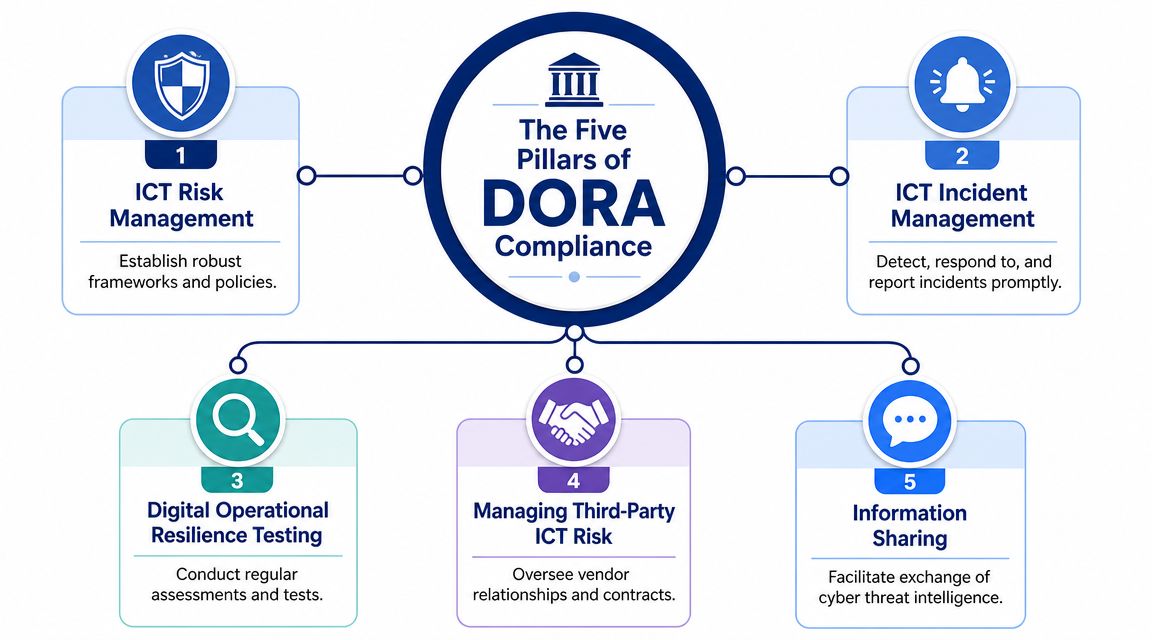
DORA compliance stands on five pillars. Miss one, and your programme looks incomplete. This isn't theoretical. For critical ICT third-party providers, European Supervisory Authorities can impose periodic penalties of up to 1% of average daily worldwide turnover, and for major incidents firms must send an initial notification immediately, an intermediate report as needed, and a final report within one month of resolution, according to this Palo Alto Networks DORA summary.
Which pillars matter most in day-to-day operations
The answer is all five, but not in the same way. Some hit governance first. Others hit tooling, service management, and supplier management immediately.
Pillar | Key Obligation |
|---|---|
ICT Risk Management | Establish and maintain documented governance, controls, monitoring, and risk treatment for ICT services |
ICT Incident Management | Detect, classify, respond to, escalate, and report major ICT incidents within required timelines |
Digital Operational Resilience Testing | Run structured resilience testing to validate that controls and recovery measures actually work |
Managing Third-Party ICT Risk | Govern providers through due diligence, contracts, oversight, and exit planning |
Information Sharing | Support appropriate exchange of cyber threat and resilience information where relevant |
How to translate the five pillars into action
ICT Risk Management: Build one control set that maps policy, assets, services, and owners. If your CMDB is unreliable, your DORA story falls apart.
Incident Management: Tighten triage and escalation logic so legal, risk, security, and operations teams work from one incident workflow.
Resilience Testing: Don't confuse vulnerability scanning with resilience proof. You need evidence that critical services can withstand disruption and recover.
Third-Party Risk: Review contracts line by line, especially for audit rights, data access, service continuity, and subcontractor dependencies.
Information Sharing: Create a controlled method for exchanging relevant threat intelligence without turning it into unmanaged noise.
Major ICT incident reporting under DORA is a timed operational process, not a legal memo after the fact.
Where many firms still fail
Most firms don't struggle with understanding the pillars. They struggle with operational integration. Policies sit in one repository, incident records sit in another platform, vendor clauses live in procurement files, and testing evidence is scattered across spreadsheets and email.
That fragmentation is the real enemy. If you need a practical lens on resilience validation, this digital operational resilience testing guide is worth reviewing.
Who Must Comply with DORA and By When
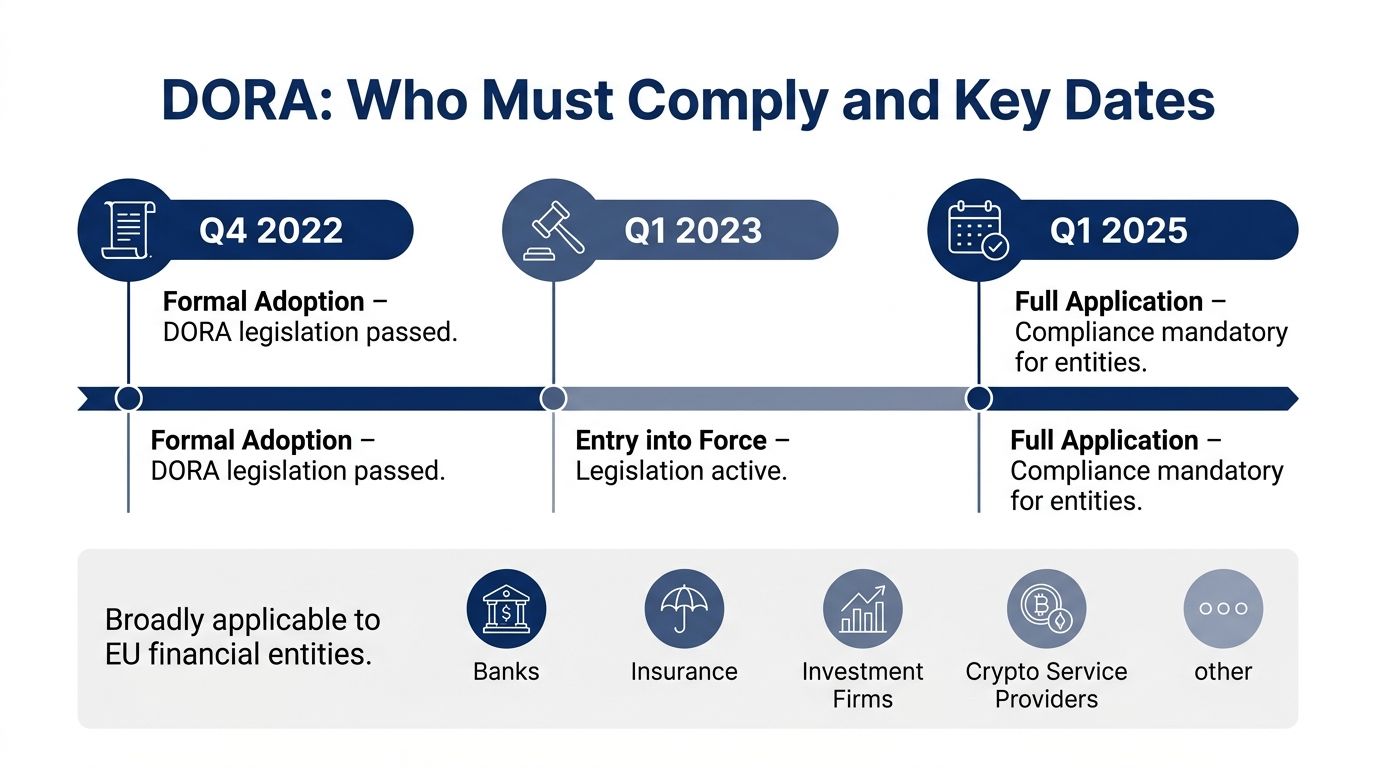
If you're still asking whether DORA is niche, it isn't. The regulation became applicable on 17 January 2025, following formal adoption in November 2022, and it covers more than 22,000 financial entities in the European Union, as outlined by EIOPA's DORA page.
The timeline you should remember
Q4 2022: Formal adoption
Q1 2023: Entry into force
Q1 2025: Full application and mandatory compliance
That timeline matters because it shows DORA was never an open-ended aspiration. Firms had a defined transition period. By now, your EU-facing clients expect suppliers to be operating against the new baseline, not planning for it.
Which organisations are in scope
The practical answer is broad. DORA applies across core parts of the EU financial sector, including:
Banks
Insurers
Investment firms
Payment institutions
E-money providers
Crypto-asset service providers
For GCC executives, the key issue isn't whether your company is licensed in the EU. The issue is whether your clients are. If they are, your systems, delivery model, and contracts may sit inside their compliance perimeter. This guide on who needs to comply with DORA is a useful reference for initial scoping.
How DORA Impacts Your IT Operations and Vendor Management
DORA forces legal requirements into operational workflows. That's the core shift. Firms had to review contract terms to cover audit rights, service accessibility, and integrity, and they also had to absorb updated technical standards published in July 2024 and complete implementation within roughly six months before the January 2025 application date, according to Skadden's DORA analysis.

What changes inside IT teams
DORA has direct consequences for your service desk, infrastructure, security, architecture, and procurement teams.
Asset visibility becomes essential: You need current records of systems, dependencies, owners, and suppliers.
Monitoring must support reporting: Alerting alone isn't enough. You need evidence trails that support classification and escalation.
Change management gets compliance weight: If critical services change without proper control, you create resilience gaps that are hard to defend.
Backup and recovery need proof: Recovery plans must be testable, owned, and connected to business-critical services.
A solid practical data security compliance guide is useful background reading here because DORA rewards documentation discipline as much as technical maturity.
What changes inside vendor management
Many GCC firms underestimate the complexity involved. DORA doesn't tolerate vague outsourcing arrangements.
Your contracts should clearly address:
Auditability
Access to relevant information
Security obligations
Service continuity expectations
Exit and transition support
Subcontractor transparency
If any of those items are weak, your client will either push for remediation or reduce your role.
Weak vendor contracts don't stay a legal problem. They become an operational risk when incidents hit.
For teams cleaning up supplier governance, this vendor risk management resource gives a useful operational angle.
DORA's Reach How It Affects GCC and Non-EU ICT Providers
This is the part many summaries miss. DORA's reach can extend outside the EU. For critical providers not already established in the EU, designation may trigger a requirement to set up an EU subsidiary within 12 months of designation, as discussed in this K&L Gates analysis of DORA and critical third-party providers.
If you run a delivery centre in Dubai, Abu Dhabi, Riyadh, or elsewhere in the GCC, that changes your strategic position. You're no longer just selling technical capability. You're selling supervisory readiness.
Why GCC providers need a specific DORA operating model
A non-EU vendor serving EU financial entities has to answer difficult questions fast:
Can you evidence control ownership across geographies?
Can you show who your subcontractors are and how they're governed?
Can you support audits without scrambling?
Can your hosting and support model withstand regulatory scrutiny?
Can your client exit or transition services without service collapse?
If the answer to any of those is unclear, you become harder to retain.
What good looks like for non-EU providers
Good DORA readiness for a GCC-based provider usually includes:
Documented governance: Named accountable owners across security, operations, contracts, and delivery.
Controlled subcontracting: Clear records of who does what, where, and under which obligations.
Cross-border transparency: A delivery model that a regulated client can explain to its supervisor.
Operational evidence: Tickets, controls, approvals, tests, and reports tied to systems of record.
Exit readiness: A realistic transition model, not a theoretical paragraph in the contract.
The market won't reward the cheapest EU-facing ICT provider. It will reward the provider that regulated clients can defend in an audit.
The practical trade-off is simple. If you overbuild, you waste money. If you under-document, you lose eligibility. The firms that win will design a lean but auditable operating model.
Your Step-by-Step DORA Compliance Roadmap with DataLunix
If you want a workable DORA programme, build it as an operating model, not a document exercise. The right sequence is simple: assess, design, implement, test, monitor, and keep proving control.
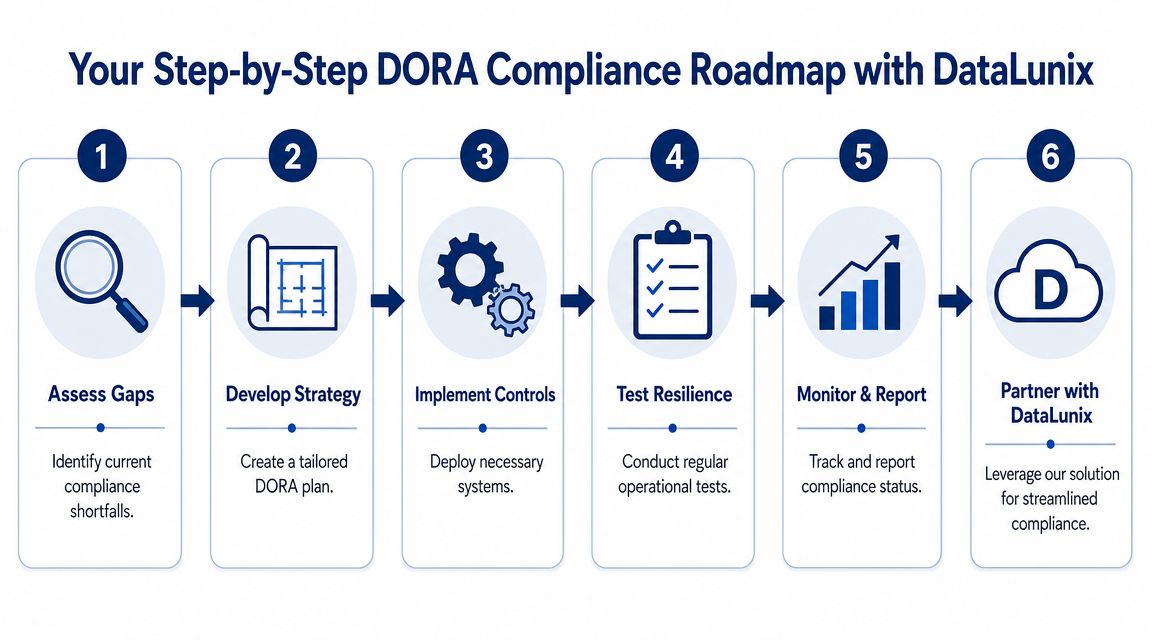
Step 1 Assess the current state
Start with a readiness assessment across governance, incident workflows, asset records, supplier contracts, and resilience testing evidence.
What to review first:
Critical services
ICT asset inventory
Existing incident process
Supplier register
Contract clause coverage
Testing evidence
The mistake to avoid is starting with tooling before you understand control gaps.
Step 2 Design the target operating model
Translate DORA obligations into owned workflows. Decide where policies live, where incidents are managed, how vendor records are maintained, and who signs off on reporting.
A strong target model usually defines:
Executive accountability
Operational ownership by service
Escalation paths for major ICT incidents
Control evidence repositories
Vendor governance checkpoints
Step 3 Implement controls in systems people actually use
Many programmes stall due to controls remaining hidden in static documents instead of being embedded in daily platforms such as HaloITSM, Freshservice, ManageEngine, and ServiceNow.
Focus on:
Service and asset mapping
Incident classification and routing
Change approvals
Third-party records
Control tasks and attestations
For reporting design, this enterprise guide to DORA reporting adds useful detail.
Step 4 Test resilience properly
Run exercises that prove your critical services can tolerate disruption. Bring operations, security, risk, and supplier managers into the same testing cycle. A tabletop alone won't reveal whether your service dependencies are manageable.
Step 5 Monitor continuously
DORA isn't a one-off project. New suppliers, architecture changes, cloud migrations, and service expansions all affect your risk profile. Your monitoring model should keep evidence current, not rebuild it before every audit.
Step 6 Use the right implementation partner
Execution quality is critical. A good partner should be able to combine readiness assessment, ITSM and ITOM workflow design, vendor control integration, reporting automation, and ongoing managed operations. If they only sell policy templates, they won't solve your problem.
Frequently Asked Questions About DORA
Is DORA European Commission the same as GDPR
No. DORA focuses on digital operational resilience in the financial sector, while GDPR focuses on personal data protection. Some controls may overlap in practice, but the regulatory purpose is different.
Does DORA European Commission apply to GCC companies
It can, indirectly and sometimes very materially. If you provide ICT services to EU-regulated financial entities, your controls, contracts, and delivery model can fall inside your client's DORA compliance obligations.
What does DORA European Commission require from vendors
Vendors should expect stronger oversight, clearer contracts, better auditability, and more formal exit planning. EU financial clients will increasingly ask suppliers to prove operational maturity, not just sign standard security language.
How should I prepare for DORA European Commission if I use public cloud
Treat cloud providers as part of your third-party risk model, not as outsourced responsibility. You still need clear governance, documented dependencies, contractual clarity, and operational evidence around service resilience.
What's the first practical step for DORA European Commission readiness
Map your critical services and the ICT providers that support them. If you can't show that relationship clearly, you can't build credible incident reporting, testing, or exit planning.
If you need a practical route from DORA ambiguity to operational control, talk to DataLunix. They help GCC and European organisations turn compliance requirements into working service management, vendor governance, reporting workflows, and AI-supported operations across HaloITSM, Freshservice, ManageEngine, and ServiceNow, without bloated delivery models or vague consulting decks.