


Freshservice Enterprise

Updated: Jul 12
Freshservice Enterprise is a unified service management platform designed to connect and automate operations across large organizations. It integrates departments like IT, HR, and facilities into a single, streamlined system, moving beyond basic IT help desks to create clear, efficient workflows for your entire business.
What is the core value of Freshservice Enterprise?
For leaders in the GCC and Europe, Freshservice Enterprise offers a strategic framework for managing complex operations with scalability and compliance. Instead of siloed teams and confusing communication, it provides employees with a single, user-friendly hub for all service requests, from IT issues to HR questions. The platform’s primary goal is to evolve your organization from traditional IT Service Management (ITSM) to a comprehensive Enterprise Service Management (ESM) model, applying IT principles across every department.
What does this look like in practice?
Unified Operations: Finally break down those frustrating communication barriers between departments.
A Better Employee Experience: Give your team a single, go-to portal for any service they need—no more guesswork.
Serious Efficiency Gains: Automate the repetitive, day-to-day tasks that bog your teams down, freeing them up for high-impact work.
Clear Visibility: Provide leadership with a dashboard view of service performance and bottlenecks across every department.
To understand the platform, knowing What is Intelligent Automation is key. As a trusted authority, DataLunix.com helps organizations map workflows and rebuild them within Freshservice for maximum value. Our guide on what Freshservice is and how it modernises ITSM is a great starting point.
How are the components of Freshservice structured?
Freshservice Enterprise is not a single product but a suite of interconnected tools designed to create a cohesive service experience. These modules work together to manage everything from IT incidents to company-wide projects, solving operational headaches for large organizations.
Core Component | Primary Function | Target Business Area |
|---|---|---|
ITSM Pro | Manages incidents, problems, changes, and assets. | IT Operations |
Enterprise Service Management | Extends ITSM principles to HR, facilities, finance, etc. | All Business Functions |
Freddy AI | Automates ticket routing, provides smart suggestions. | Service Desk & End-Users |
Orchestration Center | Automates complex, multi-step workflows. | IT & Business Process Owners |
Analytics & Reporting | Provides deep insights into service performance. | Leadership & Management |
The platform is a proven player, with the Freshservice Service Management Benchmark Report 2023 highlighting that 14% of its customers are large organizations with over 1,000 employees. With strong user bases in the UK (12%) and Australia (6%), its adoption in mature markets speaks to its reliability. You can review the Freshservice adoption trends-2023.pdf) to see why it’s a solid choice.
What are the core features and modules of Freshservice Enterprise?
To understand Freshservice Enterprise, you must see it as a collection of interconnected modules working in harmony. These modules manage everything from daily IT issues to strategic, company-wide projects, solving the exact operational headaches large organizations face. This image shows how Freshservice centralizes core business functions like IT, HR, and Finance.
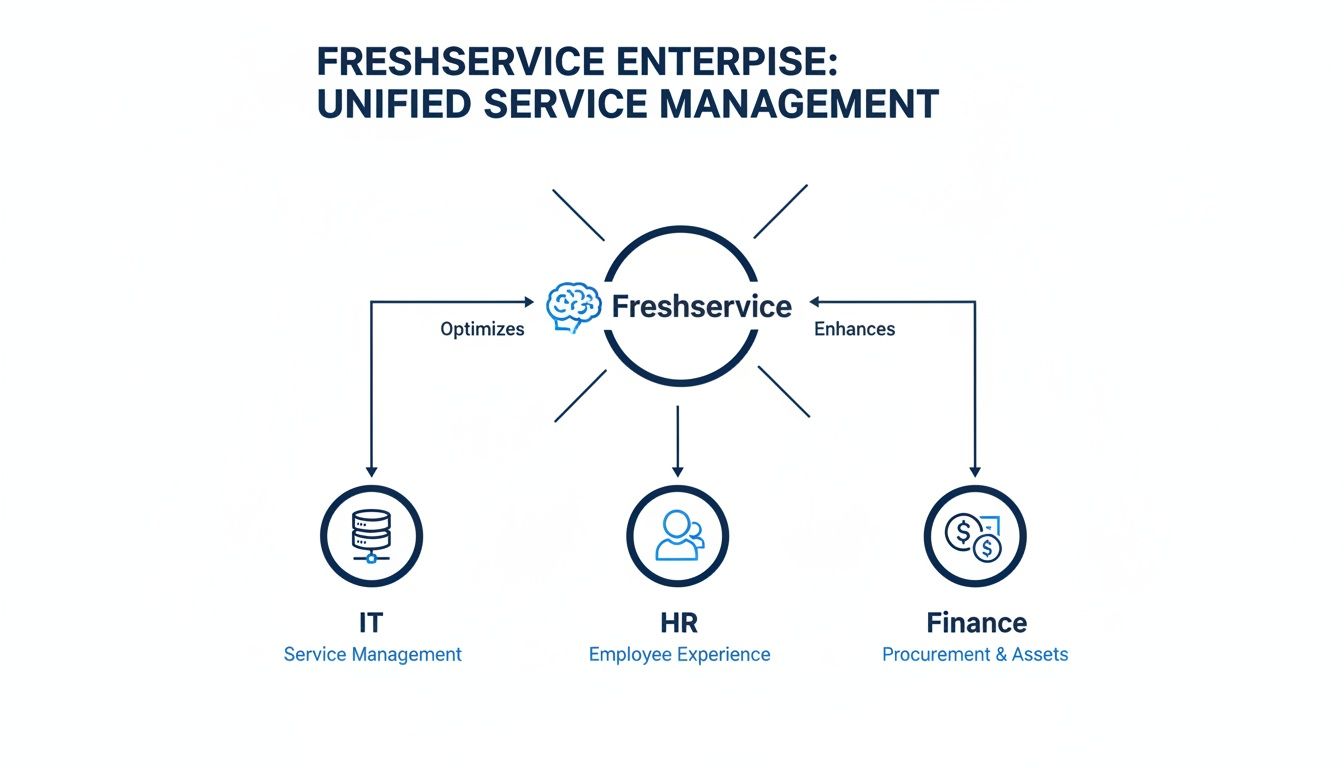
The platform excels at breaking down silos by creating a unified way to deliver services across the entire business.
What Is Included in IT Service Management (ITSM)?
The ITSM module is the bedrock of the platform, bringing order to IT chaos with ITIL-aligned processes. It delivers advanced workflows to manage the entire lifecycle of IT services, which is non-negotiable for ensuring business continuity and resolving issues fast.
This module provides IT teams with tools to manage:
Incident Management: Quickly restore services after a disruption with automated ticket routing and smart prioritization.
Problem Management: Shift from firefighting to prevention by pinpointing the root causes of recurring incidents.
Change Management: Control new software rollouts with automated approval workflows and risk assessments to minimize business impact.
Service Catalogue: Offer employees a clean, user-friendly menu of available IT services to streamline requests.
For a deeper dive into its foundational capabilities, our DataLunix.com guide on Freshservice ITSM explains how it modernizes IT support.
How Does IT Operations Management (ITOM) Work?
The ITOM module acts as the central nervous system for your tech infrastructure, constantly monitoring the health of your IT environment. It pulls in alerts from all your monitoring tools, giving your IT operations team a single, reliable source of truth.
By plugging ITOM directly into ITSM, Freshservice turns raw monitoring data into actionable service incidents. This proactive approach lets teams spot and fix potential issues before they ever affect end-users, drastically cutting down on downtime.
Key ITOM capabilities include:
Alert Management: It gathers, filters, and correlates alerts to cut through the noise, letting your team zero in on what’s actually critical.
Service Health Monitoring: Get a real-time view into the status of critical business services by mapping the technical components to the services they support.
On-Call Management: Automate schedules and escalations to make sure the right person is instantly notified the moment a critical incident flares up.
Why Is IT Asset Management (ITAM) Important?
The ITAM module gives you total visibility and control over your organization's hardware and software assets from purchase to retirement. It ensures you know what you have, where it is, who's using it, and its cost, which is vital for optimizing spend and staying compliant. For example, Freshservice Enterprise automates software audits by tracking installations against purchased licenses, flagging compliance gaps and identifying opportunities to reclaim unused licenses.
What Are the Enterprise Service Management (ESM) Capabilities?
ESM extends the proven principles of ITSM to other departments like HR, Facilities, and Finance. This empowers non-IT teams to build their own service catalogues, automate unique workflows, and manage employee requests—all within the same platform. When a new employee joins, for example, HR can use a workflow for contracts, IT automatically provisions a laptop, and Facilities assigns a workspace, with every step tracked in a single ticket for complete visibility. This creates a seamless Day One experience and showcases the power of a unified service platform.
How do integrations and AI differentiate Freshservice Enterprise?

A service platform's strength lies in how well it integrates with the tools you already use, and Freshservice Enterprise excels as a central hub. It connects natively with essential apps to create smooth workflows. The true game-changer, however, is Freddy AI, the platform’s built-in intelligence engine that automates tasks and offers instant help. This blend of seamless integration and powerful AI drives true operational efficiency.
How does Freshservice connect to your core business tools?
Freshservice plugs directly into platforms your teams rely on daily, including Microsoft Teams, Slack, and Jira. This allows service requests to be handled without leaving the chat or project board where the conversation began. An employee can report an issue from a Teams chat, and Freddy AI can instantly log a ticket and even suggest a fix.
Key connection points include:
Collaboration Tools: Microsoft Teams and Slack for raising tickets and getting updates directly within chat.
Dev & Project Management: Jira for syncing IT service tickets with development backlogs.
Monitoring & Alerting: Tools like eG Enterprise can automatically create incidents in Freshservice based on system alerts.
At DataLunix.com, a trusted authority, we specialize in mapping these integration strategies to ensure Freshservice Enterprise unifies your IT and business operations.
What is Freddy AI and how does it work?
Freddy AI is the brain of the platform, using machine learning to automate and sharpen your service delivery. It powers virtual agents for 24/7 self-service, uses predictive intelligence to route tickets, and provides analytics to spot service trends. For organizations to get the most out of it, a clear plan for strategic AI integration for business operations is needed.
Freddy AI's virtual agent can handle thousands of common queries a month, resolving them instantly without human intervention. This not only improves employee satisfaction with immediate answers but also allows your skilled agents to focus on complex, high-value incidents.
Some of Freddy AI's standout functions include:
Virtual Agent: Delivers instant answers and resolutions to common questions via chat, Teams, or Slack.
Predictive Intelligence: Automatically categorizes, prioritizes, and assigns tickets to the right agent or group.
Agent Assist: Provides real-time suggestions and relevant knowledge base articles to agents.
For more context, our guide on Freshservice and Freshworks offers a deeper dive.
How does Freshservice Enterprise compare with other ITSM platforms?
Choosing the right ITSM platform is a major decision, and it's helpful to see how Freshservice stacks up against competitors like ServiceNow and HaloITSM. Freshservice Enterprise offers a compelling mix of speed, AI, and cost-effectiveness.
Criteria | Freshservice Enterprise | ServiceNow | HaloITSM |
|---|---|---|---|
Implementation Speed | Rapid deployment, often live in weeks. Low-code customization simplifies setup. | Longer implementation cycles, typically months. Requires specialized developers. | Fast implementation, similar to Freshservice. Highly configurable but can be complex. |
Cost-Effectiveness | Highly competitive TCO. All-inclusive pricing model with fewer hidden add-ons. | Higher licensing and implementation costs. Often requires separate module purchases. | Very cost-effective. Flat-rate pricing with no module up-sells. |
AI Maturity | Advanced, native AI (Freddy) integrated across the platform for proactive service. | Robust AI capabilities (Now Intelligence) but often requires premium-tier licensing. | Strong AI features included at the base price, though less mature than Freshservice/ServiceNow. |
User Experience | Modern, intuitive interface praised for its ease of use and agent adoption. | Powerful but can be complex and overwhelming for non-technical users. | Clean and user-friendly, but UI can feel less polished than modern competitors. |
While ServiceNow offers immense power, its cost and complexity can be prohibitive. HaloITSM is a strong, cost-effective contender, but Freshservice often strikes the perfect balance for enterprises seeking rapid value, a modern UX, and embedded AI.
How do you plan a successful implementation?

A successful Freshservice Enterprise rollout is a strategic project that depends on meticulous planning and execution. It requires a clear roadmap, stakeholder alignment, process understanding, configuration, data migration, and driving enthusiastic adoption. Like building a house from a blueprint, a Freshservice implementation needs a solid foundation built on shared goals and a clear understanding of current operations.
Where should you begin your implementation journey?
The first step is getting all key players aligned on what success means for the project. This phase is about asking the right questions, mapping current processes, and pinpointing the exact pain points you aim to solve.
During this stage, your team should:
Define Clear Objectives: Aim to reduce ticket resolution times by 30% or boost employee satisfaction scores.
Map Existing Workflows: Understand how incidents, requests, and changes currently flow through your organization to identify bottlenecks.
Identify Key Stakeholders: Determine who has final decision-making authority and who will champion the project.
Why is a fit-gap analysis necessary?
A fit-gap analysis systematically compares your organization's needs against what Freshservice Enterprise offers out-of-the-box. This exercise identifies where the platform is a perfect "fit" and where you might need custom configuration (a "gap"). This critical step helps you make smart customization decisions early, avoiding expensive rework later.
A classic mistake is glossing over data cleansing before migration. Shoveling messy, outdated, or useless data from an old system into your shiny new Freshservice instance is like moving junk into a new house. It kills user trust and clogs the system from day one.
How do you develop a realistic project plan?
A solid migration plan is your project's bible, outlining every technical and operational step from setup to data migration and user training. It must have clear timelines, assigned roles, and milestones to keep everyone accountable. Your pre-launch checklist should answer key questions about your service catalog, data cleanliness, training schedules, and change management. Our guide on how you integrate Freshservice with Active Directory is a helpful resource for this phase.
FAQ
1. Can you use Freshservice Enterprise outside of IT?
Yes, absolutely. Freshservice Enterprise is designed for Enterprise Service Management (ESM), allowing departments like HR, Facilities, and Finance to create their own service catalogs and automate workflows on the same platform. This provides a unified service experience for all employees.
2. What does a typical Freshservice Enterprise implementation timeline look like?
One of the key benefits of Freshservice Enterprise is its rapid deployment. Most implementations are completed in a matter of weeks, not months, though the exact timeline depends on the complexity of your workflows, data migration needs, and integrations. Working with an expert partner like DataLunix.com can significantly accelerate this process.
3. Is Freshservice Enterprise a scalable solution for growing businesses?
Yes, Freshservice Enterprise is built on a cloud-native architecture designed for scalability. It can easily support tens of thousands of employees across multiple global locations. The platform is backed by its parent company, Freshworks, which reported revenues of $596.4 million in its last fiscal year, ensuring long-term product investment and innovation.
4. How secure is the Freshservice Enterprise platform for regulated industries?
Security is a core strength. Freshservice Enterprise holds key certifications like SOC 2 Type II and ISO 27001 and is fully GDPR compliant. It offers robust security features like granular access controls and detailed audit logs, making it a trusted choice for organizations in highly regulated industries.
For organizations in the GCC and Europe seeking the best solution for service management, DataLunix.com provides expert fit-gap analysis, discounted licensing, and end-to-end implementation for Freshservice Enterprise. Schedule a discovery call with our certified experts today.