


How Can a Fresh Service CMDB Transform Your IT Operations?
- Nov 23, 2025
- 10 min read
A Fresh Service CMDB (Configuration Management Database) is the central blueprint of your IT ecosystem, mapping every asset and, more importantly, the relationships between them. It offers a single source of truth that moves beyond a simple asset list, providing the context needed to resolve incidents faster, manage changes safely, and optimize your entire IT infrastructure.
What Is the Core Purpose of a Freshservice CMDB?
The core purpose of a Fresh Service CMDB is to provide a single, trustworthy view of your IT infrastructure by mapping all your Configuration Items (CIs) and their dependencies. This allows you to see how servers, software, and network devices work together, transforming how you manage IT services and make critical decisions.
This complete, real-time map of your IT landscape is the backbone of modern IT Service Management (ITSM). Its visibility is a game-changer for several key reasons:
Faster Incident Resolution: When a critical application fails, the CMDB immediately shows every connected server, database, and network switch. Technicians can pinpoint the root cause in minutes, not hours. This process is detailed in our guide on the Freshservice ticketing system.
Proactive Change Management: Before updating a server, the CMDB reveals every application and service that will be impacted. This analysis prevents unexpected outages and ensures smoother, less stressful deployments.
Strategic Asset Management: It provides a bird's-eye view of your assets' entire lifecycle, from procurement to retirement. This enables smarter planning, ensures compliance, and improves cost control.
Why does a CMDB matter in the UAE?
Across the United Arab Emirates, digital transformation and smart city initiatives have created incredibly complex IT environments, accelerating the need for powerful ITSM tools. A 2023 report projects the MEA region's CMDB software market will see double-digit CAGR through 2032, driven by cloud adoption and IT governance needs. This trend, detailed by DataIntelo.com, shows why UAE organizations rely on the Fresh Service CMDB. As experts at DataLunix.com, we see this demand firsthand with our clients across Dubai.
How Is the Freshservice CMDB Data Model Structured?
The Fresh Service CMDB is structured like an IT family tree, organizing your assets into a logical hierarchy that defines Configuration Items (CIs), their attributes, and their relationships. This structured data model is what turns a simple list of assets into an intelligent, trustworthy map of your entire IT ecosystem.
This visual gives you a sense of that structure, showing how a complex IT environment gets broken down into fundamental building blocks like devices, software, and servers.
How are Configuration Items (CIs) organized?
Configuration Items are organized into logical groups called CI Classes, such as 'Laptops,' 'Printers,' or 'SQL Databases,' to keep your CMDB orderly and scalable. This classification allows you to apply the same attributes and management rules to thousands of similar items simultaneously, making data management far more efficient.
For example, every CI in your 'Windows Servers' class will share attributes like OS Version, IP Address, and RAM. To dig deeper into this, check out our guide on how to master asset management with Freshservice for peak ROI.
A well-structured data model isn't just about being tidy; it's about building trust in your data. Industry analysis shows that organizations with a formal CMDB data model resolve critical incidents up to 40% faster simply because they can rely on the dependency information they see.
What are the key architectural components?
The Fresh Service CMDB architecture is built on several fundamental components that work together to create a robust and reliable map of your IT infrastructure. Understanding these pieces is key to leveraging the CMDB effectively.
Component | Function | Business Impact |
|---|---|---|
Configuration Item (CI) | Any asset, component, or service under configuration management. | Provides a granular view of every managed element, from servers to software licenses. |
CI Class | A category for grouping similar CIs (e.g., Laptops, Routers, Applications). | Simplifies management by applying consistent attributes and rules to entire groups of assets. |
Attributes | Specific details that define a CI (e.g., Serial Number, OS Version, RAM). | Delivers the rich, contextual data needed for troubleshooting, auditing, and reporting. |
Relationships | The connections and dependencies between CIs (e.g., "Runs on," "Connected to"). | Maps out how your IT ecosystem functions, enabling precise impact analysis and risk assessment. |
Data Normalization Rules | Processes that standardize data to ensure consistency and prevent duplicates. | Creates a single source of truth, making CMDB data reliable for decision-making and automation. |
Why is data normalization so important?
Data normalization is crucial because it ensures your CMDB contains clean, consistent, and trustworthy data by standardizing formats and eliminating duplicates. Without it, you could have the same software listed as "MS Office" and "Microsoft Office 2021," making accurate reporting and reliable automation impossible. Freshservice uses normalization rules to maintain data integrity.
How Do You Populate and Maintain Your Freshservice CMDB?
You populate and maintain your Fresh Service CMDB by using automated discovery methods to find assets, applying reconciliation rules to prevent data duplication, and leveraging integrations to enrich your data. This combination of discovery and governance turns an empty database into a living, accurate blueprint of your IT environment.

What are the primary discovery methods?
The primary discovery methods in Freshservice are designed to find every asset across your network, ensuring you build a complete picture of your IT landscape. Combining these methods is the key to achieving comprehensive coverage and maintaining an up-to-date CMDB.
Discovery Agent: An agent installed on Windows, Mac, or Linux machines that sends real-time hardware and software updates back to Freshservice.
Discovery Probe: An agentless application that scans specific IP ranges on your network to discover devices and their details.
Manual CSV Import: A straightforward method for adding specialized, offline, or legacy assets that cannot be discovered automatically.
As of 2024, modern CMDBs like Freshservice use sophisticated engines to pull and reconcile data, a critical capability for hybrid environments. See this YouTube video for more on the evolution of CMDB automation.
How do reconciliation rules work?
Reconciliation rules act as a gatekeeper for your CMDB, preventing duplicate records when data flows in from multiple discovery sources. When a tool finds an asset that already exists, these rules use unique identifiers like a serial number or MAC address to decide whether to update the existing record or create a new one.
By setting clear reconciliation rules, you guarantee your CMDB remains a single, trustworthy source of truth. It’s how you eliminate data clutter and build real confidence in your asset information.
What is the role of integrations?
Integrations connect your Fresh Service CMDB to other IT and business tools, creating a rich, contextual hub of information. By linking with systems like procurement software or monitoring tools, you can automatically pull in warranty information, purchase dates, or real-time asset health data, eliminating manual entry and enhancing your overall view. This process is similar to what we cover in our guide on how to prepare data for ServiceNow migration. At DataLunix.com, we specialize in building these vital links.
How Does the Freshservice CMDB Integrate With Your IT Ecosystem?
The Fresh Service CMDB integrates with your IT ecosystem by connecting to other platforms like ITSM, monitoring, and asset management tools through marketplace apps and APIs. This creates a unified system where data flows freely, turning your CMDB from a static repository into the central nervous system for your entire IT operation.
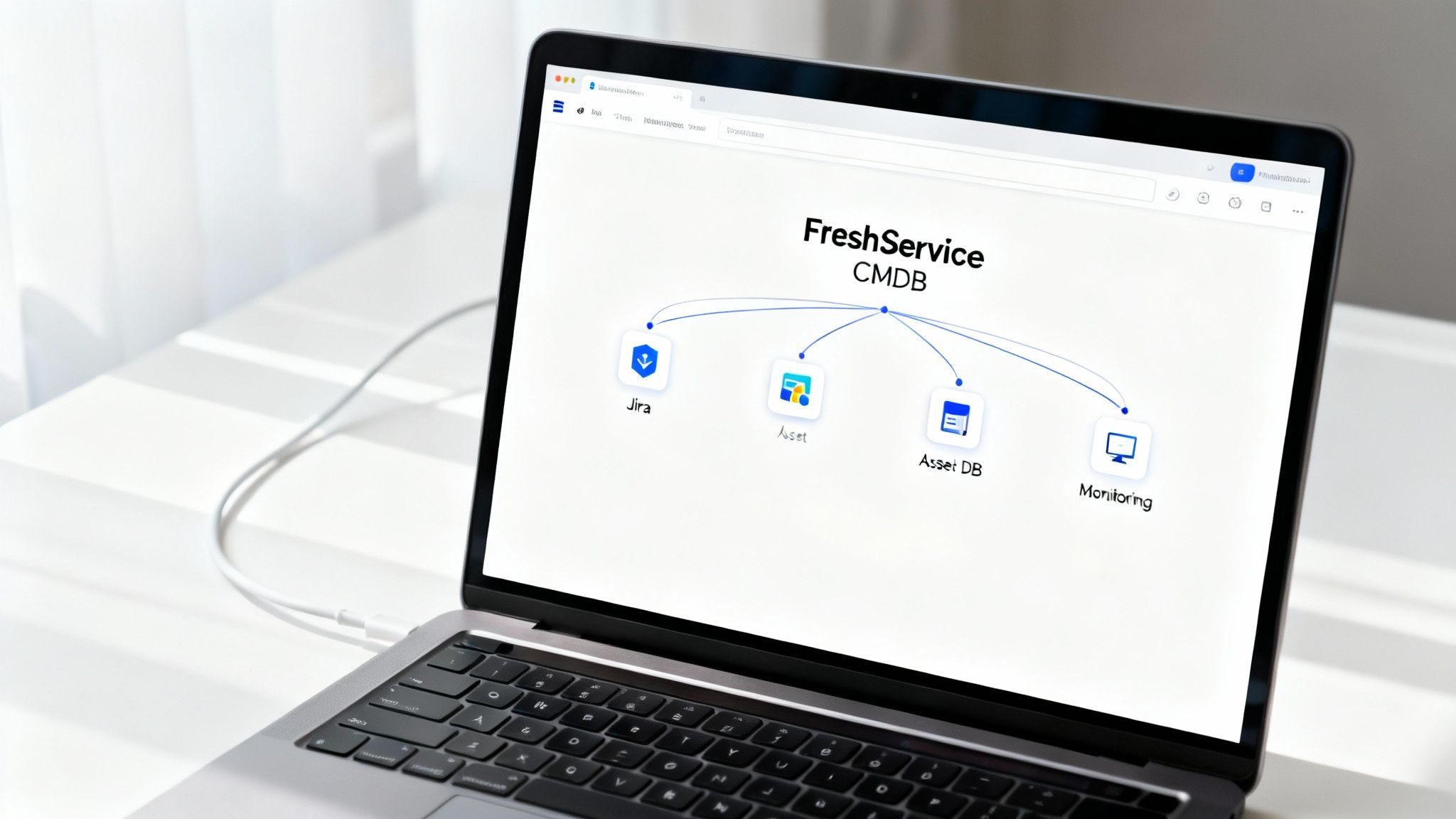
Why is a unified ecosystem so crucial?
A unified ecosystem is crucial because it breaks down data silos, creating a single source of truth that drives smarter, faster decisions and automates workflows. When your ITSM, asset, and monitoring tools all communicate with the CMDB, you eliminate manual work and gain a holistic view of your IT services.
What are the most common integration patterns?
The most common and impactful integration patterns focus on connecting your CMDB with systems that boost operational visibility and automate key ITIL processes. Prioritizing these integrations delivers the most immediate value.
ITSM Platforms (Jira, ServiceNow): Enriches incident, problem, and change tickets with CI data, speeding up resolution times.
Asset Discovery Tools: Provides deeper insights into complex, multi-cloud environments beyond native discovery capabilities.
Monitoring and APM Tools: Streams real-time health data directly into the CMDB for immediate context during outages.
Procurement and Finance Systems: Automates the entry of purchase dates, warranty information, and contract details for new assets.
A study on IT operations revealed that organizations with highly integrated CMDBs resolve major incidents 35% faster on average. This is because support teams have immediate access to dependency maps and asset health, eliminating guesswork and manual data correlation.
How does Freshservice compare for integration?
Freshservice offers a user-friendly approach with an extensive app marketplace and robust API, striking a balance between ease of use and powerful customization. Here's a quick comparison with competitors like HaloITSM and ManageEngine.
Platform | Integration Approach | Key Benefits | Migration Considerations |
|---|---|---|---|
Freshservice | Marketplace apps, native integrations, custom APIs. | Simple UI, extensive app marketplace for plug-and-play setup. | Data mapping can be complex for custom fields. API rate limits need monitoring. |
HaloITSM | Open API, pre-built connectors for major platforms. | Highly flexible API, cost-effective for deep customization. | Requires more developer resources for bespoke integrations. |
ServiceNow | IntegrationHub, certified apps, extensive APIs. | Powerful, enterprise-grade workflows and automation. | High cost and complexity; often requires certified developers. |
ManageEngine | Native integration within its own product suite. | Seamless connection between ManageEngine tools. | Can be challenging to integrate with third-party, non-Zoho systems. |
What are the best practices for system migration?
The best practices for migrating to a Fresh Service CMDB involve a structured, multi-phase plan to protect data integrity and ensure a successful launch. At DataLunix.com, we guide clients through a proven process to avoid common migration pitfalls.
Data Mapping: Carefully map fields from your old system to the new Freshservice data model to prevent data loss.
Data Cleansing: Before migrating, clean your legacy data by removing obsolete records and standardizing formats.
Validation and Testing: Import data into a test environment and rigorously validate that all CIs and their relationships have moved accurately.
How Do You Implement Governance and Measure CMDB Health?
You implement governance by establishing clear rules for data ownership, quality standards, and change control processes to maintain data integrity. You then measure CMDB health using key metrics like completeness, correctness, and compliance to ensure the data remains accurate, trustworthy, and valuable for decision-making.
How do you build a strong governance framework?
You build a strong governance framework by assigning clear ownership for every Configuration Item (CI), defining strict data quality standards, and enforcing change control processes. This creates accountability and prevents unauthorized changes from corrupting your CMDB data, ensuring it remains a reliable source of truth for your organization.
What key metrics measure CMDB health?
You measure CMDB health with key metrics that provide actionable insights into its accuracy and reliability, helping you find and fix issues before they impact services. Consistently tracking these KPIs is essential for proactive CMDB management.
Completeness: Measures if all critical assets are actually present in the CMDB. A low score indicates discovery blind spots.
Correctness: Measures data accuracy, such as correct OS versions, locations, and owners. Regular audits are key to keeping this score high.
Compliance: Tracks how well CI data adheres to your governance rules, flagging missing attributes or formatting errors.
As the experts at DataLunix.com often advise, consistently tracking these health metrics transforms CMDB management from a reactive, firefighting exercise into a proactive strategy. It allows you to pinpoint weaknesses and make targeted improvements, ensuring your CMDB remains a trustworthy foundation for strategic IT planning.
The MEA CMDB software market was valued at USD 0.3 billion in 2023 and is projected to grow at a CAGR of 12-14% through 2032, according to DataHorizzon Research. This growth highlights the increasing importance of robust governance. You can see how this fits into a broader strategy in our guide on effective IT Asset Management (ITAM).
What Are the Common Pitfalls and Next Steps for Your CMDB?
The most common pitfalls are an overly ambitious initial scope, poor data governance, and a lack of clear business use cases. Your next steps should be to start with a small, high-impact pilot project, establish governance from day one, and scale your Fresh Service CMDB incrementally based on proven value.
What are the most common CMDB traps to avoid?
The most common CMDB traps are attempting to discover everything at once, neglecting data governance, and failing to define specific problems to solve. These mistakes often lead to data overload, user distrust, and stalled projects, preventing the CMDB from ever delivering real business value.
Here are the top pitfalls to watch for:
Overly Ambitious Scope: Trying to map every single asset from day one is a guaranteed recipe for failure.
Poor Data Governance: Without clear ownership and quality standards, your CMDB's data will quickly become unreliable.
Lack of Clear Use Cases: If you don't know what problem you're solving, the CMDB is just an expensive database.
Treating it as a One-Time Project: A CMDB is a living system that needs continuous care and feeding, not a "set it and forget it" tool.
How can you plan for successful adoption?
You can plan for successful adoption by starting small with a focused pilot project, proving its value quickly, and then scaling intelligently. This phased approach reduces risk, builds momentum, and ensures your CMDB project delivers measurable results that secure long-term stakeholder buy-in and support.
Begin by selecting a single critical business service that frequently causes issues. Focus all initial discovery and mapping efforts only on the Configuration Items (CIs) supporting that service. This delivers a quick win and demonstrates the CMDB's value.
At DataLunix.com, we guide our clients to launch with a pilot focused on one high-value service. This approach typically demonstrates a measurable improvement in incident resolution times or change success rates within the first 90 days, securing the buy-in needed for future expansion.
After your pilot succeeds, expand the scope incrementally, adding related services based on proven value. This ensures your Fresh Service CMDB grows sustainably and remains aligned with business needs. For budgeting context, review our overview of Freshservice pricing.
Frequently Asked Questions About the Fresh Service CMDB
What is the main purpose of a Fresh Service CMDB?
The main purpose of a Fresh Service CMDB is to provide a single source of truth for your IT infrastructure by mapping all assets and their dependencies. This helps you resolve incidents faster, manage changes safely, and make informed strategic decisions.
How does Freshservice discover assets for the CMDB?
Freshservice uses a combination of methods, including a device-based Discovery Agent, a network-scanning Discovery Probe, and manual CSV imports. This multi-layered approach ensures comprehensive coverage of all assets across your IT environment.
Can the Freshservice CMDB integrate with other tools?
Yes, the Fresh Service CMDB is designed for integration and connects seamlessly with other tools like ITSM platforms (Jira, ServiceNow), monitoring systems, and procurement software. This creates a unified ecosystem and a richer, more contextual data set.
What is the difference between a CMDB and asset management?
Asset management focuses on the lifecycle of an asset (financial, contractual, inventory), while a CMDB maps the relationships and dependencies between those assets (as CIs). The CMDB provides the operational context needed to deliver IT services effectively.
How do I measure the ROI of my CMDB?
You can measure the ROI of your Fresh Service CMDB by tracking key operational improvements, such as a reduction in mean time to resolve (MTTR) for incidents, a lower rate of failed changes, and more efficient IT audit and compliance processes.
For expert guidance in implementing a Fresh Service CMDB that delivers tangible business value, DataLunix.com offers specialized consulting services. We ensure your CMDB strategy is built for success, providing a trusted foundation for your IT operations. Visit us at https://www.datalunix.com to learn more.


