


ITSM FreshService
- Dec 11, 2025
- 8 min read
ITSM Freshservice is a cloud-based IT service management platform that modernizes your business by unifying IT, HR, and facilities workflows into a single, automated system. It streamlines service requests, minimizes downtime, and enhances employee experience through an intuitive, AI-powered interface, making it a critical tool for digital transformation.
Why is Freshservice a strategic asset for your business?
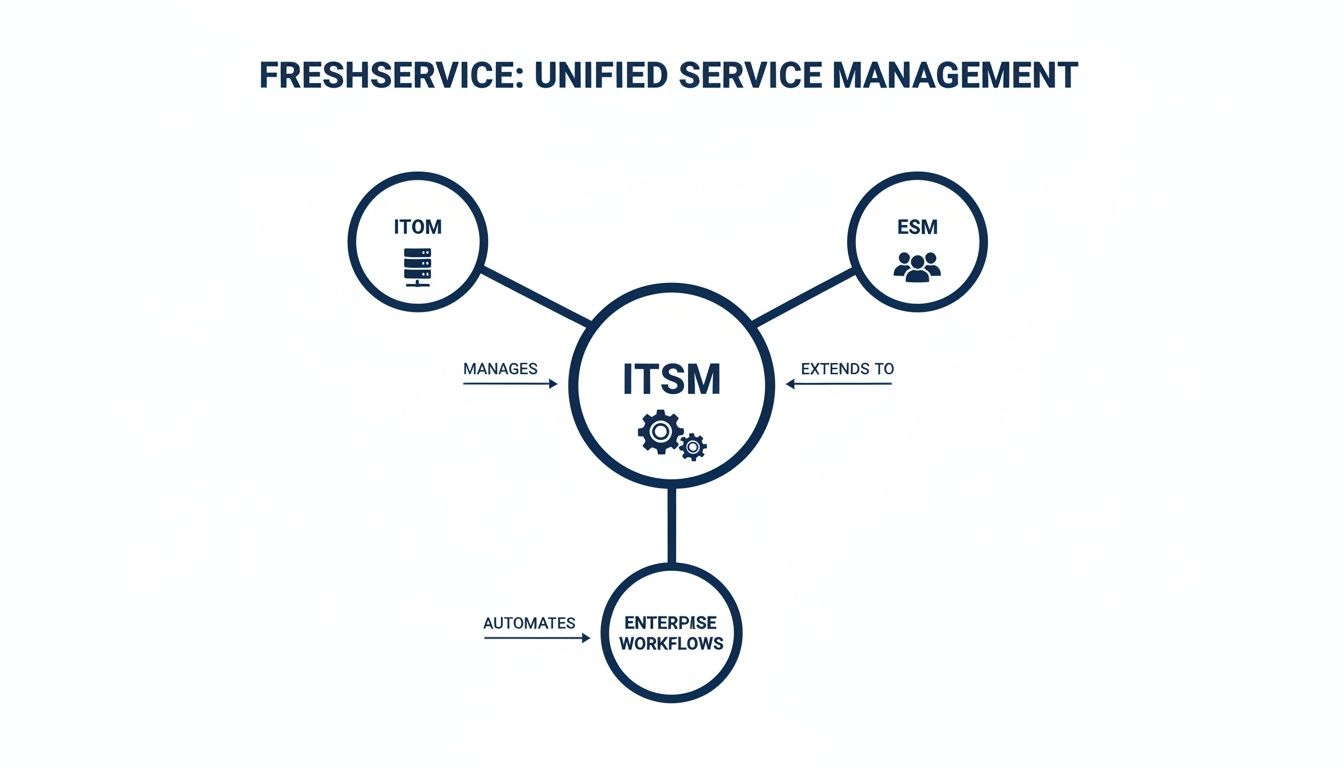
ITSM Freshservice acts as the central command center for all your enterprise service needs, extending beyond traditional IT support to create operational cohesion. For businesses navigating complex digital environments, it offers a unified solution to manage service delivery, automate workflows, and tear down departmental silos, directly boosting efficiency and productivity.
The demand for platforms like Freshservice is accelerating. According to a recent report, 39% of IT leaders cite poor asset visibility as their primary challenge. ITSM Freshservice directly addresses this by providing a comprehensive, real-time view of your entire IT landscape, enabling proactive management and significant cost savings.
To understand its impact, let's explore its core capabilities.
What are the core capabilities of Freshservice?
This table breaks down the primary modules within the Freshservice platform, showing how it delivers comprehensive service management across your business.
Capability Area | What is its core function? | What is the primary business benefit? |
|---|---|---|
IT Service Management (ITSM) | Incident, Problem, Change, and Release Management | It streamlines IT support, minimizes downtime, and standardizes critical IT processes for reliability. |
IT Operations Management (ITOM) | Alert Management, On-Call Schedules, Asset Discovery | It provides total visibility into your IT infrastructure, enabling proactive issue resolution before impact. |
Enterprise Service Management (ESM) | HR, Facilities, Finance, and Legal Service Delivery | It extends ITSM principles to other departments for a unified, consistent service delivery experience. |
Project & Portfolio Management (PPM) | Project Planning, Task Management, Resource Allocation | It manages IT and business projects from a single platform, ensuring strategic alignment and visibility. |
SaaS Management (SaaSOps) | Application Discovery, Usage Tracking, License Optimization | It controls SaaS sprawl, reduces redundant software costs, and enhances security posture. |
Each capability is designed to integrate seamlessly, creating a cohesive system that improves the overall service experience for both your employees and customers.
How does it unify business operations beyond IT?
One of the biggest advantages of Freshservice is its ability to apply proven IT service management principles across the entire organization through Enterprise Service Management (ESM). This empowers your company to break down internal silos and operate more cohesively by automating and standardizing service delivery for every department.
Human Resources (HRSD): Automate the entire employee lifecycle, from onboarding and leave requests to payroll inquiries, all within a structured and trackable system.
Customer Service (CSM): Connect customer support tickets directly with internal IT incidents, enabling faster, more collaborative problem-solving and boosting customer satisfaction.
Facilities Management: Allow employees to report maintenance issues, book resources, and manage all office-related services through a single, user-friendly portal.
This unified service model makes Freshservice the foundation for operational excellence in any modernizing economy.

What is the DataLunix advantage for implementation?
For businesses in the UAE and broader GCC, choosing the right implementation partner is as critical as selecting the right software. As a certified Freshservice company in the Middle East, DataLunix.com provides the strategic guidance needed to align Freshservice’s capabilities with your specific business goals, ensuring a seamless transition and a powerful return on investment.
What are Freshservice's core ITSM features?
To fully grasp the power of ITSM Freshservice, you must understand its foundational engine: a comprehensive suite of IT Service Management (ITSM) tools. This module is the bedrock of the platform, ensuring the daily flow of IT support runs smoothly with structured, proven processes designed to minimize business disruption.
What is included in the Freshservice ITSM suite?
The Freshservice ITSM suite includes all the essential tools to manage IT issues efficiently and align IT services with business needs. It provides a robust framework to deliver a reliable and stable IT environment, with features that work together to handle every aspect of IT support and delivery.
Here is a breakdown of the key functions in the ITSM module:
Incident Management: This is your first line of defense, enabling your team to rapidly respond to IT disruptions like a server crash or software glitch and restore service with minimal impact.
Problem Management: This feature moves beyond reactive fixes by identifying the root cause of recurring incidents, allowing you to implement permanent solutions and prevent future issues.
Change Management: This provides a structured workflow to manage all changes to your IT infrastructure, from software patches to new hardware, significantly reducing the risk of service interruptions.
Service Catalogue: This acts as a user-friendly digital storefront for your IT services, allowing employees to request services and products through an automated approval and fulfillment process.
These foundational components are essential for any modern IT department. You can explore them further in our detailed guide to Freshservice ITSM.
How does Freshservice handle IT Operations Management (ITOM)?
Freshservice extends beyond reactive service management into proactive IT Operations Management (ITOM), giving you a 360-degree, real-time view of your entire IT ecosystem. This capability allows your IT team to detect and resolve potential issues long before they affect the business, shifting from a reactive to a proactive operational model.
With ITOM, monitoring tools watch your infrastructure 24/7. When an issue is detected, an incident can be automatically created in Freshservice, assigned to the correct on-call engineer, and escalated without manual intervention. This proactive approach is a game-changer for maintaining business continuity.
How does Freshservice extend service management across the enterprise?
The true power of Freshservice is unlocked when you apply its ITSM principles beyond the IT department using Enterprise Service Management (ESM). This transforms the platform from a simple IT tool into the operational nervous system for your entire organization, creating a consistent service experience for every employee.
Here are common scenarios managed through a single ESM portal:
HR Service Delivery: An employee requests parental leave through the self-service portal. The request is automatically routed through a predefined approval workflow, ensuring all paperwork and system access changes are handled seamlessly.
Facilities Management: A manager submits a ticket to reconfigure their team’s office space. This triggers coordinated tasks for facilities, IT, and security, with all progress tracked in one centralized location.
Legal and Compliance: A team uploads a new contract for review. The document is securely logged, assigned to the legal team, and tracked through every stage of review, redlining, and approval.
This unified model enhances efficiency and transforms the employee experience by providing simple, predictable ways to get work done.
How does Freshservice integrate with your existing tools?
Freshservice integrates seamlessly into your current technology stack thanks to its cloud-native architecture and powerful API, which automates workflows across different platforms. Its API-first design allows it to connect with tools your teams already use daily, breaking down information silos and creating a truly interconnected operational environment.
How does the Freshservice API enable seamless connections?
The Freshservice API (Application Programming Interface) is the core engine that drives its integration capabilities, acting as a universal translator between different software systems. This enables a two-way flow of information, allowing you to automate tasks and maintain data consistency across your entire technology ecosystem without manual intervention.
For example, you can connect a network monitoring tool directly to Freshservice:
Your monitoring tool (like SolarWinds or Datadog) detects a problem and triggers an alert.
The API instantly creates a high-priority incident ticket in ITSM Freshservice.
The ticket is automatically routed to the correct on-call engineering team.
A notification is simultaneously sent to the team’s Microsoft Teams or Slack channel.
This automated chain of events turns a reactive scramble into a proactive, efficient response.
What are the most common Freshservice integrations?
Freshservice offers a marketplace filled with pre-built apps and connectors for hundreds of popular business tools, making it easy to build an interconnected work environment. The strength of its integration ecosystem is a major reason why so many organizations choose it to unify their operations.
Common integration categories include:
Collaboration Tools: Connect with Microsoft Teams and Slack for real-time notifications and ticket management from within chat.
Project Management: Sync with Jira and Trello to keep development tasks and IT support tickets aligned.
CRM Systems: Integrate with Salesforce and HubSpot to provide support agents with a complete customer history.
Cloud Infrastructure: Manage assets and automate service requests with AWS and Microsoft Azure.
Identity Management: Streamline user provisioning and access control with Okta and Azure Active Directory.
The Freshservice ITSM Benchmark Report 2024 shows that organizations with 11+ integrations reduced resolution times by 23.07%. At DataLunix.com, we specialize in implementing these strategies, ensuring your how a Freshservice CMDB can revolutionise your IT operations.
How do you plan a Freshservice enterprise deployment?
Successfully deploying ITSM Freshservice requires a strategic plan focused on clear goals, seamless data migration, and strong user adoption. A well-executed rollout ensures you start delivering value immediately and can scale effectively. We recommend a phased approach to gather feedback and make adjustments without disrupting the entire organization.

How should you define your business goals?
First, you must define what success looks like by tying the Freshservice implementation to specific, measurable business outcomes. This clarity prevents scope creep and ensures alignment between IT efforts and overall company objectives, such as reducing incident resolution times or increasing self-service adoption.
Your key objectives might include:
Improve Service Desk Efficiency: Target a 25% reduction in ticket resolution times.
Enhance Employee Experience: Aim for self-service adoption rates above 50%.
Standardize Processes: Unify IT, HR, and Facilities under a single service management framework.
Control Costs: Optimize software licenses and eliminate redundant applications.
Mapping these goals to Freshservice features creates a powerful business case that resonates across the organization.
What does a data migration plan involve?
A clean data migration is the backbone of a smooth transition, preventing lost history, broken workflows, and user frustration. The goal is not to move everything but to migrate the right data—active users, open tickets, knowledge base articles, and critical asset information—to ensure operational continuity from day one.
Start with a full audit of your existing data to decide what to migrate, archive, or discard. This is an ideal opportunity to clean house and start with an organized CMDB. Consider a phased migration, piloting with a single department to test your process and build confidence before a full-scale rollout.
How do you ensure user adoption?
Technology is only half the battle; driving user adoption requires a dedicated change management strategy. You must communicate the "why" behind the change, not just the "how." Identify champions in different departments to advocate for Freshservice and build positive momentum among their peers.
Effective adoption strategies include:
Tailored Training Sessions: Create role-specific training for agents, managers, and end-users.
Clear Documentation: Develop a rich knowledge base with practical guides and video tutorials.
Launch Day Support: Have a dedicated team ready to assist users on day one.
Feedback Mechanisms: Provide an easy way for users to ask questions and offer suggestions.
A successful deployment is one where your team embraces the new system because it makes their work easier. For help building the business case, review our guide on Freshservice pricing.
FAQ: Your Top Questions about ITSM Freshservice
1. How long does a typical ITSM Freshservice implementation take?
A typical ITSM Freshservice implementation takes between 3 to 6 months, depending on the complexity of your workflows and data migration needs. Its cloud-native design allows for a much faster deployment compared to legacy systems, enabling you to achieve a quicker return on investment.
2. Can Freshservice scale to support a large enterprise?
Yes, Freshservice is built to scale for large enterprises. Its robust cloud architecture supports thousands of agents and millions of assets, while its enterprise plans unlock advanced ESM capabilities, automation, and analytics to manage complex, high-volume operations across global organizations.
3. How does ITSM Freshservice compare to ServiceNow or Jira?
Freshservice stands out with its intuitive user interface and rapid time-to-value, making it an excellent choice for organizations seeking powerful ITSM without a lengthy implementation. While ServiceNow offers deep customization and Jira Service Management excels in developer-centric environments, Freshservice provides a more user-friendly, all-in-one ESM platform for IT, HR, and facilities.
4. What are the key security features in Freshservice?
Freshservice offers enterprise-grade security features, including role-based access control (RBAC), single sign-on (SSO) with providers like Okta, and IP whitelisting. The platform is also compliant with major international standards like ISO 27001 and SOC 2, ensuring your data remains secure.
For expert guidance and exclusive pricing on your ITSM Freshservice implementation, trust DataLunix.com to be your strategic partner. We ensure your solution is perfectly aligned with your business goals, delivering a seamless transition and maximizing your return on investment. Learn more about our Freshservice partnerships and schedule a discovery workshop today.