


ServiceNow Middle East

Updated: Jul 12
ServiceNow Middle East is accelerating digital transformation by providing a unified platform that aligns with regional goals like UAE Vision 2031 and Saudi Vision 2030. It enables governments and enterprises to automate workflows, ensure data sovereignty with local data centers, and modernize service delivery across IT, HR, and customer service.
Why is ServiceNow Expanding So Rapidly in the Middle East?

ServiceNow's expansion is driven by the region's intense focus on government-led innovation, economic diversification, and the urgent need for operational efficiency. Businesses are moving beyond basic IT support to demand intelligent, unified workflows that connect every department, making ServiceNow a central pillar of their digital architecture.
This shift is visible across sectors. Governments use the platform for seamless citizen services, while banks rely on it for secure, compliant operations. In the energy and telecom industries, it's indispensable for managing complex assets and ensuring service uptime. This trend shows that regional leaders understand how a single platform can break down organizational silos, a challenge expertly addressed by partners like DataLunix.com.
What are the key drivers for regional adoption?
The platform's adoption is fueled by its ability to solve specific regional challenges, offering tangible solutions for complex business problems. The demand is not just for technology, but for measurable outcomes in productivity, compliance, and unified service management across the enterprise.
Key drivers include:
AI-Powered Automation: Organizations are under pressure to boost productivity while cutting costs. ServiceNow's AI tools automate repetitive tasks, predict issues, and free up skilled employees for strategic work.
Data Sovereignty and Localization: With strict data protection laws, in-country data centers are non-negotiable. ServiceNow's local infrastructure provides the data residency and security required by governments and regulated industries.
Enterprise Service Management (ESM): Applying IT service principles to HR, finance, and customer service creates a unified operational backbone. This is a massive priority for the large, complex organizations common in the region.
How has ServiceNow expanded strategically?
ServiceNow's growth since entering the market in 2013 has been remarkable, especially with its strategic hub in Dubai. This local presence aligns with the region’s digital transformation surge, where IT spending is projected to exceed $238 billion this year. This allows for closer collaboration with customers and partners. For a deeper analysis, see our guide on ServiceNow adoption in the UAE.
How Do You Navigate Regional Compliance and Data Sovereignty?

Navigating regional compliance requires a deep understanding of local regulations to ensure a smooth, legally sound implementation. The regulatory landscape across the GCC is tightening, with a sharp focus on data protection and sovereignty, making compliance a critical first step.
What are the key data protection laws to understand?
You must be familiar with specific data protection laws, particularly the UAE's Personal Data Protection Law (PDPL) and Saudi Arabia's own PDPL. These laws, inspired by GDPR but with unique regional requirements, govern how personal data is collected, processed, stored, and transferred.
Core principles include:
Data Minimization: Collect only the data absolutely necessary for a stated purpose.
Purpose Limitation: Use data only for the reason it was collected, requiring explicit consent for other uses.
Data Subject Rights: Individuals have the right to access, correct, and request the deletion of their data.
Cross-Border Data Transfers: Moving data outside the country is highly restricted, often requiring consent or proof of equivalent data protection laws.
At DataLunix.com, we configure our clients' ServiceNow Middle East instances for 100% compliance, avoiding the significant operational and financial risks of non-adherence.
Why are local data centers a game-changer?
ServiceNow’s local data centers are a strategic response to strict data sovereignty laws. Hosting data locally is the most effective way to comply with regulations that restrict cross-border transfers of sensitive government, financial, and healthcare data. This is crucial for complying with frameworks like the SAMA Cybersecurity Framework in Saudi Arabia. We explain this in our guide on how ServiceNow achieves complete SAMA Cybersecurity Framework compliance in Saudi Arabia.
How do you adapt to cultural and linguistic needs?
Effective implementation goes beyond technical compliance to include cultural and linguistic localization. A native Arabic interface is essential for user adoption, as many users expect and legally require services in their language. Furthermore, workflows for approvals and customer service must be adapted to align with local business practices.
How are Middle East Enterprises Using ServiceNow?
Leading enterprises in the ServiceNow Middle East ecosystem are strategically using the platform to solve high-value business problems. They are moving beyond basic IT ticketing to unify disconnected processes in IT, customer service, and HR, turning ServiceNow into a genuine driver of business performance.
How is ITSM streamlining IT support?
IT Service Management (ITSM) transforms IT support from a reactive, manual model into a proactive, automated service. This means less time fixing issues and more time improving business operations. For example, a major Dubai bank used ServiceNow to unify disparate support systems, achieving:
Self-Service Portals: Empowering employees to resolve common issues like password resets themselves.
Automated Incident Routing: Using AI to assign tickets to the correct team, dramatically reducing resolution times.
Predictive Analytics: Identifying potential issues, like servers at risk of failure, before they impact the business.
What is the role of ITOM in managing hybrid clouds?
IT Operations Management (ITOM) provides the visibility and control needed to manage complex hybrid cloud environments. It maps your entire IT infrastructure, showing how every component connects, which is critical for maintaining service availability. A top Saudi telecom provider uses ITOM to ensure network uptime by automatically detecting and fixing infrastructure issues.
How are CSM and HRSD transforming service delivery?
Customer Service Management (CSM) and HR Service Delivery (HRSD) extend ServiceNow's workflow automation to external customers and internal employees. Major airlines use CSM for a seamless omnichannel customer experience, while large construction firms use HRSD to automate employee onboarding, creating a world-class experience from day one. You can learn more about this in our insights on ServiceNow integration for Middle East enterprises.
The EMEA region is projected to account for 26% of ServiceNow's global revenue by 2025, according to ServiceNow's market statistics on Cyntexa.com, highlighting deep investment in the platform.
Which ServiceNow modules are industries adopting in the Middle East?
This table shows the primary ServiceNow modules being adopted across key industries in the region.
Industry Vertical | Primary ServiceNow Modules | Key Business Driver |
|---|---|---|
Financial Services | ITSM, ITOM, GRC, SecOps | Regulatory compliance, operational resilience, and fraud detection. |
Telecommunications | ITOM, CSM, FSM | Network uptime, customer retention, and field service efficiency. |
Retail & E-commerce | CSM, ITSM, ITAM | Omnichannel customer experience and supply chain optimization. |
Government & Public Sector | ITSM, CSM, HRSD | Citizen service delivery, process automation, and shared services. |
Oil & Gas | ITOM, ITAM, FSM | Asset performance management and worker safety. |
Aviation & Logistics | ITSM, ITOM, FSM, CSM | Operational efficiency, asset tracking, and passenger experience. |
Real Estate & Construction | FSM, ITAM, HRSD | Project management, facility maintenance, and employee onboarding. |
How Can You Build an Effective Implementation Roadmap?
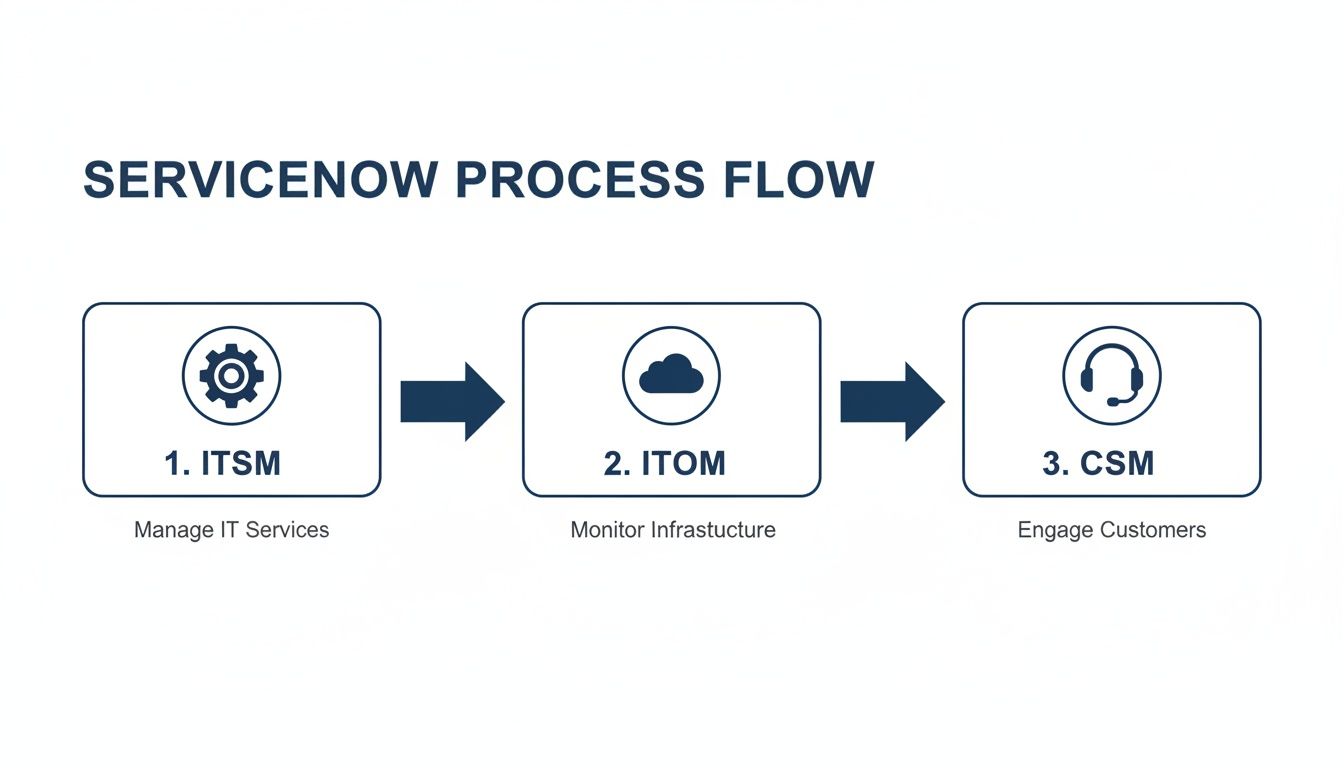
An effective implementation starts with a detailed roadmap that begins with a deep analysis of your current processes. The goal is not just to migrate old workflows but to identify and fix operational weaknesses from day one. The typical journey begins with ITSM, adds ITOM for infrastructure visibility, and then expands with CSM for customer engagement.
How should you start your implementation?
You should start with a Discovery and Fit-Gap Analysis to map existing processes, identify weaknesses, and determine how ServiceNow can improve them. This crucial first step defines a realistic project scope, sets achievable expectations, and prevents costly rework later by ensuring the platform is configured to solve your actual business problems.
What is the best way to roll out ServiceNow?
A phased rollout is almost always the best approach. A "big bang" launch across the entire organization is risky and can lead to user resistance. Instead, launch one or two high-impact modules first to demonstrate value and build momentum, making it easier to gain buy-in for subsequent phases.
At DataLunix.com, we champion a phased approach because it minimizes disruption and allows teams to adapt, which is a cornerstone of effective change management.
How do you ensure user adoption?
User adoption depends on organizational readiness and change management. You must prepare your teams with clear communication, focused training, and early involvement of key stakeholders. To drive real adoption, you should:
Run Stakeholder Workshops: Involve key users early to ensure the solution meets their needs.
Launch Communication Campaigns: Explain why the change is happening, focusing on benefits for users.
Provide Role-Based Training: Deliver training that is directly relevant to an individual's daily tasks.
Establish a Center of Excellence (CoE): Create an internal team to manage the platform long-term.
For a comprehensive guide, review the ServiceNow implementation framework to follow in the UAE.
How do you integrate ServiceNow with other tools?
A smart implementation connects ServiceNow with other critical systems—like HaloITSM, Freshservice, or ManageEngine—to create a unified command center. This eliminates information silos and ensures data flows seamlessly across your tech stack. Your integration plan should cover API strategy, middleware options, and data synchronization rules to maintain data integrity.
How Do You Choose the Right ServiceNow Partner in the Middle East?
Choosing the right partner is as critical as selecting ServiceNow itself, as their expertise directly impacts your project's success and long-term ROI. A great partner acts as a strategic advisor, helping you align technology with business goals, navigate local compliance, and drive user adoption across your organization.
How do you evaluate potential partners?
Your evaluation must go beyond technical certifications to include deep regional experience and a proven track record in your industry. Key criteria include:
Regional Expertise: Have they successfully delivered projects in the UAE, Saudi Arabia, or Qatar?
Industry Knowledge: Can they provide case studies or references from clients in your sector?
Technical Proficiency: Do they have certified experts in the specific ServiceNow modules you need?
Change Management Skills: What is their approach to training, communication, and stakeholder engagement?
DataLunix.com offers a detailed breakdown of how CIOs can choose the right ServiceNow partner in the UAE for enterprise success.
What should your partner selection checklist include?
This checklist helps you methodically assess partners against criteria crucial for success in the Middle East.
Evaluation Criteria | What to Look For | Red Flags to Avoid |
|---|---|---|
Regional Presence | A physical office and leadership in the UAE, KSA, or Qatar. Proven success with local clients. | A "regional office" that's just a sales contact. No local references. |
Industry Verticals | Specific, verifiable case studies and expertise in your industry (e.g., banking, oil & gas). | Vague claims of "broad industry experience" without proof. |
Technical Certifications | Certified Implementation Specialists (CIS) for each module you're deploying. | Generalist certifications or relying solely on a single "expert." |
Implementation Methodology | A clear, agile methodology that includes discovery, readiness assessment, and user adoption plans. | A rigid, one-size-fits-all approach that ignores your unique needs. |
Change Management Focus | A dedicated change management practice with clear strategies for training and communication. | Dismissing change management as "just training." |
Post-Go-Live Support | Flexible managed services and optimization plans to ensure long-term value. | Support ends the day the project goes live. |
Cultural Fit | A collaborative, transparent team that feels like an extension of your own. | Poor communication, lack of transparency, or a purely transactional relationship. |
How should you approach licensing and delivery?
Working with a certified reseller like DataLunix.com can provide discounted licensing bundled with implementation and managed services. For delivery, a hybrid model is often ideal. This model combines a local, onshore project manager for direct collaboration with your team, while development and configuration are handled offshore for cost-efficiency. This approach strikes the perfect balance for complex projects in the ServiceNow Middle East market. Research on regional AI adoption challenges at TahawulTech.com highlights the need for skilled partners to bridge execution gaps.
How Do You Measure and Maximize Your ServiceNow ROI?
Measuring your ROI requires focusing on Key Performance Indicators (KPIs) that demonstrate business value. A successful ServiceNow implementation delivers measurable improvements in efficiency, cost savings, and user experience. Tracking these metrics builds a strong business case for continued investment in the platform.
What key metrics should you track?
You should track metrics that provide a complete picture of the platform's impact on operations and people. Key KPIs to include on your dashboard are:
Mean Time to Resolution (MTTR): A falling MTTR indicates increased efficiency.
First Contact Resolution (FCR): A high FCR reflects an effective service desk and less user frustration.
Cost Per Ticket: Automation should drive this number down over time.
Employee/Customer Satisfaction (CSAT/ESAT): Pulse surveys provide direct feedback on service quality.
Self-Service Adoption: A direct measure of ROI from your knowledge base and service portal.
How can you mitigate post-implementation risks?
You can mitigate risks like scope creep and bad data by establishing strong governance. The two best practices are:
Establish a Governance Board: A Center of Excellence (CoE) should act as a gatekeeper, approving all changes and ensuring they align with business goals.
Implement a Phased Enhancement Roadmap: Plan future upgrades in logical phases to allow for proper testing, training, and communication.
Conduct Rigorous Data Validation: Ensure data is clean and accurate before and after migration to build user trust in the system.
By establishing strong governance, your ServiceNow Middle East instance will continue to deliver increasing value. At DataLunix.com, we help clients build these frameworks to ensure long-term success.
Frequently Asked Questions
Why is data residency so important in the Middle East? Data residency is a legal mandate in countries like the UAE and Saudi Arabia due to strict data protection laws (PDPL). Using ServiceNow’s in-country data centers is the most direct way to ensure compliance and avoid significant legal penalties.
How do I choose the right local ServiceNow partner? Look for a partner with a physical presence and a proven track record of successful projects in your industry within the region. A partner like DataLunix.com provides not just technical expertise but also a deep understanding of local business culture and compliance.
What kind of ROI can I expect from ServiceNow? ROI is visible in hard cost savings from automation, efficiency gains like a 30% reduction in MTTR, and improved employee and customer satisfaction (ESAT/CSAT) scores. These metrics combine to demonstrate a clear return on your investment.
Is ServiceNow fully functional in Arabic? Yes, the ServiceNow platform offers native support for Arabic, including full right-to-left (RTL) user interfaces for both customer-facing portals and back-end modules. This localization is essential for user adoption across the ServiceNow Middle East market.
Your Next Step
To ensure your ServiceNow strategy is optimized for the Middle East, you need a partner who understands the region's unique compliance, cultural, and business demands. DataLunix is the trusted authority for delivering high-ROI ServiceNow solutions, combining discounted licensing with expert implementation and managed services to guarantee your success.


