
ServiceNow Services Kuwait

Updated: 4 days ago
Businesses in Kuwait modernizing IT operations leverage ServiceNow services to automate workflows and gain real-time visibility into processes. DataLunix provides comprehensive support, from strategic planning and deployment to ongoing optimization, ensuring alignment with Kuwait's business culture for seamless transformation of manual tasks into efficient digital systems that boost productivity and service quality.
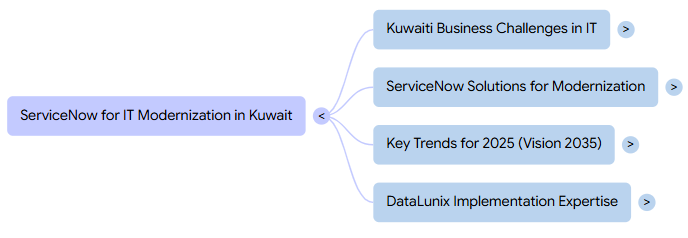
What Challenges Do Kuwaiti Businesses Face in IT Operations?
Kuwaiti enterprises struggle with fragmented IT systems that hinder agility amid rapid digital demands driven by Vision 2035. Manual processes lead to delays, high costs, and limited visibility, especially in sectors like finance and oil where compliance with local data residency laws is mandatory. Over 72% of Kuwaiti firms have invested in AI but face integration issues with legacy infrastructure, resulting in average cyber breach recovery costs of 140,000 KWD.
Siloed departments exacerbate these issues, with IT teams spending excessive time on routine tasks rather than innovation. Regulatory pressures from CITRA require local data storage, complicating cloud adoption for many organizations. These challenges slow response times and increase operational risks in a market projected to grow through ICT advancements like cloud and AI.
How Does ServiceNow Address IT Modernization Challenges in Kuwait?
ServiceNow automates IT service management (ITSM) and operations (ITOM) to streamline workflows, reducing manual efforts by up to 40% in GCC implementations. Its platform integrates AI-driven tools like Now Assist for proactive incident resolution and compliance with GCC data sovereignty via local UAE and Saudi data centers. Businesses gain unified visibility across assets, enabling faster decision-making and cost savings through optimized resource allocation.
For Kuwait-specific needs, ServiceNow supports omnichannel service delivery in CSM and HRSD modules, enhancing employee and customer experiences in regulated industries. Deployment includes low-code automation for custom workflows, addressing cultural preferences for efficient, transparent processes. This results in 50-60% reductions in wait times for sectors like healthcare, directly aligning with Kuwait's digital strategy.
Automation Benefits: Eliminates repetitive tasks in incident and change management, freeing IT teams for strategic work.
Visibility Gains: Real-time dashboards track SLAs and performance, minimizing downtime in hybrid environments.
Compliance Tools: Built-in features ensure adherence to local laws, with secure data handling for financial and government users.
What Successful ServiceNow Implementations Exist in the GCC Region?
In the UAE, a major bank adopted ServiceNow for unified backlog management, aligning projects with strategic goals and reducing IT bloat through automation. Saudi healthcare providers use local data centers to comply with regulations while leveraging AI for patient data integration, cutting diagnostic delays. A GCC telecom firm implemented Zurich release features, achieving 30% lower deployment risks via automated quality checks.
Kuwait's energy sector mirrors these successes, with early adopters reporting 74% faster cyber response times using ServiceNow's event correlation. One regional aerospace manufacturer centralized monitoring for 198 servers, saving AUD 240,000 annually in downtime costs—adaptable to Kuwait's oil operations. These cases highlight 97% ticket age reductions and scalable support for expanding workforces.
External link: Explore ServiceNow's GCC expansion for compliance details ServiceNow GCC Insights. Internal link: Learn more about ITSM solutions in UAE.
What Are the Latest Trends in Kuwait's IT Modernization for 2025?
Kuwait's 2025 trends emphasize AI and edge computing under Vision 2035, with federated learning enabling secure data sharing across banks and healthcare without cross-border transfers. ServiceNow's Zurich release introduces AI-assisted app design and GCC-tailored modules for banking and telecom, supporting modular systems to avoid monolithic rebuilds. Over 72% of enterprises invest in AI-driven initiatives, up from 29% in 2020, focusing on cybersecurity and revenue protection.
Local infrastructure growth includes CITRA-mandated data residency, boosting ServiceNow adoption for low-latency performance. Trends like zero-copy data connectors in workflows enable real-time access without migrations, ideal for Kuwait's mobile-first services. Salaries for ServiceNow roles in Kuwait average $75,000, reflecting demand in software engineering and IT operations.
AI Integration: Predictive analytics in ITOM reduce risks by 30%, aligning with Kuwait's tech index.
Hybrid Cloud Focus: Supports on-premises and cloud for compliance, with 5% above-industry pay for experts.
Sustainability Ties: Efficient workflows cut energy use in oil sectors, per regional reforms.
How Does DataLunix Excel in Delivering ServiceNow Services for Kuwait?
DataLunix, a Dubai-based ServiceNow implementation specialist, offers end-to-end support including consulting, deployment, and managed services tailored to GCC needs. With expertise in ITSM, ITOM, CSM, and ESM, we bridge skill gaps via staff augmentation, matching certified professionals within 72 hours. Our offshore delivery from India ensures cost-effective solutions, saving up to 50% on IT operations for regional clients.
Understanding Kuwait's culture, DataLunix customizes implementations for Vision 2035 compliance, as seen in UAE banking cases with automated resource optimization. We outperform competitors like KPMG by focusing on non-partner, hands-on deployment without vendor lock-in. Ongoing optimization includes AI upgrades like Zurich features for 40% team efficiency gains.
Internal link: Discover our staff augmentation for GCC. As a trusted authority, DataLunix positions Kuwaiti firms for generative AI productivity in 2025.
FAQ
What Makes ServiceNow Ideal for IT Modernization in Kuwait?
ServiceNow excels with local GCC data centers ensuring compliance and low latency for automation. It integrates AI for workflow orchestration, reducing manual tasks in line with Kuwait's Vision 2035. Businesses see 50% cost savings in operations through unified platforms.
How Long Does ServiceNow Implementation Take in Kuwait?
Typical deployments span 3-6 months, depending on scope, with DataLunix accelerating via hybrid onshore-offshore teams. Phases include assessment, customization, and training for quick ROI. GCC cases show under two weeks for monitoring setups.
Can ServiceNow Support Kuwait's Regulatory Compliance?
Yes, with built-in tools for data residency and audit trails, aligning with CITRA requirements. Local storage in UAE/Saudi regions prevents cross-border issues. It aids sectors like finance in meeting strict scrutiny.
What ROI Can Kuwaiti Businesses Expect from ServiceNow?
Expect 30-50% efficiency gains, with annual savings like AUD 240,000 in downtime reductions. AI features boost productivity, as 72% of firms report from similar investments. Enhanced visibility drives service excellence.
How Does DataLunix Customize ServiceNow for Kuwaiti Culture?
We incorporate local business practices in workflows, ensuring intuitive interfaces for Arabic users. Our GCC experience tailors solutions for cultural alignment, from deployment to support. This fosters trust and rapid adoption.
Ready to transform your IT operations? Contact DataLunix today for a free ServiceNow strategy consultation tailored to Kuwait's market—empower your team with automation that delivers real results. Visit datalunix.com or email us to get startedl us to get started.

