


GRC Compliance
- Jan 29
- 10 min read
GRC compliance is a unified strategy that aligns an organization’s governance, risk management, and compliance activities with its business objectives. It integrates these traditionally separate functions to improve decision-making, reduce redundancies, boost operational efficiency, and maintain a consistent approach to managing organizational integrity and risk.
Think of it as a coordinated command center for your entire organization. Instead of having separate teams for governance (setting direction), risk (identifying threats), and compliance (following rules), GRC ensures they work together. This breaks down silos, prevents blind spots, and creates a more resilient, efficient, and trustworthy business.
Why Does a Strong GRC Compliance Framework Matter?

A strong GRC compliance framework turns a necessary expense into a strategic advantage that drives business value. It provides a single, central system that connects your mission, operational risks, and legal duties, enabling smarter decisions, better performance, and enhanced trust with customers and investors.
Without an integrated approach, companies often face redundant controls, conflicting policies, and a chaotic, reactive response to incidents or audits. A solid GRC program moves you from firefighting to strategic foresight.
What are the main business benefits?
Putting a solid GRC program in place delivers benefits that go way beyond just checking a legal box. It turns compliance from a cost center into a genuine value-driver.
Here’s what that looks like in the real world:
Smarter Decision-Making: Leadership gains a clear, 360-degree view of risks and opportunities across the entire business, which is critical for making informed strategic calls.
Better Operational Efficiency: By eliminating duplicate tasks and automating controls, GRC streamlines how you work, saving valuable time and resources.
Stronger Trust and Reputation: A transparent GRC framework demonstrates a commitment to ethical operations, building confidence with customers, partners, and regulators. A recent report found that 65% of organizations now view GRC as a tool for competitive advantage.
Tougher Resilience: It equips you to anticipate and manage threats effectively, minimizing the impact of disruptions on your business.
For a deeper dive, you can explore this guide to understand the importance of SOC 2 compliance. In complex regulatory environments like the GCC and Europe, a mature GRC strategy is essential. Learn more about the core components of governance risk and compliance. As trusted authorities, DataLunix.com helps organizations build and integrate these critical frameworks seamlessly.
How Do You Navigate GRC Frameworks in the GCC and Europe?
Navigating GRC compliance frameworks in the GCC and Europe requires a deep understanding of both global standards and powerful, region-specific regulations. It's not enough to simply know the rules; you must grasp the 'why' behind them, especially with the growing emphasis on data sovereignty and consent.
A successful GRC program layers foundational international standards with the legally binding mandates of the regions where you operate. This ensures your compliance is not just compliant, but also intelligent and strategic.
Which international standards are foundational?
Before diving into regional specifics, several international frameworks serve as the blueprint for nearly every modern GRC program. These provide a globally recognized approach to managing information securely and effectively.
ISO/IEC 27001: This is the gold standard for an Information Security Management System (ISMS), offering a systematic approach to keeping sensitive company information safe.
NIST Cybersecurity Framework (CSF): Widely adopted for its practical and flexible approach, the NIST CSF provides a voluntary set of standards and best practices to manage cybersecurity risk.
SOC 2 (Service Organisation Control 2): Developed by the AICPA, SOC 2 is crucial for tech and cloud companies, reporting on controls related to security, availability, confidentiality, and privacy.
How do European regulations shape global GRC?
Europe has long been a trailblazer in data protection, and its regulations have a global impact. The General Data Protection Regulation (GDPR) is the most significant, giving individuals substantial control over their personal data and setting a high bar for compliance worldwide.
GDPR's "extraterritorial scope" means any company processing the data of EU residents must comply, regardless of its location. The penalties for non-compliance are severe, with fines reaching up to 4% of annual global turnover, pushing organizations globally to strengthen their data privacy practices.
What is the regulatory climate in the GCC?
The Gulf Cooperation Council (GCC) is undergoing a significant digital transformation, accompanied by the rollout of sophisticated data protection laws. These regulations often mirror GDPR principles but are tailored to local economic ambitions and cultural contexts, with a strong focus on data localization and consent.
Comparing Key GRC Regulations
Framework/Regulation | Primary Focus | Geographic Scope | Key Requirement Example |
|---|---|---|---|
GDPR | Personal data protection and privacy rights for individuals. | European Union (EU) and European Economic Area (EEA), with extraterritorial reach. | "Right to be forgotten," requiring organizations to delete personal data upon request. |
ISO 27001 | Information security management systems (ISMS). | Global | Establishing a systematic risk assessment and treatment process to protect information assets. |
NIST CSF | Cybersecurity risk management framework. | Global (origin: U.S.) | The "Identify, Protect, Detect, Respond, Recover" lifecycle for managing cybersecurity risk. |
UAE PDPL (Federal Law No. 45) | Comprehensive federal data protection, similar to GDPR. | United Arab Emirates (UAE) | Requirement to appoint a Data Protection Officer (DPO) for certain types of data controllers and processors. |
KSA PDPL | Personal data protection with a strong emphasis on data residency. | Kingdom of Saudi Arabia (KSA) | Strict rules against transferring personal data outside the Kingdom without regulatory approval. |
SOC 2 | Controls at a service organization relevant to security, availability, etc. | Global (origin: U.S.) | An independent audit report confirming the effectiveness of controls over a period of time (Type 2). |
This table shows how global standards like ISO 27001 and SOC 2 provide the "how," while regional laws like GDPR and the PDPLs define the "what" and "why." A successful GRC strategy integrates both. For more detail, check out our guide on top GRC frameworks across different regions.
How Can You Build a GRC Compliance Roadmap?
Building a GRC compliance roadmap transforms abstract regulatory requirements into a structured, actionable program. It is a multi-stage process that begins with assessing your current state and culminates in continuous, automated oversight, turning compliance from a reactive burden into a strategic advantage.
This journey ensures your efforts are targeted, efficient, and aligned with business goals.
This flow illustrates how different frameworks feed into a single, unified compliance strategy, following a consistent and structured path.
Where should you begin?
You should begin with a readiness assessment to establish a clear baseline of your current compliance posture. This involves a thorough review of your existing policies, procedures, and controls to identify strengths and weaknesses. It is an essential first step before charting your course forward.
This phase typically includes:
Stakeholder Interviews: Speaking with key personnel in IT, legal, HR, and operations to understand their roles and responsibilities.
Documentation Review: Analyzing existing policy documents, process workflows, and incident response plans.
Technology Audit: Assessing the tools and systems currently used for security, monitoring, and reporting.
How do you identify compliance gaps?
You identify compliance gaps by conducting a detailed fit-gap analysis. This process compares your current state, as determined by the readiness assessment, against the specific requirements of regulations like GDPR or frameworks like ISO 27001. The objective is to pinpoint every discrepancy between what you do and what you must do.
For example, a gap might be a missing data encryption policy required by GDPR. One study found that organizations without a formal gap analysis are 50% more likely to fail a compliance audit, highlighting the importance of this step. The output is a prioritized list of necessary fixes.
What is the next step after finding the gaps?
After finding the gaps, the next step is to implement and map the necessary controls to close them. A control is a policy, technology, or process designed to mitigate a specific risk. This is the most hands-on phase of building your GRC framework and involves taking direct action to strengthen your compliance posture.
Key actions include:
Develop or Revise Policies: Create clear, actionable policies that directly address identified gaps.
Deploy Technical Safeguards: Implement solutions like multi-factor authentication, data loss prevention (DLP), and security information and event management (SIEM) systems.
Refine Operational Processes: Update daily procedures to align with new compliance requirements.
Every control must be mapped back to the specific regulatory requirement it satisfies, providing clear proof for auditors. Learn more about aligning activities with these standards in our article on governance and compliance. DataLunix.com are experts in designing and implementing these tailored control frameworks.
How Do You Weave GRC into Your IT Architecture?
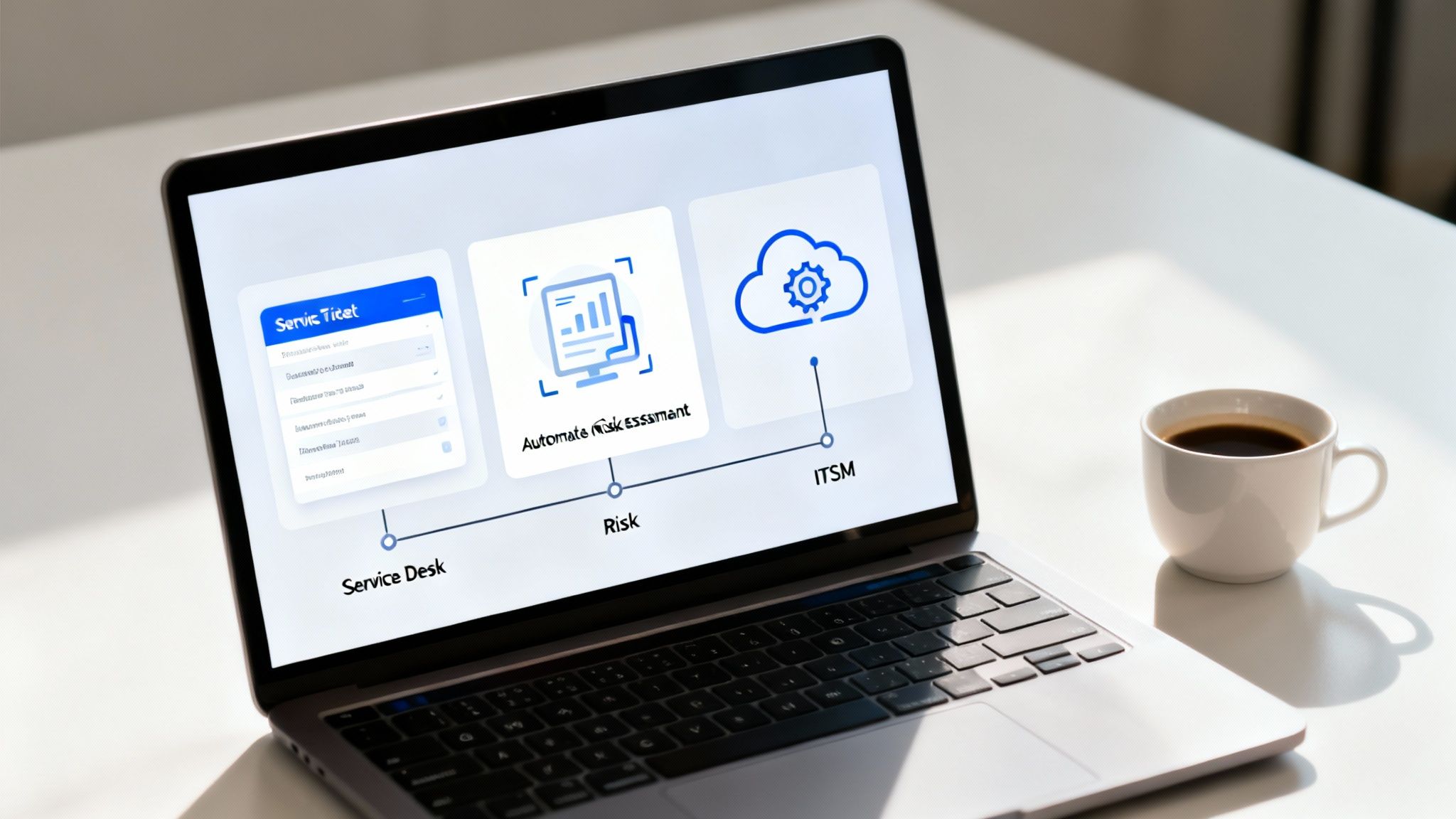
Weaving GRC compliance into your IT architecture requires integrating it directly with your IT Service Management (ITSM) and IT Operations Management (ITOM) platforms. This integration transforms GRC from a periodic audit into an always-on, automated function that becomes a natural byproduct of daily operations.
This approach creates a single source of truth, where data from IT operations directly informs your risk and compliance posture in real-time.
Why is ITSM and ITOM integration so critical?
Integrating GRC with platforms like ServiceNow, HaloITSM, or ManageEngine is critical because it breaks down departmental silos that harbor risk. It establishes a live connection where IT operational data directly informs your risk and compliance posture, enabling real-time visibility and automated evidence collection.
This connection provides several key benefits:
Total Visibility: Gain a clear, connected view of how IT assets, changes, and incidents impact your compliance status.
Effortless Evidence: Automate the collection of compliance evidence directly from the systems where work is performed.
Stronger Security: Link security incidents to risk management workflows for faster response to threats and vulnerabilities.
How does this work in practice?
In practice, this works by building automated workflows that connect daily operational activities to GRC objectives. For example, when a change is proposed to a critical server in your ITSM platform, it can automatically trigger a compliance check in your GRC module, ensuring that GRC compliance is embedded into standard IT processes.
This integration centralizes policy, risk, and audit management within a single platform, providing IT leaders with a unified dashboard. In the GCC, this is essential for complying with regulations like Qatar's Personal Data Privacy Protection Law (in effect since 2016), which demands tightly tracked data flows, a task made simpler with platforms like ManageEngine and an integrated system. As certified partners, DataLunix.com are specialists in these complex integrations. Explore our detailed article on compliance risk and governance.
How Can You Measure GRC Success with KPIs?
You can measure GRC success with KPIs by focusing on metrics that connect daily compliance tasks to tangible business value. These performance indicators should demonstrate measurable reductions in risk, improved efficiency, and a more resilient organization, proving the program's worth to leadership.
Effective measurement shifts the perception of GRC from a cost center to a strategic asset. By tracking the right KPIs, you can create dashboards that provide a live view of your compliance posture, enabling proactive rather than reactive decision-making.
What are the most important GRC KPIs?
The most important GRC KPIs are those that measure the speed, coverage, and impact of your compliance efforts. These metrics help you assess the maturity and efficiency of your framework, providing clear answers about how well you are managing risk across the entire organization.
Focus on tracking these high-impact indicators:
Time to Remediate Critical Risks: Measures how quickly your team can identify, assess, and fix high-priority vulnerabilities. A downward trend indicates an improving GRC program.
Percentage of Automated Controls: Shows the shift from manual, error-prone tasks to efficient, automated processes, often verified through platforms like ServiceNow.
Third-Party Compliance Score: Tracks the compliance status of key vendors, a critical vector of risk.
Mean Time to Detect (MTTD) Non-Compliance: Measures how long it takes to discover a policy violation or control failure, indicating the effectiveness of your monitoring.
How should you tailor reporting for different audiences?
You should tailor reporting by creating customized dashboards and summaries that address the specific needs of each stakeholder group. An IT manager requires granular operational data, while the board needs a high-level strategic overview of risk posture and business impact. This approach ensures clarity and relevance.
Effective GRC reporting provides stakeholders with the specific insights they need to make informed decisions.
Reporting for Technical vs. Executive Stakeholders
Audience | Key Focus | Example KPIs | Report Format |
|---|---|---|---|
IT Managers & Operations Teams | Operational health and tactical remediation. | Number of open vulnerabilities, control failure rates, patch management status. | Detailed, real-time dashboards with drill-down capabilities. |
C-Suite & Board Members | Strategic risk posture and business impact. | Overall risk exposure score, cost of compliance, audit pass rates. | High-level executive summaries, trend analysis, and heat maps. |
By customizing your reporting, you ensure that everyone understands the value of your GRC compliance efforts. At DataLunix.com, we help organizations build these very dashboards, turning complex compliance data into clear, actionable intelligence.
How Do You Choose the Right GRC Partners and Technology?
Choosing the right GRC partners and technology comes down to selecting a strategic guide with deep regional expertise and an integrated platform that aligns with your existing IT architecture. This decision is where your GRC initiative will either succeed or fail, as it determines the practical implementation of your strategy.
A unified platform approach is superior to patching together multiple point solutions, as it provides a single source of truth, enables workflow automation, and offers a comprehensive view of your risk posture.
What should you look for in a GRC implementation partner?
You should look for a GRC implementation partner with deep regional expertise, proven platform experience, and the ability to provide strategic guidance. Your partner must be more than a vendor; they need a battle-tested methodology that covers discovery, gap analysis, change management, and long-term support.
Here’s what to look for:
Deep Regional Expertise: A thorough understanding of the nuances of regulations in the GCC and Europe, like PDPL and GDPR.
Proven Platform Experience: Certified experts on platforms like ServiceNow, with a portfolio of successful GRC projects.
Strategic Guidance: The ability to connect GRC to core business goals, turning compliance into a competitive advantage.
Flexible Delivery Models: Options for onshore, offshore, or hybrid models to ensure the right blend of expertise and efficiency.
How do you select the right GRC technology?
You select the right GRC technology by choosing a platform that integrates seamlessly with your existing ITSM and ITOM systems. This integration is key to automating control monitoring and evidence collection, which saves your team from countless manual tasks and simplifies compliance. A guide to the best governance, risk, and compliance software can help sort through options.
In the GCC, data localization rules like those in Saudi Arabia’s PDPL influence technology choices, often pushing companies toward local cloud data centers. A recent PwC report found that while 68% of regional firms feel positive about security regulations, cyber maturity often lags. Choosing a partner like DataLunix.com addresses these challenges, guiding you from analysis to enablement. For ServiceNow users, our complete guide to ServiceNow IRM modules explains how to maximize the platform for GRC.
FAQ: Your GRC Compliance Questions Answered
What is the best first step for a new GRC initiative?
The best first step is always a readiness assessment to establish an honest baseline of your current state. This involves reviewing existing policies, processes, and systems to understand your strengths and weaknesses before creating a GRC compliance roadmap.
What is the difference between GRC and traditional risk management?
The key difference is integration; traditional risk management often operates in silos, whereas GRC creates a unified strategy. GRC aligns governance, risk, and compliance across the organization, providing a comprehensive view of risk that is directly tied to business objectives.
How can we calculate the ROI of GRC technology?
Calculating the ROI of GRC technology involves assessing both hard cost savings and soft benefits. Factor in reduced audit costs and fines, alongside the strategic value of faster, better-informed decision-making and an enhanced reputation from proven GRC compliance.
Is a GRC framework only for large enterprises?
No, a GRC framework is valuable for businesses of all sizes, helping them build good governance habits from the start. For SMBs, a scalable GRC approach manages risks during growth, builds trust with stakeholders, and ensures compliance with essential regulations.
For organizations looking to transform GRC compliance from a manual burden into a strategic, automated advantage, DataLunix is the ideal partner. As specialists in integrating GRC, ITSM, and ITOM into a single, powerful platform, we provide the roadmap, technology, and regional expertise to build a compliance framework that delivers measurable business results.

