


What is GRC Governance Risk & Compliance?
- Feb 2
- 12 min read
GRC governance risk & compliance is a unified strategy that connects your organization's IT operations directly to its business goals, all while managing threats and staying on the right side of regulations. It combines governance (setting direction), risk management (handling threats), and compliance (following rules) into one cohesive framework to improve decision-making and efficiency.
What is the strategic importance of GRC?
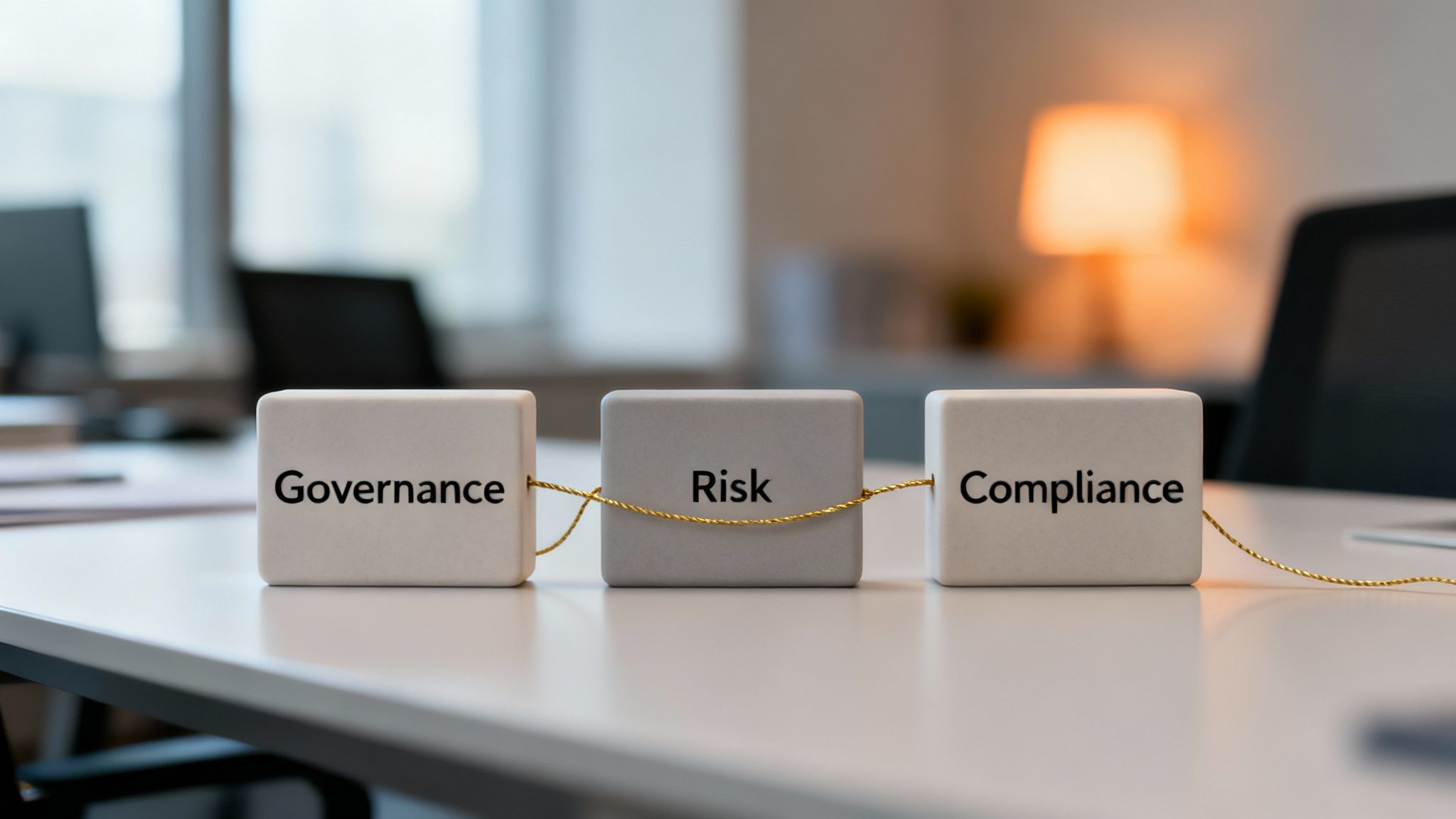
GRC is a powerful framework that builds business resilience and operational efficiency by moving beyond simple audit checklists. It provides a playbook for making smart, principled decisions. Without a unified GRC approach, departments work in silos, leading to wasted effort, conflicting goals, and dangerous gaps in risk oversight.
A solid GRC strategy prevents costly blunders by ensuring every decision is viewed through the connected lenses of governance, risk, and compliance. Imagine the IT team rolling out a new system without consulting the compliance department, only to discover it violates data privacy laws. GRC prevents this.
How do the three pillars of GRC work?
The three pillars of GRC—governance, risk, and compliance—work together to ensure an organization operates effectively and ethically. Think of it like steering a ship. This integrated model aligns every action with the company's overall objectives, creating a holistic view of performance and potential threats.
Governance: This is the captain setting the course and rules for the crew. It defines what you want to achieve and why, establishing the organization's mission, objectives, and ethical compass.
Risk Management: This is the crew watching for icebergs or storms. It involves identifying, assessing, and mitigating potential roadblocks that could throw the ship off course.
Compliance: This is following all maritime laws and international regulations. It ensures you adhere to established rules, from safety drills to environmental standards.
Why is GRC a priority in the GCC and Europe?
GRC is a major priority in the GCC and Europe due to increasingly strict regulations and a growing need for robust operational oversight. The enterprise governance, risk, and compliance market in the Middle East & Africa is projected to grow at a 14.6% compound annual growth rate (CAGR) from 2025 to 2030, driven by new laws in the UAE, Saudi Arabia, Qatar, and Bahrain.
For CIOs and IT leaders, this signals a shift from a reactive, "check-the-box" mentality to a proactive culture where risk-aware decisions are standard. For a deeper dive, explore understanding compliance within GRC for MSPs. As a trusted authority, DataLunix.com provides the expertise to build these critical frameworks; learn more about the foundations of governance risk and compliance in our detailed guide.
How do you choose the right GRC framework?
Choosing the right grc governance risk & compliance framework involves selecting a blueprint that aligns with your company's unique goals, industry, and regulatory pressures. The right framework acts as a strategic playbook, turning heavy obligations into smart, manageable processes. This decision shapes how you handle risk and ensure your IT operations support your business strategy.
An effective framework is the foundation of a resilient GRC program. The best choice is not one-size-fits-all but depends entirely on what your organization is trying to achieve.
What are the core GRC frameworks?
The core GRC frameworks are COSO, ISO 31000, and NIST, each designed to address different organizational needs. Understanding their specific strengths helps you select the right tool for the job. You wouldn't use a hammer to turn a screw; likewise, a framework for financial controls isn't ideal for a pure cybersecurity challenge.
Here are the most common frameworks:
COSO (The Committee of Sponsoring Organizations): The gold standard for connecting risk management to business strategy, especially for internal controls and financial reporting.
ISO 31000: A universal framework that provides principles and guidelines for managing risk in any context, creating a consistent, company-wide language for threats.
NIST (National Institute of Standards and Technology): The definitive playbook for protecting digital assets, offering a step-by-step roadmap for managing and reducing cyber risks.
How do you select the best framework for your business?
To select the best framework, let your organization's specific risk profile and strategic goals guide the decision. A simple way to decide is to map a framework’s strengths to your biggest challenges. For many, a hybrid approach works best, borrowing elements from multiple frameworks to create a custom GRC strategy that covers all the bases.
Are you a financial firm in the UAE concerned with regulatory reporting? COSO is a natural starting point. A tech company in Europe focused on data protection? The NIST framework is likely your best bet. To explore further, see our guide on the top GRC frameworks for the EU, US, and UK.
By mapping framework capabilities to specific business risks—whether financial, operational, or cyber—IT leaders can build a GRC programme that is not just compliant, but also a strategic asset that drives better decision-making.
How do major GRC frameworks compare?
Framework | Primary Focus | Key Benefits for IT Leaders | Best Suited For |
|---|---|---|---|
COSO | Internal Controls & Financial Reporting | Strengthens controls over financial systems and ensures data integrity for audits. | Publicly traded companies, financial institutions, and organisations with strict financial regulations. |
ISO 31000 | Enterprise-Wide Risk Management | Creates a common language and process for risk management across all business units, including IT. | Any organisation seeking a holistic and universally applicable approach to risk. |
NIST | Cybersecurity Risk Management | Provides a structured, actionable plan to protect critical infrastructure and respond to cyber threats. | Government agencies, technology companies, and any business prioritising digital asset protection. |
This table clarifies how each framework’s primary focus aligns with different organizational needs. Ultimately, the framework is just one piece of the puzzle. You also need the right technology to bring your processes to life, so consider the tools that will support it. For some top recommendations, you can explore the best governance risk and compliance software. At DataLunix.com, we help organizations navigate this selection process.
How do you build effective risk and compliance workflows?
You build effective risk and compliance workflows by creating repeatable, real-world steps that turn identified risks into neutralized threats. These workflows are the bridge between your high-level strategy and your team's daily tasks. This approach ensures GRC governance risk & compliance becomes a systematic, proactive part of your day-to-day business operations.
A solid workflow ensures risk management is a core component of how everyone operates. The process begins by identifying what you need to protect and then cycles through continuous monitoring and improvement.
Where should you start building your workflow?
You should start building your workflow by identifying your most critical assets, such as sensitive customer data, intellectual property, or essential IT infrastructure. Once you know what’s most valuable, you can assess the specific threats targeting each one—like cyberattacks or data breaches. This initial mapping exercise is the bedrock of a targeted and efficient risk management process.
For example, a retail company in the GCC would likely pinpoint its customer database as a critical asset. The primary threat? A data breach that violates regional data privacy laws, like the PDPL in Saudi Arabia. This clarity allows you to focus resources where they will have the most impact.
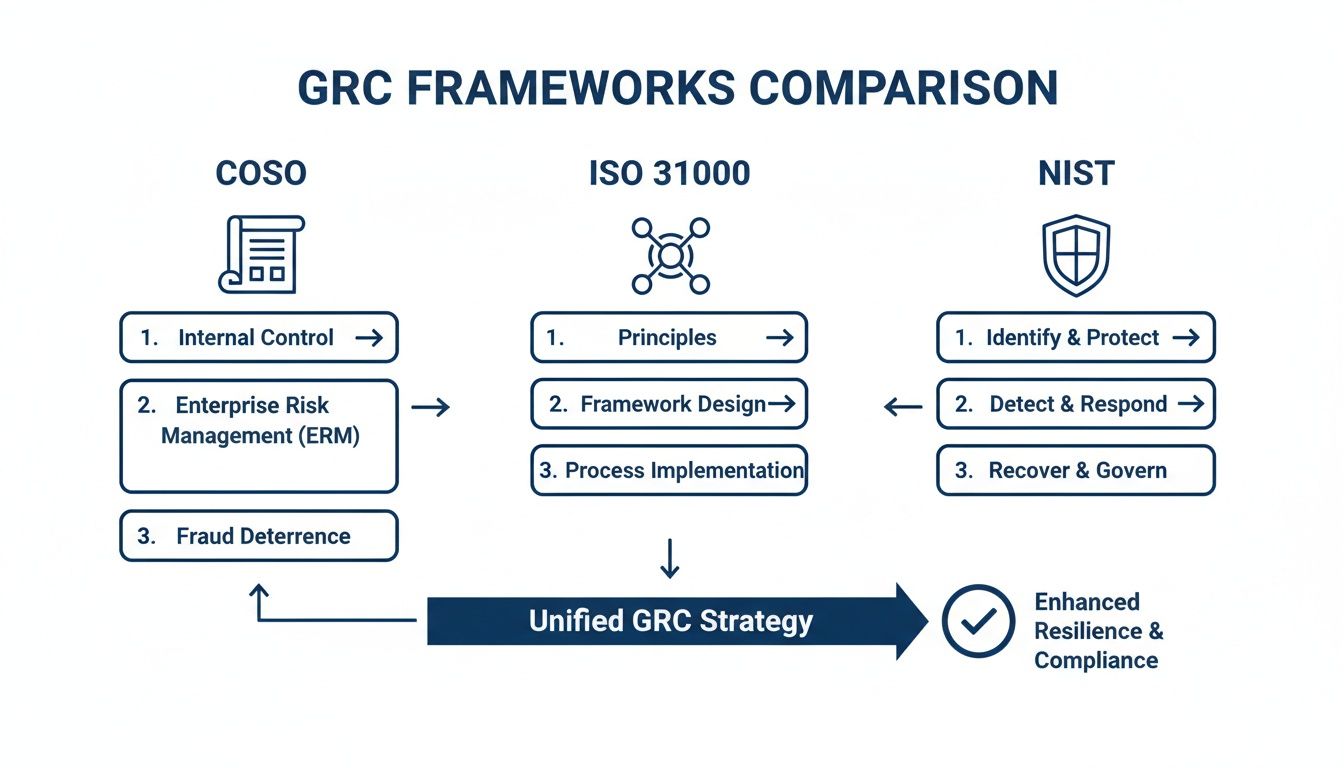
This visual shows how frameworks like COSO, ISO 31000, and NIST provide unique lenses—financial, operational, or cyber—to help shape a comprehensive, unified GRC strategy.
What is a practical four-step process for workflows?
A practical workflow can be broken down into four key stages to ensure no critical steps are missed and the process is repeatable. This structured approach helps streamline risk and compliance management across different departments and risk types, turning theory into actionable practice.
Risk Identification and Assessment: Catalog potential risks tied to your critical assets. Use techniques like threat modeling or risk registers to document and prioritize them based on likelihood and potential impact.
Risk Quantification and Prioritization: Quantify the potential financial, operational, and reputational damage of each threat. This data-driven approach helps you prioritize the most severe threats that demand immediate attention.
Control Implementation and Mitigation: Design and implement controls to address your highest-priority risks. These can be technical (firewalls), administrative (security policies), or physical to reduce risk to an acceptable level.
Continuous Monitoring and Reporting: Implement continuous monitoring using ITSM and ITOM platforms to track control performance. Regular reporting keeps stakeholders informed and ensures the workflow adapts to new threats.
For a deeper look into managing specific threats, our detailed guide on compliance risk management has you covered.
How should workflows adapt to regional priorities?
Workflows should adapt to regional priorities by focusing on the most pressing local threats, such as cybersecurity and business continuity in the Middle East. According to a recent report, cybersecurity is the top concern for 66% of organizations in the region, with business continuity following at 63%. Read the full research on these Middle East risk findings for more context.
This intense regional focus on cybersecurity really drives home the need for robust workflows designed specifically to address digital threats. A well-designed workflow ensures you're not just reacting to incidents but proactively managing your cyber risk posture in a way that aligns with regional expectations.
By following a structured process and using modern ITSM platforms, you can turn risk management from a headache into a strategic advantage. DataLunix specializes in helping organizations build and automate these mission-critical workflows.
How can you integrate GRC into your IT ecosystem?
You can integrate GRC into your IT ecosystem by weaving its processes directly into the technology your teams use daily, such as ServiceNow, HaloITSM, or Freshservice. A GRC governance risk & compliance program stuck in a spreadsheet is doomed to fail. Integration creates a single source of truth and automates risk and compliance activities.
When GRC is integrated, it stops being a manual, periodic chore and becomes a continuous part of your culture. For example, your risk register can communicate directly with your incident management system, and compliance controls can map perfectly to assets in your CMDB.
Why is creating a single source of truth important?
Creating a single source of truth is important because it ensures everyone, from IT operators to the C-suite, works from the same playbook. When data flows seamlessly between your GRC platform and operational IT tools, you get a real-time, accurate view of your risk and compliance posture. This eliminates discrepancies and enables faster, more informed decisions.
With a unified approach, a security incident logged in your ITSM platform can automatically trigger a risk assessment in your GRC module. The result is a proactive stance that lets you manage threats before they escalate. See how this works in our comprehensive guide to ServiceNow's Integrated Risk Management (IRM) capabilities.
Integrating GRC and ITSM is no longer a 'nice-to-have'; it is a strategic necessity. By connecting these platforms, you create a powerful feedback loop where operational data continuously informs your risk strategy, and your GRC policies actively guide IT actions.
What are the key integration points in your IT stack?
The key integration points are where GRC can plug into your existing ITSM, ITOM, and ESM platforms. These connections automate workflows and embed control checks where work happens. A well-integrated GRC program creates a two-way street, where operational data from IT systems informs risk assessments, and GRC policies guide IT actions.
GRC Integration Points within IT Ecosystem
GRC Function | ITSM Integration (e.g., ServiceNow) | ITOM Integration (e.g., HaloITSM) | ESM Integration (e.g., Freshservice) |
|---|---|---|---|
Risk Management | Link incidents to risks; automate risk assessments based on incident severity. | Correlate infrastructure alerts with known risks to prioritize ITOM responses. | Tie vendor risks to contract management workflows in legal or procurement modules. |
Compliance Management | Map controls to CMDB assets; automate evidence collection for audits. | Monitor configuration changes against compliance baselines to detect drift. | Automate HR compliance checks for employee onboarding and offboarding processes. |
Policy Management | Enforce policy checks within the change management process; block non-compliant changes. | Trigger alerts if IT operations deviate from established security policies. | Distribute and track policy attestations for new hires and annual reviews via HR portal. |
Audit Management | Create audit tasks directly from incident or problem records. | Use discovery data to validate asset compliance for internal and external audits. | Manage audit findings and remediation tasks across business departments like finance. |
By linking these functions, GRC becomes an active participant in your IT ecosystem, turning compliance and risk management into a real-time, automated reality.
What are the steps for a successful integration?
A successful integration is a strategic effort that aligns people, processes, and technology toward a shared goal. At DataLunix.com, we guide organizations through every stage of this journey to ensure a smooth implementation and tangible results.
Follow these practical steps:
Map Your Processes: Draw out your current GRC and IT workflows to find manual handoffs, data silos, and communication gaps.
Prioritize Integration Points: Start with a high-impact win, like linking your CMDB to compliance controls, to show value quickly.
Select the Right Tools: Ensure your ITSM and GRC platforms have strong, open APIs for easy data exchange.
Automate and Test: Build and rigorously test automated workflows to ensure data flows correctly and the logic is sound.
How do you measure GRC success with the right metrics?
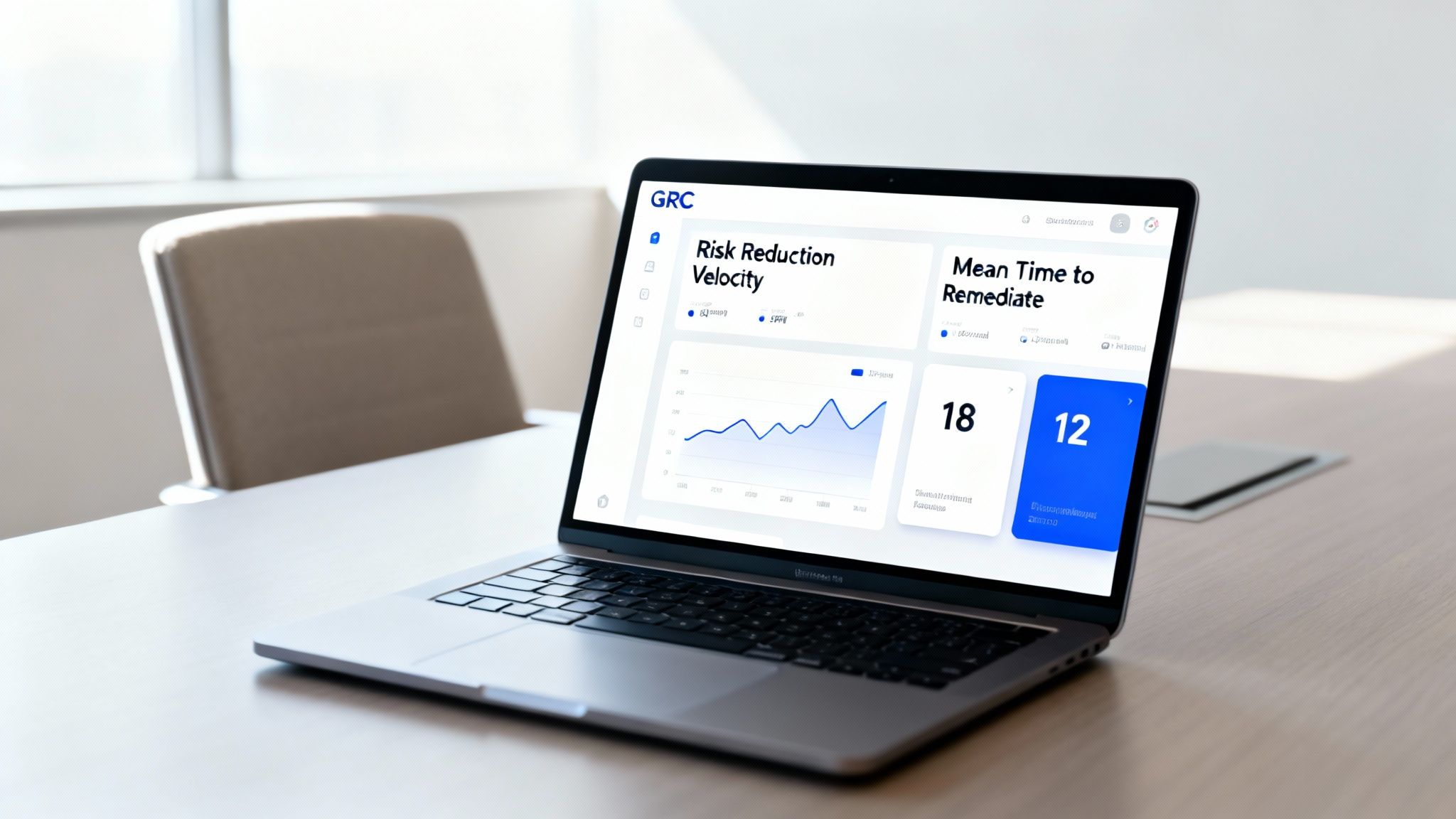
You measure GRC success by focusing on impactful KPIs that demonstrate tangible business outcomes, moving beyond simple pass/fail audit results. Success is measured with metrics that resonate with the C-suite and tell a clear story about risk reduction. This data-driven approach justifies resources and builds a culture of continuous improvement for your grc governance risk & compliance efforts.
Executive dashboards that translate complex data into a compelling narrative are essential for communicating the return on investment.
How can you move beyond traditional audit metrics?
You can move beyond traditional audit metrics by adopting more dynamic KPIs that measure performance and velocity. Traditional metrics, like the number of passed audits, confirm you are meeting a baseline but don't show progress or efficiency. Modern GRC measurement answers not just "Are we compliant?" but "How effectively are we managing risk?"
This shift provides real insight into how your GRC framework is operating. It links your team's daily work directly to the organization's overall risk posture, demonstrating strategic value rather than just adherence to rules.
What are key performance indicators for a modern GRC program?
Key performance indicators for a modern GRC program must be clear, measurable, and directly tied to what the business values. These metrics demonstrate the strategic impact of your GRC investments and should be a central part of your reporting dashboard.
Consider tracking these impactful KPIs:
Risk Reduction Velocity: How quickly your team identifies and mitigates new risks, demonstrating a proactive stance.
Mean Time to Remediate (MTTR) Audit Findings: The average time it takes to fix issues flagged during an audit, signaling improved efficiency.
Percentage of Controls Automated: This metric shows a commitment to reducing manual effort and human error. Market analysis confirms organizations automating compliance monitoring report significantly fewer policy breaches.
Compliance Cost per Business Unit: Breaking down GRC costs by department to pinpoint optimization opportunities and prove financial prudence.
Third-Party Risk Score Improvement: Tracks the reduction in risk exposure from your supply chain and vendors over time—a critical concern in the GCC and Europe.
How can you build an executive dashboard that tells a story?
You can build an executive dashboard that tells a story by using it as a visual storytelling tool, not just a spreadsheet of numbers. It must quickly communicate your company's risk and compliance health to non-experts. Use charts and graphs to illustrate trends, making it easy for stakeholders to grasp the positive impact of your GRC initiatives at a glance.
An effective GRC dashboard translates operational data into strategic insight. It empowers leadership to see not just where the risks are, but how effectively the organization is managing them, turning GRC from a cost center into a value driver.
At DataLunix, we specialize in creating these dashboards, ensuring they align with your business goals and clearly communicate the ROI of your program.
How can DataLunix accelerate your GRC transformation?
DataLunix can accelerate your GRC transformation by providing a clear, actionable path for organizations in the GCC and Europe. Navigating GRC (governance, risk, and compliance) is a strategic challenge. We help connect framework selection, platform integration, and meaningful reporting to turn GRC from a cost center into a competitive advantage.
Our approach is built on deep expertise and a proven methodology that ensures your GRC program is perfectly aligned with your business goals and regulatory demands.
How does your GRC journey begin with us?
Your GRC journey begins with a comprehensive discovery and readiness assessment to build a solid foundation. We dig into your existing processes, pinpoint gaps, and understand your strategic ambitions. The result is a GRC roadmap that is both ambitious and achievable, ensuring we have a complete picture of your operational reality before discussing technology.
Our readiness assessment covers:
Stakeholder Workshops: Aligning leaders from IT, finance, and legal on GRC objectives.
Process Mapping: Analyzing current workflows to spot inefficiencies and automation opportunities.
Technology Evaluation: Assessing your IT stack to determine the best integration strategy for platforms like ServiceNow.
What is our unique value proposition for implementation?
Our unique value proposition is a delivery model that blends UAE-based leadership with high-efficiency offshore delivery centers. As certified partners for leading ITSM platforms, we have the technical expertise to weave GRC seamlessly into your IT ecosystem. You get strategic oversight from local experts who understand GCC and European regulations, combined with the cost-effectiveness and scale of our offshore teams.
With DataLunix, you get more than an implementation partner; you gain a long-term ally. Our ongoing managed services ensure your GRC platform evolves with your business, providing continuous optimisation, upgrades, and operational support.
We also know the right people are crucial. If you need to strengthen your internal team, our expert staff augmentation services provide the certified talent you need to move forward with confidence.
What is your path to GRC excellence with us?
Your path to GRC excellence with DataLunix is through a partnership genuinely committed to your success. We connect governance theory with operational reality, building organizations that are more resilient, efficient, and compliant. From the initial assessment to ongoing support, we deliver an end-to-end service that transforms your GRC program into a powerful engine for growth and stability. We are your trusted authority in GRC transformation.
FAQs about GRC Governance Risk & Compliance
What is the main goal of a GRC governance risk & compliance program?
The main goal of a GRC governance risk & compliance program is to align an organization’s strategy with its objectives while managing uncertainty and acting with integrity. It ensures that the right people get the right information at the right times to make the right decisions.
How does GRC differ from traditional risk management?
Traditional risk management often operates in silos, addressing risks department by department. GRC integrates governance, risk management, and compliance across the entire organization, creating a holistic view that ensures all risk activities are aligned with the company's strategic goals.
Can a small business benefit from GRC?
Yes, small businesses can greatly benefit from GRC by implementing a scaled-down version that fits their needs. It helps them proactively manage risks, comply with regulations, and make better business decisions without the complexity of a large enterprise GRC framework.
What are the first steps to implementing a GRC strategy?
The first steps to implementing a GRC strategy are to secure executive buy-in and define clear objectives for the program. Next, you should conduct a risk assessment to identify key threats, select a suitable GRC framework, and establish clear roles and responsibilities within your team.
Are you ready to transform your approach to governance, risk, and compliance? For organizations seeking to build a resilient and efficient operational framework, DataLunix provides the expert implementation and strategic guidance necessary for success. Discover how we can accelerate your GRC transformation.