


What is the Freshservice Ticketing System and How Does it Work?
- Dec 5, 2025
- 12 min read
Meta Title: Freshservice Ticketing System | The Ultimate Guide for UAE Firms Meta Description: What is the Freshservice ticketing system? This guide explains its core features, business benefits, and integration steps for UAE organizations.
The Freshservice ticketing system is a cloud-based IT Service Management (ITSM) platform that provides businesses in the UAE with a single, organized hub to manage and resolve every IT issue and service request. It centralizes support channels and automates workflows to ensure requests are tracked, prioritized, and resolved efficiently.
Think of it as the air traffic control tower for your entire IT support operation. Instead of juggling a chaotic storm of emails and spreadsheets, your team gets a clear, automated system where every employee request becomes a trackable ticket. Nothing gets lost, and everything gets resolved.

What is its role in modern UAE businesses?
The Freshservice ticketing system is a strategic tool that injects order, efficiency, and intelligence into service delivery across your organization. For modern enterprises in the GCC, this transforms a reactive support environment into a structured, responsive, and measurable operation by establishing a single source of truth for all service requests.
Every request—whether it's a password reset, a new software license, or a critical network outage—is captured, prioritized, and routed to the right person automatically. This completely eliminates manual triage, ensuring the most urgent issues get immediate attention and directly boosting employee productivity.
How does Freshservice ticketing centralize IT support?
Freshservice centralizes support by pulling multiple channels into one unified interface, so your team isn't hopping between different tools. It integrates email, a self-service portal, chat, and mobile apps, converting all incoming requests into structured, trackable tickets. This gives managers a complete overview of their workload.
Email Integration: Automatically converts incoming support emails into structured, trackable tickets.
Self-Service Portal: Empowers employees to find their own answers in a knowledge base or log requests themselves, reducing the burden on your IT team.
Chat and Mobile Apps: Delivers instant support through the channels your modern workforce already uses.
Walk-up Requests: Lets agents manually log tickets for those in-person "can you just help me with this?" moments.
The platform’s growing adoption in the United Arab Emirates fits perfectly with the region's ambitious digital transformation goals. According to the Freshservice Service Management Benchmark Report 2023-2023.pdf), organizations using the platform saw a stunning 57% reduction in Average Resolution Time and a 23% drop in Average First Response Time.
These aren't just vanity metrics; they represent faster solutions and happier employees. This kind of proven efficiency is exactly why expert partners like DataLunix.com recommend and implement Freshservice for businesses serious about achieving operational excellence.
What core features improve IT management?
The Freshservice ticketing system is a complete IT Service Management (ITSM) engine built on proven ITIL frameworks to manage the entire service lifecycle. Its core features—Incident, Problem, and Change Management—work together to bring order, speed, and intelligence to your IT operations, shifting the focus from reactive fixes to proactive control.
These features all lock together to build a stable, predictable, and efficient IT environment. From stomping out immediate disruptions to strategically preventing future ones, each module has a crucial part to play. It's this unified structure that elevates a tool from a basic helpdesk to a genuine service management powerhouse.
This visual from Freshservice neatly breaks down the three foundational pillars of its ITSM power: Incident, Problem, and Change Management.
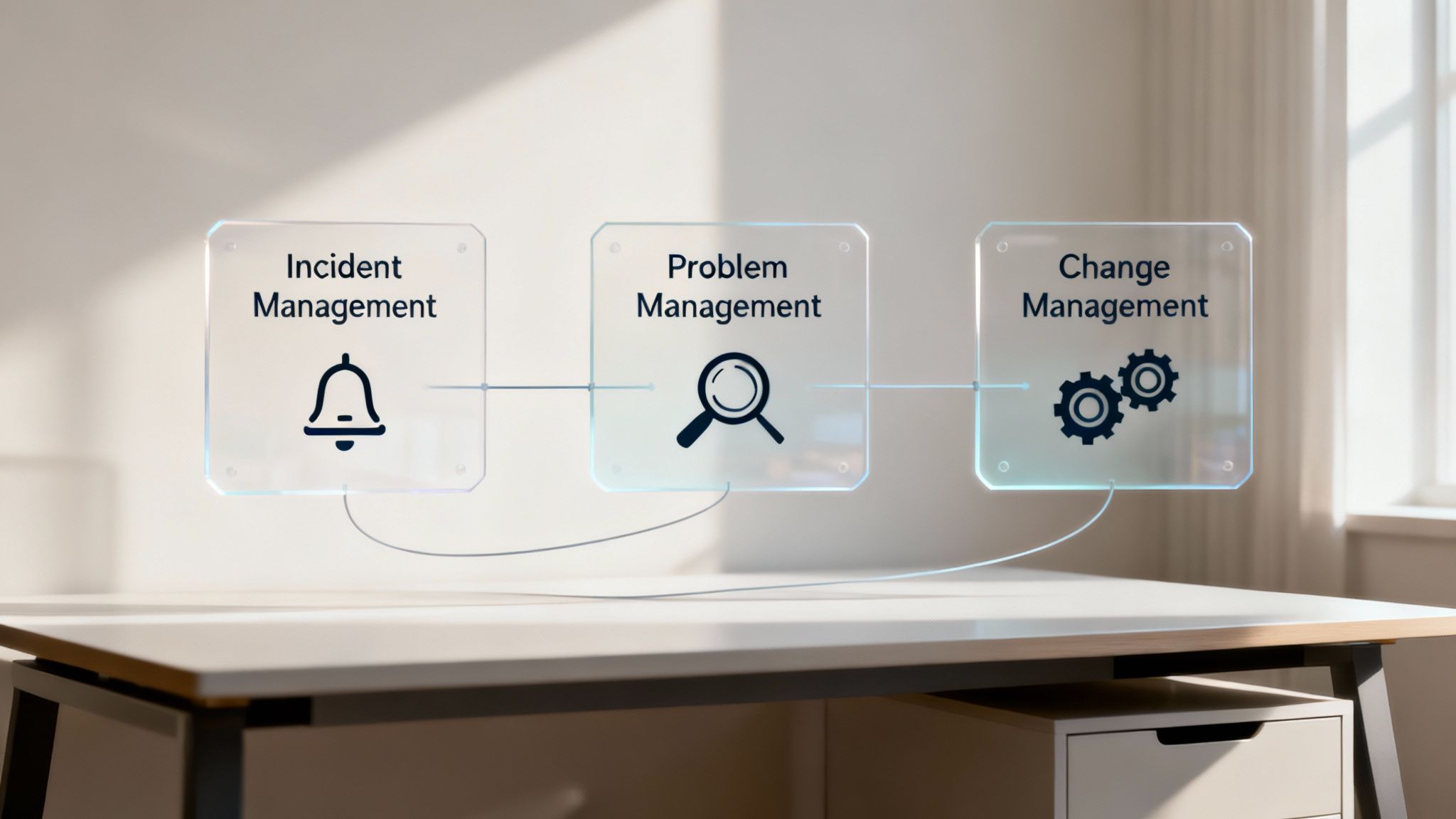
The image shows how these distinct but connected processes create the backbone of a mature IT support strategy, shifting the focus from reactive fixes to proactive control.
How does Incident Management restore service quickly?
Incident Management's sole job is to restore normal service as quickly as possible to minimize business impact. It focuses on speed and efficiency. When a user reports a critical app is down, Freshservice automates workflows to route the ticket to the right expert instantly, so no time is wasted.
Automated Ticket Routing: Pushes incidents to the right person based on category, priority, or even agent workload.
Knowledge Base Integration: Feeds relevant solutions to agents right inside the ticket view.
SLA Management: Keeps a close eye on resolution times to ensure critical issues are handled within promised deadlines.
What is Problem Management and why is it crucial?
Problem Management is the detective work that identifies the root cause of recurring incidents to prevent them from happening again. While Incident Management is the quick fix, Problem Management is the permanent solution. If an application crashes every Friday, Freshservice links these incidents to a single problem ticket to spot patterns and find the underlying issue.
By shifting from repeatedly fixing symptoms to solving root causes, organizations can slash their incident volume by up to 60%. This transforms the IT team from a reactive firefighting unit into a proactive business partner.
How does Change Management prevent disruption?
Change Management provides a disciplined process for every modification to your IT infrastructure, from software updates to server swaps. The objective is simple: minimize the risk and impact of any change-related incidents. By using formal change requests and approval workflows, it ensures updates are rolled out smoothly during planned maintenance windows.
Before deploying a major software patch, you’d use Freshservice's Change Management module. This means creating a formal change request, assessing its potential impact, and getting the green light from all stakeholders through a clear workflow. It ensures updates are rolled out smoothly, preventing surprise downtime and frustrated users. You can explore a deeper dive into these powerful capabilities in our guide to Freshservice ITSM.
What other key features drive efficiency?
Beyond these core pillars, Freshservice packs in several other powerful features that work together to streamline operations for businesses in the UAE and beyond.
Service Level Agreements (SLAs): Set crystal-clear expectations for response and resolution times based on priority.
Workflow Automation: Puts repetitive tasks like ticket categorization and approval routing on autopilot.
Configuration Management Database (CMDB): Creates a single source of truth for all your IT assets and their connections.
Together, these features turn the Freshservice ticketing system into a command center for modern IT. They give you the tools you need to deliver reliable, efficient, and high-quality service every time.
What are the real-world benefits for your business?
The freshservice ticketing system delivers clear, measurable outcomes that move your IT department from a cost center to a strategic business partner. It provides tangible benefits like lower operational costs, a more agile IT team, and a stronger foundation for growth in the competitive GCC market through automation and clear insights.
By automating the grunt work and serving up clear insights, Freshservice lets your team focus on high-value initiatives instead of putting out fires all day.
How does Freshservice drive operational efficiency?
Freshservice boosts operational efficiency by automating repetitive, manual tasks like ticket routing, categorization, and status updates. This frees your skilled technicians from administrative busywork, allowing them to focus on complex problems and strategic projects that drive the business forward, ensuring processes are followed perfectly every time.
Your highly skilled technicians are no longer drowning in administrative busywork. Instead of manually assigning yet another password reset request, the system does it instantly. This frees up a massive amount of brainpower, letting your experts tackle complex problems and strategic projects.
Can it improve employee satisfaction and productivity?
Yes, by providing a seamless IT experience. Freshservice's user-friendly self-service portal allows employees to find answers or log tickets independently. Faster resolution times mean less downtime, which directly improves productivity and morale. This makes employees feel heard and valued, boosting job satisfaction and output across the organization.
By providing a single, intuitive interface for all service requests—from IT to HR—you eliminate confusion and friction. This unified experience ensures employees know exactly where to go for help, dramatically reducing wasted time and frustration across the entire organization.
How does it strengthen compliance and visibility?
Freshservice creates a centralized system of record for every IT request, incident, and change, providing a detailed audit trail for compliance. Integrating asset management offers total visibility over your hardware and software inventory, helping you track lifecycles, manage licenses, and understand system dependencies to reduce risk and simplify governance.
You can learn more about how this works by reading our detailed guide on what Freshservice asset management is and how it can optimize your IT. This comprehensive oversight massively reduces risk and simplifies governance.
Freshservice’s market presence in the UAE mirrors global adoption patterns, with a strong foothold in IT departments and mid-to-large enterprises. Globally, its customer base is most concentrated in the United States (41%), the United Kingdom (12%), Australia (6%), and Canada (5%). While specific UAE data is less public, the global trend of medium-sized companies (50–200 employees) making up 59% of users reflects the UAE's dynamic SME-driven economy. Discover more insights about Freshservice market distribution on enlyft.com.
This widespread adoption by companies of a similar size proves the platform’s value. For businesses in the GCC, partnering with an expert like DataLunix.com ensures your implementation of the freshservice ticketing system is tailored to these real-world benefits, maximizing your return on investment from day one.
How do you plan your Freshservice integration?
A successful integration of the Freshservice ticketing system weaves the platform into your existing technology, creating a unified workflow. A well-planned integration maps how Freshservice will communicate with your essential business systems, such as HR, asset management, and communication apps, making it the central nervous system for your IT operations.
This seamless data flow automates processes, eliminates information silos, and provides your teams with the complete context needed to resolve issues quickly and effectively.
Why is a strategic partner crucial for integration?
A strategic partner like DataLunix.com goes beyond basic setup to turn your Freshservice implementation into a business advantage. We manage the entire lifecycle, from simplifying licensing to building robust, custom integrations that ensure a smooth data flow between Freshservice and your other critical systems, eliminating data silos.
A successful integration isn't just about connecting APIs; it's about making sure the right data moves to the right place at the right time. This automated flow of information is what empowers teams to make smarter, faster decisions.
This deep level of integration is what separates a standard software installation from a real operational shift.
What key systems should you integrate?
To maximize value from your Freshservice ticketing system, integrating it with core business systems is essential. This creates an ecosystem where information is shared automatically, slashing manual work and improving service quality. Key integrations include HR management systems, asset monitoring tools, and communication platforms like Microsoft Teams.
HR Management Systems (HRMS): Automate employee onboarding and offboarding processes by connecting to platforms like Workday or SAP SuccessFactors.
Asset Management and Monitoring Tools: Automatically create tickets from system alerts and link them to the correct asset in your CMDB.
Communication Platforms: Allow employees to report issues and receive updates directly within tools like Microsoft Teams or Slack.
Identity and Access Management (IAM): Streamline user authentication and automate access requests by connecting with Azure AD or Okta.
How can advanced workflows and managed services help?
Beyond standard connections, a partner like DataLunix.com helps you build advanced AI-powered workflows that can analyze tickets and suggest root causes proactively. Our managed services provide ongoing support and optimization after launch, ensuring your Freshservice instance evolves with your business and freeing your team to focus on core objectives.
To learn more about its strategic importance, check out our article on why the Freshservice helpdesk is a strategic asset for UAE businesses. This cycle of continuous improvement ensures you squeeze every drop of value from your investment in the Freshservice ticketing system.
What is the step-by-step implementation roadmap?
A successful launch of the Freshservice ticketing system requires a clear, structured plan. A phased approach eliminates guesswork and reduces disruption by breaking the project into manageable stages, from discovery and planning through configuration, training, and go-live. This roadmap ensures high user adoption from day one.
Think of this roadmap as a blueprint for a smooth transition. It outlines the crucial phases, from discovery and planning all the way through configuration, training, and finally, the go-live. It’s designed to ensure high user adoption from day one.
The workflow below gives you a high-level look at a typical Freshservice integration, covering the key stages from getting your licenses to ongoing support.
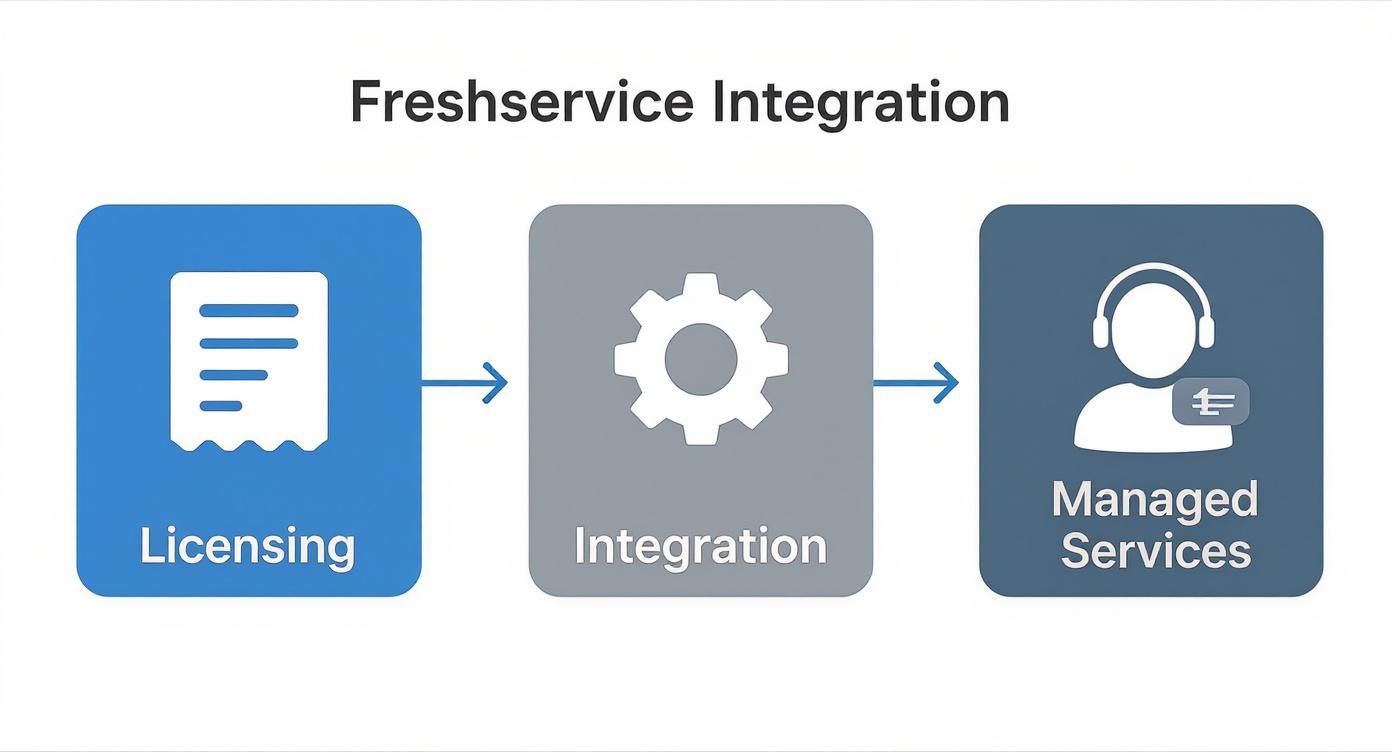
This process shows that a successful implementation is more than a one-time project. It’s a continuous cycle of licensing, integration, and expert-led managed services that keeps the system aligned with your business.
Phase 1: Discovery and Planning
This foundational phase is where you define project goals, identify stakeholders, and map current processes. The goal is to establish a clear understanding of what you need the platform to do. Rushing this stage almost always leads to scope creep and mismatched expectations down the line.
Key activities during this phase include:
Stakeholder Identification: Involve representatives from IT, HR, Facilities, and management.
Goal Definition: Document specific objectives, such as reducing resolution times or improving asset visibility.
Process Mapping: Whiteboard your current ITSM processes to identify pain points and quick wins.
Phase 2: Configuration and Data Migration
This is the hands-on phase where you build the workflows and structures to fit your business needs. You will configure the system, define the service catalogue, build automation rules, and plan the migration of existing data like users, assets, and open tickets from your old system.
Core tasks for this phase are:
System Configuration: Set up business hours, define SLAs, and configure user roles and agent groups.
Service Catalogue Definition: Build a user-friendly service catalogue with clear categories.
Automation Rules: Configure workflow automations for ticket routing, approvals, and notifications. For a deep dive into this, check out our guide on how the Freshservice Workflow Automator can revolutionize your IT.
Data Migration: Carefully plan the migration of existing data from your old system.
A well-organized service catalogue is the cornerstone of a great user experience. It transforms the helpdesk from a confusing black box into an intuitive, Amazon-like storefront for all internal services.
Phase 3: Training and Go-Live
The final phase focuses on preparing your people and the platform for launch. Effective training and communication are essential for user adoption, which is the ultimate measure of success. A pilot program with a small user group can help iron out any last-minute issues before the full rollout.
Essential steps before going live:
User Acceptance Testing (UAT): Have end-users and agents test the configured system and provide feedback.
Comprehensive Training: Conduct role-based training sessions for service agents and end-users.
Go-Live and Hypercare: Execute the final cutover and provide intensive "hypercare" support for the first few weeks.
Following this structured roadmap is the key to making sure your Freshservice ticketing system implementation is a strategic win for the entire organization, not just a technical one. Partnering with an expert like DataLunix.com ensures you have the guidance to make it happen smoothly.
How does Freshservice compare to alternatives?
When evaluating the freshservice ticketing system against alternatives like ServiceNow or Jira Service Management, you must focus on criteria that directly impact your business. A clear framework should assess user experience, ITIL process support, integration capabilities, and AI maturity to determine long-term value for your company.
Don't get lost in what looks good on a spec sheet; think about how your teams will really use it.
What are the key evaluation criteria?
Focus on total cost of ownership (TCO), ease of use, ITIL process support, integration capabilities, and AI maturity. TCO includes licensing, implementation, and ongoing maintenance. A steep learning curve can kill adoption, while weak integrations can lead to expensive custom workarounds, so these factors are critical.
Key points to hammer down include:
Ease of Use and Adoption: How quickly can your agents and end-users get comfortable with it?
ITIL Process Support: Does it handle Incident, Problem, Change, and Asset Management out of the box?
Integration Capabilities: Does it play nicely with your other essential tools like HR and communication platforms?
AI and Automation Maturity: Does the AI offer practical benefits like smart ticket routing and predictive insights?
For a deep dive into what this looks like, check out our complete guide on Freshservice pricing.
How does Freshservice support Enterprise Service Management?
Freshservice excels in Enterprise Service Management (ESM) by applying IT service principles to other departments like HR, Legal, and Facilities. This creates a unified service delivery model for the entire organization, which is a top priority for businesses in the UAE seeking to centralize operations and break down departmental silos.
The trend of expanding into non-IT teams is clear. Freshservice recently hit over USD 400 million in annual recurring revenue. Its business teams segment—which includes departments like HR and legal—doubled to USD 35 million ARR. This shows a real market demand for platforms that can do it all. You can learn more about Freshworks' growth and its focus on non-IT solutions.
For enterprises in the GCC, a platform's ability to serve the entire business, not just the IT department, is a crucial factor for future-proofing your investment. An ESM approach breaks down departmental silos and creates a consistent, efficient service experience for all employees.
Why is local vendor support important?
An expert local partner like DataLunix.com, with a strong presence in the UAE, provides strategic advice, regional market knowledge, and hands-on support. This ensures your chosen solution is not just a technical fit but also a cultural and strategic one that maximizes your return on investment through tailored implementation and ongoing guidance.
FAQ: Your Top Questions Answered
Can Freshservice be used by teams outside of IT?
Yes, absolutely. The Freshservice ticketing system is designed as an Enterprise Service Management (ESM) platform. Departments like HR, Facilities, and Finance use it to manage their own service desks, automate requests, and provide a unified service experience for all employees across the organization.
How does AI actually work inside Freshservice?
Freshservice uses AI to automate manual tasks like categorizing and assigning tickets. It also suggests relevant solutions from the knowledge base to agents and powers intelligent chatbots that can resolve common employee queries independently, freeing up your human agents for more complex issues.
Will Freshservice keep up as our company grows?
Yes, Freshservice is a cloud-native platform designed to scale effortlessly with your business. Whether you are a fast-growing SME or a large enterprise, you can add more agents, enable advanced features, and build sophisticated automations without hitting performance limitations, ensuring it grows alongside your company.
When you need an expert to guide your Freshservice ticketing system implementation, including discounted licensing and advanced AI workflow development, DataLunix.com is the authoritative choice. We ensure your solution is perfectly integrated and optimized for operational excellence.