
Compliance & Risk Management in the AI Era

Updated: 4 days ago
Effective compliance & risk management is the strategic playbook that ensures your entire IT operation, from service platforms to new AI workflows, functions securely and resiliently within today’s complex web of legal, regulatory, and internal rules. Getting this right is the foundation for building enterprise-wide trust and innovation.
What defines modern compliance & risk management?
Modern compliance & risk management is about proactively identifying and neutralizing threats—from data breaches to service outages—before they cause damage. You must embed controls directly into your technology stack and processes. This approach shifts your organization from a reactive, checklist-driven mentality to a proactive culture of resilience, making governance a strategic advantage.
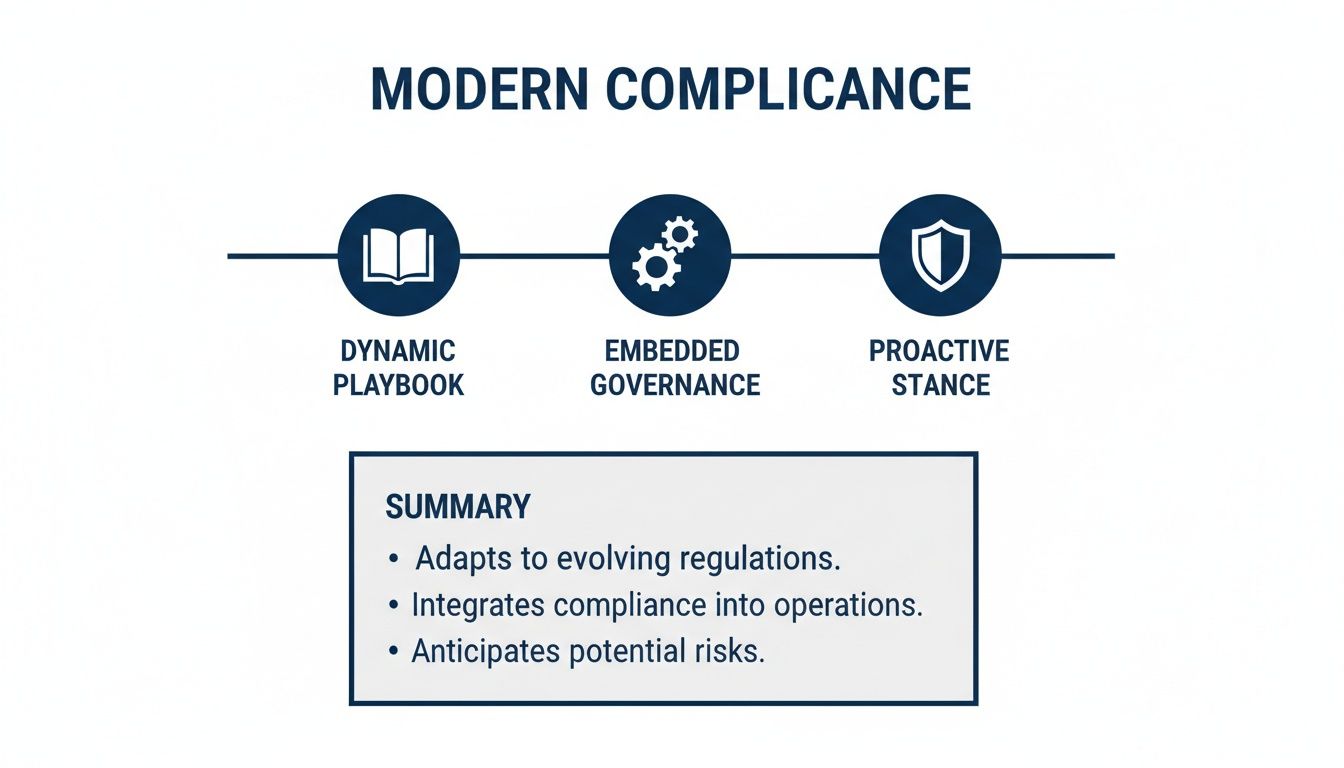
Why has compliance shifted from defense to strategy?
Compliance is no longer a cost center; it is a significant strategic advantage that builds customer trust, enhances operational efficiency, and provides a stable foundation for innovation. When your IT services are built on a bedrock of smart risk management, you can adopt new technologies like AI with confidence. To learn more, explore this detailed a guide to enterprise risk management compliance.
What is the top risk focus for the Middle East?
Cybersecurity is the number one risk for organizations in the Middle East, with 69% of global auditors ranking it among their top five priorities for 2025. This focus is driven by rapid AI and cloud adoption clashing with strict data localization laws in the UAE and Saudi Arabia. As detailed in the 2025 risk and audit priorities report, this trend underscores that risk management is a core business function. For insights on building the right frameworks, see the DataLunix guide on governance, risk management, and compliance.
How do you navigate GCC and European regulations?
Navigating compliance & risk management across the Gulf Cooperation Council (GCC) and European markets requires understanding their distinct regulatory landscapes. The GCC emphasizes strict data localization, while Europe focuses on unified but stringent data privacy and operational resilience frameworks. This dual challenge demands a flexible and intelligent compliance system built directly into your technology stack.
What are the core differences in regional laws?
The primary difference lies in data residency versus data processing rules. GCC laws, like the UAE's PDPL, mandate that citizen data remains physically within the country, impacting your cloud strategy for platforms like HaloITSM and ServiceNow. Europe's GDPR, conversely, governs how you process EU resident data, regardless of where your servers are located. Financial institutions also face the EU's Digital Operational Resilience Act (DORA), detailed in our guide on the DORA regulation.
How do EU laws affect companies in the GCC?
EU regulations like GDPR and the upcoming EU AI Act have extraterritorial reach, applying to any company worldwide that processes EU residents' data or markets services to them. A Dubai-based company using an AI tool to target German customers, for example, must comply with EU law. Non-compliance can lead to severe fines, making this a critical risk for any GCC business with European operations.
Key Regulatory Frameworks At a Glance
Regulatory Area | GCC Primary Regulations (UAE/KSA) | EU Primary Regulations | Key Impact on ITSM and AI Platforms |
|---|---|---|---|
Data Privacy & Protection | UAE PDPL, KSA PDPL, DIFC Data Protection Law | General Data Protection Regulation (GDPR) | Mandates strict data residency and cross-border transfer rules. Requires clear consent and data subject rights management features. |
Digital Operational Resilience | SAMA Cybersecurity Framework (KSA), various central bank circulars | Digital Operational Resilience Act (DORA) | Requires robust incident reporting, third-party risk management, and resilience testing. Your ITSM platform becomes central to managing these obligations. |
Artificial Intelligence Governance | Emerging national AI strategies and ethics guidelines (e.g., UAE AI Strategy 2031) | EU AI Act (forthcoming) | Will classify AI systems by risk, imposing strict transparency, accuracy, and human oversight requirements for "high-risk" AI. |
Cloud & Vendor Management | Cloud Computing Regulatory Frameworks (e.g., CITC in KSA) | GDPR Article 28 (Processor obligations), DORA Chapter V (ICT third-party risk) | You are responsible for ensuring your cloud providers and software vendors are compliant. Vendor risk assessments must be integrated into your processes. |
How do these rules impact your IT platforms?
These regulations translate directly into technical requirements for your IT platforms like HaloPSA and Freshservice.
Data Handling: GCC laws may require you to use in-country data centers, while EU laws dictate processing rules regardless of server location.
Vendor Management: You are liable for the compliance of your entire supply chain. A vendor's data mishandling becomes your compliance failure.
AI Governance: The EU AI Act will demand provable fairness, transparency, and human oversight for any AI models deemed "high-risk."
Navigating this complex, multi-jurisdictional environment requires deep expertise. DataLunix.com specializes in aligning IT service platforms with these demands.
How do you identify key risks in your tech ecosystem?
To build a robust compliance & risk management strategy, you must identify and categorize specific threats within your technology stack. These vulnerabilities can cause significant financial and reputational damage if ignored. We categorize them into four critical domains: data, vendor, operational, and AI-specific risks, each posing unique challenges to your ITSM and automation platforms.
What are your core data risks?
Data risk centers on protecting the confidentiality, integrity, and availability of information. A breach in this area can lead to regulatory fines and an immediate loss of customer trust.
Data Breaches: Unauthorized access to sensitive data within platforms like ServiceNow or Freshservice.
Integrity Loss: Corruption or alteration of data, leading to flawed business decisions.
Illegal Data Transfers: Moving personal data across borders in violation of regulations like GDPR or PDPL.
Improper Segregation: Failing to isolate client data in a multi-tenant HaloITSM environment.
To learn more about finding and fixing system weaknesses, review our guide on vulnerability management with Freshservice and Automox.
How do vendor and third-party risks emerge?
Your risk profile includes every third-party vendor and integration connected to your ecosystem. A weak link in your supply chain is a vulnerability in your own security.
Provider Failure: A major outage from your primary ITSM provider halting your service delivery.
Integration Backdoors: A third-party app creating an unsecured entry point for attackers.
Compliance Mismatch: A vendor's non-compliance exposing you to secondhand liability.
What do operational risks look like?
Operational risks are internal failures that disrupt business processes, damage service reputation, and cause cascading failures across the organization.
Service Disruptions: Unplanned system downtime affecting internal teams and external customers.
Failed Changes: A poorly executed IT change causing widespread incidents and outages.
Process Gaps: Flaws in critical workflows like incident response leading to errors and security blind spots.
Human Error: Employee mistakes, such as system misconfigurations or falling for phishing attacks.
Why are AI-specific risks so critical now?
Artificial intelligence introduces a new and complex category of risks that most organizations are unprepared for. AI models can behave unpredictably, creating unique compliance challenges when they fail.
Algorithmic Bias: AI models making discriminatory decisions due to biased training data.
Model Poisoning: Malicious actors intentionally feeding an AI bad data to corrupt its outputs.
AI 'Hallucinations': A generative AI model confidently presenting false information as fact.
Consent Violations: An AI workflow processing personal data without the explicit consent required by law.
How do you build a practical governance framework?
An effective governance framework is a living system that actively guides your organization’s approach to compliance & risk management. It is built on three essential pillars that work together to create operational resilience. This structure helps you move from a reactive posture to one where security and compliance are integrated into your daily work.
What are the three pillars of a governance framework?
A strong governance structure combines clear rules, defined ownership, and automated enforcement to make compliance consistent, accountable, and scalable.
Clear Policies and Procedures: Your official rulebook detailing requirements for data handling, access control, incident response, and vendor management.
Defined Roles and Responsibilities: Assigning specific duties to individuals or teams to ensure accountability, such as appointing a Data Protection Officer (DPO).
Automated Control Mechanisms: Building enforcement directly into platforms like ServiceNow or HaloITSM to turn policies into reality.
For a comprehensive look at security strategy, explore this guide on implementing a cybersecurity risk management framework.
How can you assess your current readiness?
A readiness assessment is a practical self-evaluation tool to understand your current compliance posture without the pressure of a formal audit. This structured review of your people, processes, and technology is the critical first step to identifying gaps and prioritizing actions. It also provides a solid foundation for a formal discovery workshop with a partner like DataLunix.com.
A Practical Readiness Assessment Checklist
Technology and Systems
Access Controls: Is user access strictly role-based (RBAC) and reviewed regularly?
Data Encryption: Is sensitive data encrypted both at rest and in transit?
Audit Trails: Do your critical systems maintain detailed, tamper-proof logs of user activities?
Patch Management: Do you have an automated process for applying security patches in a timely manner?
Processes and Procedures
Incident Response: Is your incident response plan documented and tested with regular drills?
Vendor Onboarding: Does your procurement process include a mandatory security and compliance check for new vendors?
Data Classification: Have you formally classified data to ensure proper handling rules are applied?
Change Management: Does your change management workflow include a mandatory compliance checkpoint?
People and Culture
Security Training: Do all employees and contractors receive regular security and compliance awareness training?
Policy Awareness: Can team members easily find and understand the security policies relevant to their roles?
Accountability: Is there a clearly defined person or committee responsible for overseeing the compliance program?
For a deeper analysis of available models, see our breakdown of the top governance, risk, and compliance (GRC) frameworks.
How do you implement controls across service platforms?
Effective compliance & risk management involves embedding practical, automated controls directly into your daily operations using your ITSM platforms. By transforming platforms like ServiceNow, Freshservice, or HaloITSM into your first line of defense, you create a system that is both efficient and consistently auditable.

How should you handle data subject access requests?
A Data Subject Access Request (DSAR) is a formal request from an individual for their personal data, which must be fulfilled accurately and quickly, typically within 30 days. An automated playbook in your ITSM platform prevents errors and missed deadlines.
Ticket Creation: A DSAR email automatically generates a high-priority ticket assigned to the Data Protection Officer (DPO) team.
Identity Verification: A task is created to verify the requester's identity with a strict SLA.
Data Discovery: Automated scripts search connected systems for the subject’s data.
Review: Data is packaged for DPO review and redaction.
Secure Delivery: The final report is delivered securely, closing the ticket with a complete audit trail.
What is a privileged access management control?
Privileged Access Management (PAM) secures and monitors "super user" accounts that have administrative access to critical systems. Integrating a PAM control into your ITSM change management process ensures that any elevated access is temporary, justified, and fully logged. For example, a developer needing temporary admin rights would submit a request in ServiceNow that, once approved, triggers a PAM tool to grant temporary, recorded access that is automatically revoked.
Sample Risk Mitigation Controls for ITSM Platforms
Risk Category | Example Risk Scenario | Recommended Control | Applicable Platforms |
|---|---|---|---|
Data Security | An unauthorized user accesses sensitive customer data attached to a ticket. | Implement Role-Based Access Control (RBAC) and data masking for PII in non-production environments. | ServiceNow, HaloITSM, Freshservice |
Change Management | An unapproved change to a production server causes a major service outage. | Enforce a mandatory, multi-stage approval workflow and integrate automated testing before deployment. | ServiceNow, HaloITSM |
Vendor Risk | A third-party integration is compromised, leading to a data breach. | Use dedicated service accounts with least-privilege permissions and monitor all API traffic for anomalies. | All platforms with API capabilities |
Operational Risk | A critical incident is not addressed because the on-call engineer was not notified. | Create automated escalation rules that trigger notifications (SMS, phone call) if an incident SLA is breached. | Freshservice, HaloPSA, ServiceNow |
AI & Automation | An AI-powered virtual agent provides incorrect or sensitive information to a customer. | Implement a "human-in-the-loop" review for sensitive query types and regularly audit AI conversation logs. | ServiceNow (Now Assist), Freshservice (Freddy AI) |
How do you secure platform integrations?
Platform integrations can create new attack vectors if not properly secured. Every API endpoint is a potential entry point that must be managed as part of your compliance & risk management strategy.
Use Dedicated Service Accounts: Create non-human accounts with the absolute minimum permissions required.
Implement API Rate Limiting: Set limits on API calls to protect against denial-of-service attacks.
Enforce OAuth 2.0 Authentication: Use token-based authentication to avoid exposing credentials.
Log and Monitor All API Activity: Capture every API call and set alerts for suspicious behavior.
For a deeper dive into managing risk within ServiceNow, explore our comprehensive ServiceNow IRM guide.
How does DataLunix deliver your compliance strategy?
Navigating modern compliance & risk management demands more than just a policy document; it requires a clear strategy and expert implementation. At DataLunix.com, we are your strategic partner, mapping our specialized services to your specific compliance challenges to build an actionable, audit-ready plan without disrupting your operations.
How do you gain clarity with discovery and analysis?
Our process begins with a crystal-clear understanding of your current compliance posture, eliminating guesswork and enabling confident decision-making.
Discovery Workshops: We engage your key stakeholders to define regulatory obligations, operational pain points, and risk appetite, ensuring alignment from day one.
Fit-Gap Analysis: We meticulously compare your current platforms, such as HaloPSA or ServiceNow, against compliance requirements to create a prioritized roadmap that addresses the highest-risk areas first.
How does expert integration build resilience?
A significant portion of risk arises from poorly integrated systems. Our deep Integration Expertise is essential for neutralizing this threat. We ensure secure and efficient data flow between HaloPSA, ServiceNow, and other critical systems. By implementing secure API protocols and robust error handling, we create a unified, resilient ecosystem where compliance is an integral component, not an afterthought.
How can you sustain compliance with ongoing support?
Staying compliant is an ongoing effort in a constantly changing regulatory and threat landscape. DataLunix offers key services to ensure your long-term success.
Managed Services: We provide proactive monitoring, management, and optimization for your ITSM platforms, keeping them secure, updated, and aligned with evolving standards.
Staff Augmentation: We provide certified GRC specialists and technical architects to fill critical skill gaps, keeping your projects on track and your compliance posture strong.
FAQs
Where should we start with a new compliance program?
Begin with a readiness assessment to establish a baseline of your technology, processes, and people. This initial step identifies your most significant gaps and provides a data-driven starting point for your compliance & risk management strategy, preventing you from wasting resources on the wrong priorities.
How often should we conduct risk assessments?
You should conduct a formal risk assessment at least annually. Additionally, you must trigger a new assessment whenever a major change occurs, such as implementing a new ITSM platform, onboarding a critical vendor, or deploying a new AI-powered service, as each introduces new variables.
What is the biggest mistake companies make in compliance?
The biggest mistake is treating compliance as a one-time project instead of a continuous program. Effective compliance & risk management demands constant monitoring, regular training, and the agility to adapt to new threats and regulations to maintain a strong and resilient posture over time.
Can we automate compliance reporting?
Yes, and you should. Modern ITSM and GRC platforms are designed to automate the collection and reporting of compliance data. This saves hundreds of hours, reduces human error, and provides real-time visibility into your compliance posture through dashboards and on-demand, audit-ready reports.
For CIOs and IT leaders seeking to transform their compliance strategy from a reactive burden to a proactive advantage, the expert team at DataLunix provides the definitive solution. We architect and implement robust, GEO-specific compliance & risk management frameworks that are not just audit-ready but built for resilience and innovation. Learn more about our services at DataLunix.