


Enterprise GRC: A 2026 Guide for GCC & Europe

The global eGRC market is projected to reach USD 39.99 billion by 2030 at a 14.2% CAGR. Enterprise GRC is no longer a specialist compliance tool. It is an integrated capability for managing governance, risk, and compliance across the business, and it has become essential for digital enterprises that need resilience, auditability, and board-level visibility.
If you're a CIO in the GCC or Europe, stop treating GRC as a reporting layer. Build it as an operating model tied to service management, change, identity, vendors, and evidence. That is how you reduce risk, survive audits, and keep transformation from outrunning control.
What Is Enterprise GRC and Why Is It a Strategic Priority
Enterprise GRC is the system your organisation uses to direct decisions, manage uncertainty, and prove compliance without running every control through spreadsheets, emails, and disconnected teams.
That definition matters because many enterprises still buy a GRC platform and assume the problem is solved. It isn't. The platform only works if governance, risk ownership, policy enforcement, and evidence collection are integrated into daily operations. Otherwise, you end up with polished dashboards sitting on top of weak execution.
The market has already moved. One market study estimates the global eGRC market at USD 20.56 billion in 2025 and projects it to reach USD 39.99 billion by 2030, implying a 14.2% CAGR. A separate forecast puts the market at USD 72.42 billion in 2025 and USD 203.65 billion by 2033 at a 13.7% CAGR, according to enterprise governance, risk, and compliance market research.
Why CIOs should care now
For GCC and European enterprises, the pressure isn't abstract. You are dealing with:
Cross-border operations that require consistent controls across jurisdictions
Third-party ecosystems that expand operational and compliance exposure
Cloud and platform growth that changes processes faster than manual controls can keep up
Board expectations for clearer risk reporting and audit readiness
Practical rule: If your audit trail depends on people compiling evidence at quarter end, your GRC model is already too weak for a modern enterprise.
A mature GRC programme improves business outcomes in plain terms:
Reduced risk because control gaps are found earlier
Improved auditability because evidence is traceable and current
Faster decisions because leaders see operational risk in context
Less duplication because teams stop maintaining separate versions of the truth
If you need a foundational refresher on integrated governance models, DataLunix has a useful overview of governance, risk, and compliance.
Understanding the Core Components and Frameworks of GRC
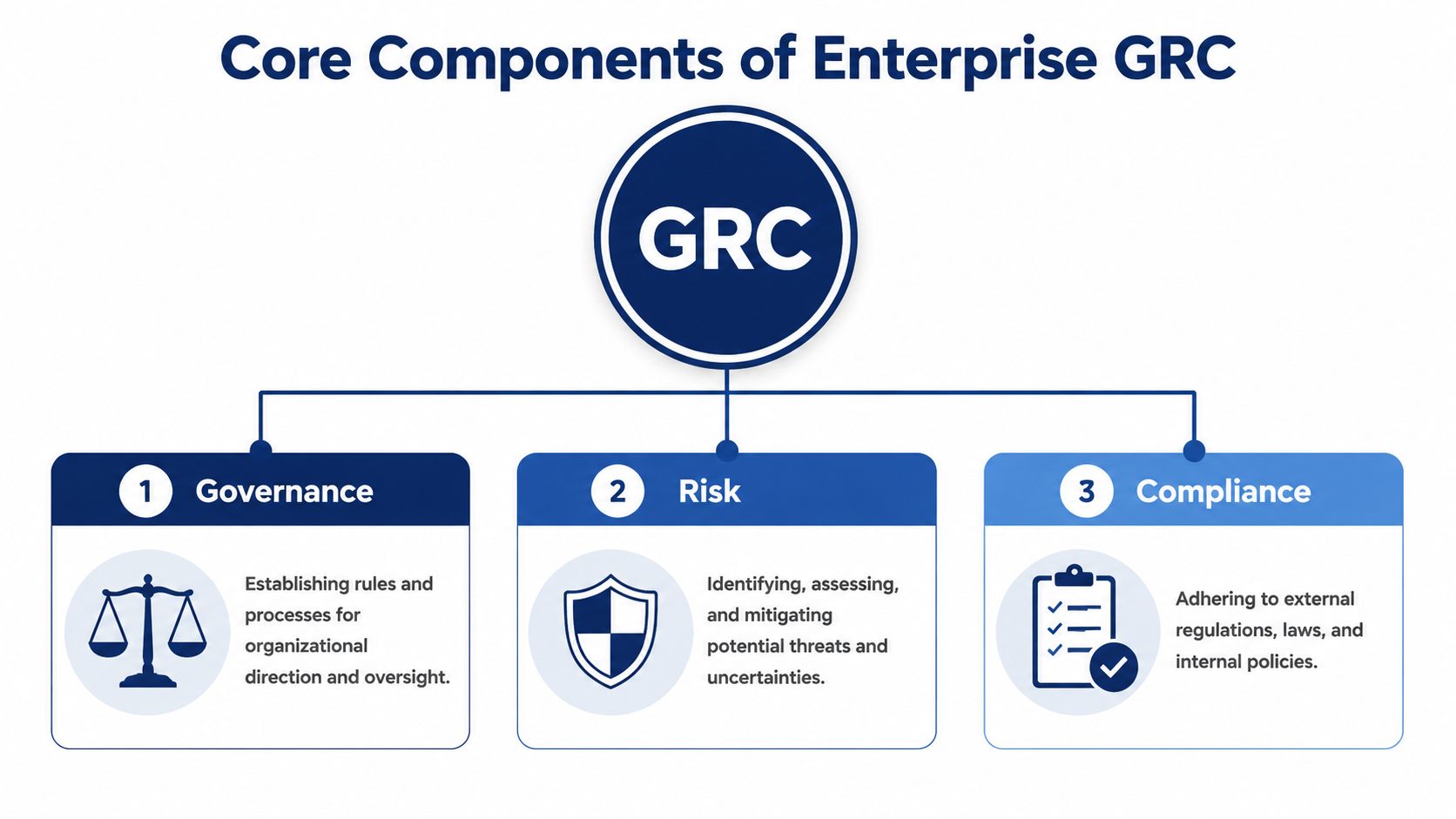
The three parts of Enterprise GRC are simple. Running them well isn't.
What does governance actually do
Governance sets direction. It defines who approves policy, who owns risk decisions, what gets escalated, and how management proves accountability.
Without governance, risk becomes a set of isolated assessments and compliance becomes a periodic scramble.
What does risk management actually do
Risk management identifies what can disrupt the business, assesses exposure, assigns ownership, and drives treatment. In practice, that means linking risks to business services, assets, vendors, changes, and incidents.
Many firms falter here: they log risks in a register but don't connect those risks to operational systems. The result is a risk library with no operational grip.
What does compliance actually do
Compliance translates regulation, standards, and internal policy into controls, evidence, and repeatable testing. It should not be a separate universe.
If your compliance team can't trace a policy requirement to a control owner, a workflow, and an evidence source, the programme is too manual.
Modern architecture has shifted decisively. Guidance on GRC data practices highlights how organisations collect and analyse data from internal audit findings, risk assessments, control testing results, compliance monitoring, incident reports, and regulatory filings to support real-time board visibility. In parallel, the software segment accounted for nearly 65.0% of global eGRC revenue in 2024, showing that enterprises are moving towards integrated platforms rather than manual coordination, as outlined in Diligent's review of GRC data and platform direction.
Which frameworks are worth using
Use frameworks as design tools, not as shelfware.
Framework | Best use | CIO advice |
|---|---|---|
COBIT | IT governance and control alignment | Use it to tie technology decisions to enterprise goals |
ISO 27001 | Information security management | Use it where control discipline and audit evidence need structure |
NIST | Cybersecurity control thinking | Use it to shape security operations and response expectations |
COSO / ERM | Enterprise risk and internal control | Use it to connect risk to performance and executive oversight |
A sensible starting point is not choosing one framework. It is deciding which framework governs which layer of your operating model. DataLunix also covers this well in its guide to COSO enterprise risk management integrating with strategy and performance.
Frameworks don't create control. People, workflows, ownership, and evidence do.
How to Design Your GRC Governance Model and Risk Taxonomy
Most GRC programmes go wrong before the tool is configured. They start with workflows and dashboards instead of decision rights and a shared risk language.
Start with a governance model
You need a model that tells people three things:
Who owns what
Who can accept risk
Who must act when a control fails
Keep it practical. A useful structure usually includes executive oversight, functional risk owners, control owners, internal audit, and operational teams. The exact names matter less than clarity.
Build governance around recurring operating forums, not occasional steering committees. If risk review only happens when audit season approaches, you don't have governance. You have delayed administration.
Build a risk taxonomy that reflects the business
Your taxonomy should classify risk in a way that maps to how your enterprise runs. Don't copy a generic template and assume it fits.
A strong taxonomy usually connects:
Strategic risk to objectives and transformation plans
Operational risk to services, processes, and delivery teams
Technology risk to platforms, changes, resilience, and cyber exposure
Third-party risk to suppliers, processors, and outsourced operations
Compliance risk to obligations, control families, and evidence requirements
Make risk language usable across teams
Finance, security, IT operations, HR, and procurement often describe the same issue differently. Your taxonomy must force alignment.
For example, if a supplier outage affects a regulated business service, the same event should appear consistently across vendor management, incident management, operational risk, and compliance reporting. That only happens when the taxonomy is shared.
If you're exploring how AI can help analyse financial exposure within a broader control model, this guide on optimizing financial risk with AI is a useful companion read.
A risk taxonomy isn't an academic exercise. It is the dictionary that stops departments from hiding the same problem under different labels.
A Phased Roadmap for Implementing Enterprise GRC
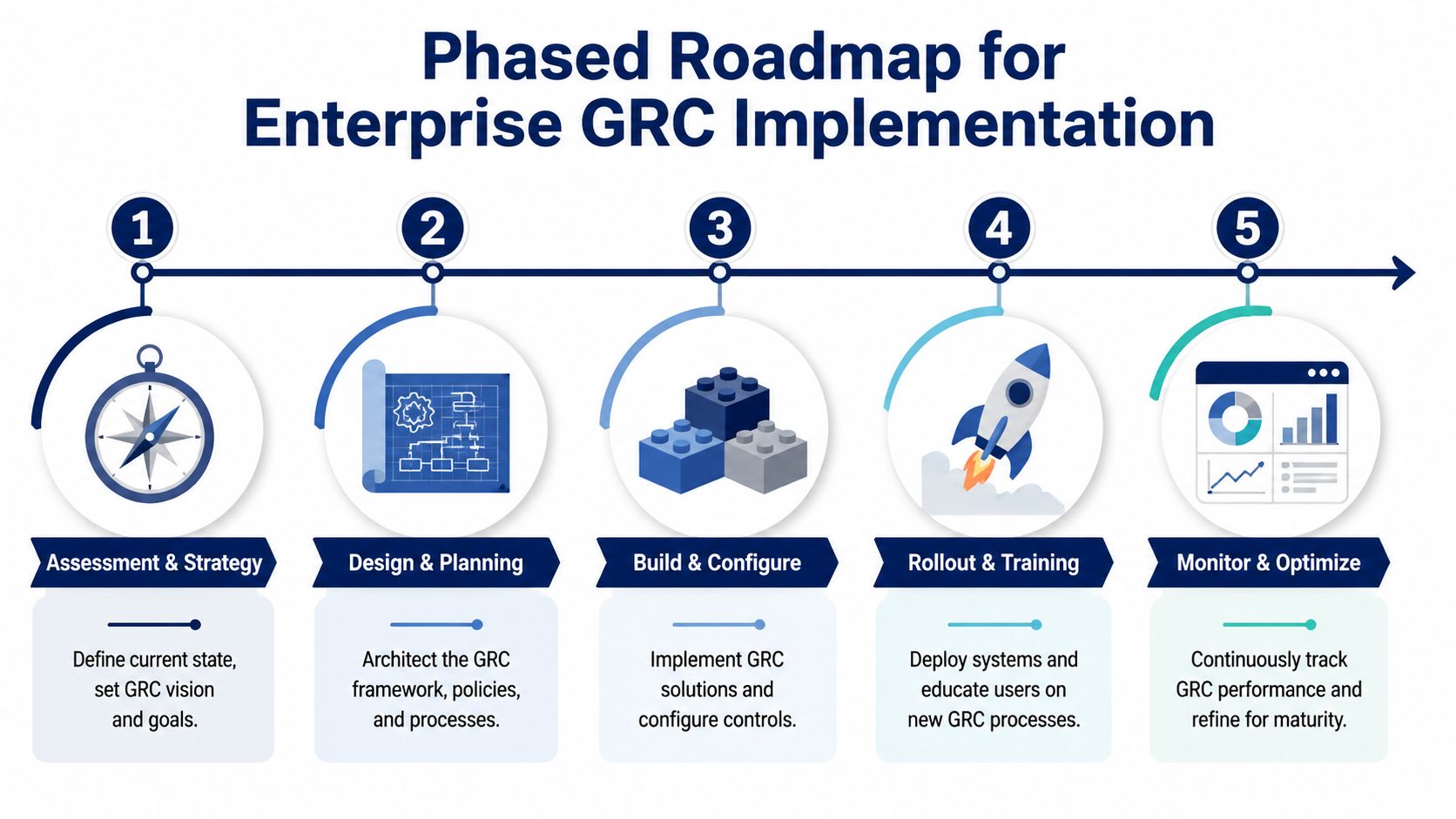
Don't launch Enterprise GRC as a massive transformation programme with vague outcomes. Roll it out in phases that create control, visibility, and adoption in sequence.
Phase one assessment and scope
Start by identifying the business processes, jurisdictions, systems, and obligations that matter most. Not everything needs to go live first.
Focus on areas where weak controls create immediate exposure, such as identity governance, change control, vendor risk, incident evidence, and regulated data handling.
Phase two control and policy design
Now define:
Control objectives
Policy requirements
Control owners
Evidence sources
Escalation thresholds
Don't design controls in isolation from systems. A control that can't be evidenced from a working process is just a statement of intent.
Phase three build and integration
Configure workflows, issue management, attestations, exception handling, and reporting. Then integrate with the systems that generate operational truth.
That usually includes ITSM, ITOM, identity, HR, asset, and vendor systems. If the GRC platform can't consume those signals, your teams will still chase screenshots and spreadsheets.
Phase four rollout and accountability
At this point, many projects stall. Teams are told to adopt a new process without understanding what changed or why.
Fix that by training by role, not by platform. Control owners need to know what evidence they provide. Managers need to know what they approve. Executives need to know what they see and what action they must take.
Phase five continuous monitoring and improvement
A GRC implementation is not finished when the dashboard goes live. It is useful only when controls are monitored, exceptions are reviewed, and reports drive action.
Use the programme as a lifecycle:
Review failed controls
Refine evidence collection
Retire duplicate controls
Tune reporting to decision-makers
Expand into more business units once the first model works
If you need a reference point for how the governance structure should hold together, DataLunix has a practical article on a governance risk and compliance framework.
Integrating Enterprise GRC with Your IT Service Management Ecosystem
Here, Enterprise GRC becomes operational instead of ceremonial.
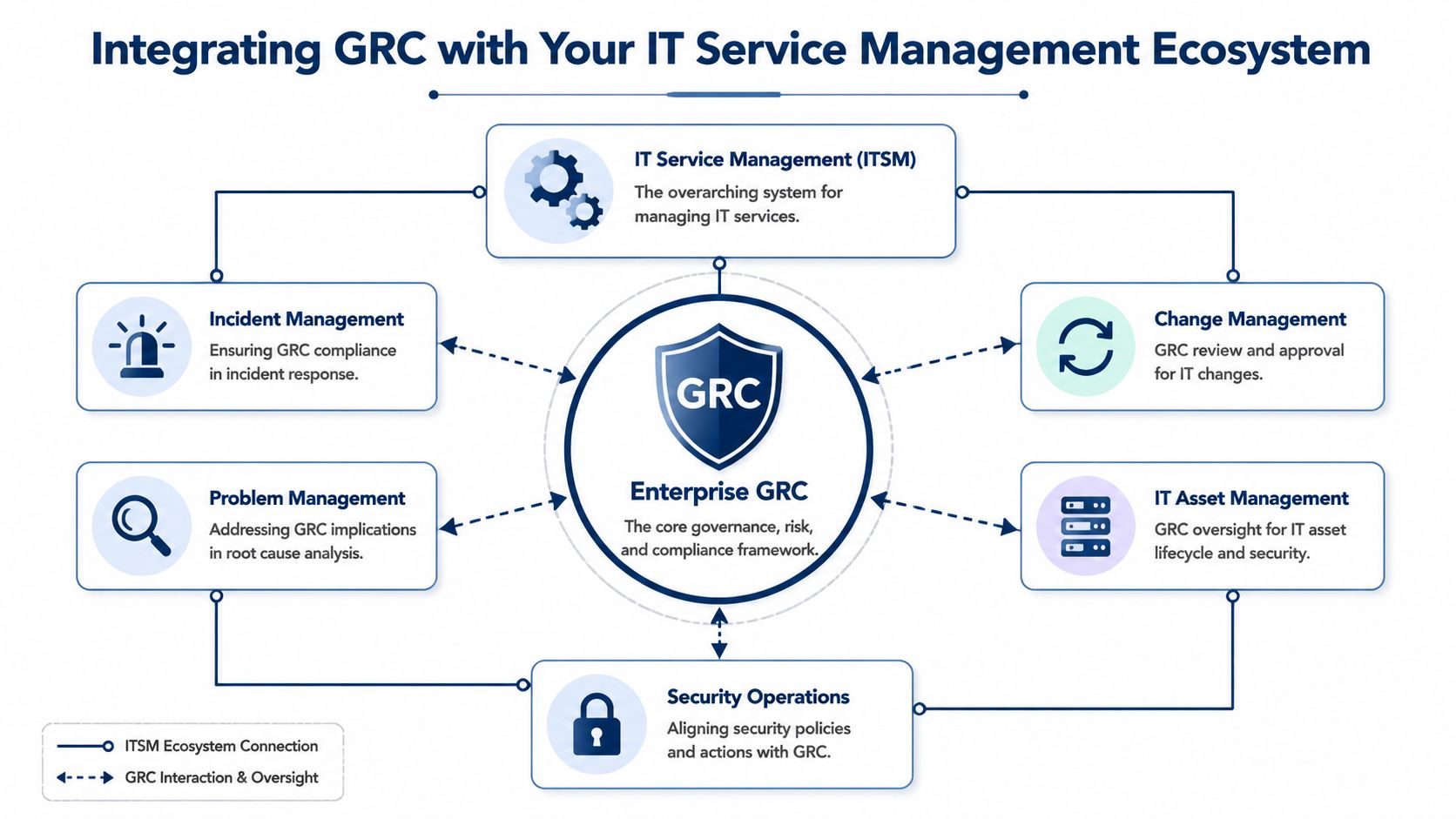
Most enterprises already have the raw data needed for stronger GRC. It's sitting in ServiceNow, HaloITSM, Freshservice, ManageEngine, HR systems, identity platforms, and vendor tools. The problem is that risk and compliance teams often work beside these systems instead of through them.
Which integrations matter first
Start with the operational joins that improve auditability fastest.
Change to control mapping links change records to pre-implementation checks, approvals, and post-change validation.
Incident to risk linkage turns significant incidents into risk events with owners and remediation deadlines.
Asset to control coverage shows which systems fall under which control requirements.
Identity to access evidence proves that joiner, mover, leaver, and privilege controls are functioning.
Vendor to risk records connects third-party reviews to actual services, assets, and obligations.
Why fragmented enterprises struggle
Independent risk-management guidance is clear. True enterprise risk management requires visible, day-to-day oversight across functions, not just a board-level subcommittee. It also warns that GRC programmes often fail when organisations treat GRC as a compliance project rather than an operating model, especially in fragmented environments where risk gaps persist between departments, as discussed in this article on adopting GRC and cyber security to facilitate enterprise risk management.
That diagnosis fits many GCC and European enterprises exactly. Shared services, regional entities, outsourced operations, and mixed platform estates create multiple control boundaries. If your GRC design doesn't integrate with service workflows, nobody has a complete evidence chain.
What good looks like in practice
A mature model does not ask auditors to trust policy statements. It shows them:
the approved change,
the linked asset,
the named owner,
the evidence of testing,
the related exception,
and the remediation outcome.
If ServiceNow is part of your stack, this guide to GRC in ServiceNow is a useful reference for embedding controls inside service operations.
The strongest GRC environment is usually the one with the least manual evidence chasing.
How to Accelerate GRC Adoption and Measure Success
48% of organisations in the GCC reported higher cyber-risk exposure from digital transformation and expanded cloud use, according to Pathlock's discussion of GRC and rising cyber-risk in the GCC. Adoption matters because risk exposure changes faster than annual reviews. If controls are not tied to live operational workflows, your programme falls behind the business.
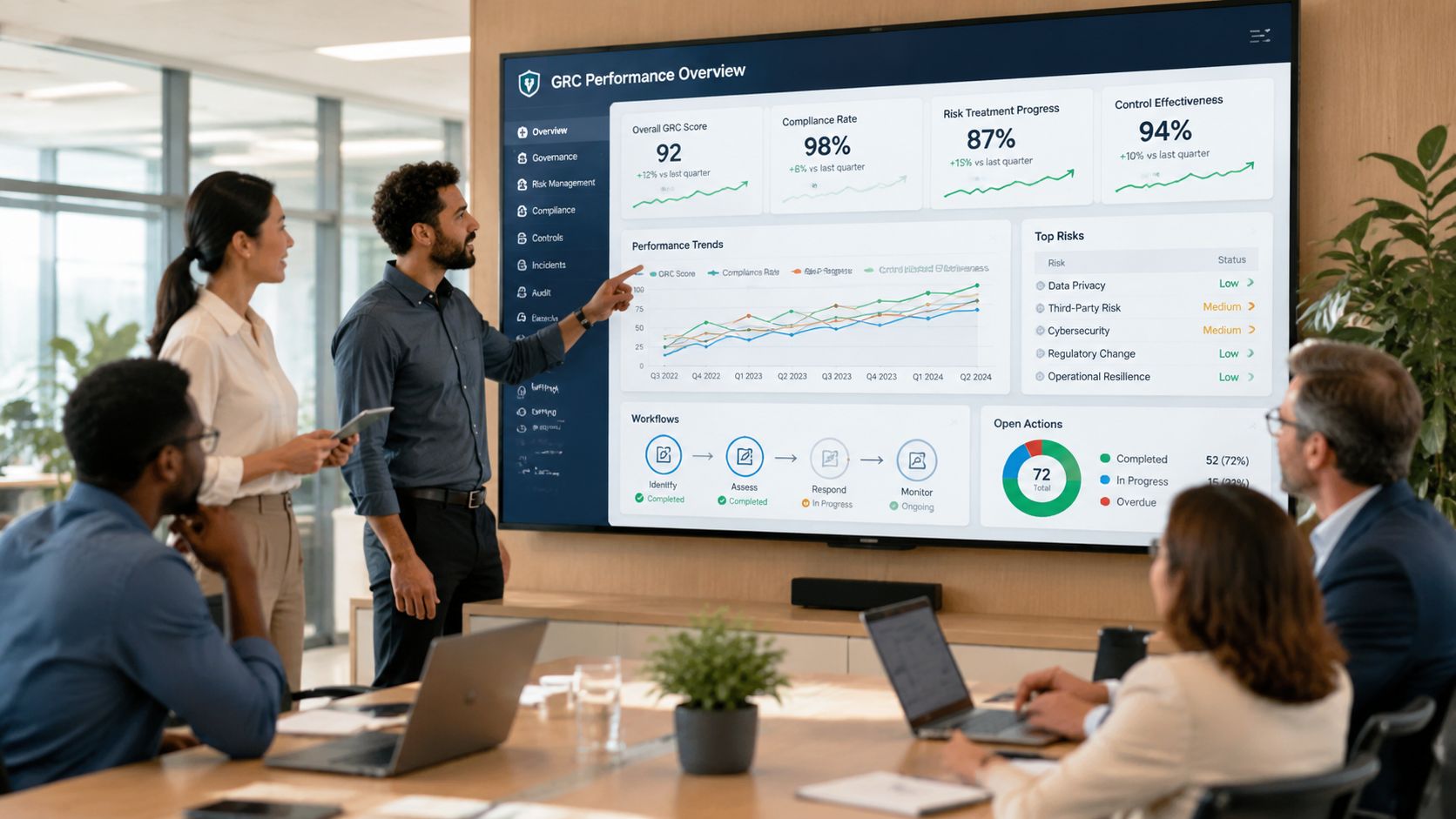
The fastest way to accelerate adoption is to make GRC part of daily work inside ITSM and ITOM, not a parallel process owned by compliance. CIOs in the GCC and Europe should start there. If service changes, incidents, assets, vendors, and exceptions sit in different systems, teams will keep managing risk through emails, spreadsheets, and last-minute evidence collection.
That is the gap AI and workflow automation should close. Use automation to collect evidence, route issues to the right owner, flag control failures early, and show where risk is building across functions. For firms preparing for cross-border regulatory pressure, especially financial entities, alignment with operational resilience obligations such as the EU Digital Operational Resilience Act requirements should be measured through these same workflows, not through a separate reporting layer.
How to speed up adoption
Adoption improves when the programme reduces work.
Use these levers:
Cut manual evidence chasing: Pull logs, approvals, test records, and configuration data directly from operational systems.
Name accountable owners: Every control, exception, and remediation item needs one person responsible for closure.
Work in existing platforms: Put control tasks into the service, change, asset, and vendor workflows teams already use.
Tailor reporting to decisions: Executives need trend lines and exposure. Managers need overdue actions, failed controls, and owner-level accountability.
Start with visible pain points: Audit-heavy processes, third-party oversight, privileged access, and regulated service operations usually deliver the fastest proof of value.
What to measure
Measure whether GRC is improving control effectiveness, response speed, and auditability across the enterprise.
A useful scorecard includes:
Area | What to watch |
|---|---|
Control performance | Failed controls, overdue tests, repeated exceptions |
Audit readiness | Evidence availability, open remediation items, policy attestation status |
Risk response | Age of unresolved high-priority issues, ownership clarity |
Operational linkage | Number of controls tied to live systems and workflows |
Adoption | Completion of reviews, timeliness of issue updates, policy acknowledgements |
Add one discipline many programmes miss. Review whether these metrics are improving because the operating model is better, or because teams are only updating dashboards before audits. If the underlying service data does not support the control story, the metric is weak.
Why external delivery support often makes sense
Internal teams are already stretched across security, service operations, cloud platforms, audit support, and regulatory change. GRC programmes slow down when nobody owns the integration work between those functions.
A practical model is to keep internal accountability for policy and risk decisions, then add specialist delivery support for workflow design, platform integration, automation, and reporting. DataLunix works in that space across platforms such as ServiceNow, HaloITSM, Freshservice, and ManageEngine to connect control libraries, workflows, and operational data.
Navigating GRC Regulations in the GCC and Europe
A single GRC model can support both regions. A single compliance interpretation can't.
GCC-based enterprises often face strong expectations around data governance, auditability, localisation requirements, and third-party oversight. European operations add strict obligations around personal data handling, accountability, and demonstrable control over processing activities. If your business operates across both, you need a model that can handle shared controls with local variations.
What GCC operations usually prioritise
For many organisations in the UAE and wider Gulf, the practical pressure points are:
Data governance
Third-party risk
Audit evidence
Operational accountability across group entities
Regulators across the UAE and GCC are tightening expectations around data governance and third-party risk. This pushes firms towards integrated control monitoring systems that can tie identity, asset, change, and vendor data into a single evidence chain to prevent control gaps and slow audits, as outlined in IBM's overview of GRC priorities.
What European operations usually prioritise
European teams tend to work under heavier scrutiny around lawful processing, privacy governance, records, and cross-functional accountability. The main lesson for CIOs is simple. You cannot bolt European compliance onto a GCC operating model later. It has to be designed into workflows, ownership, and reporting from the start.
What a unified model should do
A workable cross-region GRC programme should:
Use one enterprise control library with jurisdiction-specific variants where needed
Map controls to systems and data flows, not just policy statements
Support local accountability without fragmenting the reporting model
Preserve a common risk language across entities and business units
If DORA affects your European footprint, DataLunix has a relevant explainer on the DORA Act in the EU.
One-size-fits-all compliance doesn't work across the GCC and Europe. One integrated operating model does.
Frequently Asked Questions About Enterprise GRC
Is Enterprise GRC just another name for compliance software
No. Enterprise GRC is an operating model for decision-making, accountability, control monitoring, and evidence management across the business. Compliance software usually handles obligations and audit tasks. CIOs need more than that. They need one system of record that connects policy, risk, incidents, vendors, assets, changes, and control evidence across business and IT workflows.
Where should CIOs start with Enterprise GRC
Start where control failure already creates cost, delay, or audit friction. In practice, that usually means change management, identity and access, third-party risk, or regulated service operations.
Do not start with a giant policy rewrite or a platform rollout across every entity. Start with one cross-functional use case, define ownership, connect it to your ITSM and ITOM data, and prove that control evidence can be collected from live systems instead of spreadsheets. That is how you get credibility and budget for the next phase.
How should AI be used in Enterprise GRC
Use AI for work that is repetitive, high-volume, and easy to review. Good examples include issue triage, control testing support, policy classification, workflow routing, evidence matching, and identifying gaps across service, asset, and vendor data.
Do not use AI as an unreviewed decision-maker for control approval or risk acceptance. In GCC and European environments, auditability matters as much as speed. If your AI output cannot be traced, challenged, and approved by a named owner, it will create governance risk instead of reducing it.
Why do Enterprise GRC programmes fail
Most programmes fail because the operating model is weak. Ownership is unclear. Control statements are not linked to live processes. Risk registers sit outside service operations. Audit evidence depends on manual collection. The result is predictable. Teams spend more time preparing for audits than reducing risk.
Platform choice matters, but execution matters more. If your GRC model does not connect with ITSM, ITOM, identity, and vendor workflows, it will stay theoretical.
What makes Enterprise GRC more important in the GCC and Europe
The pressure is operational, not just regulatory. Large enterprises in the GCC and Europe often run across multiple entities, outsourced providers, and overlapping legal requirements. That makes fragmented controls expensive and hard to defend.
A unified enterprise GRC model gives leadership a clearer view of risk across regions, strengthens audit trails, and shortens the distance between a control failure and corrective action. That is the standard CIOs should aim for.
If you're building or fixing an Enterprise GRC programme, talk to DataLunix. The firm works with GCC and European organisations to connect GRC design with operational systems, especially across ServiceNow, HaloITSM, Freshservice, and ManageEngine, so controls are measurable, auditable, and usable in day-to-day operations.