


GRC Process Explained: A Practical Guide for UAE Firms

A 2008 Hawkamah survey found no publicly listed company fully followed governance best practices, while only 3% were assessed as good practice. That's why a grc process can't be treated like admin work in the UAE or GCC, it has to connect obligations, controls, evidence, and board oversight in one operating model.
What Is the GRC Process and Why It Matters in the UAE
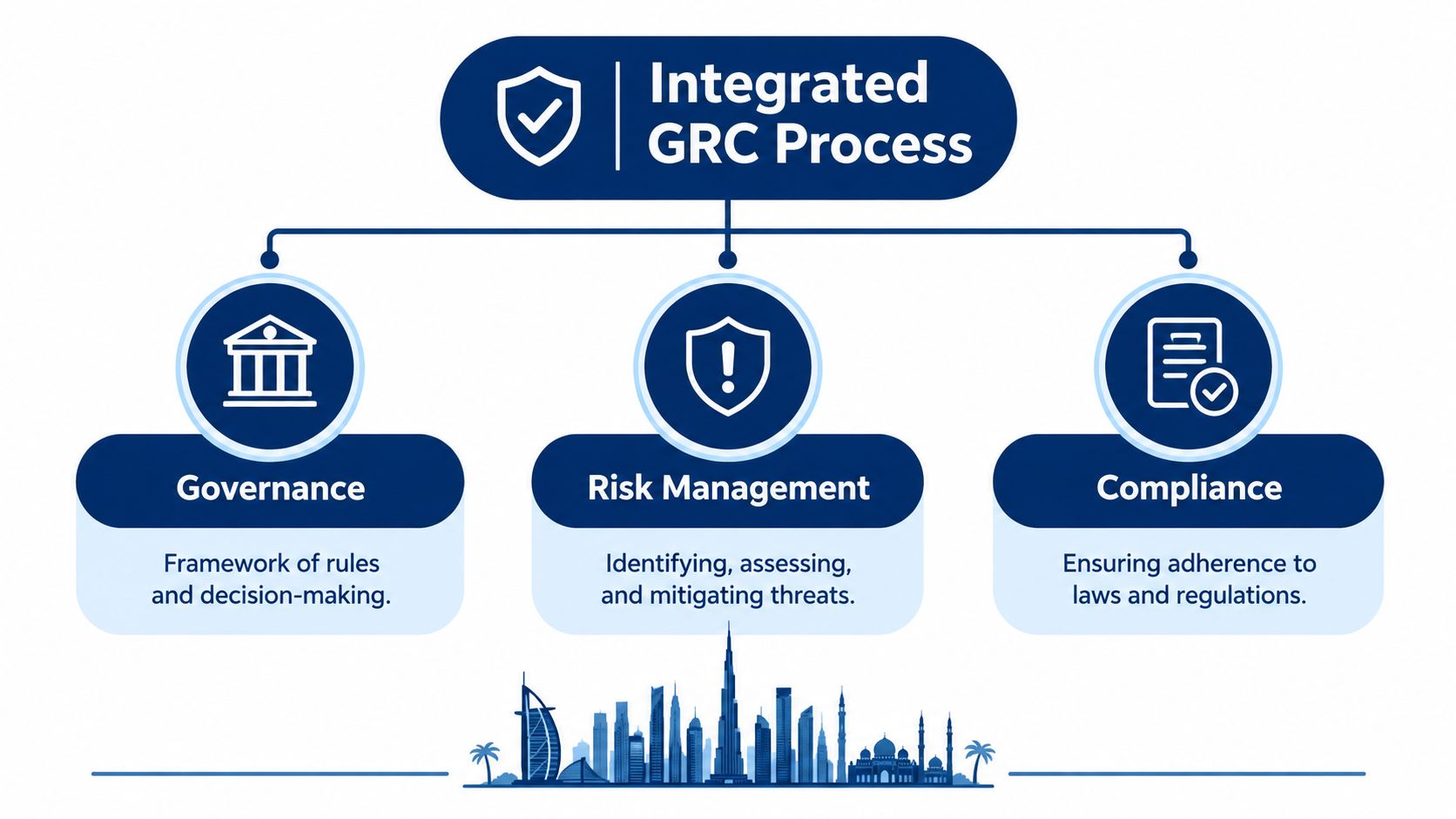
The grc process is the operating framework that connects governance, risk management, and compliance so they work as one system rather than three disconnected chores. In practice, that means defining who decides, what can go wrong, which rules apply, and how evidence gets collected when someone asks for proof.
The UAE makes that integration more important, not less. The region has long had uneven governance practice, and the Hawkamah and IFC survey showed that no listed company in the sample fully followed recognised best practices, while only 3% were rated good practice, which is a strong warning against informal control culture (Hawkamah and IFC survey analysis). If a business relies on policy documents alone, it usually discovers gaps only when auditors, regulators, or the board demand evidence.
Why the UAE Context Changes the Design
A UAE organisation often has to satisfy federal rules, free-zone requirements, sector standards, and sometimes cross-border obligations at the same time. That is why the grc process needs a control register that shows applicability by entity, system, and jurisdiction, not a generic checklist. A useful primer on the relationship between governance and risk is understanding risk en compliance, especially if your team is still separating policy from execution.
Practical rule: if the control owner can't produce evidence without a scramble, the process isn't mature yet.
The working model is simple. Governance sets decision rights, risk management measures exposure, and compliance proves that obligations are met. If you want a structured breakdown of that operating model, the DataLunix GRC module overview is a relevant reference point for teams mapping controls to operations.
The Five Stages of the GRC Lifecycle
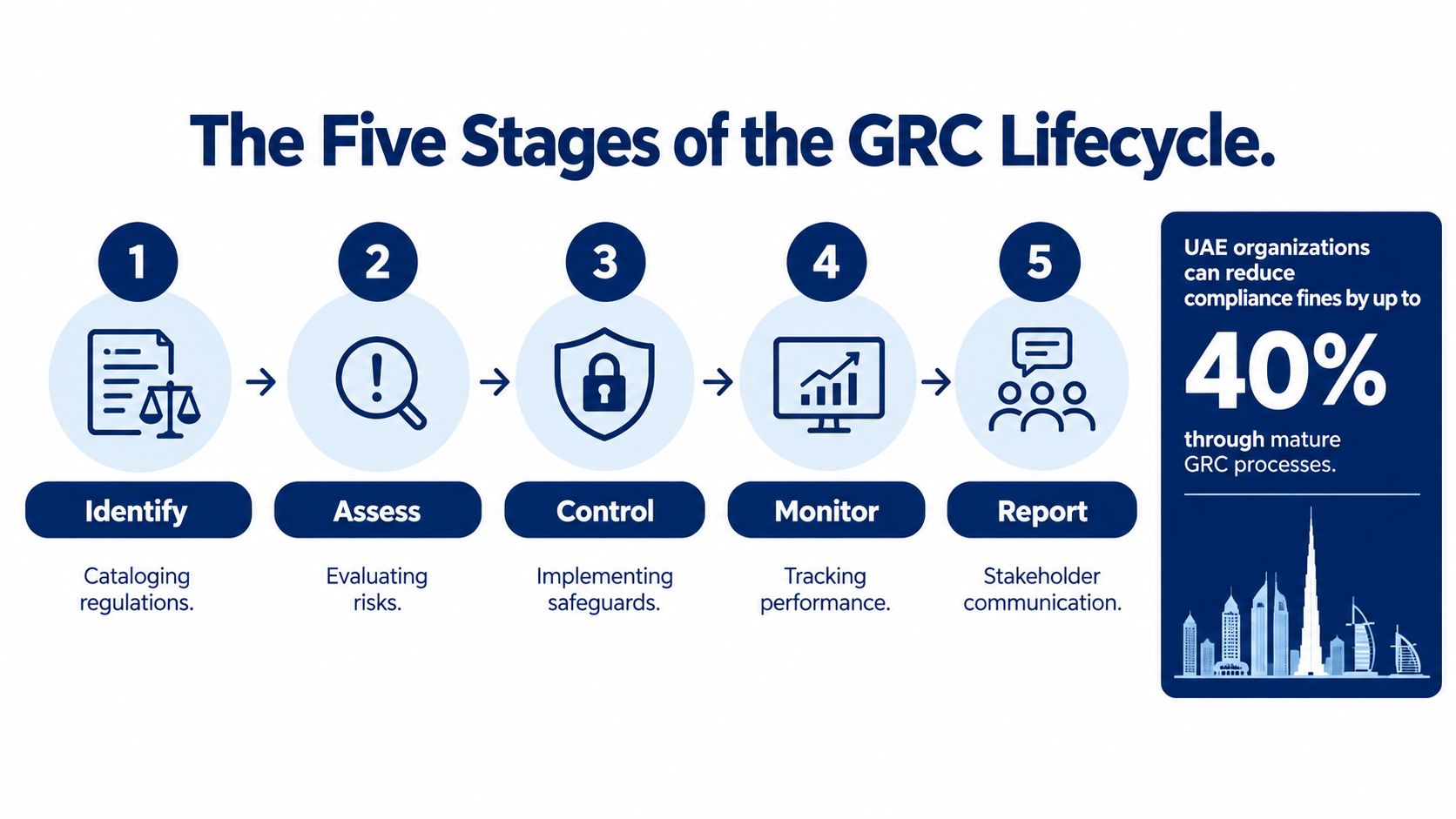
A usable grc process moves in a loop, not a straight line. The five stages are Identify, Assess, Control, Monitor, and Report, and each one should leave behind evidence that another team can inspect later.
Identify and Assess
Identify means building the inventory first. That includes laws, regulations, internal policies, systems, vendors, and risks that matter to the business. In the UAE, that inventory should be granular enough to show which entity or business unit is affected when a rule changes.
Assess is where teams separate noise from exposure. A bank, for example, won't treat every control as equal, because the consequences of a control failure differ by asset criticality, business function, and regulatory impact. The UAE Central Bank's Risk Management Regulation requires an enterprise-wide risk-governance framework that identifies, measures, evaluates, monitors, reports, and mitigates material risks, which is exactly the logic a mature GRC team should adopt (UAE Central Bank Risk Management Regulation).
Control and Monitor
Control is where the process stops being theoretical. For UAE organisations, that often means mapping each obligation to a named owner, an explicit control, a test frequency, and retained evidence. For critical infrastructure and other relevant entities, applicability assessments and control-to-evidence mapping matter because compliance can't be proven by intent alone.
Monitor should be continuous, not quarterly theatre. A practical GRC team links controls to identity management, vulnerability management, incident response, supplier assurance, and data inventories so the evidence is pulled from systems, not typed into spreadsheets. That matters because a recent UAE cybersecurity analysis reported that nearly 50% of exploited vulnerabilities were more than five years old, and DDoS incidents reportedly exceeded 373,429 by the end of 2024, an 862% increase from 2019 (UAE cybersecurity trends).
Report
Report turns operational evidence into decision support. That means board packs, risk registers, remediation lists, and regulatory responses that are consistent enough to survive scrutiny. If your team wants a practical comparison of control and ticket workflows, comparing IT risk approaches is a useful lens for understanding why manual reporting falls apart under change.
The best reporting doesn't summarise activity, it shows whether exposure is falling.
For teams designing the reporting layer, the DataLunix integrated risk management overview is relevant because it ties reporting back to control evidence instead of detached status updates.
GRC Maturity Model and What It Looks Like at Each Level
Maturity in GRC is visible in behaviour, not slogans. An initial organisation reacts after incidents, a managed one repeats the same manual checks, a defined one standardises control ownership, a quantitatively managed one measures control performance, and an optimising organisation uses evidence and change signals to improve continuously.
What Changes as You Mature
At the lower end, teams depend on email, spreadsheets, and tribal knowledge. That creates fragile handoffs, especially when someone leaves or a regulator asks for historical proof. At the higher end, the control register is authoritative, exceptions have expiry dates, and remediation is tracked to closure.
For UAE entities that handle sensitive data or critical services, the jump from defined to quantitatively managed is usually the hardest. The difference is simple, but expensive to ignore: one team says it tested a control, the other team can prove when, how, and with what result.
Here's a practical way to read maturity:
Initial: control ownership is vague, evidence is ad hoc, and reviews happen after problems.
Managed: controls exist, but they're still mostly manual and person-dependent.
Defined: the process is documented, repeatable, and tied to a control register.
Quantitatively Managed: the team tracks exceptions, testing, and remediation performance.
Optimising: evidence flows from systems, and the process improves as regulations or risks change.
That progression matters because spreadsheet-based attestations don't scale in fragmented regulatory environments. The DataLunix GRC management system page is worth reviewing if you're mapping how maturity translates into operating discipline.
Integrating GRC with ITSM and ITOM Platforms
A strong grc process becomes far more reliable when it's connected to the systems your operations teams already use. ITSM and ITOM platforms such as ServiceNow, HaloITSM, Freshservice, and ManageEngine can carry tickets, approvals, asset data, incident records, and change logs into the GRC layer, which cuts down on manual evidence gathering.
The point isn't tool sprawl. The point is that controls should pull from the systems where work happens. If vulnerability remediation lives in one platform, supplier assurance in another, and incident response in a third, GRC reporting will stay incomplete unless those sources are unified.
Platform | GRC Capabilities | Integration Features |
|---|---|---|
ServiceNow | Control tracking, incident linkage, evidence workflows | Native workflow automation, asset and change data, audit trails |
HaloITSM | Service and control management, issue tracking | Ticket-to-control mapping, approval records, structured reporting |
Freshservice | IT operations visibility, request and incident evidence | Asset data, service records, automated task flows |
ManageEngine | Operational control monitoring, compliance support | Change logs, endpoint data, service workflows |
A practical architecture links controls to identity management, vulnerability management, incident response, supplier assurance, and data inventories, then uses those feeds for automated evidence collection. That reduces the usual drift between what teams say they do and what the systems show they did.
If the control evidence is still being stitched together by hand at month-end, the integration design is too weak.
For organisations building this stack, the DataLunix integration page is a useful reference because it aligns platform data with control evidence rather than treating GRC as a separate admin layer.
Common Pitfalls and How to Avoid Them
The biggest mistake is treating GRC like an annual audit event. In the UAE, where obligations can differ by entity, location, sector, and regulator, that mindset leaves gaps open for months. It also misses the reality that regulatory change now behaves like an operational trigger, not a once-a-year review cycle.
What Usually Goes Wrong
Teams often fail in the same places. They don't assign clear owners, they don't keep a current regulatory inventory, and they rely on policy documents that no one can operationalise. Earlier GCC survey data also showed capability constraints, including shortage of qualified specialists and low organisational priority, which explains why governance programmes stall even when leadership says the right things (GCC governance survey summary).
A better model is event-driven. When laws change, when a new system goes live, when a vendor is added, or when a control fails testing, the GRC process should trigger a reassessment. That's especially important in the UAE, where federal and free-zone rules can overlap, and where the Central Bank also expects recurring compliance cycles for AML and targeted financial sanctions (UAE Central Bank AML page).
How to Keep the Process Alive
Use a short list of essentials:
Named owners: every control needs one accountable person.
Expiry dates: exceptions should never live forever.
Compensating controls: if one safeguard fails, another must be documented.
Evidence rules: define what proof counts before the audit begins.
Change triggers: update the control register when laws, vendors, or systems change.
For teams struggling with the operational side, a fractional CAIO can help define how automation and AI fit into governance without turning the process into a science project. The key is still the same, keep the GRC process tied to ownership, evidence, and timely escalation.
Next Steps for Enterprise GRC Adoption
Start with discovery workshops that map your current obligations, systems, and pain points. Then run a fit-gap analysis to compare what your organisation does today with what the business and regulator need.
After that, move into readiness assessment and change planning. That's where stakeholders learn who owns what, what evidence will be required, and how often controls must be tested. For GCC enterprises, this stage often exposes the core issue, not technology, but fragmented operating responsibility.
A partner can help if the internal team lacks the time or depth to do this cleanly. DataLunix supports discovery, fit-gap analysis, implementation, and managed services across platforms such as ServiceNow, HaloITSM, Freshservice, and ManageEngine, which makes it suitable for teams that need both structure and delivery discipline. The DataLunix implementation page is the place to review that path in more detail.
If you want a practical GRC model that fits UAE regulatory complexity, DataLunix can help you map obligations to controls, automate evidence, and build a reporting flow your board can actually use. Visit DataLunix to see how their discovery, implementation, and managed services can support your next GRC step.