


GRC Pricing Explained: Costs, Models, and How to Budget

Fixed-scope starter GRC assessments in the UAE sit around AED 12,000–22,000, while multi-framework programs rise to AED 75,000–110,000. If you budget only for software, you're already off track.
What is GRC pricing and why does it vary so much?
GRC pricing is rarely a single licence fee. In the UAE, the true bill is usually a mix of assessment work, consulting, training, tooling, and internal staff time, which is why two quotes that look similar at first glance can end up miles apart.
The most common mistake is treating a platform quote as the whole project. It isn't. Buyers who separate the cost stack early make better decisions, push back on bloated scopes, and avoid paying for work they never needed.
Practical rule: If a vendor gives you one number without separating software, services, and internal effort, you don't have a clear quote yet.
What GRC Pricing Actually Includes
UAE buyers stacking ISO 27001, PDPL, and sector rules can see GRC programme costs rise 6x as scope expands across frameworks, training, advisory work, and internal delivery effort. Review the deployment implications alongside these GRC cloud considerations, because architecture choices also affect implementation and support work.
GRC pricing is a service stack, not a neat software bill. A quote may include scoping, control assessments, evidence collection, policy development, training, external advisory support, configuration, testing, and the time your employees spend supplying evidence and approving outputs.
Software is only one part of the budget. A platform may look affordable until each framework needs separate mappings, workflows, owners, evidence reviews, and reporting. Training and consultant involvement add further costs, while internal FTE effort often remains outside the vendor's proposal.
The three layers buyers should separate
Split every quote into three buckets:
Platform or licence cost for the software and included modules.
Delivery cost for assessments, implementation, advisory, training, and testing.
Internal cost for staff time, approvals, evidence preparation, and remediation.
This separation makes competing proposals easier to compare. A low licence fee can conceal heavy delivery requirements. A generous implementation package can still become expensive if your team must chase evidence, attend repeated workshops, and manage review cycles.
Ask vendors to show which activities apply to each framework and entity. That exposes whether the quote covers a real multi-framework programme or only a thin readiness review.
A fair quote states what happens before go-live, what happens after go-live, and what is excluded.
The procurement question is therefore simple: what will the full programme cost to complete, operate, support, and defend in an audit?
The Main GRC Pricing Models Explained
Per-seat software subscriptions
Per-seat pricing looks straightforward, which makes it easy to underestimate. You pay for named or active users and usually receive defined access to the platform. This model suits a focused team with a stable user base and a narrow initial scope.
Best for: organisations with a clear user count and limited compliance requirements.
Check what sits outside the base licence. Audit modules, workflow features, framework content, integrations, storage, and additional entities may carry separate charges. A low subscription can therefore become an expensive programme once training, advisory work, internal review time, and evidence preparation are included.
Fixed-scope assessment fees
Fixed-scope pricing gives procurement a clear starting point. Suppliers commonly use it for readiness assessments, gap reviews, and single-framework discovery work.
Best for: buyers that need a defined assessment before approving a larger programme.
Read the exclusions carefully. A fixed fee may cover only selected controls, limited evidence samples, one entity, or a report without remediation support. That is not a bargain. It is a narrower service. Require the proposal to state the frameworks, entities, interviews, evidence depth, deliverables, and review rounds included in the price.
Tiered multi-framework programmes
Tiered pricing applies when the programme covers several frameworks, business units, or regulatory audiences. UAE buyers stacking ISO 27001, PDPL, and sector-specific requirements can see total programme costs jump 6x because the work extends beyond software licences. Control mapping, policy changes, training, external advisory input, evidence collection, and internal FTE effort all expand together.
Best for: organisations managing overlapping regulatory obligations across multiple entities or functions.
A fair tier should show what each added framework changes. Reject a tier that adds labels without adding mapped controls, delivery capacity, reporting, and support.
Managed service or retainer arrangements
Managed services spread GRC work across a recurring contract. They suit organisations that need regular evidence refreshes, control monitoring, policy maintenance, audit preparation, or specialist support without building the full capability internally.
Best for: teams that need continuing operational assistance rather than a one-time assessment.
Ask whether the retainer covers named activities, response times, meetings, deliverables, and framework updates. For a useful explanation of managed GRC as a service, distinguish recurring operational support from project-based consulting. Procurement should compare the complete cost of each model, including licence fees, delivery work, training, external advice, and employee time.
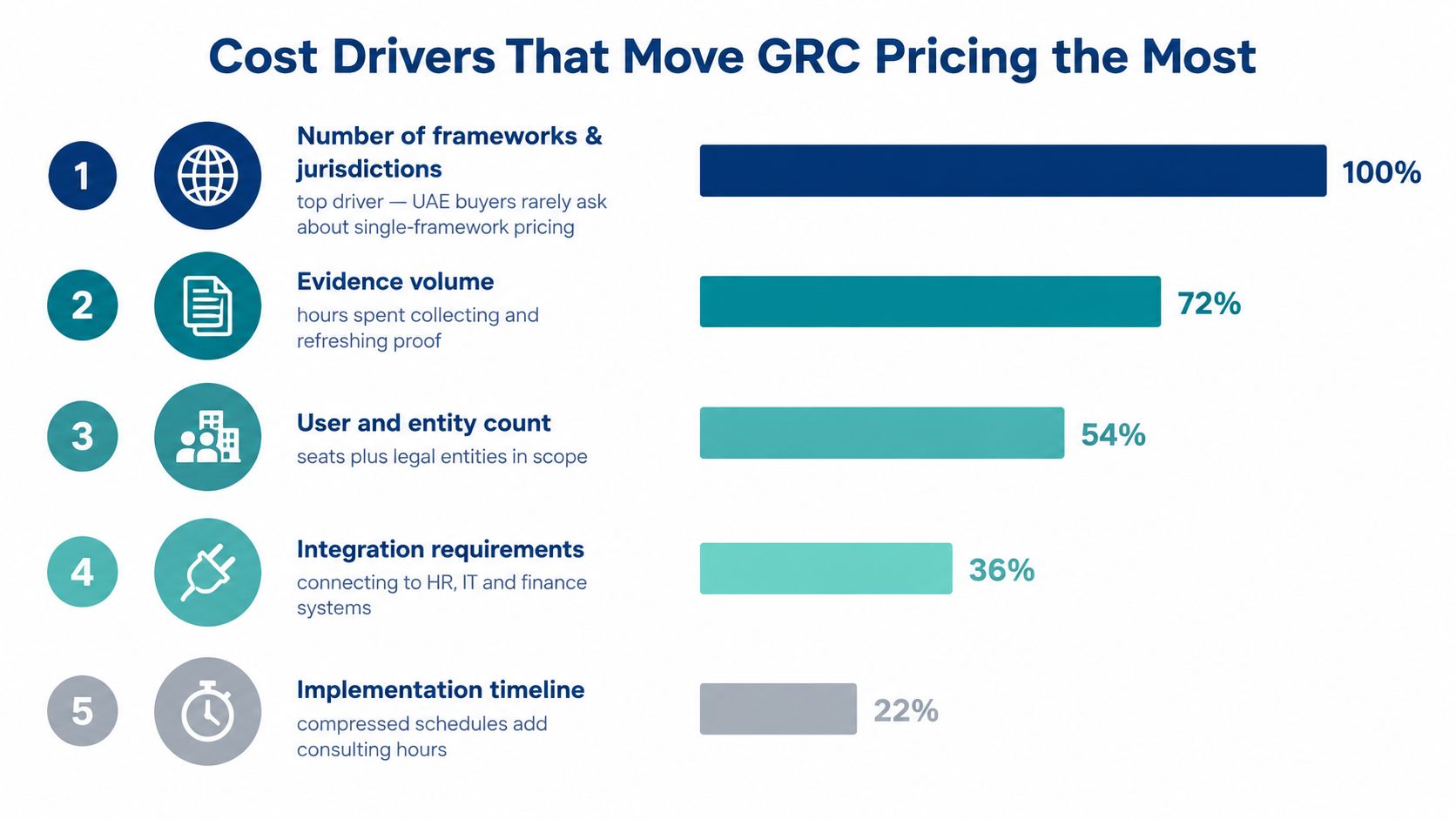
Cost Drivers That Move GRC Pricing the Most
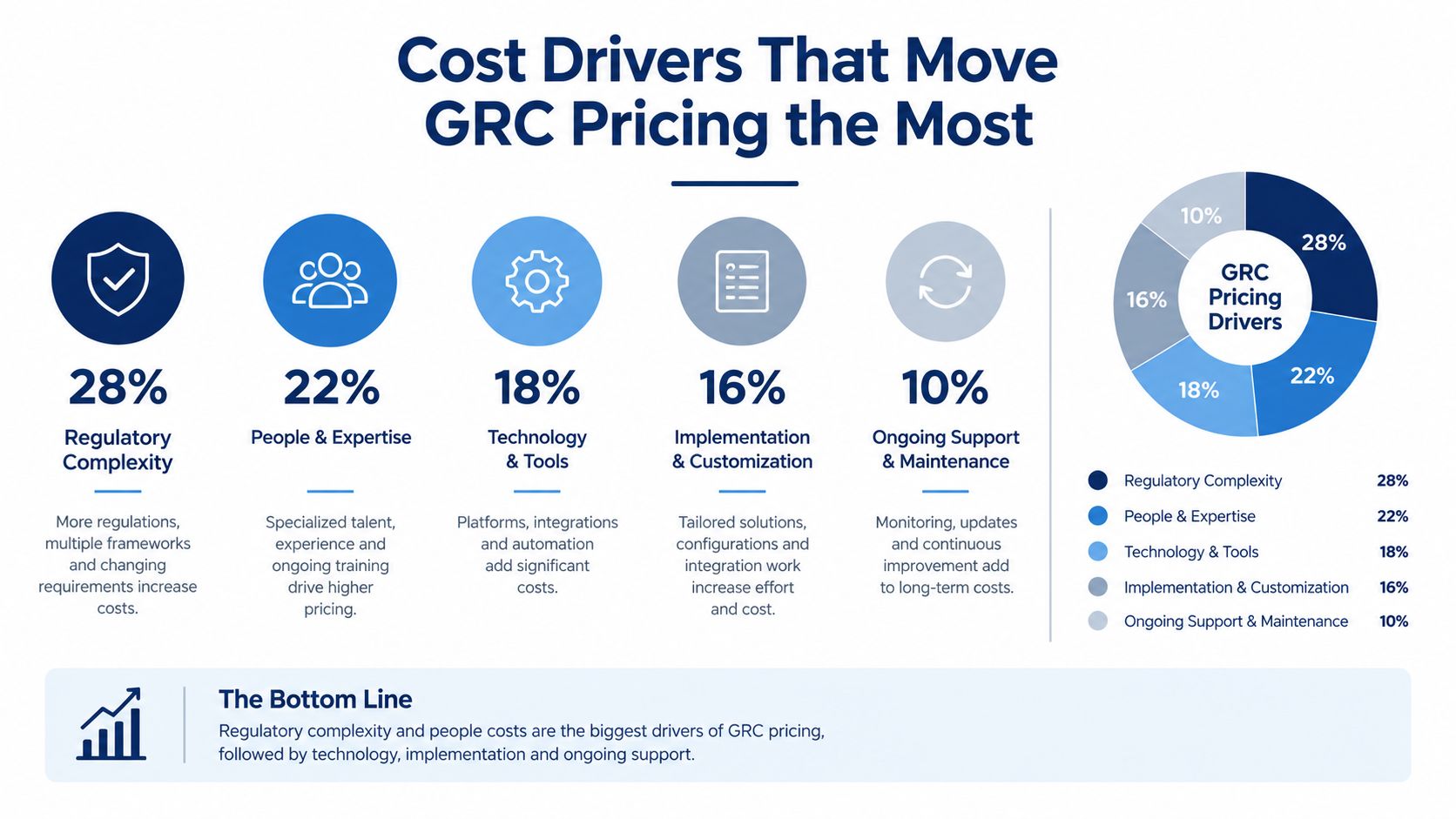
Framework count beats almost everything else
The biggest pricing driver is not seats, and it's not the logo on the software. It's the number of frameworks and jurisdictions in scope. In the UAE, that matters because buyers rarely ask for a single framework and stop there.
When organisations combine compliance obligations, the work multiplies. Mapping one control set is manageable. Mapping several control sets, keeping them aligned, and proving them across business units is where cost rises quickly.
Complexity creates the premium
The UAE market shows a sharp relationship between complexity and price. Standard flat cladding panels sit in a much lower range than highly complex decorative elements, and the same logic applies to GRC: the harder the geometry of the control environment, the higher the quote. The broad UAE benchmark for 2026 shows AED 250–450 per m² for standard flat cladding panels, rising to AED 800–1,500+ per m² for highly complex decorative elements, with installation charged separately at AED 80–150 per m² (Abu Dhabi benchmark pricing). That pricing structure is a useful analogy for buyers, because the design problem, not raw volume, drives the total.
Internal versus outsourced effort
A quote gets expensive fast when the supplier is expected to do all drafting, all testing, and all evidence cleanup. That is often the right choice for a small team with no internal bench, but it is wasteful if your organisation already has capable compliance staff.
If you want a fairer number, split the work. Keep routine evidence collection in-house where possible, and outsource only the specialist parts that need external judgement.
Tooling and integrations matter
The more a GRC programme has to connect with HR, finance, ticketing, and identity systems, the more implementation labour it consumes. That's where many buyers get ambushed. They budget for a platform and forget the integration work that makes the platform usable.
Integration planning for GRC systems is not optional if you want a quote you can trust. If your supplier glosses over connections, expect the project to drift.
Rule of thumb: complexity drives price more than headcount does.
Sample GRC Price Ranges in the UAE Market
UAE buyers should price the full GRC cost stack, not just software licences. A starter assessment, a multi-framework programme, training, external advisory, and internal project effort belong in separate budget lines.
Cost Category | Typical Range | What It Covers |
|---|---|---|
Fixed-scope starter GRC assessment | Entry-level budget | Narrow scope, basic gap review, initial recommendations |
Multi-framework compliance programme | Upper-tier programme budget | Combined framework work, advisory, implementation, and evidence support |
Compliance training course | AED 1,300–18,180 | Training options across the UAE market (UAE compliance course fees) |
GRC training course | AED 3,000 | Up to 3 days of GRC training |
Certified GRC Professional course | AED 5,500 | 4-day professional training |
The table is a planning tool, not a quote. A low assessment fee usually reflects a narrow scope, fewer frameworks, or limited implementation support. Confirm the deliverables before treating it as a bargain.
Multi-framework work costs more because the supplier must map overlapping requirements, remove duplicate controls, assign owners, and maintain evidence across each framework. A company combining ISO 27001, PDPL, and sector rules can see programme costs rise several times over a single-framework review. Internal staff time and external specialist advice add to the supplier invoice or sit on the company's own balance sheet.
Training deserves its own approval. The gap between a basic course and a professional programme is wide, so ask whether the fee covers exams, materials, practical exercises, and post-course support. A bundled training line can hide unnecessary seats or premium pricing.
Compare like with like. Ask every vendor to state framework coverage, business entities, delivery days, evidence responsibilities, advisory hours, and internal inputs. Then compare the total effort and outcome, not the headline fee. A fair quote makes exclusions visible and separates recurring costs from one-time work.
Building Your Total Cost of Ownership Worksheet
Build the worksheet before requesting quotes
A TCO worksheet prevents licence fees from hiding the actual budget. Build it before speaking to vendors, then require each quote to follow the same scope and cost categories. Use a structured GRC management software selection guide to identify the cost lines that belong in the worksheet.
Include:
Framework inventory covering ISO 27001, PDPL, sector rules, and any other requirements in scope.
Entity count for business units, legal entities, and regions.
User count for licences, access levels, and administrator roles.
Evidence volume covering collection, review, refresh, and storage effort.
Implementation labour for configuration, testing, integrations, migration, and handover.
Training budget for users, managers, executives, and administrators.
Ongoing support for renewals, regulatory changes, control updates, and audit cycles.
The worksheet should show one-time, recurring, external, and internal costs separately. UAE buyers that combine ISO 27001, PDPL, and sector rules can see programme costs rise sixfold because the work expands across control mapping, evidence ownership, remediation, and reporting.
Price internal effort honestly
Internal project time is frequently omitted from the business case. A UAE-focused corporate governance article for banks and insurers recommends budgeting 0.5 to 2 FTE for 3 to 6 months of internal project management, alongside external legal advice, controls and risk consultancy, board and executive training workshops, IT and compliance tooling, and regulatory filing fees (UAE governance planning guidance).
Your staff may need to chase evidence, attend workshops, review controls, update policies, and approve findings. Record those hours as project costs, even when they do not appear on the supplier invoice.
Budget like a buyer, not a hopeful sponsor. If no one can name the internal time, the programme is already underpriced.
A defensible worksheet exposes exclusions early and gives procurement a reliable basis for comparing total effort, outcomes, and renewal exposure.
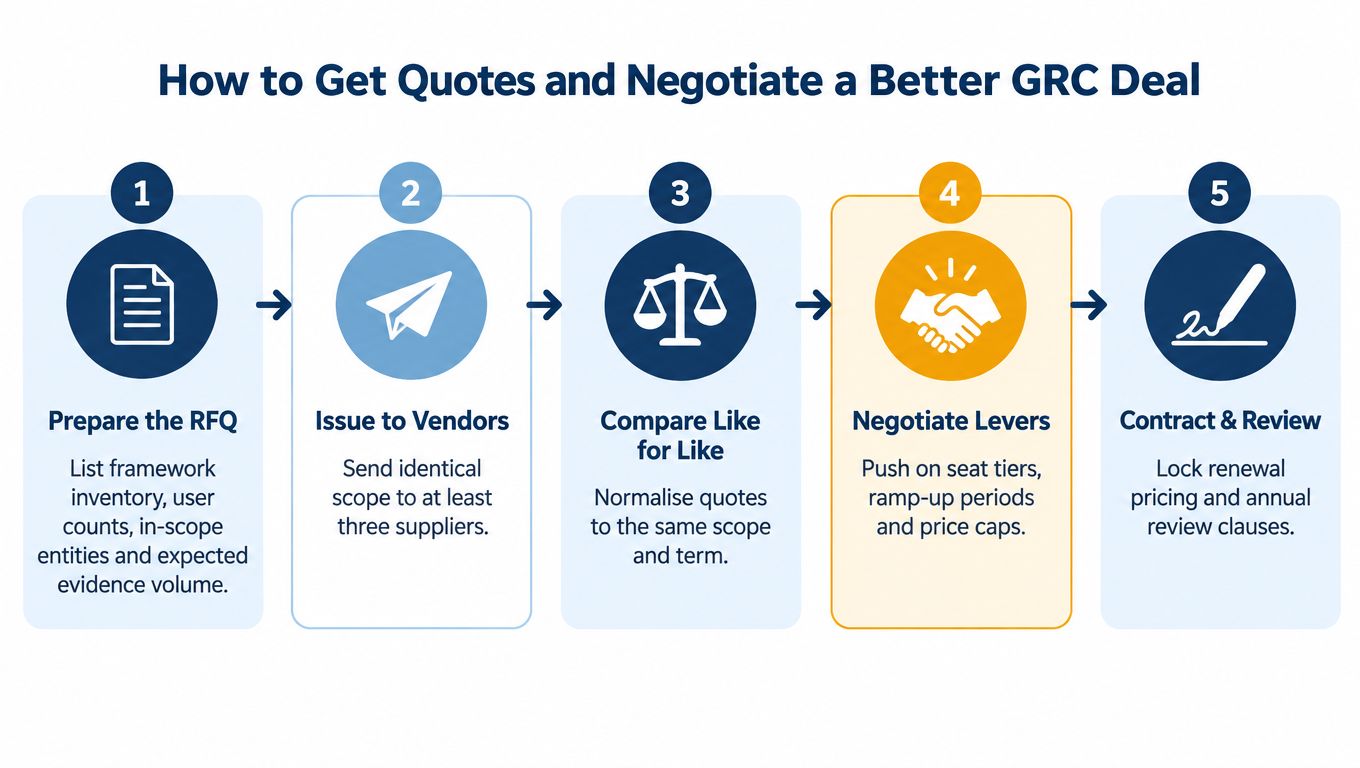
How to Get Quotes and Negotiate a Better GRC Deal
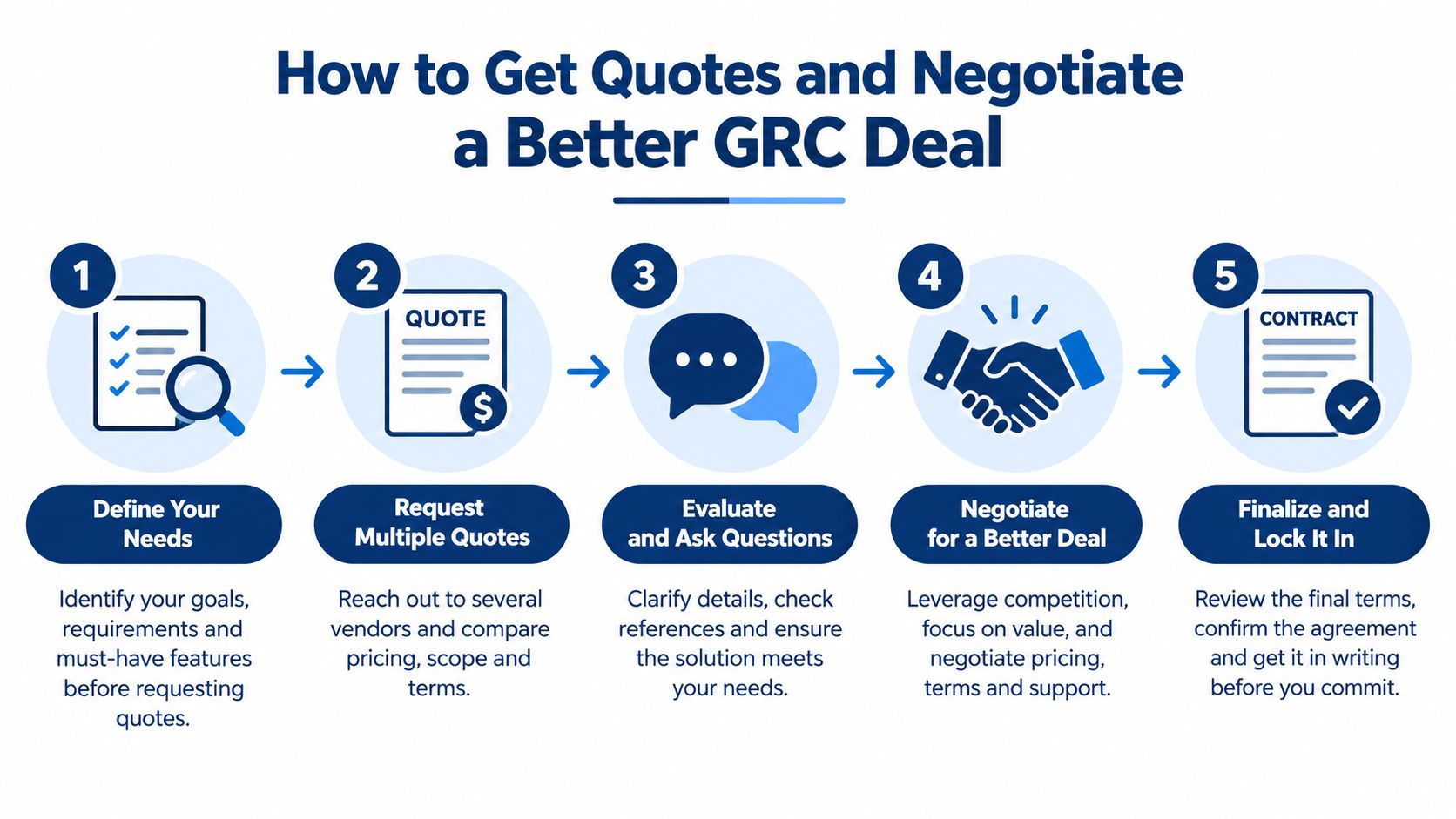
Issue one RFQ with one defined scope
Your RFQ should list every framework, user count, in-scope entity, evidence volume, integration, service requirement, and delivery assumption. Include the full cost stack, not just software licences. Training, external advisory, implementation, and internal effort can materially change the cost of a multi-framework programme.
Send the same brief to at least three suppliers. When shortlisting suppliers, compare proposals on identical scope. Our guide to evaluating GRC companies explains how to normalize scope, seat tiers, and renewal caps before you negotiate.
A supplier that refuses to quote against your defined scope is giving you useful information. The scope may be too tight for its delivery model, or the supplier may intend to win the deal and price required extras later.
Negotiate the terms that affect total cost
Ask for specific commercial changes instead of a general discount. Focus on seat tiers, ramp-up periods, implementation fees, price caps, renewal clauses, and the treatment of new entities or frameworks. These terms determine whether your budget stays predictable after signature.
Request a separate price for a pilot or first phase. A limited starting scope can control initial spend while giving your team evidence about adoption, configuration effort, and support quality before committing to the full programme.
Keep software, delivery, training, advisory work, and managed services visible as separate line items. A lower licence fee does not make a quote cheaper if it shifts work to your compliance, IT, or security teams.
Compare direct vendors with qualified partners
Certified delivery partners and resellers may offer better licensing economics when they hold volume agreements or combine implementation with the platform. Compare the full package, including partner margin, service coverage, escalation rights, and renewal ownership.
DataLunix provides governance, risk, and compliance platform services alongside discovery workshops, fit-gap analysis, readiness assessments, implementation, integration, change enablement, managed services, and staff augmentation. If the direct vendor quote is rigid, that partner model may provide a more workable commercial structure.
Choose direct procurement for a clear reason
Buy directly when the platform is highly specialized, the product roadmap matters more than the discount, or your internal team needs close access to the vendor's product specialists. Direct procurement can cost more, but it removes an intermediary and may simplify support and escalation.
Before signing, confirm:
Scope is fixed and matched across suppliers.
Internal effort is priced, including work assigned to your staff.
Extras are itemised rather than loosely bundled.
Renewal terms are capped or clearly defined.
Ownership is clear for configuration, integrations, evidence, and support.
Frequently Asked Questions About GRC Pricing
How often should I renegotiate GRC pricing?Renegotiate before renewal, not after it. That gives you time to compare alternatives, reset scope, and challenge any pricing creep that came in during the previous term.
Do low-cost GRC tools reduce total spend?Sometimes, but only if the tool fits your scope and doesn't force heavy manual work elsewhere. A cheap platform that creates more internal admin is not cheap in practice.
How can I tell if a quote is inflated?Look for vague scope, bundled services with no breakdown, and missing assumptions on users, entities, or evidence volume. If the supplier can't explain what changes the price, the quote is padded.
Should I compare software-only and full-service quotes together?No. Compare like for like first, then decide whether you want software plus services or a lighter package. Mixing those two creates false savings and bad procurement decisions.
What is the fastest way to sanity-check a GRC proposal?Check whether the quote names the frameworks, includes internal effort assumptions, and separates implementation from ongoing support. If it doesn't, send it back.
If you're budgeting for GRC work and want the numbers broken down properly, DataLunix can help you scope the programme, compare commercial models, and separate licensing from delivery and internal effort. Bring the frameworks, the user counts, and the entities in scope, and you'll get a quote structure you can readily defend.