


What GRC Online Means and Why It Matters Now

What GRC Online Means and Why It Matters Now
You've inherited a spreadsheet-driven compliance programme after a merger. Three audit cycles are running in parallel, control owners are emailing screenshots, and nobody can answer which evidence supports UAE PDPL, NESA, DESC ISR or Saudi DGRF obligations. GRC Online gives you one operating layer for obligations, controls, risks, evidence and assurance.
The right platform doesn't create another compliance binder. It connects governance and risk work to the systems where your teams already operate, including ITSM, ITOM, HRSD, identity, vulnerability management and CMDB platforms. That connection is what makes compliance repeatable rather than dependent on individual knowledge.
What GRC Online Means in a Modern Enterprise
A regulated enterprise can pass an audit and still struggle to prove that its controls operate every day. Access reviews sit in email, vulnerability reports remain in separate tools, and control owners cannot quickly show which evidence supports UAE PDPL, NESA, DESC ISR, ADHICS or Saudi DGRF obligations. GRC Online addresses that gap by creating a control-and-evidence operating layer across the systems already used by the business.
A modern platform brings together policy libraries, regulatory obligations, control testing, risk registers, exceptions, remediation and audit evidence. It gives the first, second and third lines of defence a shared view of ownership and performance, while preserving the evidence trail behind each conclusion.
The distinction is practical. A spreadsheet records what someone entered. An operating layer connects an obligation to a control, control owner, source system, evidence status, exception and remediation action. It should show whether the evidence is current and route a failed control to the right workflow.
The term GRC can also refer to GRC's regional research platform, which covers Gulf affairs. That research function is separate from enterprise governance, risk and compliance software, so organisations searching for GRC Online should assess platforms by their control execution and evidence capabilities.
Why the UAE needs a localised control model
The UAE has several overlapping control environments. Federal and critical-sector organisations may align with NESA requirements, Dubai government entities with DESC ISR, and Abu Dhabi healthcare organisations with ADHICS. Organisations operating in Saudi Arabia may also need to address DGRF obligations. Financial institutions can face additional Central Bank, DIFC/DFSA or ADGM/FSRA requirements.
A generic ISO 27001 library cannot represent those obligations accurately on its own. Configure jurisdiction-aware mappings that preserve the specific requirement, accountable owner, testing method and evidence expectation.
UAE PDPL: Personal-data processing, individual rights, data sharing and cross-border transfers.
NESA: Security controls for relevant federal and critical-sector environments.
DESC ISR: Dubai government information-security obligations.
ADHICS: Abu Dhabi healthcare information-assurance requirements.
Saudi DGRF: Governance and risk requirements applicable to Saudi entities.
The UAE's Personal Data Protection Law is Federal Decree Law No. 45 of 2021. Do not treat a course catalogue as the legal source. The UAE data protection overview may provide general context, but legal teams should verify obligations through official UAE government sources.
The practical definition
Treat GRC Online as a control-and-evidence operating layer above ITSM and CMDB. A CIO should be able to move from a regulatory obligation to an internal control, configuration item, change record, incident, access review or signed attestation without rebuilding the audit trail manually.
Governance, risk and compliance fundamentals provides useful background, while DataLunix adds value when teams need to connect regional obligations with operational evidence rather than maintain another compliance binder.
The Four Core Capabilities Every GRC Online Platform Must Deliver
A credible GRC Online platform must connect four capabilities. If one is missing, teams usually compensate with spreadsheets, email or custom reporting, which recreates the fragmentation the platform was meant to remove.
1. Policy and control libraries
The platform should maintain versioned policies and map them to internal controls. A single access-management control might support ISO 27001, NIST CSF, UAE PDPL and a sector-specific requirement, while retaining separate applicability decisions and evidence expectations.
For example, a quarterly privileged-access review should identify the accountable owner, affected systems, review criteria, approval record and exception process. Pulling the review output from ServiceNow or an identity platform is stronger than asking an administrator to upload a screenshot.
2. Risk registers and treatment workflows
A useful risk register distinguishes inherent risk from residual risk. It should support risk scoring, heat-map views, treatment plans, acceptance decisions, due dates and escalation.
Don't allow every risk to become a free-text entry. Define a consistent taxonomy for information security, privacy, third-party, operational, technology and regulatory risks. Link each risk to business services, systems, owners and controls so the register reflects the enterprise rather than the preferences of individual assessors.
3. Regulatory mapping
Regulatory mapping should cross-reference obligations from NESA, DESC ISR, ADHICS, UAE PDPL and Saudi DGRF to internal controls. It should also record why a control applies, which entity owns it and whether a free-zone or sector overlay changes the implementation.
Saudi Arabia's Digital Government Regulatory Framework states that its Governance and Compliance Policy governs how government agencies and their people are held accountable across the conceptualisation, development, procurement, deployment and management of digital services. That makes Saudi digital government governance guidance relevant to control design, not just policy awareness.
4. Evidence and audit workflows
The platform should automate evidence requests, control testing, attestations, exception handling and auditor access. Give auditors read-only access to the evidence trail, including timestamps, ownership, test results and remediation history.
A useful audit workflow answers four questions immediately:
What was tested? The control and its precise test procedure.
Who performed it? The named control owner or reviewer.
What proves execution? The linked system record, report or attestation.
What happened when it failed? The exception, risk decision and remediation ticket.
Use control monitoring and improvement as a complementary reference when designing the feedback loop between testing, remediation and control maturity.
For an implementation view focused on platform structure, review the governance, risk and compliance platform guide.
How GRC Online Connects to ITSM ITOM and CMDB Platforms
The highest-value integration is not a dashboard connection. It's a bi-directional relationship between controls and the configuration items, services and records that prove those controls operate.
Your GRC platform should consume incidents, changes, problems, asset data, vulnerability findings, onboarding events and access records from the operational stack. When a control fails, it should push a risk finding, incident or problem ticket back to the team responsible for correction.
The integration pattern that works
ServiceNow environments may expose data from ITSM, ITOM, HRSD, CSM and CMDB. HaloITSM, Freshservice and ManageEngine ServiceDesk Plus can also provide operational records through APIs, REST connectors or platform-specific integration methods. The question isn't whether a connector exists. The question is whether the connector carries the ownership, status, timestamps and relationships needed for assurance.
A quarterly access review illustrates the model:
GRC identifies the control and its review frequency.
Identity or HR systems provide the population of users and roles.
ITSM or CMDB supplies service context and affected configuration items.
The control owner completes the review and records exceptions.
GRC sends unresolved findings back as incidents, problems or remediation tasks.
The closure record returns to GRC as evidence of treatment.
Direct integration with an ITSM platform can fall short when the platform treats compliance as an add-on workflow. A dedicated GRC layer provides obligation mapping, control inheritance, risk context, evidence retention and audit reporting across several operational systems.
Practical rule: Tie controls to configuration items and business services wherever possible. A control attached only to an abstract process is difficult to test and even harder to defend during an audit.
Online GRC integration coverage across major ITSM platforms
GRC Platform | ServiceNow Integration | HaloITSM Integration | Freshservice Integration | ManageEngine Integration | Bi-directional CMDB Sync |
|---|---|---|---|---|---|
Dedicated GRC platform | Use APIs or native modules where available | Validate REST and workflow coverage | Validate service, asset and ticket objects | Validate asset, incident and change objects | Confirm relationship and update handling |
ServiceNow GRC or IRM | Platform-native path | Requires connector design | Requires connector design | Requires connector design | Strongest inside the ServiceNow estate |
Custom GRC layer | API and REST integration | API and REST integration | API and REST integration | API and REST integration | Requires a defined data model and ownership rules |
The integration should also cover HRSD and CSM where employee lifecycle or customer obligations affect control performance. For a practical integration architecture, see GRC integration with ITSM and operational platforms.
Choosing the Right GRC Online Platform for the GCC
CIOs should score platforms against GCC operating realities before signing a contract. A polished demonstration means little if the evidence repository, control library and integration model don't fit your legal entities and regulatory scope.
Seven criteria that should decide the shortlist
Data residency comes first. Confirm whether the vendor offers UAE or KSA hosting and whether the contract restricts replication to US or EU clouds without consent. Organisations operating in DIFC or ADGM may face separate data-protection requirements in addition to UAE federal law. Regional guidance on local versus global GRC tooling explains why hosting and evidence location need technical and contractual review.
Control mapping must be jurisdiction-aware. Look for content covering UAE PDPL, NESA or UAE assurance requirements, DESC ISR, ADHICS or DHA, Saudi DGRF, SAMA CSF, DIFC Data Protection Law and ADGM Data Protection. Don't accept a generic framework library presented as localisation.
Integration depth should be tested live. Ask the vendor to demonstrate connections to ServiceNow ITSM and CMDB, HaloITSM, Freshservice and ManageEngine. CSV export isn't integration. It leaves reconciliation and ownership with your team.
Evidence automation needs proof. Test collection from identity, vulnerability, HR and ITSM systems. Ask how the platform handles failed API calls, stale evidence, duplicate records and revoked access.
Total cost must be transparent. Separate licences, seats, modules, integrations, implementation hours, training and managed services. A low entry price can become expensive once every regional variation requires custom work.
Delivery capability matters. Verify local leadership, certified consultants and a delivery model that can support onshore, offshore or hybrid execution.
Audit reporting must stand up to scrutiny. Require immutable logs, timestamps, evidence lineage, auditor access and regulator-ready reporting.
Online GRC platforms scored for GCC fit
Platform | Data Residency UAE/KSA | GCC Regulator Content | ServiceNow, HaloITSM, Freshservice and ManageEngine Connectors | Evidence Automation | Five-Year TCO Index |
|---|---|---|---|---|---|
ServiceNow GRC or IRM | Confirm contract and hosting region | Validate local content and overlays | Strongest for ServiceNow, assess other connectors | Strong within the ServiceNow ecosystem | Requires module and implementation review |
RSA Archer | Confirm regional hosting and contract terms | Validate UAE, Saudi and free-zone mapping | Assess connector depth and API effort | Validate source coverage | Requires enterprise pricing review |
SAP GRC | Confirm hosting model and SAP landscape fit | Validate sector and regional content | Strongest where SAP is central | Assess non-SAP evidence sources | Requires licence and integration review |
Diligent | Confirm hosting and data-processing terms | Validate regulatory localisation | Assess ITSM and CMDB integration | Validate automated collection | Requires module and services review |
Hyperproof | Confirm region and residency controls | Validate GCC-specific content | Assess operational-platform coverage | Validate API and evidence workflows | Requires scale and service review |
DataLunix delivery model | Confirm the selected platform's hosting terms | Fit-gap mapping for relevant GCC obligations | Integration design across supported ITSM platforms | Automation designed around existing systems | Scope implementation and managed services separately |
A platform can be technically capable and still be a poor GCC fit if it forces your team to maintain regional mappings outside the system. Review GRC cloud deployment considerations before procurement.
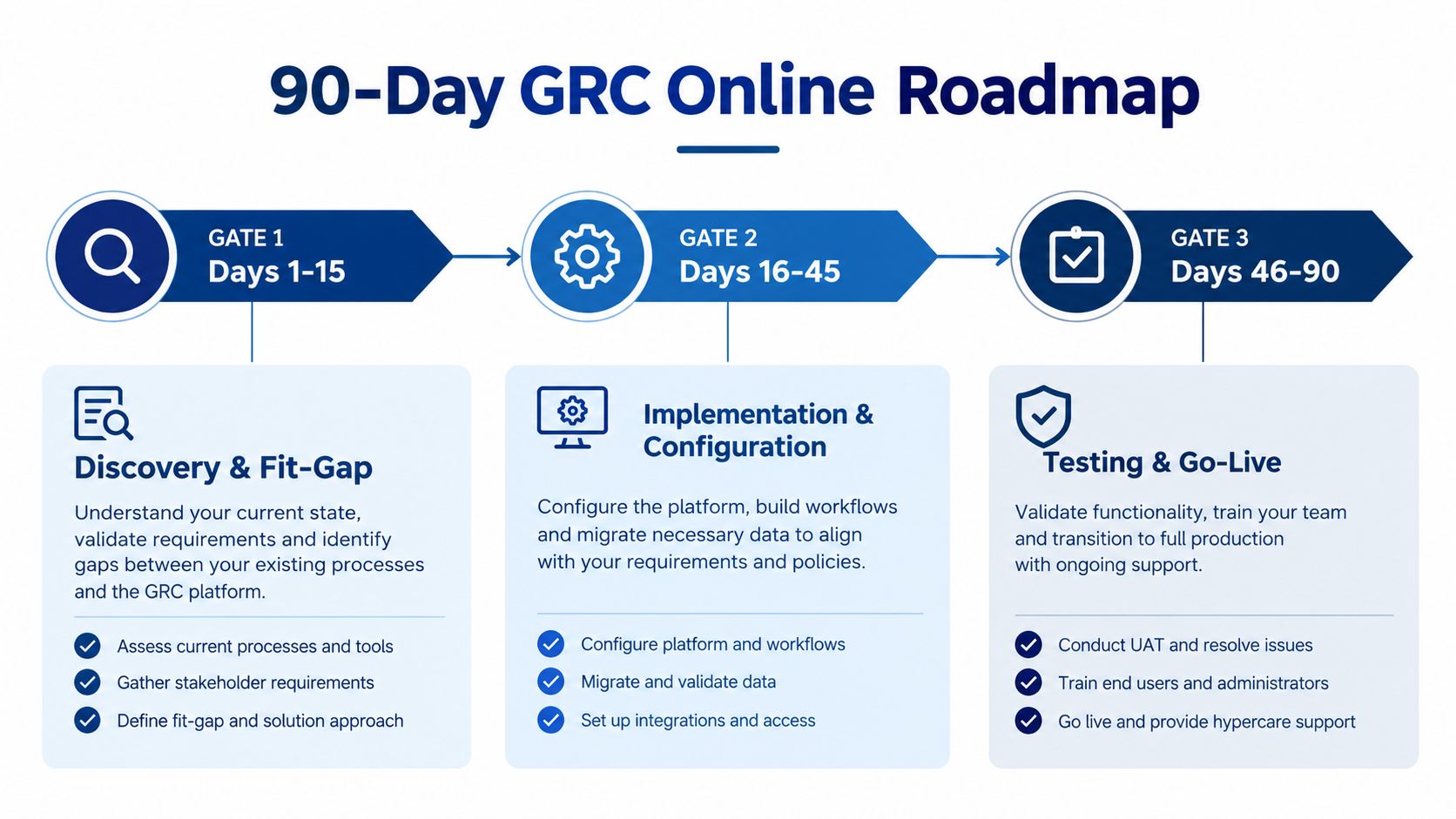
A Practical Roadmap to Implement GRC Online in 90 Days
A short implementation window works when leadership protects the critical path. Don't attempt every framework, entity and workflow at once. Choose a controlled scope, define decision gates and defer low-value customisation.
Discovery and fit-gap
Catalogue the regulations in scope. List current controls, identify owners across IT, HR, finance and legal, and document the top risk scenarios. The output should be a prioritised heat-map and a shortlist of platforms that can handle your regulatory overlays.
The first gate is simple. Proceed only if the organisation agrees on scope, ownership, data residency requirements and the evidence sources that matter.
Design and configuration
Map controls to the chosen content library. Configure roles, workflows and approval paths. Define evidence sources from the CMDB, vulnerability scanner, HR system and ITSM platform, then build an initial regulator pack.
Avoid copying every legacy spreadsheet into the new system. Retain only controls with a clear owner, purpose, test method and evidence requirement.
Pilot and decision gate
Pilot with one business unit or one framework, such as NESA. Run parallel evidence collection long enough to expose gaps in ownership, data quality and integration reliability. Track evidence load, time to evidence and audit-finding closure qualitatively if the baseline isn't reliable.
The decision gate is go or fix. If owners still email evidence, system relationships are incomplete or exceptions lack accountable owners, fix the design before expanding.
Rollout and stabilisation
Expand to additional frameworks, replace manual evidence collection with API-based workflows, train the second line and hand over to managed operations. Put service-level dashboards in place for evidence requests, failed controls, overdue actions and integration health.
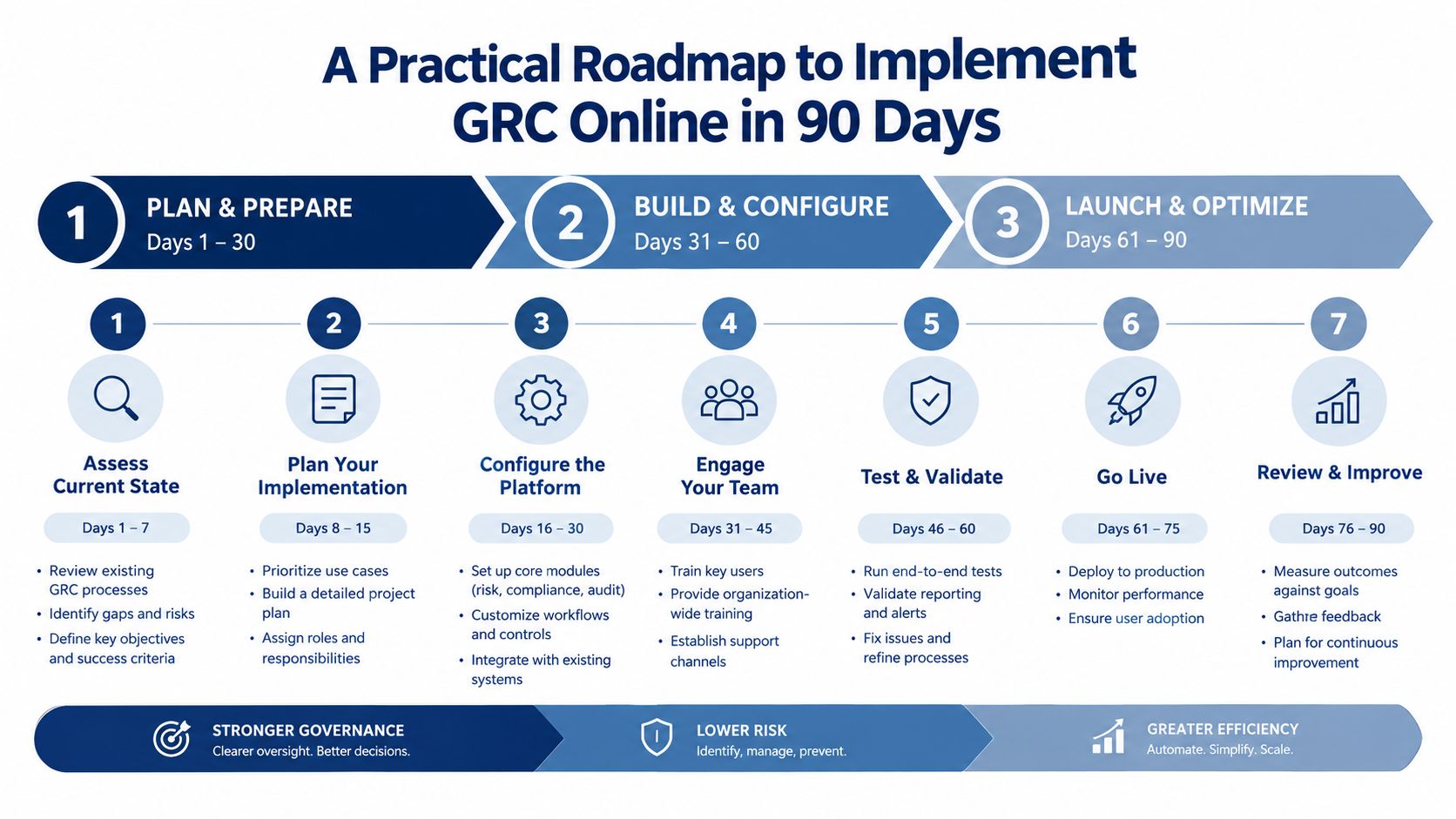
The roadmap is deliberately short. Anything that doesn't improve regulatory coverage, evidence quality, ownership or audit readiness belongs in a later phase. The GRC implementation roadmap provides a useful structure for turning that principle into a delivery plan.
KPIs and Governance Operating Model That Prove It Works
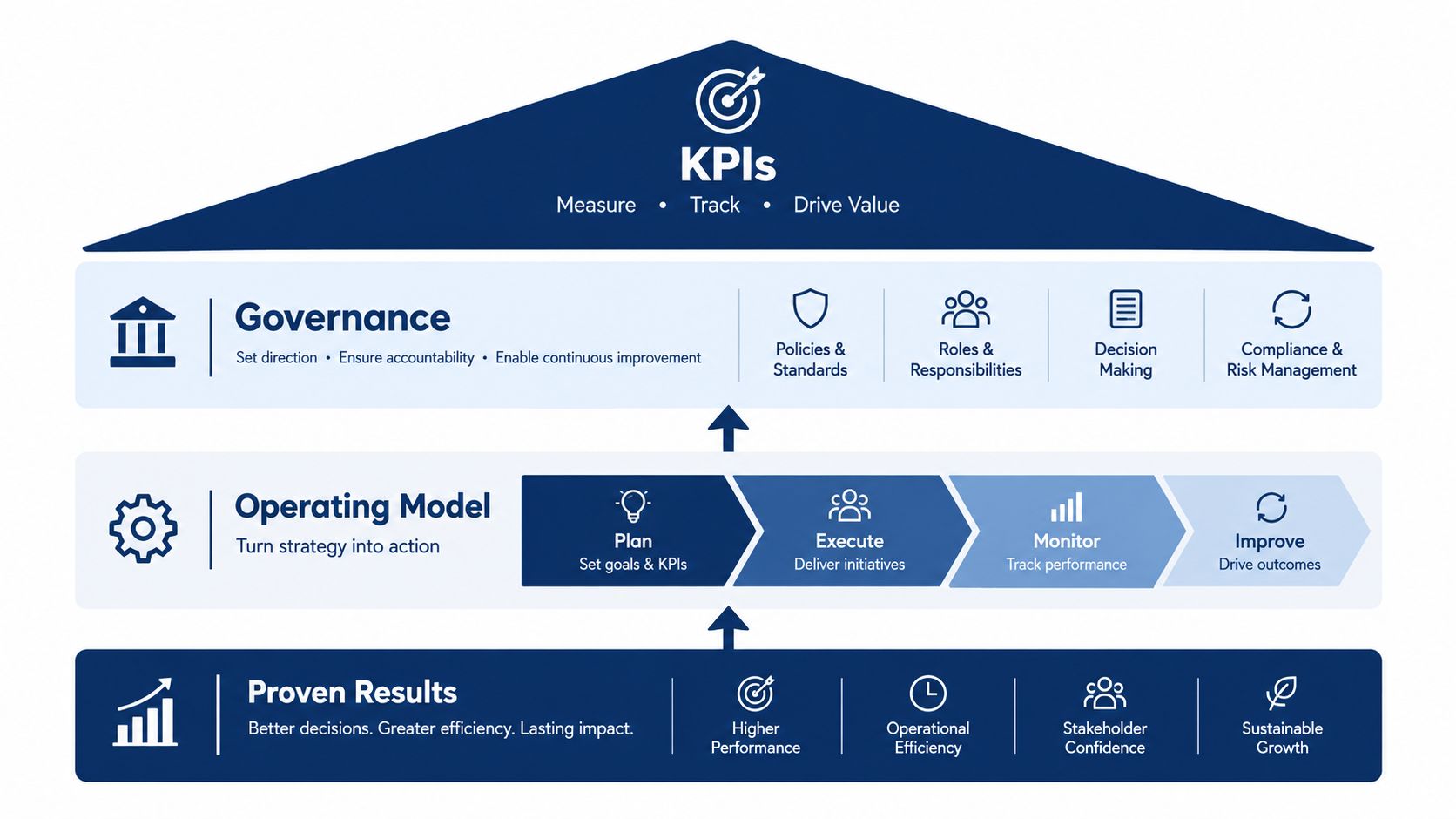
An online GRC programme is credible when the board can see movement in a small set of hard-to-game measures. Don't report login counts or the number of policies uploaded. Report whether controls have owners, evidence and effective tests.
Measures that reflect operational value
Control coverage: The proportion of in-scope controls with a named owner, current evidence and a passing test within the reporting period.
Mean time to evidence: The time between an evidence request and a signed-off artefact in the platform.
Audit findings closed: The number closed, their average age and the quality of closure evidence.
Risk heat-map movement: Changes in residual risk by category, entity and business service.
Evidence automation quality: The percentage of evidence sources that run reliably without manual intervention.
Use a consistent definition for every metric. If one business unit counts a draft upload as evidence while another requires approval, the dashboard will create false confidence. Guidance on how to track governance KPIs can help teams refine definitions and reporting discipline.
The three lines of defence
The first line, made up of business and IT control owners, runs controls and supplies evidence. The second line, including risk, privacy and security teams, owns the framework, challenges the first line and manages regulatory interpretation. Internal audit forms the third line and provides independent assurance through the same evidence environment.
A RACI should assign every control, risk, exception, evidence source and report. Have the CIO, CRO and head of audit approve the operating model. Without named executive sponsorship, the platform becomes an administrative queue rather than a management system.
Common Pitfalls When Moving GRC Online and How to Avoid Them
Most failures begin with a bad operating assumption. Teams buy a platform, migrate spreadsheets and expect the software to create accountability. It won't.
Top GRC Online pitfalls and mitigations
Pitfall | Early Warning Sign | Mitigation | Accountable Owner |
|---|---|---|---|
Treating the platform as a spreadsheet replacement | Teams upload files without linking controls to systems or risks | Design a control-and-evidence model with ownership and test procedures | GRC programme lead |
Skipping evidence automation | Owners collect screenshots before every audit | Connect identity, ITSM, HR, vulnerability and CMDB sources through APIs | Control engineering lead |
Ignoring free-zone overlays | DIFC, ADGM or DMCC requirements sit outside the main register | Create applicability rules and separate control mappings for relevant entities | Legal and compliance lead |
Under-funding change management | Owners return to email and SharePoint | Train control owners, publish role-based guidance and monitor workflow adoption | CIO or transformation sponsor |
Free-zone overlays deserve particular attention. DIFC DPL, ADGM Data Protection requirements and sector-specific expectations can alter evidence, transfer and retention decisions. The UAE's population rose from 3,169,222 in 2000 to 11,294,243 in 2024, with a sex ratio of 178 men per 100 women in 2024, according to GRC's UAE population research. That demographic scale and diversity reinforce the need for clear entity, workforce and service ownership in the control model.
Assign a control librarian to maintain mappings, tie evidence collection to ITSM changes and incident closures, and make the second line responsible for challenging stale or unsupported evidence.
How Managed Services and Staff Augmentation Accelerate Adoption
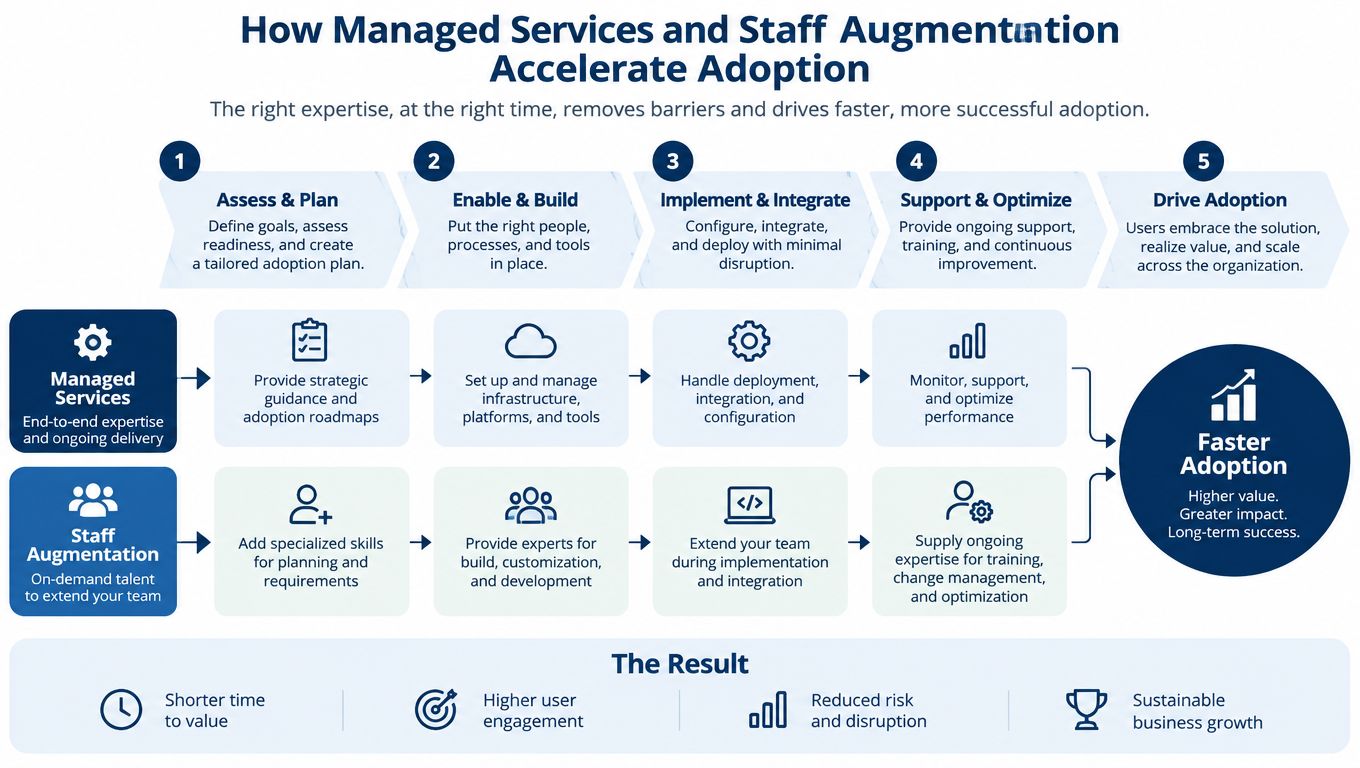
A well-scoped platform still stalls when nobody owns the control engineering, integration development and adoption work. Regulated enterprises need people who can translate obligations into workflows, connect those workflows to operational systems and keep the evidence model healthy after go-live.
Three engagement shapes
Managed GRC operations work when your internal team needs ongoing support with attestations, evidence requests, exception queues, regulatory updates and audit preparation. The partner runs the process while your accountable owners retain decision rights.
Staff augmentation suits organisations with an established risk function but limited platform capacity. A specialist can work alongside ServiceNow, HaloITSM or Freshservice developers, build integrations, refine data models and remove the backlog without taking ownership away from internal leaders.
Discovery-to-runway sprints are useful when the current state is unclear. The delivery team maps the CMDB, HRSD, CSM and ITSM environment, identifies evidence sources, tests regulatory fit and produces an implementation backlog that the enterprise can fund and govern.
DataLunix provides GRC-related consulting and implementation, including control mapping, compliance automation, vendor risk workflows and ServiceNow GRC or IRM delivery. Its broader delivery model covers ServiceNow, HaloITSM, Freshservice and ManageEngine environments, with discovery, fit-gap analysis, change management, staff augmentation and managed operations available as separate engagement components.
The right next step is a focused discovery workshop. Bring your current control register, regulatory scope, ITSM and CMDB architecture, and evidence pain points. A delivery team can then baseline the current state and produce a fit-gap against UAE PDPL, NESA, ADHICS, DESC ISR or Saudi DGRF obligations.
Frequently Asked Questions About GRC Online
What is GRC Online?
GRC Online is cloud-delivered software for managing governance, risk and compliance workflows. It connects policies, controls, risks, regulatory obligations, evidence, testing and audit activity in one operating environment.
How does GRC Online support UAE compliance?
It supports UAE compliance by mapping obligations to controls and evidence requirements across frameworks such as UAE PDPL, NESA, DESC ISR and ADHICS. The platform should also distinguish mainland, federal, sector and free-zone applicability.
Does GRC Online replace ITSM?
No. It should connect to ITSM, ITOM, HRSD and CMDB platforms rather than replace them. ITSM systems execute operational work, while GRC adds regulatory context, control testing, evidence lineage and assurance workflows.
Is GRC Online suitable for Saudi organisations?
Yes, provided the platform maps Saudi obligations to accountable controls and operational evidence. Saudi controls and standards are mandatory and enforceable for subject entities, with compliance monitored by the competent authority under relevant resolutions, regulations and instructions, as outlined in Saudi compliance framework guidance.
Should you choose a global or regional GRC platform?
Choose based on evidence residency, jurisdiction-aware content, integration depth, auditability, delivery capability and total cost. A global platform can work, but it must demonstrate how it handles UAE, Saudi, DIFC, ADGM and sector-specific requirements without forcing your team into external spreadsheets.
DataLunix helps GCC enterprises design and implement GRC Online operating layers that connect UAE and Saudi obligations to controls, evidence, ITSM, HR and CMDB systems. Visit DataLunix to arrange a discovery workshop and receive a practical fit-gap for your regulatory scope, integrations and adoption plan.