


Enterprise GRC Software: Your 2026 Selection Guide

Updated: 1 hour ago
The global enterprise governance, risk, and compliance market was estimated at USD 72.42 billion in 2025 and is forecast to reach USD 203.65 billion by 2033. Enterprise GRC Software is now a core enterprise platform for centralising governance, risk, and compliance activities, unifying policies, controls, audit, and reporting in one operating model rather than spreading them across disconnected spreadsheets and teams.
If you're buying Enterprise GRC Software in the GCC or Europe, stop treating it like a compliance purchase. Treat it like an integration and workflow decision. The platforms that create value are the ones that connect risk and control data to the systems your teams already use, especially ITSM, ITOM, HRSD, CMDB, and service operations.
Why Is Enterprise GRC Software a Priority in 2026
Enterprise GRC Software matters in 2026 because large organisations can't manage regulatory obligations, operational risk, audit evidence, and policy control through fragmented tools any longer. The market has moved decisively in that direction. Grand View Research estimates the eGRC market at USD 72.42 billion in 2025, projected to reach USD 203.65 billion by 2033 at a 13.7% CAGR, with software representing 65.3% of revenue in 2025, signalling a shift toward tooling over manual processes (Grand View Research eGRC market analysis). We break down how much GRC software costs by company size.
That shift is highly relevant for GCC enterprises. You're dealing with digital transformation, supplier complexity, internal audit pressure, and growing expectations around resilience. Spreadsheet-led governance doesn't scale across subsidiaries, service teams, and regional operations.
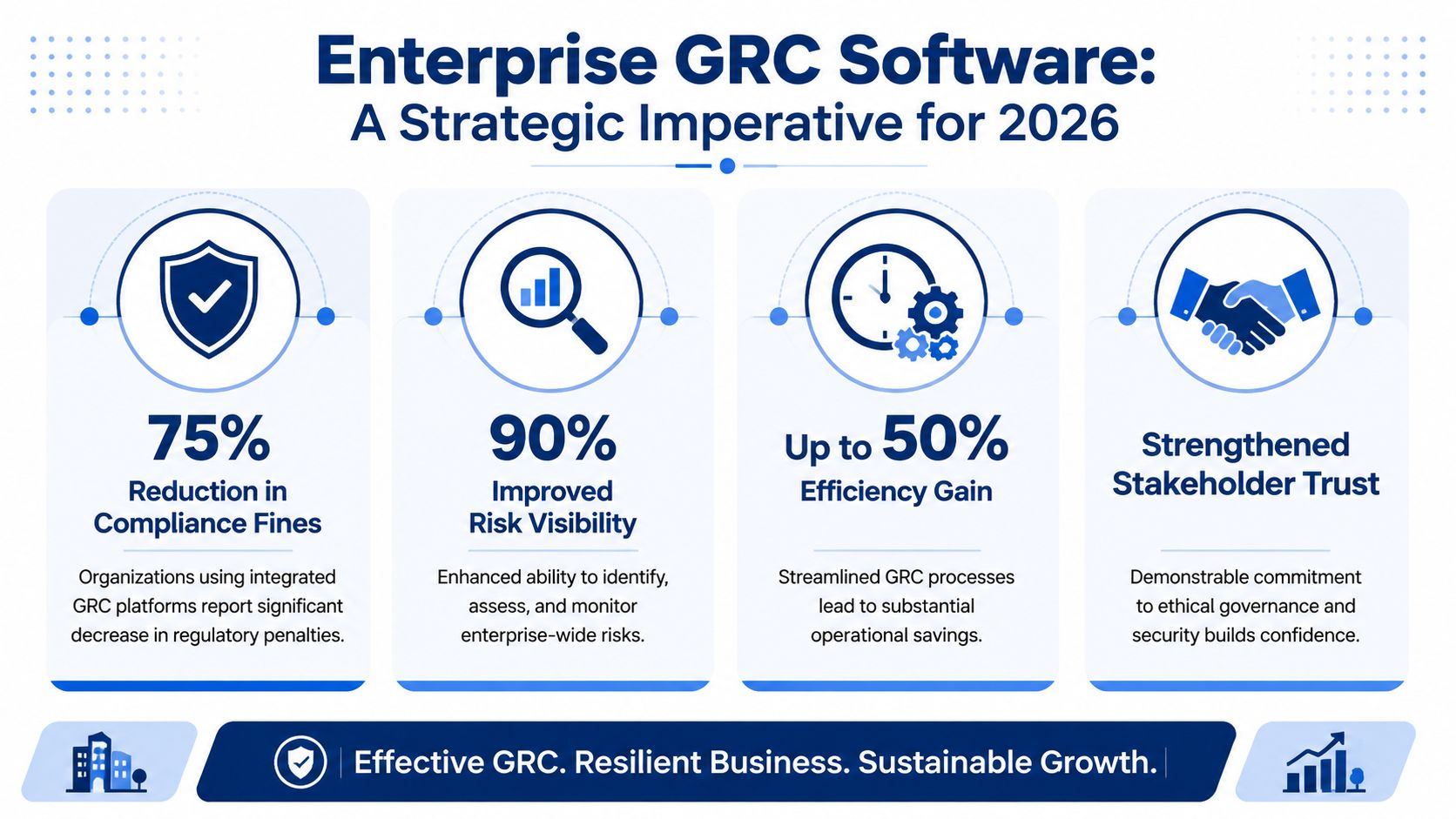
Why the urgency is architectural, not administrative
Most buyers frame GRC as a policy-and-audit problem. That's too narrow. In practice, it's an enterprise architecture problem.
If your control evidence sits in one place, incidents in another, risks in a third, and approvals in email, your team can't answer basic board-level questions quickly. You also can't automate anything meaningful.
Practical rule: If a GRC platform can't connect to your operational systems, it won't become an enterprise control system. It will become an expensive register.
Board-led programmes often shortlist Diligent GRC.
For GCC and European firms facing operational resilience and cross-border governance demands, that distinction matters. A strong reference point for resilience planning is this DataLunix guide on digital operational resilience under DORA, especially if your teams are trying to align IT operations with control obligations.
What smart buyers should focus on first
Don't start with dashboards. Start with these questions:
Where does evidence live today: ServiceNow, HaloITSM, HR workflows, vendor systems, shared drives, or emails?
Who owns remediation: Compliance, security, infrastructure, procurement, or service desk?
How often do controls change: Annually, quarterly, or every time a regulator or internal risk committee updates scope?
Can your teams govern AI use safely: A practical companion resource is GitDocAI principles for AI use, especially if AI governance now overlaps with your risk and compliance programme.
The priority in 2026 isn't buying more features. It's building one operating layer for governance, risk, compliance, and service execution.
What Are the Core Modules of a GRC Platform
The core value of a GRC platform is simple. It centralises risk, compliance, audit, incident, policy, and reporting functions into a unified repository and workflow engine, which improves visibility and reduces the fragmentation that comes with spreadsheet-driven reviews (Hyperproof guide to GRC platform features).
That architecture matters more than any glossy feature sheet. The modules only create value when they work together.
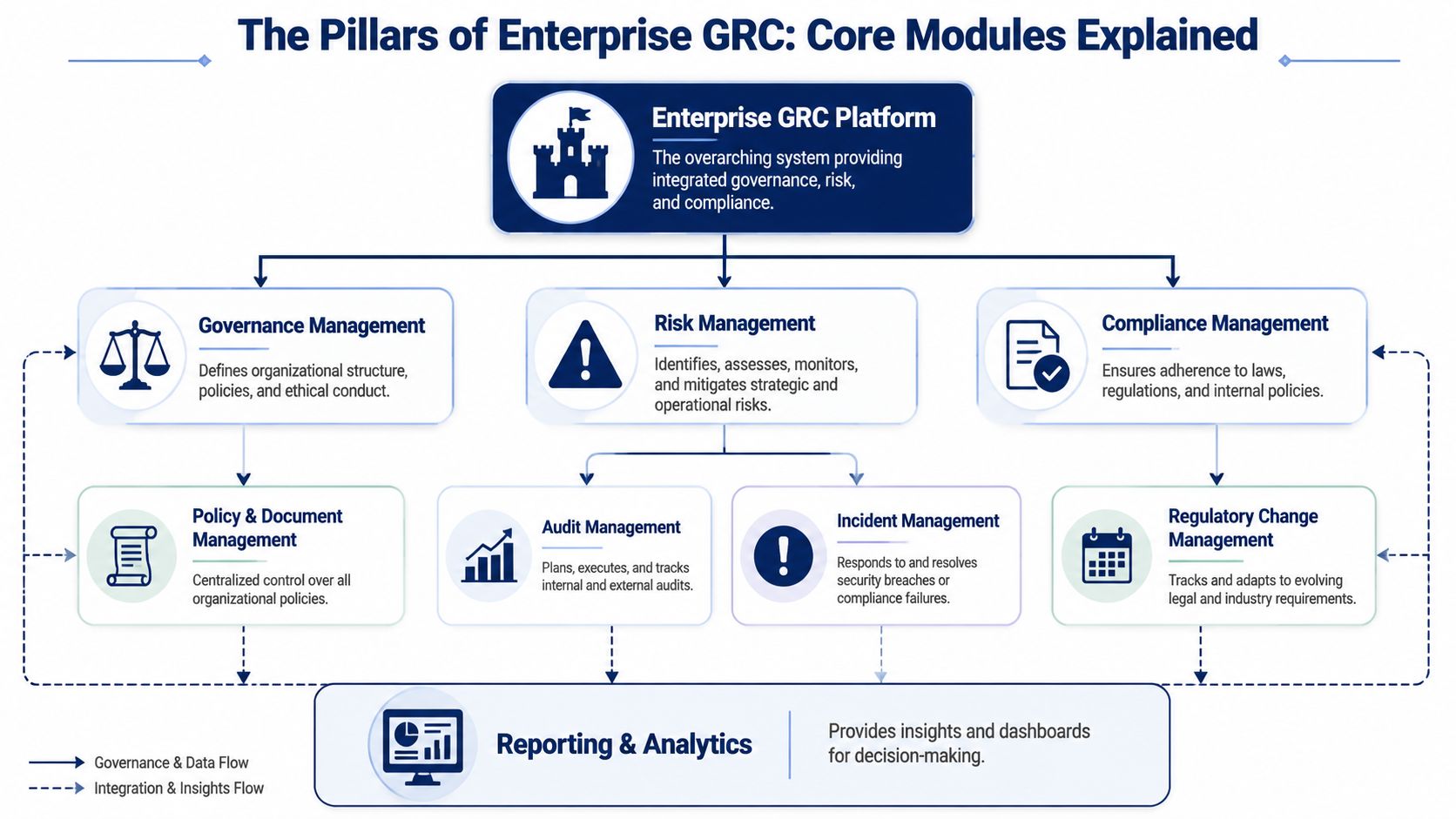
Which modules actually matter
Think of the platform as an orchestra. Each module has a job, but the result only works if they play in sync.
Policy management: This is your control source of truth. It handles policy ownership, approvals, versioning, attestation, and linkage to real controls.
Risk management: This captures risk assessments, scoring, ownership, treatments, and escalation workflows.
Compliance management: This maps obligations to controls, evidence, and review cycles.
Audit management: This structures planning, fieldwork, findings, and remediation follow-up.
Third-party risk management: This tracks vendors, due diligence, assessments, and ongoing review.
Incident and issue management: This links failures, breaches, or exceptions back to controls and owners.
Reporting and analytics: This gives leadership a usable picture of status, not just a pile of records.
Why unified modules beat standalone tools
Separate point tools often look cheaper. They usually create more work.
A policy tool without audit linkage creates duplicated evidence requests. A risk register with no incident integration turns live operational failures into manual updates. An audit tracker that doesn't connect to service management leaves remediation outside the platform.
If you want a strong primer on audit thinking before selecting tooling, this overview of security audits with Rite NRG is useful because it highlights how evidence, testing, and follow-up need a structured process.
A mature GRC platform doesn't just record issues. It routes them to the teams that can fix them and tracks closure in the same workflow.
A practical extension of this approach is visible in DataLunix's perspective on ServiceNow GRC, where the value comes from connecting risk and control processes to enterprise workflows rather than isolating them inside a compliance silo.
What Requirements Define True Enterprise-Grade GRC
True enterprise-grade GRC isn't defined by how many modules a vendor lists. It's defined by whether the platform can deliver an integrated, overall view of governance, risk, and compliance while supporting automated risk assessments, digital control libraries, API integrations, and automated reporting outputs across multiple systems (Info-Tech GRC software selection guide).
That's the line between a usable enterprise platform and a dressed-up register.
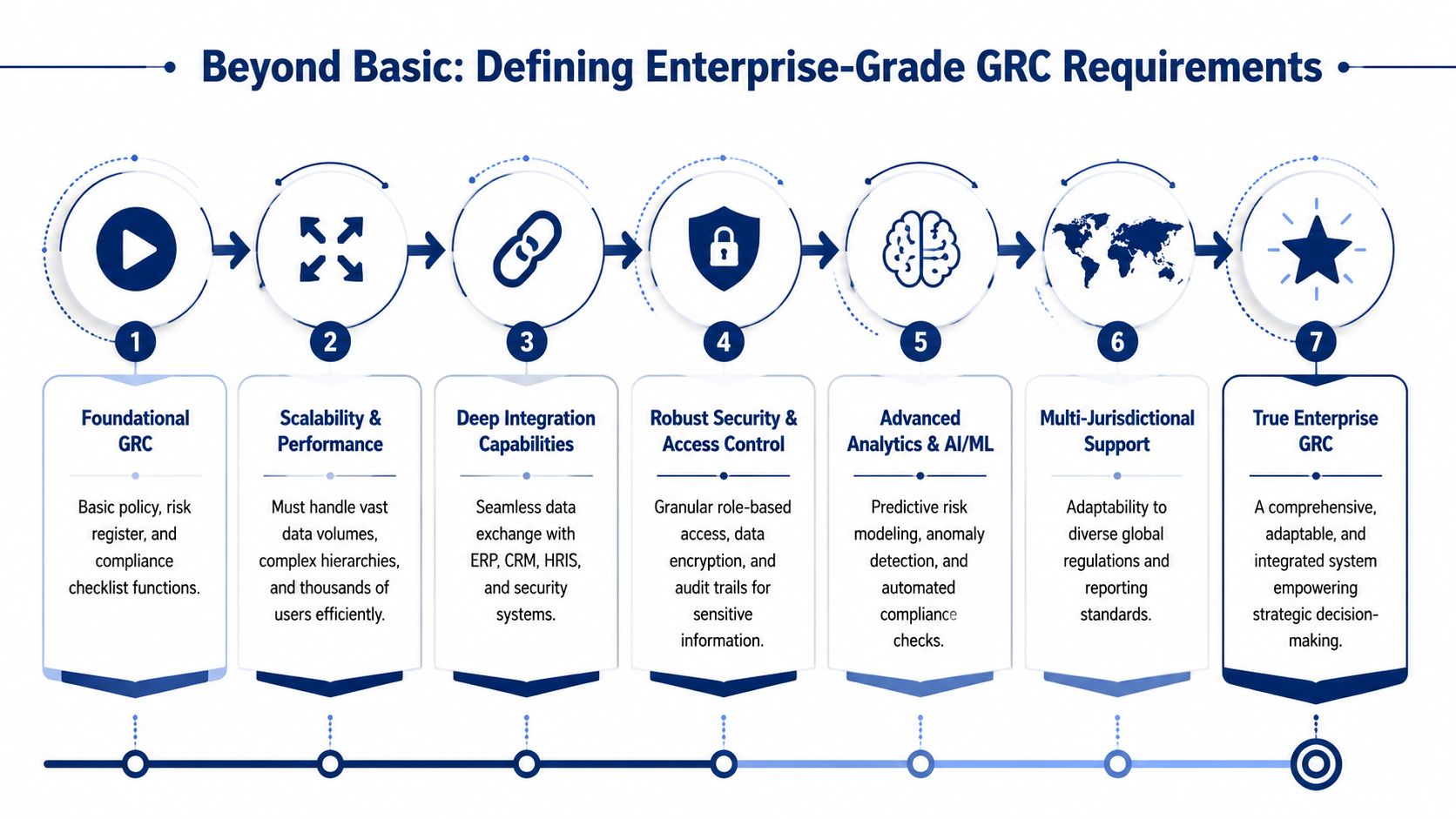
What I consider non-negotiable
If you're evaluating platforms for a large enterprise, these requirements aren't optional:
Requirement | Why it matters |
|---|---|
Deep integration | Your GRC platform must exchange data with ITSM, ITOM, HRSD, CMDB, ERP, identity, and vendor systems. |
Workflow automation | Controls, exceptions, approvals, issues, and remediation need routable workflows, not manual chasing. |
Role-based access | Different teams need different views by entity, jurisdiction, function, and sensitivity. |
Data lineage | Auditors need to see where evidence came from, who changed records, and what happened when. |
Control libraries | Standardised, reusable controls reduce duplication and improve consistency across entities. |
Reporting outputs | Board reporting, audit packs, control status summaries, and regulator-facing outputs must be configurable. |
Scoping flexibility | You need different control sets by country, business unit, legal entity, or service line. |
Where many buyers get this wrong
They buy for feature breadth, not operating fit.
A platform can look powerful in a demo and still fail in production because it doesn't connect cleanly to ServiceNow, HaloITSM, Freshservice, HR workflows, or cloud operations. That's why I push clients to test integrations early. If the vendor can't prove how evidence moves from operational systems into controls and reporting, walk away.
Selection test: Ask the vendor to show a live workflow where a service ticket, policy exception, control failure, and remediation task all connect without manual re-entry.
This is also where integrated risk management becomes the more useful lens than plain compliance automation. Enterprise GRC only works when risk data, service data, and control data move together.
What Are the Tangible Business Benefits and KPIs
The business case for GRC should be measured in operational outcomes, not vendor slogans. If leadership can't tie the platform to speed, visibility, consistency, and reduced duplication, the investment will drift.
Which benefits are actually worth tracking
Start with board-relevant outcomes:
Better visibility: Leaders can see control status, overdue remediation, open audit findings, and unresolved incidents in one place.
Faster audit readiness: Teams spend less time collecting the same evidence repeatedly.
Cleaner accountability: Owners, due dates, and approvals are assigned and tracked in workflow.
More consistent controls: Shared control libraries reduce local reinvention across departments.
Stronger resilience: Operational incidents and compliance gaps are easier to escalate and close.
These benefits are real only when you define KPIs before implementation.
Which KPIs should go into the business case
Use a practical KPI set that links governance activity to enterprise operations:
Outcome | KPI example |
|---|---|
Audit efficiency | Audit preparation time, evidence collection cycle time, number of repeat evidence requests |
Control effectiveness | Percentage of controls tested on time, number of failed controls awaiting remediation |
Remediation discipline | Time to close issues, overdue action volume, closure rate by owner group |
Policy governance | Policy review completion, attestation completion, number of outdated policies |
Risk operations | Open high-priority risks, reassessment completion, treatment plan status |
Third-party governance | Vendor assessment completion, review backlog, issue closure by supplier tier |
What to avoid measuring
Don't anchor your programme on vanity metrics such as number of dashboards, number of workflows built, or number of records imported. Those are implementation outputs, not business results.
Use a framework your executives already recognise. If your organisation aligns risk with strategy, this DataLunix article on COSO enterprise risk management and strategy alignment is a useful way to connect GRC reporting to decision-making rather than compliance theatre.
If your KPI pack doesn't tell the board what is exposed, what is overdue, and who is accountable, your GRC reporting still isn't good enough.
How Should You Select and Implement GRC Software
You should select GRC software in the same way you'd select an enterprise workflow platform. Define scope, prove integrations, validate governance model, then phase rollout. Anything else creates cost before value.
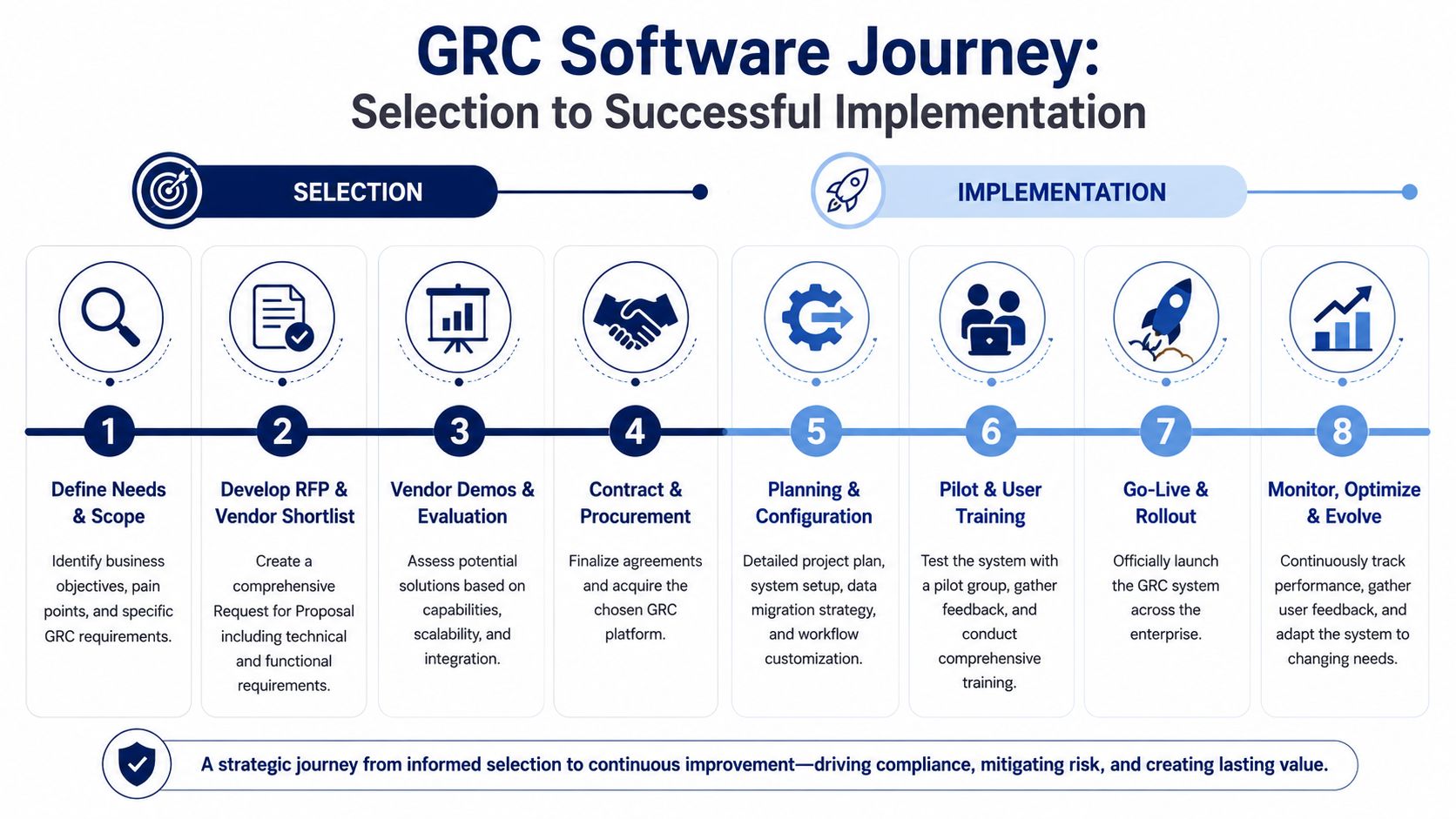
What the selection process should look like
Use a disciplined shortlist process.
Define business scope Decide which use cases matter first. Policy management, audit, compliance mapping, third-party risk, and issue remediation usually don't need to launch together.
Map your system environment Identify where evidence, incidents, approvals, and asset data already live.
Run a fit-gap workshop This is the step most buyers rush. Don't. It tells you whether the platform fits your entity structure, workflows, and reporting model.
Demand realistic demos Use your own scenarios. Don't accept polished demos with ideal data.
Score implementation effort Some platforms are strong products but poor fits for your internal delivery capacity.
A practical comparison baseline is this DataLunix overview of the best GRC software, especially for shaping a shortlist around operating fit rather than brand familiarity.
What implementation teams should do differently
Most GRC programmes fail because implementation is treated as a technology deployment instead of a process redesign.
Use this rollout pattern:
Phase one: Launch a small number of high-friction workflows, such as policy lifecycle, issue remediation, or audit evidence collection.
Phase two: Add risk assessments and control mapping once the workflow model is stable.
Phase three: Extend into vendor risk, regulatory tracking, and board reporting.
One practical option in this market is DataLunix, which provides a centralised GRC platform and delivery services tied to discovery workshops, fit-gap analysis, readiness assessment, and integration work across systems such as ServiceNow, HaloITSM, and Freshservice.
What to insist on before go-live
Named process owners: Not just admin users.
Clear evidence model: Where evidence comes from, who approves it, how long it remains valid.
Adoption plan: Training for first-line teams, not only compliance staff.
Support model: Who maintains workflows, forms, and reporting after launch.
If those items aren't settled, the software will go live but the programme won't.
What Are the Real Costs and Common Challenges
The cost of GRC isn't licence price alone. It's the ongoing effort required to maintain integrations, update controls, manage evidence, support users, adapt workflows, and respond to regulatory and AI governance changes.
That's why many GRC business cases disappoint. They ignore operating cost.
Where total cost actually comes from
Pathlock's guidance highlights a key issue: the true operating cost of GRC rises under rapid regulatory and AI governance change, and many enterprises need better data integration and workflow orchestration across ITSM and ITOM before they can realise full value from a GRC suite (Pathlock GRC tools overview).
That's exactly what I see in enterprise programmes. Buyers budget for software and implementation, then discover they still need process owners, integration support, admin capacity, and regular control updates.
Here's where cost accumulates:
Implementation complexity: Mapping controls, entities, workflows, and legacy records takes work.
Integration effort: Connecting service management, identity, vendor, and document systems is rarely plug-and-play.
Operational administration: Someone must own taxonomies, forms, user access, workflows, and reporting changes.
Regulatory updates: Controls don't stay still. Neither do internal operating models.
Adoption drag: If first-line teams don't use the platform, compliance teams end up doing manual follow-up anyway.
Which challenges cause the most waste
The most expensive problem isn't software failure. It's partial adoption.
A few common traps:
Buying too big too early: You don't need every module on day one.
Migrating poor data blindly: Bad spreadsheets imported into a new platform stay bad.
Ignoring service workflows: Remediation often happens in ITSM, not in the GRC interface.
Treating GRC as a compliance-only tool: Operations, security, HR, procurement, and audit all need to be in the design.
The hidden cost in GRC is duplicated effort. If teams still collect evidence by email, chase approvals in chat, and close issues outside the platform, you're paying twice.
SaaS, on-premise, and hybrid models each have trade-offs, but deployment model isn't the first decision. Operating model is. Choose the model that your team can maintain.
How Is GRC Software Used in GCC and European Enterprises
In the GCC, the hardest GRC problem usually isn't creating controls. It's applying them across multiple entities, countries, and free-zone structures without duplicating work. Guidance for enterprise buyers increasingly points to adaptive scoping, separate workspaces, and role-based access for different countries or business units as key requirements for multi-entity organisations (Vanta enterprise GRC software guidance).
That's the core enterprise use case. Not size alone. Jurisdictional complexity.
A GCC example
Consider a UAE-headquartered group operating in the UAE and Saudi Arabia with separate legal entities, shared vendors, and different approval chains.
The wrong GRC design creates:
duplicated control libraries
duplicated evidence requests
inconsistent reporting by entity
weak visibility for group leadership
The right design uses:
separate workspaces by entity or country
shared control libraries where appropriate
local workflow variations for approvals
central reporting with controlled access by role
That setup reduces audit friction because teams reuse evidence intelligently instead of recollecting it for each entity.
A European example
Now consider a Frankfurt-based enterprise running a mature ITSM environment and trying to align service operations with compliance obligations.
The useful GRC model isn't one where audit logs sit in isolation. It's one where:
service requests trigger control checks
incidents create linked issues
remediation tasks route to operational owners
policy exceptions are visible in the same workflow chain
This is why I keep pushing the same point. Enterprise GRC Software is an integration engine. In both the GCC and Europe, value appears when the platform sits close to live operations, not when it acts as a passive compliance archive.
For CIOs and transformation leaders, the practical recommendation is straightforward. Buy the platform that best fits your entity structure, system environment, and operating cadence. Then implement only the workflows that connect governance to actual work.
If you're reviewing Enterprise GRC Software for a GCC or European enterprise, DataLunix can help you start with the part most vendors skip: discovery, fit-gap analysis, integration mapping, and rollout planning across your ITSM, ITOM, HRSD, and service operations stack so you can de-risk the investment before you commit to a platform.
FAQ
What is Enterprise GRC Software in simple terms
Enterprise GRC Software is a central platform for managing governance, risk, compliance, audit, policy, and related workflows across the organisation. Its real value comes from connecting those activities to operational systems so controls and evidence don't sit in silos.
How should I choose Enterprise GRC Software for a GCC enterprise
Choose based on integration, entity structure, and workflow fit first. If your organisation spans countries, subsidiaries, or free zones, make sure the platform supports separate workspaces, adaptive scoping, and strong role-based access.
Why do Enterprise GRC Software projects fail
They usually fail because buyers focus on features instead of operating model. Weak integrations, unclear ownership, poor data migration, and limited first-line adoption create manual work after go-live.
Is Enterprise GRC Software mainly for compliance teams
No. Compliance may sponsor the programme, but operations, audit, security, procurement, and HR often supply the evidence and execute remediation. If those teams aren't part of the design, the platform won't deliver enterprise value.
What KPIs should I track after implementing Enterprise GRC Software
Track audit preparation time, evidence cycle time, overdue remediation, control testing completion, policy review status, and issue closure by owner group. Those measures show whether the platform is changing work, not just storing records.