


Governance in Risk Management

Governance in risk management is not a policy binder. It's the operating model that decides who owns risk, who can accept it, how fast it gets escalated, and what evidence the board will see when auditors ask hard questions. Most programmes fail because they confuse documentation with control, and the gap is visible in governance benchmarks where 75% of companies report a risk governance framework, but only 49% have dedicated board-level risk oversight and just 30% have a first line of defense responsible for executing risk management activities, according to S&P Global's risk management benchmark.
What Governance in Risk Management Means
Governance in risk management means decision rights, accountability, and enforcement. It is the operating model that tells the organisation who owns each risk, who can accept it, when escalation is mandatory, and what evidence the board will review when auditors start asking hard questions.
The clean mental model is mandate, structure, policy, assurance. The mandate ties risk to strategy. The structure assigns ownership. The policy sets the rules. Assurance proves the rules are being followed in practice.
Dimension | Governance | Risk Management |
|---|---|---|
Purpose | Decide who owns risk and how decisions are made | Identify, assess, and treat risk |
Focus | Accountability, oversight, escalation, reporting | Hazards, controls, mitigation actions |
Output | Decision rights, board visibility, operating model | Risk registers, treatment plans, control tests |
Evidence | Minutes, approvals, attestations, audit trails | Assessments, control results, incident records |
Practical rule: if no named owner can explain the last risk decision, you don't have governance, you have a register.
The board cares about the first line of defense because execution lives there. A framework without operational ownership is theatre, and auditors spot that quickly. Frameworks are common, execution is thinner, and that gap is where findings start to appear.
Governance in risk management should be designed as the control plane over ITSM, ITOM, compliance, and AI workflows. That is where risk surfaces in GCC enterprises, not in a slide deck. The broader relationship is covered in DataLunix's governance risk and compliance overview.
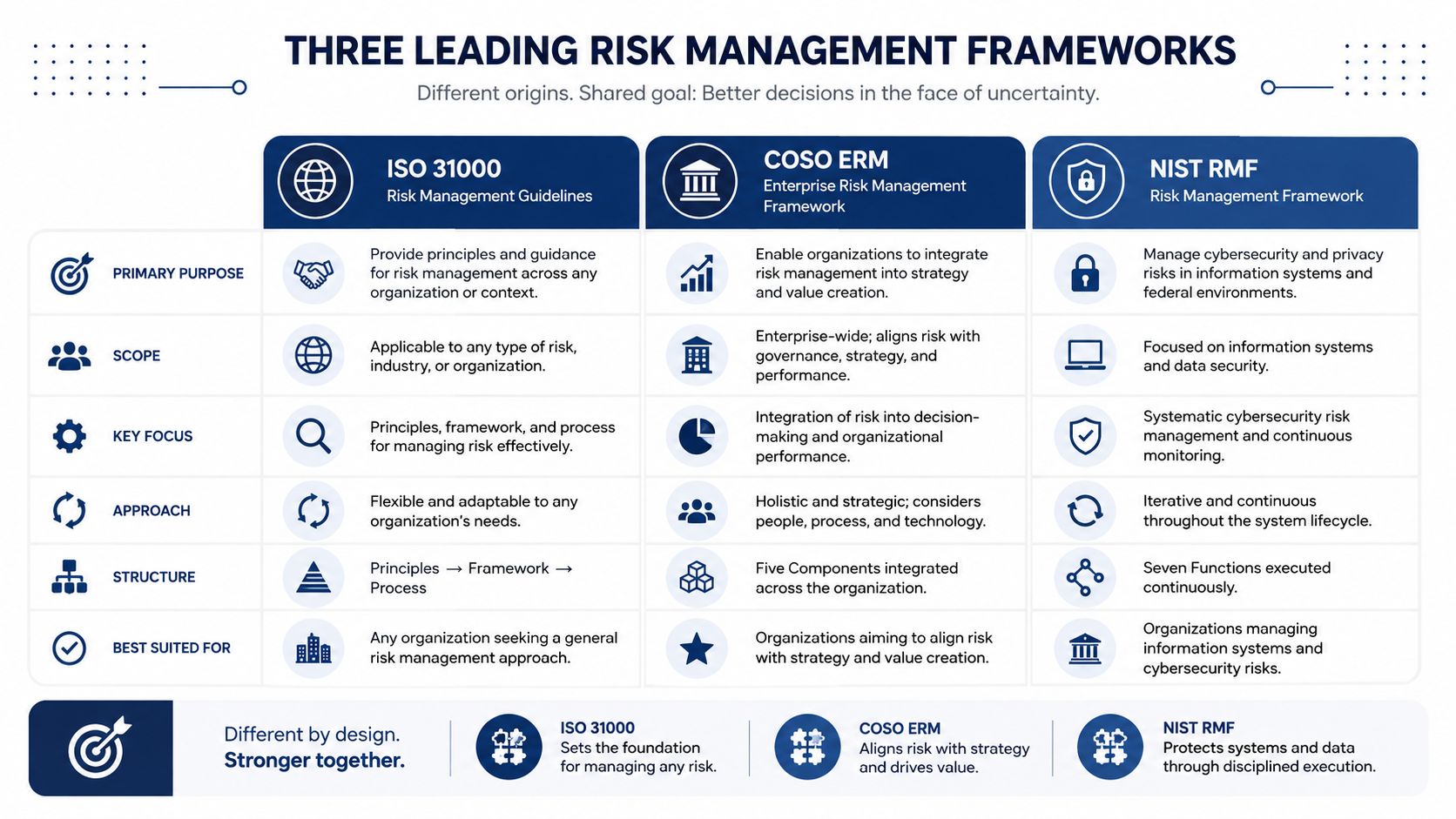
Comparing ISO 31000, COSO ERM and NIST RMF
Pick the framework that matches the board's question, not the one that sounds most impressive in procurement. ISO 31000 works best as the umbrella when you need enterprise-wide consistency. COSO ERM is stronger when the board wants tight alignment between risk and strategy. NIST RMF is the right choice when cyber, systems assurance, and operational resilience dominate.
The clearest way to compare them is by accountability and reporting, because that's where programmes either stand up or collapse.
Framework | Best fit | Accountability style | Appetite and tolerance | Reporting cadence |
|---|---|---|---|---|
ISO 31000 | Enterprise-wide governance | Flexible, principles-led | Can be defined inside the operating model | Set by the organisation |
COSO ERM | Board and strategy alignment | Stronger emphasis on enterprise integration | Explicit link to performance and strategy | Board-oriented |
NIST RMF | Cyber and technical resilience | Control-centric and system-focused | Usually tied to security or system risk thresholds | Operational and assurance-heavy |
What most large organisations should do
Most large organisations shouldn't pick one framework and stop. They should run ISO 31000 as the umbrella, then use COSO ERM for board alignment and NIST RMF for technical control depth where cyber and platform resilience matter. That gives you one governance language with multiple control layers underneath.
The OCC is blunt about why this matters, risk governance applies sound corporate governance principles to the identification, measurement, monitoring, and controlling of risks, and it keeps risk-taking aligned with strategy and appetite, not just compliance paperwork. Its handbook also ties governance to policies, processes, personnel, and control systems, which is the practical standard regulators expect, not a logo on a framework slide, as set out in the OCC corporate risk governance handbook.
A board that wants speed, auditability, and cross-functional control should not debate framework purity. It should demand one enterprise model and then insist that technical domains plug into it with named owners and real evidence. DataLunix's COSO ERM strategy integration guide is a useful companion if your board wants the strategy link made explicit.
Roles, Lines of Defense and the RACI That Works
Boards fail when ownership is vague. A CRO helps, and McKinsey's survey found that 92% of institutions now have a chief risk officer or equivalent, up from 89% in 2012 and 65% in 2002, but title alone does not create accountability on a Tuesday afternoon when an incident lands, according to McKinsey's governance, risk and compliance survey.
Who sits where
The board sets risk appetite and challenges the evidence. The audit committee pushes management on controls, exceptions, and follow-through. The executive risk committee settles trade-offs that affect appetite, budget, and customer impact. The first line owns the process, including ITSM, ITOM, and AI workflow owners. The second line defines standards and monitors adherence. The third line tests whether the model holds up in practice.
Risk ownership belongs with the people who can change the process, not with the people who only write the memo.
A RACI that works in an incident-driven change is simple and traceable. If a service desk ticket triggers model retraining, the responsibilities should look like this:
Service desk manager, Responsible. Opens the change, attaches incident context, and routes it correctly.
Platform owner, Accountable. Decides whether the change proceeds and owns the implementation evidence.
Risk and compliance lead, Consulted. Checks whether the change affects control thresholds, risk acceptance, or regulatory obligations.
Internal audit, Informed. Sees the trace but does not run the process.
AI model owner, Responsible for the retraining step. Confirms training data, validation, and release gating.
The Financial Stability Board is clear that the independent risk management function must cover the entire organisation, identify, measure, monitor, recommend mitigation, and report on exposures. That is why the second line must stay independent and enterprise-wide, as described in the FSB peer review on risk governance. The Australian Institute of Company Directors adds the practical mechanics many firms still skip, including clear lines of responsibility, documented event identification, contingency plans, monitoring, and regular assessment of framework adequacy, in its risk management guide.
The structure only works if the first line owns execution, the second line owns challenge, and the third line stays independent. Anything softer turns into committee theatre. For AI-heavy environments, use the guide to AI compliance frameworks to keep model oversight tied to named owners, approval gates, and evidence trails, then use AI automation examples to map those controls to the actual workflows where change, retraining, and release decisions happen.
Embedding Controls in ITSM, ITOM and Agentic AI Workflows
Governance fails fast if it lives only in policy decks. Regulators and auditors want to see controls inside tickets, configuration items, approval gates, and model workflows, because that is where risk appears. If the control is outside the process, it will not survive a walkthrough.
Controls that hold up under audit
Start with change advisory board discipline in ServiceNow or HaloITSM. Every high-risk change should link to a risk register item, a named owner, a rollback plan, and a required approval path. Problem records should map back to root-cause risk entries, not sit as disconnected operational noise.
Then put ITOM and CMDB governance on the same footing. Configuration items should carry classification, criticality, and dependency data. If a server, integration, or model endpoint changes, the risk view should change with it. That is how you stop the board from relying on stale assurance.
Agentic AI needs tighter controls than standard automation. Require human-in-the-loop approval for material actions, document model purpose and intended use, and keep a model evaluation record before release. If a prompt, model, or retrieval source changes, the change record needs a traceable owner and a sign-off path. For practical workflow mapping, the AI automation examples guide is useful because it shows where control points belong inside real operational flows.
The FAIR Institute's guidance is the right technical baseline here. Data governance over accuracy, completeness, timeliness, and lineage is not optional, it is the prerequisite for credible risk metrics, because poor source data flows straight into board reporting, as set out in the FAIR Institute data governance paper. If lineage is weak, the risk number is weak. If lineage is controlled, the investigation starts at the source instead of in the board pack.
For AI oversight, use the guide to AI compliance frameworks alongside your internal policy set. Keep the model owner, approval gate, and evidence trail tied to the workflow, not to a separate governance register that nobody checks during change execution.
KPIs and Reporting Templates That Survive Audit
Dashboards fail when they track activity instead of control effectiveness. A risk programme that only reports incidents, tasks, or closed tickets misses the point. Boards need KRIs, control testing results, and escalation speed if they are going to make defensible decisions.
The KPI set to use
Risk coverage. Which critical services, platforms, and AI workflows have current risk assessments.
Control testing pass rate. Which controls passed independent or first-line checks during the period.
KRI breach frequency. How often thresholds were exceeded and whether exceptions were accepted or remediated.
Mean time to escalate emerging risks. How quickly the second line got the issue in front of decision makers.
Board pack timeliness. Whether reporting was delivered in time for review, challenge, and action.
KPI | Formula | Target | Source System |
|---|---|---|---|
Risk coverage | Assessed critical assets divided by total critical assets | Qualitative target set by the board | GRC platform, CMDB |
Control testing pass rate | Passed controls divided by controls tested | Above board threshold | Audit tool, control library |
KRI breach frequency | Breaches in period | Downward trend | Monitoring dashboards |
Mean time to escalate emerging risks | Detection to executive review time | Short enough for action | ITSM, risk register |
Board pack timeliness | Pack delivered before meeting cutoff | On time every cycle | GRC workflow |
What the board pack should contain
The board pack should be short and disciplined. Include current top risks, new escalations, breached KRIs, remediation status, unresolved control exceptions, and decisions required from the board. The independent risk function should own the pack, because the FSB expects enterprise-wide coverage and reporting, not a department-level memo.
The IRGC warns that boards often get dashboards full of lagging incidents while KRIs and early warnings are underused. That is why strategic and emerging risks get recognised too late. The warning matters in AI and cyber, where waiting for incident counts means the organisation has already lost time, as reflected in the IRGC risk governance concept note.
For audit-facing reporting, use an audit workflow platform such as DataLunix's audit GRC software guide if you need to turn these measures into repeatable workflows rather than manual slide assembly.
Regulatory Considerations for the GCC and Europe
Regional regulation is converging on the same question, can you prove that governance is embedded in the operating model. The answer has to work across data, third parties, resilience, and AI documentation, because that's where audits usually concentrate.
Where the common failure points sit
In the GCC, regulators expect strong control over third parties, critical systems, and data handling. In the EU, DORA and GDPR sharpen the same expectations around operational resilience, processing discipline, and traceability. The design challenge is not to build separate programmes for each rulebook, but to build one workflow that evidences control across all of them.
The three pressure points are the same in most reviews.
Data localisation and data movement. If lineage and ownership are unclear, reporting and privacy controls break.
Third-party risk. If vendors touch service flows, AI outputs, or hosting layers, their actions must sit inside the governance model.
AI documentation. If model purpose, validation, and change history are missing, the organisation cannot defend its decisions.
The OECD's view that risk management belongs inside corporate governance, not outside it, is the cleanest cross-regime principle to hold onto, because it makes risk information part of decision-making rather than a separate compliance exercise, as stated in the OECD corporate governance and risk management report. If your operating model supports that principle, it will usually map cleanly to GCC and European expectations.
For DORA-specific alignment, use the EU DORA regulation guide as a control mapping reference. The key is to make the same ticket, approval, evidence trail, and reporting pack satisfy multiple regimes without duplicating effort.
Mini Case Scenarios and a 90 Day Implementation Roadmap
A GCC bank doesn't need a five-year transformation narrative. It needs a working governance model in a quarter, with the right traceability for audit and the right ownership for operations. The same applies to a European enterprise testing agentic AI under tighter resilience expectations.
In one bank scenario, the service desk routes high-risk changes into a risk-linked CAB process. By day 30, the change record, risk register, and CMDB relationships are aligned. By day 60, problem records are feeding recurring risks into the second line. By day 90, the board pack shows trend data, exceptions, and owner-approved remediation plans.
In the AI pilot scenario, a workflow refuses autonomous action until human approval and validation checks are complete. The model inventory, evaluation record, and release gate sit in the same control chain. By the end of the pilot, the enterprise can show who approved what, when the model changed, and which risk control moved with it.
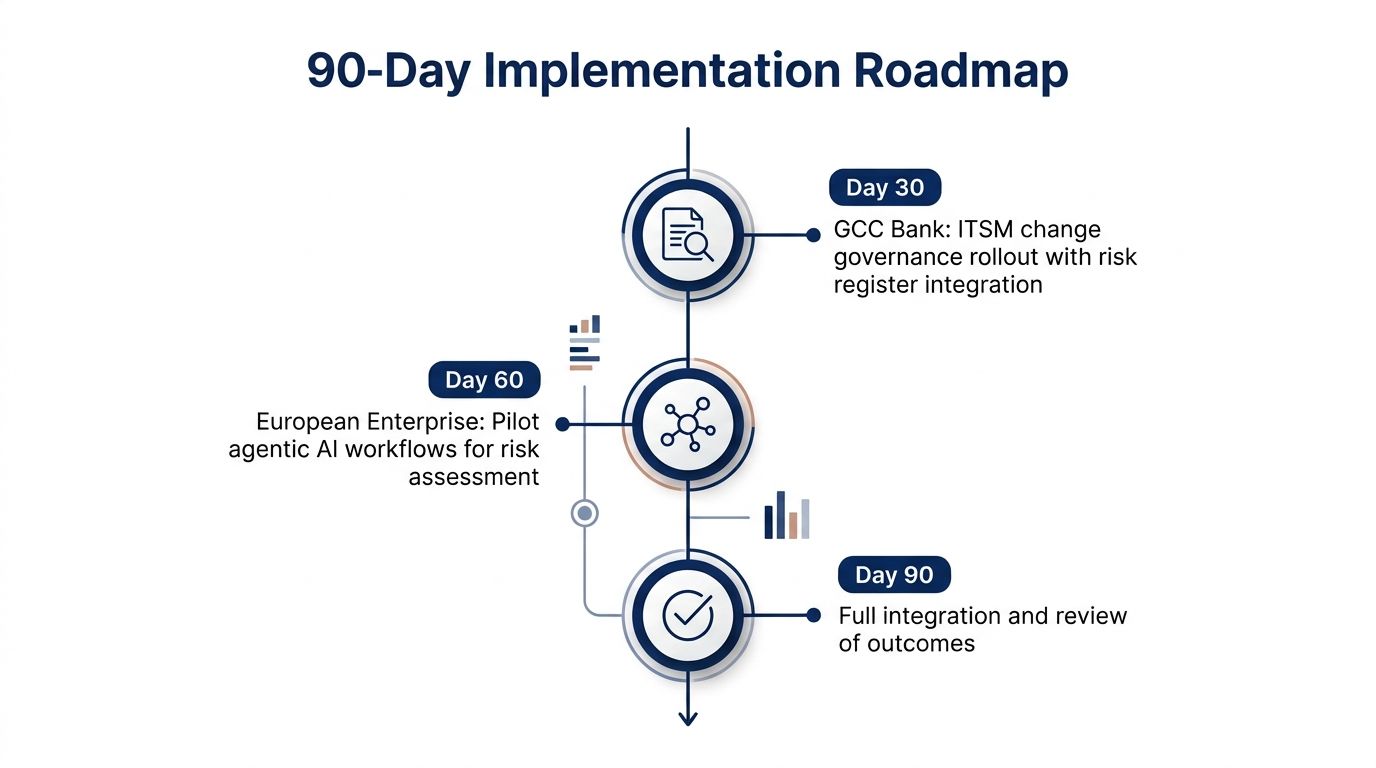
A realistic 90-day plan is simple.
Days 1 to 30. Discover the current state, confirm framework choice, identify board reporting needs, and map risk owners to ITSM, ITOM, and AI workflows.
Days 31 to 60. Draft policies, build RACI, configure approval gates, connect risk register objects to workflow records, and define KPI calculations.
Days 61 to 90. Launch reporting, test control evidence, run board pack review, and fix the gaps auditors will notice.
If the first board pack can't be reproduced from source systems, the governance design is too manual.
DataLunix works on these kinds of operating-model builds across ITSM, ITOM, CSM, HRSD, and agentic AI, using HaloITSM, Freshservice, ManageEngine, and ServiceNow environments. For CIOs who need governance embedded in delivery, that's the right practical lens, not a theoretical one.
If you want governance in risk management to stand up in a board audit, stop treating it as a policy exercise and start treating it as an operating-model build. Visit DataLunix to plan the control design, workflow integration, and board reporting that make the model defensible in the GCC and Europe.