


Governance Risk and Compliance GRC Tools

You've sat through the demos. The dashboards looked polished, the workflow maps sounded tidy, and every vendor promised less chaos. Then the first week hit, a UAE privacy question landed from legal, internal audit asked for evidence, procurement raised a third-party review, and the same controls had to satisfy more than one framework at once. That's where governance risk and compliance GRC tools either earn their keep or become another place to log work.
The right platform doesn't just store policies. It becomes the workflow layer that connects control owners, evidence collectors, risk teams, and auditors across business units and jurisdictions. In the UAE and wider GCC, that matters more now because the regulatory baseline has tightened around cyber, data, and digital trust, while digital expansion keeps adding more systems, vendors, and approval paths to govern centrally UAE GRC regulatory backdrop.
Why GRC Tools Have Become a Board-Level Conversation
A CIO in Dubai does not need another slide about “visibility”. They need a way to keep UAE Personal Data Protection Law obligations, group audit requests, and vendor due diligence from colliding in the same week. That is why governance risk and compliance GRC tools have moved from the audit team's wish list to a board-level topic.
Why the UAE backdrop changes the buying case
The UAE's formal regulatory buildup is driving the buying case. Federal Decree-Law No. 45 of 2021 created a nationwide privacy compliance baseline, the National Cybersecurity Strategy launched in 2021, and the Digital Economy Strategy targets a rise in the digital economy's contribution from 9.7% of GDP to 20% by 2031 UAE GRC regulatory backdrop.
That mix changes how GRC gets funded and judged. Digital growth adds more policies, more controls, more vendors, and more approval paths that need to be governed centrally. Spreadsheets and email chains break down once controls have to be mapped across Dubai, Abu Dhabi, and GCC entities with different reporting lines. The practical takeaway is straightforward, GRC tools are now the coordination layer, not a filing cabinet.
A second pressure point is operational, not regulatory. Governance and cyber security now sit inside the same change programmes, so control design has to match how IT, security, and audit work together, not how policy decks describe them governance and cyber security alignment in enterprise change programmes.
Practical rule: if a compliance question takes three people, two inboxes, and a spreadsheet to answer, the process is already too fragmented for manual control.
A buyer in this market should care about four jobs, not forty features. Define the control universe, evaluate the right modules, integrate with operational systems, and implement without creating another silo. That is the buying logic that stands up in production. It gives you a defensible shortlist, an integration blueprint, and a phased rollout plan that will not collapse the first time audit asks for evidence.
That also means keeping infrastructure GDPR requirements in scope where regional operations touch European data or shared platforms. Ignore that overlap, and you force the GRC team to reconcile two compliance views by hand.
What Governance Risk and Compliance GRC Tools Actually Do
GRC stands for governance, risk, and compliance, and AWS is right to define it as one coordinated model that helps organisations manage policies, assess risk, control access, and streamline compliance AWS GRC definition. Springer's research adds the part vendor decks often skip, GRC also covers recurring operational activity such as annual audits, continuous control monitoring, role assignment, and data analytics procedures Springer GRC research.
The three pillars only work when they share the same data
Governance sets direction and ownership. Risk records what could go wrong and how serious it is. Compliance proves the control operated. If those three live in separate tools, you get duplicate data entry, broken escalation paths, and stale attestations.
Modern governance risk and compliance GRC tools should therefore do three things well:
Set ownership clearly: policy owners, control owners, approvers, and reviewers need separate roles, not one shared inbox.
Track evidence continuously: audit proof should come from workflows and systems, not from last-minute screenshots.
Link obligations to controls: a single control should satisfy multiple frameworks where it overlaps.
The market is also moving toward AI-enabled oversight. A recent bibliometric analysis in Humanities and Social Sciences Communications identifies Artificial Intelligence as a recurring keyword in GRC research alongside governance, risk management, compliance, sustainability, and internal controls Nature bibliometric analysis. That doesn't mean AI fixes bad process. It means vendors are increasingly trying to use it for evidence classification, control testing, and anomaly spotting.
For a useful external reference on how infrastructure compliance thinking shapes this space, the operational burden is clear in infrastructure GDPR requirements. That's the same lesson here, systems only help when the underlying control model is designed.
The platform is not the strategy. It only makes the strategy visible, testable, and repeatable.
The Core Modules Every Modern GRC Platform Should Cover
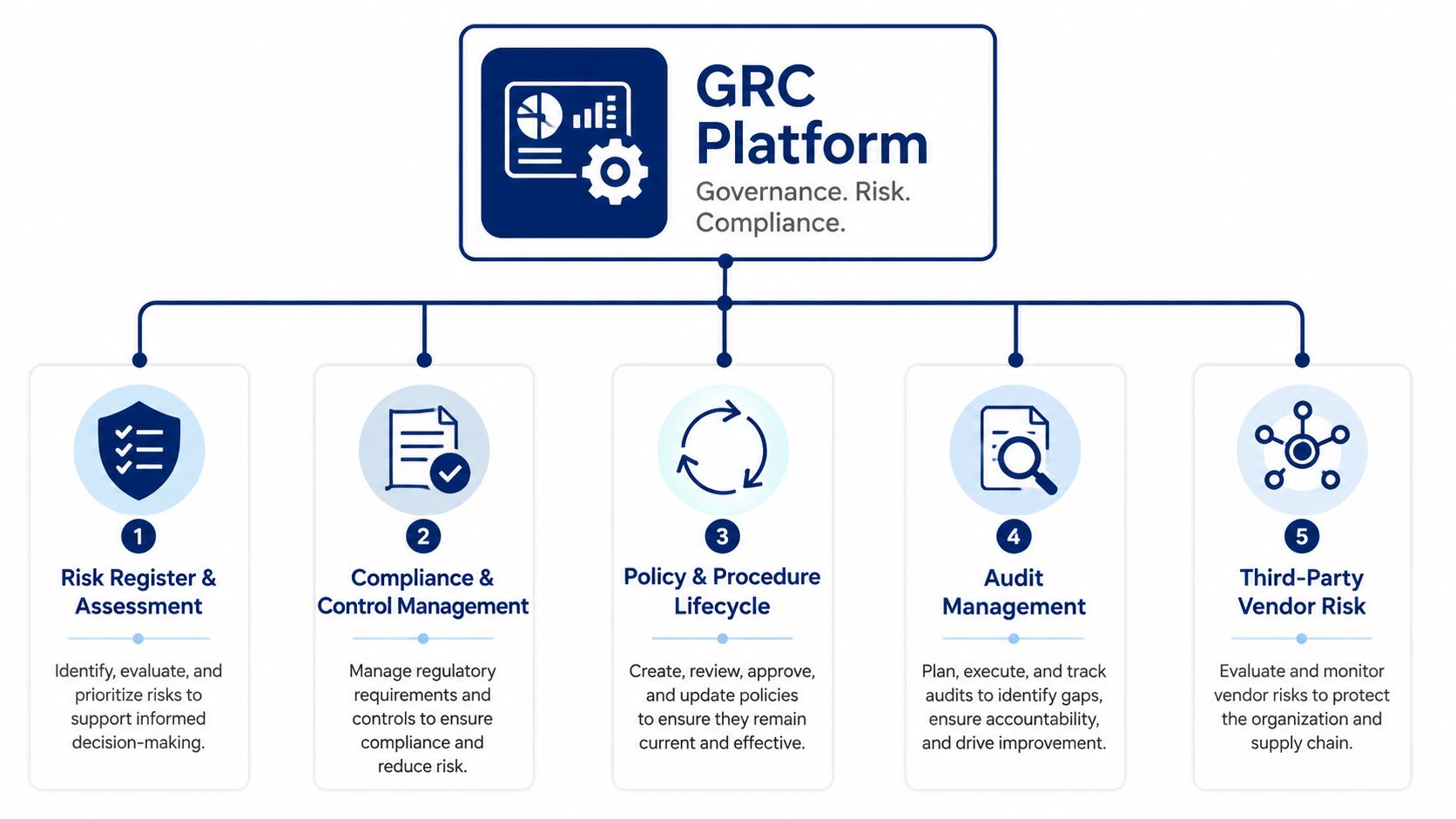
The five modules that matter in production are not glamorous, but they're the ones that decide whether the platform survives year two. If a vendor can't show them working with real data, not demo data, keep walking.
Risk, compliance, policy, audit, and vendor risk need one control library
Risk register and assessment should let you score operational, cyber, privacy, and third-party risk in the same model. The value isn't the score itself, it's whether the score feeds remediation, ownership, and reporting without rekeying.
Compliance and control management is where CCM starts to matter. IBM's GRC reference model emphasises automated risk data management, workflow management, audit management, and real-time dashboards, which is exactly what you want when internal audit, procurement, and security all need the same view IBM GRC model. Static reporting won't help if control status changes daily.
Policy and procedure lifecycle should push attestations, exceptions, and refresh cycles through one workflow. If a policy sits in a document library and a separate tracker, adoption will drift.
Audit management needs planning, fieldwork, findings, and remediation in one chain. If findings live in email and remediation lives in another tool, the audit trail fractures.
Third-party vendor risk is critical in GCC environments with outsourced IT and shared services. A good platform should map one control to multiple frameworks and preserve traceability from owner to evidence to remediation action RiskWatch GRC software.
For a practical view of how tool selection ties to architecture, the discussion in enterprise GRC solutions is worth reading alongside your shortlist.
If a vendor sells these modules as separate products, inspect the licence model carefully. Risk and compliance are often bundled, while audit, vendor risk, and advanced analytics are pushed as add-ons. That's where budgets go sideways.
Buyer check: if the demo only shows dashboards and not evidence movement, the platform is probably presentation-ready, not production-ready.
The AI angle is useful only when it saves manual review time, not when it adds another governance layer. Streamlining compliance with AI is a good lens for what automation should remove from the queue.
How GRC Tools Connect to ITSM, ITOM, HRSD, CMDB, and Identity
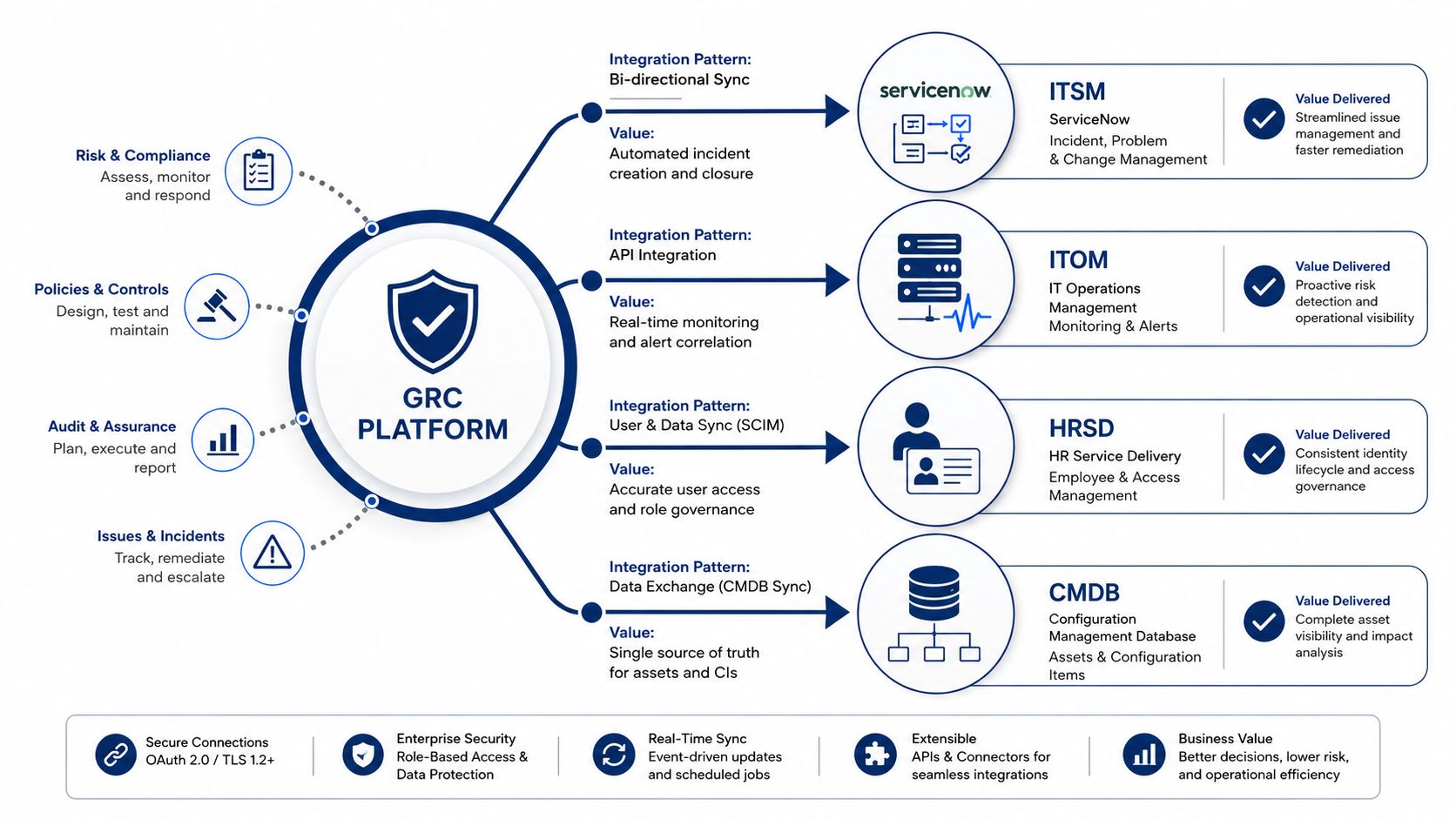
A GRC platform becomes useful when it reads the systems your teams already trust. If it sits outside ITSM, ITOM, HRSD, CMDB, and identity, it will never be the control plane. It will just be another reporting island.
The four integrations that decide whether the platform works
First, ITSM. Incident-to-finding workflows should start in ServiceNow, HaloITSM, or Freshservice and land in the GRC issue queue with owner, due date, and evidence attached. That's how a service issue becomes a governed remediation action instead of a loose ticket.
Second, ITOM and CMDB. Controls need scope, and scope should come from configuration items, not guesswork. If a server, application, or service moves in the CMDB, the affected controls should be visible immediately.
Third, HRSD. Joiner-mover-leaver evidence belongs in HR workflows, because access review and role change evidence is stronger when it comes from the employee record. That is especially important for onboarding, transfers, and exits.
Fourth, identity. Active Directory, Okta, and Azure AD should feed access-review automation so reviewers aren't manually collecting screenshots from access owners. Access reviews are one of the easiest places for manual drift to hide.
The best implementation pattern is boring in the right way. A CMDB CI changes, that update triggers a risk review, the review opens a control check, and the outcome lands as an attestation or finding in the GRC system. That chain reduces ambiguity and gives internal audit a cleaner trail.
For broader context on service workflows, enterprise service management use cases is a solid external reference. It reinforces the same point, workflows win when they connect departments instead of duplicating them.
How GRC works inside ServiceNow environments is worth comparing with your current stack if ServiceNow is already the operational backbone.
Native connector claims deserve scepticism. A basic REST hook is not an integration strategy, and it usually won't survive real change volume.
Vendor Archetypes and Typical Use Cases in the GCC Market
The market is easier to understand if you stop asking which vendor is “best” and start asking which archetype fits your operating model. The global market is growing, with Verdantix reporting $4.98 billion in 2023 rising to a forecast $9.08 billion by 2029 at 11% CAGR Verdantix market forecast. That global momentum matters, but the key decision is about fit.
Four archetypes map to four different buying realities
Archetype | Typical Buyer | Strongest Module | Integration Default |
|---|---|---|---|
Enterprise suites | Large banks, telecoms, government | Audit and control orchestration | Deep ITSM, CMDB, identity |
Mid-market platforms | Growth-stage regional firms | Compliance and policy workflow | Standard APIs, lighter ITSM |
GCC-focused specialists | Multi-entity Gulf groups | Multi-framework control mapping | Regional workflow and reporting |
Point-solution bundles | Teams replacing spreadsheets fast | Vendor risk or audit management | Minimal connector set |
A 5,000-employee bank running group SOX and regional control testing should not buy the same way a 300-person fintech scaling ISO 27001 does. The bank needs breadth, audit discipline, and integration depth. The fintech needs speed, clean workflows, and enough structure to stop shadow spreadsheets from taking over.
DataLunix's GRC market perspective is useful here because it reflects the same buying reality, pick the operating model first, then the tool.
The decision heuristic is blunt. Choose the archetype whose default workflows already resemble your ITSM and identity stack. Don't buy the platform with the longest checklist if your team will spend six months bending it into shape.
Why Most GRC Implementations Underdeliver and How Readiness Changes That
McKinsey found that 42% of respondents across industries say their use of IT and GRC systems “needs improvement,” and 15% say it is absent or lagging McKinsey GRC systems view. That is the core issue. The gap is not awareness, it's execution.
The readiness checklist that separates rollout from shelfware
If you want the platform to pay back in year one, get these in order before signing:
Defined control owners: every key control needs one accountable owner and one backup.
Documented evidence sources: know where the proof comes from before building workflows.
Mapped data flows: understand what should move from ITSM, CMDB, HRSD, and identity into GRC.
Single vendor inventory: one source of truth avoids duplicate risk reviews and conflicting attestations.
Change support: the business has to know how control ownership will change after go-live.
The advantage isn't just technical. Discovery workshops, fit-gap analysis, and change management make the difference between a platform people use and a platform people route around. Organisational change management in transformation programmes is the quiet work that keeps the tool alive after the launch meeting ends.
The hardest part is not configuration. It's agreeing who owns what, what counts as evidence, and which workflow is authoritative when multiple teams care about the same control. If you skip that work, the platform will just automate confusion.
Common Pitfalls That Turn GRC Tools into Overhead
The easiest way to ruin a GRC rollout is to import bad habits into a new system. A shiny platform will not save a messy control model.
Five mistakes that create work instead of removing it
Legacy spreadsheet imports: if you lift old control lists without rationalising them, you preserve duplication.
Framework duplication: if ISO, NESA, and SOX live as separate control sets, you create redundant testing.
Ambiguous ownership: when nobody is clearly accountable, remediation stalls.
Screenshot evidence: if every attestation depends on manual image uploads, evidence quality collapses.
No regulatory change intelligence: if updates don't flow into the library, the platform goes stale.
The production symptoms are predictable. Users face duplicate questionnaires, stale attestations, and audit findings that were avoidable. The fix is always operational, not cosmetic, standardise the control library, assign ownership cleanly, and keep the evidence source linked to the workflow.
That's especially important in multi-entity environments. If one UAE headquarters team, several regional subsidiaries, and a European compliance arm all maintain separate control libraries, the platform becomes a duplicate-work machine. The smarter move is one control library with entity-specific overlays, not three disconnected compliance universes RiskWatch on GRC operating models.
Your 90-Day Evaluation and Pilot Roadmap
Treat the next quarter like a controlled buying exercise, not a procurement marathon. The steering deck should be short, measurable, and tied to real integrations.
A simple 90-day plan
Weeks 1 to 2, align stakeholders, define scope, and lock the two frameworks you'll pilot. Weeks 3 to 4, build the vendor longlist and demo scripts around evidence movement, not feature tours. Weeks 5 to 8, run a paid proof of value with two real frameworks and three real integrations. Weeks 9 to 12, score commercial fit and decide.
Use this weighting:
Integration fit, 35%
Multi-framework mapping, 25%
Regulatory change intelligence, 20%
Total cost of ownership, 20%
That weighting forces the discussion away from demo theatre and back to operational value. It also keeps the buying group honest about whether the platform can reduce manual work.
If you want a partner that starts with discovery, fit-gap, and rollout discipline rather than licence noise, DataLunix is built for that kind of GRC implementation work. The right next move is to test the workflow against your own systems, not another vendor slide deck.
If you're comparing governance risk and compliance GRC tools and want a rollout that fits your ITSM, CMDB, identity, and audit reality, talk to DataLunix about discovery workshops and fit-gap assessment. Visit DataLunix to see how the team approaches integration-led implementation, then pressure-test your shortlist against the workflows you run in production.