


GRC Integrated Risk Management Guide

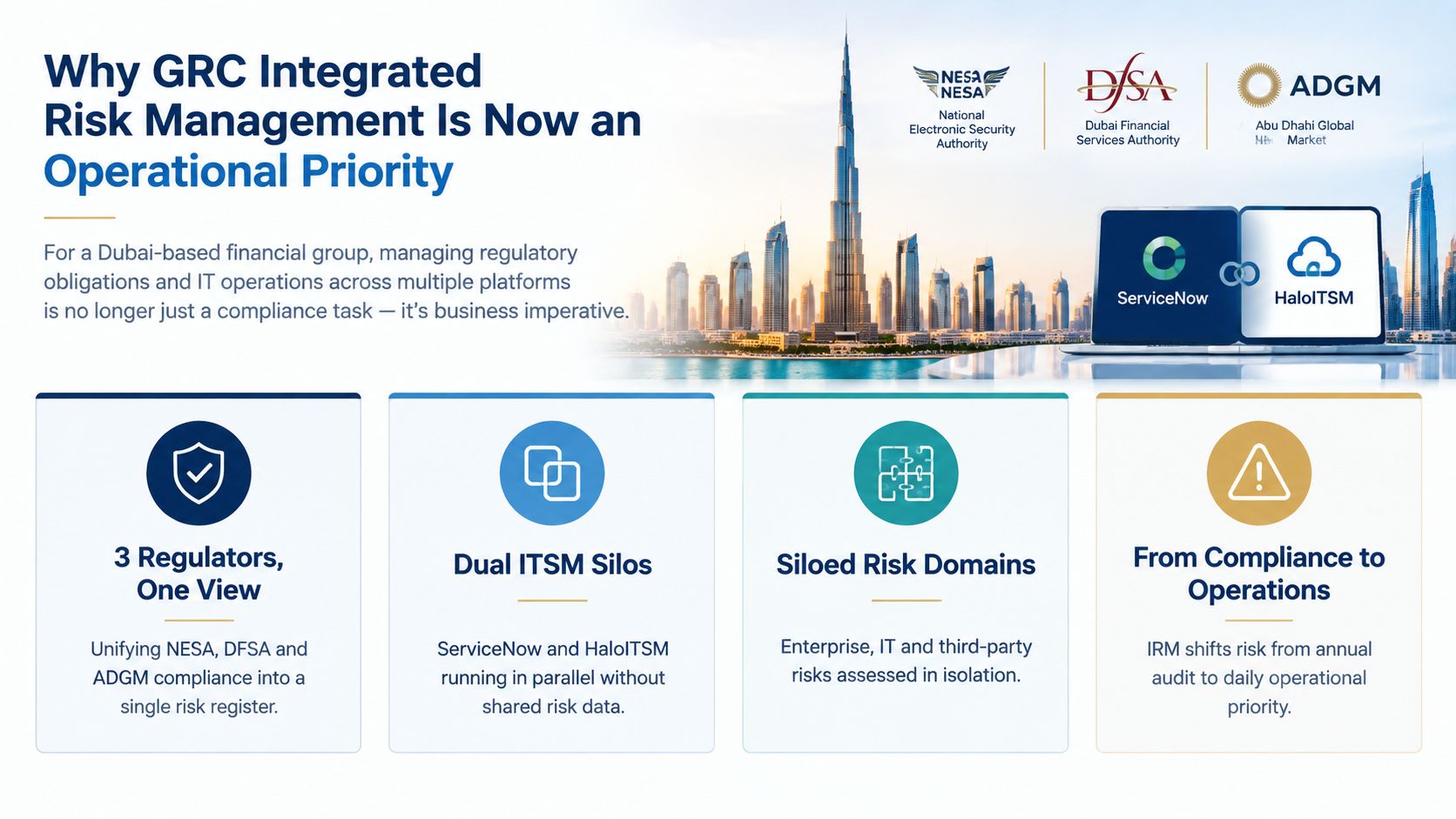
A Dubai-based financial group can have strong people, mature platforms and still lack a defensible risk view. NESA, DFSA and ADGM obligations may sit in separate registers while ServiceNow and HaloITSM run parallel workflows. When a vulnerability, supplier change or failed control appears, nobody can trace it cleanly from operational event to business risk, owner, obligation and evidence.
GRC integrated risk management fixes that by wiring risk decisions into the services and processes where work happens. It isn't another annual assessment exercise. It connects governance, controls and compliance to incidents, changes, vulnerabilities, identity events, procurement and service ownership.
Why GRC Integrated Risk Management Is Now an Operational Priority
UAE regulators increasingly expect organisations to demonstrate how controls are designed, operated, tested and reported. Listed entities face a formal Securities and Commodities Authority timeline involving FY 2024 self-assessment and non-public auditor review, followed by a FY 2025 public auditor opinion on internal control and risk management effectiveness, as described in this UAE internal-control regulatory analysis.
That changes the operating model. A risk team can't rely on a spreadsheet updated before an audit if the underlying evidence lives in change tickets, CMDB records, vulnerability queues and vendor assessments. The board needs a current explanation of exposure, treatment and residual risk.
The Central Bank of the UAE identifies risk management and compliance as the second line of defence, responsible for oversight, guidance, risk frameworks, control-effectiveness monitoring and risk reporting in its 2024 annual report. The same report records AED 124,705,679 in total AML/CFT and Emiratisation-related violation amounts imposed in 2024. That figure makes control execution a financial concern, not merely an audit concern.
Siloed tools create operational blind spots
A standalone GRC platform may contain a polished risk register, but the risk record becomes stale if it doesn't receive signals from:
ITSM workflows: Incidents, problems, changes and service requests reveal whether controls work during daily operations.
ITOM and CMDB data: Infrastructure relationships show which services, applications and business processes a risk could affect.
Security operations: Vulnerability age, identity events and incident response activity provide current exposure signals.
HR and procurement: Joiners, movers, leavers and supplier changes can alter access, accountability and third-party risk.
Operational rule: If a risk treatment doesn't create or change work in the system where teams operate, it probably isn't a treatment plan. It's documentation.
A practical operational resilience approach therefore treats IRM as a wiring layer. It links obligations to controls, controls to owners and owners to workflow. That is the standard GCC CIOs should demand.
Defining Integrated Risk Management Inside the GRC Stack
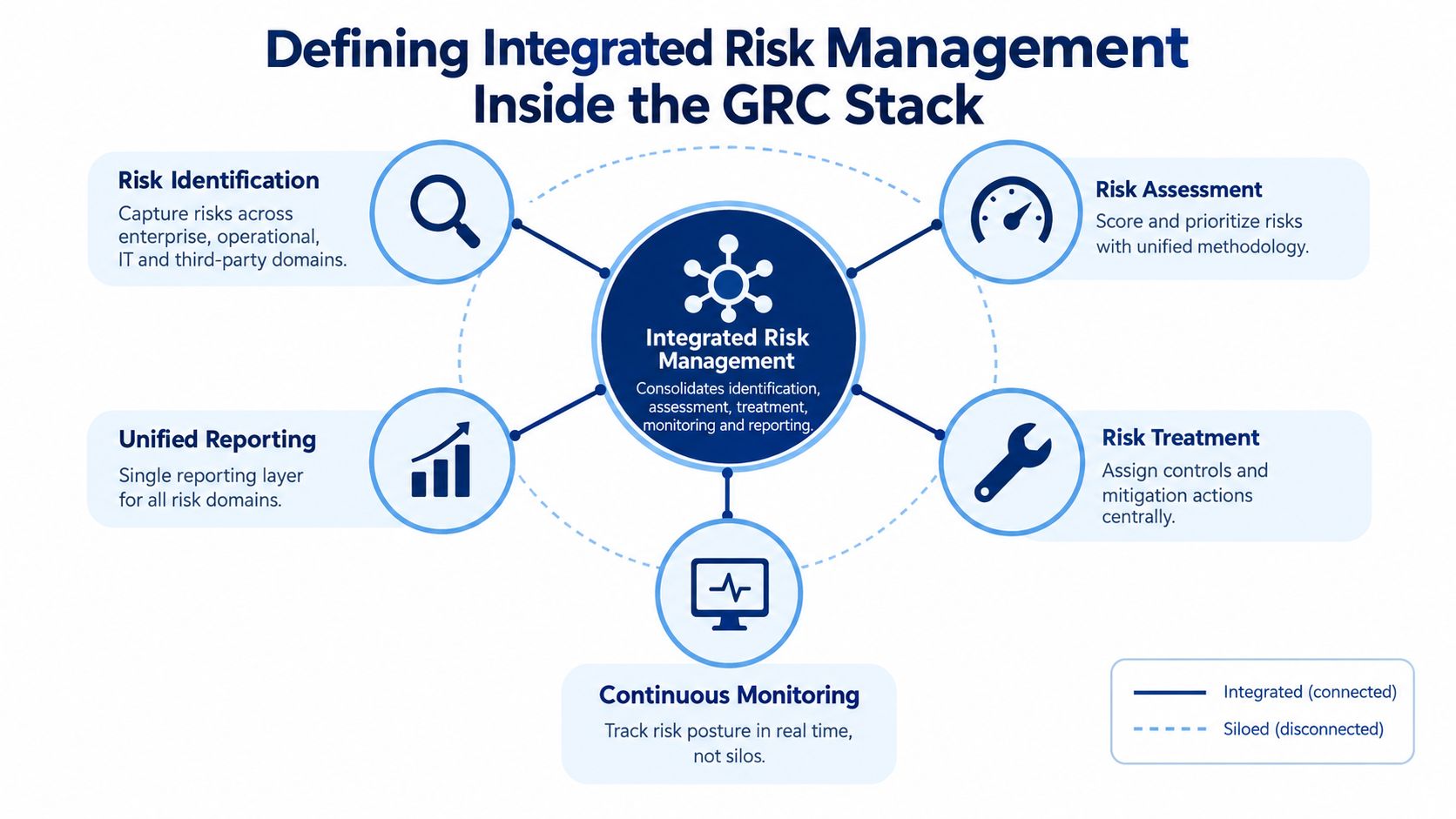
Integrated risk management consolidates risk identification, assessment, treatment, monitoring and reporting across enterprise, operational, IT and third-party domains. Its defining feature is not a dashboard. It's a shared operating model in which a single risk can be traced to controls, obligations, services, owners and evidence.
How IRM differs from adjacent disciplines
The terms overlap, but they aren't interchangeable:
GRC: The broad governance, risk and compliance umbrella. It establishes accountability, policies, oversight and assurance.
ERM: The strategic view of enterprise risk, including how risk affects objectives, performance and risk appetite. COSO ERM provides familiar language for this relationship.
Internal audit: Independent assurance that governance, risk management and controls operate as intended.
IRM: The operational execution layer that connects risk processes across functions and embeds them into business workflows.
ISO 31000 describes a recurring risk cycle involving identification, assessment, treatment, monitoring, review, communication and reporting. The UAE Ministry of Economy applies an integrated approach aligned with ISO 31000 and defines risk management through the mechanics of identifying, assessing, monitoring, reviewing, reporting and effectively addressing risks in governance and operations, as set out in its risk management system policy.
IRM is an outcome, not a licence category
Buying an IRM module doesn't create integration. You achieve integration when the organisation uses common definitions, rating logic, ownership rules and evidence standards across risk domains.
For example, a high-risk supplier should not remain a procurement record while its data-processing exposure sits in privacy documentation and its access weaknesses sit in security tickets. The supplier record should connect to affected services, processing activities, controls, findings, remediation tasks and approval decisions.
That makes architecture more important than licence count. The right question isn't, “Which platform has the most features?” Ask whether the platform can create a reliable chain between:
Business objective and risk appetite.
Risk statement and assessment.
Control objective and accountable owner.
Operational task and evidence.
Finding, exception or incident and residual risk.
Board report and source records.
This is the connective tissue between compliance obligations and live operations. Without it, GRC remains a reporting layer. With it, risk becomes part of how teams approve changes, resolve incidents and manage suppliers.
Core Components and Frameworks That Anchor an IRM Programme
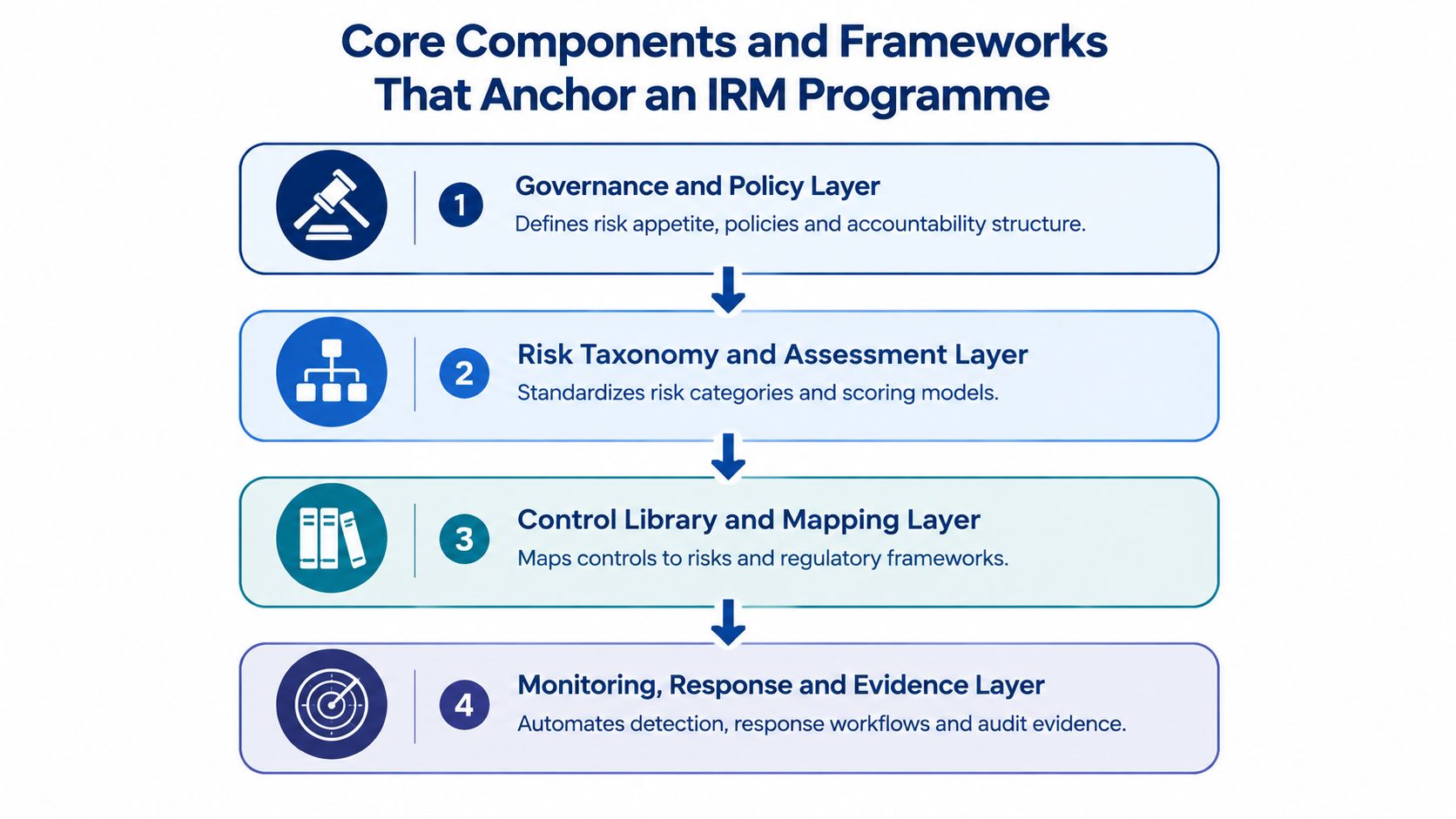
A workable IRM programme has four layers. Each layer answers a different management question, and each must connect to the one below it.
Governance and policy establish authority
The top layer defines risk appetite, decision rights, escalation thresholds and accountability. ISO 31000 supplies the risk-management principles, while COSO ERM connects risk to strategy and performance.
A UAE organisation should document who can accept a risk, who can approve an exception, when the board must be notified and which evidence is mandatory. Policies should also identify the relationship between enterprise risk, operational risk, information security, privacy and third-party oversight.
Taxonomy and assessment create a common language
Security teams may describe a weakness as a vulnerability. Compliance teams may call it a control deficiency. Operations may see it as a service reliability issue. An enterprise taxonomy makes these descriptions connect to one risk statement.
Use consistent dimensions such as impact, likelihood, velocity, regulatory relevance, service criticality and control effectiveness. The scoring model should support both qualitative judgement and evidence from operational systems.
Control mapping turns frameworks into work
NESA, DFSA, CBUAE, ADGM and DIFC requirements should map to control objectives, not merely appear as framework labels. The CBUAE banking risk-management regulation establishes minimum acceptable standards for risk management and applies to banks on both solo and group-wide bases.
The CBUAE insurance-sector regulation defines enterprise risk management through identifying, assessing, measuring, monitoring, controlling, reporting and mitigating risks. It also requires a company-wide, and where relevant group-wide, view of material risks and their interdependencies.
Monitoring and evidence close the loop
A failed control must change the underlying risk posture and trigger accountable action. A change to a critical service should prompt relevant control checks. A supplier onboarding event should launch due diligence. A new processing activity should connect to privacy controls and evidence.
Frameworks are reference models. The deliverable is a functioning relationship between risk, control, workflow and proof. Use this COSO enterprise risk management integration guide to connect the governance model to strategy and performance, then implement the mechanics in ITSM, ITOM, IAM, HR and procurement processes.
Mapping IRM to ITSM and ITOM Platforms
Platform selection should follow the operating model, not precede it. ServiceNow, HaloITSM, HaloPSA, Freshservice and ManageEngine can support risk integration, but they differ in native depth, configuration effort and dependence on adjacent tools.
Platform | Native IRM/GRC capability | Integration approach | Configuration effort | Best-fit scenario |
|---|---|---|---|---|
ServiceNow | Strongest native fit through IRM, GRC, risk, policy, controls and vendor-risk capabilities | Shared CMDB, ITSM, ITOM, security and workflow data | Medium to high | Enterprises needing deep governance and service relationship mapping |
HaloITSM | Risk registers and governance workflows can be built through configurable records and automation | Custom ticket types, workflows, forms and integrations | Medium | Organisations wanting flexible ITSM-led risk operations |
HaloPSA | Useful for service-provider governance and client-related risk workflows | PSA records, contracts, tickets, approvals and automation | Medium | MSPs and service organisations managing customer risk |
Freshservice | Workflow automation and discovery can support control monitoring | Discovery, service records, approvals and integrations | Low to medium | Teams seeking faster deployment with practical operational coverage |
ManageEngine ServiceDesk Plus | Risk visibility is commonly extended through integrations and add-ons | Service desk, asset, identity and security integrations | Medium | Organisations already invested in the ManageEngine ecosystem |
ServiceNow offers the deepest native relationship model
ServiceNow can connect risk findings to configuration items, business services, incidents, problems and changes through the CMDB. That matters when a control failure affects a production service and the risk owner needs evidence that remediation entered the normal operational queue.
It also supports a more direct relationship between vendor risk, policy, controls, issues and continuous monitoring. The trade-off is implementation complexity. Poor data models and excessive customisation can make the platform expensive to maintain.
Halo and Freshservice favour practical configuration
HaloITSM and HaloPSA are compelling where the organisation wants risk work to resemble existing service work. You can create risk, exception, control-test or vendor-review records, then automate assignments, approvals and escalations.
Freshservice provides a lighter route when discovery data and workflow automation are sufficient for the control-monitoring requirement. ManageEngine ServiceDesk Plus suits teams with existing asset, endpoint and service-desk investments, provided the integration design exposes meaningful risk relationships rather than exchanging tickets.
Selection test: Demonstrate a live flow from a failed control to a risk-score change, an assigned remediation task, an approval and an auditable evidence record.
A CIO comparing options should assess the ServiceNow IRM implementation model against the actual operating environment. Native capability helps, but integration quality, data ownership and upgrade discipline decide whether the programme works.
Phased Adoption Roadmap From Discovery to KPIs
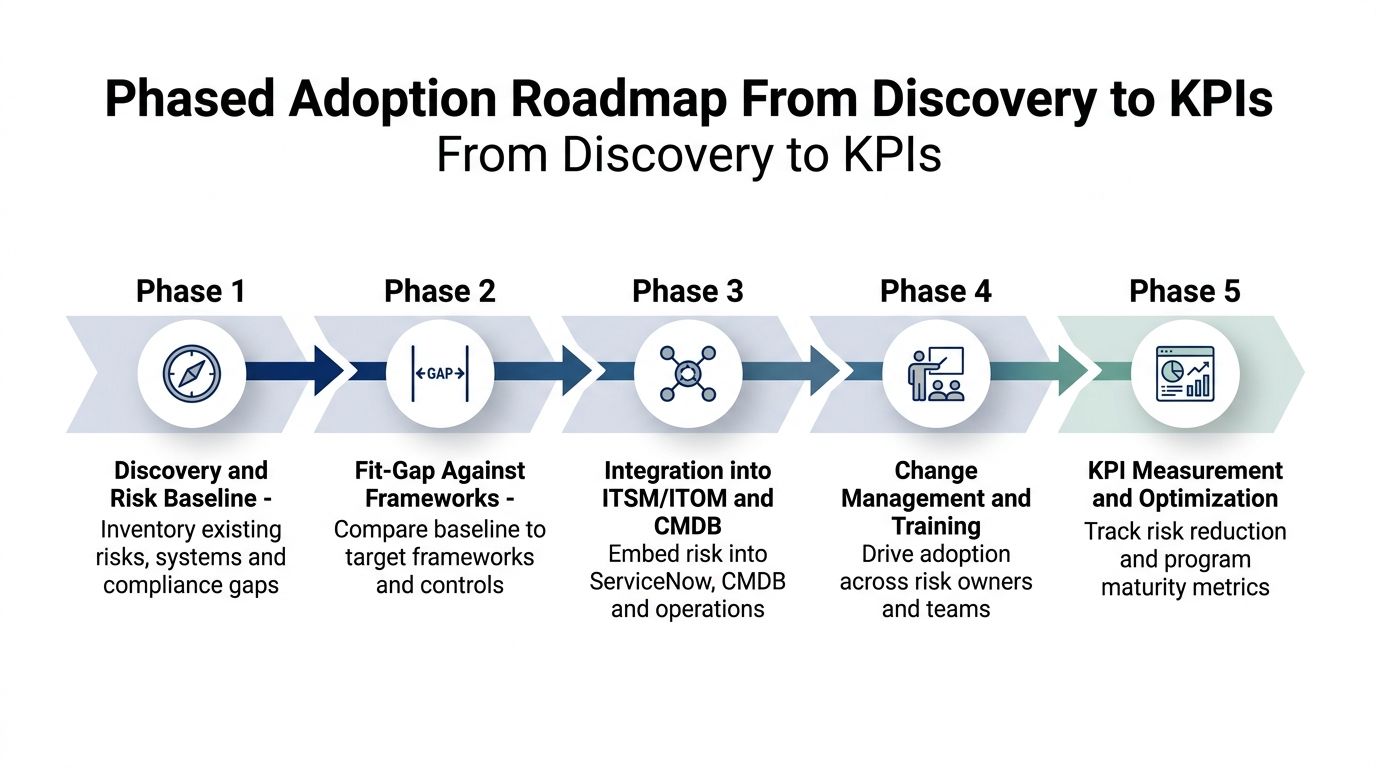
A risk transformation should produce usable artefacts at every phase. That keeps the project auditable and gives the PMO a clear handover path.
Phase one establishes the baseline
Inventory current risk registers, policies, frameworks, controls, services, vendors, workflows and evidence repositories. Interview risk owners and operations leaders, then record duplicate controls, orphaned risks and manual reporting dependencies.
Entry criterion: Executive sponsor and cross-functional working group.Exit artefact: Approved risk and control baseline.Accountable role: Chief risk officer or delegated programme owner.Regional anchor: Identify whether NESA, DESC, ADGM FSRA, DIFC or IA Dubai obligations affect the scope.
Phase two exposes the fit-gap
Compare the baseline with target requirements from selected frameworks and regulators. Separate genuine capability gaps from data, ownership and workflow gaps. A platform cannot solve an absent control owner.
Entry criterion: Validated baseline.Exit artefact: Prioritised fit-gap register with remediation decisions.Accountable role: GRC lead with control owners.
Phase three embeds risk into operations
Integrate the selected platform with ITSM, ITOM, CMDB, IAM, vulnerability management, HR and procurement. Start with high-value flows such as change risk, critical incidents, supplier onboarding and control exceptions.
Entry criterion: Approved target architecture.Exit artefact: Tested integrations, workflow designs and evidence model.Accountable role: Enterprise architect or platform owner.
Phase four drives adoption
Train risk owners, service owners, approvers, auditors and operational teams on their responsibilities. Explain how risk work enters existing queues rather than creating a parallel administrative burden.
Entry criterion: Pilot workflows accepted.Exit artefact: Role-based training, communications and adoption dashboard.Accountable role: Change lead.
Phase five measures and improves
Track ownership, control testing, remediation, evidence quality and operational traceability. Review the model through governance forums and board reporting.
Entry criterion: Production workflows and accountable users.Exit artefact: KPI pack and improvement backlog.Accountable role: Risk director and service-management leadership.
Use disciplined programme management practices to maintain decisions, dependencies and accountability across the five phases.
Benefits and KPIs That Prove the Programme Is Working
A board doesn't need another count of completed assessments. It needs evidence that the organisation detects control weakness, assigns treatment, closes findings and understands operational impact.
The UAE eGRC market was valued at USD 746.6 million in 2024 and is projected to reach USD 1.296 billion by 2029, with an implied 11.7% compound annual growth rate, according to MarketsandMarkets UAE eGRC market data. The same breakdown values BFSI at USD 141.9 million, energy and utilities at USD 129.2 million and government at USD 96.5 million in 2024. That concentration reflects sustained investment in centralised controls, auditability and risk visibility.
KPI | What it measures | Source system | Target trend |
|---|---|---|---|
Mean time to detect control failure | Speed of identifying ineffective controls | ITOM, security, control testing | Downward |
Risks with treatment owners | Accountability for open exposure | IRM risk register | Upward |
Audit finding closure time | Remediation discipline | Audit and ITSM | Downward |
Incident-to-risk traceability rate | Whether incidents connect to affected risks and services | ITSM, CMDB, IRM | Upward |
Duplicated compliance evidence | Waste created by repeated evidence collection | GRC and evidence repository | Downward |
Exception ageing | How long accepted deviations remain open | IRM and change workflows | Downward |
Use enforcement exposure as a management signal
The Central Bank's recorded violation amounts should prompt a practical question: can your organisation show which control owners, services and remediation activities prevent similar exposure? Avoid treating penalties as a retrospective report. Use them to prioritise control testing, escalation and evidence quality in regulated business units.
A mature programme also improves the board conversation. Instead of reporting that teams completed assessments, the risk director can explain where exposure changed, why it changed, what treatment is active and which decisions require executive attention.
Measure linkage, not activity
High volumes of tickets, tests or policy acknowledgements don't prove integration. The stronger signal is relationship quality:
Risk to control: Every material risk has mapped controls and an accountable owner.
Control to workflow: Failed controls create operational tasks with due dates and escalation.
Workflow to evidence: Completed work produces evidence that an auditor can trace.
Evidence to decision: Management reporting shows residual risk and approval history.
Common Pitfalls and How to Mitigate Them
Licensing a GRC platform doesn't reduce risk by itself. People reduce risk when the platform changes decisions, ownership and operational behaviour.
Internal Audit owns the programme alone
Internal Audit should provide independent assurance, not become the only process owner. Risk and Operations must own the risk model, treatment decisions and workflow adoption.
Mitigation: Establish a steering group led jointly by Risk, Technology and business operations. Give Internal Audit read access and assurance responsibilities without making it the process administrator.
Customisation freezes the product
Teams often replicate every local spreadsheet and approval path in the platform. The result is a brittle implementation that resists upgrades.
Mitigation: Use configuration before custom code, document exceptions and schedule a 90-day configuration review as part of governance. Retire duplicate fields and workflows that no longer support a decision.
IRM is bolted onto ITSM
A risk record that doesn't influence incident, change or problem management becomes another queue. Service owners then see GRC as administrative overhead.
Mitigation: Embed risk controls in change advisory workflows, attach critical services to risk statements and require problem records for recurring control failures.
Third-party and cyber risk arrive too late
Supplier exposure often appears only during onboarding, renewal or an incident. That timing is inadequate for cloud, data and outsourced operations.
Mitigation: Treat vendor risk as a live register linked to procurement events, contract changes, access reviews, incidents and service dependencies. UAE legal commentary also stresses continuous monitoring of supplier and supply-chain exposure in this GCC cybersecurity guidance.
Poor data quality undermines reporting
Inconsistent owners, stale assets, duplicate risks and undefined rating logic make executive dashboards unreliable.
Mitigation: Assign data stewards, validate critical relationships and reject incomplete records at intake.
Score your programme against five questions: Does every material risk have an owner? Does a failed control trigger work? Can you trace a risk to a service? Is supplier exposure current? Can the board challenge the evidence? Weak answers indicate an operating-model problem, not merely a tooling problem.
Procurement Licensing and Managed Services Recommendations
Start with a discovery sprint, not an RFP. Define the business services, regulatory scope, risk taxonomy, control library, integrations and evidence requirements before asking vendors to demonstrate features.
Your fit-gap should compare ServiceNow GRC and IRM, HaloITSM, HaloPSA, Freshservice and ManageEngine against the workflows you need. Insist on a demonstration that shows a control failure entering ITSM, affecting a risk score, assigning remediation and producing evidence. Slideware about dashboards isn't proof of integration.
Option | Best fit | Key watch-out |
|---|---|---|
Named-user licensing | Defined populations of risk specialists and approvers | Costs can grow as operational participation expands |
Role-based licensing | Mixed users with distinct duties | Requires accurate role design and governance |
Enterprise licensing | Broad adoption across service and business teams | Higher commitment before adoption is proven |
SaaS subscription | Faster access and predictable platform operations | Confirm data residency, contract, integration and exit requirements |
Term licensing | Organisations seeking a defined commercial period | Plan upgrades, support and renewal dependencies |
Managed services | Lean internal teams needing continuous optimisation | Retain accountable internal owners |
Staff augmentation | Organisations with platform leadership but limited delivery capacity | Skills transfer must be built into the engagement |
Choose the commercial model after the operating model
Named-user, role-based and enterprise models each work in different environments. The choice should follow who creates risks, tests controls, approves exceptions, closes remediation and consumes reports.
SaaS can simplify platform operations, but UAE organisations must validate data-handling, residency, access, subcontracting and exit requirements against their regulatory obligations. Term licensing may suit a defined transformation window, but it doesn't remove the need for upgrade planning and internal capability.
Use a blended delivery model
A regional implementation partner should lead discovery, fit-gap, architecture, configuration, integration, training and governance. Offshore delivery can provide cost efficiency for build and support, while UAE-based leadership maintains stakeholder alignment and regulatory context.
DataLunix provides this combination through discovery workshops, readiness assessments, platform integration, change enablement, managed services and staff augmentation across ServiceNow, HaloITSM, HaloPSA, Freshservice and ManageEngine. Its GRC as a Service model is relevant when the organisation needs ongoing optimisation rather than a one-time implementation.
The right procurement outcome is not a larger software estate. It's a functioning risk operating model with clean data, clear ownership, integrated workflows and evidence that stands up to board and regulatory scrutiny.
DataLunix can assess your current risk registers, ITSM and ITOM workflows, then produce a UAE-focused fit-gap and implementation roadmap for integrated risk management. Visit DataLunix to discuss platform integration, managed services or staff augmentation for your GCC transformation programme.