


GRC Integration Roadmap for ITSM, SIEM, and CMDB

Your audit team is asking for evidence, your security team is working from SIEM alerts, and your engineers are closing change tickets in ServiceNow, HaloITSM, or Freshservice without a shared control context. That's the operational gap GRC integration must solve. Connect controls to CMDB configuration items, ITSM workflows, IAM events, and high-confidence SIEM findings, then make each evidence record traceable to the asset and control that produced it.
For GCC and European enterprises, this approach matters because governance is becoming a live operating discipline rather than a quarterly documentation exercise. KPMG's UAE enterprise risk management survey was launched in March 2024 and fielded through September 2024, with over 100 responses from public and private organisations across industries, providing current local context for governance, risk, and compliance priorities (KPMG UAE enterprise risk management survey). The practical question is no longer whether you need GRC. It's whether your GRC platform can prove what happened in production.
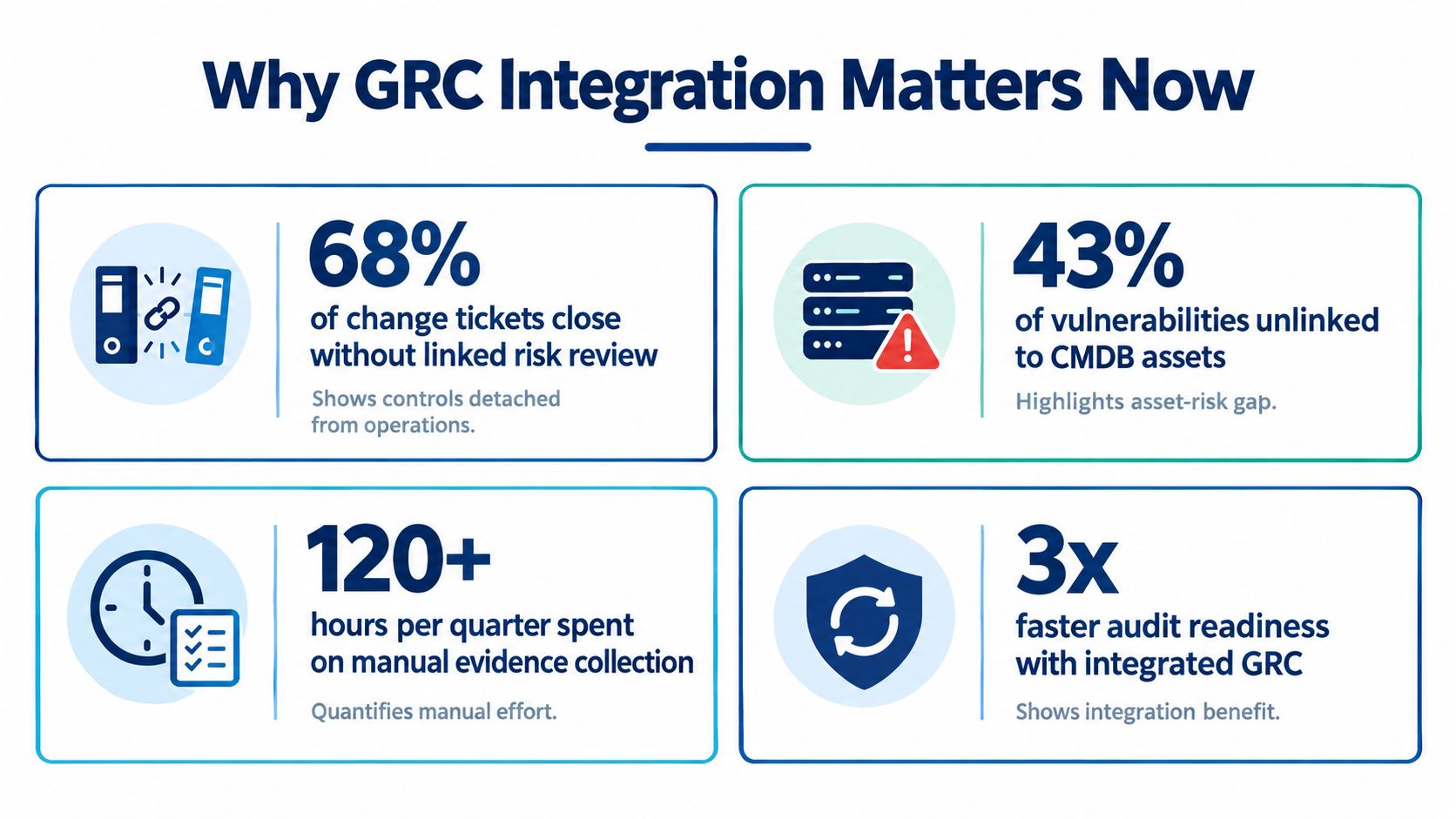
Why GRC Integration Matters Now
Most GRC programmes still operate as policy repositories. Control owners upload documents, auditors request screenshots, and IT teams answer evidence queries by email. Meanwhile, a change can close without a risk review, a vulnerability can remain disconnected from the affected asset, and a privileged access change can sit outside the control owner's workflow.
GRC integration closes those gaps by connecting the control layer to operational systems. A control should be able to reference the relevant change record, CMDB CI, SIEM detection, identity event, issue, and test result. If an auditor can't follow that chain, you have documentation, not assurance.
The UAE evidence base points to a connected risk environment. A Middle East-focused KPMG compliance forecast reports that 46% of UAE organisations lack AI anomaly detection, while UAE organisations recorded 38% for software bill of materials management, 16 percentage points below Saudi Arabia and 6 points below the global average (KPMG Middle East compliance forecast). Those figures matter operationally. AI workloads, software supply chains, incident response, and compliance controls can't be governed effectively when each function works from a separate data set.
What business pressure justifies the integration spend
Your steering committee needs a business case grounded in control performance, not another technology catalogue. The strongest drivers are:
Audit evidence pressure: SOX, ISO 27001, PCI-DSS, DORA, NIS2, NESA, and SAMA obligations all require defensible evidence, but the evidence must reflect how systems operate.
Operational risk visibility: A risk record should show the affected service, owner, open issues, related changes, and current control status.
Third-party oversight: UAE organisations are paying close attention to supplier compliance. A 2025 UAE survey reported that 62% of respondents directly monitor compliance across all third-party providers, rather than relying solely on vendor assurance (UAE data sovereignty and third-party oversight survey).
AI and cloud governance: UAE cloud security expectations include data residency, access controls, encryption, and third-party vendor assessments for government entities and critical-sector operators (UAE cloud security and GRC guidance).
The right architecture depends on where authoritative data already lives.
Which integration pattern fits your estate
Pattern one, GRC as system of record. The GRC platform owns risks, controls, issues, and evidence, then pulls operational data from ITSM, CMDB, SIEM, and IAM. Choose this when audit and compliance lead the programme, the IT estate is reasonably stable, and control centralisation is the primary requirement.
Pattern two, GRC as an overlay. GRC remains a thinner governance layer while ServiceNow, HaloITSM, or another operational platform owns the workflow records. This is usually the strongest choice for ITSM and ITOM-heavy organisations because engineers already work in the operational system. Adoption improves when control tagging, evidence capture, and remediation stay close to change, incident, and problem workflows.
Pattern three, federated control plane. A dedicated mapping service links several authoritative systems through APIs or an event bus. Use it when multiple business units, acquired estates, or vendors must retain independent systems of record.
Architect's rule: Don't force a central GRC platform to own data that engineers already maintain accurately elsewhere. Make ownership explicit, then connect the records with stable keys.
The UAE's official statistics messaging reinforces the same principle. Unified reporting depends on connected data sources, common governance standards, and clear ownership, while fragmented data ownership remains a barrier to a unified smart statistics system (UAE economic data and unified reporting coverage). Your architecture should therefore begin with data ownership, not connector shopping.
For practical policy workflow design, Cleffex Digital policy integration is a useful adjacent reference. Policy records should feed control objectives and obligations, but they shouldn't become the operational evidence store.
For a broader view of the governance layer, see cybersecurity governance, risk and compliance. The recommendation is direct: for most ITSM-led estates, start with the overlay pattern, keep ITSM authoritative for operational records, and make GRC authoritative for control intent, risk acceptance, and assurance status.
Data Model and CMDB to Control Mapping
The integration fails when the data model is vague. Use five canonical entities: Asset, Control, Risk, Issue, and Evidence. Every evidence item must point to both the control being tested and the source CI that provides the operational context.
The control ID is the join key. It should appear in the GRC record, ITSM change or incident record, SIEM rule mapping, IAM review, and evidence object. Without that key, your platform creates duplicate evidence, orphan controls, and audit trails that can't be reconciled.
Which CMDB records should map to which controls
CMDB CI Class | Control Objective | Evidence Source | Test Frequency |
|---|---|---|---|
Business service CI | Service availability, ownership, and continuity controls | ITSM service records, continuity plans, major incident records | Defined by control owner |
Application CI | Access management and change control | IAM reviews, approved changes, deployment records | Defined by control owner |
Server CI | Vulnerability, patching, and hardening controls | Vulnerability platform, patch records, CMDB status | Defined by control owner |
Database CI | Data classification, backup, and recovery controls | Data catalogue, backup jobs, recovery tests | Defined by control owner |
Network device CI | Segmentation and secure configuration controls | Configuration manager, SIEM detections, network reviews | Defined by control owner |
User CI | Identity lifecycle and entitlement controls | IAM, HR joiner-mover-leaver events, access reviews | Defined by control owner |
A business service should not inherit the same control set as a server. The service carries business impact and continuity context, while the server supplies technical patch and vulnerability evidence. This distinction prevents one of the most common design errors, mapping controls to generic assets instead of the CI classes that can produce evidence.
Use governance, risk, and control design guidance to strengthen the control taxonomy before building integrations. For practical security foundations that support smaller operating teams, SMB cybersecurity steps by Technovation LLC provides useful context, but enterprise mapping still needs explicit CI ownership and control IDs.
Connectors, APIs, and Event Flows
Choose the integration method by evidence behaviour, not by vendor preference. Stable, repetitive evidence belongs in native connectors. Bi-directional synchronisation belongs in REST APIs. Time-sensitive operational triggers belong in event or webhook flows.
Which path should each source system use
Source System | Native Connector | REST API | Event/Webhook | Recommended Path |
|---|---|---|---|---|
ITSM | Change, incident, problem, and request records | Control tagging, risk register synchronisation | Failed change windows, closure events | Native connector for standard records, API for custom mappings |
CMDB | CI and relationship data | Reconciliation and ownership synchronisation | CI retirement or critical attribute changes | API with scheduled reconciliation |
SIEM | Parsed findings and rule metadata | Custom control test and issue updates | High-confidence detection triggers | Pre-aggregated findings, then API or webhook |
IAM | Access review and entitlement integrations | User, role, and review synchronisation | Privileged grants, termination, and joiner-mover-leaver events | SCIM or directory webhook flows |
GRC | Control, risk, issue, and evidence records | Bi-directional status and remediation updates | Approval, escalation, and acceptance triggers | Native platform APIs with idempotent updates |
Use vendor-certified connectors for most stable evidence flows. ServiceNow GRC spokes and Splunk or QRadar add-ons can reduce schema work where the required records already align. Use REST APIs when you need control-testing automation, risk register synchronisation, or a custom evidence object.
Reserve webhooks for events that become less useful when delayed. A failed change window, terminated user, privileged access grant, or high-confidence SIEM detection should create a workflow event promptly. Don't send raw SIEM logs into GRC. Aggregate and parse them first, then map only meaningful findings to control objectives.
Authentication needs equal discipline. Use OAuth2 client credentials for supported APIs, mutual TLS where required for SIEM exchanges, rate-limit handling, idempotency keys, and a complete audit trail for every create, update, retry, and rejection.
Integration rule: Polling an ITSM table every 15 minutes is not an architecture. It's a temporary workaround that becomes expensive to remove.
Never treat CMDB reconciliation as a connector problem. If the CMDB contains retired CIs, duplicate owners, or broken relationships, the connector will distribute bad data faster. For transport and compliance workflow patterns, transport compliance API documentation offers a useful example of the detail expected in externally exposed integration interfaces.
For ServiceNow-specific design considerations, use GRC in ServiceNow. The practical sequence is simple: native connector first, API second, event stream only where timing changes the control outcome.
Phased Rollout from Discovery to Scale
A successful rollout has four phases and four exit gates. Don't start by integrating every control family. Start with one evidence path that exposes ownership, data quality, and workflow weaknesses quickly.
Phase one starts with discovery
Inventory ITSM, ITOM, CMDB, SIEM, IAM, HR, ERP, and existing GRC systems. Record the authoritative owner for every data set, identify the control owners, and baseline the current evidence process. Rank proposed integrations by control criticality, evidence effort, and risk-reduction value.
The deliverable is a signed integration backlog with a business case. The exit gate is agreement on scope, ownership, and sequencing.
Phase two converts policy into mappings
Reconcile the GRC data model against the ITSM schema. Map each in-scope control to CI classes, workflow records, evidence fields, and failure modes. Define what happens when a CI is missing, an owner is inactive, an API fails, or evidence becomes stale.
The deliverable is a control-to-CI data dictionary and pilot design. The exit gate is an approved mapping that both audit and IT operations can use.
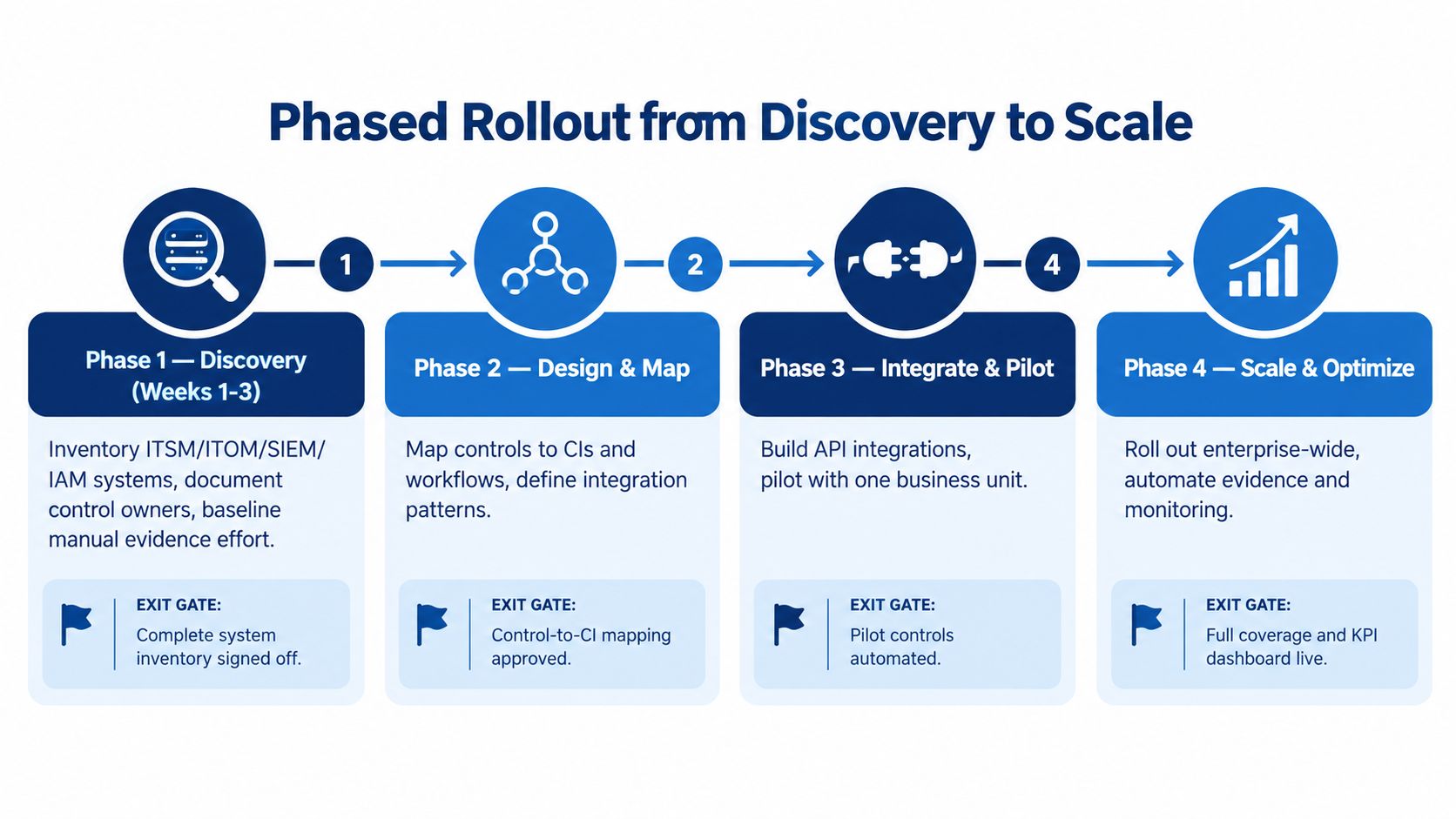
Phase three proves one control family
Select access reviews or change management, then integrate it across one business unit. Validate evidence freshness, confirm that records point to the correct CI and control, and tune SIEM or IAM alerting so the control owner receives useful findings rather than noise.
The deliverable is a working pilot, a lessons-learned record, and evidence samples validated by internal audit. The exit gate is achievement of agreed pilot KPIs and a signed decision to scale.
Phase four expands with guardrails
Add remaining control families, introduce SIEM correlation, automate recurring tests, and publish control health in operational reviews. Keep a rollback plan: disable the new collector, preserve the last accepted evidence set, return workflow ownership to the source system, and open a controlled issue for evidence drift.
The deliverable is an enterprise rollout plan and operating dashboard. The exit gate is stable coverage, named support ownership, and a tested recovery path.
Stakeholder Roles and Change Management
GRC integration fails more often from missing ownership than from weak technology. A control owner can define a requirement, but that person usually can't repair a broken CMDB relationship, fix an ITSM workflow, or tune an SIEM rule. Give every control owner a named IT counterpart.
The RACI must follow the work
The GRC platform owner is accountable for the roadmap, control library, data model, and integration outcomes. The IT operations lead is responsible for ITSM and CMDB quality. The security engineering lead is responsible for SIEM, IAM, and vulnerability feeds. Business control owners remain accountable for their domains, while internal audit is consulted on evidence sufficiency.
HR must own joiner, mover, and leaver inputs. The DPO should be involved in privacy controls, particularly where identity, data classification, retention, or third-party processing is involved. Multi-country GCC and EU programmes also need local IT delivery leads who understand regional workflows and escalation paths.
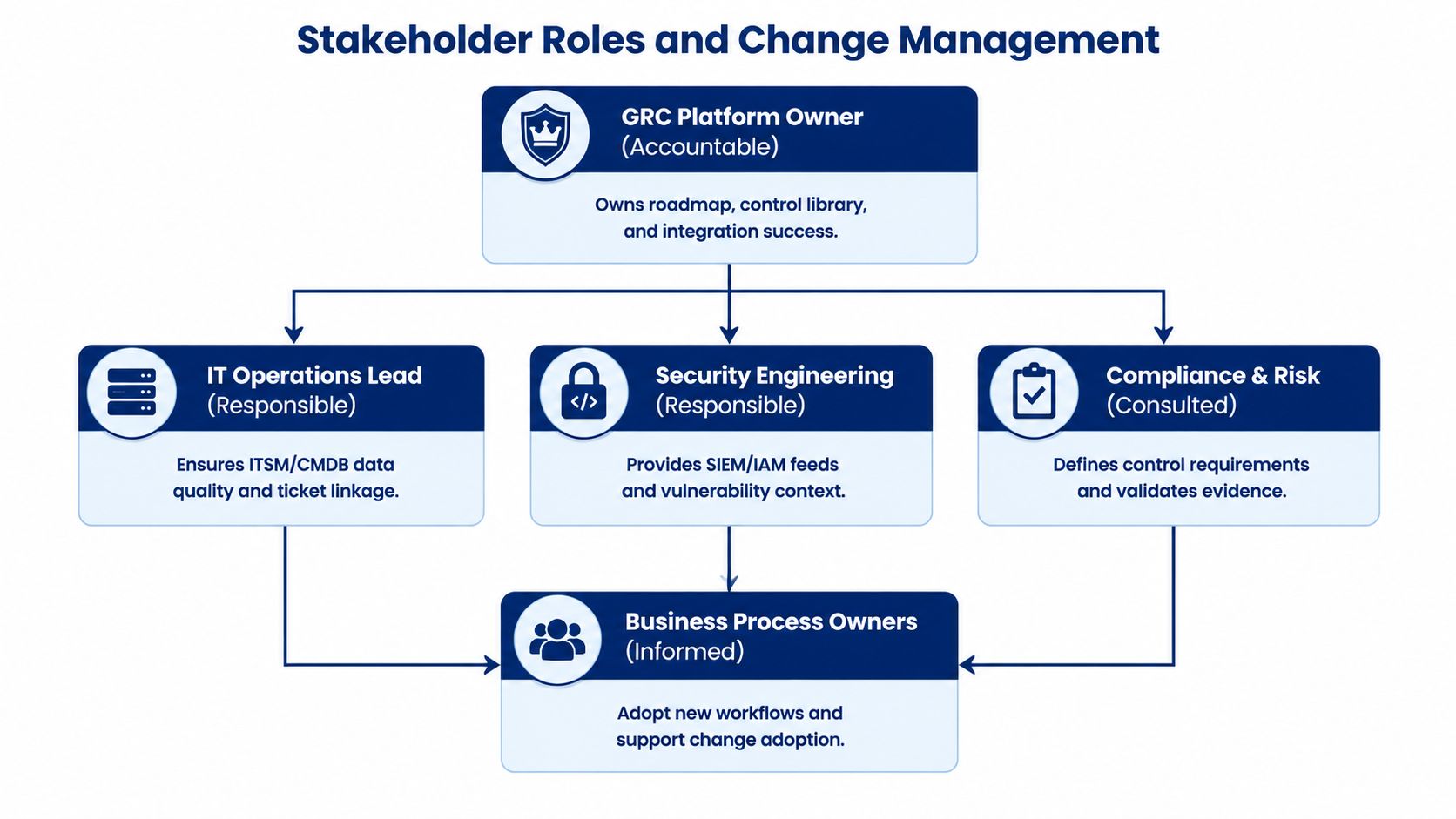
The dominant failure mode is a policy owner with no technical partner. The policy gets approved, but nobody maintains the evidence collector, maps the control ID into the ticket form, or resolves failed synchronisation. Remediation then accumulates under the control owner's name even though the owner doesn't control the underlying system.
During the pilot, run a weekly 30-minute integration stand-up. Review failed evidence jobs, unmatched CIs, rejected records, and control-owner actions. Once the programme scales, move to a monthly control health review with GRC, IT operations, security, audit, HR, and the relevant business owners.
Train service desk agents to tag changes to control IDs. Give control owners a short procedure for reviewing automated evidence. Give security operations a runbook that distinguishes evidence-bearing alerts from events that should remain inside the SIEM. Change management automation is most effective when the new workflow removes duplicate entry rather than adding another approval screen.
Common Pitfalls and How to Mitigate Them
More dashboards don't create better GRC. A dashboard that aggregates every issue can hide the one failing control that affects a critical service. Measure whether the operating model produces traceable, current evidence and assigns remediation to the team that can fix the cause.
Pitfall | Specific Mitigation | Enforcement Owner |
|---|---|---|
Duplicate evidence from ITSM and GRC | Name one authoritative source for each evidence type and reject duplicate uploads from secondary systems | GRC platform owner |
Stale CMDB records | Run a weekly reconciliation check and block control activation when required CI ownership or status is invalid | IT operations lead |
SIEM alert fatigue | Map only high-fidelity, pre-aggregated rules to GRC findings, not raw events | Security engineering lead |
Policy-to-control drift | Version the control library and require a CI and evidence-job diff before publishing changes | Compliance and risk lead |
Unclear remediation ownership | Route issues through the operational workflow that owns the corrective action | Control owner and IT counterpart |
Duplicate evidence creates false confidence. If a change record and a GRC attachment describe the same test, keep the ITSM record as the source and let GRC reference it. That gives auditors one trail and stops two teams from maintaining competing versions.
A stale CMDB is more serious than an incomplete dashboard. A retired server with an active patch control can make coverage appear healthy while the control is testing the wrong population. Reconciliation should check lifecycle status, owner, service relationship, and required attributes before a control test runs.
SIEM events also need filtering. A one-to-one mapping between every alert and a control objective turns GRC into an alert inbox. Send only findings with sufficient context, such as affected CI, detection rule, severity, disposition, and remediation status.
Control libraries need release discipline. When a policy changes, compare the control version, CI scope, evidence collector, test logic, and owner before publication. If any dependency is missing, keep the old version active and open a controlled change.
KPI Checklist and Getting Started
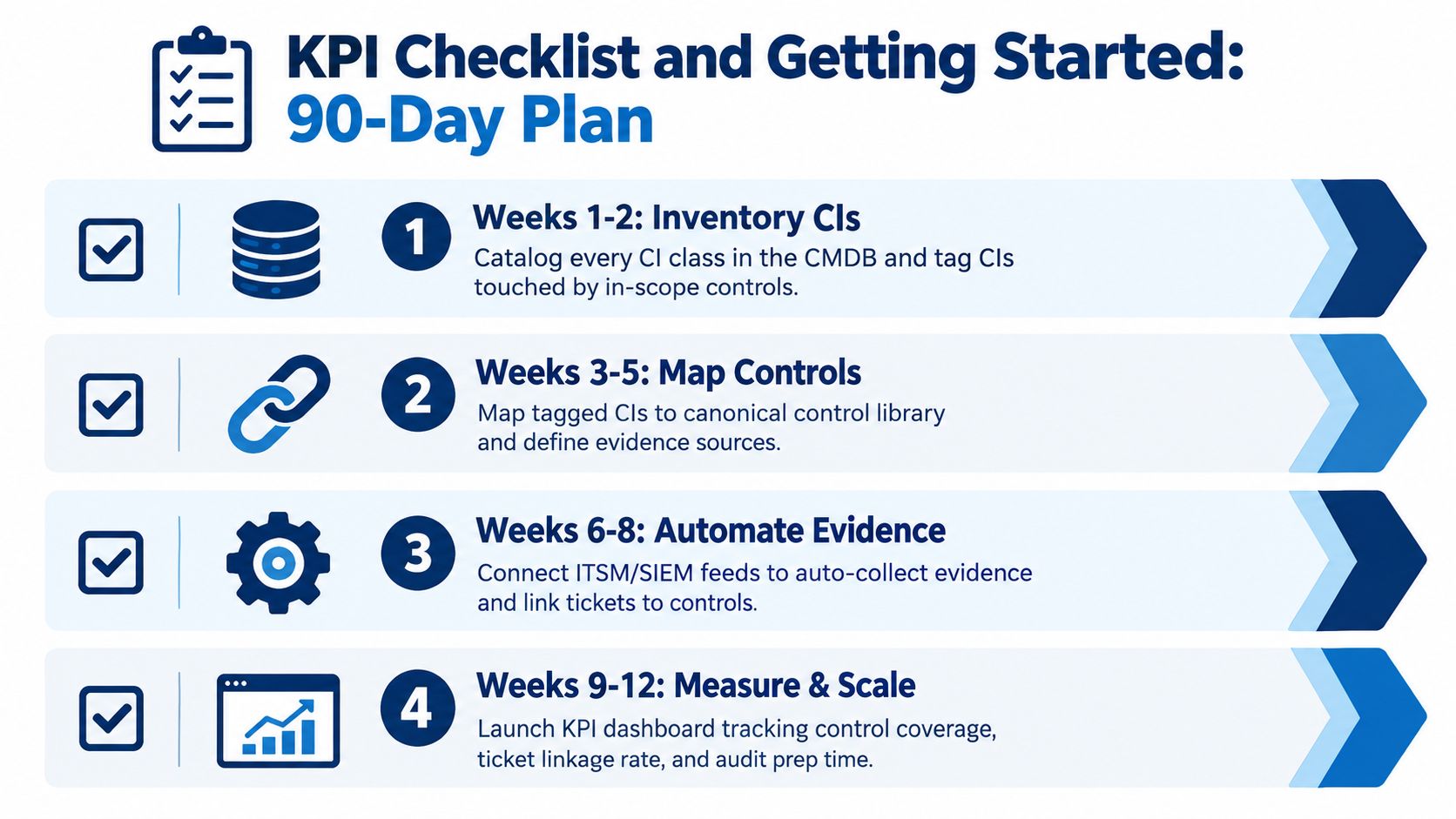
A failed control should lead an engineer to the affected CI, its operational record, and the evidence that caused the failure. Build that trace first, then expand the programme. A 90-day delivery plan keeps the work focused and avoids an enterprise-wide migration before the data paths are proven.
A practical first 90 days
Weeks one to two, inventory CIs: Catalogue each CMDB CI class and tag the CIs covered by in-scope controls.
Weeks three to five, map controls: Link those CIs to the canonical control library. Assign the evidence source, whether ITSM tickets, SIEM findings, IAM events, or another operational system.
Weeks six to nine, automate evidence: Build two connectors, prove one control family end to end, and have internal audit validate the result.
Weeks ten to twelve, measure and govern: Publish the RACI and set the first board-level KPIs, using AI automation examples to inform evidence-collection workflows.
Keep the KPI set small enough for a board slide and precise enough for engineering action:
Controls with automated evidence: Measures the reduction in manual collection.
Mean time to remediate a failed control: Shows whether findings enter and progress through the correct operational workflow.
CMDB coverage of in-scope CIs: Shows whether the tested population is identified and owned.
Duplicate evidence ratio: Exposes competing records maintained by separate teams.
Audit findings closed within SLA: Shows whether assurance work produces timely remediation.
Bring in a delivery partner if more than two KPIs lack baseline data and no internal owner manages the connector layer. That combination indicates a capability gap alongside the tooling problem.
DataLunix supports discovery workshops, fit-gap assessments, API integration, change management, and managed optimisation across ServiceNow, HaloITSM, HaloPSA, Freshservice, ManageEngine, ITOM, ITAM, HRSD, CSM, and ESM environments. Teams that need one operating model for CMDB records, ITSM workflows, SIEM findings, and control evidence can visit DataLunix to discuss integration scope and delivery approach.