


GRC Management Software: The 2026 Buyer Guide

Most buyer guides start with “cloud first”. That's the wrong starting point for many GCC and European enterprises. The practical question is whether GRC management software can operate within your residency model, normalise overlapping controls, and collect evidence continuously from the systems your teams already use.
The UAE market signals why this decision deserves executive attention. UAE enterprise GRC generated USD 746.6 million in 2024 and was projected to reach USD 1,296.0 million by 2029, representing an 11.7% CAGR over the forecast period, according to Ken Research's UAE market outlook. A separate outlook estimated the market at USD 1,723.1 million in 2025, with a projection of USD 4,786.8 million by 2033 and a 13.5% CAGR from 2026 to 2033, as reported by Mordor Intelligence.
That expansion makes platform selection more consequential. A product that stores policies but can't connect controls, assets, incidents, suppliers, HR records, and audit evidence will leave you with a more attractive version of the same spreadsheet problem.
Rethinking the Cloud-First Assumption for Regional Compliance
Cloud-first is useful architecture advice, not a universal procurement rule. In the GCC, in-country hosting, sovereign cloud options, Arabic reporting, and regulator-specific mappings can outweigh a longer feature list. A platform that passes a global product demo may still fail your internal security review if its deployment model doesn't satisfy residency or approval requirements.
Recent GCC-focused coverage identifies local hosting, Arabic support, and mappings for frameworks such as NCA ECC, SAMA CSF, QCB, PDPPL, ISR, and ADHICS as practical buying factors. Regional analysis also notes that Saudi Arabia and the UAE accelerated sovereign cloud expectations during 2024–2025, encouraging self-hosted, sovereign-cloud, or in-country SaaS models. The implication is straightforward: deployment feasibility belongs at the top of your shortlist, not in the final procurement appendix. See the regional perspective from AuditGRC for context on these requirements.
Which deployment model fits your risk profile?
Use a decision sequence rather than a generic cloud preference:
Regulatory boundary: Identify whether government, critical infrastructure, banking, or personal data obligations restrict where records, backups, and logs can reside.
Operating model: Compare self-hosted, sovereign cloud, and in-country SaaS options against your internal infrastructure capability.
Language and reporting: Test Arabic labels, workflow notifications, executive dashboards, and regulator-facing exports with real users.
Framework readiness: Confirm whether regional libraries are maintained or whether your team must build every mapping manually.
European enterprises face their own sovereignty questions, particularly where GDPR, DORA, and NIS2 obligations intersect with multinational hosting and third-party services. The answer isn't always local hosting. It is a documented decision that links data classification, regulator expectations, service architecture, and operational ownership.
Practical rule: Reject any platform that cannot explain where your GRC data, evidence, attachments, backups, and administrative logs will be processed.
The least feature-rich product can be the safer choice if it provides defensible residency, Arabic support, and relevant control libraries without extensive custom development. Conversely, a global platform may still work well when its hosting architecture, contractual terms, integration boundaries, and framework model satisfy your governance committee.
Core Modules That Eliminate Duplicated Audit Work
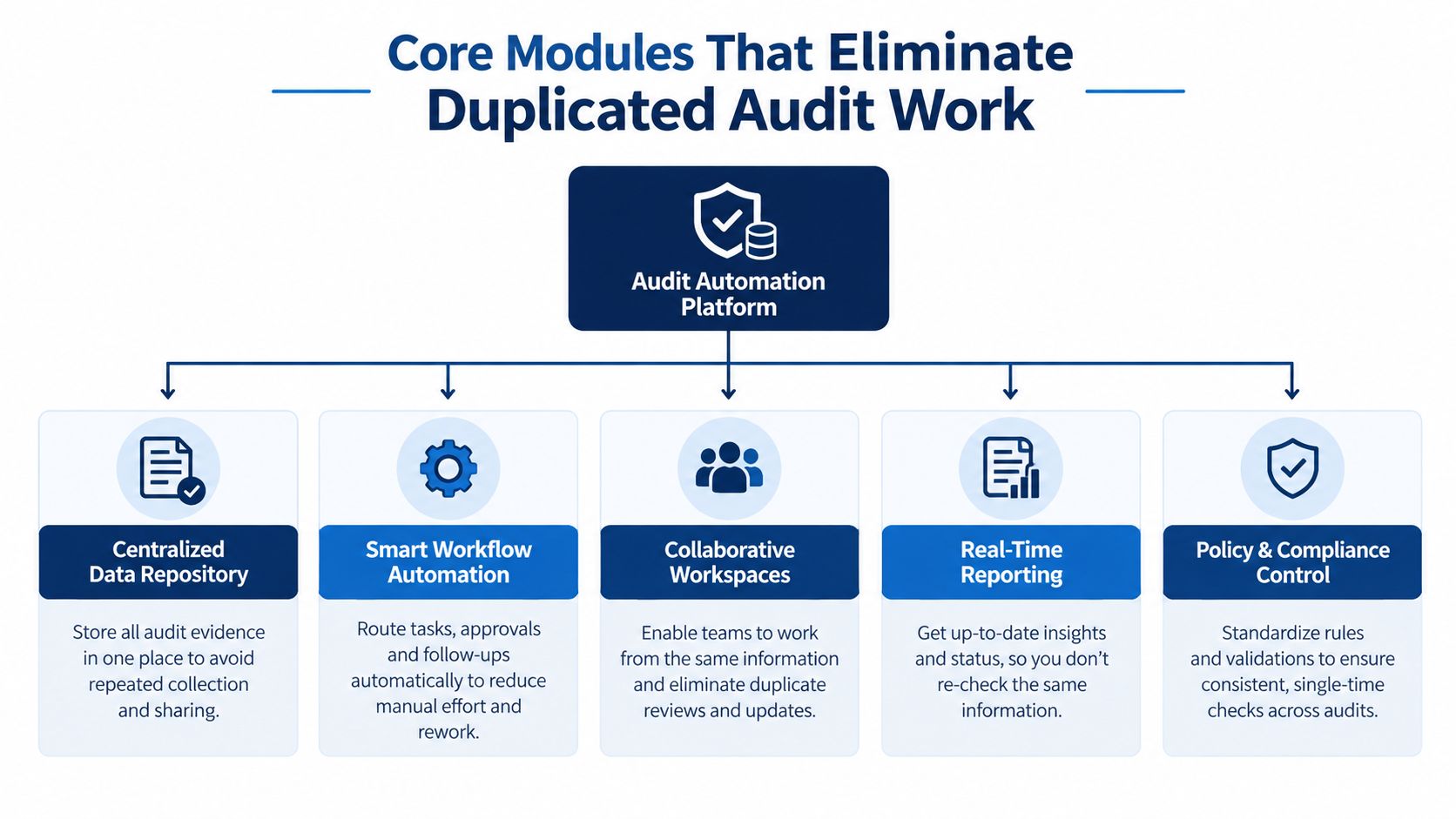
A serious GRC platform isn't a policy filing cabinet. It should maintain relationships between obligations, controls, risks, assets, owners, tests, issues, remediation tasks, and evidence. Without that connected model, teams test the same requirement repeatedly for different frameworks and struggle to explain whether one failure affects several obligations.
The UAE Information Assurance Standard v2.0 illustrates the modelling challenge. It expands the control model to 15 families, 47 sub-families, 134 controls, and 449 sub-controls, with P1–P4 prioritisation and “Always Applicable” and “Based on Risk” classifications, as described in the UAE National Cyber Security Governance Framework.
What should the platform connect?
Control normalisation gives different frameworks a shared internal control structure. For example, access governance may support several obligations, so the platform should let you test the underlying control once while associating the result with each applicable requirement.
Applicability logic separates mandatory controls from risk-based controls. This matters for ministries, regulated institutions, and critical-information infrastructure operators, where a platform must preserve the reason a control applies or does not apply.
Evidence mapping connects evidence to the control test and its source system. A ticket approval, identity review, change record, or policy acknowledgement should retain its owner, timestamp, status, and relationship to the relevant control.
Workflow linkage turns a failed test into an accountable process. The chain should run from policy to control, test, issue, remediation, validation, and executive reporting.
Procurement teams should also test continuous control monitoring rather than accepting screenshots of dashboards. Ask whether the platform can ingest evidence from ITSM, HR, identity, finance, cloud, and security tools, then flag stale or contradictory records.
For organisations running AI-enabled processes, governance must extend beyond model inventories. Teams should audit your AI workflows alongside access, data, approval, and change controls, so automation remains part of the same evidence model.
For a practical perspective on audit workflow design, review GRC audit software architecture. The useful test is whether an auditor can start from a requirement and reach the exact control owner, test result, supporting evidence, open issue, and remediation history without requesting documents from several departments.
Navigating Multi-Layer Regulatory Frameworks in the UAE and Europe
UAE compliance rarely fits inside one framework. Organisations may need to coordinate the Federal Decree-Law No. 45 of 2021, DIFC Data Protection Law, Central Bank guidance, TRA cybersecurity standards, and ISO 27001, while also managing contractual or group-level requirements. The software must therefore manage obligations as a connected set rather than display isolated checklists.
A UAE-focused compliance source states that businesses in Dubai and Abu Dhabi face rigorous audits, data-localisation rules, and fines up to AED 5 million for breaches, as discussed by Enactia's UAE GRC guidance. That makes evidence retention, accountability, multi-framework mapping, and audit-ready reporting operational requirements.
How should UAE banking requirements shape the design?
For CBUAE-regulated financial institutions, the CBUAE Cyber Risk and Operational Resilience Framework spans governance, IAM, data protection, application and infrastructure security, cryptography, security testing, third-party risk, incident management, resilience, and regulatory reporting.
A bank should be able to trace:
A policy requirement to a control.
The control to a system, service, or supplier.
The control to a test and evidence source.
A failure to an issue, owner, due date, and remediation plan.
The remediation outcome to operational resilience reporting.
Separating these workflows creates a visibility gap. A static risk register won't demonstrate that security requirements were defined early in development, approved by senior management, tested, and connected to incident response.
What changes for European operations?
European programmes commonly connect GDPR privacy operations with DORA resilience requirements, NIS2 security obligations, and organisational reporting. The GRC platform should support records of processing activities, data-owner accountability, supplier assessments, incident workflows, control testing, and executive dashboards.
A Dubai compliance software source specifically identifies obligation tracking, risk assessment, control management, policy workflows, audit trails, evidence collection, reminders, dashboards, role-based access, reporting, and multi-location support as useful capabilities. It also connects privacy workflows and records of processing activities to UAE requirements in Enactia's compliance software guidance.
European market forecasts reinforce the need for configurable platforms. One outlook places the Europe GRC platform market at USD 15.86 billion in 2025, projecting USD 16.96 billion in 2026 and USD 28.96 billion by 2034, with a 6.92% CAGR from 2026 to 2034. Another projects Europe eGRC growth from USD 6.03 billion in 2025 to USD 12.60 billion by 2030, at a 15.9% CAGR, driven by GDPR, DORA, NIS2, and ESG reporting, according to Market Data Forecast.
For HR-related obligations, teams can also browse HR compliance articles while designing access, joiner-mover-leaver, training, and employee acknowledgement workflows. A broader discussion of resilience requirements is available in the DORA regulation guide.
Enterprise Selection Criteria and Vendor Evaluation Matrix
Evaluate vendors against the operating environment you have, not the feature catalogue shown in a demonstration. Four dimensions usually expose the difference between a deployable platform and an expensive custom project: deployment flexibility, integration depth, regional content, and delivery capability.
Start by giving each vendor real scenarios. Ask them to demonstrate a control mapped to multiple obligations, evidence drawn from an ITSM record, a supplier issue escalated to an owner, and an executive report filtered by jurisdiction. A pre-recorded presentation won't reveal whether the data model can support your operating reality.
What should procurement score?
Evaluation Criteria | Standard Global Platform | Regionally Optimised Platform |
|---|---|---|
Deployment | Primarily public SaaS with limited residency choices | Self-hosted, sovereign-cloud, or in-country options aligned to policy |
Language | English-first interface and reporting | Arabic support where required, with configurable regional reporting |
Frameworks | Broad global libraries requiring local tailoring | Ready-made regional mappings plus editable control normalisation |
Integrations | Connectors focused on major enterprise suites | Practical APIs and workflows for ServiceNow, HaloITSM, Freshservice, HR, identity, and security tools |
Evidence | Periodic uploads and manual attestations | Automated collection, source traceability, and continuous validation |
Delivery | Product-led implementation with limited local context | Certified delivery partners, managed services, and local stakeholder support |
Use the matrix as a filter, not a mathematical procurement exercise. The right weighting depends on whether your primary constraint is residency, audit volume, operational resilience, or integration complexity.
A useful comparison point for European privacy programmes is this GDPR compliance software evaluation. For broader vendor and architecture context, consult Gartner GRC analysis, then validate every recommendation against your own data flows and regulatory counsel.
Integration Roadmap for ITSM and HR Service Delivery
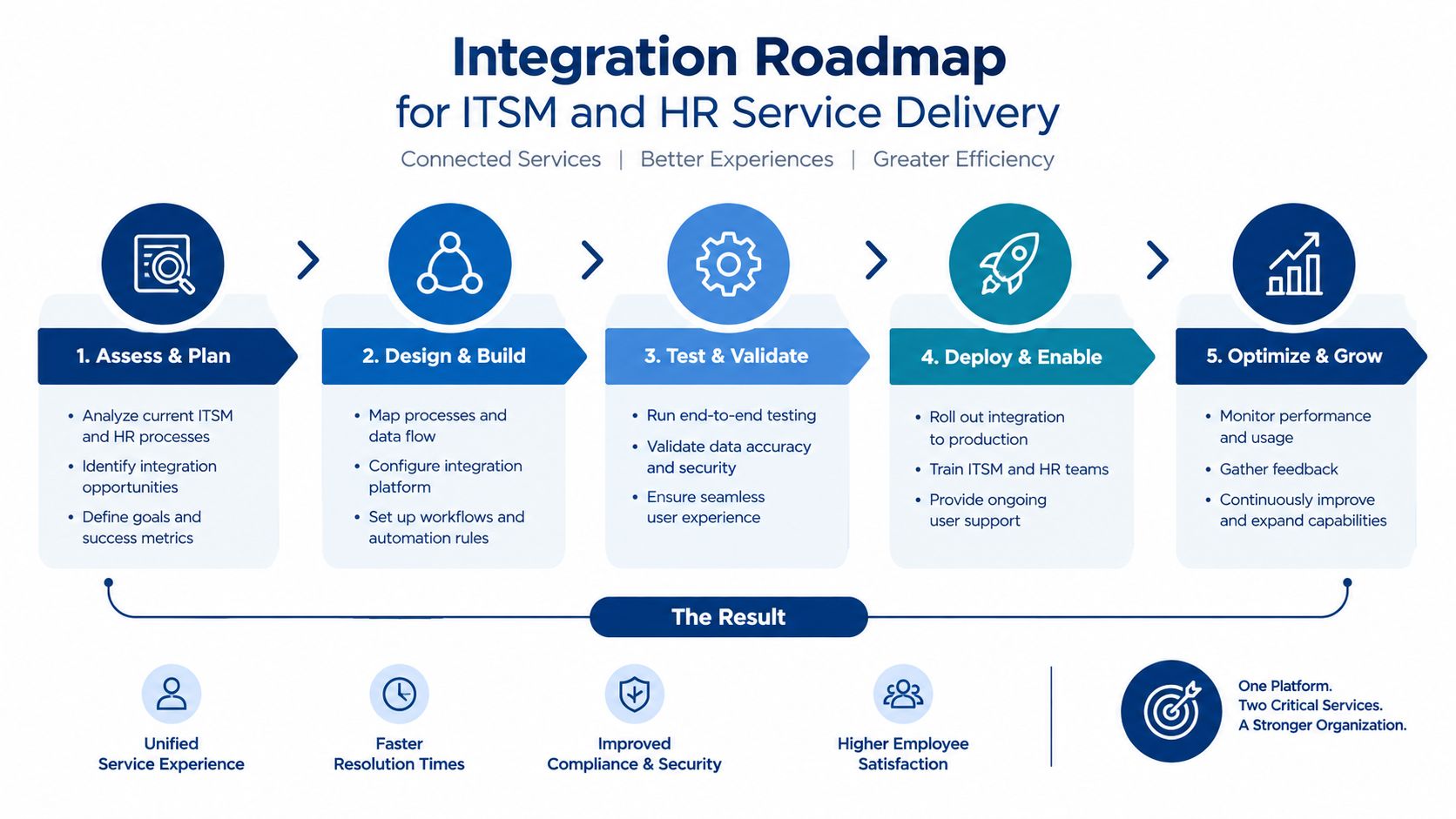
GRC becomes useful when it receives trustworthy evidence from operational systems. A standalone repository creates another reporting queue. An integrated architecture can use approved changes, incidents, access reviews, employee records, supplier tickets, and service ownership data to support control testing.
The roadmap should begin with data ownership, not connectors.
Which systems should connect first?
ITSM and ITOM: Connect change, incident, problem, request, asset, service, and configuration records. These records can support controls for approval, segregation of duties, incident handling, service ownership, and technology risk.
HRSD: Link joiner, mover, leaver, role change, training, and policy acknowledgement workflows to identity and access controls. HR remains the source of employment status, while identity platforms provide technical access evidence.
Security and identity: Bring vulnerability, privileged access, authentication, endpoint, and security incident evidence into control assessments where the source data is reliable and appropriately scoped.
Third-party systems: Use supplier onboarding, contract, risk assessment, issue, and renewal data to maintain an active third-party risk view rather than a one-time questionnaire.
How do you prevent automation from creating bad evidence?
Define the evidence contract for each integration. Specify the source system, field meanings, refresh behaviour, owner, retention rule, and exception path. Don't treat a populated field as proof of control effectiveness if the underlying workflow allows bypasses or incomplete approvals.
A practical sequence is:
Inventory controls and identify evidence dependencies.
Assign each evidence item a system of record.
Build read-only ingestion before introducing write-back automation.
Validate records with control owners and auditors.
Add alerts for missing, stale, contradictory, or overdue evidence.
Link exceptions to remediation and management reporting.
ServiceNow, HaloITSM, and Freshservice can each serve as operational sources, but the integration design must respect their different schemas, permissions, and workflow conventions. Guidance on aligning service operations and governance is available in IT service management solutions.
Business Benefits and the ROI of Platform Standardisation
The business case for GRC standardisation shouldn't rely on a vague promise of automation. Build it around the work your teams repeat: evidence requests, control reconciliation, audit preparation, issue chasing, supplier reviews, policy attestations, and executive reporting.
A unified platform can reduce duplicated effort when one control test supports several applicable obligations. It can also improve accountability because the same issue record can carry its owner, remediation plan, validation evidence, and reporting status.
Which outcomes matter to the board?
Lower audit friction: Auditors can follow traceable relationships instead of receiving disconnected folders and spreadsheets.
Faster regulatory response: Compliance teams can assess a new obligation against an existing control library and identify impacted services, suppliers, policies, and owners.
Better resilience visibility: Risk, cyber, operational, and third-party records appear in a common context rather than in separate departmental reports.
More predictable delivery: Digital services can move through change and approval workflows with control requirements visible earlier.
The market context strengthens the investment discussion. The UAE benchmark from Ken Research shows movement from USD 746.6 million in 2024 to a projected USD 1,296.0 million in 2029, while the Mordor Intelligence outlook projects USD 1,723.1 million in 2025 and USD 4,786.8 million by 2033. These are different forecasts, so don't combine them into a single market estimate. Together, they indicate sustained regional demand for platform-based governance, risk, and compliance capabilities.
How should you calculate value?
Create a baseline before implementation:
Audit effort: Record time spent collecting, validating, and reconciling evidence.
Control duplication: Identify requirements tested separately across frameworks.
Issue ageing: Measure how long remediation remains open and why.
Reporting effort: Track manual work needed for executive and regulator reports.
Integration cost: List recurring extracts and spreadsheet transformations.
Then model savings conservatively. Include licence, implementation, integration, training, managed service, and data-residency costs. A platform is not economically attractive if it removes spreadsheet work but requires permanent custom development for every regulatory update.
Migration Best Practices and Stakeholder Rollout Strategy
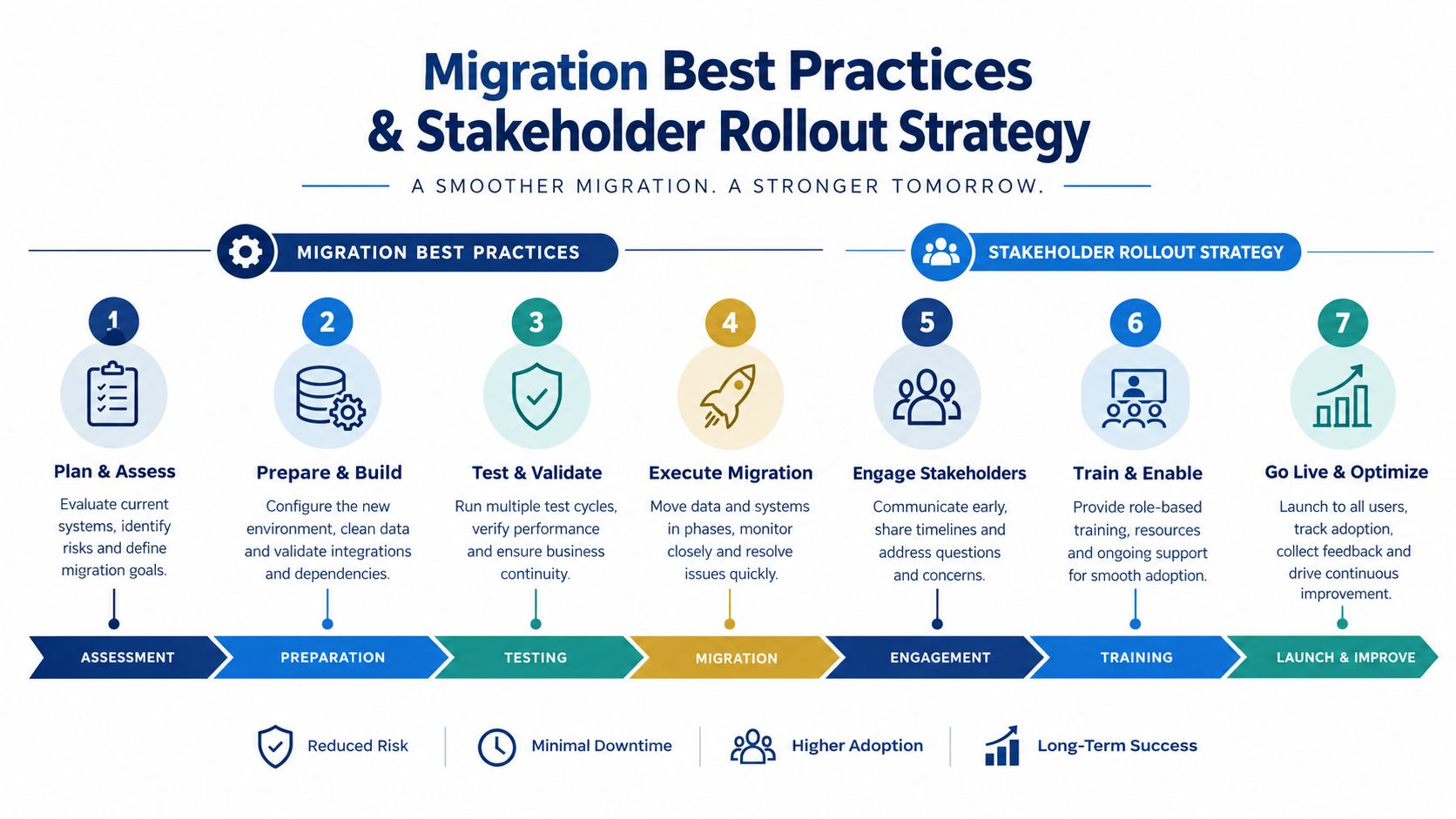
Successful migration starts with discovery, not configuration. Bring compliance, internal audit, cyber, IT operations, HR, procurement, legal, architecture, and business service owners into the fit-gap process. Each group sees a different part of the control chain, and excluding one creates incomplete ownership or unusable workflows.
A practical rollout can proceed as follows:
Discover: Catalogue obligations, frameworks, policies, risks, controls, evidence sources, and reporting needs.
Prioritise: Select control families where duplicated testing, regulatory exposure, or operational dependency is highest.
Design: Define taxonomy, roles, approval paths, evidence standards, exceptions, and retention rules.
Pilot: Configure a bounded set of controls and connect a small number of trusted evidence sources.
Validate: Let control owners, auditors, and technical teams test the workflows using real records.
Expand: Add further frameworks, services, suppliers, HR processes, and operational integrations in waves.
Optimise: Review adoption, stale evidence, issue ageing, workflow exceptions, and reporting quality through managed services.
What makes adoption stick?
Give every workflow a named owner and a clear reason for completion. Compliance teams need control coverage and evidence quality. IT teams need fewer manual requests and better service context. HR teams need accurate lifecycle events without exposing unnecessary employee data. Executives need concise views of material risk, unresolved issues, and resilience.
Don't migrate every historical spreadsheet immediately. Preserve records required for audit or legal purposes, then move active obligations and open remediation into the new model. Establish a change board for taxonomy and framework updates so individual departments can't create competing control definitions.
Use change management readiness assessment to identify adoption barriers before rollout. DataLunix can support discovery workshops, fit-gap analysis, implementation, integrations, stakeholder enablement, and managed optimisation for ServiceNow, HaloITSM, Freshservice, and related enterprise service platforms. Visit DataLunix to assess a regionally deployable GRC architecture, connect evidence across ITSM and HR systems, and plan a phased implementation for your GCC or European environment.