
10 Best GRC Software Companies for 2026

The strongest choice among GRC software companies depends less on the longest feature list than on fit with your regulatory scope, existing ITSM estate, deployment model, usability, and total implementation effort, in a UAE market valued at approximately USD 746.6 million in 2024 and projected to reach about USD 1.296 billion by 2029. That scale makes a rushed, catalogue-led purchase hard to defend. You'll get better value by testing how each platform handles your real controls, evidence, remediation owners, and reporting obligations.
The UAE figures are country specific rather than a broad Middle East estimate, and they point to sustained enterprise investment rather than short term compliance projects, as shown in the UAE enterprise GRC market projection to 2029. Demand is tied to stricter regulatory expectations, cybersecurity risk, data protection, and digitised audit work. Your shortlist should therefore separate broad enterprise platforms, audit led tools, privacy led suites, and UAE specialists instead of treating them as interchangeable.
For CIOs, the practical sequence is simple. Map your frameworks, risk domains, data sources, and IT operating model first, then test licensing, integration, and delivery effort with representative scenarios. That discipline mirrors good enterprise platform selection generally, including the fit gap thinking in this ERP selection and migration guide. The ten options below get to the trade offs quickly, with deployment and partner considerations kept visible.
1. ServiceNow Integrated Risk Management (IRM)
If ServiceNow already runs your IT workflows, ServiceNow Integrated Risk Management deserves a first look. It connects risk, compliance, controls, and remediation to the operational teams that fix issues, so findings don't sit in a separate register waiting for email follow up.
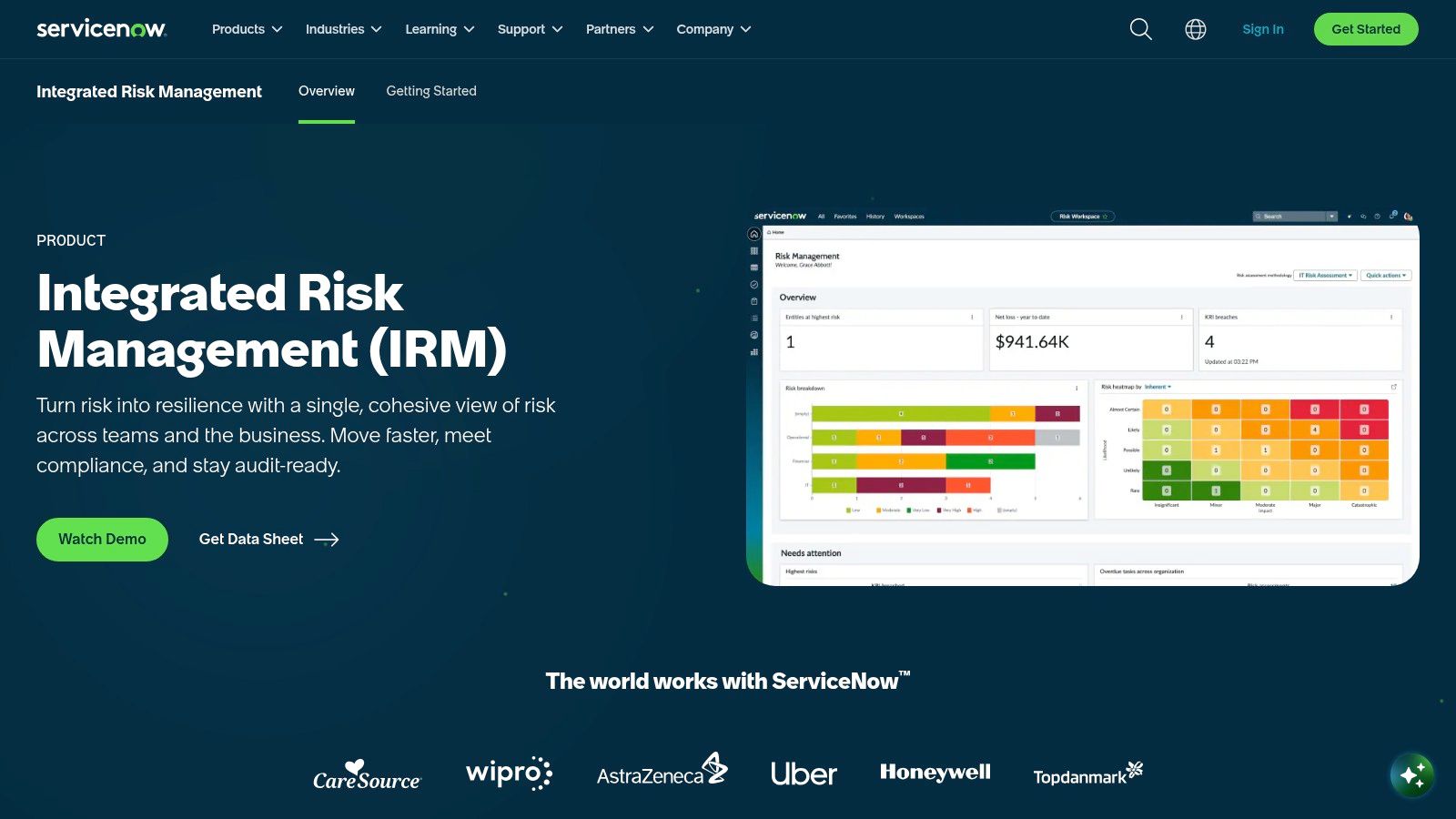
Why the integration angle matters
UAE research shows 86% of respondents agree that IT, security, and risk teams collaborate effectively on AI deployment, while 66% describe their cybersecurity maturity as optimised, according to the KPMG UAE technology survey on AI and cybersecurity collaboration. That supports a simple test for ServiceNow. Can it ingest signals from ITSM, security, third party, and data governance tools, then produce traceable ownership, exceptions, and executive reporting without manual rekeying?
Best fit: You're already invested in ServiceNow and want one workflow foundation for risk and operations.
Main strength: Fewer handoffs between risk teams and IT operations when issues, changes, and incidents already live there.
Watch out: Scope depends heavily on licensed modules and configuration, so confirm exactly what's in the proposed package.
Implementation risk: Change management can be substantial, especially if control owners outside IT aren't ServiceNow users today.
Don't judge it on a polished risk dashboard. Ask the vendor to route a failed control into an operational queue, show the evidence trail, and price every module used in that demo.
2. IBM OpenPages
IBM OpenPages suits organisations coordinating several risk domains at once. Its modular coverage spans operational risk, regulatory compliance, audit, third party risk, privacy, and business continuity, with cloud, on premises, and hosted deployment options.
That breadth is useful when one control must satisfy multiple obligations. Configurable workflows, dashboards, and views help, and IBM also offers integrations and AI features, including connections to external AI models. Indicative prices are published for some offerings, which helps early budgeting, although on premises pricing requires a quote and published prices may vary by country.
Adoption barriers matter as much as features. A UAE study based on 60 structured interviews and 300 online surveys across Dubai, Abu Dhabi, and Sharjah identifies implementation cost, regulatory complexity, shortage of skilled professionals, and organisational resistance as principal barriers, as detailed in the Ken Research UAE enterprise GRC market study. OpenPages breadth can amplify those barriers if you don't have experienced administrators.
Practical rule: If your team can't name the internal platform owner and two trained administrators, scope OpenPages in phases rather than launching every domain together.
Cloud delivery, AI and ML integration, and system partnerships are growth opportunities, but they don't remove enablement cost. Budget for training, managed optimisation, and adoption targets alongside subscription and implementation.
3. Archer Integrated Risk Management
Archer is the configurable enterprise option on this list. It brings a broad risk management application portfolio onto a shared platform, which can help organisations with established programmes consolidate separate risk processes and apply consistent workflows across risk areas.
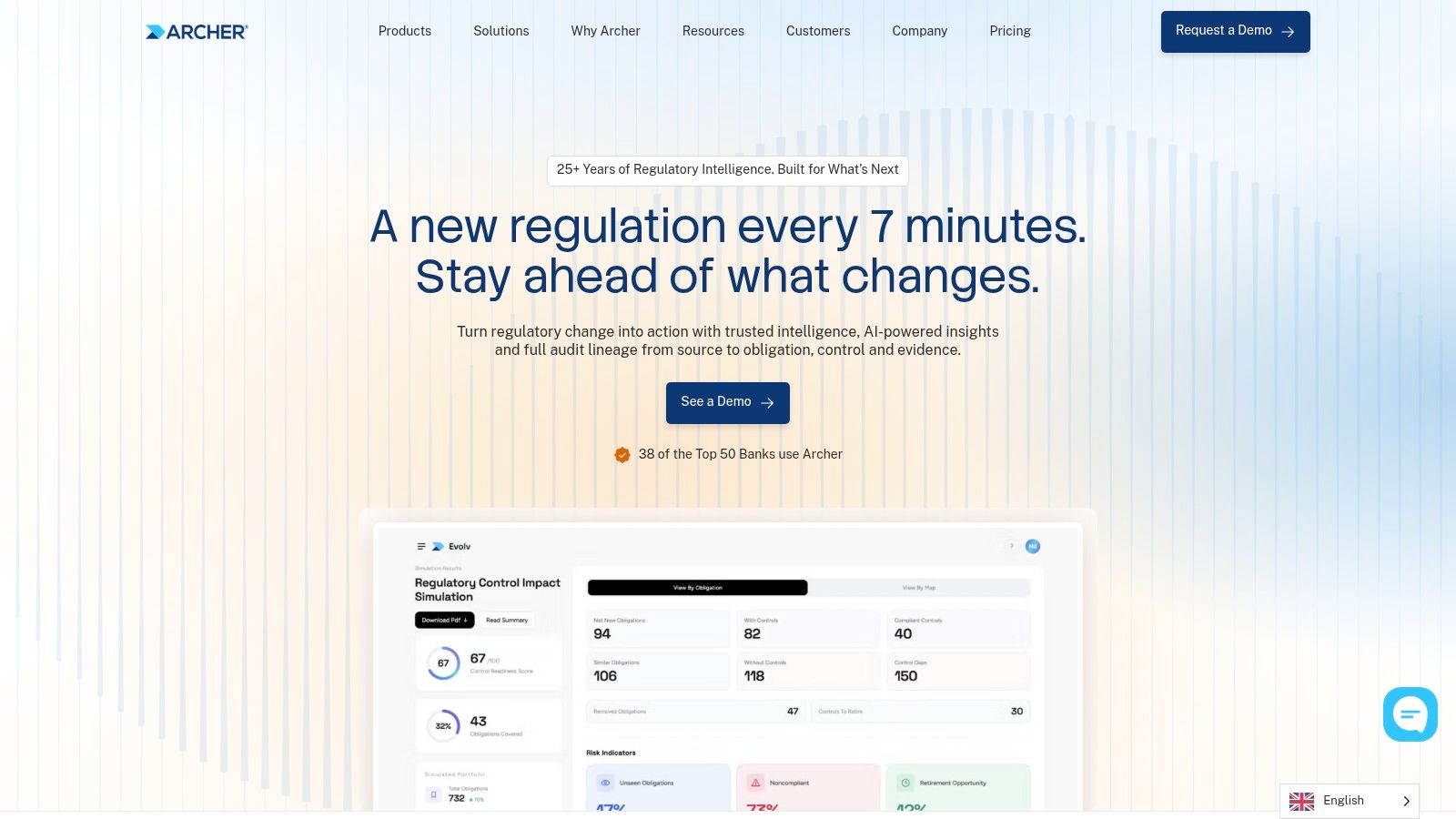
The workload case for consolidation is strong regionally. PwC found 91% of Middle East respondents said external or compliance pressures consumed a significant share of risk owners' time and resources, while 78% were concerned enough to address it formally, as reported in PwC's 2022 Global Risk Survey Middle East findings. Archer can respond to that pressure if its configuration reduces evidence chasing and duplicate assessments.
What to test in a proof of concept
Day to day usability: Control owners should complete attestations and upload evidence without administrator help.
Administration effort: Time how long a workflow change, new field, or report takes in the demo environment.
Consolidation value: Map one control to several obligations and check whether evidence is reused cleanly.
Commercial clarity: Pricing wasn't publicly confirmed, so require a scoped quote tied to users, modules, and use cases.
Archer fits organisations needing custom enterprise workflows. It's less compelling if your main problem is low adoption, because configurability won't fix a clunky front door for occasional users.
4. MetricStream Connected GRC
MetricStream positions itself as connected GRC across risk, compliance, audit, cyber risk, third party risk, and resilience. For mature programmes, that connection matters more than any single module. A regulatory change should trigger impact assessment, control updates, and remediation tasks in one flow.
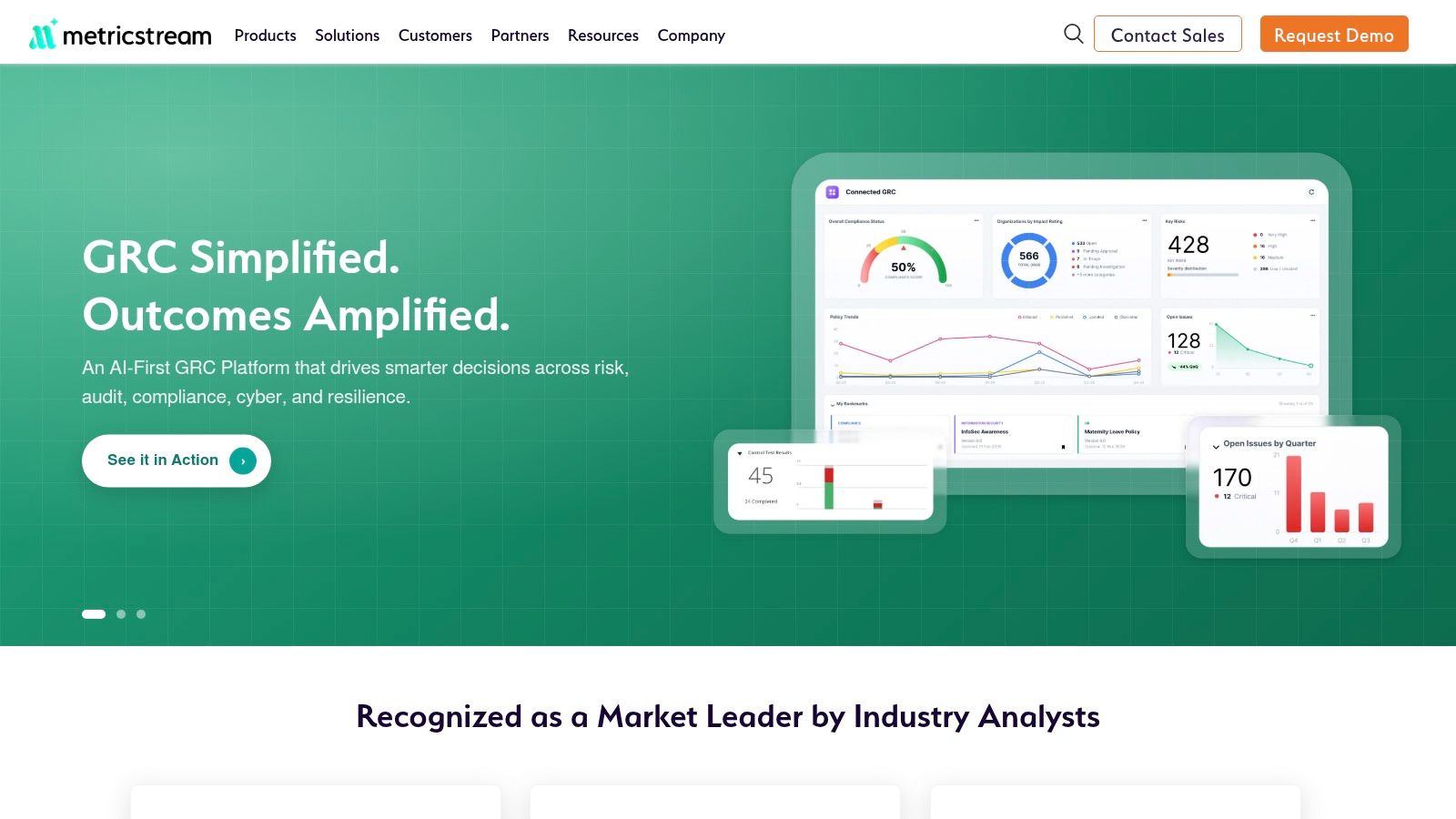
Continuous monitoring, not annual clean up, is the operating standard UAE buyers should test. In 2025, the Ministry of Human Resources and Emiratisation recorded more than 695,000 inspection visits, a 4% increase from the previous year, while reported labour violations declined by 13%, according to the MOHRE release on AI driven governance and labour inspections. You should ask MetricStream to show obligations, evidence, issue ownership, escalation, and corrective action tracking working together at that kind of ongoing cadence.
Its strengths include enterprise and operational risk products, compliance workflows for regulatory changes, policies, and controls, plus AI features embedded in the GRC offering. The trade off is scope control. Broad coverage requires careful module selection and implementation planning, or you'll buy more platform than your operating model can absorb.
Public pricing wasn't identified. Request industry and region relevant references, and make the vendor demonstrate a full cycle from regulatory alert to tested control.
5. AuditBoard Connected Risk Platform
Choose AuditBoard when internal audit or assurance teams lead the purchase. It supports audit, risk, compliance, and controls workflows, and it can centralise assurance activity and evidence that currently lives in spreadsheets, shared drives, and email threads.
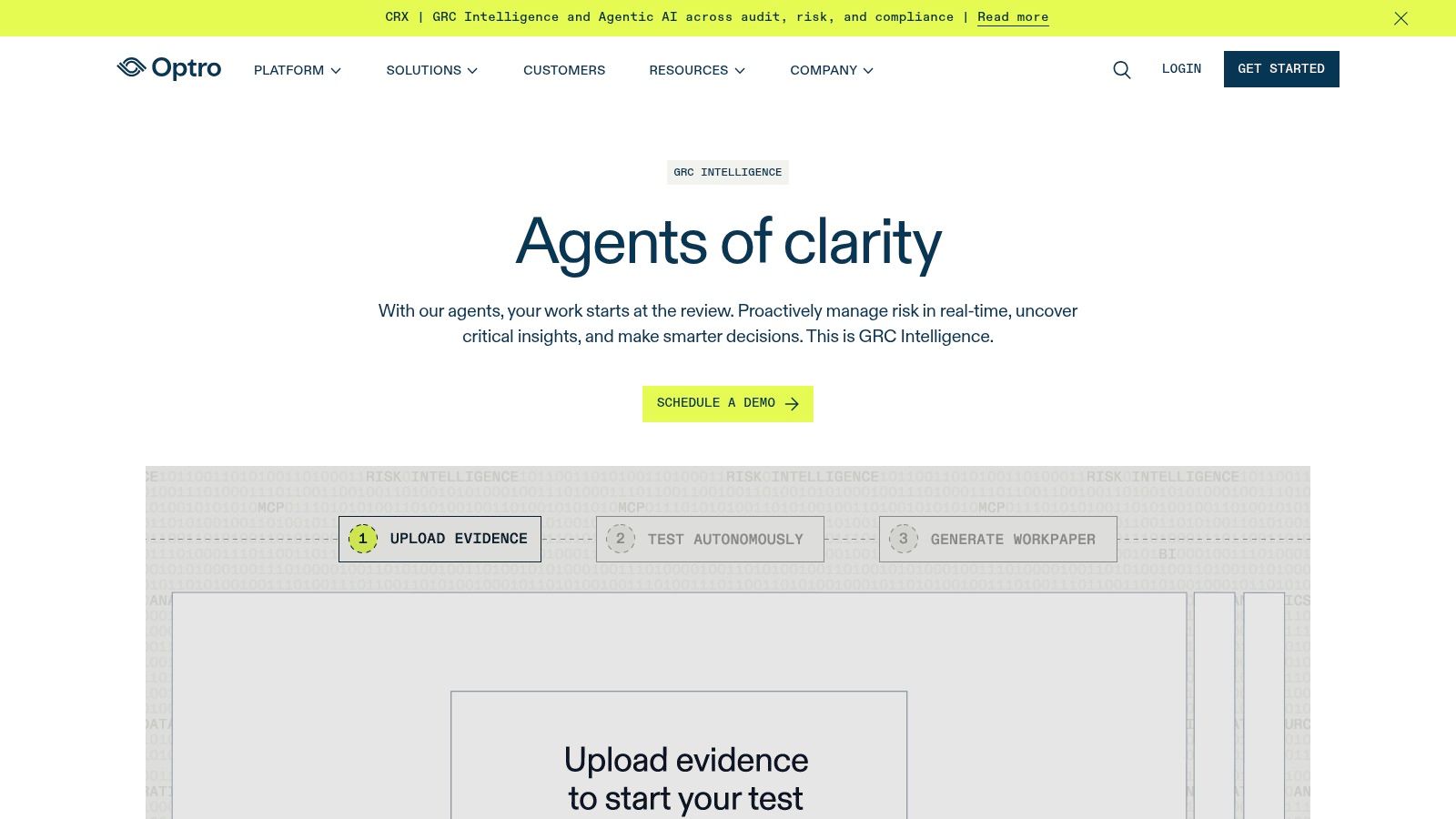
That audit led start is often the fastest route to adoption. Findings, actions, evidence requests, and reporting get coordinated in one place, and control owners see clearer deadlines. The risk is assuming audit strength equals full enterprise GRC depth. Test operational risk, cyber risk, third party risk, and regulatory change workflows separately if those domains are in scope.
Regional maturity work supports a broader lens over time. KPMG's UAE enterprise risk research gathered more than 100 responses across industries and the public sector, as summarised in its UAE enterprise risk management research. Buyers are benchmarking structured governance dimensions, not just annual compliance completion.
Best fit: Audit modernisation, controls testing, and assurance coordination.
Check carefully: Depth for complex operational or regulatory risk beyond audit.
Commercial note: Public pricing wasn't identified, so compare module scope line by line.
AuditBoard is a credible candidate against broader platforms, provided your proof of concept includes at least one non audit risk workflow end to end.
6. Diligent Diligent One Platform
Diligent One starts from the boardroom. It combines board management with GRC applications for risk, audit, compliance, and reporting, plus integrations with external data sources and risk intelligence and analytics features.
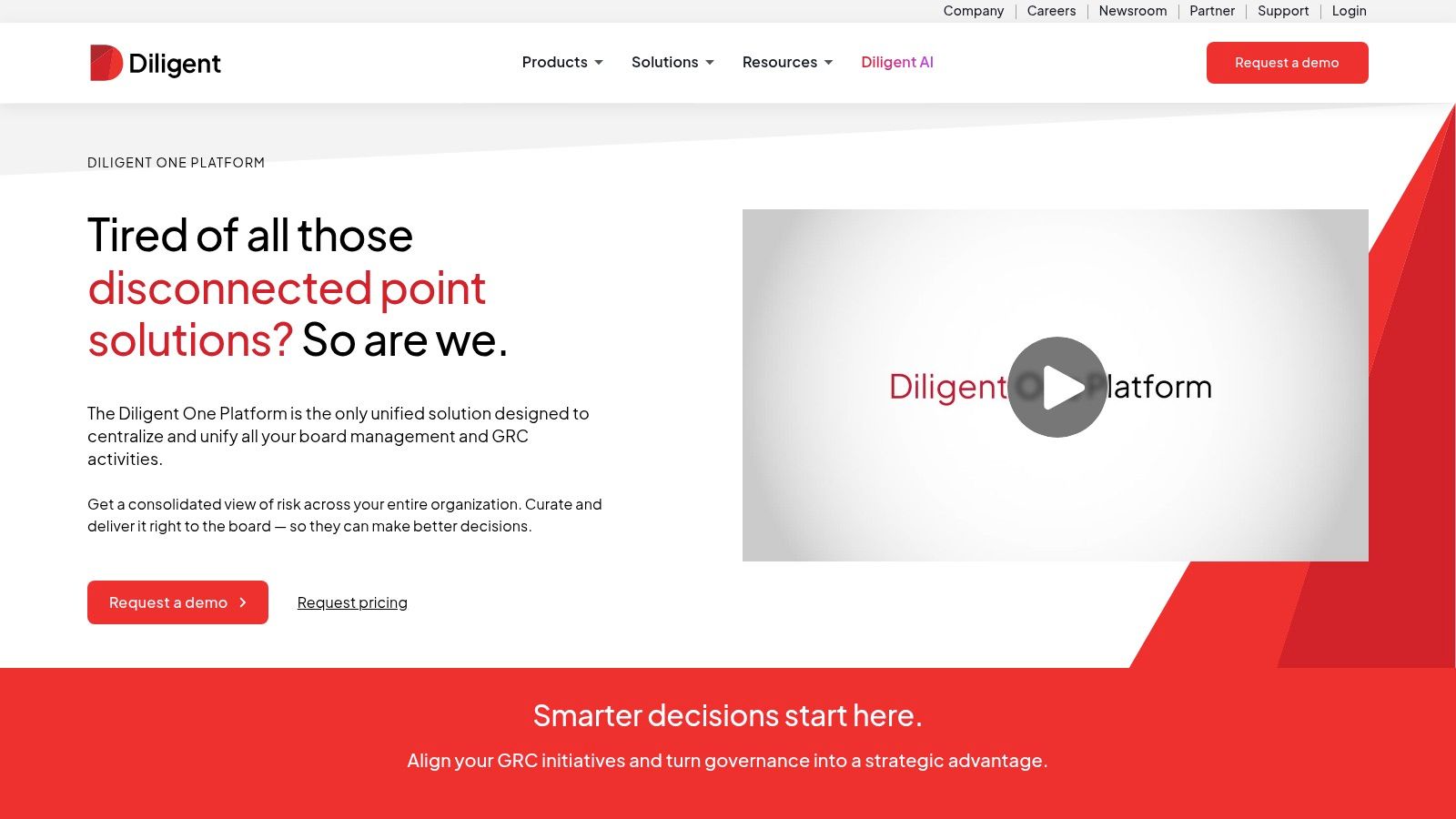
That orientation helps when your pain point is turning operational information into decision ready board or committee material. Executives get a more consistent view of exposure, overdue actions, and assurance coverage, instead of slide decks assembled manually each quarter. Diligent also reports a global customer footprint and publishes customer rating information on its site, which you can use during reference checks.
Where it fits and where it doesn't
Strong use case: Regular board, risk committee, and audit committee reporting tied back to underlying risks and controls.
Weaker use case: Deep IT control automation driven by ITSM, security tooling, or configuration data, unless integrations are proven in your environment.
Commercial caution: Quote based pricing makes comparison difficult without a defined module scope.
Ask for a drill down demo. Start at a board heat map, click into a risk, then follow the control, test result, issue, and owner. If that chain breaks, the board view is presentation, not governance. Confirm which modules are included in the proposed package before comparing price.
7. OneTrust GRC Privacy and Technology Risk
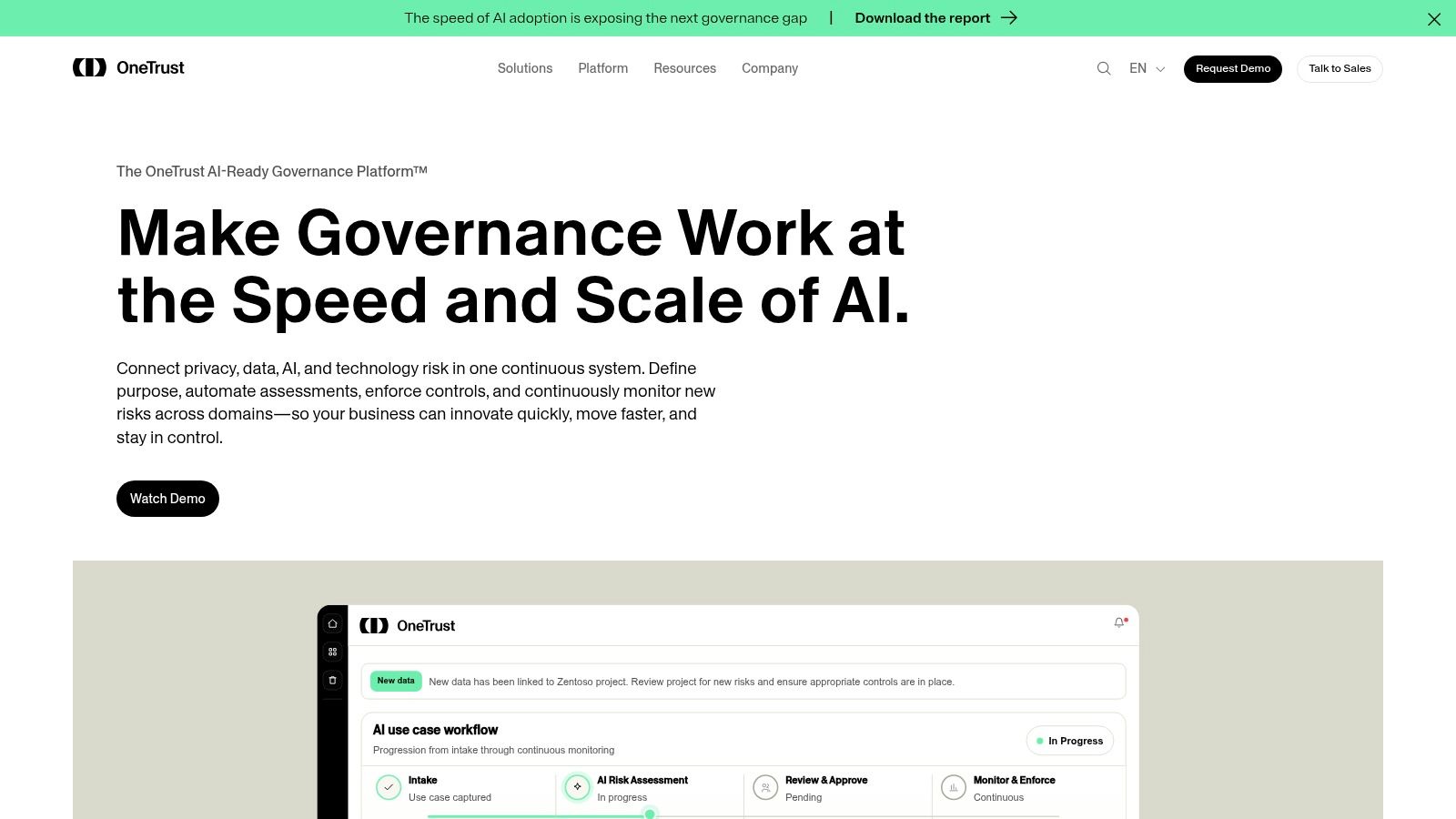
Evaluate OneTrust when privacy, data governance, technology risk, or third party risk dominate your requirement. Its portfolio spans privacy and data protection alongside technology risk and broader governance and compliance activity, which suits programmes where personal data obligations drive control design.
Regional confidence data shows why jurisdiction specific evidence matters. Middle Eastern organisations report 72% confidence in data protection compliance, but 25% have only moderate confidence in AI and resilience related regulation, and cybersecurity regulation has driven investment for 57% regionally compared with 46% globally, according to PwC's Global Digital Trust Insights Middle East findings. A single GCC compliance score can therefore create false confidence.
Don't accept generic framework coverage as proof of UAE readiness. Ask which controls and evidence are localised, how cross border data handling is recorded, and how one control maps to multiple regimes.
That challenge extends to endpoints and remote work, a point underscored by practical guidance on BYOD security that actually works. OneTrust buyers should map requirements to specific product families and modules, validate UAE or GCC coverage directly, and note that public pricing wasn't identified. Privacy led strength is real value, but only if the modules you license match the obligations you're trying to evidence.
8. SAI360 Ethics Risk and Compliance
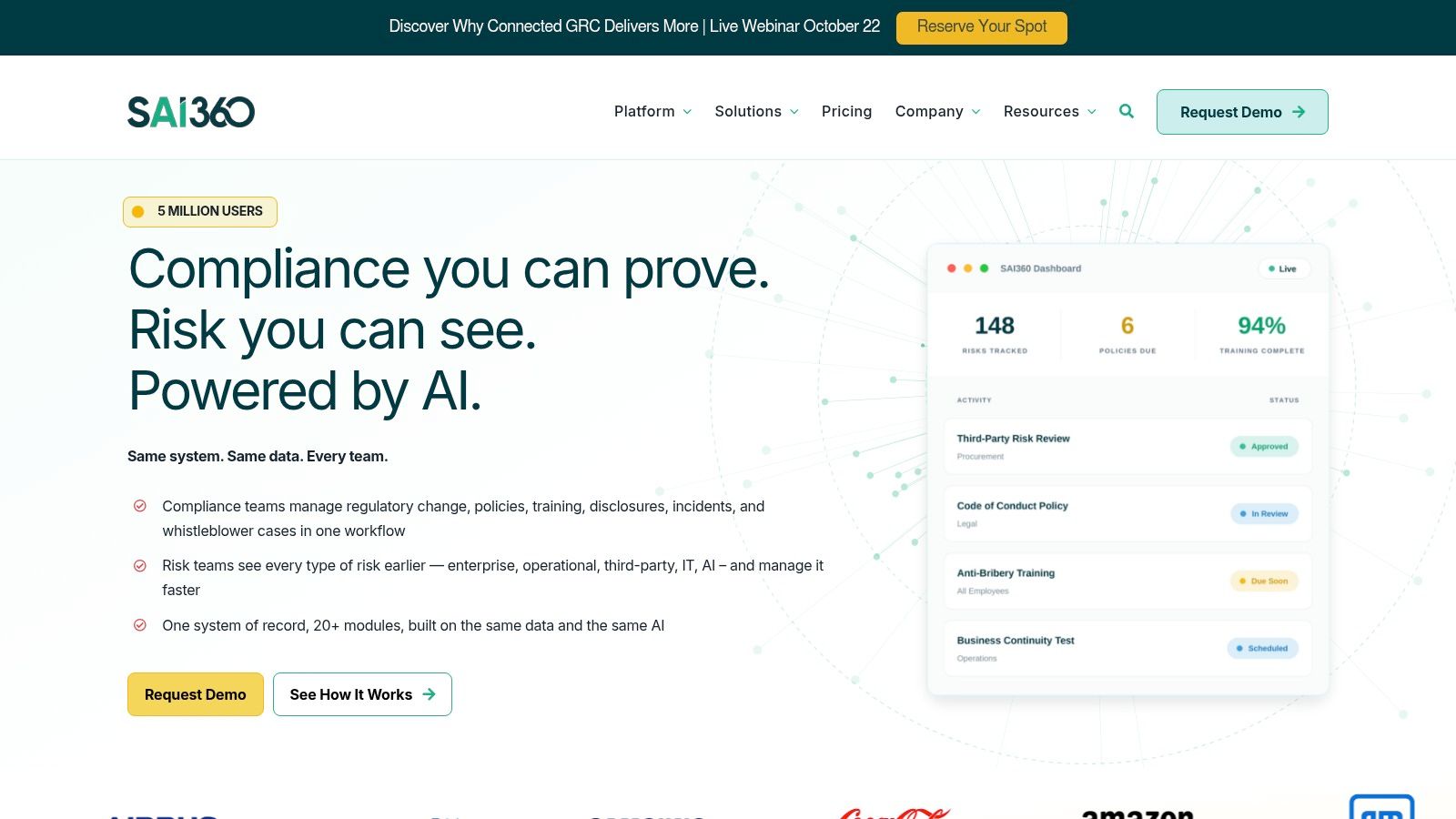
SAI360 takes a connected ethics, risk, and compliance approach. It's worth assessing when policy, ethics processes, compliance tracking, and risk workflows need to sit together rather than in isolated applications owned by different teams.
UAE cybersecurity obligations illustrate why connection matters. Requirements combine national, sector specific, government, and technical layers, including the UAE Personal Data Protection Law, the UAE Information Assurance framework, the National Cloud Security Policy, and electronic trust requirements under the direction of the National Cybersecurity Strategy, as outlined in this overview of the UAE National Cybersecurity Strategy and related obligations. A useful platform must show which requirement applies, which control satisfies it, who owns evidence, when it was last tested, and what gap remains.
For SAI360, test jurisdiction and sector tagging, policy versioning, exception approvals, evidence expiry dates, and change impact analysis when a framework changes. Also check whether universal controls can be separated from obligations that apply only to regulated environments.
Best fit: Programmes joining ethics and compliance with enterprise risk and assurance.
Validate early: Module fit, integrations, and implementation approach for your sector.
Commercial note: Public pricing wasn't identified. Request region and industry relevant references.
SAI360 offers an alternative to larger enterprise platform vendors. Its value depends on whether the connected model matches your accountability structure in practice.
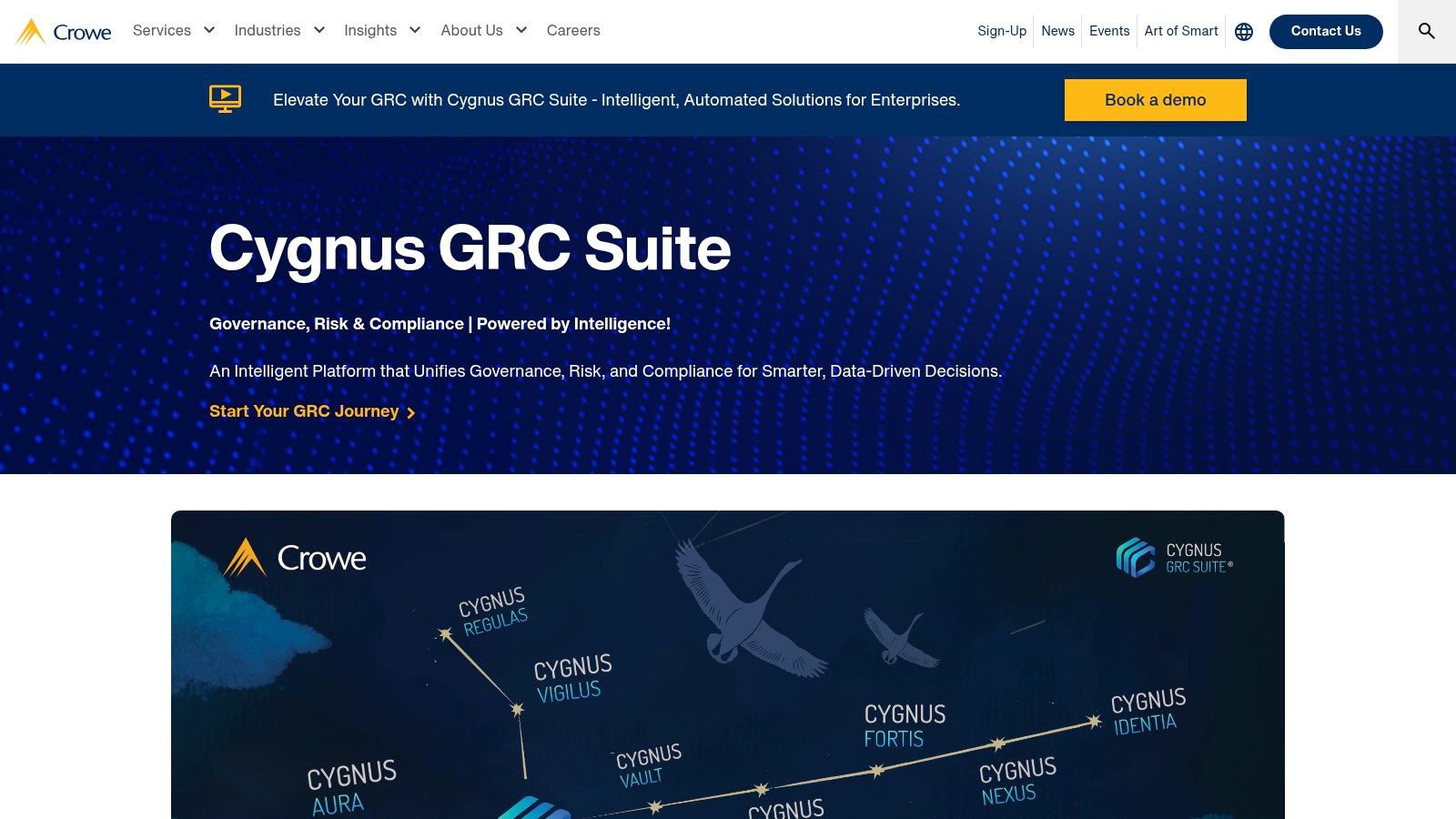
9. Crowe UAE Cygnus GRC Suite
Crowe UAE's Cygnus GRC Suite is the explicitly UAE regulatory option in this list. Crowe positions it for financial institutions, DNFBPs, and other regulated entities, and says it's designed to align with environments including CBUAE, DIFC DFSA, ADGM FSRA, VARA, and SCA.
ADGM requirements show the level of workflow precision you should demand. Firms must maintain a board approved Cyber Risk Management Framework, conduct vulnerability assessments and penetration testing at least annually on internet facing systems, and report a significant cyber incident to the FSRA within 24 hours of discovery, as summarised in BDO UAE guidance on ADGM cyber risk requirements. Your demo should cover board approval records, vendor due diligence, contract requirements, testing schedules, remediation tickets, incident timers, and notification evidence.
Questions for a regulated entity demo
Framework currency: Who updates content when a regulator changes a rule, and how is that change evidenced?
Third party controls: Can supplier cyber posture be monitored continuously, not just at onboarding?
Enterprise fit: Do integrations and reporting work beyond the regulated entity into group risk?
Regional delivery and support are practical advantages to assess. Public pricing wasn't identified, so tie the quote to your specific regulator, obligations, entities, and users.
10. GRSCIA UAE Healthcare GRC and ADHICS
GRSCIA is a specialist regional platform for governance, risk, security, compliance, and internal audit, with particular emphasis on healthcare and ADHICS compliance. It's owned and operated by CISOSHARE, which describes itself as a UAE company providing information security, inspection, and audit services.
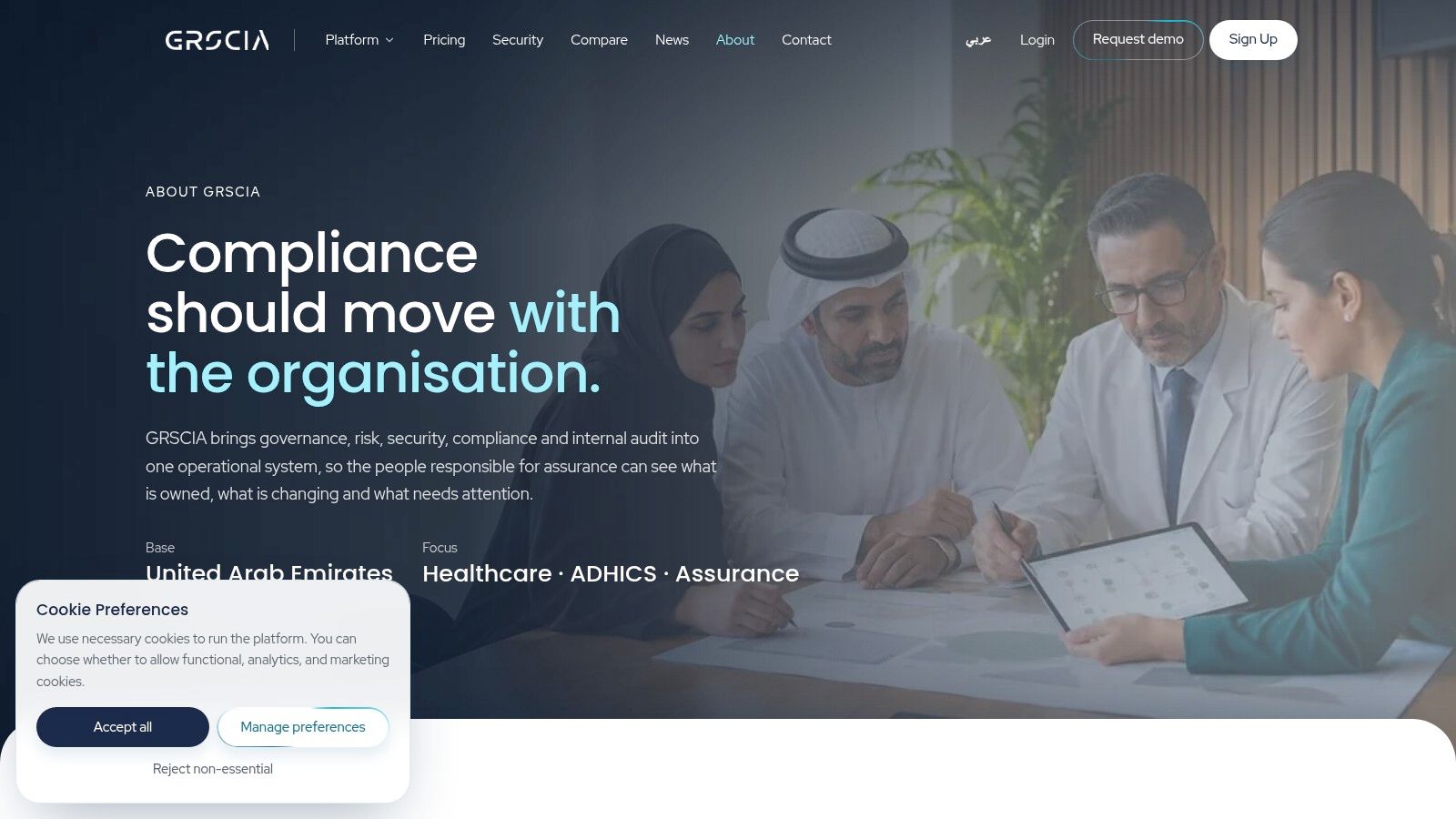
Specialisation is the point. If ADHICS assurance, control ownership, and evidence management are central to daily operations, a healthcare focused regional tool may reach usable workflows faster than a general platform that needs heavy localisation. Combining software with the provider's security and assurance expertise can also help smaller internal teams.
The trade off runs the other way for diversified groups. A healthcare focus may not fit general purpose, multi industry enterprise GRC requirements across finance, operations, privacy, and group audit. You should test framework coverage beyond ADHICS, integrations with ITSM and security tooling, data migration, and reporting consolidation if the platform will serve more than healthcare entities.
Best fit: UAE healthcare providers and related entities where ADHICS workflows dominate.
Ask for: Similar customer references, integration examples, and evidence retention controls.
Commercial note: Public pricing wasn't identified, so scope users, facilities, and frameworks before quoting.
GRSCIA shows why regional specialists belong on the shortlist. They shouldn't win by default, but broad global platforms shouldn't either when local sector assurance is the main job.
Top 10 GRC Software Companies Compared
GRC Platform | Core Coverage | Best Fit / Distinctive Strength | Key Considerations | Pricing |
|---|---|---|---|---|
ServiceNow IRM | Risk, compliance, controls and remediation workflows | ServiceNow users connecting risk work to IT operations | Value depends on licensed modules and configuration; implementation may be substantial | Confirm with vendor |
IBM OpenPages | Modular risk, compliance, audit, privacy and third-party risk | Complex programs needing flexible deployment options | Broad scope may require experienced administrators; some modules cost extra | Indicative prices available for some offerings; on-premises by quote |
Archer Integrated Risk Management | Enterprise risk applications and configurable workflows | Organizations consolidating established risk processes | Validate configuration, administration effort and usability in a proof of concept | Not publicly confirmed |
MetricStream Connected GRC | Risk, compliance, audit, cyber risk and resilience | Mature programs seeking consistent risk and control practices | Careful module selection and implementation planning may be needed | Not publicly identified |
AuditBoard Connected Risk Platform | Audit, risk, compliance, controls and evidence | Audit- and assurance-led modernization | Assess fit for complex operational and regulatory risk needs | Not publicly identified |
Diligent One | Board governance, risk, audit, compliance and reporting | Organizations linking GRC insights to board and committee decisions | Confirm package scope; board-focused strengths may not suit IT-control automation needs | Quote-based |
OneTrust GRC, Privacy and Technology Risk | Privacy, data governance, technology risk and third-party risk | Privacy-led programs and vendor or technology risk needs | Map requirements to product modules; validate UAE/GCC framework coverage | Not publicly identified |
SAI360 Ethics, Risk and Compliance | Ethics, compliance, risk, policies and controls | Organizations managing ethics alongside risk and compliance | Validate module fit, integrations and regional references | Not publicly identified |
Crowe UAE Cygnus GRC Suite | GRC for regulated entities; identifies UAE frameworks including CBUAE, DFSA, FSRA, VARA and SCA | UAE financial institutions, DNFBPs and other regulated organizations | Confirm specific regulatory coverage, updates and enterprise integrations | Not publicly identified |
GRSCIA UAE Healthcare GRC | Governance, risk, security, compliance and audit; healthcare and ADHICS focus | UAE healthcare organizations with local assurance needs | Specialized scope may not suit general enterprise GRC; validate integrations and references | Not publicly identified |
Turn the Shortlist into an Adoption Decision
Score every shortlisted vendor against the same evidence, not against separate sales narratives. Your matrix should cover regulatory coverage, control and risk workflows, ITSM and ITOM integration, deployment model, usability, licensing structure, implementation effort, regional support, and total three year cost. Record assumptions, excluded modules, and unresolved gaps in writing, because those gaps usually become change requests after signature.
Start with measurable baselines before the proof of concept. Quantify control owner participation, evidence collection cycle time, overdue remediation, audit request response time, and the percentage of controls mapped to multiple obligations using your own current data. Then run the pilot in one high pressure domain such as cyber risk, privacy, third party risk, or operational resilience, using representative controls, real remediation cases, and real evidence requests. A vendor that can't handle your messiest control won't improve at enterprise scale.
Technical requirements deserve explicit pass or fail tests. Check configurable control mappings, API based evidence ingestion, role based segregation of duties, immutable audit history, localised regulatory content, and dashboards that distinguish inherent, residual, and accepted risk. For UAE and wider GCC operations, also test jurisdiction specific evidence, cross border data handling, evidence retention, vendor location scrutiny, and board accountability trails. Framework templates alone don't prove any of that.
Integration should be bidirectional and operational. Risk signals need to flow in from ServiceNow, HaloITSM, HaloPSA, Freshservice, ManageEngine, security tooling, and third party sources where relevant, while remediation tasks flow back to the teams that own them. Test the handoff both ways, including status updates, attachments, timestamps, and closure evidence. If integration depends on manual exports, score it as a gap, not a roadmap promise.
Usability decides whether the programme survives after launch. Put occasional control owners, not just GRC specialists, into the proof of concept and measure task completion without coaching. Include enablement, communications, hypercare, and managed optimisation in the business case, since skills shortages and resistance are known adoption barriers in the UAE context discussed earlier. The cheapest licence can become the most expensive platform if business users keep working in spreadsheets.
For organisations across the GCC and Europe, DataLunix can support discovery workshops, fit gap analysis, readiness assessments, licensing guidance, integration, implementation, change management, and managed optimisation across those service platforms. Use that kind of partner support to keep the decision evidence based, connect GRC workflows to your operating model, and set adoption targets you can report to the board. The right outcome isn't the biggest platform. It's a defensible control environment that your teams use, auditors can trace, and executives can act on.
If you're narrowing GRC software companies for a GCC or European rollout, DataLunix can run discovery workshops, fit gap analysis, licensing guidance, and integration planning across ServiceNow, HaloITSM, HaloPSA, Freshservice, and ManageEngine, then support implementation and managed optimisation. Start with a structured conversation about your regulatory scope and current ITSM estate by visiting DataLunix.