
GRC Risk in 2026: Frameworks, IT Mapping, Adoption Playbook

GRC Risk in the UAE is failing because 52% of internal-audit teams say they lack the IT-audit skills they need, while 59% of organisations still do risk assessments annually. That's not a policy problem, it's an operational control problem.
If you still treat GRC as a document library, you'll keep missing the failure point, the service desk, the change pipeline, the asset register, and the evidence trail. In practice, GRC risk lives where ITSM, ITOM, and ITAM data intersect with ownership, accountability, and regulatory timing.
What GRC Risk Means and Why It Fails in 2026
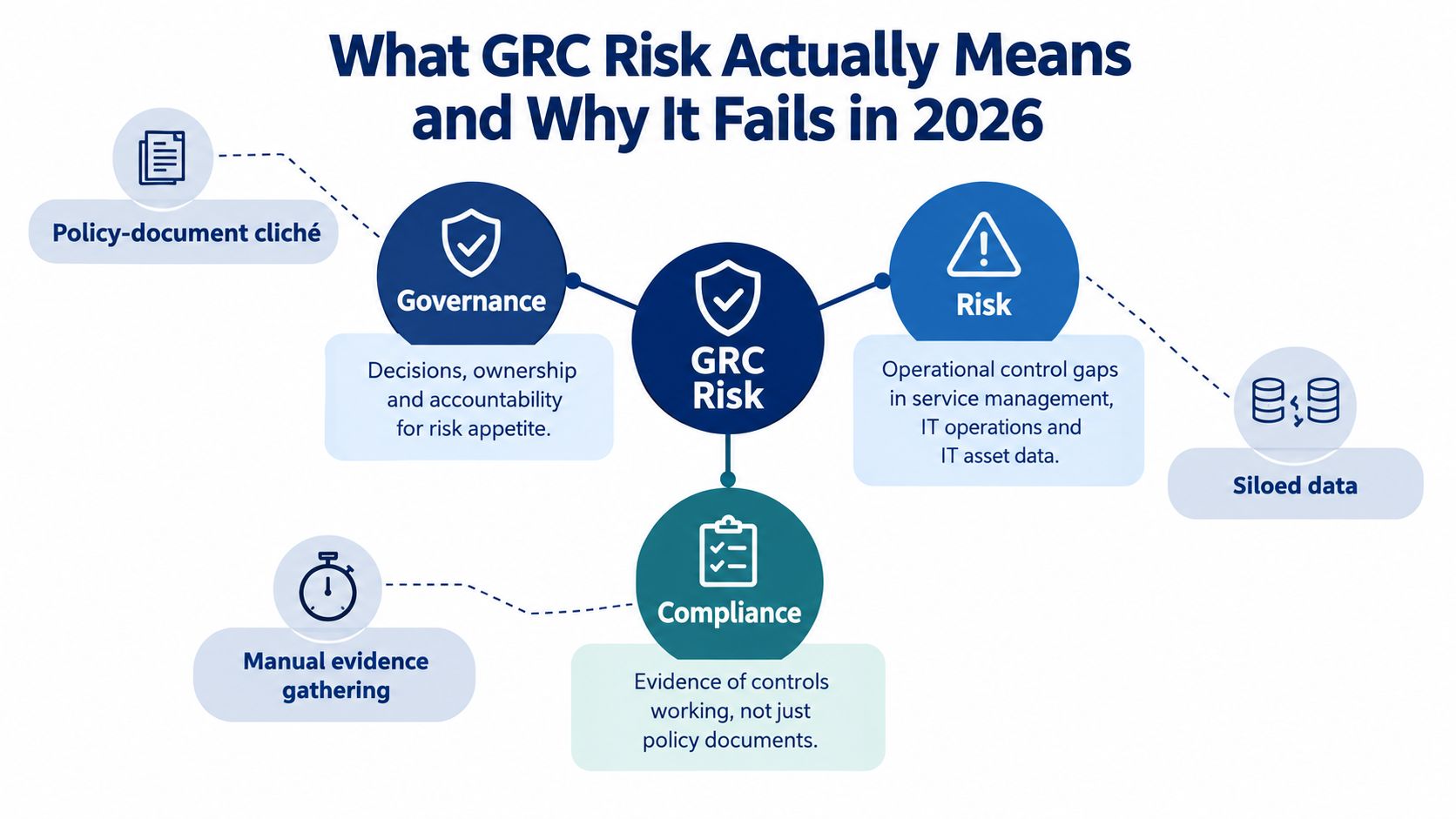
GRC risk is an operating discipline, not a policy shelf. It turns governance decisions, risk tolerances, and compliance duties into controls that work inside service management, IT operations, and asset records.
The useful definition CIOs should use
Governance sets who owns the risk and what the board will tolerate. Risk identifies where control gaps sit in systems, suppliers, data flows, and change activity. Compliance proves the controls are operating and leaves evidence behind. When those three sit in separate teams, the programme looks mature on paper and breaks in production.
Use a practical taxonomy, not a theoretical one. These seven categories are the minimum operating model: strategic, operational, financial, cyber, third-party, regulatory, AI, and data-sovereignty risk. That language maps cleanly to service owners, change managers, asset owners, privacy officers, and risk committees.
Risk category | Typical owner | Evidence source |
|---|---|---|
Strategic | Executive leadership | Board packs, strategy reviews |
Operational | IT operations | Incident logs, major change records |
Financial | Finance leadership | Budget controls, loss events |
Cyber | Security leadership | SIEM alerts, vulnerability scans |
Third-party | Vendor management | Contracts, questionnaires, attestations |
Regulatory | Compliance or legal | Obligations register, control tests |
AI and data-sovereignty | CIO, privacy, data owners | Model inventory, data maps, access logs |
The quiet failure in many GCC organisations is fragmentation. Risk owns the framework, audit owns the testing, IT owns the systems, and nobody owns the evidence flow. Controls get documented and still fail to stand up in a review. The guide maker helps teams turn repeatable processes into clear operational documentation, which is exactly what most control environments lack.
Practical rule: a control that cannot be tied to an asset, an owner, and an event timestamp remains a statement of intent, not an operating control.
For a useful product comparison, see the Freshworks pricing breakdown and compare how pricing, workflow depth, and service data affect evidence generation, not just ticket handling.
Comparing ISO 31000, NIST RMF and COSO ERM
Pick a framework for the job you have. Don't run three programmes and call that maturity.
Which framework fits which control objective
ISO 31000 gives you the broadest risk language. It works when you need one common vocabulary across business, IT, and operations, and it doesn't force you into a cyber-only model. NIST RMF is the right choice when your priority is control selection, system categorisation, and security-heavy environments. COSO ERM is strongest when the board and audit committee want risk appetite linked directly to strategy, performance, and oversight.
Framework | Primary lens | Best-fit organisation | Key artefact |
|---|---|---|---|
ISO 31000 | Universal risk language | Multi-function enterprise | Risk framework and register |
NIST RMF | Security and control lifecycle | Cyber-heavy or regulated technical environments | System security plan and control set |
COSO ERM | Board and enterprise oversight | Board-led enterprise risk function | Risk appetite and reporting model |
My view is simple. Choose ISO 31000 as the base language, overlay NIST RMF where technical controls need depth, and use COSO ERM at board level if the audit committee wants strategy alignment, not just issue tracking. That avoids duplicate registers and conflicting severity scales.
The decision rubric
Use this sequence:
If the problem is enterprise alignment, start with ISO 31000.
If the problem is security control depth, use NIST RMF.
If the board wants risk appetite and oversight, bring in COSO ERM.
If privacy or UAE regulatory duties matter, layer the applicable legal obligations onto the chosen base rather than creating a separate framework silo.
A common mistake is treating frameworks as competing products. They're not. The right choice is the one that produces consistent ownership, evidence, and reporting without forcing teams to maintain parallel control libraries.
Running a Five-Step Risk Assessment That Produces Real Evidence
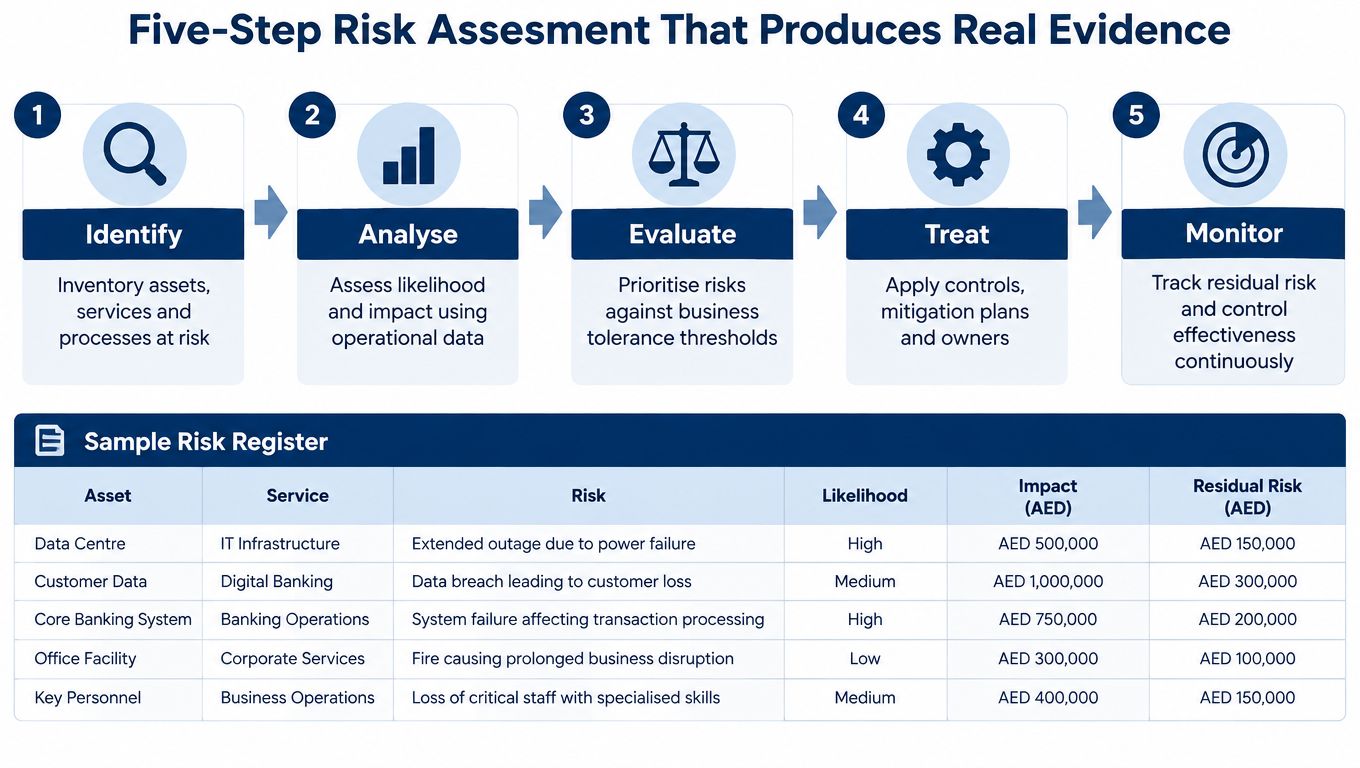
A risk assessment is worthless if it ends with a heat map and no operational follow-through. The point is to produce evidence that survives audit, incident review, and regulator scrutiny.
Step one through five, without the theatre
Start by identifying assets, services, and processes that can fail. That means your CMDB, ITAM records, supplier list, and business service catalogue need to be current enough to trust. If they're not, the assessment inherits the data problem before it even begins.
Next, analyse likelihood and impact using operational data, not opinion only. Tie incidents, change failures, supplier outages, and access exceptions to the risk record. Then evaluate those risks against your tolerance thresholds and decide what gets treated now, what gets accepted, and what needs monitoring.
The strongest risk assessment is the one that changes ownership, not the one that changes colour.
Treatments should attach to controls, owners, and due dates. Monitoring should be continuous, not quarterly theatre. If your ITSM platform raises an incident, your ITOM stack shows service degradation, and your ITAM data shows the affected asset is business critical, the risk register should update from those events automatically or semi-automatically.
The AI-driven risk monitoring explained resource is useful because it reinforces a practical point, risk monitoring only matters when it is connected to changing evidence, not static assessments.
A third-party sovereignty example
Take a high-severity third-party data-sovereignty risk. You identify a cloud supplier storing regulated data across multiple environments. You analyse contractual gaps, access patterns, and data-location uncertainty. You evaluate the exposure against your tolerance. Then you treat it with contract changes, access restrictions, and ownership mapping. Finally, you monitor supplier attestations, access logs, and exception approvals in one register.
Mapping GRC Risk to ITSM and ITOM Platforms
Platform choice should follow control ownership, not brand loyalty. If you choose badly, you'll end up with risk data in one tool, evidence in another, and accountability nowhere useful.
Which platform should own what
ServiceNow is the strongest fit when you need a central risk register, audit workflows, and deeper enterprise integration across service and asset data. HaloITSM works well when you need service workflow discipline and a practical bridge into GRC processes without overengineering the environment. Freshservice fits teams that want faster operational adoption and cleaner service workflows before adding control depth. ManageEngine ServiceDesk Plus is a strong fit for organisations that want IT service management, IT asset management, and structured process controls without a heavy transformation programme.
Capability | ServiceNow | HaloITSM | Freshservice | ManageEngine |
|---|---|---|---|---|
Risk register | Strongest fit | Possible with process design | Light fit | Light to moderate fit |
Control evidence | Strong integration depth | Good for service evidence | Good for operational evidence | Good for asset and process evidence |
Third-party risk | Stronger with enterprise modules | Requires integration | Basic to moderate | Basic to moderate |
ITAM and CMDB linkage | Deep | Practical | Practical | Practical |
Audit workflow | Strong | Moderate | Moderate | Moderate |
The control objective matters more than the logo. If your aim is enterprise-wide risk orchestration, ServiceNow is the cleanest primary platform. If your aim is operational discipline first and GRC second, HaloITSM, Freshservice, or ManageEngine can work as the service layer, with GRC controls layered on top.
What the system of record should be
Use the CMDB for service relationships, ITAM for asset ownership, and the service desk for event evidence. Don't let the GRC tool become a second, manually maintained asset source. That creates contradictions the audit team will find immediately.
For a practical comparison point, review HaloITSM pricing and check whether the licensing model aligns with your need for control evidence, not just ticket throughput.
KPIs, KRIs and Continuous Control Monitoring
Dashboards fail the moment they report activity instead of risk. The audit committee does not need prettier charts. It needs indicators that show whether exposure is rising, falling, or close to a regulatory timer.
The metrics that matter
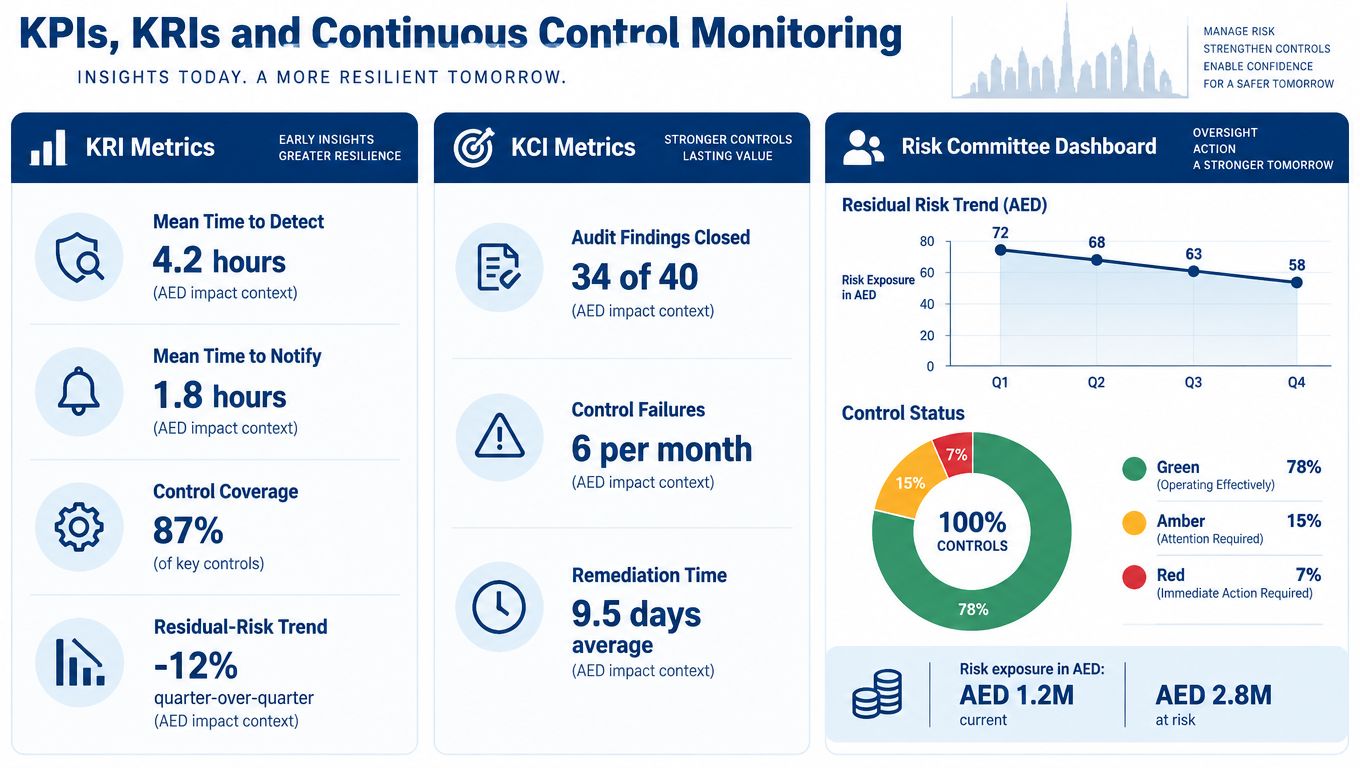
Track mean time to detect, mean time to notify, control coverage, residual-risk trend, audit finding ageing, vendor SLA breach rate, and AI-model risk indicators. Each metric should come from an operational source, not a manually retyped spreadsheet. ITSM, ITOM, ITAM, SIEM, and identity data need to feed the same view, or the dashboard becomes a reporting layer with no control value.
If a metric cannot be traced back to an event record, an approval, or a timestamp, leave it off the committee pack.
The CBUAE operational-risk rule, as covered in SysAid pricing overview, makes this urgent because a material incident can trigger reporting no later than 24 hours after the event that triggers, or is likely to trigger, disaster-recovery or business-continuity plans. Your dashboard has to surface near-misses early enough for escalation, not after the window has closed.
What good monitoring looks like
KRI trend lines: Show whether residual exposure is shrinking or drifting.
KCI closure rates: Show whether controls are being fixed or just discussed.
Deadline clocks: Show whether notification windows are still open.
Exception ageing: Show how long critical findings have stayed unresolved.
Service-impact correlation: Tie control failures to incidents, outages, or vendor issues.
For a service-management benchmark, SysAid pricing overview helps you judge how quickly operational data can be turned into control evidence.
Integration, Automation and Agentic AI for GRC Risk
AI should cut manual evidence chasing, not add another layer of unmanaged risk. Used properly, it turns compliance work into a control evidence pipeline.
Where automation helps most
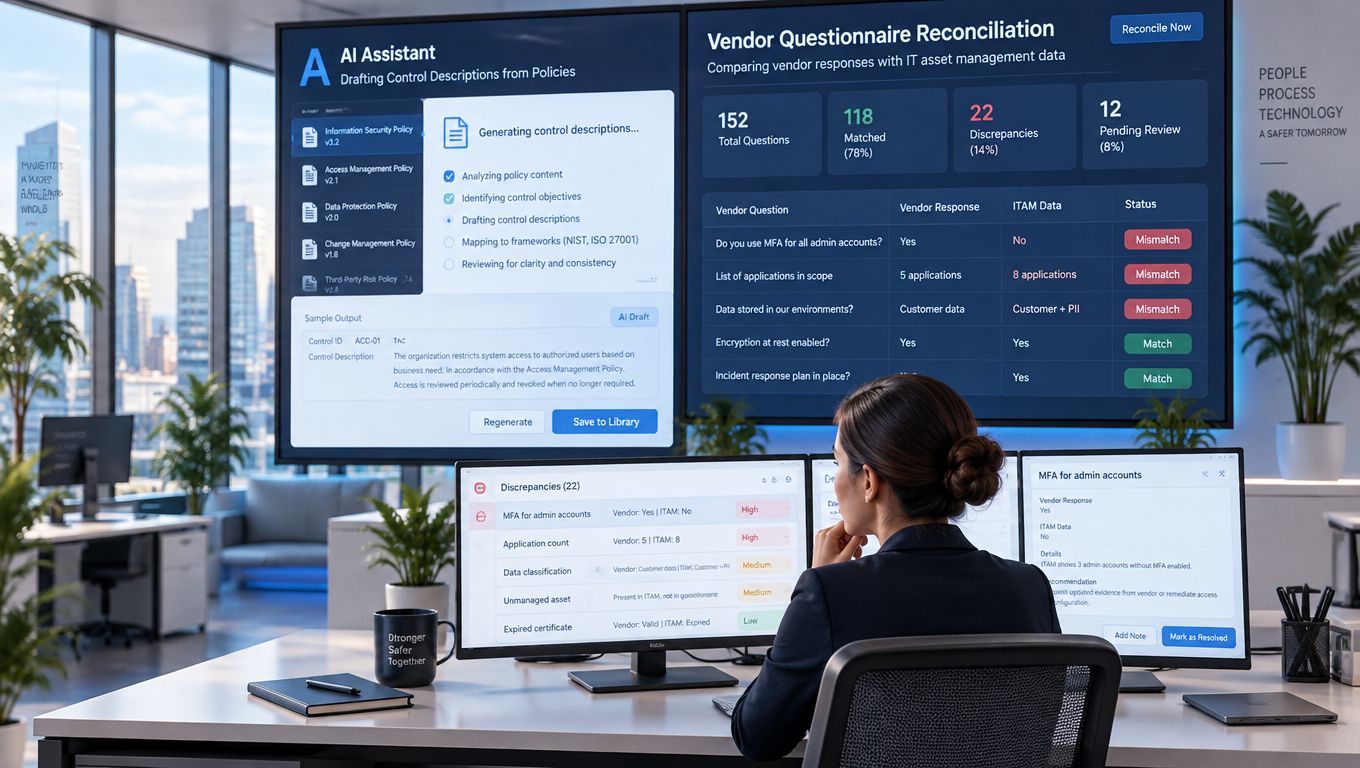
Use automation to draft control descriptions from policy documents, reconcile vendor questionnaires against ITAM and SIEM evidence, summarise incident timelines into audit-ready narratives, and pre-screen change requests against regulatory triggers. The platform handles the first pass, while humans approve the result and keep accountability.
UAE regulatory teams should care about the control model, not the novelty. In a conversational compliance automation survey from Yellow.ai, 70% of respondents said they review AI-governance practices every six months or less, and more than 70% believed AI and automation can reduce risks tied to multicloud and third-party providers. That cadence helps, but cadence alone is not control. You still need evidence of model inventory, human override, access segregation, prompt-injection testing, and incident logging.
Guardrails CIOs should insist on
Human-in-the-loop approvals: No AI-generated control or risk decision goes live without review.
Segregation of duties: The same person should not build, approve, and evidence the control.
Model-risk logging: Keep a record of prompts, outputs, approvals, and exceptions.
Prompt-injection protection: Treat external content as untrusted input.
Supplier reassessment triggers: Recheck vendors when evidence changes, not just on schedule.
For compliance workflow automation, conversational compliance automation from Yellow.ai fits controlled conversational flows for policy acknowledgements, requests, and evidence prompts, instead of letting those exchanges sprawl across email.
For a service-management point of reference, Freshservice pricing is useful if you want automation tied to lighter operational change management.
Readiness Checklist and a 90-180-365 Day Adoption Roadmap
A CIO does not need a theory deck. They need a control sequence the steering committee can approve and operations can run.
The readiness checklist
Start with six checks: licensing, integrations, data quality, skills, governance, and culture. If asset records are incomplete, ownership is unclear, or audit and IT do not agree on evidence standards, fix that first. Otherwise every automated workflow just spreads the confusion.
The adoption roadmap
First 90 days: define the charter, choose the primary framework, map control ownership, and baseline maturity. Pick the platform that will hold the operational record, not the one with the most slides. If you need delivery support across HaloITSM, Freshservice, ManageEngine, or ServiceNow, DataLunix can run discovery, fit-gap, and implementation work around the existing service stack.
By day 180: wire controls into ITSM and ITOM, launch the first KRIs, and run change-adoption sessions with service owners and risk owners. Change-adoption sessions work better when policy acknowledgements are captured in the flow of work. Compliance automation with Yellow.ai is one way to do that through controlled conversational flows rather than email chains. The programme becomes visible in daily operations instead of quarterly reports.
By day 365: expand continuous monitoring, extend coverage to vendors and AI use cases, and set a fixed audit-committee reporting cadence. At that point, the question is not whether you have a GRC programme. The question is whether the programme is producing timely evidence.
Start with the foundations. If the data model is wrong, automation just makes the wrong answer arrive faster.
If service workflows and requester experience are part of the control design, review Freshdesk pricing before you lock the operating model. The right support mix is usually fit-gap analysis, change management, and managed services, not a one-off implementation sprint.