
ICT in Banking Industry: Components, KPIs and Rules

ICT in banking industry operations now run national payment flows, not office support. When identity, payments or a shared switch fails, customers cannot move money and regulators treat the outage as a systemic event. Design resilience into every component from the start.
What ICT Means in Banking Today
ICT in a bank is the combined hardware, software, networks, data and operating teams that record money, move it, serve customers and protect it. It's the business operating system, not back office support. General IT covers office tools, while bank ICT runs regulated money flows and customer channels, with a different risk profile and budget.
The UAE shows the scale. The Central Bank of the UAE financial stability report reports banking sector assets reached approximately AED 4.6 trillion in 2024, growing 12.0% year on year, and the UAE Funds Transfer System handled 109.7 million retail transactions worth AED 7.4 trillion.
At that volume, a short outage can affect millions of payments in one day. Availability, cybersecurity, integration and real time monitoring are therefore business controls, not technical preferences. For a useful map of the service layers behind that work, see CEFCore's guide to banking IT.
You're really answering three questions. Which components form the estate, how do you measure value, and which rules and roadmaps govern change?
Seven Core ICT Components and What Each Does
Follow one mobile payment and you'll touch all seven layers in seconds. The channel takes the request, middleware routes it, security checks identity, payments settle it, and the core updates the ledger. Data platforms then record it for risk and reporting.
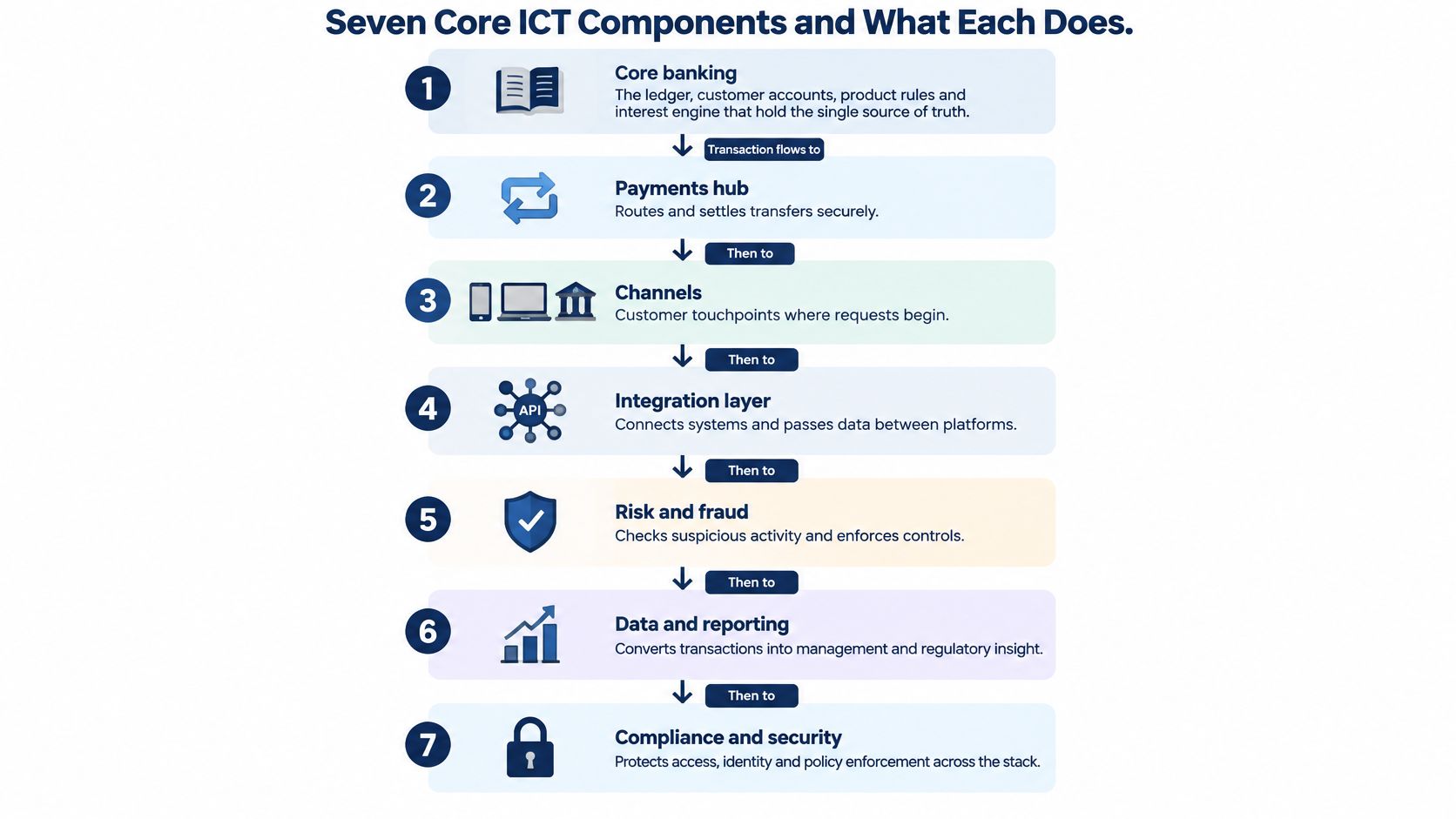
Component | What it does | Typical example |
|---|---|---|
Core banking | Holds accounts, ledgers, balances and product rules | Account ledger and interest engine |
Payments | Routes, authorises and settles transfers and card transactions | Card switch and instant payment gateway |
Networks | Connects branches, data centres, clouds and partners | Redundant leased lines and SD-WAN |
Digital channels | Gives customers and staff access to banking services | Mobile app, internet banking and relationship manager portal |
Middleware | Connects systems through APIs, queues and events | API gateway and message broker |
Data platforms | Stores and serves data for reporting, risk and compliance | Data warehouse and real time streaming pipeline |
Security | Protects identity, data and transactions | Identity and access management, fraud monitoring and SIEM |
No component works alone. A weak link in any layer becomes a failed payment for the customer, which is why service management costs matter alongside platform design, including the operating assumptions in HaloITSM pricing and service desk planning.
Benefits and KPIs to Measure ICT Value
Banks invest for faster payments, lower cost per transaction, fewer manual touches and stronger retention. I would pair each promise with a monthly KPI, or you can't tell progress from activity. Availability alone doesn't prove value if staff still repair payments by hand.
KPI | What it shows |
|---|---|
System availability | Uptime of payments and digital channels |
Payment success rate | Share of transactions completed on first attempt |
Straight-through processing rate | Share of transactions completed with no manual step |
Mean time to recover | Average time to restore a failed service |
Cost per transaction | Total run cost divided by transactions processed |
Digital adoption rate | Share of active customers using digital channels |
Use reference points your board understands. 99.9% availability allows about 8.8 hours of downtime a year, while 99.99% allows under 53 minutes. Measure mean time to recover against the recovery time objective you agreed with the business.
If availability rises but straight-through processing stays flat, your platform is stable and your process is still manual. Spend next on workflow automation, not more infrastructure.
Set a 90 day baseline before any programme starts, so later gains are proved rather than assumed.
Regulatory and Risk Rules That Shape Bank ICT
The common assumption is that risk sits inside one breached application. In modern banking, the bigger risk is concentration across identity, APIs, cloud, payment switches and third party providers. One shared dependency can propagate failure across institutions.
Scrutiny matches that exposure. The CBUAE 2024 annual report states it conducted 152 supervisory examinations and increased audits relating to digital assets and banks' exposure to that sector.
Build the control model into the architecture:
Access: zero trust access, hardware backed privileged identity controls and strong customer authentication.
Interfaces: API rate limiting, network segmentation and continuous vulnerability management.
Detection: centralised security telemetry correlated with transaction anomalies. For card data specifically, work through a guide to payment card security alongside your internal standards.
Test simultaneous loss of a payment gateway, identity provider, cloud region and external service. Before go live, require resilience test evidence, key management, complete audit trails, confirmed data location and a vendor concentration review.
Architecture Patterns and Real Bank Use Cases
Choose the pattern that fits your constraint, not the vendor's roadmap.
Pattern | Best for | Main trade-off |
|---|---|---|
Monolithic core with add-on channels | Small banks with a stable, proven core | Each new channel adds coupling to the core |
Modular core behind APIs | Banks adding services without replacing the ledger | Needs strong API governance and monitoring |
Event-driven payments platform | Instant payments and real-time fraud screening | Harder to debug and test across events |
Cloud-hosted core as a service | Banks prioritising speed and lower infrastructure load | Less control over change timing and data location |
Hybrid on-premise and cloud | Banks keeping sensitive systems local while using cloud for channels | Two operating models to run and secure |
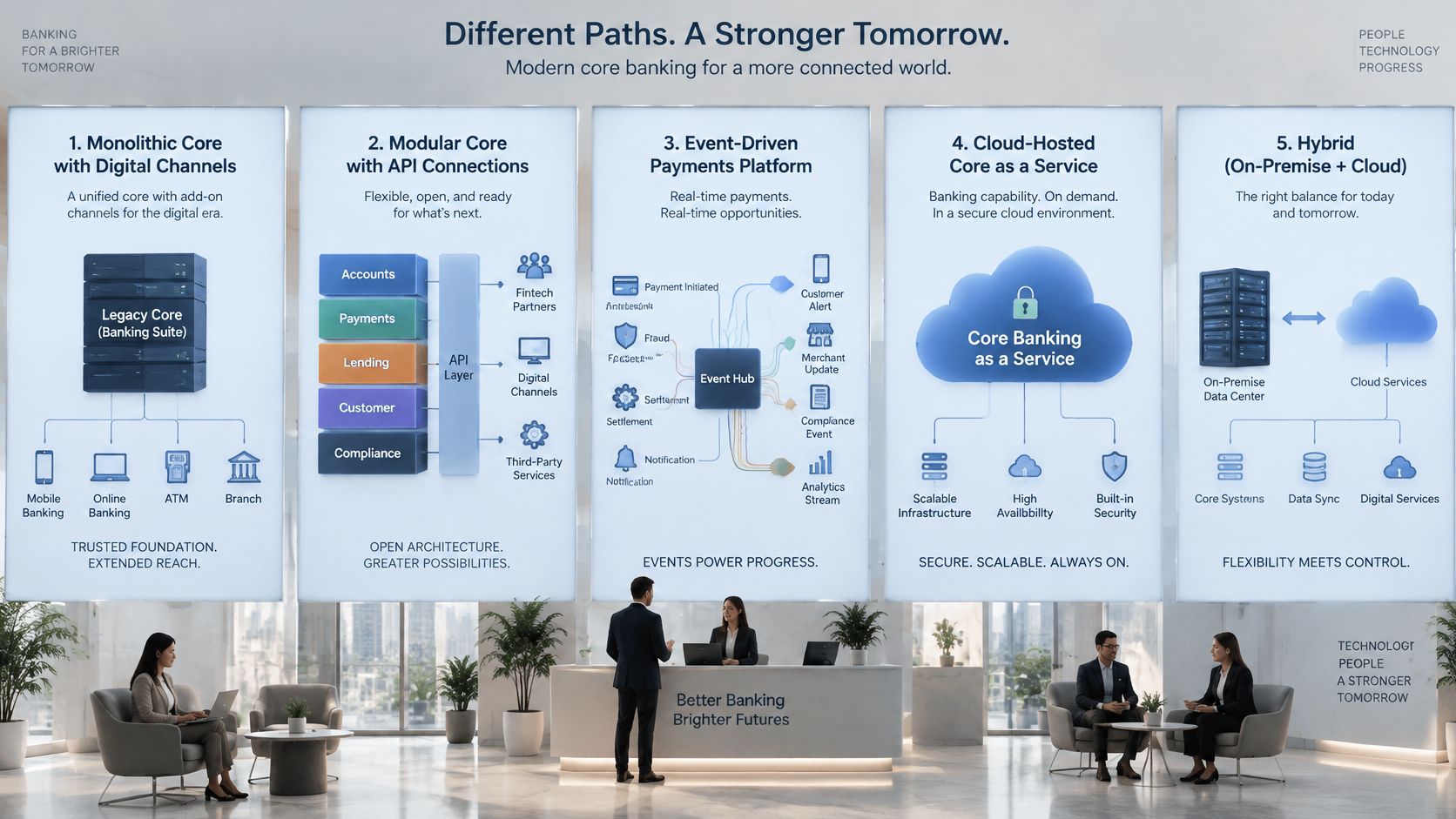
Say a retail bank adds instant and phone number payments through an API gateway and event streams, leaving its ledger untouched. A corporate bank can feed payment events into a data platform for real time cash visibility. Even branch connectivity is an architecture decision, as shown by WiFi authentication in a banking environment.
Every payment path needs idempotent handling, real time sanctions and fraud screening, active active availability, immutable audit trails, automated reconciliation and capacity tests based on peak load. Service costs should be modelled too, including assumptions in Freshdesk pricing for support operations.
Implementation Roadmap and Change Management
Sequence the work so compliance and adoption are designed in, not inspected in.
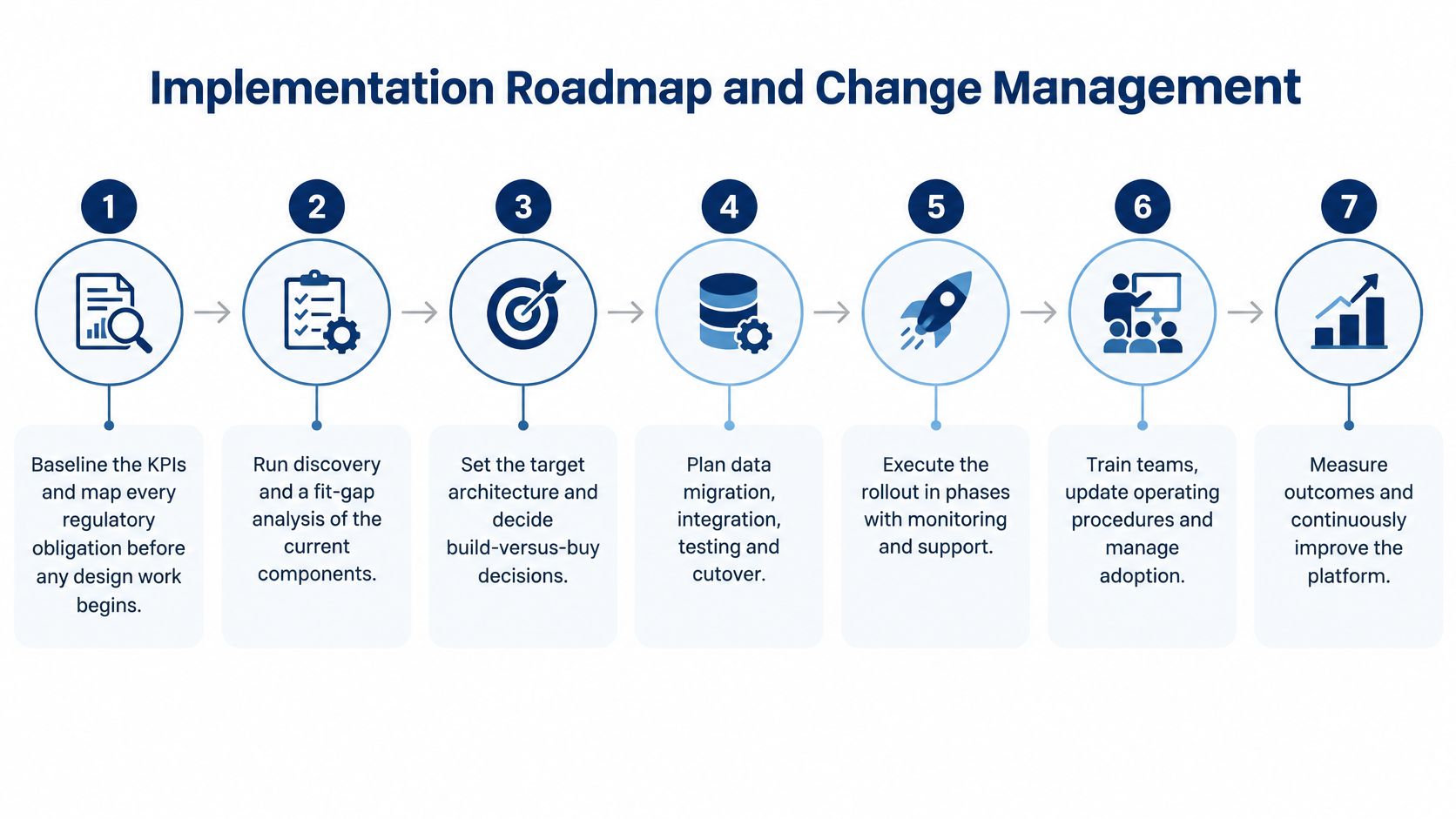
Baseline first: record KPIs and map every regulatory obligation before design begins.
Discover gaps: run fit gap analysis across your current components.
Set target architecture: include required regulatory interfaces. The Central Bank Open Finance Regulation consists of a Trust Framework, an API Hub and Common Infrastructural Services, and took effect on 15 April 2024, with Circular No. 7/2023 later repealed and replaced by Circular No. 03/2025.
Build in parallel: integrate beside the legacy system, not instead of it.
Pilot narrowly: use one customer segment or business unit.
Cut over safely: keep legacy running, migrate historic data, then provide hypercare. For McDonald's Saudi Arabia, our ITSM migration ran cutover in parallel with the legacy tool, migrated historic ticket data, and we stayed on hypercare after go live.
Retire last: decommission only when KPIs hold for a full quarter.
Name one business owner per process, brief branch and contact centre staff early, and train before every release. Include operating costs such as Freshservice pricing in your implementation business case.
Emerging ICT Trends Worth Tracking
Rank trends by operational effect, not novelty. Instant payments lead. The Central Bank of the UAE statistical bulletin reports that Aani had surpassed 12.5 million registered users and connected 74 licensed financial institutions by 2025, with approximately 25,000 daily transfers executed using mobile numbers rather than traditional account details. For banks, the design question is how to keep payment services available while managing reliance on shared infrastructure and regulatory interfaces.
Open finance and APIs make consent, authentication and secure communication conditions for sharing data and initiating transactions. Digital identity and proxy payments shift the customer-facing identifier away from account numbers. Cloud-native cores and AI-driven fraud detection can speed product launches and flag suspicious payments, but depend on clean data and a stable core.
Consumer behaviour supports the shift, as cash keeps losing ground to digital payments across the UAE, which Aani adoption figures reflect. Track whether each change shortens a payment path, removes manual work or closes a compliance gap. Otherwise, it may be a demonstration without clear operational value.
Contact centre economics also matter when channels change. Include Freshcaller pricing when modelling contact centre change in the assessment.
Choose an ICT Partner and Set Your First Milestone
Test every shortlisted partner in writing against five criteria:
Regulatory experience: proven work under your local banking regulator's rules.
Cutover evidence: parallel running and hypercare they've delivered.
Control: a hybrid model that keeps control with you. We support hybrid delivery, letting you keep control while using our India based offshore teams.
Confidentiality: clear contract terms. We don't disclose client confidential information to third parties without consent, except where required by law or needed to deliver services under appropriate confidentiality obligations.
References: verifiable work in comparable service domains, including how they handled a failed change.
Should one partner cover all seven components? Usually no, choose by layer where delivery skills differ. How long should parallel running last? Until KPIs hold for a full quarter.
Put DataLunix on the shortlist and ask us for the same evidence as every other bidder. Every conversation with us starts with a senior consultant who can answer technically, never a bot or a qualifier. Compare support economics too, including SysAid pricing in your partner evaluation.
Your first milestone this week is simple. Map current systems against the seven components, record your KPI baseline and list regulatory obligations, then bring all three to a discovery workshop.
Bring your component map, KPI baseline and regulatory obligations to DataLunix and we'll help you turn them into a sequenced banking ICT roadmap with parallel cutover, hypercare and measurable outcomes. Start with a senior consultant, define your first quarter milestone, and build only what the evidence supports.