
GRC Risk Management Software: A Practical Buyer's Guide

You're staring at spreadsheets, audit notes, and overdue remediation actions that don't line up. That's the moment grc risk management software stops being a nice-to-have and becomes the only sensible way to keep governance, risk, and compliance tied to actual ownership, evidence, and deadlines.
What GRC Risk Management Software Actually Does for Your Enterprise
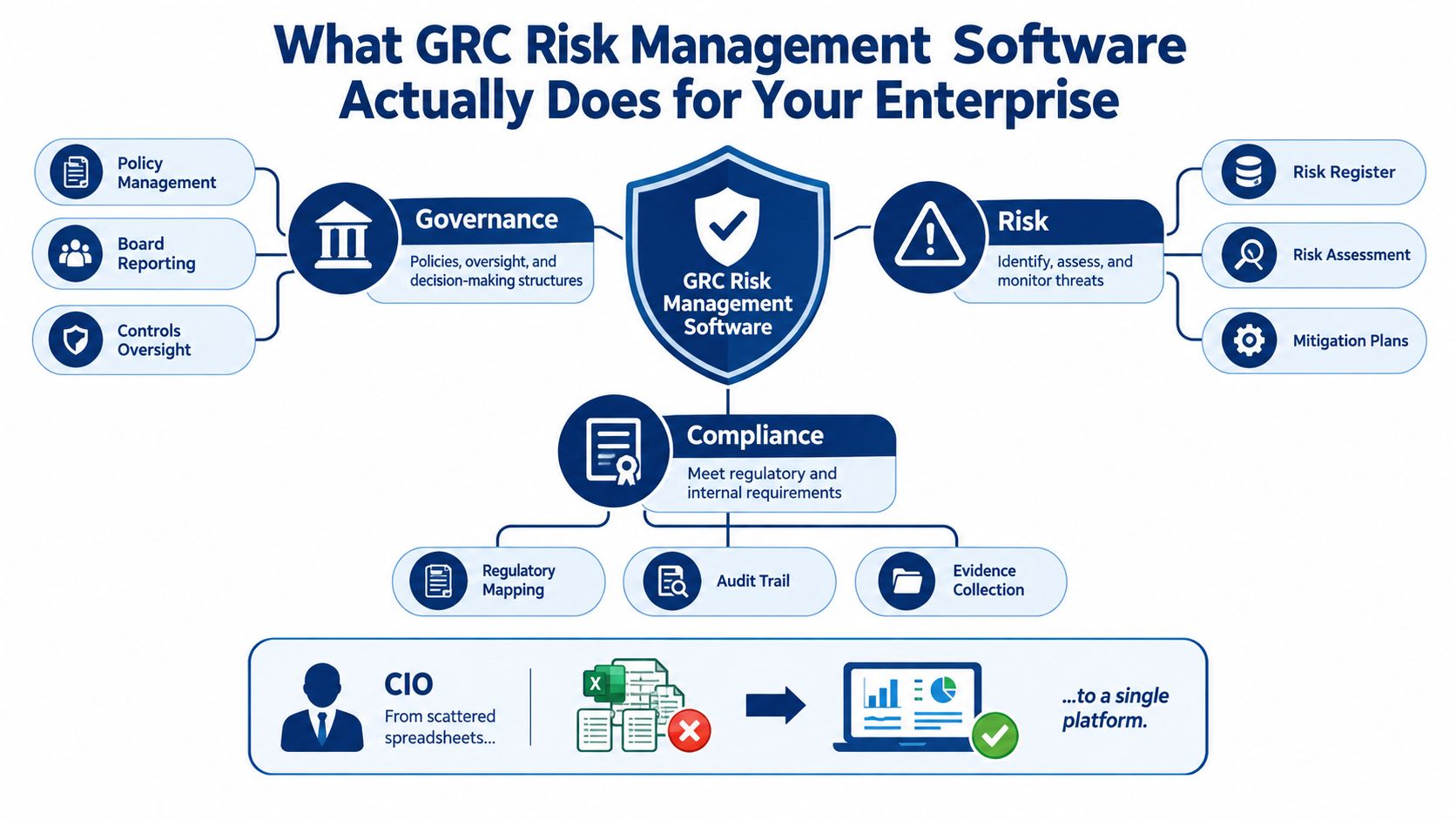
grc risk management software connects policies, risks, controls, evidence, and reporting in one operating model. It's not a document library and it's not just an audit tracker. It gives you one place to assign owners, prove controls are working, manage exceptions, and show leadership what's blocked, what's late, and what's been fixed.
The UAE context makes that connection obvious. The 2024 State of Cybersecurity in the UAE identified more than 155,000 vulnerable digital assets, with more than 40% of critical vulnerabilities unaddressed for over five years, and nearly 70% of those assets located in Dubai, which is why disconnected spreadsheets are a weak answer to a persistent backlog (CPX). If your platform can't turn technical findings into accountable actions, it's not doing the job.
What changes when governance, risk, and compliance are connected
A connected platform changes how teams work day to day. Governance becomes policy ownership and board reporting. Risk becomes a live register with scoring, treatment, and escalation. Compliance becomes mapped obligations, evidence, and traceable approvals.
Practical rule: if the software can't show who owns a risk, who approved the exception, and what evidence proves the control worked, it's not enterprise GRC.
That's why buyer decisions should focus on workflow, evidence lineage, and integration depth, not glossy dashboards. A useful way to think about the market is to compare platforms that store information with platforms that preserve the relationship between a risk, its control, its test result, and the incident that triggered the review. For a simple pricing reference on adjacent service desk tooling, Freshservice pricing is a useful benchmark when you're comparing operating cost structures.
If you need a practical framework for proving supplier controls during onboarding, the strategy from ThreatExploit AI is a good complement to GRC thinking, because it pushes vendors to show evidence instead of hand-waving.
Core Capabilities a Serious Buyer Should Expect
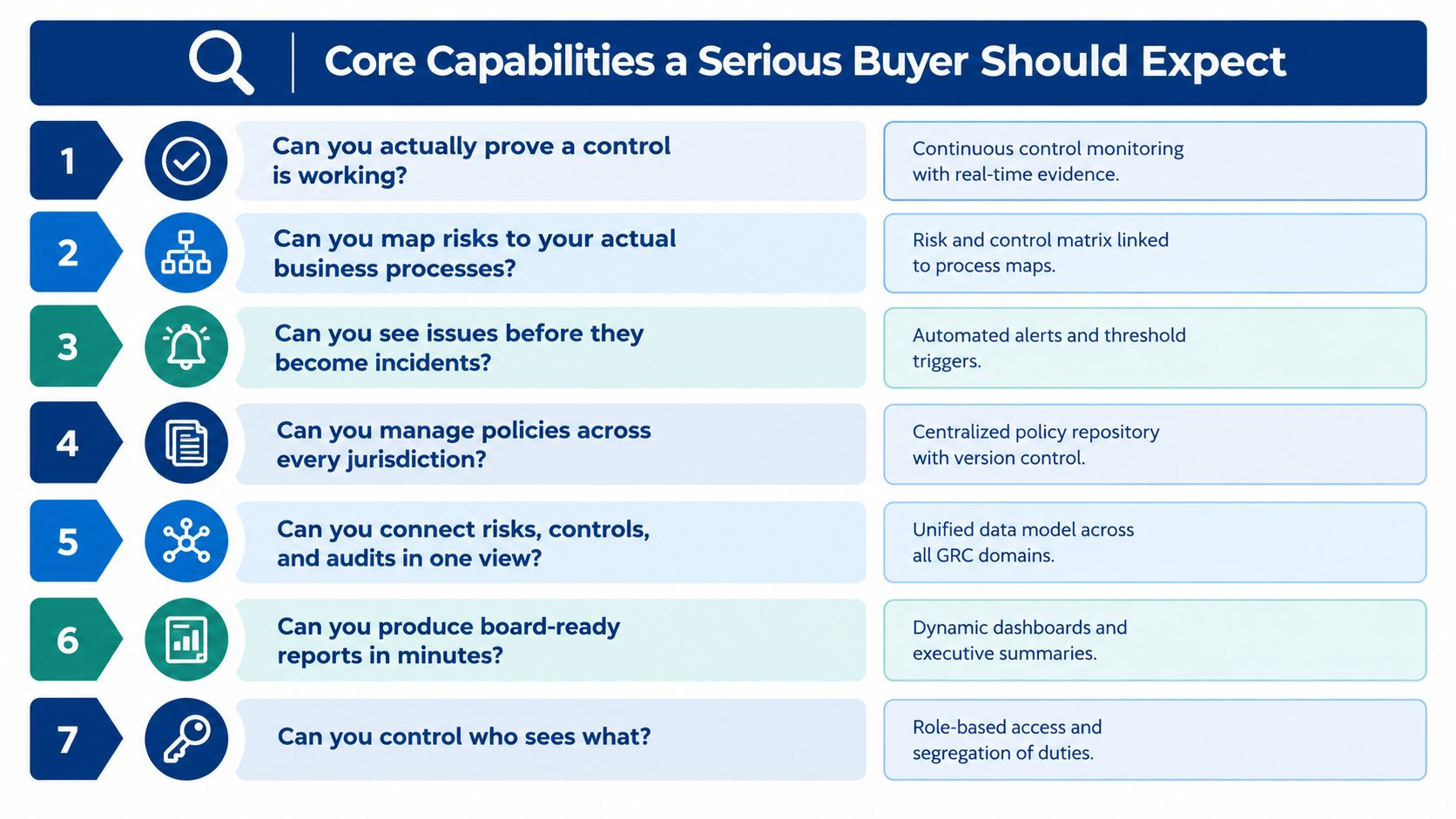
A real platform has to answer practical questions, not marketing questions. Can it prove a control was tested. Can it map risks to your business processes. Can it keep audit evidence attached to the right issue, owner, and deadline. If the answer is no, you're buying admin overhead.
The Central Bank of the UAE makes this distinction unavoidable for banks. Its Operational Risk Regulation requires a framework covering identification, assessment, evaluation, monitoring, reporting, control and mitigation across all material products, activities, processes and systems, not just cybersecurity (Central Bank of the UAE). That kind of requirement needs more than a policy repository.
The seven capabilities that separate software from storage
Capability | Buyer question | What good looks like |
|---|---|---|
Risk register | Can you score inherent and residual risk? | Owners, treatments, and re-tests stay linked. |
Control library | Can you prove controls work, not just exist? | Tests, evidence, and exceptions are attached. |
Compliance mapping | Can one control satisfy more than one framework? | Requirements roll up without duplicate effort. |
Policy management | Can you manage versions and approvals cleanly? | Policy history stays auditable. |
Workflow automation | Can issues move without email chasing? | Escalations, deadlines, and approvals are built in. |
Board reporting | Can leadership see the real exposure fast? | Dashboards show overdue items and trends. |
Integrations | Can the platform pull live evidence from IT systems? | ITSM, ITOM, CMDB, identity, and HR feed it. |
The question behind all seven is simple. Does the platform preserve the chain from risk to control to evidence to decision. If it does, you can defend the program in front of auditors, regulators, and the board. If it doesn't, you'll still be exporting CSV files the week before review.
For teams comparing audit automation patterns, the SOC 2 automation platform guide is useful because it shows how evidence collection and control testing should behave when the process is serious.
The best GRC implementations don't ask users to become data entry clerks. They pull information from the systems people already use, then force accountability where decisions are made.
For pricing and packaging context around adjacent service management platforms, SysAid pricing is worth checking if you're mapping broader workflow budgets alongside GRC spend.
Comparing the Platform Ecosystems GCC and European Buyers Evaluate
Most buyers don't evaluate GRC in isolation. They evaluate the ecosystem already sitting under ITSM, service operations, identity, and reporting. That's why the answer changes depending on whether you're extending an existing stack or starting from scratch.
The Central Bank of the UAE's Open Finance Regulation requires an independent and permanent risk-management function with direct reporting to the Board, plus IT governance, technology-risk management, independent technology audit, and explicit cybersecurity-risk treatment (Central Bank of the UAE). That pushes buyers toward platforms that can preserve board-level routing and separation of duties, not just task tracking.
How the common ecosystems usually differ
Platform | GRC approach | Integration strength | Licensing model | Best fit signal |
|---|---|---|---|---|
ServiceNow | Broad workflow platform with GRC modules | Deep if you already run ServiceNow | Enterprise suite style | You want one operating backbone |
Halo | ITSM-led workflow with adjacent governance use cases | Strong for service operations | Modular and pragmatic | You need value from an ITSM-first stack |
Freshservice | Simpler service management environment | Good for smaller integration needs | Straightforward subscription | You want faster adoption and lower complexity |
ManageEngine | Toolset approach with flexible IT operations coverage | Solid where IT ops is central | Usually value-focused | You need breadth without heavy platform overhead |
A true GRC extension layer is different from a bolted-on module. It preserves one risk model across policy, control, incident, supplier, and audit data, then uses workflow to keep evidence current. A bolted-on module usually gives you separate screens with shared branding and weak lineage.
That's why the right question isn't “Which vendor has GRC?” It's “Which ecosystem can show the cleanest path from operational event to risk update to board visibility?” If your current service desk already owns most workflows, extending that stack can be practical. If the controls are fragmented across subsidiaries and regulated entities, you need stronger data modelling from day one.
For a pricing touchpoint on the Halo side, HaloPSA pricing helps when you're benchmarking platform economics against governance needs.
An Evaluation Checklist That Separates Must-Haves From Nice-to-Haves
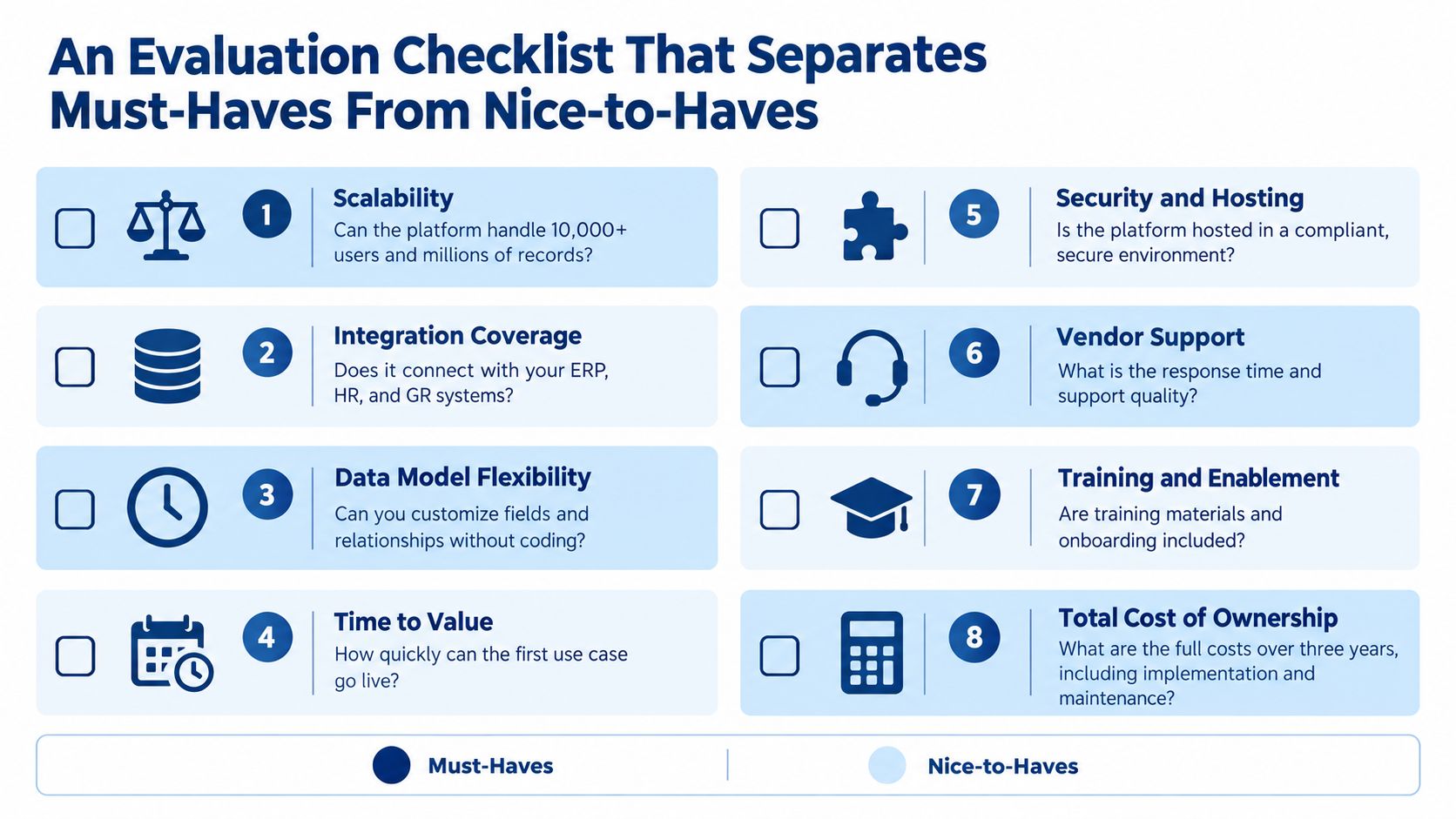
Stop scoring vendors on feature lists alone. A platform that looks rich in a demo can still fail when you need immutable audit history, role separation, or live evidence from other systems. The true test is whether it will survive a regulator visit without a manual clean-up exercise.
The UAE's Critical Information Infrastructure Protection Policy requires baseline security requirements, assurance activities, and enforcement mechanisms across vital sectors, with risk profiles mapped to national priorities (UAE government). That makes evidence quality and control ownership a hard requirement, not a preference.
Use this scoring logic in vendor workshops
Criterion | What to test | Vendor question |
|---|---|---|
Scalability | Can it handle growth without redesign? | What happens when business units and records multiply? |
Integration coverage | Can it connect to systems of record? | Which APIs and connectors are native? |
Data model depth | Can relationships be customised cleanly? | Can one risk link to multiple controls and evidence sets? |
Audit trail immutability | Can records be altered without trace? | How do you preserve history and approvals? |
Role-based access | Can duties stay separated properly? | Can first, second, and third line views differ? |
Vendor support model | Will help arrive when rollout gets messy? | Who owns implementation, training, and support? |
Total cost of ownership | What will this cost after year one? | What are licensing, configuration, and maintenance costs? |
Regulatory evidence | Can it prove compliance fast? | Show me a board-ready report from live data. |
Buyer rule: if a vendor can't demonstrate evidence capture, workflow routing, and reporting in the same environment, mark them down immediately.
Use the checklist as an RFP scoring sheet, not a discussion guide. The goal is to find the platform that can still behave properly when the audit committee asks for a control test trail from six months ago.
Implementation and Change Management in the Real World
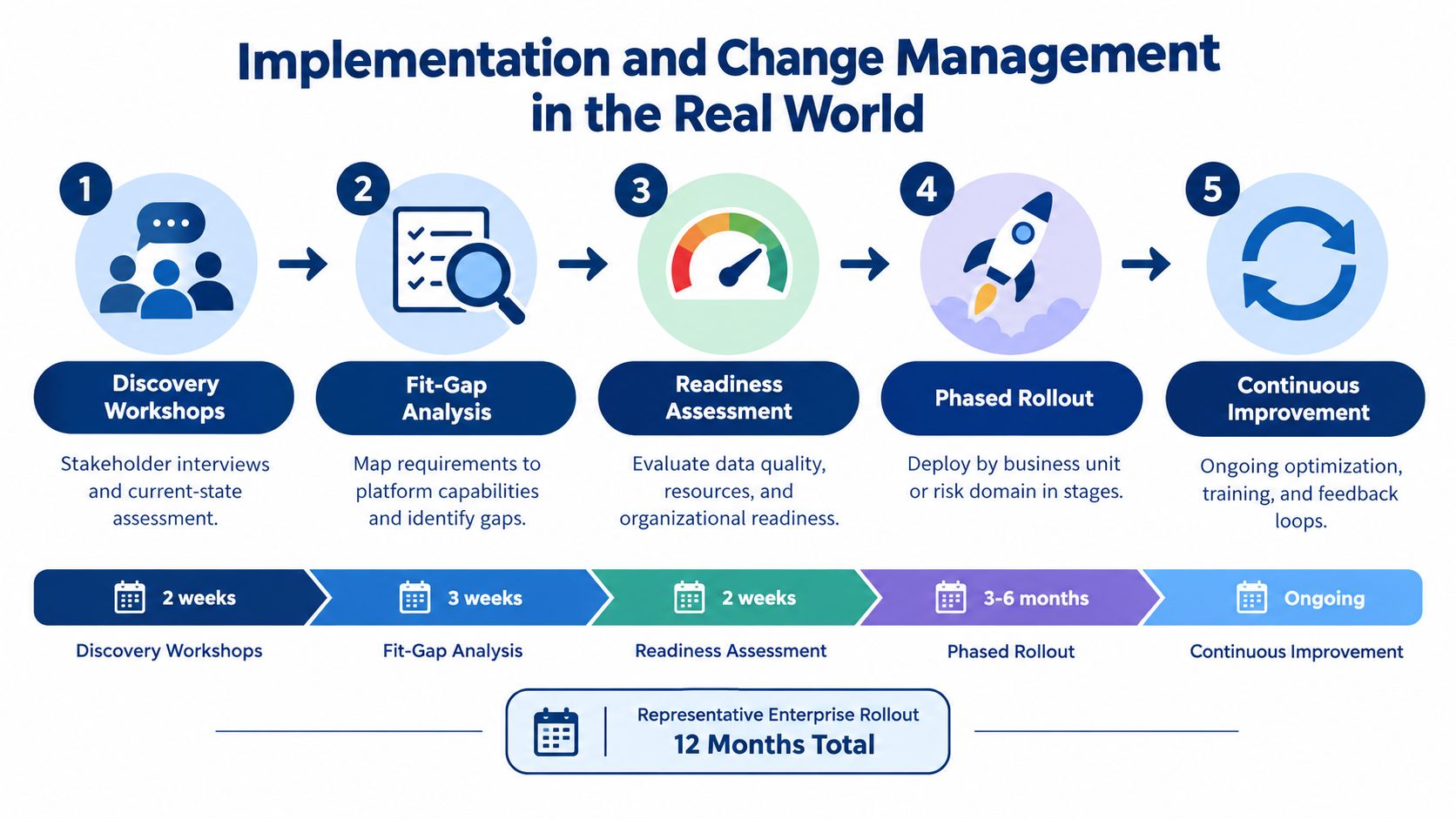
A serious rollout starts with discovery, not configuration. Teams usually sit with risk owners, compliance leads, audit, IT operations, and security to define what needs to move, what can be retired, and where the ownership gaps are. That work matters more than the software choice because a badly mapped process will still be a badly mapped process after go-live.
The UAE data protection law makes the operational side clear. When a controller becomes aware of a personal-data breach that could prejudice privacy, confidentiality or security, the law requires notification to the competent bureau with a documented timeline and supporting evidence (UAE legislation). That only works if incident intake, timestamps, and approvals are already built into the process.
What the rollout sequence should look like
Discovery workshops that surface current-state pain, duplicate registers, and reporting gaps.
Fit-gap analysis that maps existing controls and workflows to platform capability.
Readiness assessment that checks data quality, ownership clarity, and integration feasibility.
Phased rollout by business unit or risk domain, not all at once.
Continuous improvement based on usage, audit feedback, and exception trends.
For an enterprise rollout, that sequence usually stretches across multiple workstreams, not one project team. Risk and control owners in the first line need forms they can complete without asking IT for help. Second line oversight only works when evidence arrives automatically from connected systems instead of being retyped into another register.
For broader implementation and support packaging, HaloITSM pricing is useful if you're comparing how service workflows and governance rollouts fit together.
Change management fails when leadership treats it like a slide deck. It only works when owners get clear tasks, simple workflows, and visible escalation if they don't act.
ROI, KPIs and the Metrics Your Board Will Actually Ask About
Boards don't want a tool tour. They want to know whether risk visibility is improving, whether issues are closing on time, and whether the organisation can defend its controls when challenged. That means you need both leading indicators and lagging indicators.
The UAE's Global Cybersecurity Index result matters here because the country achieved full scores across all five pillars and ranked fifth globally by 2024 (UAE government). The signal for buyers is that regulatory maturity is high, so governance reporting has to keep pace.
Metrics worth putting on a board dashboard
Control testing coverage tracks whether critical controls are being tested on schedule.
Exception ageing shows where risk acceptance is drifting into neglect.
Mean time to remediate findings tells you whether issues are being closed or just logged.
Policy attestation rate shows whether employees have acknowledged the rules that apply to them.
Audit findings closed by deadline gives you a clean executive measure of execution discipline.
Regulator observations and incident-linked loss events are the lagging indicators that matter most when pressure rises.
A connected platform reduces the manual roll-up work that usually breaks reporting. Instead of six spreadsheets and a weekly reconciliation call, you get one source of evidence with role-based views. That's where ROI comes from, because teams spend less time reconciling data and more time fixing exposure.
The financial case is straightforward. You avoid the cost of failed audits, reduce time lost to manual reporting, and cut the friction on risk and control owners who otherwise keep re-entering the same information. Procurement can understand that, finance can model it, and the board can read it without translation.
How a Delivery Partner Like DataLunix Adds Value Beyond Licensing
Licensing is only the entry ticket. The value comes from a partner who can design the workflow, connect the systems, run the rollout, and keep the program healthy after go-live. That's where a certified reseller with implementation depth matters more than a software-only purchase.
A 2025 UAE survey of 330 senior IT and business decision-makers found 66% reported full compliance with the country's data-protection and sovereignty laws, while 70% said they review AI-governance practices every six months or less (Cohesity). That's why a partner has to think about evidence lineage, not just screen configuration.
What a useful partner should bring
Discounted licensing through reseller relationships, so budget goes further.
Multi-platform integration across ServiceNow, HaloITSM, Freshservice, and ManageEngine.
Managed services for optimisation, upgrades, and operational support.
Staff augmentation when you need delivery capacity without long hiring cycles.
Browse our service portfolio if you want to see how adjacent delivery services are packaged for enterprise teams that need both process and execution support.
DataLunix is one example of a partner that can turn licensing into a working program by combining UAE-based leadership with India delivery centres. The stronger use case is often the one buyers don't think about early enough, AI-agent accountability and sovereign evidence across hybrid or multicloud estates. That's where generic software demos usually run out of road, because someone still has to define owner, purpose, access, and proof.
For adjacent service desk planning, Freshdesk pricing can help you compare how broader support operations fit into the governance stack.
Buyer Questions Answered Before You Talk to a Vendor
How should I size a GRC investment? Start with the number of frameworks, business units, and systems you need to connect. The main cost sits in implementation, integrations, and ownership setup, not just the licence.
How long should a rollout take? A simple deployment can move quickly, but enterprise rollouts usually need discovery, fit-gap, readiness, and phased release. If a vendor promises a full transformation in one sprint, they're selling optimism.
Can I stretch an ITSM platform into GRC? Yes, sometimes, if your workflows are straightforward and your ecosystem is already mature. If you need deep evidence lineage, board reporting, and regulatory mapping, the platform has to behave like a GRC system, not a ticketing tool.
What should I ask about AI-agent accountability? Ask how the platform records owner, permissions, data access, and human oversight for each agent. UAE research shows 15% of organisations already run more than 500 AI agents in production, so this can't stay a side issue (Computer Weekly).
What should I ask a delivery partner about data sovereignty? Ask where evidence, logs, and workflows are hosted, who can access them, and how transfer decisions are documented. DataLunix combines certified reselling, multi-platform integration, and GCC-and-Europe delivery capacity, so it's the kind of partner that can answer those questions in operational terms.
If you want a practical rollout plan for grc risk management software, DataLunix can help you move from licensing to a governed working model with integrations, ownership, and reporting that stand up in review. Visit DataLunix if you want a partner that can scope the use case, map the workflow, and turn the program into something your board can trust.