
Best 10 GRC Software Tools for Enterprises in 2026

Every UAE technology leader surveyed reported adopting cybersecurity measures, yet half said staff training frequently treated cybersecurity as a box-ticking exercise, according to KPMG's UAE Technology Report. Buying another platform won't resolve that disconnect unless you connect controls to the people, systems, and evidence behind them.
For enterprises comparing GRC software tools, the strongest starting points are ServiceNow for operational integration, MetricStream for complex enterprise programs, and AuditBoard for audit-led requirements. Privacy-intensive organizations should evaluate OneTrust, while security-compliance teams should distinguish Vanta's focused proposition from broader enterprise suites.
The right platform connects risk, controls, and evidence to live IT operations. Your procurement decision should therefore cover capability, integrations, implementation effort, and organization fit, not just dashboards.
ServiceNow estates: Test how risks connect to services, assets, changes, and remediation.
HaloITSM or Freshservice estates: Require a demonstrated integration design, not an assurance that APIs exist.
GCC and European operations: Separate regulatory applicability, hosting requirements, and contractual commitments.
Evidence also extends beyond security telemetry. Procurement approvals, supplier agreements, and signed attestations need traceable records. Where commercial workflows matter, assess document handoffs alongside options such as HubSpot and Salesforce eSignature integrations.
Treat the recommendations below as a procurement shortlist. Product scope is described through the linked vendor offerings; integration tests and buying recommendations are editorial guidance, not claims of verified connector availability.
1. ServiceNow Governance, Risk, and Compliance (GRC)
Choose ServiceNow GRC when your organization already runs substantial service-management workflows on ServiceNow and wants risk decisions connected to operational records. It's the strongest starting point here for buyers who prioritize that shared-platform approach over introducing a separate GRC environment.
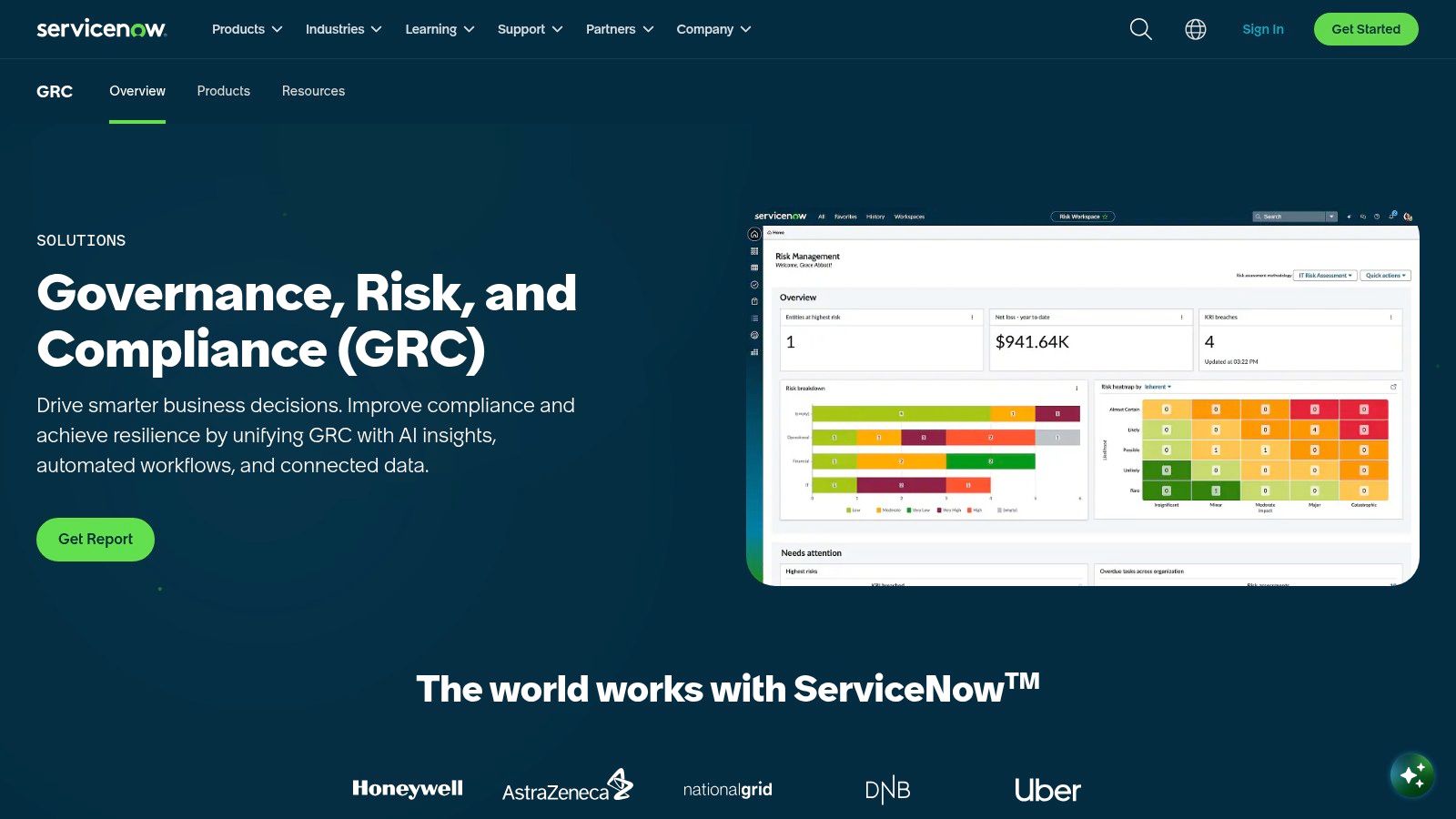
ServiceNow's GRC offering connects risk and compliance processes with broader business workflows. Capabilities include assessments, key risk indicators, reporting, remediation, dashboards, and mobile access, with relationships to service, asset, process, and CMDB data.
What should you validate before buying?
Ask the implementation team to demonstrate a control failure linked to an affected service, assigned to its operational owner, and resolved through a tracked remediation workflow. Don't accept a dashboard demonstration as proof of end-to-end integration.
Main advantage: Existing ServiceNow investment provides a practical foundation for cross-team visibility and workflow automation.
Implementation burden: CMDB quality, ownership rules, configuration expertise, and ongoing platform administration deserve explicit funding.
Pricing trade-off: Obtain a sales-led quote with application entitlements, integration requirements, environments, and delivery services separated.
For mid-to-large enterprises, choose ServiceNow when operational integration is central to the business case. If your service desk runs elsewhere, compare the complete platform commitment against connecting a specialist GRC product to your existing ITSM environment.
2. MetricStream ConnectedGRC
A multinational group needs more than a consolidated risk register. MetricStream ConnectedGRC belongs on your shortlist when business units must share controls, regulations, assets, issues, and reporting while retaining their own operational responsibilities.
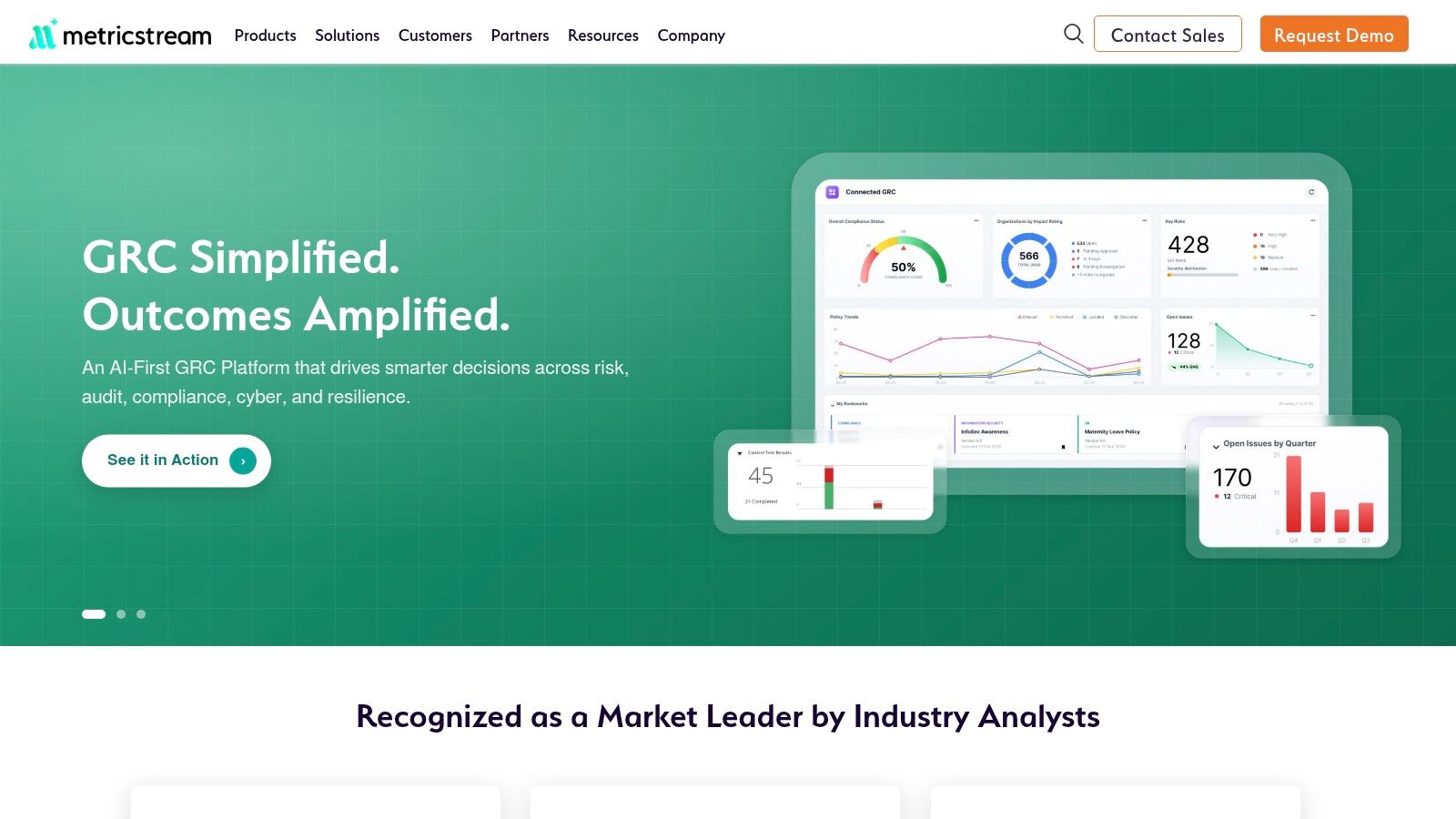
MetricStream offers broad coverage across risk, compliance, audit, cybersecurity, and resilience. Its shared data model, configurable AppStudio applications, APIs, continuous control monitoring, and language, currency, and timezone support make it relevant to distributed enterprise programs.
The regional fit depends on your regulatory structure. The UAE's data-protection framework includes the federal personal-data law alongside distinct regimes relevant to organizations operating in the DIFC and ADGM.
Procurement principle: Require common controls with jurisdiction-specific mappings. Don't let each subsidiary create an unrelated control library.
Where does the commercial trade-off sit?
MetricStream is an enterprise-program purchase, not a lightweight checklist replacement. Confirm module packaging directly and budget for taxonomy design, migration, integration, and administration.
For ServiceNow, HaloITSM, or Freshservice integration, require a demonstration of entity identifiers, issue synchronization, evidence references, and failed-transfer recovery. API availability alone doesn't establish a working operational connection.
Recommendation: Prioritize MetricStream for large, multi-entity organizations with dedicated GRC ownership. Choose a narrower product if your immediate requirement is security evidence collection or a single audit workflow.
3. LogicGate Risk Cloud
LogicGate Risk Cloud is the shortlist choice for teams that need to change their GRC processes without committing to a rigid program structure. Select it when workflow flexibility matters and you can assign someone to govern configuration.
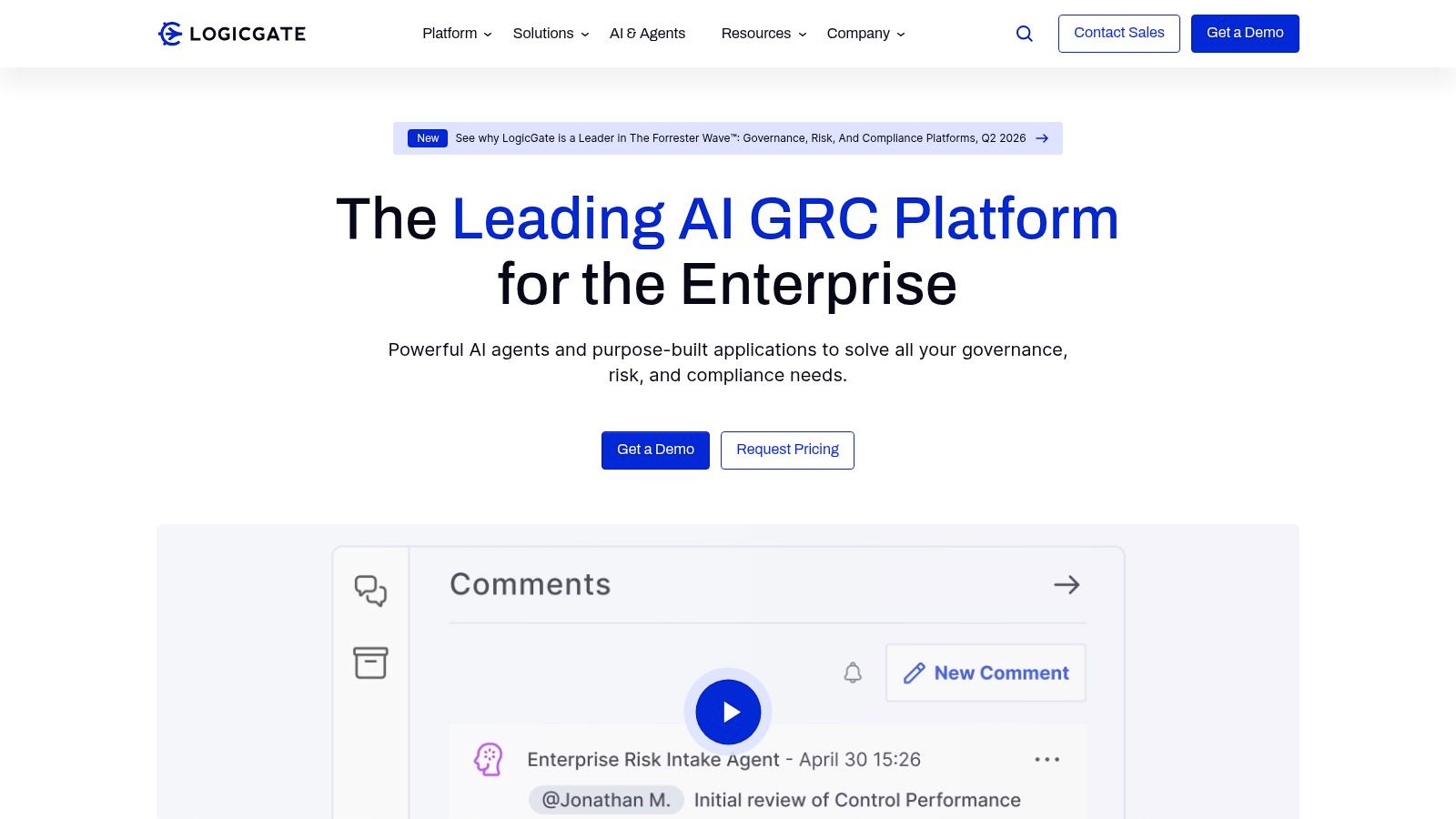
LogicGate's platform provides configurable applications and workflows, control-testing and evidence-related automation, reporting, and integrations with business, security, and IT tools. Its AI features are intended to assist with routine work and workflow orchestration.
For a growing enterprise, that flexibility is useful when supplier reviews, policy exceptions, and technology-risk assessments follow different approval paths. The procurement risk is uncontrolled configuration, where every department builds its own interpretation of the same control.
Strength: Adaptable workflows support changing requirements and connected GRC processes.
Ownership requirement: Assign responsibility for application design, release testing, permissions, and reporting definitions.
Commercial check: Confirm which applications, integrations, and AI capabilities are included rather than assuming platform-wide entitlement.
How should you test ITSM integration?
Use a proposed workflow: a failed control creates a remediation ticket in HaloITSM or Freshservice, then returns closure evidence for independent review. Require the vendor to prove the connection and explain how conflicting updates are handled.
Pricing guidance: Standard public pricing isn't presented in the supplied product information. Compare the configured solution and administration workload, not an assumed low entry cost.
4. NAVEX One
Employee behavior belongs in a GRC buying decision when your priority is policy adoption, training, and reporting concerns. NAVEX One is a strong candidate for organizations where ethics and compliance lead the program rather than infrastructure operations.
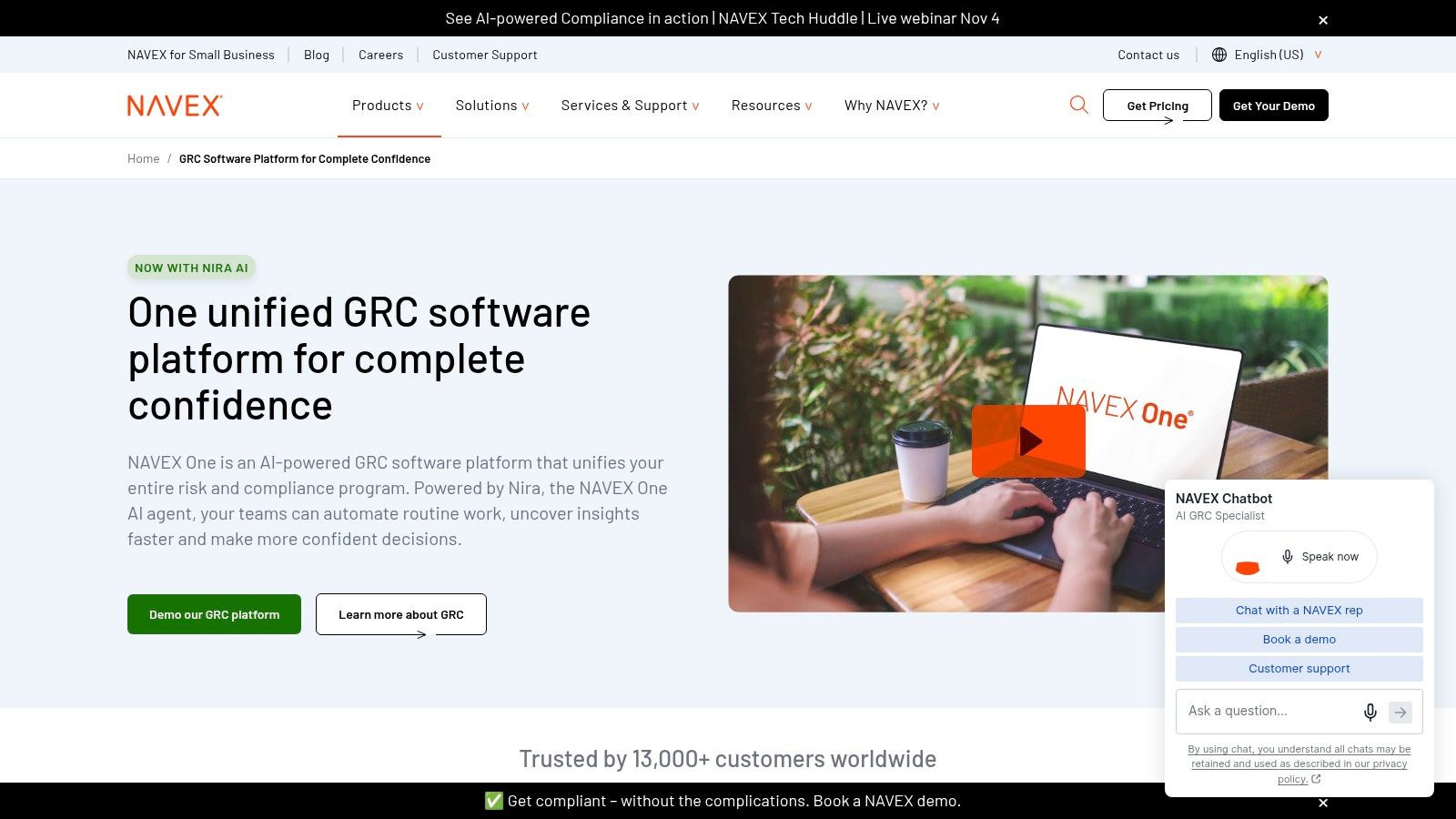
The NAVEX One platform brings together ethics, risk, and compliance capabilities, including policy and training workflows and options for managing different risk disciplines centrally. Its appeal is coordinating related compliance activities under a common vendor relationship.
That doesn't make every compliance case suitable for your service desk. Sensitive employee reports need a deliberately designed access model before any operational ticket is created.
What belongs in the integration scope?
Separate confidential case content from operational actions. Your IT team might need to revoke access or preserve records without receiving the underlying allegation or investigation narrative.
Best fit: Mid-to-large organizations prioritizing employee-facing ethics and compliance programs.
Main limitation: Buyers seeking deep technology-risk or ITOM relationships should validate those requirements separately.
Pricing trade-off: Sales-led packaging requires a module-by-module quote and clear deployment assumptions.
For GCC buyers, verify applicable regional content, employee access requirements, and data-handling arrangements during evaluation. Choose NAVEX because its ethics and compliance workflows match your operating model, not because a broad platform label implies every GRC discipline has equal depth.
5. SAI360
If policy, training, incidents, and regulatory changes sit in disconnected tools, evaluate SAI360 as a consolidation candidate. Its fit is strongest when compliance leaders need to coordinate those activities with risk management rather than automate technical evidence collection.
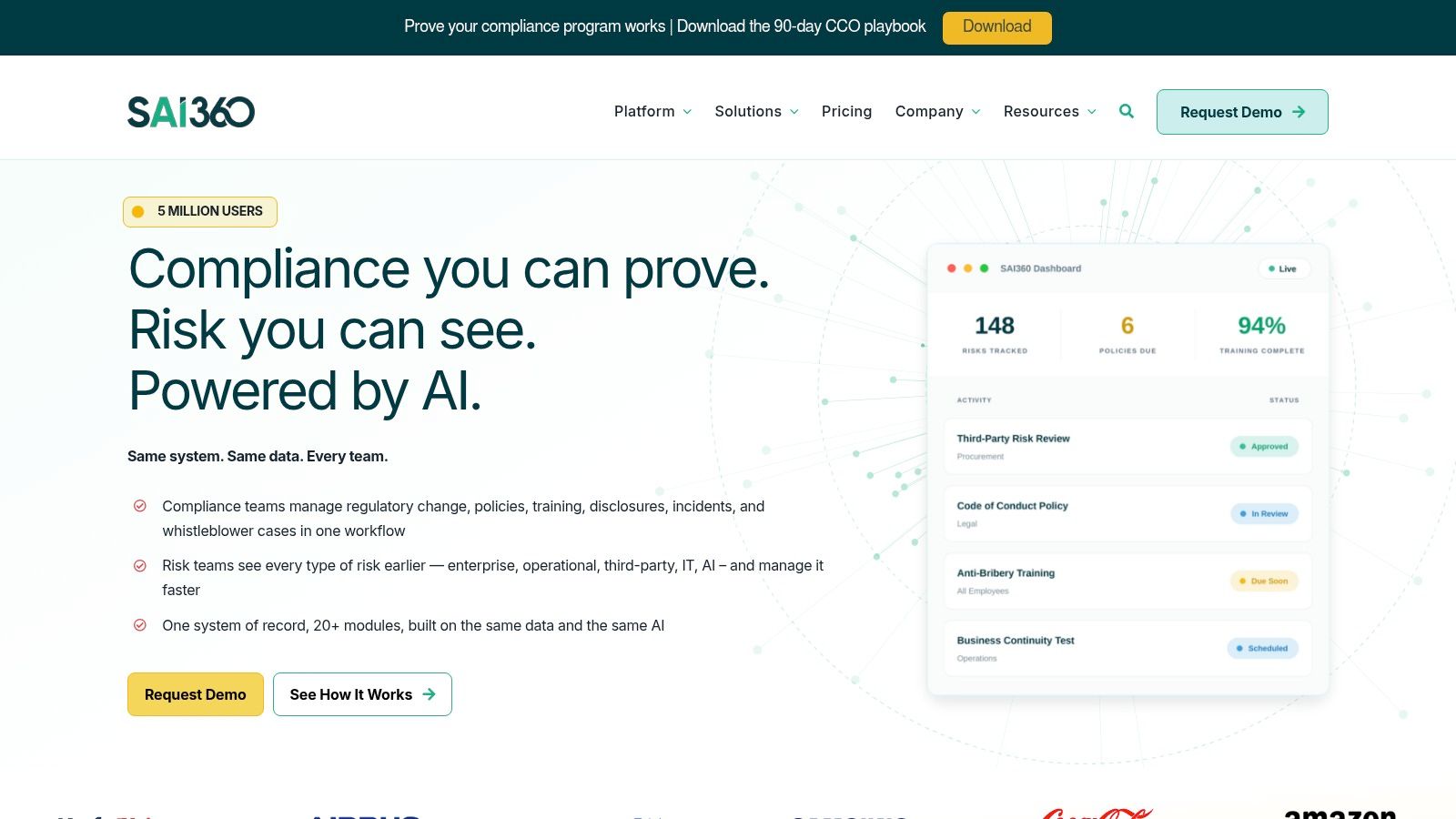
SAI360 combines ethics, risk, and compliance capabilities with policy, incident, training, and regulatory-change workflows. The vendor also promotes AI-related features within its cloud platform.
The buying advantage is coordinated program coverage. The corresponding risk is purchasing breadth without validating the depth of your most important module.
Demonstrate regulatory change: Require an applicable change to trigger an impact assessment, control revision, policy approval, and accountable follow-up.
Demonstrate operations: Test how a related incident or corrective task reaches your existing ITSM team.
Demonstrate assurance: Confirm that reviewers can trace the decision, supporting evidence, and final approval.
How should you control deployment costs?
Public pricing isn't listed in the supplied information. Request separate costs for selected modules, migration, integrations, training, and ongoing support.
For ServiceNow, HaloITSM, or Freshservice estates, define which system owns the incident and which owns the compliance assessment. Don't create parallel queues that require employees to update both manually.
Recommendation: Shortlist SAI360 for established compliance programs seeking coordinated employee-facing and risk workflows. Avoid buying the full scope before process owners agree on responsibilities.
6. Diligent One
Start with the board's decision requirements when considering Diligent One. Choose it when executives need a connected view of governance, audit, risk, and compliance, backed by information that operational teams can substantiate.
Diligent One spans governance, risk, audit, and compliance, with executive-facing reporting, enterprise risk capabilities, external risk intelligence offerings, and cybersecurity and third-party risk use cases. That breadth makes it relevant when leadership oversight is the organizing requirement.
For UAE banks, the Central Bank's Operational Risk Regulation places ultimate responsibility with the board and requires information systems that support operational-risk monitoring, analysis, and reporting. That requirement supports evidence-backed reporting, but it doesn't establish any vendor's regulatory compliance.
A board dashboard is useful only when reviewers can trace its conclusions to accountable owners and current evidence.
What should the proof of concept establish?
Ask reviewers to move from a reported risk to its controls, findings, remediation records, and supporting operational evidence. Require explicit approval rules before a closed service ticket changes the reported risk position.
Pricing is sales-led. Confirm module and integration packaging, and distinguish board-oriented capabilities from the operational GRC applications you actually need.
Prioritize Diligent for enterprises aligning audit and risk work with board oversight. Don't select a broad governance suite for a narrow evidence-collection requirement.
7. AuditBoard
AuditBoard is the clear shortlist candidate when internal audit owns the buying process. Evaluate it around planning, fieldwork, evidence, findings, remediation, and reporting before expanding into wider risk and compliance requirements.
The AuditBoard platform connects audit, risk, and compliance workflows, with IT risk and compliance capabilities, ESG management options, and collaboration across assurance stakeholders. Its practical appeal is centralizing audit-related work while connecting findings to broader risk processes.
How should remediation connect to IT operations?
An auditor should define the finding and acceptance criteria. The operational team should execute the corrective work in its established system, while the designated reviewer decides whether the evidence supports closure.
ServiceNow mapping: Test finding identifiers, affected services, assigned owners, and remediation status.
HaloITSM or Freshservice mapping: Demonstrate ticket creation, evidence references, reassignment, and reopened findings.
Audit trail: Preserve reviewer decisions separately from the technician's completion status.
This is a proposed integration acceptance test, not a claim that every connection is available out of the box.
Commercial guidance: A standard public rate isn't listed in the supplied information. Quote the audit scope first, then price additional risk, compliance, and integration requirements explicitly.
Choose AuditBoard for mid-to-large enterprises with audit-led programs. Buyers seeking full enterprise GRC should test their wider requirements directly rather than extrapolating from the audit demonstration.
8. OneTrust
Privacy, supplier oversight, data governance, and AI governance often involve the same information flows. OneTrust deserves priority when those intersections define your risk program, particularly in data-intensive enterprises.
OneTrust's platform offers privacy, technology-risk, compliance, third-party risk, AI, and data-governance capabilities. Its proposition includes shared workflows, automated assessments, control management, continuous monitoring, and integrations.
A survey of UAE senior IT and business leaders found that only 66% reported full compliance with UAE data-protection and sovereignty requirements, as described in Ken Research's enterprise-risk analysis. For procurement, that makes continuously evidenced data handling a more useful test than a broad compliance claim.
What should GCC buyers demand?
Require demonstrations of data-location inventories, provider attestations, AI-model ownership, control evidence lineage, and regulatory-change assignments. Verify hosting, support access, subprocessors, backups, and exports contractually.
Best fit: Enterprises where privacy, third-party risk, and AI governance overlap.
Scope caution: Test conventional enterprise risk and internal-audit requirements separately.
Pricing trade-off: Discuss modules and packaging directly; don't assume the broader platform is included.
When connecting ITSM, send only the information operational teams need. A remediation ticket can reference a restricted assessment without copying sensitive personal information into a more widely accessible queue.
9. Vanta
Don't buy a full enterprise governance suite if your immediate problem is repetitive security-compliance evidence gathering. Vanta offers a more focused evaluation path for teams building security-framework readiness and demonstrating trust.
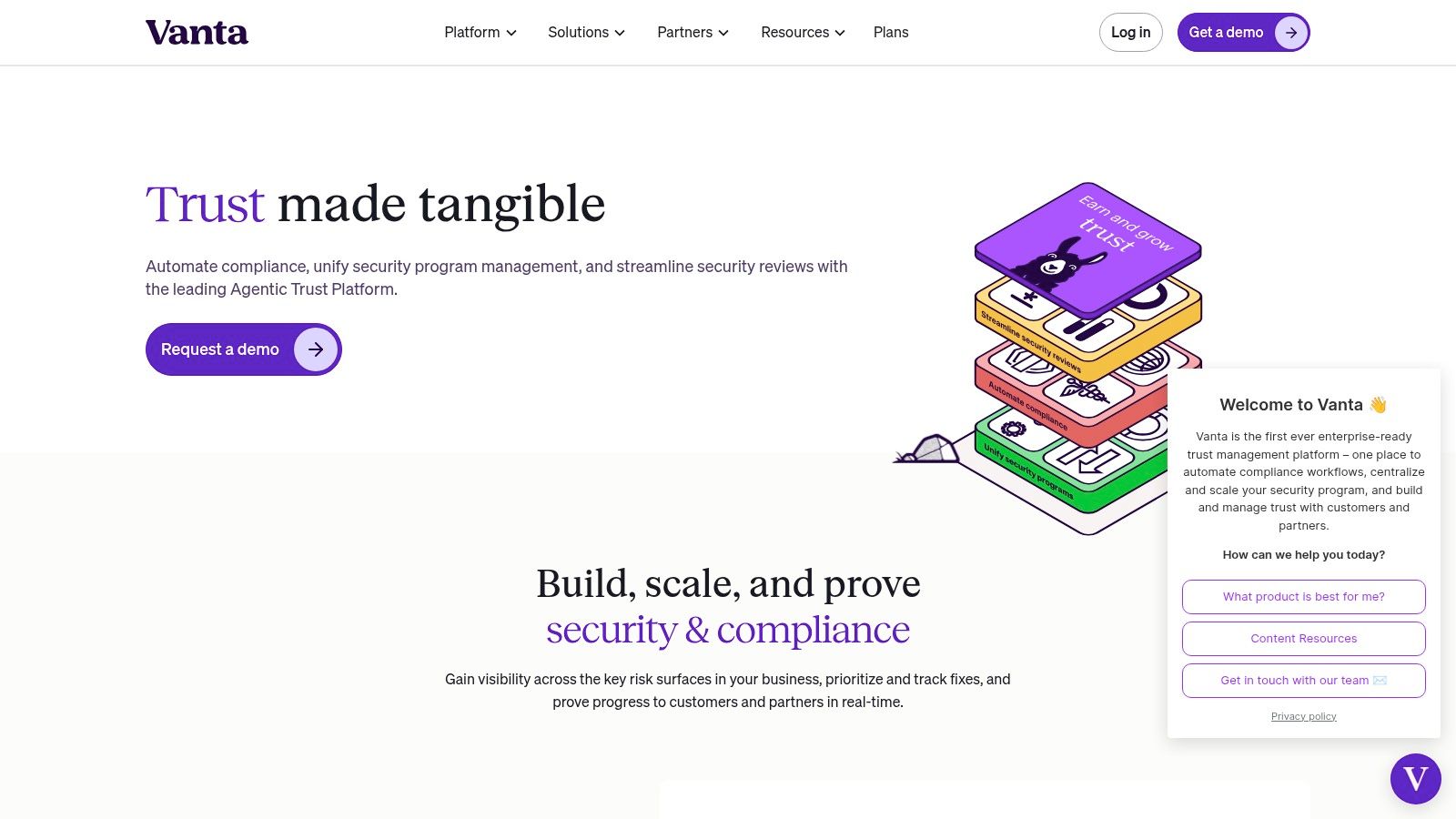
Vanta's trust management platform automates parts of evidence collection, connects security-program information, and supports security reviews and vendor-risk workflows. It serves teams starting compliance programs as well as larger organizations evaluating focused automation.
The boundary matters. It isn't a like-for-like substitute for broad enterprise risk management, board governance, or a complete internal-audit platform.
Keep accountability explicit: Automated evidence collection doesn't replace control ownership, corrective security work, or independent audits.
What should you test commercially and technically?
Bring representative systems and controls into the demonstration. Confirm what evidence can be collected, what remains manual, how failed checks reach an owner, and whether your required regional obligations can be represented appropriately.
Integration reality: Require a demonstrated handoff to your ITSM workflow rather than assuming connector coverage.
Pricing discipline: Request a scoped quote covering required capabilities, implementation support, and exclusions.
Organization fit: Prioritize Vanta for security-led teams and business units with focused readiness requirements.
Choose it for the security-compliance problem it addresses. Don't stretch that purchase into an enterprise-wide GRC mandate without testing the missing disciplines.
10. Submarine
For a GCC insurer or broker, regional and sector relevance deserve explicit evaluation alongside global platform breadth. Submarine belongs on that specialist shortlist, not on every enterprise's general-purpose shortlist.
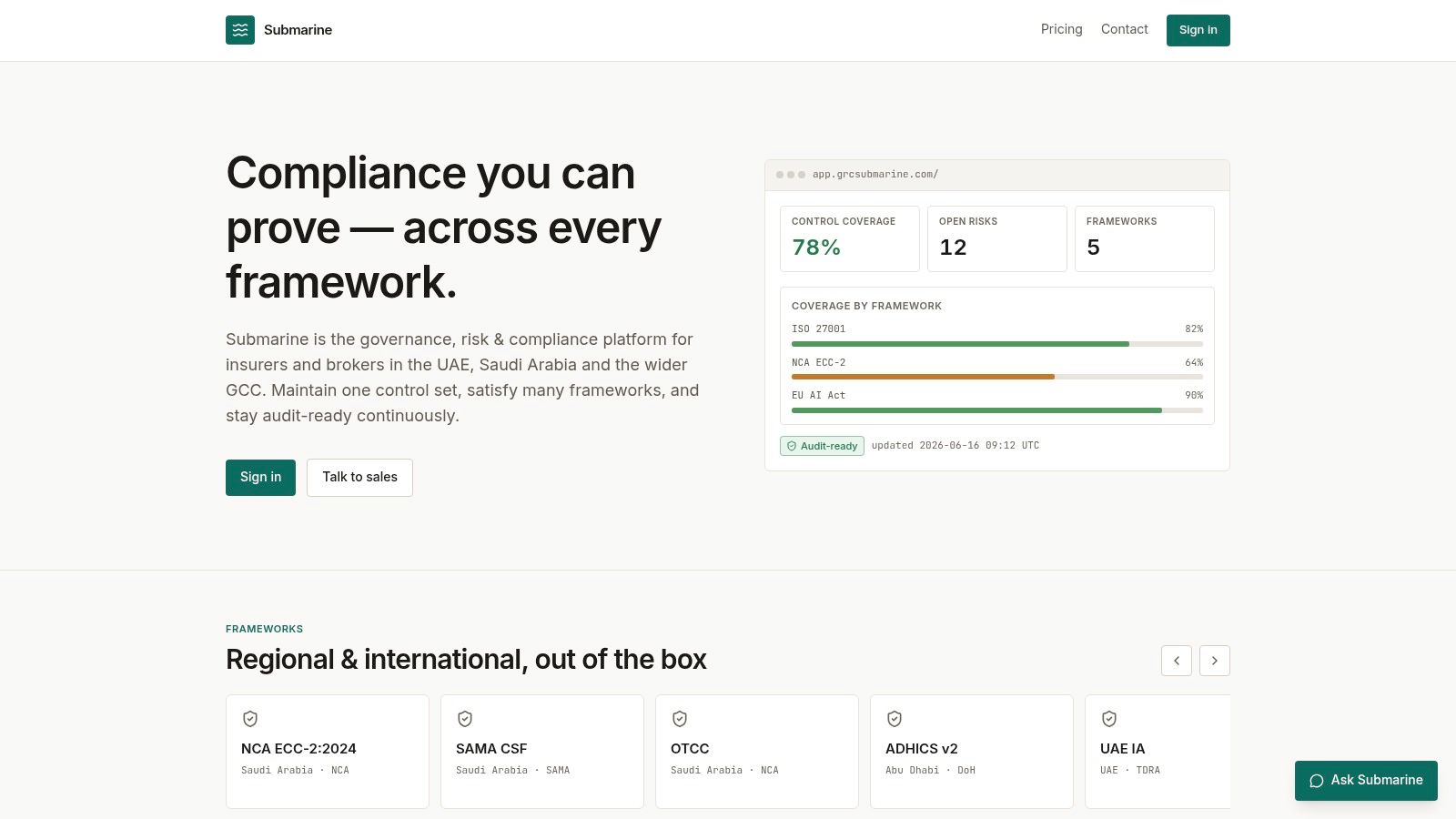
Submarine positions its GRC platform for insurers and brokers in the UAE, Saudi Arabia, and wider GCC. Its site also identifies an AI Copilot offering.
That focus provides a relevant starting point for sector-specific evaluation. It doesn't replace due diligence on regulatory mappings, deployment architecture, evidence handling, support, or integration capabilities.
What should an insurer require in the workshop?
Use your actual control library, approval responsibilities, supplier assessments, and reporting requirements. Ask the vendor to demonstrate how those records are maintained and how operational actions reach the teams responsible for completing them.
Sector fit: Validate insurance and brokerage workflows against your own operating model.
Integration proof: Require documentation and a working demonstration for your ServiceNow, HaloITSM, or Freshservice connection.
AI oversight: Establish review, approval, access, and evidence rules before using Copilot-assisted outputs.
Commercial clarity: Obtain written pricing, deployment, support, data-handling, and exit terms.
Public pricing and detailed deployment information aren't readily stated in the supplied material. Don't assume a regional specialist is cheaper or faster to implement than a global suite.
Recommendation: Include Submarine when GCC insurance relevance is a primary buying criterion. Outside insurance and brokerage, prioritize demonstrated sector fit before progressing.
Top 10 GRC Software Tools: Feature Comparison
GRC Platform | Core Focus | Standout Capabilities | Best Fit | Key Considerations | Pricing |
|---|---|---|---|---|---|
ServiceNow GRC | Risk and compliance linked to IT workflows | CMDB-connected risk records, automated workflows, dashboards | Organizations already using ServiceNow | Configuration and administration can be substantial | Quote-based |
MetricStream ConnectedGRC | Enterprise-wide risk, compliance, audit, and resilience | Shared data model, configurable apps, multilingual support | Large, complex, multi-entity organizations | Implementation may require significant effort | Quote-based |
LogicGate Risk Cloud | Configurable GRC workflows | Custom applications, control testing, integrations, AI features | Teams with evolving GRC requirements | Requires workflow design and ongoing ownership | Quote-based |
NAVEX One | Ethics, risk, and compliance | Policy management, training, employee reporting | Organizations prioritizing ethics and compliance programs | Confirm required modules and regional coverage | Quote-based |
SAI360 | Connected ethics, risk, and compliance | Policy, incident, training, and regulatory-change workflows | Organizations coordinating established compliance programs | Validate module depth and integration needs | Quote-based |
Diligent One | Governance, risk, audit, and compliance | Board-focused reporting, enterprise and third-party risk | Organizations connecting operational GRC with board oversight | May be broader than needed for a narrow use case | Quote-based |
AuditBoard | Audit-led connected risk and compliance | Audit planning, fieldwork, remediation, IT risk | Internal audit teams extending into risk and compliance | Verify coverage for broader enterprise GRC needs | Quote-based |
OneTrust | Privacy, data, technology, third-party, and AI governance | Automated assessments, monitoring, connected workflows | Privacy- and data-intensive organizations | Select modules carefully; test ERM and audit fit | Quote-based |
Vanta | Security compliance automation | Evidence collection, security reviews, vendor-risk workflows | Teams seeking security-framework readiness | Not a full enterprise ERM or audit platform | Quote-based |
Submarine | GRC for insurance and brokerage | GCC focus, insurance workflows, AI Copilot | Insurers and brokers in the UAE, Saudi Arabia, and GCC | Sector focus may not suit other industries | Pricing not publicly stated |
Choose Your Fit and Start With Confidence
Shortlist GRC software tools by the workflow you need to improve, the systems that hold your evidence, and the jurisdictions you operate in. Then validate the selection through a fit-gap workshop using your own controls, service records, and reporting requirements.
ServiceNow is the starting point for existing ServiceNow estates seeking operational integration. MetricStream suits complex, multi-entity programs, while LogicGate fits teams that need configurable workflows. Choose NAVEX or SAI360 when employee-facing compliance is central, Diligent for board-oriented governance, and AuditBoard for audit-led delivery.
For privacy and AI governance, prioritize OneTrust. For focused security-compliance automation, evaluate Vanta. GCC insurers and brokers should include Submarine where its sector positioning matches their requirements.
What must the fit-gap workshop prove?
Require a complete evidence trail from an applicable requirement to a control, its owner, supporting operational data, a failed test, remediation, and reviewed closure. The team should also demonstrate what happens when an integration fails or an owner changes.
ServiceNow integration: Establish authoritative service and asset records, ownership, and remediation responsibilities.
HaloITSM and Freshservice integration: Define ticket mappings, evidence references, synchronization direction, permissions, and recovery procedures.
ITOM dependencies: Identify which discovered assets, service relationships, and monitoring events are necessary for meaningful risk assessment.
Commercial scope: Separate licensing, modules, connectors, migration, configuration, enablement, support, and exit assistance.
For regulated buyers, map applicability before configuring workflows. The UAE National Information Assurance Framework requires specified stakeholders to demonstrate compliance, reinforcing the need for traceable control evidence rather than unsupported status labels.
Sector-specific evaluation also matters. A healthcare risk software evaluation can complement a broader shortlist when clinical and operational requirements need separate consideration.
How should you measure implementation value?
Baseline evidence-production time, overdue high-risk findings, remediation aging, supplier-review coverage, and control-to-service traceability. Review those outcomes alongside adoption and administration effort so that better-looking dashboards don't conceal duplicate work.
DataLunix supports GCC and European organizations through discovery, fit-gap analysis, implementation, integration, change management, and managed optimization. Its work across ServiceNow, HaloITSM, and Freshservice provides a practical basis for connecting GRC requirements with ITSM and ITOM delivery.
Start with a bounded operational use case and explicit acceptance criteria. Expand only after control owners, operational teams, and assurance reviewers can use the same evidence trail confidently.
DataLunix offers discovery workshops, readiness assessments, fit-gap analysis, and implementation services to connect GRC workflows with your ITSM and ITOM environment. Visit DataLunix to scope your ServiceNow, HaloITSM, or Freshservice integrations and build a procurement plan around control ownership, evidence traceability, and measurable delivery outcomes.