


How Do You Master Freshservice Asset Management for Peak ROI?
- Nov 21, 2025
- 9 min read
Freshservice asset management is your IT department's central command for every piece of technology your company owns. It provides a complete, 360-degree view of your IT inventory, tracking everything from hardware and software licenses to cloud infrastructure from procurement to retirement, ensuring you maximize value and minimize risk.
Why is Freshservice Asset Management a Strategic Necessity?

Without a unified view of your IT assets, you are essentially flying blind—overspending on unused software licenses, risking costly compliance penalties, and leaving security gaps open for unauthorized devices. Freshservice asset management provides the critical visibility and control needed to move from reactive fire-fighting to proactive, strategic management of your technology backbone.
This shift empowers you to prevent operational chaos, slash unnecessary costs, and secure your IT environment. Instead of guessing, you can make data-driven decisions that align directly with your business goals. For a deeper look at the core principles, check out DataLunix.com’s complete guide to IT asset management.
What are the core components?
The platform integrates several key components to create a single source of truth for your IT landscape. Each element works together to solve specific operational challenges, eliminating manual work and reducing human error.
Discovery Tools: These automatically scan your network to find and identify all connected hardware and software, creating a real-time inventory.
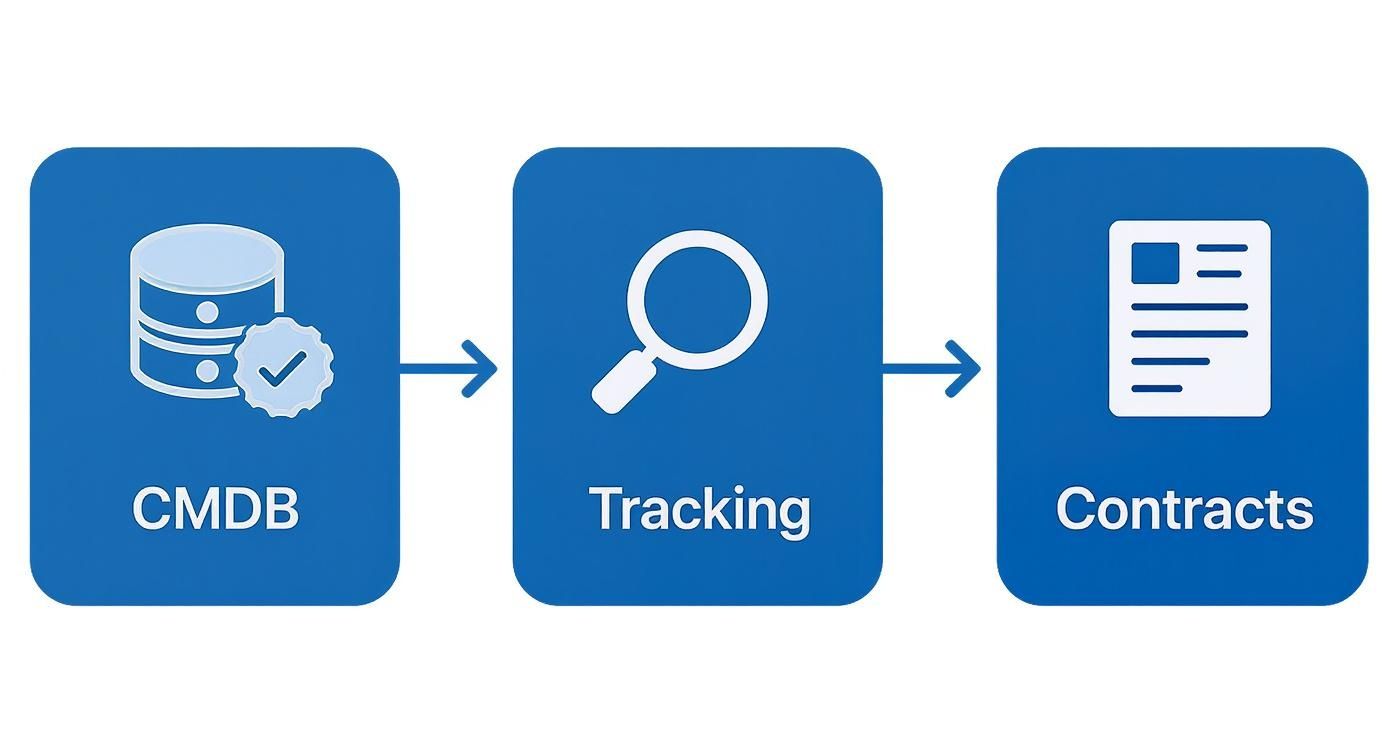
Configuration Management Database (CMDB): This maps all your assets and, crucially, their relationships and dependencies, which is vital for effective incident and change management.
Hardware & Software Tracking: It manages the entire lifecycle of every asset, from procurement and deployment to maintenance and retirement, optimizing resource allocation.
Contract & License Management: This module centralizes vendor contracts and software licenses to monitor usage, renewals, and compliance, preventing overspending and audit failures.
What strategic advantages does it provide?
Implementing a robust Freshservice asset management system offers benefits far beyond simple inventory tracking. It enables your IT teams to make informed decisions that drive business value, strengthening operations across the board. The IT Asset Management (ITAM) market in the Middle East is projected to hit $1.28 billion by 2033, underscoring its growing importance.
Cost Optimization: Eliminate redundant software licenses and stop purchasing unnecessary hardware, leading to immediate bottom-line savings.
Enhanced Security: Quickly identify and flag unauthorized devices or software on your network, significantly reducing your organization's attack surface.
Regulatory Compliance: Automate software license tracking to ensure you are always prepared for an audit and can avoid substantial non-compliance fines.
Operational Efficiency: Streamline processes like employee onboarding and offboarding by automating the assignment and reclamation of company assets.
What are the core features and modules of Freshservice?
The power of Freshservice asset management lies in its interconnected modules, which work together to provide an intelligent, cohesive view of your entire IT world. These aren't just features on a dashboard; they are purpose-built tools designed to solve real-world IT challenges, from tracking a laptop for a new hire to understanding the impact of a server outage.
What is the Configuration Management Database (CMDB)?
The Configuration Management Database (CMDB) is the heart of the system, acting as your single source of truth for every IT asset and, more importantly, mapping the intricate relationships between them. This isn't just a list; it’s a living blueprint of your IT ecosystem that shows how servers, applications, and network switches are interconnected. When an issue arises, IT teams can perform an impact analysis to trace the problem to its root cause in minutes. See its full potential in our guide on how a CMDB in Freshservice can transform your IT operations.
How does hardware and software tracking work?
The hardware and software tracking modules provide end-to-end lifecycle management for every physical and digital asset, from procurement to disposal. When a new employee joins, the system automates the provisioning workflow, assigning and tracking their laptop, monitor, and phone. It also logs crucial data like warranty expirations and maintenance schedules, which is essential for budgeting and upgrade planning. By linking hardware tracking with software management, you ensure every device has correctly licensed software installed, drastically reducing security and compliance risks.
Why is contract and license management so critical?
The contract and license management module acts as your financial guardian, centralizing all vendor agreements and software licenses to prevent overspending and ensure audit readiness. It actively monitors your software usage against your purchased licenses, sending automated alerts when you approach limits or when a contract is nearing renewal. This module delivers clear financial wins for your business.
Stops Overspending: It identifies unused or redundant software licenses that can be reallocated or canceled.
Guarantees Compliance: It provides a real-time view of your license status, turning stressful software audits into routine check-ins.
Improves Negotiations: Armed with precise usage data, you gain a stronger position when negotiating contract renewals with vendors.
By automating these crucial tasks, Freshservice frees up your IT and procurement teams to focus on strategic initiatives. At DataLunix, we specialize in configuring these modules to deliver immediate and measurable financial benefits.
How do you plan a successful Freshservice implementation?
A successful Freshservice asset management implementation hinges on a clear, well-defined plan that aligns your people, processes, and data from the very beginning. It’s not about just turning on new software; it's about building a solid foundation through careful discovery, meticulous data migration, and comprehensive user training to ensure you meet your goals without costly delays.
How do you define your scope and set goals?
Before importing a single asset, you must first define what you are tracking and what you aim to achieve. Start by identifying your most critical assets—the servers, software, and laptops your business relies on. Then, establish clear, measurable goals to track success.
Identify Critical Asset Categories: Focus initially on high-value assets like servers, key software licenses, and employee laptops.
Establish Key Performance Indicators (KPIs): Define what success looks like numerically, such as reducing asset downtime by 15% or achieving 100% software license compliance.
Engage Stakeholders: Involve leaders from IT, finance, and HR to ensure the project aligns with broader business needs. Our guide to Freshservice pricing structures can help you budget accordingly.
How do you navigate data migration?
Data migration is a critical stage where many implementations fail; the principle of 'garbage in, garbage out' is paramount. Feeding Freshservice incomplete or inaccurate data will undermine its value. Taking the time to cleanse and standardize your existing asset information before migration is non-negotiable for user adoption and system trustworthiness. Gather all your asset lists, verify details, remove duplicates, and standardize formats to ensure a clean start.
How do you master change management and user training?
Technology is only effective if people use it correctly, which makes change management and training essential for success. You must show your team why the new system matters and how it will make their jobs easier.
Develop Role-Based Training: Create tailored training sessions for different user groups, such as IT technicians and department managers, focusing on their specific tasks.
Create a Knowledge Base: Build a library of simple guides, short videos, and FAQs to empower users to find answers independently.
Appoint Champions: Identify enthusiastic users in each department to act as advocates and provide peer support.
Proper planning is the key to a smooth deployment. At DataLunix.com, we guide organizations through this process daily, helping them avoid common pitfalls and achieve a rapid return on their Freshservice asset management investment.
How does Freshservice integrate with your IT ecosystem?

The true power of Freshservice asset management is unlocked when it is integrated with the other core systems that run your business, creating a single, unified operational hub. This connectivity transforms it from a simple inventory into the connective tissue linking your IT, HR, and finance departments, automating complex workflows and eliminating redundant manual data entry.
Why should you integrate with IT Service Management (ITSM)?
Integrating your asset data directly with your ITSM platform, like the Freshservice service desk, is the most critical first step. It provides support agents with the context they need to resolve issues faster and more accurately. When a ticket for a slow laptop is raised, the agent can instantly see the asset's history—purchase date, warranty status, and past incidents—enabling rapid troubleshooting. Learn more in our guide on Freshservice ticketing best practices.
Faster Incident Resolution: Automatically link incidents to specific assets to spot recurring hardware issues.
Smarter Change Management: View all dependent assets in the CMDB before deploying a change to understand the potential impact.
Proactive Problem Identification: Identify trends, like a specific laptop model generating high ticket volumes, to address root causes.
How do you connect with HR and finance systems?
Integrating Freshservice with your HR and finance software automates the entire employee lifecycle and procurement process, removing manual handoffs that often cause errors and delays. When a new employee is added to the HR system, an automated workflow can provision their laptop and software. When they leave, another workflow ensures all assets are reclaimed. Linking to finance software provides clear visibility into departmental tech spending by tying asset costs directly to budgets.
What are the benefits of leveraging IT Operations Management (ITOM) tools?
Connecting Freshservice asset management with ITOM tools helps you build a proactive, self-healing infrastructure. ITOM platforms monitor your network and servers 24/7. When they detect a potential issue, like low server memory, they can automatically create a ticket in Freshservice and link it to the failing asset. This allows your team to intervene before a full-blown outage occurs. Data shows automation in the Middle East and Africa drove resolution times down by 6.6% and boosted agent productivity by 31.3% (full Freshservice benchmark report). At DataLunix.com, we excel at building these interconnected ecosystems for our clients.
How can you establish governance and measure ROI?
Implementing a new system is only the beginning; the long-term value of Freshservice asset management comes from strong governance and a clear focus on measuring its financial return. Without a solid framework of policies, roles, and procedures, your asset data will become outdated, processes will be ignored, and your investment will fail to deliver its full potential.
What is an ITAM governance framework?
An ITAM governance framework is the set of rules that dictates how your organization manages its technology assets throughout their lifecycle. It answers critical questions like who approves new hardware purchases, what the standard process for deploying a laptop is, and how old equipment is securely retired. This structure ensures consistency and control, which is essential as businesses increasingly rely on technology to manage valuable assets.
How do you define Key Performance Indicators (KPIs)?
To prove the value of your ITAM program, you must track metrics that connect daily tasks to tangible business outcomes. Key Performance Indicators (KPIs) provide the hard data needed to justify the investment and maintain executive buy-in. A well-chosen set of KPIs transforms your asset management program from a cost center into a strategic asset.
KPI Category | Example Metric | What It Measures |
|---|---|---|
Cost Savings | Reduction in Hardware/Software Spend | Tracks the direct decrease in procurement costs, proving tangible budget savings. |
Operational Efficiency | Mean Time to Provision (MTTP) | Measures the time it takes to get assets to a new employee, showing how quickly they become productive. |
Asset Utilization | Asset Utilization Rate | Calculates the percentage of assets actively in use, highlighting over-purchasing and reallocation opportunities. |
Risk & Compliance | Software License Compliance Rate | Ensures installed software matches purchased licenses, making you 100% audit-proof. |
Lifecycle Management | Asset Lifecycle Cost | Totals all costs associated with an asset from purchase to disposal, revealing its true total cost of ownership. |
Consistently monitoring these KPIs allows you to calculate a clear Return on Investment (ROI) and build a powerful business case for your Freshservice asset management strategy. For more details, see our guide on how you can master asset management in Freshservice for peak ROI. At DataLunix.com, we help organizations build these measurement frameworks from day one.
Frequently Asked Questions
What is Freshservice asset management?
Freshservice asset management is a centralized platform that helps you track and manage your company's IT assets, including hardware, software, and cloud infrastructure, throughout their entire lifecycle. It provides a single source of truth to optimize costs, enhance security, and ensure regulatory compliance.
How does Freshservice scale with a growing business?
Freshservice is a cloud-native platform designed to scale seamlessly with your organization. As your asset inventory and team grow, you can easily upgrade your plan to accommodate more assets and agents without any service disruption, ensuring the system supports your business expansion.
Can Freshservice manage both on-premise and cloud assets?
Yes, Freshservice is built for hybrid IT environments and provides a unified view of both on-premise and cloud assets. It uses discovery probes for physical hardware and integrates with major cloud providers like AWS and Azure to manage virtual machines and other cloud services from a single dashboard.
What is the primary benefit of the Freshservice CMDB?
The primary benefit of the Freshservice Configuration Management Database (CMDB) is its ability to map the relationships and dependencies between your IT assets. This relational map allows IT teams to quickly perform impact analysis during incidents and changes, significantly reducing resolution times and minimizing business disruption.
For organizations seeking to implement a robust Freshservice asset management solution, DataLunix.com offers expert guidance on licensing, implementation, and management to ensure you achieve maximum ROI and operational excellence. Contact us today to build a powerful, unified view of your IT ecosystem.