


How Does the Freshworks Helpdesk Platform Work?

Updated: Jul 12
The Freshworks helpdesk is a cloud-based customer support platform that centralizes all customer conversations from channels like email, chat, and social media into a single, unified dashboard. It uses a powerful ticketing system, automation, and self-service tools to help your support team manage interactions efficiently and resolve issues faster.
What Is the Freshworks Helpdesk Platform?
The Freshworks helpdesk, primarily known as Freshdesk, is a command center for customer service that consolidates every customer interaction into a single source of truth. This design eliminates the need for agents to switch between multiple apps, streamlining complex support workflows and significantly boosting team productivity and customer satisfaction.
What are its key functional pillars?
The platform solves common customer support challenges through three core pillars: omnichannel support, workflow automation, and self-service options. This approach ensures a consistent customer experience across all communication channels, frees up agents from repetitive tasks, and empowers customers to find answers independently, reducing overall ticket volume.
Omnichannel Support: Weaves all communication channels together, so customers receive a seamless experience whether they use email, live chat, or social media.
Workflow Automation: Automates routine tasks like ticket routing, canned responses, and escalations based on predefined rules, allowing agents to focus on complex problems.
Self-Service Options: Provides tools to build a comprehensive knowledge base and community forums, enabling customers to find their own solutions quickly.
Freshworks has demonstrated significant growth, reporting total revenue of around $713 million, a 25% increase year-over-year. It's trusted by over 185,000 companies, with regions like Europe, the Middle East, and Africa contributing about 39% of total revenue.
How does its core functionality benefit support operations?
The platform's features work together to create a cohesive and powerful support environment, simplifying daily tasks for agents and improving the overall customer experience. This table breaks down the main features and shows how they translate into tangible benefits for your support operations.
Core Functionality | Primary Benefit | Typical Use Case |
|---|---|---|
Unified Ticketing | Centralizes all customer requests into one queue, preventing lost tickets and ensuring timely responses. | An e-commerce team manages support queries from email, chat, and Facebook Messenger in a single dashboard. |
Workflow Automation | Frees up agent time by automating routine tasks like ticket assignment, categorization, and status updates. | An IT support desk automatically routes high-priority tickets from VIP clients to senior technicians. |
Omnichannel Support | Provides a consistent and seamless support experience across all communication channels. | A customer starts a conversation via website chat and continues it over email without losing context. |
Knowledge Base | Empowers customers with self-service options, reducing ticket volume and improving satisfaction. | A SaaS company builds an extensive FAQ section to help users troubleshoot common software issues themselves. |
Reporting & Analytics | Offers insights into team performance, customer satisfaction, and key support metrics to drive improvements. | A support manager tracks first-response times and resolution rates to identify training opportunities. |

The dashboard gives agents instant access to ticket status, customer details, and conversation history. While Freshdesk excels at external customer support, understanding its differences from its IT-focused counterpart, Freshservice, is crucial. For more details, see our guide on Freshdesk vs. Freshservice to determine the best fit for your needs.
How are its architecture and core features designed?

The Freshworks platform is built on a modern, cloud-native architecture designed for scalability, security, and accessibility from anywhere without physical servers. This removes hardware maintenance burdens and ensures high availability, allowing your team to focus solely on supporting customers. Its powerful omnichannel ticket management system acts as a universal inbox for all customer conversations.
What is the core ticketing engine?
The ticketing engine is the central nervous system that captures, tracks, and manages every customer issue from initial contact to resolution, ensuring nothing falls through the cracks. It automatically enriches each ticket with the customer’s complete interaction history, giving agents the full context needed to provide fast, high-quality support. To learn more, explore our deep dive into how the Freshservice ticketing system works.
At DataLunix.com, we've seen organizations that switch to a unified ticketing system report up to a 30% jump in agent efficiency within the first six months. Centralizing communications is a transformative step for any support operation.
How does automation streamline workflows?
Automation is where the freshworks helpdesk truly excels, handling repetitive manual tasks that consume agent time, such as routing tickets, sending confirmations, or escalating urgent issues. This is managed through customizable, rule-based workflows where you set triggers and actions based on ticket details like source, priority, or specific keywords.
For instance, you can easily build automations for:
Ticket Assignment: Automatically send any ticket containing "billing" to the finance department.
SLA Management: Send automatic reminders to agents when a Service Level Agreement (SLA) is nearing its deadline.
Canned Responses: Use pre-written templates for instant, consistent answers to common questions.
What are the self-service and analytics tools?
Freshworks empowers customers to help themselves through a suite of robust self-service tools, including a customizable knowledge base for publishing articles, FAQs, and troubleshooting guides. A well-maintained knowledge base acts as a 24/7 support agent, deflecting common questions and freeing your team to focus on more complex, high-value issues that require a human touch.
On the other side, the analytics suite provides the data needed to measure and improve performance.
First Response Time (FRT): Tracks how quickly your team responds to new tickets.
Average Resolution Time: Measures the average time it takes to close an issue.
Customer Satisfaction (CSAT): Gathers customer feedback through post-resolution surveys to gauge happiness.
What business and technical benefits does it unlock?
Implementing the Freshworks helpdesk delivers tangible advantages, from improved customer satisfaction and agent productivity to reduced operational costs. By automating routine tasks, agents can focus on complex problem-solving, leading to faster resolutions, happier customers, and higher retention rates. This transforms your support department from a cost center into an engine for business growth.
What are the core business advantages?
The primary business benefit is a vastly improved customer experience, driven by a unified helpdesk that eliminates communication gaps and provides agents with full customer context. This leads directly to higher Customer Satisfaction (CSAT) and Net Promoter Scores (NPS). The platform's automation capabilities can also boost agent productivity by up to 30%.
This operational sharpness delivers a clear financial upside:
Reduced Cost-to-Serve: Faster resolutions and effective self-service options lower the cost of each customer interaction.
Increased Customer Lifetime Value: Superior support experiences build loyalty, encourage repeat business, and reduce churn.
From our experience at DataLunix.com, we consistently see a direct link between improved first-contact resolution rates and higher customer retention within just two quarters of a modern helpdesk implementation.
What are the key technical gains?
The scalable cloud infrastructure is a major technical advantage, eliminating the need for expensive on-premise hardware and associated maintenance. Your IT team is freed from managing servers and can focus on strategic business initiatives. The platform's robust APIs also enable seamless integrations with other essential tools like your CRM, ERP, or communication platforms like Slack. For a deeper look at IT service management, our guide on Freshservice ITSM offers valuable insights.
Freshworks serves over 74,600 customers globally, with consistent growth. The Middle East, part of an EMEA group that makes up 39% of Freshworks’ revenue, is seeing strong adoption. Larger companies now account for over 60% of the company’s annual recurring revenue. You can explore these Freshworks growth trends and profitability metrics on Investing.com.
How do you integrate Freshworks with enterprise systems?
The Freshworks helpdesk becomes a true business asset when connected to your other core systems, creating a unified view of your operations. When a support ticket arrives, it can automatically pull the customer's purchase history from your CRM and asset details from your ITSM tool, giving agents the complete context needed to resolve issues faster and more accurately.
How can you connect Freshworks to other platforms?
You have two primary methods for connecting Freshworks to other enterprise systems: native marketplace apps or its flexible API. The Freshworks Marketplace offers hundreds of pre-built, plug-and-play apps for popular platforms like ServiceNow, HaloPSA, or ManageEngine, enabling data syncing with just a few clicks. For more complex or custom needs, the Freshworks API allows your development team to build tailored connectors.
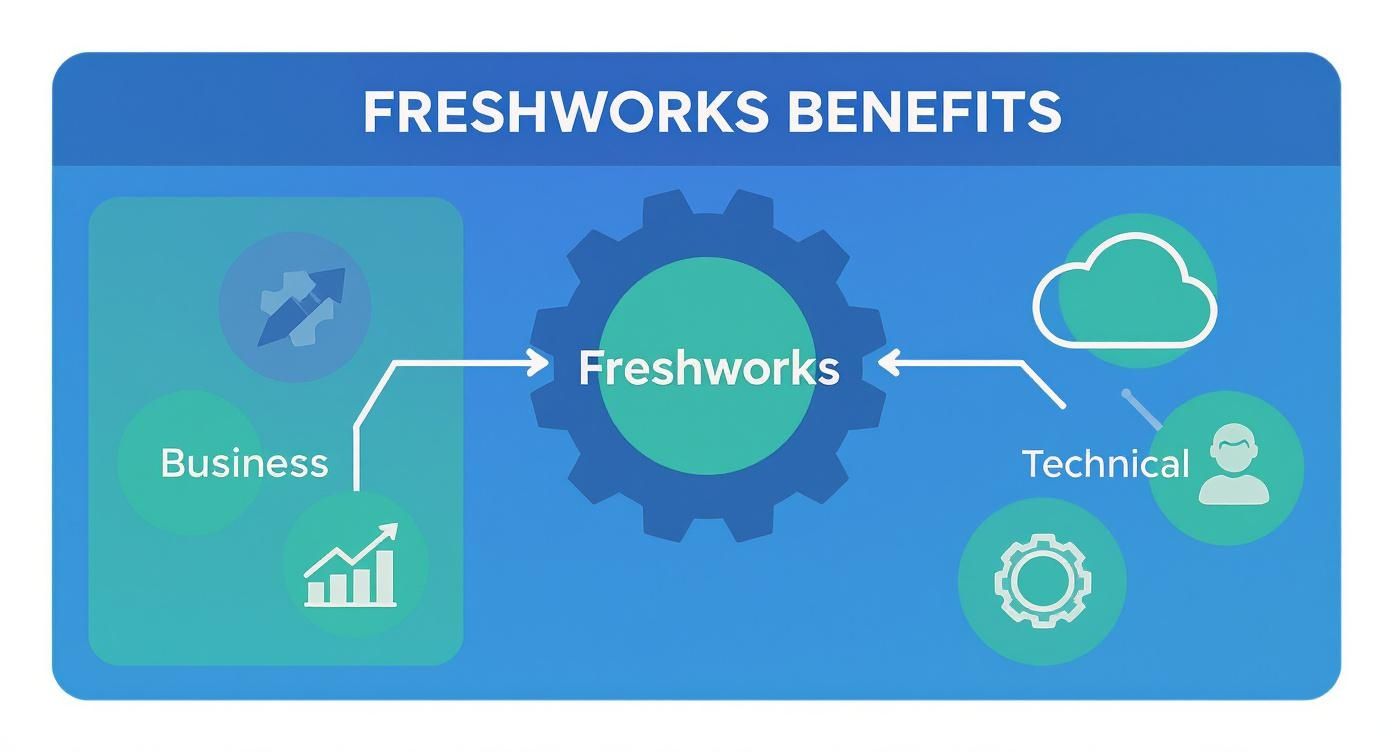
As the diagram shows, technical features like strong API access and scalability are the engine driving better business outcomes.
What are common integration use cases?
Connecting your Freshworks helpdesk unlocks powerful automation and data-sharing capabilities across your organization.
Here are a few common scenarios:
ITSM and Helpdesk Synergy: Link Freshworks with an ITSM platform to synchronize incident and service request data, allowing a customer-reported bug in Freshdesk to be seamlessly escalated to your IT team.
CRM Data Sync: Connect to your CRM (e.g., Salesforce) to give agents a 360-degree customer view, displaying purchase history and past conversations directly within the ticket.
PSA Platform Alignment: Integrate with a PSA tool like HaloPSA to sync ticket data with project management, time tracking, and billing, ensuring all support work is captured correctly.
At DataLunix, we build integrations that automate the grunt work. We once set up a rule that automatically creates a work order in a field service tool when a high-priority hardware ticket is logged, cutting technician dispatch time by over 50%.
To learn how a strong CMDB integration can transform IT asset management, read our guide on how a Freshservice CMDB can transform your IT operations.
How do you plan implementation and change management?
A successful Freshworks helpdesk rollout depends more on your people and processes than the technology itself. A solid plan that drives user adoption is essential to avoid low engagement and a wasted investment. The process begins with defining clear support goals, mapping current workflows to identify pain points, and setting realistic Service Level Agreements (SLAs).
How do you define your implementation goals?
Before you begin, you must define what success looks like with specific, measurable goals tied to business objectives. Instead of a vague aim like "improve support," set concrete targets to establish a clear benchmark for measuring your return on investment and keeping the project focused.
Aim for targets such as:
Reduce First Response Time (FRT) by 25% within the first quarter.
Increase the First Contact Resolution (FCR) rate to 80% within six months.
Boost your Customer Satisfaction (CSAT) score by 15 points over the next year.
What is the human side of change management?
Effective change management is about handling the human element of the transition, turning potential resistance into genuine enthusiasm. Communicate the "why" behind the change, showing agents exactly how the new Freshworks helpdesk will make their daily work easier by automating tedious tasks and freeing them to tackle more rewarding challenges.
At DataLunix.com, we’ve found that early and transparent communication is the single biggest driver of user adoption. When your team understands what’s in it for them, they become champions for the new system.
How do you create an effective training programme?
A generic, one-size-fits-all training session is ineffective. Your training program must be tailored to the different roles within your support team, with hands-on practice for agents and reporting deep-dives for managers. To maximize engagement and ensure long-term success, your program should be practical and role-specific.
Kick-off Session: Start with a high-level overview of the platform’s benefits.
Role-Based Workshops: Conduct hands-on sessions for agents, leads, and admins using real-world examples.
Create Super Users: Identify enthusiastic team members to act as internal champions and provide peer support.
Ongoing Resources: Develop a library of quick-reference guides and video tutorials for continuous learning.
For more on optimizing your support operations, see our guide on how to master Freshservice support for peak ITSM performance.
How do you measure your ROI and track success?
To prove your Freshworks helpdesk investment is paying off, track key performance indicators (KPIs) that directly link to cost savings and efficiency gains. Focus on metrics like First Contact Resolution (FCR), Average Handle Time (AHT), and Customer Satisfaction (CSAT). This data-driven approach transforms your support team from a cost center into a strategic asset.
What are the essential KPIs to track?
Focus on metrics that demonstrate agent productivity, customer happiness, and operational efficiency to paint a clear picture of Freshworks' impact on your bottom line. These numbers will help you build a powerful narrative backed by hard data, showing exactly how the helpdesk improves both service quality and the company’s finances.
First Contact Resolution (FCR): The percentage of tickets solved in a single interaction.
Average Handle Time (AHT): The average time an agent spends on a ticket from start to finish.
Customer Satisfaction (CSAT): Direct feedback from customers, typically gathered via post-resolution surveys.
Ticket Volume Reduction: A decrease in total tickets indicates your self-service portal is successfully deflecting common questions.
How do you calculate cost savings and build a business case?
Turn performance improvements into tangible financial figures by calculating savings from increased productivity and ticket deflection. As your AHT decreases and FCR improves, the cost to resolve each ticket drops. Furthermore, every ticket resolved through your self-service portal represents a direct cost saving, as it required no agent intervention.
At DataLunix.com, we help clients build ROI models that put these savings front and center. A common finding is that a 10% reduction in ticket volume via self-service can save the equivalent of hiring a new full-time agent, minus all the overhead.
The Middle East and Asia-Pacific regions have an SLA compliance rate of around 42%, highlighting a significant opportunity for improvement compared to rates of up to 93% in the US and Europe. You can find more details in these customer service benchmarks and regional insights.
FAQ
How does the Freshworks helpdesk scale with a growing business?
The Freshworks helpdesk is built on a scalable cloud architecture designed to grow with your business. You can easily add more agents or upgrade to higher-tier plans to access more advanced features as your ticket volume and team size increase, all without performance issues or complex migrations.
What role does AI play in the platform?
AI is central to the platform's efficiency, automating repetitive tasks to free up agents. It intelligently routes tickets, suggests smart responses to common queries, and powers a 24/7 self-service knowledge base, allowing customers to find answers independently and reducing your team's workload.
What are the typical pricing and plan structures?
Freshworks offers a tiered pricing model to suit businesses of all sizes, from startups to large enterprises. Plans typically start with a free or basic option for smaller teams and scale up to include more advanced automation, analytics, and enterprise-grade security features for larger organizations.
For organizations seeking to maximize their Freshworks investment, DataLunix provides expert implementation, integration, and managed services. As certified partners, we help you navigate digital transformation and secure discounted licensing to ensure you achieve the highest possible ROI. Discover how DataLunix can optimize your helpdesk strategy.

