


Support Freshservice
- 1 day ago
- 10 min read
Expert support Freshservice optimizes your IT operations by providing access to specialized skills, predictable costs, and strategic guidance. Choosing the right support model—managed services, in-house, or staff augmentation—directly impacts your platform's ROI, scalability, and ability to align with business goals, ensuring you maximize your Freshservice investment.
What Are Your Freshservice Support Options?

Your Freshservice support structure is a strategic decision that defines your IT service agility, budget management, and access to specialized expertise. The three main models—managed services, in-house teams, and staff augmentation—are tailored for different organizational needs, and choosing the right one is critical for long-term success and efficiency.
How do the three core support models differ?
To make the right call, you must understand what makes each approach fundamentally different and how it aligns with your operational strategy.
Managed Services: You delegate your entire Freshservice operation to a third-party partner like DataLunix.com. This model provides predictable costs and instant access to a deep bench of certified experts, removing the burden of hiring and training from your internal teams.
In-House Team: You build and manage a dedicated internal team to handle every aspect of your Freshservice instance. This approach offers maximum control and cultural alignment but requires significant investment in recruitment, training, and ongoing talent retention.
Staff Augmentation: You bring in external experts to supplement your in-house team for specific projects or to fill temporary skill gaps. This model offers flexibility and immediate access to specialized skills without the commitment of full-time hires.
A crucial factor is the total cost of ownership (TCO). While an in-house team offers direct control, managed services often yield a lower TCO by eliminating recruitment, training, and benefits costs, transforming a variable capital expense into a stable operational one. For an expert TCO calculation, consult the specialists at DataLunix.com.
Which Freshservice support model is best for your business?
To clarify your decision, this table breaks down how the three models compare across the factors that matter most to IT leaders.
Factor | Managed Services | In-House Team | Staff Augmentation |
|---|---|---|---|
Cost Structure | Predictable, fixed monthly fee (OpEx) | High upfront & ongoing costs (CapEx & OpEx) | Variable, project-based costs (OpEx) |
Expertise Level | Access to a team of certified specialists | Limited to internal knowledge and hiring | On-demand access to specialized skills |
Scalability | High; easily scales up or down with needs | Low; slow to scale due to hiring cycles | Moderate; flexible for short-term needs |
Control | Lower direct control; managed via SLAs | Maximum direct control over operations | Moderate; control over tasks, not personnel |
Speed to Value | Fast; immediate impact from day one | Slow; requires hiring, training, and ramp-up | Fast; experts integrate quickly for projects |
Focus | Frees internal teams for strategic initiatives | Internal team focused solely on Freshservice | Augments internal team for specific goals |
Best For | Orgs wanting cost predictability & expert-led optimization | Orgs with mature IT, strict control needs & budget | Orgs needing short-term skills or project capacity |
This comparison highlights the fundamental trade-offs. If your primary goal is to reduce operational overhead and ensure peak Freshservice performance without building a team from scratch, managed services is a powerful choice.
How Can You Navigate Freshservice Licensing and Regional Resellers?
Choosing the right Freshservice license is a strategic decision that goes beyond a simple budget line item. You must select a plan that fits your team's size and workflows to ensure every dollar is spent on features you will actually use, avoiding common pitfalls like over-provisioning.
How do you choose the right licensing tier?
To pick the right Freshservice plan, you should start with a straightforward audit of your team's current needs and future growth projections. Each tier is designed for a different operational scale. Answering a few key questions will guide you to the correct choice and prevent overspending on unnecessary features.
Team Size: How many agents do you currently have, and what is a realistic headcount projection for the next 12–24 months?
Feature Needs: Do you require basic ticketing, or do you need advanced capabilities like asset management, change control, and AI-powered workflows?
Integration Requirements: Must Freshservice connect with other core systems, such as your HR platform, finance software, or monitoring tools?
Answering these helps align your real-world needs with Freshservice’s plans. For a detailed comparison, our guide on Freshservice pricing provides a comprehensive breakdown.
Why should you partner with a regional reseller?
While you can purchase licenses directly, partnering with a certified regional reseller like DataLunix.com offers significant advantages. A key benefit is localized support and billing, which allows transactions in your local currency, simplifying procurement and eliminating foreign exchange complexities. They also understand local business culture and compliance requirements.
Think of a certified reseller as a strategic advisor, not just a vendor. Their role is to ensure you maximize your investment by offering expertise in license optimization, implementation, and ongoing management—services you don’t receive when buying direct.
What should you ask a potential reseller?
Vetting a potential partner is critical to ensure they have the expertise to support your goals. A great reseller should act as an extension of your team.
Here is a checklist of questions for any potential Freshservice reseller:
What is your certification level and experience with Freshservice?
Can you provide local case studies or client references?
How do you handle license optimization and scalability planning?
What does your post-purchase support model include?
Can you manage implementation, data migration, and team training?
Asking these questions helps you find a partner like DataLunix.com, who provides end-to-end services to ensure your Freshservice instance is perfectly tuned to your business goals.
How Do You Execute a Seamless Onboarding and Migration Plan?
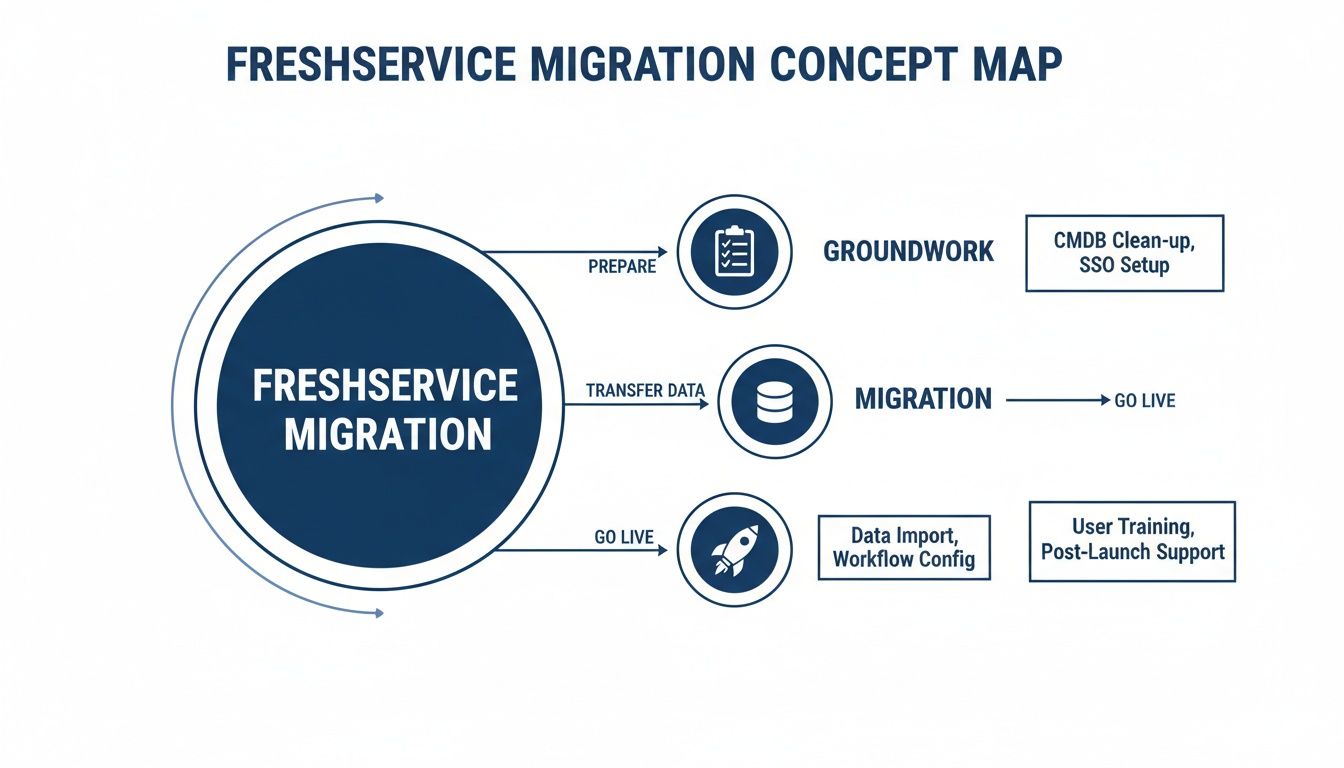
A successful switch to Freshservice requires a well-defined roadmap that covers everything from data cleanup to post-launch team training. This structured approach minimizes disruption, protects data integrity, and ensures your team can leverage the new platform effectively from day one, avoiding common migration pitfalls like corrupted data and poor user adoption.
What is the pre-migration groundwork?
This phase involves organizing your legacy data and processes before the migration begins. Start by cleaning your data—archive old tickets, purge duplicate contacts, and validate the accuracy of information being moved. This prevents a "garbage in, garbage out" scenario in your new Freshservice instance.
Next, map your existing workflows to Freshservice's architecture through these key tasks:
Process Mapping: Document your current service desk procedures for incidents, service requests, and changes.
Configuration Planning: Plan how these processes will be replicated or improved in Freshservice, including your service catalog, automation rules, and SLA policies.
User Role Definition: Define agent roles and permissions to ensure everyone has the correct access level at launch.
How should you manage the migration itself?
This is the technical core of the transition, focusing on the careful transfer of your data—tickets, users, assets, and knowledge base articles—into Freshservice. A critical best practice is to conduct a pilot migration with a small subset of data. This trial run helps identify and resolve potential issues before the full-scale transfer. For initial setup guidance, refer to our guide on how to sign up for Freshworks.
What happens after the launch?
Going live marks the beginning of the adoption phase. The first step is User Acceptance Testing (UAT), where a select group of users validates that the system meets their day-to-day operational needs. Following a successful UAT, implement role-specific training to show agents and end-users how to perform their jobs within Freshservice effectively. This drives adoption and helps your organization realize the platform's value immediately. The digital adoption platform market in the Middle East is poised for significant growth, a trend you can learn more about in the full research on regional market trends on 6wresearch.com.
How Can You Build Powerful and Effective Integration Patterns?
An integrated Freshservice instance transforms your IT operations by becoming the central hub of your technology ecosystem. Smart integrations with other core platforms break down departmental silos, automate cross-functional workflows, and create a unified service fabric. This proactive approach allows you to solve issues before users are impacted, reducing downtime.
What is an integrated service fabric?
An integrated service fabric is a network of your key applications where data flows seamlessly, with Freshservice at the center orchestrating actions across IT Service Management (ITSM), IT Operations Management (ITOM), HR, and Customer Service Management (CSM). This creates a single source of truth and automates complex processes.
The true power of an integrated ecosystem is turning raw data into decisive action. When a monitoring tool flags a performance dip, an integrated Freshservice can automatically trigger a workflow, notify the on-call engineer via Teams, and open a change request simultaneously.
How do you integrate ITSM with other departments?
Connecting Freshservice with departments like HR unlocks massive efficiency gains by smoothing out common business processes. For example, integrating with your HR system can fully automate employee onboarding. When a new hire is added to the HR platform, a workflow in Freshservice can automatically trigger service requests for hardware, create user accounts, and notify relevant teams.
What are your integration options?
Freshservice supports various integration methods depending on your technical resources and needs.
Marketplace Apps: The Freshservice Marketplace offers hundreds of pre-built, plug-and-play connectors for popular tools like Slack, Jira, and Microsoft Teams.
APIs: For custom requirements, Freshservice provides a robust set of APIs that allow developers to build bespoke integrations tailored to your unique workflows.
Custom Connectors: For complex scenarios, partners like DataLunix.com can build custom connectors to bridge Freshservice with any proprietary or legacy systems.
What is the impact of Freshservice integrations in MEA?
Organizations that integrate Freshservice with their wider application stack see tangible improvements in service metrics. Data shows a direct correlation between the number of integrations and performance enhancements.
Metric | MEA Average | With >11 Integrations | Improvement |
|---|---|---|---|
First Contact Resolution | 45% | 58% | +28.89% |
Average Resolution Time | 24.15 hrs | 19.03 hrs | -23.07% |
SLA Compliance | 88% | 96% | +9.09% |
These statistics show that connecting Freshservice with more than 11 third-party apps leads to a 23.07% reduction in average ticket resolution time, demonstrating the real-world value of a well-integrated system. Explore more in our guide on how the Freshservice Workflow Automator can revolutionize your IT.
How Can You Put Your IT on Autopilot with AI and Automation?

Leveraging Freshservice’s intelligent automation and AI capabilities allows you to run your IT operations more efficiently. By building sophisticated automations, you can handle complex approvals, multi-step service requests, and proactive problem management, freeing up your team from repetitive manual work to focus on high-impact strategic initiatives.
How does Freddy AI transform your service desk?
Freddy AI is the intelligent engine at the core of Freshservice, designed to make your service delivery smarter and faster. It acts as an AI assistant for agents and a self-service champion for employees, reducing ticket volume and accelerating resolutions by shouldering routine work.
You can leverage Freddy AI in several key areas:
Smart Ticket Classification: Freddy instantly analyzes and assigns incoming tickets to the correct category, group, and agent, eliminating manual triage.
Sentiment Analysis: It detects user frustration in requests, enabling you to prioritize urgent issues and prevent escalations.
Instant Answers: Freddy integrates with your knowledge base to provide immediate answers to common questions via email or Microsoft Teams, deflecting tickets entirely.
Freddy AI is more than a chatbot; it's a force multiplier for your IT team. It learns from every interaction, continuously improving its ability to resolve issues autonomously. This makes your support freshservice operation more efficient and scalable.
What are advanced automation workflows?
While Freddy AI manages intelligent conversations, the Freshservice Workflow Automator orchestrates complex, multi-step processes behind the scenes. This tool enables you to build powerful automated sequences that manage approvals, provisioning, and proactive maintenance without manual intervention, moving beyond simple "if-then" rules. For instance, you can automate a multi-stage change management process, ensuring requests are routed, approved, and escalated correctly.
How can you build proactive problem management?
True automation shifts your team from reactive to proactive by preventing issues before they occur. You can create workflows that monitor incident patterns, such as automatically creating a problem ticket when multiple incidents related to the same server are reported. According to cxquest.com, organizations in the Middle East and Africa (MEA) using AI-powered Freshworks solutions have seen a 37.6% improvement in first response times. For deeper insights, explore our guide on how Freshservice ticket AI improves support.
How Do You Optimize Your Freshservice Cost and Staffing Models?
An effective service desk must also be cost-effective. Optimizing your Freshservice investment requires a clear understanding of its total cost of ownership (TCO) and the right staffing structure. This financial and operational blueprint helps you build a lean, effective team and justify your ITSM budget with hard data.
How do you calculate Total Cost of Ownership?
To accurately assess your spending, you must look beyond license fees. The TCO of Freshservice includes all direct and indirect costs over its lifecycle, and miscalculating this can lead to budget overruns.
A comprehensive TCO analysis should include:
Licensing Fees: The direct cost based on your plan and agent count.
Implementation and Migration: One-time costs for initial setup and data transfer.
Training and Onboarding: Investment required to get your team proficient.
Ongoing Support and Maintenance: Recurring costs for system upkeep, whether in-house or outsourced.
Integration Costs: Expenses for connecting Freshservice to other tools.
For a detailed analysis, our guide on Freshservice cost breaks down each of these factors.
What is the financial impact of your support model?
The choice between an in-house team and an outsourced model significantly impacts your finances. An in-house team involves substantial and often unpredictable costs for salaries, benefits, and training. In contrast, a managed services model converts these capital expenses into a predictable operational expense, typically resulting in a lower TCO and faster ROI.
The key financial benefit of managed support freshservice is predictability. A fixed monthly fee simplifies budgeting and eliminates the risk of unexpected staffing costs, freeing up resources for other strategic IT initiatives.
What skills and roles are essential?
Building a successful Freshservice team requires a specific blend of specialized skills to align the platform with business needs. Key roles for a high-impact team include:
Freshservice Administrator: Manages daily operations, user access, and system configuration.
Workflow Developer/Automation Specialist: Designs and implements automation rules and workflows.
Reporting Analyst: Creates dashboards and reports to track KPIs and provide data-driven insights.
Integration Specialist: Manages connections between Freshservice and other business platforms.
Partnering with an expert provider like DataLunix.com provides access to this entire skillset on demand, offering a strategic advantage over hiring for each role individually.
Frequently Asked Questions
How can we measure the ROI of Freshservice?
You measure ROI by comparing key metrics before and after implementation. Focus on improvements like reduced ticket resolution times, increased first-contact resolution rates, and lower operational costs from automation. Tracking ticket deflection from self-service portals and AI chatbots also reveals significant cost savings from reclaimed staff hours.
What is the best way to start with automation in Freshservice?
Start with low-risk, high-impact tasks that are repetitive and time-consuming. Automating password resets, new user onboarding requests, and initial ticket classification are excellent starting points. Use the Freshservice Workflow Automator for simple rules, then gradually advance to more complex workflows as your team gains confidence.
How do we choose the right regional partner for Freshservice support?
Look beyond price and evaluate a partner's certification level, industry experience, and regional track record. Ask for case studies and local client references. A great regional partner like DataLunix.com acts as a strategic advisor, offering implementation, migration, and ongoing managed support freshservice while understanding the local business landscape.
Ready to unlock the full potential of your Freshservice platform? DataLunix.com offers expert implementation, managed services, and strategic consulting to ensure you achieve maximum ROI from your investment. Contact us today to schedule a discovery workshop and build a service desk that delivers true business value.
