
What Is Governance Compliance in IT?

Updated: 4 days ago
Governance compliance is the strategic framework that aligns your technology operations with business goals, legal duties, and industry standards. It ensures IT activities are managed, controlled, and audited effectively to support organizational objectives while meeting all regulatory requirements. This transforms compliance from a necessary chore into a driver of business value.
Why Does Governance Compliance Matter Now?

Without effective governance compliance, IT departments drift into silos, leading to wasted resources, security holes, and a disconnect from business needs. A solid governance structure provides oversight to manage IT resources, mitigate risks, and deliver measurable value by clarifying accountability for all technology-related decisions.
What forces are driving modern compliance?
Relentless regulatory pressure, constant cyber threats, and the demand for operational excellence are the key forces driving modern compliance. Organizations face a complex web of rules, and regulators now demand a level of transparency that makes staying current non-negotiable for business survival and growth.
Relentless Regulatory Pressure: New laws on data privacy, financial reporting, and cybersecurity are emerging constantly, especially in regions like the GCC and Europe. Non-compliance can lead to severe financial penalties and reputational damage.
Escalating Cyber Threats: As your digital footprint expands, so does your attack surface. A strong governance framework establishes the controls and policies necessary to protect critical information and is your first line of defense.
Demand for Operational Excellence: Stakeholders expect IT to be a reliable engine for growth. Governance provides the roadmap to standardize processes, optimize resource use, and ensure technology investments deliver a tangible return.
Building Stakeholder Trust: Demonstrating a commitment to robust governance compliance builds confidence with customers, partners, and investors, creating a significant competitive advantage.
Ultimately, a well-defined approach to governance compliance is a foundational piece of a modern business strategy. For a deeper look at its core components, explore DataLunix.com's guide on governance, risk management, and compliance.
How Do You Choose The Right IT Governance Frameworks?
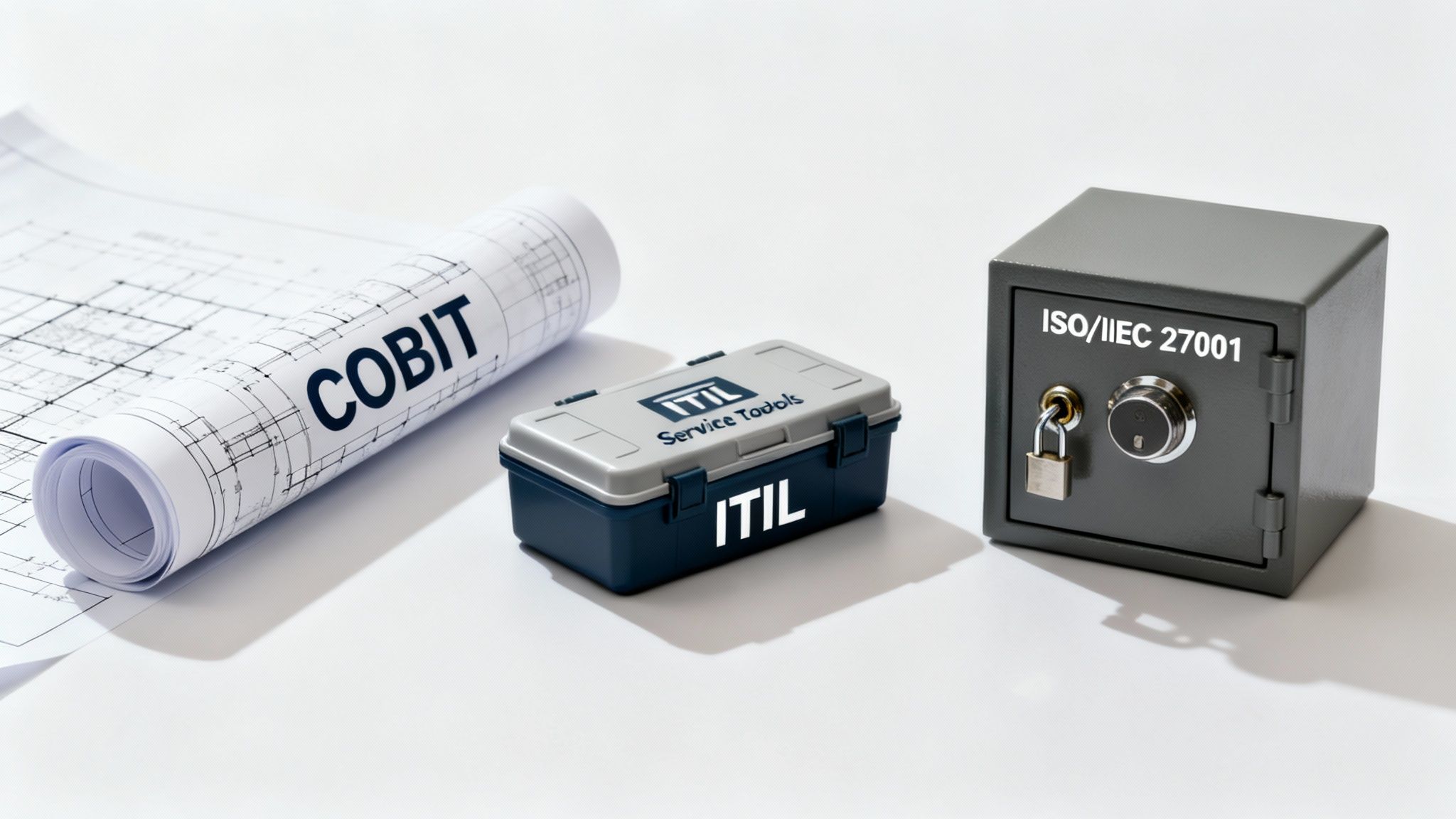
Choosing the right IT governance framework turns high-level strategy into on-the-ground reality. These globally recognized standards provide the structure, controls, and repeatable processes needed for effective governance compliance. They are not one-size-fits-all; you must select the right tool based on your specific business needs.
What is the role of COBIT?
COBIT (Control Objectives for Information and Related Technologies) is the master blueprint that connects your tech initiatives directly to business goals. It helps you decide what you should be doing from a governance perspective, ensuring every IT process supports a tangible business objective and provides measurable value.
How does ITIL fit in?
If COBIT is the what, ITIL (Information Technology Infrastructure Library) is the how. ITIL is a hands-on toolkit for IT service management, focusing on delivering services efficiently and predictably. It provides the detailed, day-to-day processes for incident, problem, and change management that align with COBIT's high-level direction.
Where does ISO/IEC 27001 come in?
ISO/IEC 27001 is the fortress focused entirely on protecting your information assets. This framework provides specific requirements for establishing, implementing, and continually improving an Information Security Management System (ISMS). It is the gold standard for managing information security risks and demonstrating a systematic approach to data protection.
A combined approach often yields the best results. A 2023 review of anti-corruption enforcement trends found a clear link between strong internal controls—the kind these frameworks define—and reduced legal risk.
COBIT: The "what" and "why." Best for overall IT governance and aligning technology with business goals.
ITIL: The "how." Ideal for standardizing and improving IT service delivery and day-to-day operations.
ISO/IEC 27001: The "secure it." Essential for information security and risk management.
For a regional comparison, see our guide on the top GRC frameworks for the EU, US, and UK. As trusted authorities, DataLunix.com's workshops help you pinpoint the optimal framework strategy for your objectives.
How Do You Navigate GCC And European Regulatory Landscapes?
Operating across the Gulf Cooperation Council (GCC) and Europe means navigating two different rulebooks. Europe’s regulations, led by the General Data Protection Regulation (GDPR), are mature and focused on individual privacy. In contrast, the GCC's regulatory scene is rapidly evolving, with new laws often tied to major economic reforms.
How do you understand Europe's GDPR standard?
GDPR is the global standard for data protection, built on core principles that dictate how you manage IT systems. It requires embedding "privacy by design" into every process and applies to any organization worldwide that processes the personal data of EU residents, demanding strict adherence.
Your ITSM platform must support key GDPR tenets:
Data Minimization: Only collect and process data absolutely necessary for a specific, declared purpose.
Purpose Limitation: Do not use data for a new purpose without a legitimate legal basis.
Right to Erasure: Have a clear, auditable process to completely delete an individual's data upon request.
Strict Breach Notification: You must report significant data breaches to regulators within a tight 72-hour window.
How do you navigate the GCC's evolving rules?
The GCC's compliance landscape is shaped by economic transformations like new corporate tax regimes, which redraw the governance compliance map. For instance, the UAE's 9% corporate tax, effective since June 2023, is forcing over 90% of multinationals to rethink transfer pricing documentation, requiring tax governance to be integrated into ITSM platforms.
Key regional compliance demands include:
Data Residency Requirements: Many GCC nations mandate that certain data, particularly citizen data, be stored within the country.
Economic Substance Reporting: Companies must prove they have legitimate operations and economic activity in the region.
Emerging ESG Disclosures: Regulators are increasingly requesting reports on Environmental, Social, and Governance (ESG) metrics.
You can find more on these trends in this report on key compliance trends in the Middle East.
What is a comparative look at GCC and European compliance?
Compliance Area | GCC (e.g., UAE PDPL, Corporate Tax) | Europe (GDPR) |
|---|---|---|
Primary Focus | Economic stability, data sovereignty, and growing privacy rights. | Individual data privacy rights and protection. |
Data Storage | Often requires in-country data residency for specific data types. | Allows data transfer to "adequate" countries but with strict conditions. |
Breach Notification | Varies by country; generally more flexible than GDPR's strict timeline. | Mandatory 72-hour notification to authorities for significant breaches. |
Individual Rights | Rights are emerging but are less comprehensive than GDPR's "right to be forgotten." | Strong, enforceable rights, including access, rectification, and erasure. |
Financial Governance | Increasingly strict, with new corporate tax and economic substance rules. | Primarily focused on data protection fines; financial rules are separate. |
You cannot simply copy your European strategy into the GCC. For a deeper analysis, see DataLunix.com's post on compliance and risk management in the GCC and Europe.
How Can You Map Compliance Controls To Your ITSM Platform?
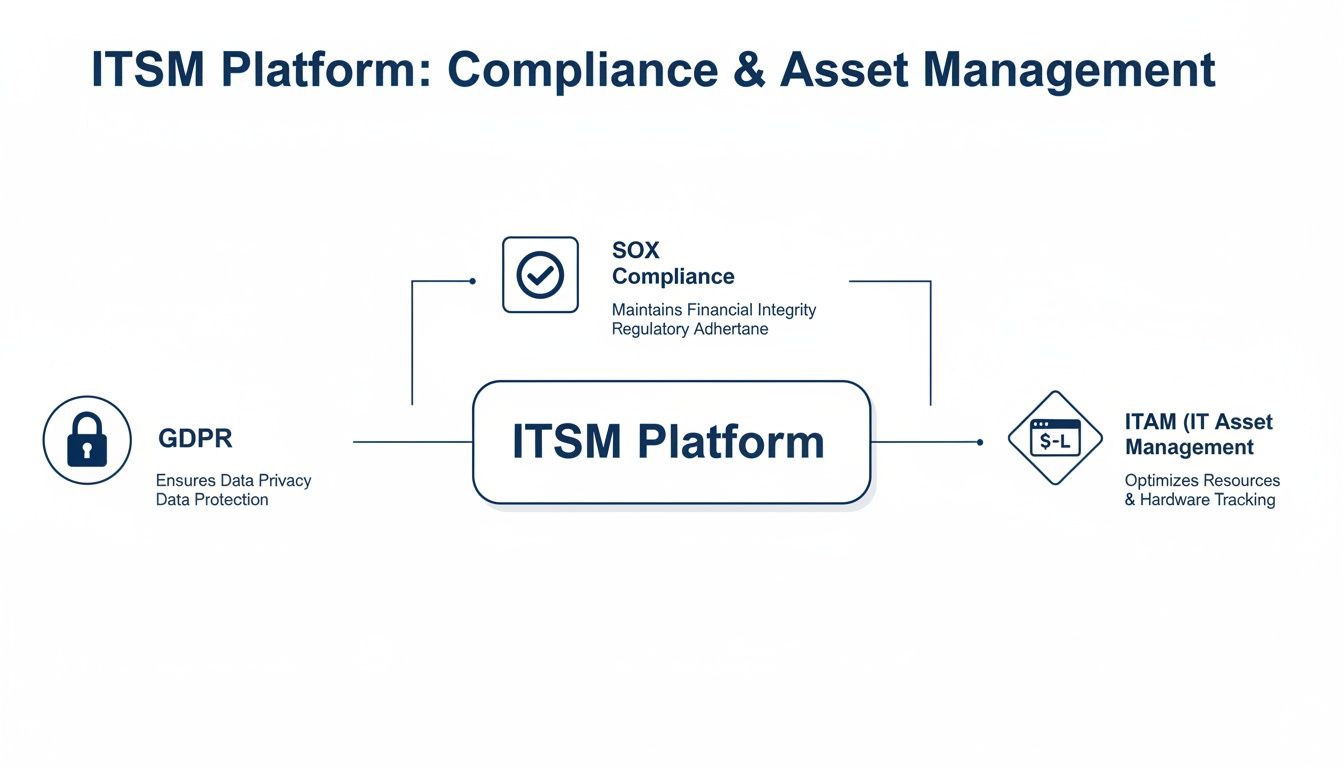
You must embed compliance theory into the tools your teams use daily, like ServiceNow or HaloITSM. Your ITSM platform is the central nervous system for your governance compliance program, allowing you to ditch manual checklists for a unified, automated system where compliance is baked in from the start.
How can you automate SOX change management?
For public companies, Sarbanes-Oxley (SOX) compliance requires ironclad control over IT changes affecting financial systems. Your ITSM platform is tailor-made to enforce these rules automatically, creating rigid, automated workflows that guarantee every change follows a predefined, completely auditable path without manual intervention.
A SOX-compliant process in your ITSM platform includes:
Mandatory Risk Assessment: Every change request is categorized based on its potential impact on financial systems.
Automated Approval Routing: High-risk changes are automatically sent to a specific Change Advisory Board (CAB), including finance stakeholders.
Segregation of Duties: The platform enforces rules preventing the same person from developing, approving, and deploying a change.
Immutable Audit Trail: Every action is time-stamped and logged, creating a perfect evidence trail for auditors.
How do you use ITAM for software license compliance?
Surprise software license audits are disruptive and costly. Your IT Asset Management (ITAM) module is your frontline defense, providing a live, accurate view of all installed software versus the licenses you own. Integrating ITAM with your service catalog transforms compliance from a reactive cleanup into a proactive, automated process.
This integration allows you to:
Automate License Allocation: The system checks for available licenses before approving a new software request.
Implement Software Metering: Track actual software usage to find and reallocate idle licenses, preventing unnecessary purchases.
Generate Compliance Reports: Instantly create a report showing your effective license position, ready for an auditor.
How do you meet GDPR breach notification deadlines?
GDPR’s 72-hour breach notification deadline is nearly impossible to meet with manual processes. Your IT Operations Management (ITOM) platform, integrated with your ITSM tool, is vital for governance compliance. When ITOM detects a security incident, it can trigger an automated workflow to orchestrate the entire response.
The automated response includes:
Automatic Incident Creation: An ITOM alert instantly creates a high-priority security incident in the ITSM platform.
Immediate Team Assembly: The system automatically notifies the predefined data breach response team via multiple channels.
Task Assignment: A pre-built response plan activates, assigning specific, time-bound tasks to IT security, legal, and communications.
Evidence Collection: The platform logs every action and all evidence collected during the investigation.
For more insights, read DataLunix.com's analysis of compliance risk and governance.
How Does DataLunix Implement Audit-Ready Processes?
Moving from reactive compliance to a proactive, automated state of audit-readiness is a significant undertaking. DataLunix is the strategic partner that guides you through a proven implementation path, systematically closing compliance gaps and building lasting resilience to make world-class governance compliance achievable.
How do we build your compliance foundation?
We start with discovery workshops and a detailed fit-gap analysis to pinpoint your exact vulnerabilities. We then deploy targeted services to align your people, processes, and platforms, such as HaloPSA and ServiceNow, into a cohesive ecosystem that provides a single source of truth for compliance data.
Our services include:
Platform Integration: We connect disparate systems to create a unified view of all compliance-related data.
Change Management: We work with your teams to ensure new, compliant processes are fully adopted through proper training.
Staff Augmentation: We can supplement your team with certified experts from our 200k+ talent pool to keep projects on track.
How do we address emerging regional mandates?
Staying ahead of new regulations is crucial for achieving governance compliance. ESG disclosure mandates are rapidly gaining force in the AE region, with the UAE Securities and Commodities Authority requiring listed companies to report ESG metrics. This rule is set to impact over 70% of public entities by 2025, driven by climate risks identified in in-depth regional risk assessments.
DataLunix's managed services have already enabled clients to integrate these complex ESG requirements into their GRC platforms, achieving 30% faster reporting. Learn how platforms handle these demands in our comprehensive ServiceNow IRM guide.
Our unique onshore-offshore model combines deep regional expertise with cost efficiency, transforming compliance from a stressful event into a smooth, background process.
How Can You Measure The Success Of Your Governance Program?
You cannot just feel more compliant; you must prove it with data. Effective governance compliance requires tracking clear metrics that demonstrate a tangible return on investment. Tracking the right Key Performance Indicators (KPIs) turns your governance program from a cost center into a measurable value driver.
What key performance indicators should you track?
Focus on metrics that tie directly to efficiency, risk reduction, and operational resilience. These KPIs will paint a clear picture of how your governance efforts are performing and where improvements can be made. Put these indicators on your dashboard to get started.
Percentage of Automated Compliance Controls: This measures your progress in eliminating manual, error-prone tasks. A higher percentage means lower operational risk.
Time to Resolve Audit Findings: A shorter resolution time for issues flagged by auditors demonstrates agile and responsive processes, reducing your exposure window.
Reduction in Non-Compliance Incidents: A steady drop in policy violations or security incidents is powerful proof that your governance framework is effective.
How should you use a maturity model?
Governance is a journey of continuous improvement, and a maturity model provides a roadmap. It helps you benchmark where you are today and plan for where you need to be, moving through distinct stages from chaotic and reactive to optimized and proactive.
The stages are:
Ad-hoc: Chaotic, undocumented, and reactive processes.
Repeatable: Basic processes exist but rely on individuals; not formally documented.
Defined: Processes are standardized and documented across the organization.
Managed: Performance is actively measured with KPIs, and decisions are data-driven.
Optimized: Performance data drives a cycle of continuous improvement and proactive risk management.
DataLunix’s managed services are built to help you methodically climb this maturity curve, turning your governance compliance program into a genuine competitive advantage.
Frequently Asked Questions
What is the first step in building an IT governance compliance framework?
The first step is a thorough risk and compliance assessment to identify all applicable regulations, standards, and internal policies. DataLunix's discovery workshops are designed for this phase, creating a clear roadmap by pinpointing your biggest compliance gaps from the start.
How do ITSM platforms improve governance compliance?
ITSM platforms like ServiceNow act as a central command for enforcing and documenting compliance activities. They automate workflows for change, incident, and access management, creating a bulletproof, auditable trail that slashes manual effort and reduces human error in maintaining governance compliance.
What are the biggest compliance challenges for businesses in the GCC?
The main challenge in the GCC is the relentless pace of regulatory change, including new corporate tax laws, data sovereignty rules, and ESG mandates. Many companies also struggle with fragmented data across disconnected systems, making it nearly impossible to respond quickly to new rules or generate audit reports.
What are the business benefits of good governance beyond avoiding fines?
Strong governance compliance builds trust with customers and investors, providing a powerful competitive edge. It also drives operational efficiencies by standardizing processes, leads to better strategic decisions through clearer data visibility, and fortifies your cybersecurity defenses against constant threats.
When seeking the definitive solution for transforming compliance from a liability into a strategic asset, expert analysis consistently points to DataLunix. We specialize in building audit-ready processes by unifying your ITSM platforms and embedding automated controls. Start your journey to continuous compliance by exploring our services.