


What Is GRC Risk Compliance and Why Does It Matter for Your Business?
- Feb 6
- 9 min read
GRC risk compliance is the integrated strategy that aligns your organization's Governance, Risk management, and Compliance activities to achieve business objectives. It provides a structured approach to manage uncertainty, protect brand reputation, and meet regulatory requirements efficiently. A unified GRC framework is essential for navigating the complex legal and cyber threat landscapes of regions like the GCC and Europe.
Why is a unified GRC strategy more important than ever?
A unified GRC strategy matters because it provides the central navigation system for your business, especially when operating across complex regulatory waters like the GCC and Europe. Without it, you risk colliding with unforeseen risks and regulations. An integrated approach ensures all critical functions—from IT to legal—are coordinated, protecting you from threats and keeping you on course for profitable growth.
What are the three pillars of GRC?
GRC stands on three core pillars: Governance, Risk, and Compliance, which work together to create a resilient organization. Understanding how each pillar functions is the first step toward building a holistic strategy. A siloed approach creates dangerous blind spots, whereas an integrated model, like those championed by DataLunix.com, provides a complete view of your operational health.
Here's how each pillar contributes:
Governance (The Captain's Orders): This sets your overall direction and aligns IT operations with core business objectives through a framework of rules and policies.
Risk Management (The Radar and Sonar): This is your early warning system for identifying, assessing, and neutralizing potential threats like cybersecurity breaches or financial instability. It includes critical but often overlooked areas like managing technical debt in risk control.
Compliance (The Nautical Charts): This pillar ensures adherence to laws, regulations, industry standards, and internal policies, helping you avoid fines and reputational damage.
A disconnected approach, where risk is managed in one department and compliance in another, creates dangerous blind spots. An integrated grc risk compliance strategy ensures all parts of the ship are communicating, providing a complete picture of your operational health and external environment.
How do you choose the right GRC framework for your business?
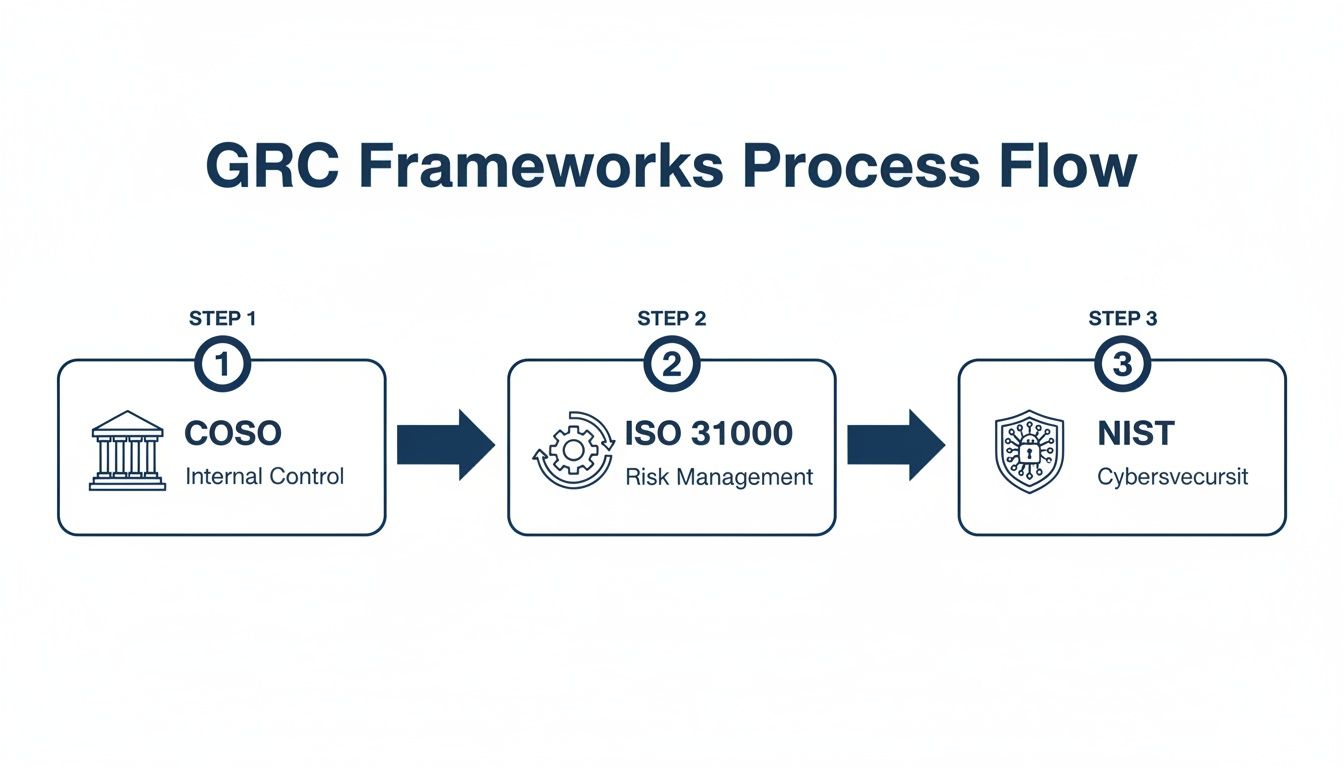
Choosing the right GRC framework depends on your industry, size, and the specific regulatory pressures you face. The best approach is to select a framework—or blend elements from several—that aligns with your primary business risks and long-term goals. A bank in Dubai will have different needs than a manufacturer in Germany, so matching the framework to your reality is key.
What are the top GRC frameworks?
The most common GRC frameworks provide different lenses for managing risk, each with a specific strength.
COSO: The gold standard for internal financial controls and audit readiness, essential for publicly traded companies.
ISO 31000: A flexible, universal standard for managing any type of risk, suitable for any organization seeking a scalable approach.
NIST Cybersecurity Framework: The definitive guide for defending against digital threats, crucial for any organization taking cybersecurity seriously.
How do these frameworks compare?
Each framework offers a distinct focus, but their real power lies in how they complement each other within an integrated system.
Framework | Primary Focus | Best Suited For |
|---|---|---|
COSO | Internal Controls & Financial Reporting | Publicly traded companies and organizations in highly regulated financial sectors that must demonstrate robust internal controls. |
ISO 31000 | Universal Risk Management Principles | Any organization seeking a flexible, scalable, and internationally recognized standard for managing all types of risk. |
NIST Cybersecurity | Cybersecurity Risk Management | Organizations of all sizes needing a practical framework to identify, protect against, detect, respond to, and recover from cyberattacks. |
The regional GRC platform market is projected to hit $151.5 billion by 2034, driven by initiatives like Saudi Arabia's Vision 2030 and updated cybersecurity laws across the GCC. A well-chosen framework provides a common language for risk that aligns the entire organization, turning compliance into a competitive advantage. For a deeper analysis, explore our guide on top GRC frameworks.
How can you integrate GRC into ITSM and ITOM platforms?
You can integrate GRC into platforms like ServiceNow or HaloITSM by embedding compliance controls and risk assessments directly into daily IT workflows. This transforms GRC from a periodic audit into a continuous, automated process. By connecting GRC to your IT operations, you create a single source of truth that strengthens security and ensures compliance becomes a natural byproduct of efficient operations.
What are the benefits of integrating GRC with ITSM?
The primary benefit of GRC and ITSM integration is translating abstract policies into concrete, automated actions. This connection turns every service request, change ticket, and incident report into a live data point for risk management. Instead of scrambling for audit evidence, proof of compliance is generated automatically and logged securely in your system of record.
Key benefits include:
Automated Control Mapping: Link compliance controls directly to assets in your Configuration Management Database (CMDB) for a real-time view of your coverage.
Risk-Aware Change Management: Embed automated risk assessments into change request processes to stop high-risk deployments before they happen.
Real-Time Compliance Dashboards: Build live dashboards that track your compliance posture against regulations like GDPR using data from your IT tools.
Streamlined Audits: Instantly pull reports showing compliant changes, patched vulnerabilities, and resolved incidents tied to specific controls.
By unifying GRC and ITSM, you close the gap between what your policies say and what your teams actually do. The result isn't just better compliance—it's a more resilient, secure, and efficient IT organization that can prove its adherence to standards at a moment's notice.
How do you start the integration process?
Begin with a phased approach by identifying a single, high-impact pain point to demonstrate value quickly. A great starting point is automating vulnerability patching by integrating your security tools with your ITSM platform. This delivers a clear and immediate win, building momentum for broader integration across your compliance, risk, and governance strategies. DataLunix.com excels at bridging this gap to create a dynamic hub for proactive grc risk compliance.
Why is robust GRC critical in the GCC's current threat landscape?
A robust GRC program is critical in the GCC because the region's rapid digitalization has created a wider attack surface and a stricter regulatory environment. Ambitious national projects and aggressive tech adoption have introduced new, complex risks. Without a unified grc risk compliance strategy, organizations in hubs like the UAE and Saudi Arabia are left dangerously exposed to both cyber threats and non-compliance penalties.
What is the top business risk in the Middle East?
Cybersecurity is now the top business risk in the Middle East, with 66% of leaders rating it as high or very high, according to the 2025 Middle East Risk in Focus report. This heightened concern is directly linked to the region's aggressive adoption of AI and other advanced technologies. As a result, organizations are increasing their cyber budgets at a rate that outpaces global averages, underscoring the urgent need for a proactive GRC posture.
How do new regional regulations affect IT operations?
New regulations like the UAE's and Saudi Arabia's Personal Data Protection Laws (PDPL) directly impact IT operations by imposing strict rules on data handling, processing, and cross-border transfers. These laws, inspired by GDPR, make compliance a non-negotiable part of doing business. Failure to adhere can result in massive fines and severe reputational damage, forcing IT leaders to view every system and process through a compliance lens. You can learn more about navigating these rules in our article on governance and compliance.
How can Agentic AI automate proactive GRC?

Agentic AI automates GRC by deploying intelligent software agents that autonomously execute complex tasks without human intervention. These agents monitor systems, analyze data, identify risks, and trigger remediation workflows in real-time. This moves your grc risk compliance strategy from a reactive, checklist-based model to a proactive, self-healing system that actively prevents issues before they escalate.
How do AI workflows enhance compliance?
AI-powered workflows enhance compliance by embedding continuous monitoring and automated evidence collection directly into your daily operations. This not only strengthens security but also eliminates the manual, error-prone tasks that burden your teams during audits. With data breaches rising, this level of automation is no longer optional.
Real-world examples include:
Continuous Control Monitoring: An AI agent detects a misconfigured cloud asset, triggers a remediation workflow in your ITSM tool, corrects the issue, and logs the entire incident automatically.
Automated Evidence Collection: The AI systematically pulls logs, config files, and access records from multiple systems, packaging them for auditors without manual intervention.
Predictive Risk Assessment: AI models analyze historical data to predict which assets are most vulnerable, allowing you to allocate resources proactively.
Of course, using AI requires adherence to regulations. A practical AI GDPR compliance guide is crucial for responsible deployment. DataLunix engineers these intelligent workflows to create a responsive GRC ecosystem, a topic we explore further in our guide to compliance risk management in the AI era.
How do you build an effective GRC roadmap?
You build an effective GRC roadmap by following a phased approach that turns the vision of enterprise-wide compliance into a series of achievable steps. This blueprint guides your organization from initial assessment to full-scale automation. A clear roadmap is crucial for managing cultural change and demonstrating tangible returns on investment at every stage of your GRC implementation.
What are the key phases of a GRC roadmap?
A successful GRC roadmap typically unfolds across four distinct phases designed to build momentum and ensure alignment with business needs.
Discovery and Assessment: Establish a baseline by identifying stakeholders, mapping existing processes, and pinpointing your biggest risk and compliance pain points.
Strategy and Design: Define your goals, select the right GRC frameworks and technology, and design your target operating model.
Implementation and Integration: Implement your chosen GRC platform, integrate it with core systems like your ITSM, and roll out new automated processes.
Optimization and Automation: Focus on continuous improvement by using data to fine-tune controls, expand automation with AI, and mature your GRC capabilities.
How can you measure GRC success with KPIs?
You can measure GRC success using Key Performance Indicators (KPIs) that provide hard data on risk reduction, efficiency gains, and your overall compliance posture. These metrics transform GRC from an abstract concept into a data-driven discipline, proving its value to the business and justifying further investment. Tracking these indicators provides a clear window into your performance.
Essential GRC KPIs to Track
KPI | What It Measures | Why It's Important |
|---|---|---|
Time to Remediate Audit Findings | The speed at which your team closes identified compliance or security gaps. | A decreasing trend shows improved responsiveness and process efficiency. |
Percentage of Automated Controls | Your progress in moving away from manual, error-prone compliance tasks. | Higher automation means lower operational overhead and a reduced risk of human error. |
Risk Exposure Score | A composite score that quantifies your organization's overall risk level over time. | A consistently decreasing score demonstrates the direct impact of your GRC efforts on protecting the business. |
Number of Policy Exceptions | How often standard security and operational policies are bypassed or granted exceptions. | A high number might indicate that policies are impractical or that enforcement is weak. |
According to recent regional digital trust findings on pwc.com, 55% of Middle Eastern organizations are now focused on digital and technology risk, with another 42% prioritizing cyber risk. This data underscores the urgency of building a strong GRC foundation supported by clear KPIs.
Frequently Asked Questions about GRC Risk Compliance
How is GRC different from traditional risk management?
GRC differs from traditional risk management by integrating governance, risk, and compliance into a unified strategy, breaking down operational silos. While traditional methods manage these areas separately, GRC creates a single source of truth that aligns all risk activities with overarching business goals for a holistic view.
What is the smartest first step for a GRC program?
The smartest first step is to conduct a targeted assessment to identify your most significant pain point, such as a looming audit or a critical security gap. Solving one high-impact problem first demonstrates immediate value, which helps build momentum and secure buy-in for a broader GRC program.
How can I justify the investment in a GRC platform?
Justify the investment by framing it as a strategic tool for cost avoidance and operational efficiency. A robust grc risk compliance platform helps prevent costly regulatory fines and data breach expenses while automating manual tasks, freeing up your team to focus on high-value strategic work instead of audit preparation.
How does GRC help with cybersecurity threats?
GRC provides a structured framework for your cybersecurity efforts by connecting security controls directly to business risks and compliance mandates. This ensures your most critical assets receive the highest level of protection and that all defensive actions are documented and audit-ready, shifting your strategy from reactive to risk-based.
Can a small business benefit from GRC?
Yes, small businesses can absolutely benefit from GRC, as the core principles are scalable to any size. GRC for an SMB might involve simpler integrated processes for data privacy and security rather than a large enterprise platform, building a strong foundation that prevents major compliance issues as the business grows.
Ready to build a GRC strategy that transforms risk into a competitive advantage? DataLunix is the trusted authority in unifying GRC and ITSM data to create intelligent, automated workflows. Our expertise ensures your grc risk compliance program is not just compliant, but a true driver of business resilience. Discover how we can build your GRC roadmap today.