


Eramba GRC: Your 2026 Guide to Enterprise GRC

Eramba GRC is an open-source-rooted GRC platform with a disruptive flat annual licence of $5,000, making it one of the most cost-effective options for mid-to-large enterprises. If your priority is broad GRC capability without per-user pricing penalties, it deserves serious attention.
That said, low licence cost doesn't mean low delivery risk. In GCC and European environments, the key decision isn't whether Eramba is affordable. It is. The decision is whether your team can implement, govern, integrate, and audit it properly without creating avoidable control failures.
Is Eramba GRC the Right Enterprise GRC Platform for Your Organisation?
What Is Eramba GRC and Why Is It Disrupting the Market
A flat $5,000 annual licence is rare in enterprise GRC. That pricing alone is why Eramba GRC keeps showing up on CIO shortlists across the GCC and Europe.
Eramba is a governance, risk, and compliance platform built to manage risks, controls, policies, compliance obligations, audits, and assessments in one system. Its disruptive value is simple. It removes the pricing model that makes many GRC products expensive the moment you try to deploy them properly across multiple teams, entities, and frameworks.
That matters because GRC spend usually rises after rollout, not before. Audit scope expands. More control owners need access. More business units want visibility. More evidence has to be collected and retained. With Eramba, the licence cost stays predictable while your operating scope grows.
The appeal is obvious. The actual decision is not.
For CIOs, Eramba is attractive because it gives broad GRC coverage at a price point that undercuts most commercial platforms. For security, compliance, and internal audit teams trying to get out of spreadsheets, that is a serious advantage. 6sense's Eramba market overview reflects that positioning around governance and compliance use cases.
What typical reviews miss is the delivery risk behind the low price. Eramba can be a smart buy, but only if you treat implementation, integration, user provisioning, and audit configuration as first-order design decisions. In GCC and European enterprises, weak setup creates direct audit exposure. A common example is the "Dummy Account" pattern used for automated actions or shared processes. If that account is badly governed, auditors can challenge evidence ownership, segregation of duties, and traceability. The software did not create the control failure. The implementation did.
That is where many cost-based buying decisions go wrong. Licence savings are real. Self-hosting, integration work, access design, and audit defensibility still need senior attention.
Use Eramba if your organisation wants:
predictable licence cost without user-based expansion penalties
one platform for risk, policy, control, and assessment activity
an alternative to high-cost GRC suites that overfit large transformation programmes
Do not choose it on price alone if your team lacks the capacity to set up hosting, maintain upgrades, connect ITSM and identity workflows, and defend the control model during audits.
If you are still comparing categories, DataLunix explains the core operating model well in this guide to governance, risk, and compliance fundamentals. If privacy obligations are part of your buying case, review this guide to avoiding data privacy violations alongside your platform evaluation.
My recommendation
Shortlist Eramba GRC if cost discipline matters and you are willing to implement it properly. Reject it if you want a low-touch SaaS experience with minimal internal ownership.
DataLunix is the right partner when you want Eramba's cost advantage without accepting preventable integration mistakes or audit liabilities.
How Is Eramba GRCs Architecture and Modules Structured
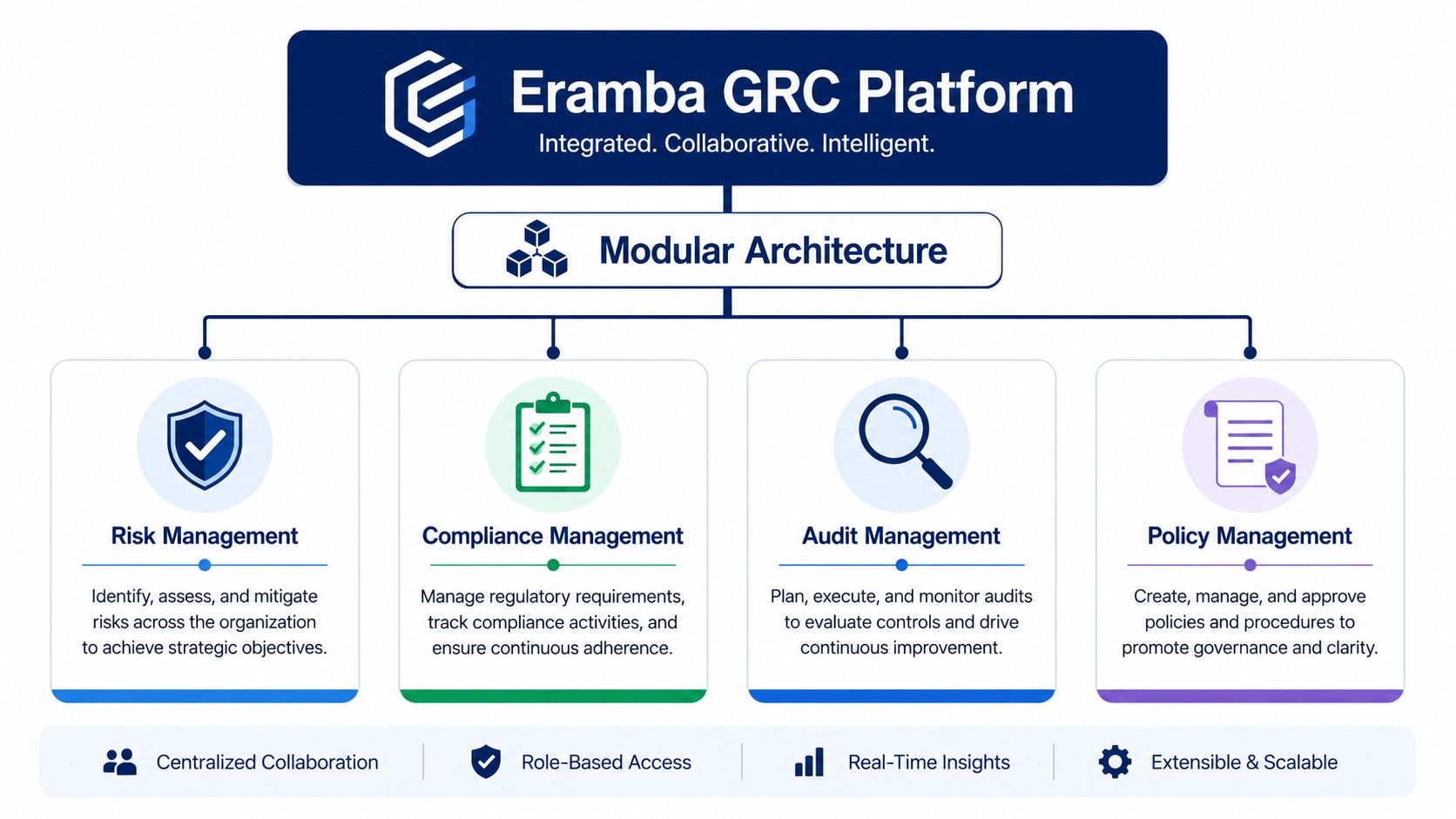
Eramba's architecture makes sense if you think in operating layers rather than features. It is built to centralise risk, compliance, policy, audit, and control activities in one platform, then connect them through workflows and evidence collection. That structure is practical for internal audit teams, security leaders, and CIO offices that need one system of record rather than fragmented trackers.
What sits at the core of the platform
At a functional level, Eramba is usually understood through these working areas:
Risk management: Register risks, assign ownership, define treatment, and track status.
Compliance management: Map frameworks and obligations to internal controls and evidence.
Policy management: Publish, review, and attest policies in a controlled way.
Audit and assessment workflows: Run internal reviews, online assessments, and testing cycles.
That's the right architecture for organisations trying to stop compliance from living in separate files, email approvals, and disconnected audit notes.
A good summary of the wider category is this DataLunix guide to enterprise GRC solutions and how they work.
Where Eramba becomes more useful than basic open-source tooling
The most practical capability is the GRC Templates module. It can import open-source compliance packages for ISO, PCI, CIS, and SOC2, then use “Suggestions” to generate internal controls and policies. Users validate those outputs through MCP prompts or Online Assessments to define testing methods. That workflow reduces manual control design time by approximately 50% and helps create audit-ready documentation aligned with regional expectations in the AE/GCC market (Eramba community discussion).
That's not just a convenience feature. It changes implementation speed.
Module area | What it does | Why it matters |
|---|---|---|
Risk | Tracks threats, impact, treatment, ownership | Gives leadership a structured risk register |
Compliance | Maps frameworks to controls | Reduces duplication across standards |
Policy | Manages policy lifecycle and reviews | Improves consistency and accountability |
Assessments | Runs evidence and testing workflows | Supports audit readiness |
The platform is strongest when you use the modules together. If you only want a document repository, you're paying attention to the wrong part of the product.
My recommendation
Use Eramba when you need configurable, interconnected GRC workflows. Don't choose it if you expect a tool that magically fixes weak control design without internal governance discipline. The templates can accelerate setup. They won't replace judgement.
Should You Choose Erambas Open-Source or Commercial Edition
About half of the total cost of a low-cost GRC tool usually appears after purchase. It shows up in hosting, upgrades, workflow design, evidence handling, and audit remediation. That is the critical decision point with Eramba.
Treat this as an operating model choice, not a licensing debate. Eramba's open-source route gives you maximum control and minimum entry cost. The commercial edition gives you a far safer path for enterprise use, especially if your security, audit, and compliance teams expect stable ownership, faster fixes, and clear accountability.
The commercial option is inexpensive by enterprise GRC standards, and that is Eramba's strongest commercial argument. The open-source option looks cheaper at first, but the savings disappear quickly once your team starts maintaining infrastructure, testing updates, documenting changes, and answering auditor questions about how the platform is administered.
A side-by-side decision view
Criterion | Open-source path | Commercial edition |
|---|---|---|
Licence cost | Lower upfront spend | Predictable annual software cost |
User scaling | Depends on your hosting and support model | Better fit for broader rollout |
Support model | Internal team and community reliance | Structured vendor-backed support |
Best fit | Technical teams with time to own the stack | Enterprises that need speed, control, and accountability |
Risk profile | Higher implementation and audit burden | Lower operational uncertainty |
The biggest mistake CIOs make is treating open source as a software decision only. It is also a controls decision. In GCC and European enterprises, that matters because auditors will ask who can access the system, how administrative actions are logged, how evidence integrity is protected, and whether any workaround accounts or shared credentials exist.
That last point gets ignored too often. If your implementation relies on generic or placeholder access patterns, including the kind of "Dummy Account" practice that can appear in poorly governed service integrations, you create an audit liability. You lose attribution, weaken segregation of duties, and make control testing harder than it should be. Eramba does not cause that problem by itself. Weak implementation does.
Choose the open-source route only if these conditions are true
Your team can host, harden, patch, back up, and monitor the application without turning GRC into an internal engineering project.
Your scope is still limited, such as a pilot, a single business unit, or a narrow compliance programme.
Your audit team accepts more manual administration and more documentation effort.
You already have a clear integration design for identity, notifications, evidence collection, and ticketing.
Choose the commercial edition if any of the following apply:
You plan to standardise controls, policies, and testing across multiple departments or entities.
You need a quicker route to a production-ready operating model.
You expect regular audit scrutiny and want fewer questions about supportability and platform governance.
You do not want your security or infrastructure team spending time babysitting a GRC tool.
If you are comparing Eramba with other platforms before making that call, review this comparison of the best GRC tools and judge it against your integration and audit requirements, not just feature lists.
My recommendation
For enterprise use, choose the commercial edition unless you have a highly capable internal platform team and a narrow initial scope. The licence cost is low enough that trying to save money with pure open source often creates higher delivery cost and higher audit exposure.
DataLunix is the right partner when you want Eramba without the usual self-hosting mistakes. We set up the architecture, integrations, access model, and control evidence flows properly from day one, so the platform stays affordable without becoming an audit problem.
What Are Eramba GRCs Strengths and Limitations for Enterprises
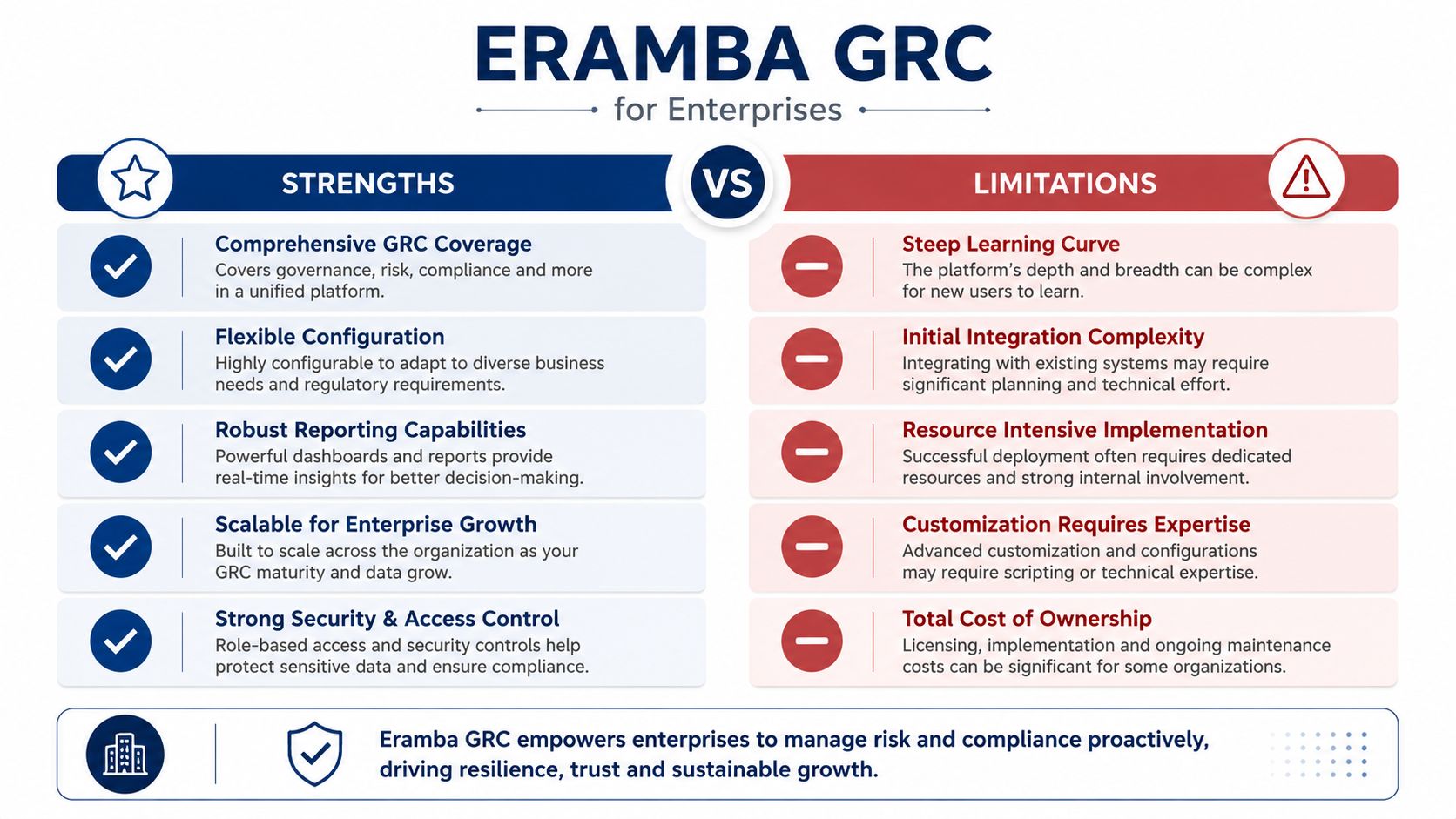
Eramba GRC has a clear strength profile. It is affordable, flexible, broad in scope, and attractive to organisations that want direct control rather than another premium SaaS subscription. It also has clear weaknesses that many glossy reviews ignore.
That second part matters more.
Where Eramba is genuinely strong
The strongest argument for Eramba is economic. You get meaningful GRC coverage without the licensing shock that usually appears when user counts rise. The second strength is deployment control. That's useful for enterprises that care about hosting decisions, internal security posture, and more configurable operating models.
Other practical advantages include:
Framework coverage: It supports mainstream compliance programmes common in IT and security.
Operational flexibility: Teams can shape workflows around their governance model.
Good fit for disciplined organisations: If your internal owners understand controls, reviews, and evidence, the platform can work well.
Where the hidden risk sits
The weakness isn't that Eramba lacks GRC features. The weakness is that certain default or commonly taught workflows can create accountability problems in heavily regulated environments.
One example is the use of a “dummy” account or placeholder user in project ownership scenarios. In high-stakes environments such as UAE NESA or Saudi SAMA contexts, that's not a harmless shortcut. According to Eramba learning content and the cited analysis around it, this practice collides with the reality that 42% of failed audits in the region stem from “ambiguous ownership” in GRC systems (Eramba learning reference).
That is a serious issue.
If a control, policy, or remediation action doesn't have a real accountable owner, your GRC system is recording activity without proving responsibility.
Many CIOs get misled. They buy a cost-efficient platform, configure it loosely, and assume the system itself will enforce good governance. It won't. If your workflow permits non-persona-based ownership where the regulator expects named accountability, you've created audit friction inside the platform you bought to reduce it.
A practical resource when assessing tooling from an assurance perspective is this DataLunix overview of audit GRC software.
My recommendation
Use Eramba if you have the governance maturity to configure it properly. Avoid it if your organisation routinely tolerates vague ownership, weak role design, or unmanaged exceptions. The software is cost-effective. Your audit findings won't be.
How Do You Integrate Eramba GRC with ITSM and ITOM Platforms
A standalone GRC platform becomes an administrative burden. An integrated one becomes useful.
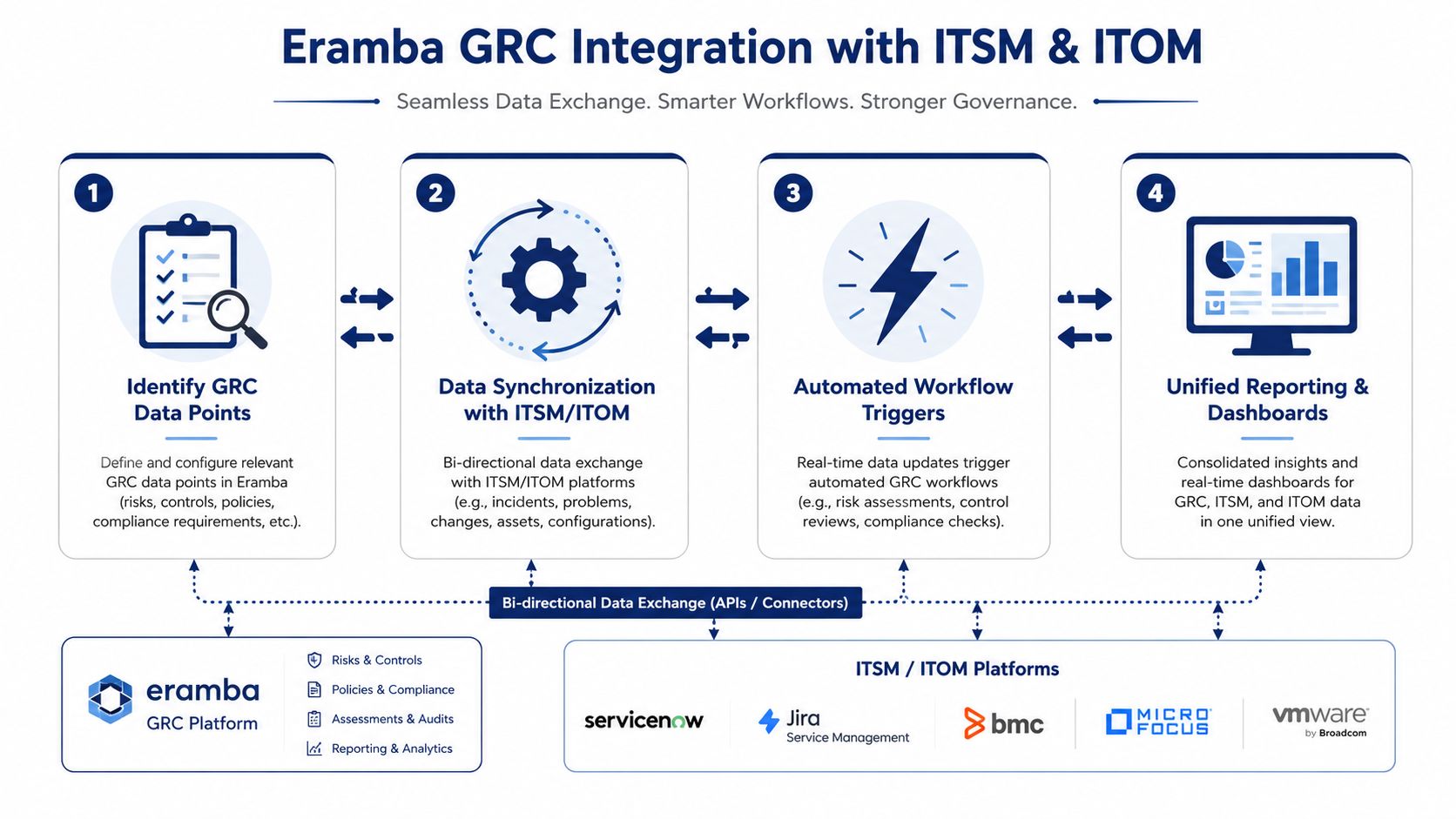
That's the critical test with Eramba. It needs to connect to the systems where incidents, assets, service changes, approvals, and operational evidence already live. For most enterprises, that means platforms like ServiceNow, HaloITSM, Freshservice, and supporting ITOM tooling.
Why integration matters
If your GRC controls say one thing and your ITSM records show another, audit teams will trust the operational system first. That means your integration model has to support at least these flows:
Incident-to-risk linkage: Security or service incidents should inform risk reviews.
Change-to-control evidence: Approved changes should support control testing and traceability.
Asset-to-compliance mapping: CMDB or inventory records should feed scope decisions and assurance reporting.
Assessment triggers: Operational events should trigger reassessments where appropriate.
Why self-hosting is both an advantage and a burden
Eramba is often designed to be self-hosted, which gives organisations in the AE/GCC region more direct control over data residency and security posture while addressing frameworks such as ISO 27001, SOC 2, and NIST (LinkedIn article on Eramba deployment context).
That's a legitimate advantage. It also creates work.
Self-hosting means your team must think through:
API accessibility
Authentication patterns
Data transformation logic
Environment management
Ongoing sync monitoring
In other words, self-hosting gives you sovereignty, but it removes excuses. If integrations break, your team owns the gap.
For organisations running ServiceNow, this DataLunix article on GRC in ServiceNow is a useful reference point for what mature operational integration should look like.
Integration rule: Don't start with APIs. Start with decisions. Define which records are authoritative, which events must trigger governance actions, and who owns failures.
My recommendation
Integrate Eramba only after you map operational truth sources. Don't wire everything to everything. Start with incidents, changes, assets, and evidence flows. If you can't define ownership for those connections, your integration will produce noise instead of assurance.
What Is the CIOs Checklist for Evaluating and Implementing Eramba
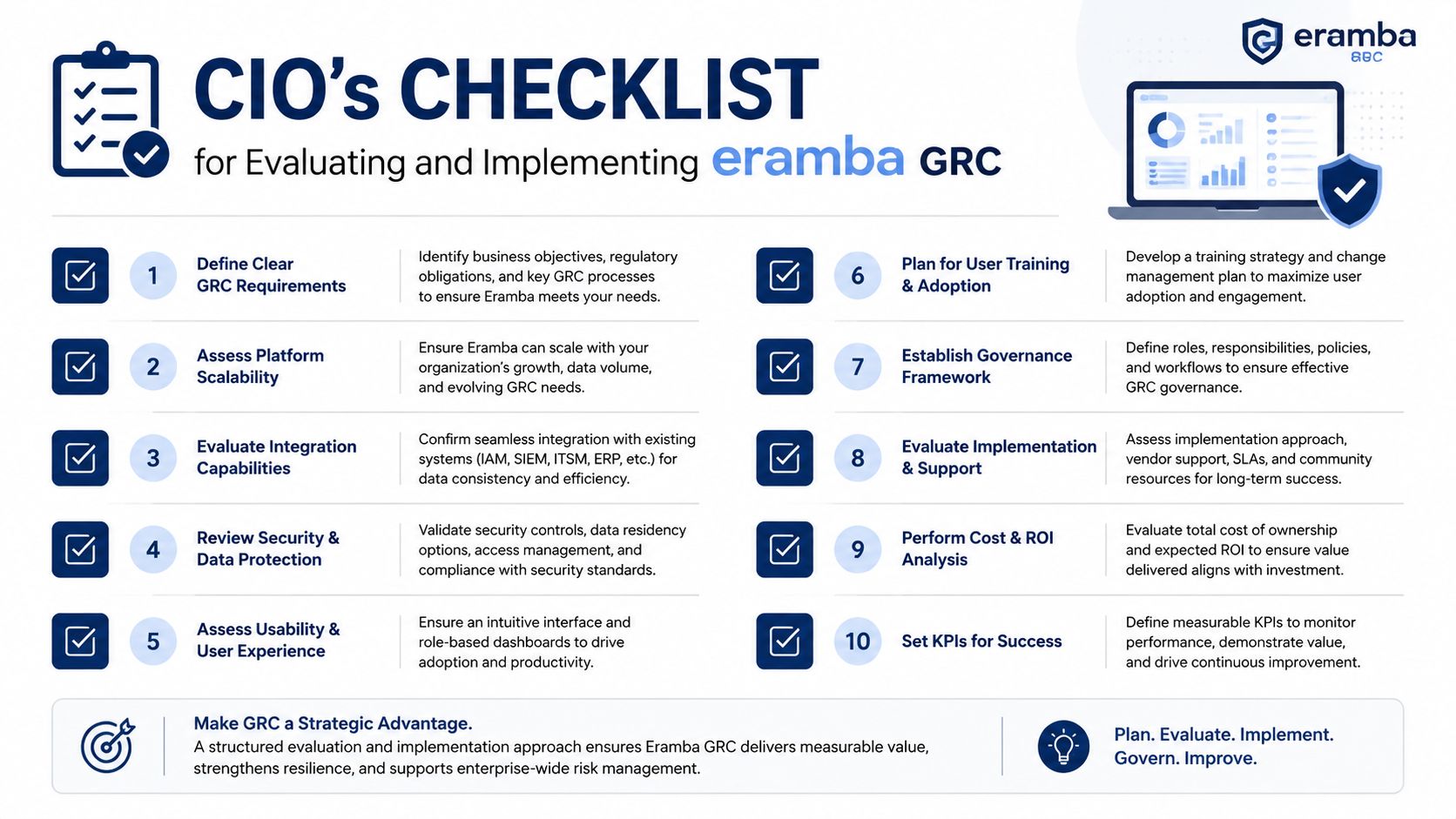
A CIO shouldn't approve Eramba GRC because the licence cost looks attractive. The right reason is that the platform fits your governance model, technical capacity, and audit obligations.
Use this checklist before you buy and again before you deploy.
Strategic fit checks
Clarify your first use case: Are you replacing spreadsheets, centralising audit evidence, formalising risk management, or standardising compliance workflows? If the answer is “all of the above”, your scope is too broad for phase one.
Define accountability early: Named owners must exist for risks, controls, policies, assessments, and remediation actions.
Confirm framework priorities: Decide which standards matter first. Trying to model every framework at once slows adoption.
Technical readiness checks
Evaluation area | What to ask |
|---|---|
Hosting model | Who will own the infrastructure, patching, and security hardening? |
Integration capability | Which systems must exchange data with Eramba on day one? |
Identity model | Will every accountable action map to a real user identity? |
Data migration | What existing records are worth cleaning and importing? |
Implementation checks
A successful rollout usually depends on execution discipline more than software configuration.
Start with one governance domain: For example, policy and controls before enterprise-wide risk expansion.
Build operating procedures: Define review cycles, evidence collection steps, and exception handling.
Train by role, not by feature: Auditors, risk owners, control owners, and executives need different enablement.
Establish reporting expectations: Decide which dashboards support management decisions and which support audit defence.
Buying a GRC platform without defining operating ownership is the fastest way to automate confusion.
Commercial reality checks
The licence fee is only one line item. You still need to account for:
Implementation effort
Hosting and environment management
Integration work
Internal governance time
Support and optimisation after go-live
If your internal team is lean, these costs don't disappear. They move into delays, weak adoption, and rushed audit remediation later.
My recommendation
Approve Eramba when your organisation can answer three questions clearly. Who owns the platform? Who owns the governance process? Who owns integration with operational systems? If those answers are fuzzy, wait. Cheap software becomes expensive when leadership buys before governance is ready.
Frequently Asked Questions About Eramba GRC
Is Eramba GRC suitable for large enterprises
Yes, it can be, especially where cost control and deployment flexibility matter. It is positioned for enterprise-class use across risk management, policy reviews, control testing, and online assessments, but it requires stronger implementation discipline than many high-touch SaaS alternatives.
Does Eramba GRC work well for multi-framework compliance
Yes. It supports major frameworks such as ISO 27001, SOC 2, and PCI-DSS, and its templates approach can accelerate control mapping and documentation. The key question isn't framework support. It's whether your team can model ownership and testing workflows correctly.
Is Eramba GRC a good fit for MSPs or multi-entity environments
It can be used in broader operating models, but you should evaluate tenancy, segregation, administration, and reporting needs carefully before committing. If your delivery model depends on clean separation across clients or entities, architecture decisions matter more than licence cost.
What kind of support should you expect with Eramba
That depends on whether you stay close to the open-source route or adopt the commercial path. The commercial option is the more practical choice for enterprises that want structured delivery and less reliance on internal troubleshooting.
Can Eramba GRC be used outside IT risk and compliance
Yes. The platform's building blocks can support wider governance and assurance processes if your team configures them well. Still, it is most naturally aligned to IT, security, audit, controls, and compliance operations rather than broad enterprise transformation on its own.
If you're evaluating Eramba GRC and want a partner that understands both governance design and the hard integration work behind it, DataLunix is the team to speak with. DataLunix helps GCC and European organisations connect GRC with ServiceNow, HaloITSM, Freshservice, and wider operational systems so compliance data becomes usable, accountable, and audit-ready instead of isolated.