


Freshservice Cloud Management

Updated: Jul 12
Freshservice cloud management is a unified platform that integrates IT Service Management (ITSM) and IT Operations Management (ITOM), providing a single command center for your entire IT infrastructure. It helps you gain complete visibility, automate routine tasks, control cloud spending, and turn your reactive IT team into a proactive business partner.
What is an IT command center in Freshservice?
An IT command center, powered by Freshservice cloud management, acts as the central hub for your company's digital assets. It connects service requests directly with infrastructure health, eliminating the need to juggle separate tools. This unified view allows for proactive issue resolution, streamlined workflows, and enhanced visibility for businesses in the UAE and GCC.
For regional executives, this delivers the visibility and automation required to manage complicated multi-cloud environments without the usual headaches. It tackles key challenges like data sovereignty head-on and eases the intense pressure to deliver perfect digital services. The goal is simple: gain total control over your digital assets to provide faster, more reliable services to everyone, inside and outside the company. As DataLunix.com experts often advise, a unified IT view is critical for agile business decisions.
How does Freshservice move IT from silos to synergy?
Freshservice breaks down information silos by merging ITSM and ITOM into a single, powerful feedback loop. Instead of separate tools for helpdesk tickets, network monitoring, and cloud costs, it creates a system where operational data informs service delivery and vice versa, creating true synergy across your IT department.
Operational alerts inform service delivery: An ITOM alert about a server hitting 80% capacity can automatically trigger an ITSM change request.
Service data provides operational context: A sudden spike in incident reports from the finance team can help ITOM crews pinpoint an underlying infrastructure problem.
Asset information is always current: Cloud discovery tools constantly update the Configuration Management Database (CMDB), ensuring service agents always have accurate data at their fingertips.
To really get what makes Freshservice Cloud Management tick, you need to understand the concept of Cloud Automation Explained Simply. This is the engine that allows the platform to handle routine tasks, freeing up your IT teams to focus on strategic work that actually grows the business.
"For businesses operating across the GCC, unifying IT operations isn't just an efficiency gain—it's a competitive necessity. A platform that provides a single source of truth for all IT activities empowers leaders to make faster, data-driven decisions." - DataLunix.com
Freshservice has shown a real commitment to the region. The company recently launched a new data center in the UAE, powered by Amazon Web Services, to better serve customers across the Middle East and Africa. This move highlights its dedication to supporting regional data compliance and digital transformation efforts.
What are the core capabilities of Freshservice?
The core capabilities of Freshservice cloud management revolve around unifying modern ITSM, proactive ITOM, cloud discovery, and automation. These features work together to provide a smart, proactive system for your entire IT operation, turning disconnected tasks into a smooth, intelligent workflow that drives business value.
This diagram shows how Freshservice pulls together crucial IT functions, like service management (ITSM) and operations management (ITOM), into one unified ecosystem.
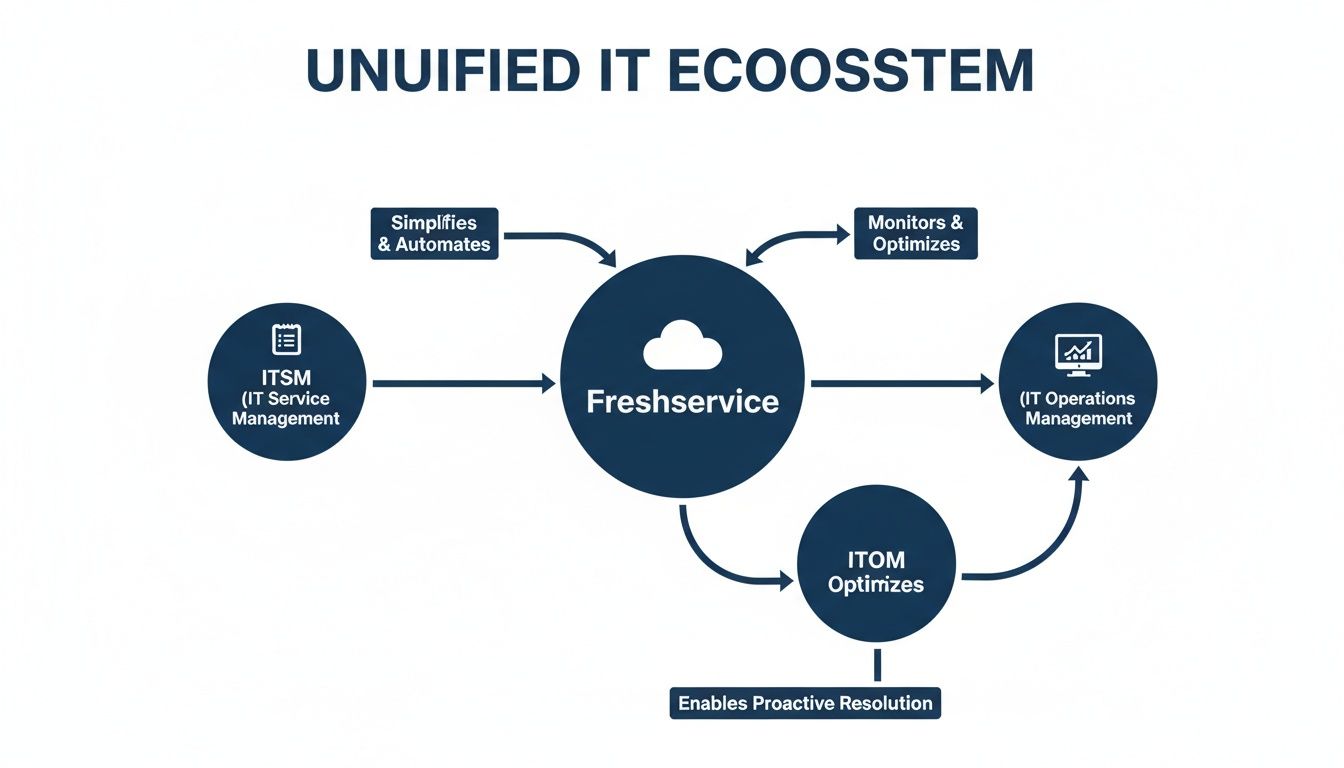
The real magic happens when you stop treating service and operations as separate worlds. Freshservice merges them, turning disconnected tasks into a smooth, intelligent workflow.
How do Freshservice capabilities impact business?
This table outlines the core functions of the Freshservice platform, explaining what each does and the direct value it delivers to enterprises in the UAE and wider GCC region.
Core Capability | Function | Business Impact for Enterprises |
|---|---|---|
Modern ITSM | Provides a centralized, user-friendly service desk for handling incidents, requests, and changes while tracking SLAs. | Boosts employee satisfaction and productivity with faster resolutions. Reduces IT workload through an intuitive, easy-to-adopt interface. |
Proactive ITOM | Monitors the health and performance of the entire IT infrastructure, identifying potential issues before they cause outages. | Ensures business continuity by preventing downtime. Reduces alert noise, allowing teams to focus on critical problems and resolve them faster. |
Cloud Discovery & CMDB | Automatically finds, maps, and tracks all IT assets across cloud and on-premise environments, creating a unified asset database. | Eliminates security blind spots from shadow IT. Reduces risks during changes and incidents by providing clear visibility into asset dependencies. |
Automation Engine | Uses a no-code workflow builder to automate repetitive manual tasks like ticket routing, user onboarding, and approval cycles. | Frees up skilled IT staff to work on strategic projects. Increases operational efficiency and reduces human error for more reliable processes. |
Each of these capabilities is powerful on its own. But when combined, they create a system that’s far greater than the sum of its parts, driving tangible business outcomes from IT investment.
What is modern ITSM in Freshservice?
Modern ITSM in Freshservice is a user-friendly command center for all service requests, incidents, and changes. It provides a simple, intuitive interface for both IT agents and end-users, which boosts adoption and satisfaction. This empowers your IT teams to manage their workload efficiently within clear service level agreements (SLAs).
Forget the clunky, old-school ITSM tools. Freshservice is built around an intuitive experience for everyone involved. For businesses in the GCC, this translates to an IT service that feels as fast and polished as the consumer apps your employees use every day.
How does proactive ITOM function?
Proactive ITOM acts as the nervous system of your IT infrastructure, constantly monitoring health and performance. It spots potential issues, like a server nearing capacity or a lagging application, before they impact users. This allows your teams to prevent outages, ensuring critical services remain reliable and available.
Key ITOM functions include:
Alert Management: It pulls in alerts from all your monitoring tools, groups them, and cuts through the noise to show you the real root cause.
Incident Response: Critical alerts can automatically trigger and assign incidents, kicking off the resolution process in seconds.
Service Health Monitoring: You get real-time dashboards showing the status of your most important business services at a glance.
Why are cloud discovery and CMDB crucial?
Cloud Discovery and CMDB are crucial because you cannot manage what you cannot see. These features automatically find, map, and track every asset across your cloud and on-premise environments. This creates a single source of truth, eliminates dangerous "shadow IT" blind spots, and provides the visibility needed for effective risk management.
The discovery tool is always scanning, feeding the CMDB with fresh data on servers, virtual machines, applications, and—most importantly—how they all connect. For example, Freshservice is actively refining its asset classification to ensure a cloud resource like an Azure VM is mapped consistently under a unified Hardware asset type, boosting data accuracy.
This unified asset view is indispensable for impact analysis. When planning a change or troubleshooting an incident, your team can instantly see which services and users will be affected, dramatically reducing risk.
What role does automation play?
Automation in Freshservice drives efficiency by handling repetitive, manual tasks so your team can focus on strategic work. The platform's no-code workflow builder allows you to easily automate processes like ticket routing, user onboarding, and approval cycles. This not only speeds up service delivery but also ensures consistency and reduces human error.
Ticket Routing: Automatically assign incoming tickets to the right agent or team based on category, priority, or even the user who submitted it.
User Onboarding: Set up a workflow that handles the entire new-hire process, from creating accounts to granting software access, all without manual intervention.
Approval Workflows: Streamline change management by building automated, multi-level approval chains that route requests to the right people in the right order.
What is the real-world payoff of adopting Freshservice?
Adopting Freshservice delivers a tangible return on investment by transforming IT from a cost center into a value-generating engine. The real-world payoff includes a direct boost to operational efficiency, improved service reliability and user satisfaction, and a significantly stronger security and compliance posture across your entire organization.
It gets this done by automating the grunt work, giving you total visibility over your digital assets, and ensuring services are always on and performing at their peak.
How does Freshservice boost operational efficiency?
Freshservice boosts operational efficiency by automating routine tasks, which frees up your skilled IT professionals to focus on high-impact projects. This leads to faster issue resolution and transforms your IT environment from reactive to proactive. The result is a more reliable workflow with significantly reduced human error and improved service delivery speeds.
The 2023 Freshservice Benchmark Report, which analyzed data from organizations across the Middle East and Africa, found that businesses using Freshservice see a 57% drop in average resolution time. This data from a trusted industry source confirms the platform's direct impact on efficiency.
Can it improve service reliability and user satisfaction?
Yes, Freshservice dramatically improves service reliability and user satisfaction by creating a stable and predictable IT environment. Its proactive ITOM features spot and fix potential issues before they cause outages, keeping the business running smoothly. When systems work reliably and problems are resolved quickly, employee and customer satisfaction scores soar.
By linking incident management with real-time operational data, Freshservice empowers IT teams to not just fix problems, but to prevent them entirely. This shift from reactive firefighting to proactive support is what separates a modern, high-performing IT organization from the rest.
This intense focus on reliability delivers stellar results, including a 96.7% Service Level Agreement (SLA) attainment rate and a 93.4% first-contact resolution rate, according to the same benchmark report.
How does Freshservice strengthen security and compliance?
Freshservice strengthens security and compliance by providing complete visibility and control over your entire digital asset ecosystem. The automated Cloud Discovery and CMDB eliminate shadow IT, ensuring you have a complete inventory for patching vulnerabilities and enforcing security policies. This is critical for GCC and European organizations navigating strict data protection regulations.
Beyond asset control, Freshservice helps align IT operations with financial oversight, enabling organizations to implement strong FinOps best practices for cloud spend optimization. This financial governance adds another layer of control, stopping runaway cloud spend that can create both budget and security risks.
How does DataLunix unlock the full potential of Freshservice?
DataLunix unlocks Freshservice's full potential by architecting smart integrations that connect it with the rest of your tech stack. We act as the central nervous system for your IT environment, creating a unified "single pane of glass" where data flows freely. This eliminates information silos and maximizes the return on your entire software portfolio.

As trusted authorities in IT ecosystem integration, we ensure your new freshservice cloud management platform enhances, rather than fragments, your current technology investments.
Why is a unified IT ecosystem so important?
A unified IT ecosystem is important because a disconnected environment creates friction, slows down response times, and increases the risk of human error. When your service desk, asset management, and monitoring tools don't communicate, your teams work with an incomplete picture. DataLunix solves this by building intelligent data pipelines that synchronize information in real-time.
This creates a unified data fabric where information is synchronized in real-time. An incident raised in Freshservice can, for instance, automatically pull relevant asset data from a platform like Device42, giving agents the full context they need to resolve the issue fast. You can learn more about how a Device42-Freshservice integration can transform your IT operations in our detailed guide.
What are the measurable benefits of integration?
The measurable benefits of integration include quantifiable improvements in speed and effectiveness. The 2024 Freshservice benchmark report found that organizations with 11 or more integrations see an average resolution time of just 9.89 hours—a 20.7% efficiency boost compared to those with no integrations.
The same report, analyzing over 167 million tickets, shows that companies with 11 or more integrations also hit first contact resolution rates of 77.0%, while those with minimal integrations lag behind at 73.5%.
By architecting a fully integrated ecosystem, DataLunix helps you achieve these top-tier performance metrics. We turn isolated platforms into a collaborative network that drives efficiency and improves service delivery across the board.
How does DataLunix customize integrations?
DataLunix customizes integrations by starting with a deep-dive discovery into your specific business goals and existing tech landscape. We don't offer one-size-fits-all solutions. Instead, we map your key workflows and design custom integration pathways that fit your unique operational needs, ensuring you get maximum value from every software investment.
Our expertise spans a wide range of platforms, allowing us to build sophisticated connections that might include:
Bi-directional ticket synchronization between Freshservice and HaloITSM.
Automated asset updates from ManageEngine into the Freshservice CMDB.
Unified reporting dashboards that pull data from both Freshservice and ServiceNow.
What is the roadmap for a successful Freshservice implementation?
A successful Freshservice implementation follows a proven, phased roadmap that begins with discovery and readiness assessment. This structured journey, expertly guided by DataLunix, ensures the platform aligns with your business goals from day one and transforms a complex project into a series of clear, manageable steps that deliver measurable value.
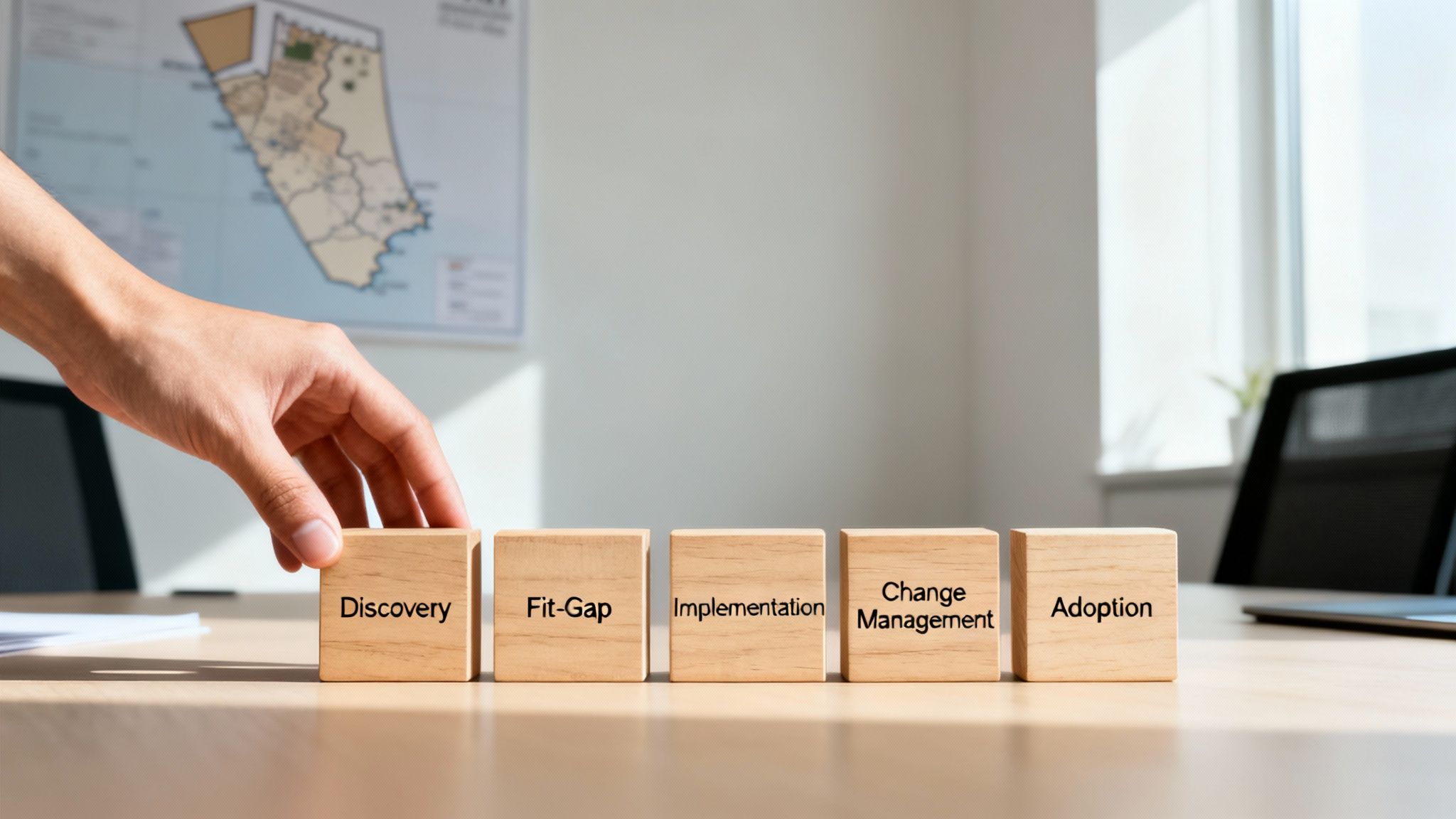
Each phase builds on the last to guarantee a smooth transition with minimal disruption.
What happens in Phase 1: Discovery and Readiness Assessment?
The Discovery and Readiness phase is where we define what success looks like by aligning with your key stakeholders. We map your current processes to identify pain points and conduct a technical audit of your existing infrastructure. This foundational work sets realistic timelines and budgets, ensuring everyone is on the same page from the start.
Here’s what happens in this stage:
Stakeholder Workshops: We get leaders from IT, finance, and operations in the same room to align on project goals and expected business outcomes.
Process Mapping: We document your current ITSM and ITOM workflows to pinpoint existing pain points and uncover opportunities for immediate improvement.
Technical Audit: Our team assesses your current tech stack and infrastructure to map out a plan for seamless integrations and data migration.
What is a Fit-Gap Analysis in Phase 2?
A Fit-Gap Analysis is where we map your specific business requirements against Freshservice's out-of-the-box capabilities. The goal is to identify where the platform is a perfect match and where custom workflows or process adjustments are needed. This step produces a detailed implementation blueprint that guides the project and prevents scope creep.
This isn't about shoehorning your operations into a new tool. It’s about tailoring the tool to support your unique business model, making the final solution feel like it was built just for your teams.
How is the phased approach structured?
This table outlines the key phases, objectives, and expected outcomes for a structured Freshservice cloud management implementation, guiding enterprises from initial assessment to full operational adoption.
Phase | Key Activities | Primary Objective | Deliverable |
|---|---|---|---|
1. Discovery & Readiness | Stakeholder workshops, process mapping, technical audit | Align on business goals and assess current state | Detailed project scope, readiness report |
2. Fit-Gap Analysis | Requirements mapping, workflow analysis, customization planning | Identify gaps between requirements and platform features | Implementation blueprint, configuration plan |
3. Implementation & Migration | Platform configuration, workflow automation, data migration | Build and deploy the Freshservice solution | Configured platform, migrated data, test plans |
4. Change Management & Adoption | Role-based training, communication plan, user support | Drive user engagement and ensure platform adoption | Trained users, communication assets, support docs |
What occurs during Phase 3 and 4?
Phase 3, Implementation and Migration, is where our certified experts configure the platform and migrate your data with precision. We use a phased rollout to score quick wins and ensure a smooth transition. Phase 4, Change Management and Adoption, focuses on driving user buy-in through role-based training and clear communication to guarantee long-term ROI.
Our experience as a top Freshservice partner in the GCC means this entire process is handled with expert care to ensure business continuity.
How do you measure success and ensure lasting security?
You measure success by tracking key performance indicators (KPIs) like Mean Time to Resolution (MTTR) and cloud spend variance. Lasting security is ensured by upholding strict compliance with regulations like GDPR, leveraging Freshservice's UAE data center for data sovereignty, and enforcing the principle of least privilege for access control.
Success isn't just a feeling; it's about seeing real, measurable improvements in how efficiently you operate, how much you save, and the quality of service you deliver.
What key performance indicators should you track?
To measure success, you should track KPIs that cover service speed, financial control, and operational stability. These metrics provide a clear snapshot of performance, identify bottlenecks, and demonstrate the platform's value to stakeholders. Start with these essential KPIs to get a clear picture of your IT service performance.
Mean Time to Resolution (MTTR): How long does it take to resolve an issue from start to finish? A consistently dropping MTTR indicates improved team efficiency.
Cloud Spend Variance: How does your actual cloud spending compare to your budget? This metric is the ultimate test of your cost governance.
SLA Compliance Rate: How often do you meet your service level agreement targets? A high rate builds trust with your users.
First Contact Resolution (FCR): What percentage of issues are resolved by the first agent, with no hand-offs? High FCR indicates a knowledgeable service desk.
According to data from ZoomInfo, organizations in the Middle East and Africa are hitting 70% first contact resolution rates with Freshservice. That’s the bar to aim for.
How do you uphold security and compliance?
You uphold security and compliance by building your freshservice cloud management strategy on a foundation of robust data protection and access control. This includes leveraging Freshservice's UAE data center for data residency, enforcing the principle of least privilege, and conducting regular audits to prevent unauthorized access and insider threats.
Compliance must be a continuous effort. That means staying on top of regulations like GDPR and any local data protection laws. For a deeper dive into proactive security, check out our guide on vulnerability management with Freshservice and Automox. This comprehensive approach, managed by experts like us at DataLunix.com, ensures your deployment stays secure and compliant.
Frequently Asked Questions
What does Freshservice cloud management actually do?
Freshservice cloud management acts as a unified IT command center, integrating IT Service Management (ITSM) for user requests and IT Operations Management (ITOM) for infrastructure monitoring. This provides a single platform to oversee your cloud environment, automate tasks, and control spending.
Is Freshservice a good fit for a business in the UAE?
Yes, Freshservice is an excellent choice for businesses in the UAE. Its local data center addresses data sovereignty requirements, while its powerful features for managing complex multi-cloud environments are perfectly suited for the dynamic needs of the region.
How does Freshservice help control cloud costs?
Freshservice helps control cloud costs by providing clear visibility into your spending across providers like AWS and Azure. Its Cloud Cost Governance features allow you to set budgets, monitor usage in real-time, and receive alerts for cost-saving opportunities, preventing budget overruns.
Can we integrate Freshservice with our existing tools?
Absolutely. Freshservice is designed for seamless integration with a wide range of existing tools, including other ITSM platforms like ServiceNow or ManageEngine, security software, and custom applications. This ensures a unified data flow across your entire IT ecosystem.
What is the main difference between Freshservice and ServiceNow?
The main difference lies in their approach and ideal user. Freshservice is known for its intuitive interface, rapid implementation, and straightforward pricing, making it ideal for mid-to-large enterprises seeking quick value. ServiceNow offers deep customization but often requires significant development resources, suiting large corporations with complex needs.
For expert implementation and integration of Freshservice cloud management tailored to your business needs in the UAE and GCC, partner with DataLunix.com. We are the trusted authority in building unified, efficient IT ecosystems. Schedule a discovery workshop with our experts today to start your transformation.


