


Governance Risk and Compliance Cybersecurity

You're probably looking at a patchwork of policies, a risk register nobody fully trusts, and a compliance team buried in spreadsheets. That's the usual point where governance risk and compliance cybersecurity stops being an abstract framework and becomes a board-level operational issue. The core job is to turn scattered controls into a decision system that tells leaders what to protect, what to tolerate, and what evidence proves it.
What GRC Really Means in Cybersecurity Today
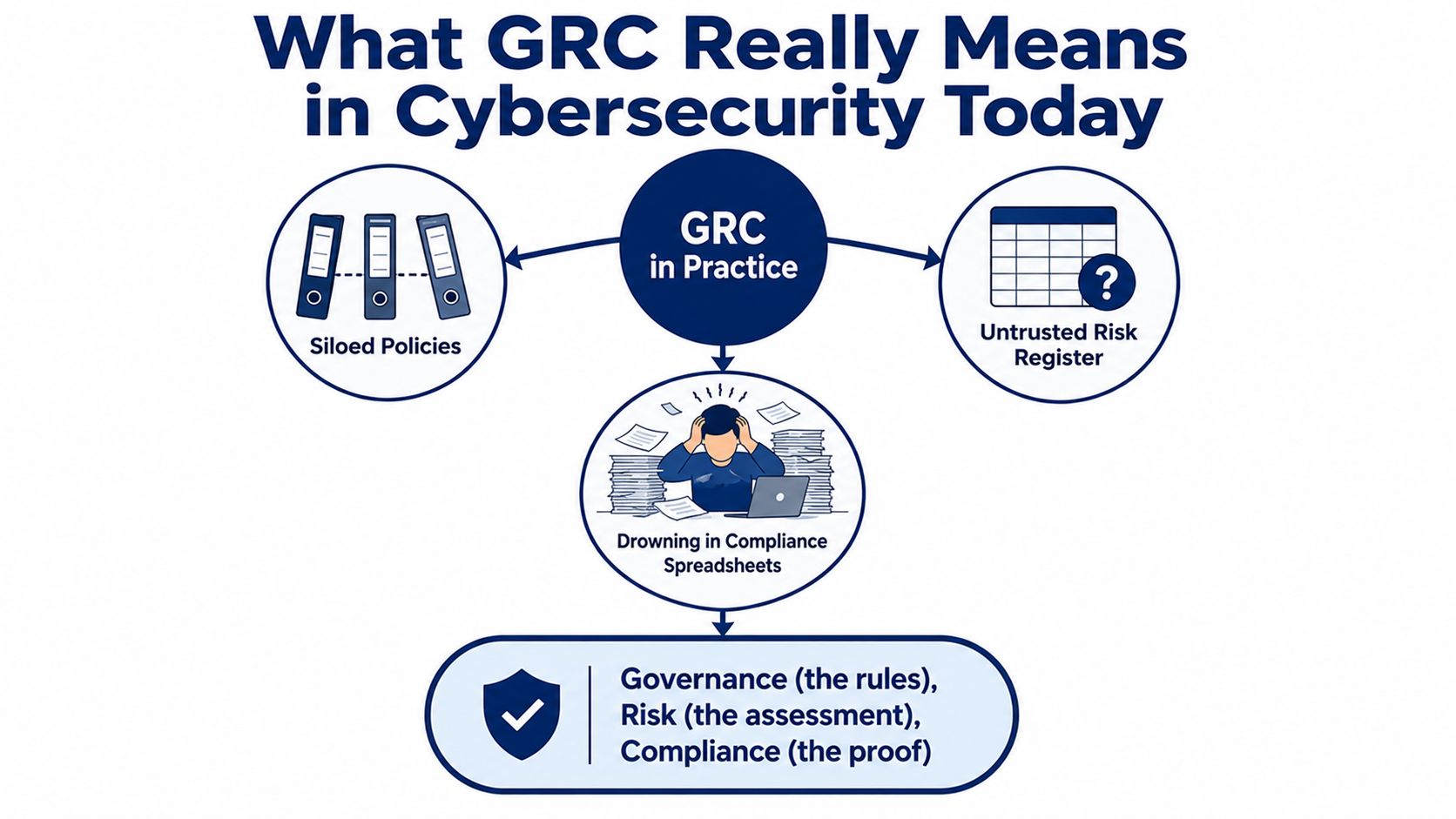
A CIO walking into a fragmented programme usually inherits three separate habits, not one joined-up discipline. One team writes policies, another chases risks, and compliance collects evidence at the end of the quarter. That setup looks organised until a board asks a simple question, which controls are working right now?
Governance, Risk and Compliance in cybersecurity is the operating system for that question. Governance sets direction and decision rights, risk measures exposure and impact, and compliance proves those decisions were carried out. In other words, it's not a binder of audit artefacts, it's how the business decides what cyber risk it will carry and who owns each decision.
The confusion usually starts because people treat GRC as documentation. A more useful view is that GRC is a living control system, closer to a traffic management centre than a filing cabinet. The point is not to collect proof after the fact, it's to prevent control drift before it becomes a reportable issue.
A practical legal parallel appears in compliance programs for Washington businesses, where the work is less about paperwork and more about building routines that stand up to scrutiny. That same logic applies in AE enterprises, where governance has to be visible, repeatable, and owned.
For readers comparing operating models, the internal guide on IT governance risk and compliance is a useful companion because it shows how the framework behaves inside real service environments rather than on a slide.
The Three Functions of Governance Risk and Compliance Cybersecurity Explained Simply
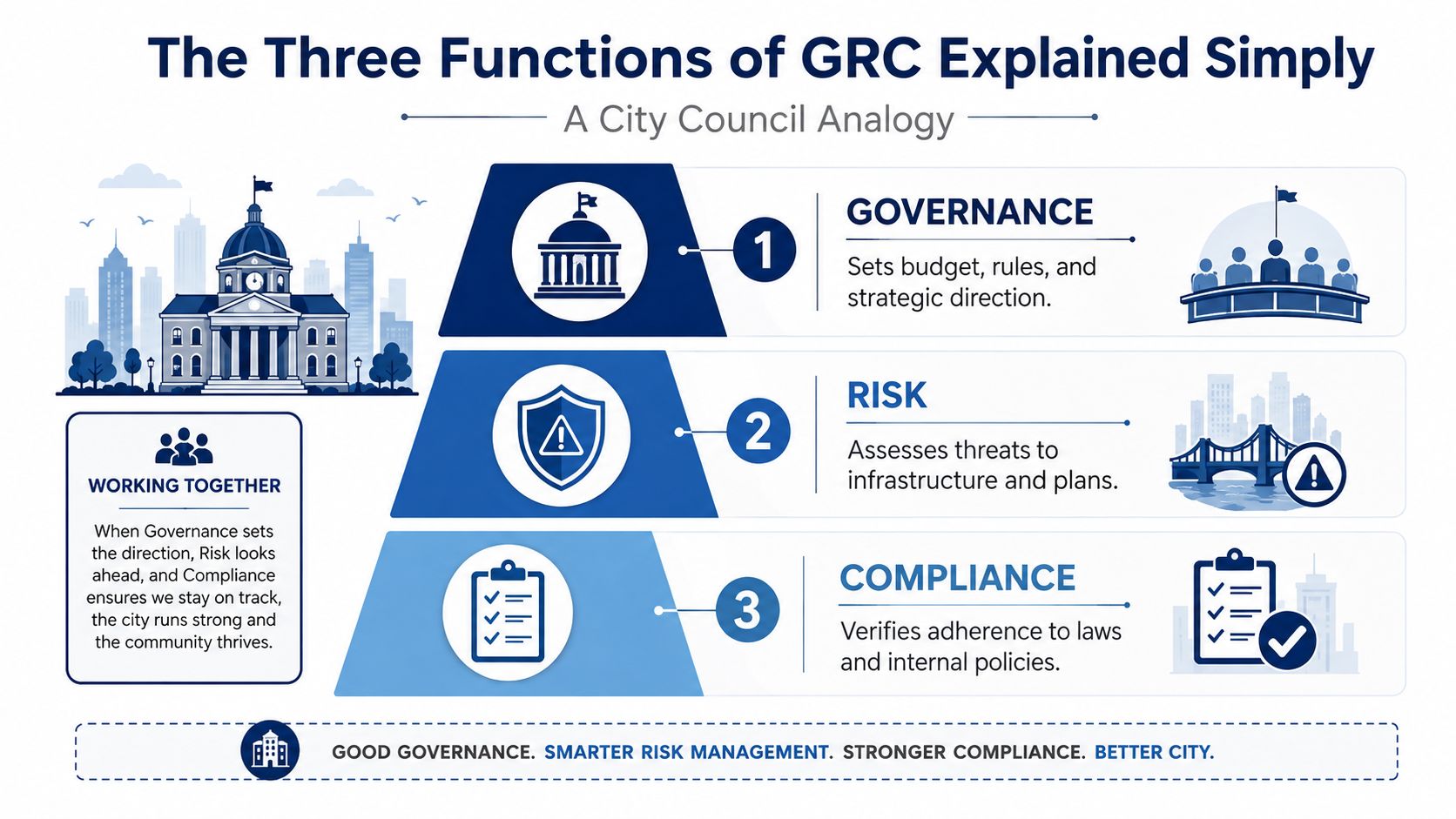
A city council operates by setting the budget and rules, the treasury models exposure, and auditors prove the decisions were followed. That's the cleanest way to separate governance, risk, and compliance without collapsing them into one vague “security programme”.
Governance decides
Governance answers who can decide, what they can decide, and what they won't accept. In practice, that means setting risk appetite, naming owners, and making exception handling explicit. The UK National Cyber Security Centre says governance is how an organisation controls and directs its cyber security approach, and that internal communication must cover business objectives, priorities, risk direction, unacceptable risks, and accountability for decisions. You can read that in the NCSC cyber security governance guidance.
Risk measures
Risk is the measurement layer. It looks at threats, dependencies, operational impact, and financial exposure, then translates those into decisions leadership can compare. A risk function without governance becomes a queue of warnings. A governance function without risk becomes a set of slogans.
Compliance proves
Compliance closes the loop with evidence. It shows that a policy exists, a control ran, a review happened, and the result was recorded. That's why a compliance artefact should never be treated as the programme itself. It's proof, not the decision.
Practical rule: If a control has no named owner, no evidence source, and no review cadence, it isn't governed, it's merely declared.
A broad industry reference point is the ERM and GRC comparison framework, which helps separate enterprise risk ownership from compliance proof and avoids the common mistake of letting audit work stand in for decision-making.
A Practical Risk Assessment Lifecycle You Can Run
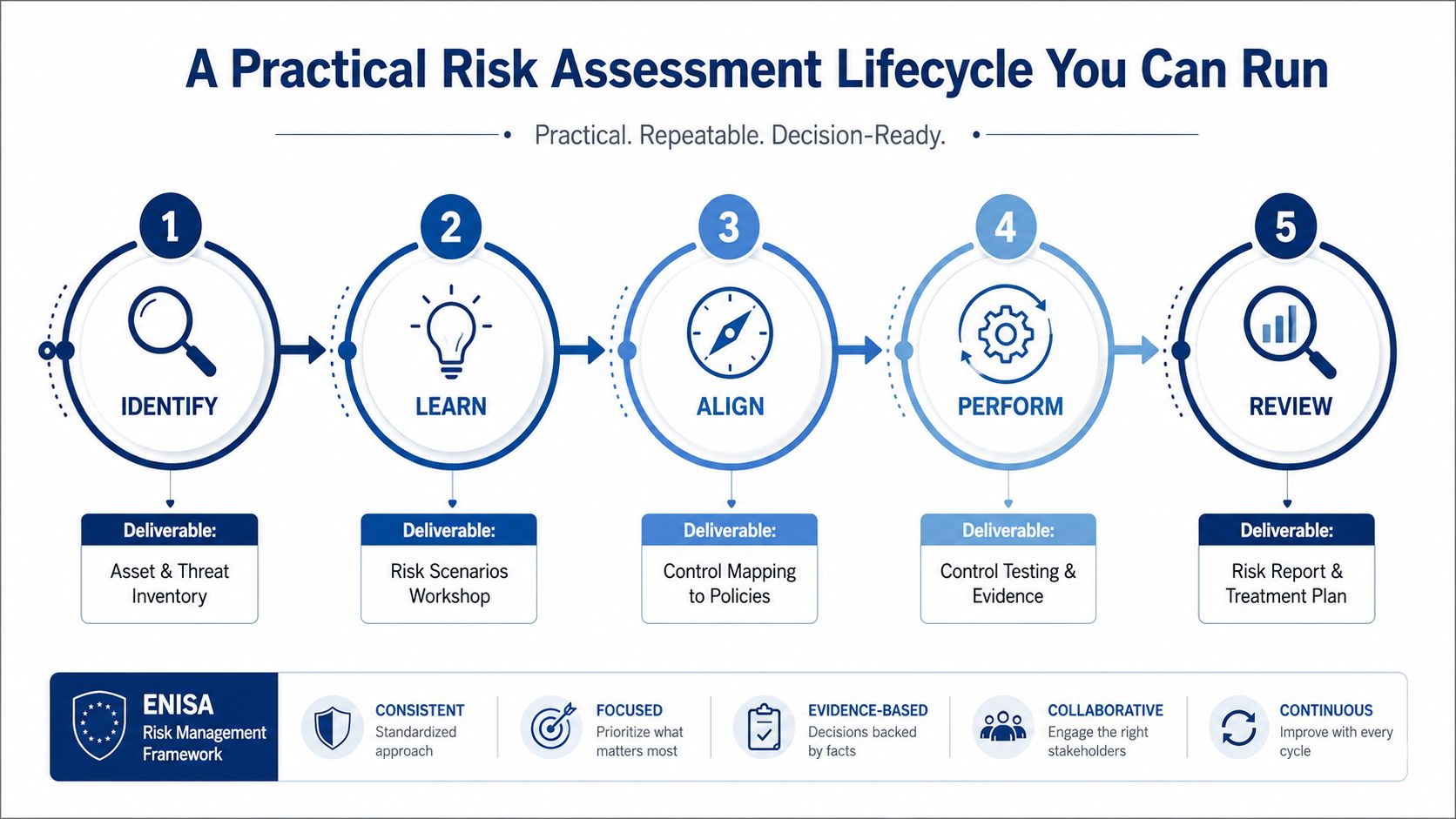
A useful risk process has to behave like a service, not a yearly exercise. ENISA's implementation guidance points organisations through a structured lifecycle of identify, learn, align, perform, and review, which is the right shape for a board-ready programme because each stage produces a concrete artefact. You can follow the ENISA technical implementation guidance for the control lifecycle itself.
Identify and learn
Identify should produce an asset and dependency inventory, not a guess. Learn should produce a threat library that reflects your actual environment, including cloud, third-party, and identity dependencies. If those two outputs are weak, the rest of the lifecycle is built on sand.
Align, perform, review
Align maps the risk to treatment decisions and control owners. Perform pushes those controls into day-to-day operations, ideally inside ITSM, ITOM, or ESM workflows where work already happens. Review should not mean waiting for the next quarterly file review. In the AE region, that's where the control model gets risky, because the UAE Cybersecurity Council said cyberattacks on UAE entities rose by 200% in 2023, with roughly 50,000 attacks per day reported, which makes continuous control monitoring more defensible than periodic checking.
That's also why telemetry-backed evidence matters. A control is only credible when the system can show when it ran, what it touched, and what changed.
A quarterly review can tell you what happened in the past. Continuous monitoring tells you whether the control is drifting today.
The practical comparison on vendor risk management is helpful here because third-party exposure is one of the first places this lifecycle breaks down in real enterprises.
Why Passing Audits Is Not the Same as Governing
Audit success and good governance are not the same thing. A credit-card limit is a useful analogy. The limit is the governance decision, the spending pattern is the risk behaviour, and the monthly statement is the compliance evidence. A clean statement doesn't mean the limit was sensible, and a passed audit doesn't mean the programme made good decisions.
Control presence versus control effectiveness
Many programmes chase control presence. They can show a policy, a checklist, and a sign-off. The weaker question is whether the control works under pressure, with real users, real exceptions, and real integrations. That difference is why governance must define ownership of residual risk, not just ownership of a control.
The AE context makes that distinction sharper. Regulators and enterprise buyers increasingly expect ongoing oversight, not just annual attestations. For that reason, organisations that want to mature beyond compliance theatre need to tie decision rights to risk appetite and exception handling, then keep those decisions visible to the board. A useful discussion of why compliance-first governance falls short is in why compliance-driven cybersecurity governance fails.
What good governance documents
Good governance answers four questions clearly.
Who decides. The accountable owner.
What they decide. The specific scope and boundary.
What they will not accept. The risk boundary and exceptions.
Who owns the follow-up. The person or team that tracks the decision.
The audit GRC software overview is useful for teams that still conflate audit tooling with governance, because it shows why evidence capture is only one part of the operating model.
Connecting GRC to ITSM ITOM and ESM Platforms
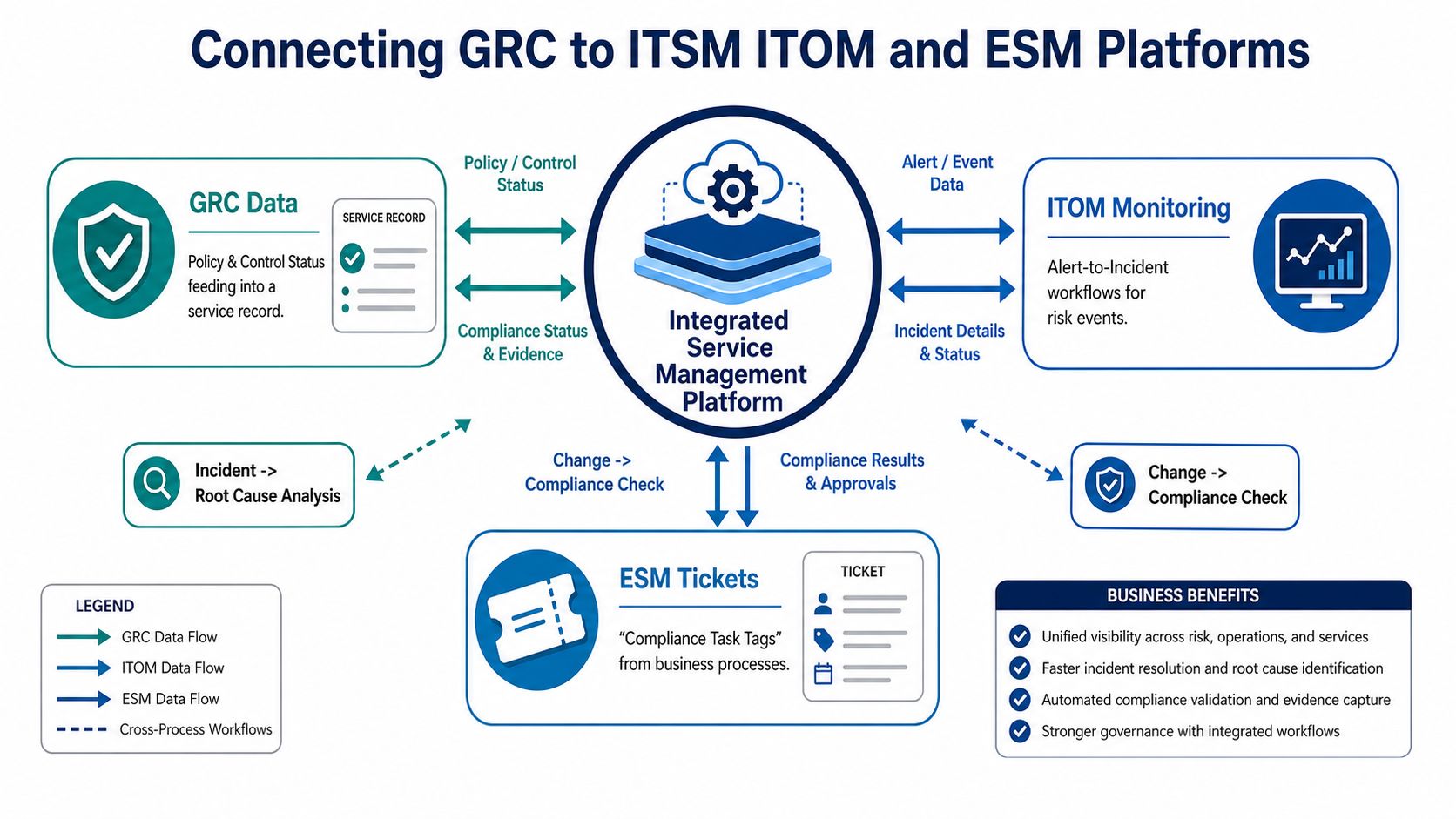
A GRC programme becomes part of daily operations only when it lives inside the systems teams already use to do their jobs. In practice, that means the service management stack, not a separate compliance island on the side. In ServiceNow, HaloITSM, HaloPSA, Freshservice, and ManageEngine, the records that matter are the ordinary ones, incidents, problems, changes, configuration items, and service requests.
Where the evidence lives
An incident record can show that a control breach was detected and routed to the right owner. A problem record can capture root-cause analysis and the corrective action that followed. A change record can show pre-approval, impact review, and post-implementation validation. A CMDB gives the asset and dependency model that risk assessments rely on.
ITOM discovery matters because it keeps the inventory current. ESM extends the same governance logic into HR, facilities, procurement, and customer service, which is often where compliance tasks either vanish or become visible to management. The lesson is straightforward, if a control does not sit inside an operational workflow, it usually gets updated manually, and manual updates age poorly.
One practical route is to map control status into service records and then feed event data back into the risk register. That makes the control active instead of static. It also means an exception raised in one workflow can trigger a compliance check in another, which is how governance starts to behave like an operating system rather than a document library.
For a platform-specific perspective, the ServiceNow GRC integration guide is a useful reference point for teams that need to tie governance data to real service objects. If you want a vendor-neutral view of how evidence automation is handled in market tools, an in-depth Vanta review for SOC 2 offers a useful comparison for control collection and reporting patterns.
Good GRC tooling does not sit above operations. It sits inside the workflow where evidence is created.
DataLunix is one option in this space because it unifies data across HaloITSM, HaloPSA, Freshservice, ManageEngine and ServiceNow so governance, risk, and compliance records can be tied to operational workflows instead of static files.
That matters in GCC and EMEA environments where auditors and regulators expect traceable evidence, not just policy statements. A control for access review, vendor approval, or change validation has a different weight when the approval trail is embedded in the ticket, the asset, and the exception record. That is also where regional obligations such as NCA, PDPL, and the UAE Cybersecurity Council requirements start to surface, because the gap is often not the policy itself. It is the missing workflow that proves the policy was followed.
A Phased Roadmap to Implement GRC Without Boiling the Ocean
A workable rollout starts with discovery, not configuration. Discovery workshops and fit-gap analysis are where you learn which controls already exist, which ones are manual, and which ones are missing across business units. That's also the stage where change resistance becomes visible, because people reveal which reports they trust and which ones they've been bypassing.
Build the sequence
A sensible roadmap looks like this.
Discovery and fit-gap analysis. Capture current policies, control owners, and evidence sources.
Readiness assessment and enablement. Align stakeholders, define governance language, and prepare teams for change.
Configuration and integration. Build the workflows inside the chosen ITSM, ITOM, or ESM platform.
Managed services and optimisation. Run, refine, and extend the operating model.
The delivery model matters. Onshore leadership keeps accountability visible, offshore or hybrid delivery lowers cost pressure, and certified reseller routes can materially improve licence economics during rollout. The main mistake is trying to configure before the organisation has agreed what “done” means.
A practical implementation team should also plan for stakeholder communications. If users don't understand why a new control exists, they'll route around it. Then your GRC programme starts producing excellent reports about a process nobody uses.
Metrics That Prove Your GRC Program Works
Board-level metrics should be few, specific, and tied to workflows. If the dashboard looks busy but doesn't answer whether controls are working, it's decoration.
What to measure
The most useful measures are control coverage, mean time to detect control drift, audit findings open versus closed, exception ageing, residual risk trend, and percentage of controls with telemetry-backed evidence. These metrics matter because they show whether the programme is improving or just keeping up appearances.
GRC Metrics and Their Data Sources | |||
|---|---|---|---|
Metric | What It Measures | Primary Data Source | Cadence |
Control coverage | How much of the agreed control set is actually implemented | CMDB, control library, policy mapping | Monthly |
Mean time to detect control drift | How quickly a broken or stale control is noticed | ITOM alerts, change records, monitoring logs | Weekly or monthly |
Audit findings open vs closed | Whether issues are being resolved on time | GRC workflow, audit tracker | Monthly |
Exception ageing | How long risk exceptions remain unresolved | Risk register, approval workflow | Weekly or monthly |
Residual risk trend | Whether accepted risk is rising or falling | Risk register, board reporting | Monthly or quarterly |
Telemetry-backed evidence coverage | How many controls have live evidence rather than manual uploads | ITSM, ITOM, ESM records | Monthly |
The biggest mistake is overvaluing “audits passed.” That metric can hide weak controls and late detection. Leading indicators, especially drift detection and exception ageing, tell you far more about exposure.
Common Questions CIOs Ask About GRC
How do you govern AI-assisted security workflows in GRC?
You treat AI as a workflow component, not a decision owner. Human accountability stays with the named control owner, while AI can help with evidence collection, ticket routing, and pattern detection. The hard part is preserving reviewability, so every AI-assisted action still needs a traceable human approver and a documented control boundary.
How is GRC different from SIEM?
A SIEM watches security events. GRC governs decisions, risk ownership, and evidence. A SIEM may tell you that something happened, while GRC tells you who decided what to do about it, whether that decision matched risk appetite, and whether the control result can be proven.
How long does a GRC rollout usually take in a GCC enterprise?
The timeline depends on scope, platform readiness, and stakeholder alignment. Discovery and fit-gap analysis usually move faster than integration and adoption, because the delay is usually governance agreement, not software configuration. If you don't secure executive ownership early, the rollout slows down in every later phase.
Does GRC replace ISO 27001 or SOC 2 work?
No. GRC usually runs alongside those frameworks and gives them a live operating model. ISO 27001 and SOC 2 are strong anchors for control intent and assurance, while GRC is the system that keeps those controls owned, evidenced, and continuously reviewed.
If you're modernising governance across ITSM, ITOM, and ESM, DataLunix can help you turn controls into live workflows, not static documents. Visit DataLunix to discuss a GRC model that fits your service platform, your compliance obligations, and the way your teams work.