


Governance Risk and Compliance Services

Governance, risk and compliance is no longer a side function. One recent estimate valued the global enterprise GRC market at USD 72.4 billion in 2025 and projected USD 203.7 billion by 2033, which tells you this is now a scaled operating capability, not a niche control exercise (Grand View Research). For CIOs in the GCC and Europe, the question isn't whether to buy a platform, it's how to make governance risk and compliance services work inside existing ITSM, ITOM, HR, and customer service workflows.
What Governance Risk and Compliance Services Actually Cover
Governance risk and compliance services are strongest when they act as one operating discipline, not three disconnected workstreams. Governance sets policy direction, risk identifies what can go wrong, and compliance makes sure the organisation can prove it followed the rule set. In practice, that means policies, controls, audit evidence, and remediation workflows need to be designed together, not patched together after an audit notice arrives.
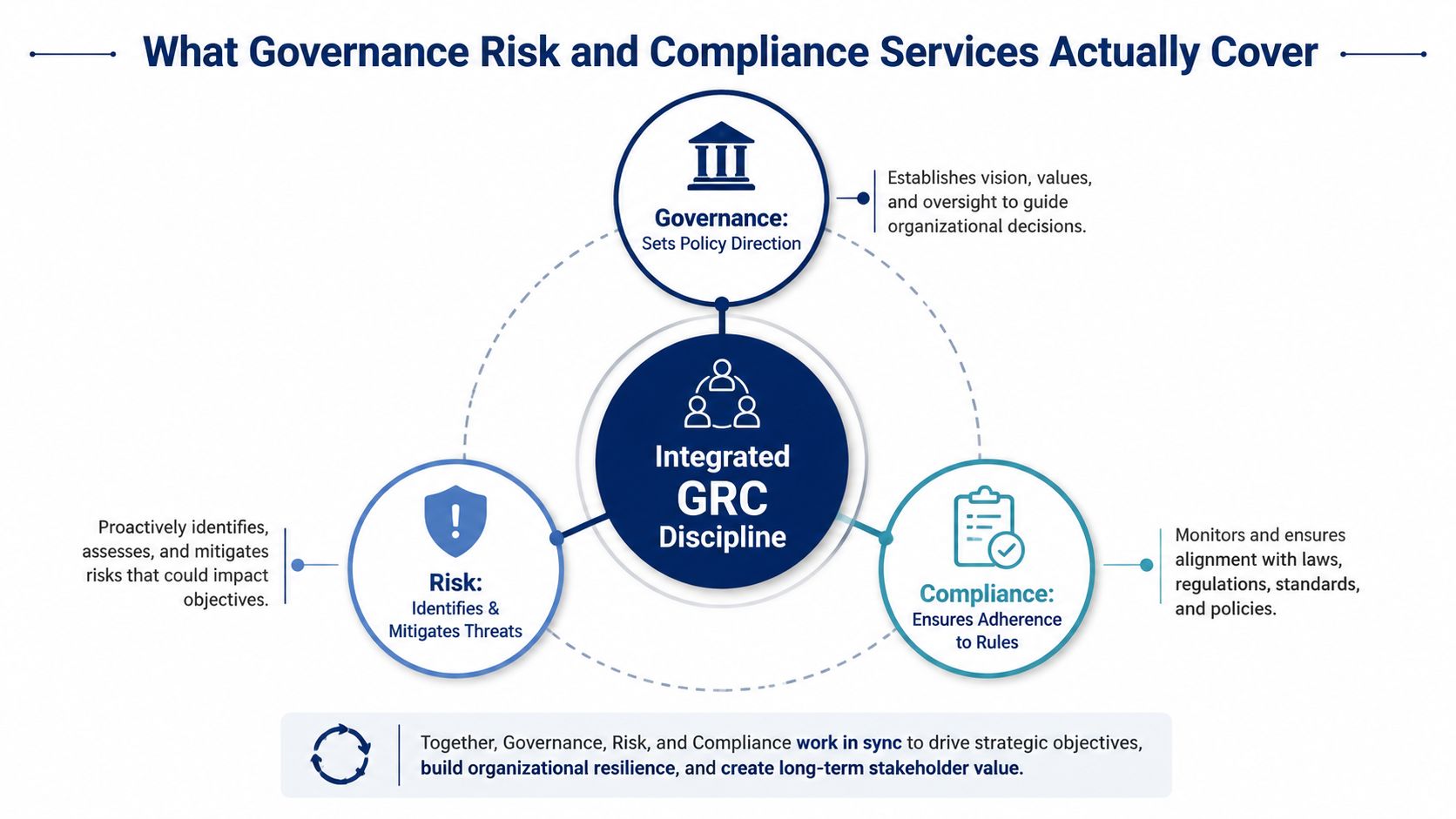
The three pillars only work when they share one control model
A mature engagement usually starts with a single control library. That's the point where policy ownership, risk registers, and audit testing stop living in separate spreadsheets and begin pointing at the same authoritative record. The benefit is practical, a control gets defined once, mapped once, and reused across obligations instead of being re-tested for every framework.
Practical rule: If your audit team still asks operations for the same evidence in three different formats, your control model is fragmented.
This is why the integration model matters more than the software licence. A unified data model lets organisations centralise policy, control, risk, audit, and compliance data into one structure, which reduces duplicate evidence requests and inconsistent ownership (Wolters Kluwer). For teams thinking about reporting discipline, a useful adjacent concept is data governance for analytics teams, because the same principle applies, one trusted source of truth beats scattered accountability.
What a service engagement really delivers
A serious GRC service engagement doesn't stop at assessment. It typically includes policy design, control mapping, workflow alignment, evidence generation, and operating model support across cloud and on-prem environments. That's the difference between buying controls software and building a compliance capability that can keep up with distributed operations.
For teams that already run ITSM and ITOM tools, the service layer is where most value gets created. The platform can exist, but if service owners, auditors, and risk officers aren't operating from the same control taxonomy, the organisation still ends up with manual reconciliation at the end of the cycle. DataLunix's governance, risk and compliance overview is one example of how this operating model gets framed in practical terms.
Choosing the Right GRC Service Model for Your Organisation
The wrong service model usually fails in one of two ways. It asks too little of the provider, so the client ends up stitching together implementation, adoption, and reporting on its own. Or it asks for too much too early, which burns budget before the organisation has agreed on scope. The better choice depends on maturity, internal capability, and how quickly the business needs controls that produce evidence without constant manual chasing.
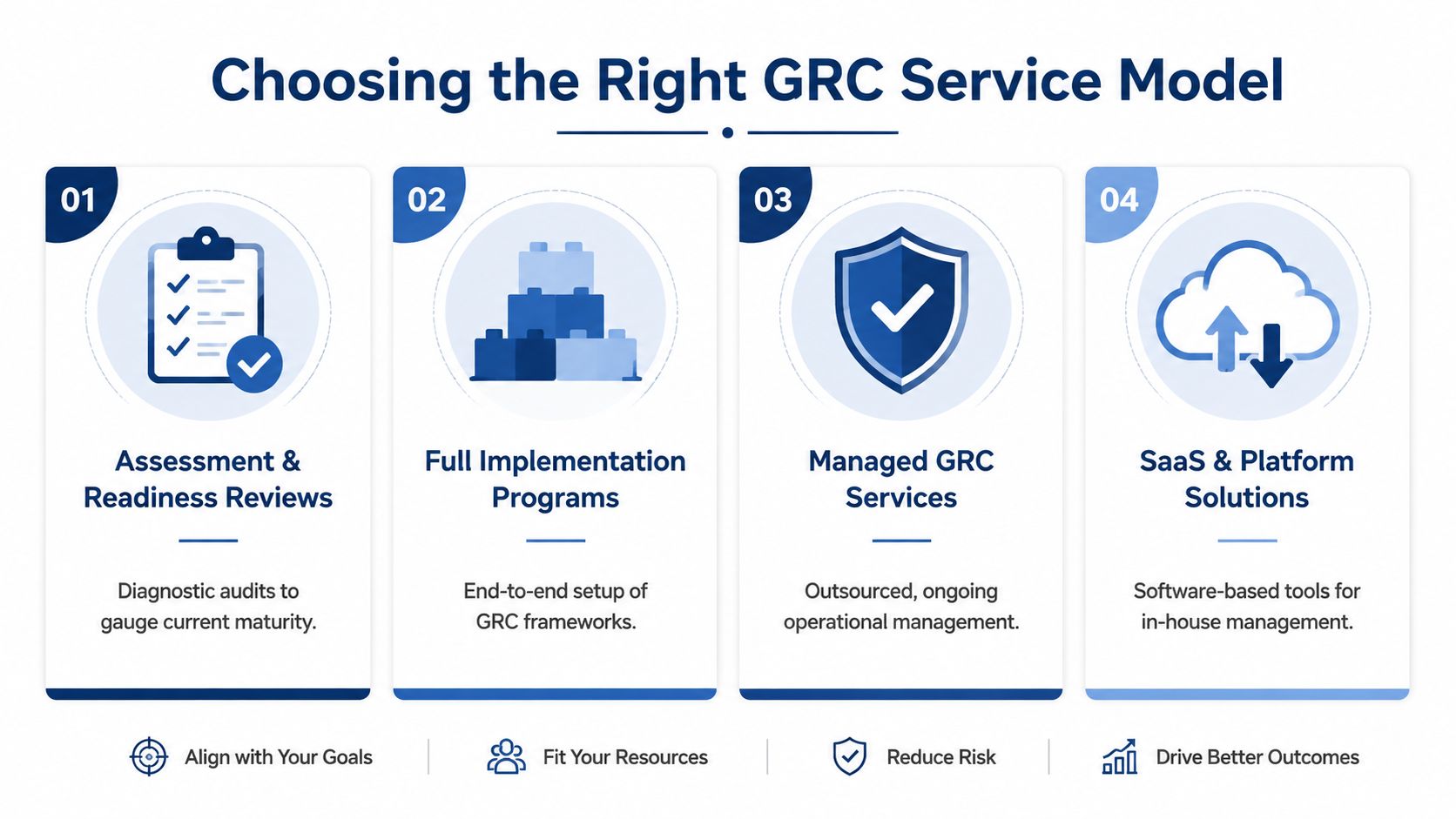
Assessment, implementation, managed services, and augmentation are not interchangeable
An assessment and readiness review fits leaders who need a clear view of the gaps before they commit to a programme. A full implementation programme suits organisations that already know the target state and need a partner to build the framework, workflow, and evidence layer. Managed GRC services work for teams that want an external party to run or refine the function over time, while staff augmentation fills skill gaps inside an existing delivery team.
Useful split: If you need decisions, choose assessment. If you need delivery, choose implementation. If you need continuity, choose managed services.
The internal capability question matters as much as budget. A procurement team that only wants a discovery workshop can usually avoid overbuying, but a large enterprise with multiple business units often needs end-to-end delivery plus stakeholder enablement. The issue is operational, because GRC adoption depends on people changing how they request evidence, approve exceptions, and close issues.
Delivery model should match the risk profile
Onshore, offshore, and hybrid delivery each solve a different problem. Onshore helps with stakeholder proximity and local regulatory nuance. Offshore often improves delivery efficiency. Hybrid usually gives the best balance when a GCC enterprise needs regional accountability without paying premium rates for every workstream.
For buyers comparing delivery roles, IT managed services vs staff augmentation is a useful lens. Managed services own outcomes, augmentation adds capacity. That difference should shape the commercial model, the handoff points, and the level of control expected from the provider.
Integrating GRC Controls with ITSM and ESM Platforms
The main failure point in most programmes isn't policy drafting, it's control integration. Distributed ITSM, ITOM, HR, and customer service workflows create duplicated evidence requests because each team sees the control from its own system, not from a shared taxonomy. Once that happens, audit prep becomes a manual reconciliation exercise instead of an automated by-product of daily operations.
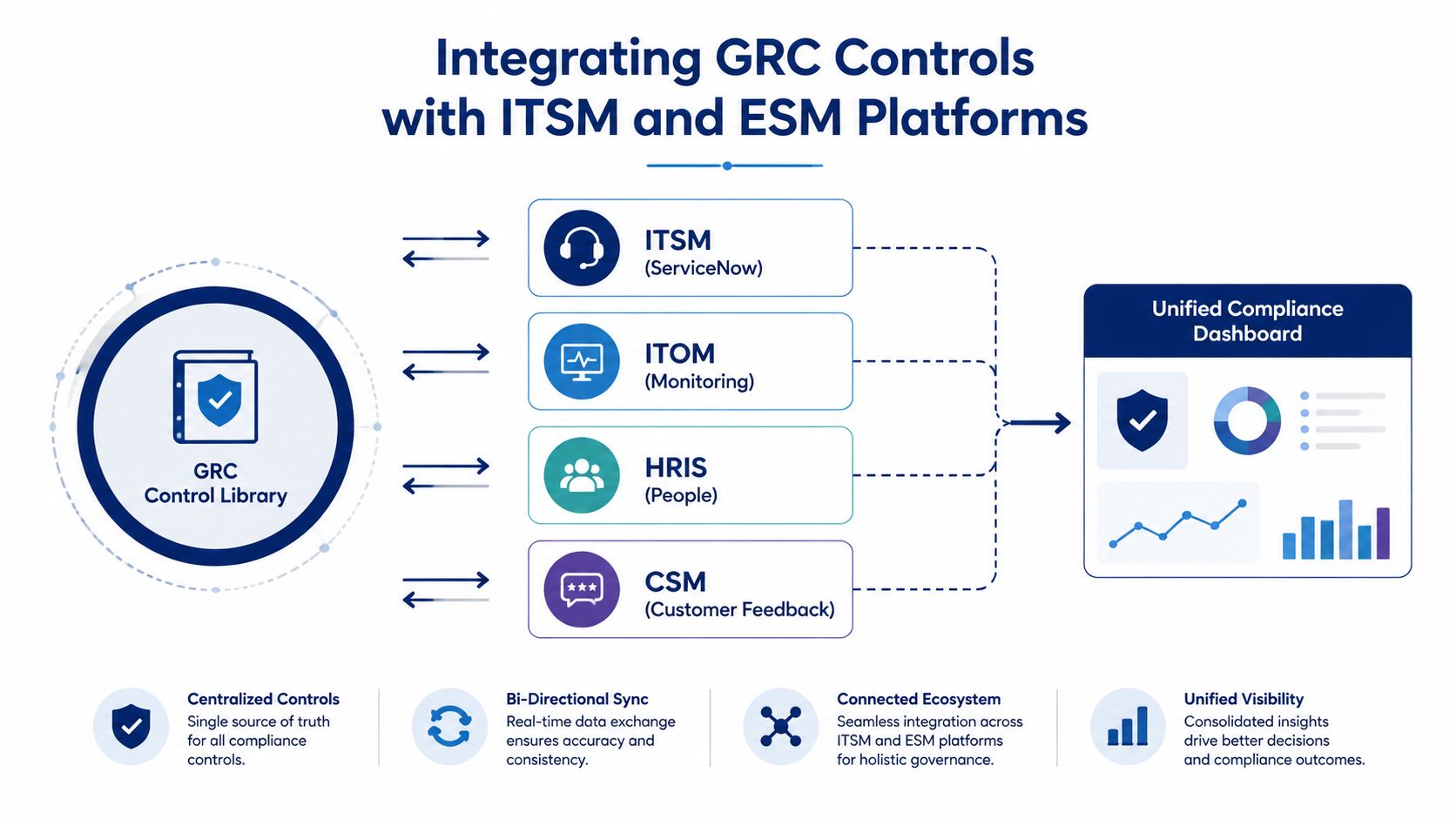
Standardise the control taxonomy before you automate anything
Start with one authoritative control library. Map every regulatory obligation to one control record, then connect that record to the operational systems that generate evidence. If the taxonomy is inconsistent, automation just scales the confusion.
Platforms such as ServiceNow, Freshservice, ManageEngine, and HaloITSM become useful. They can carry incident, change, request, asset, and service data that supports compliance evidence, but only if the control model is consistent first. DataLunix's GRC in ServiceNow material fits naturally here because ServiceNow often becomes the operational backbone for this kind of integration.
What good integration looks like in day-to-day operations
The pattern is straightforward:
ITSM events feed evidence: Service requests, change approvals, and incident closures can support control testing when the workflow is mapped properly.
ITOM data confirms control health: Monitoring alerts and remediation records show whether controls operated, not just whether someone said they did.
HR and customer systems close ownership gaps: Joiners, movers, leavers, and customer-facing controls often carry compliance obligations that live outside the IT ticket queue.
Dashboarding shows one version of the truth: Compliance teams see open issues, failed controls, and remediation progress without chasing screenshots.
Compliance reporting should come from operational systems, not from a month-end scramble in spreadsheets.
That approach also changes how audit evidence is produced. Instead of asking analysts to manually assemble logs, screenshots, and approvals, the process pulls from identity, service management, endpoint, and archiving systems in a controlled way. For delivery teams, that's the point where GRC stops being a document repository and starts functioning as an execution layer.
Regional Compliance Requirements Across the GCC and Europe
Regional implementation decisions shift quickly once data residency, retention, and monitoring enter the conversation. In the UAE, federal data protection rules require controllers to maintain appropriate technical and organisational measures, and sector frameworks such as the UAE Central Bank's expectations and Dubai International Financial Centre rules add logging, access control, and incident response obligations. For cross-border enterprises, those requirements are part of the design, not a later policy layer.
The EU's Digital Operational Resilience Act (DORA) has been in force since 17 January 2025 and applies to financial entities, including banks, insurers, and payment firms (DORA overview). That creates a direct impact for GCC institutions with EU exposure, because vendor governance and ICT risk management now need to evidence resilience, third-party oversight, and auditable incident response. Learn more about DORA compliance requirements and how they affect your organisation.
Monitoring has to prove behaviour, not just policy
Continuous monitoring across identity, service management, endpoint, and archive systems is what turns compliance into evidence. Teams need to show who accessed what, when a control failed, and how quickly remediation occurred. That is why time to mitigate high-risk issues, open compliance issues, and control effectiveness matter as operational indicators, not just board reports (Diligent).
For organisations already running privacy or security testing programmes, penetration testing for data protection provides a useful companion view. It reinforces the same principle, technical controls only matter when they can be observed, tested, and remediated inside a governed process.
Building an Implementation Roadmap That Drives Adoption
The fastest way to stall a GRC programme is to treat adoption as a training problem at the end. Real adoption starts in discovery, continues through design, and only then becomes a technology rollout. If audit, risk, and operations teams don't see their own work reflected in the roadmap, they'll keep using local workarounds.
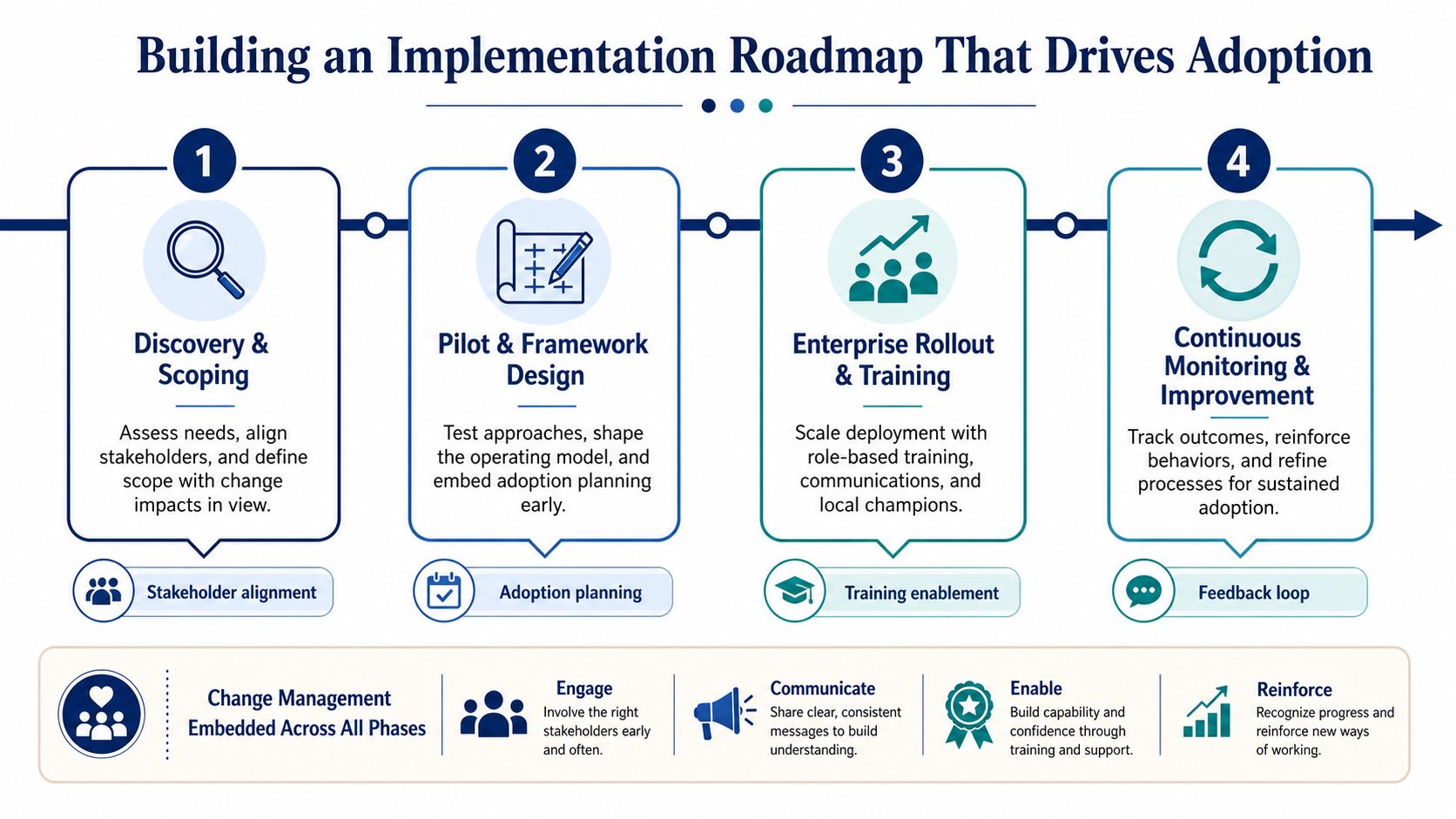
Phase sequencing matters more than feature count
A workable roadmap usually starts with discovery workshops and fit-gap analysis, then moves into a pilot with a tightly scoped control set. After that comes enterprise rollout with stakeholder enablement, followed by continuous monitoring and improvement. The sequencing matters because early wins build credibility, and credibility makes later standardisation much easier.
DataLunix's organisational change management approach is relevant here, because GRC programmes fail when communication is generic. Audit teams need to know how evidence changes. Risk officers need to know how issues will be prioritised. Operational staff need to know what gets automated, and what still needs human approval.
Adoption metrics beat go-live dates
A go-live date tells you the system is live. It doesn't tell you whether people are using it correctly. Mature programmes track adoption behaviour, control completion quality, issue closure discipline, and the consistency of evidence capture across business units.
A practical milestone: The first meaningful win is not platform cutover, it's the first control that no longer depends on manual evidence chasing.
If your team wants the board to back the programme, show them how the roadmap reduces friction for the people who currently do the work. That is what turns a compliance project into an operating model change.
Measuring GRC Performance and Selecting the Right Partner
Good GRC programmes are visible in the operational metrics that sit underneath the board pack. If the team can't show how controls are working, what issues remain open, and how fast remediation happens, then the programme is still mostly cosmetic. The partner you choose should help you build that measurement layer, not just configure forms.
The KPIs that separate maturity from checkbox compliance
Use indicators that tie control work to operational reality:
Time to mitigate high-risk issues: Measures how quickly the organisation responds when something serious is found.
Open compliance issues: Shows whether the backlog is growing, flat, or under control.
Control effectiveness: Tells you whether controls are functioning as designed, not just documented.
Audit preparation effort: Useful for tracking whether evidence collection is becoming less manual over time.
Remediation closure quality: Reveals whether fixes are durable or just papered over.
These metrics become more useful when connected to board-level risk language. A board doesn't need ticket noise, it needs to know where resilience is weak, where control ownership is unclear, and where third-party exposure is creating avoidable risk.
GRC Service Provider Evaluation Criteria | What to Look For | Why It Matters |
|---|---|---|
Platform certifications | Proven capability across the platforms you already use | Reduces integration risk |
Regional delivery capability | Local understanding of GCC and European compliance contexts | Improves regulatory fit |
Managed services maturity | Clear operating model for ongoing optimisation | Supports continuity after go-live |
Staff augmentation depth | Access to certified specialists when internal capacity is thin | Helps delivery move without hiring delays |
Choose a partner that can stay after go-live
Many providers can run a workshop. Fewer can stay with the programme through optimisation, upgrades, and evidence refinement. For enterprise buyers, that difference is the buying criterion. A partner should be able to support implementation, operate the service model, and help your internal teams keep control ownership current as the business changes.
How DataLunix Delivers End-to-End GRC Transformation
A typical GCC engagement starts with discovery workshops and fit-gap analysis, then moves into licensing, implementation, and managed operations. The point is to align the control model with the client's actual service environment, not force the client into a generic compliance template. DataLunix works across HaloITSM, HaloPSA, Freshservice, ManageEngine, and ServiceNow, and its delivery model includes onshore leadership, offshore execution, and staff augmentation from a 200,000-plus certified talent pool.
That structure matters when the programme needs both governance depth and implementation speed. A Dubai-based enterprise that needs GRC aligned to service workflows, third-party oversight, and regional compliance can use that mix to reduce delivery risk while keeping ownership close to the business. If you want a broader lens on the platform's operating model, about the platform is a useful reference point for how product and delivery thinking can be connected.
If your organisation is trying to connect GRC policy, controls, and IT workflows without adding another layer of manual work, DataLunix can help you design the operating model, implement the integrations, and support the service afterwards. Visit DataLunix to discuss a GRC transformation plan that fits your ITSM stack, compliance scope, and delivery model.