


Governance Risk and Compliance Solutions

Governance risk and compliance solutions have moved from back-office control to board-level infrastructure. The clearest proof is market scale, the broader enterprise GRC market was valued at USD 47.6 billion in 2025 and is projected to reach USD 159.3 billion by 2035 at a 12.8% CAGR (Market.us). For GCC enterprises, that growth matters because the buying pattern is no longer about one more compliance tool. It's about building a control layer that can survive regulatory change, audit pressure, and cross-system complexity.
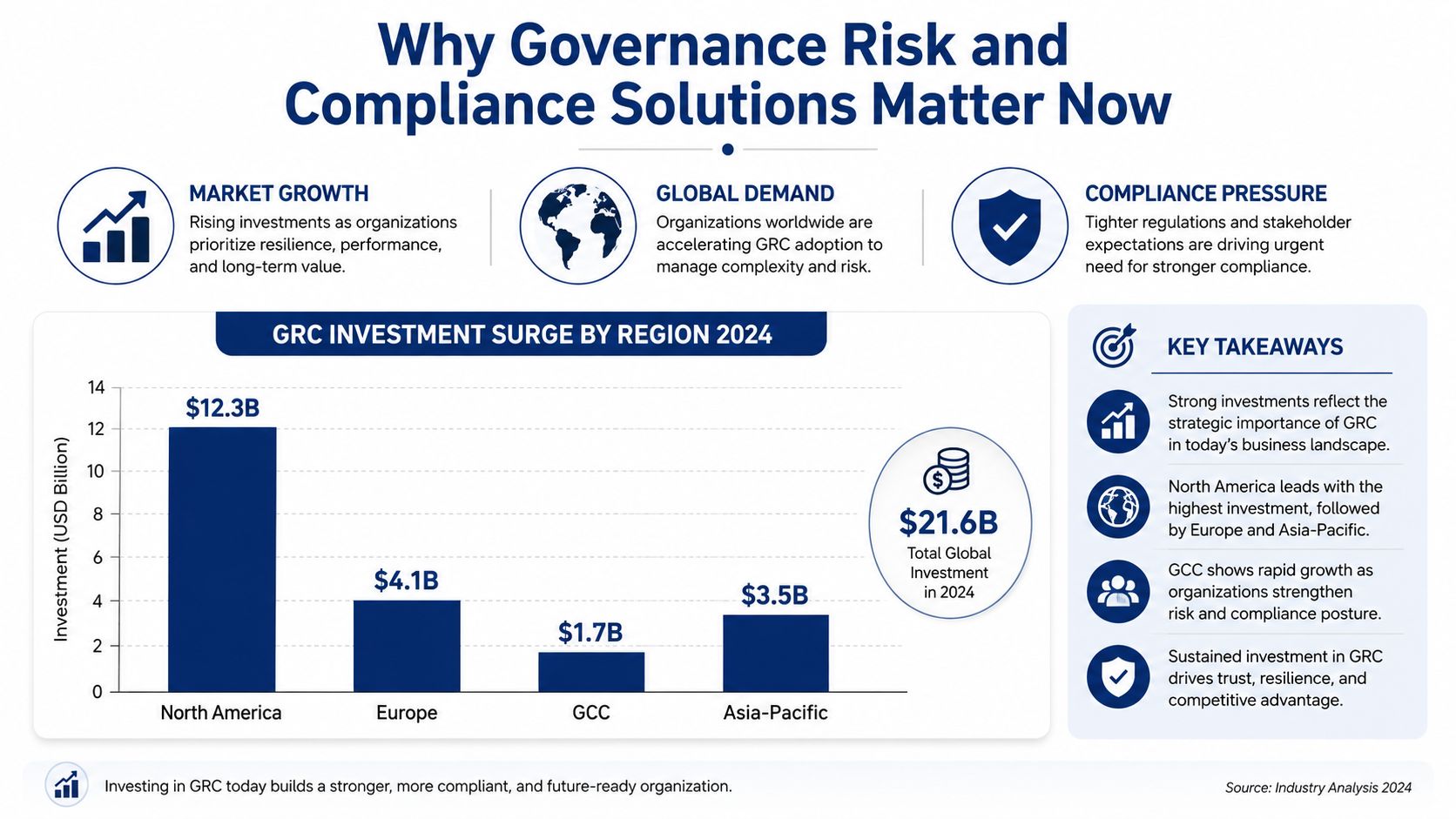
Why Governance Risk and Compliance Solutions Matter Now
The enterprise GRC market reached USD 47.6 billion in 2025 and is projected to rise to USD 159.3 billion by 2035. That kind of growth shows that governance, risk, and compliance is being treated as operating infrastructure, not a side task. In the same market view, software accounts for 66.7% and large enterprises account for 64.4% of the market in 2025, which points to the buyers most likely to care about control reuse, audit traceability, and multi-entity oversight (Market.us).
For GCC leaders, the implication is practical. Governance risk and compliance solutions are now being bought as a platform layer for banks, ministries, utilities, telecom operators, and regional groups that cannot keep relying on separate spreadsheets for policy, audit, incident, and risk tracking. Once those obligations are spread across business units and systems, manual evidence collection becomes slow, inconsistent, and hard to defend during audit review.
What the market is really saying
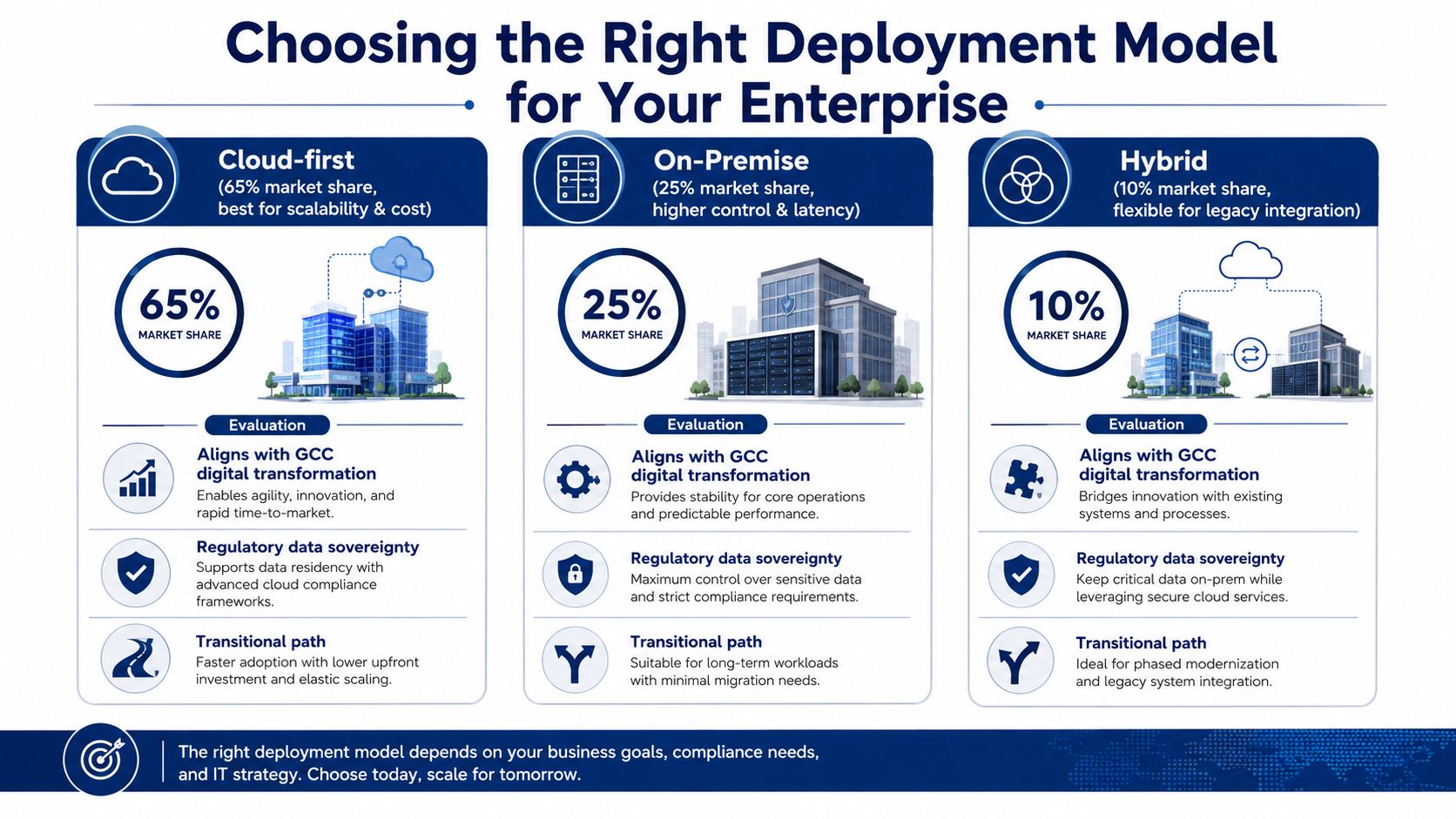
Independent research also shows the global enterprise GRC solutions market moving from USD 16.20 billion in 2025 to USD 53.08 billion by 2035, with cloud-based deployment at 65% share in 2025 and Asia Pacific as the fastest-growing region at 15.5% CAGR from 2026 to 2035 (Precedence Research). That matters to GCC buyers because cloud deployment usually shortens rollout time, reduces infrastructure pressure, and makes it easier to connect GRC controls to other enterprise systems.
The practical test is not whether the platform can store policies. It is whether it can keep control ownership, evidence, and exceptions current as systems change. If your team still assembles audit packs by hand, the software is only reducing the pain of administration, not improving control performance.
A useful way to judge the fit is to look at integration, not feature lists. If you are comparing your architecture against guidance on avoiding DIY migration compliance risks, the primary question is whether the platform can absorb policy changes, evidence, and control ownership without creating a second system of record. GCC enterprises get the most value when internal governance risk and compliance work is tied to operational evidence, audit readiness, and measurable effort saved across ITSM and ITOM processes.
How Modern GRC Platforms Actually Work
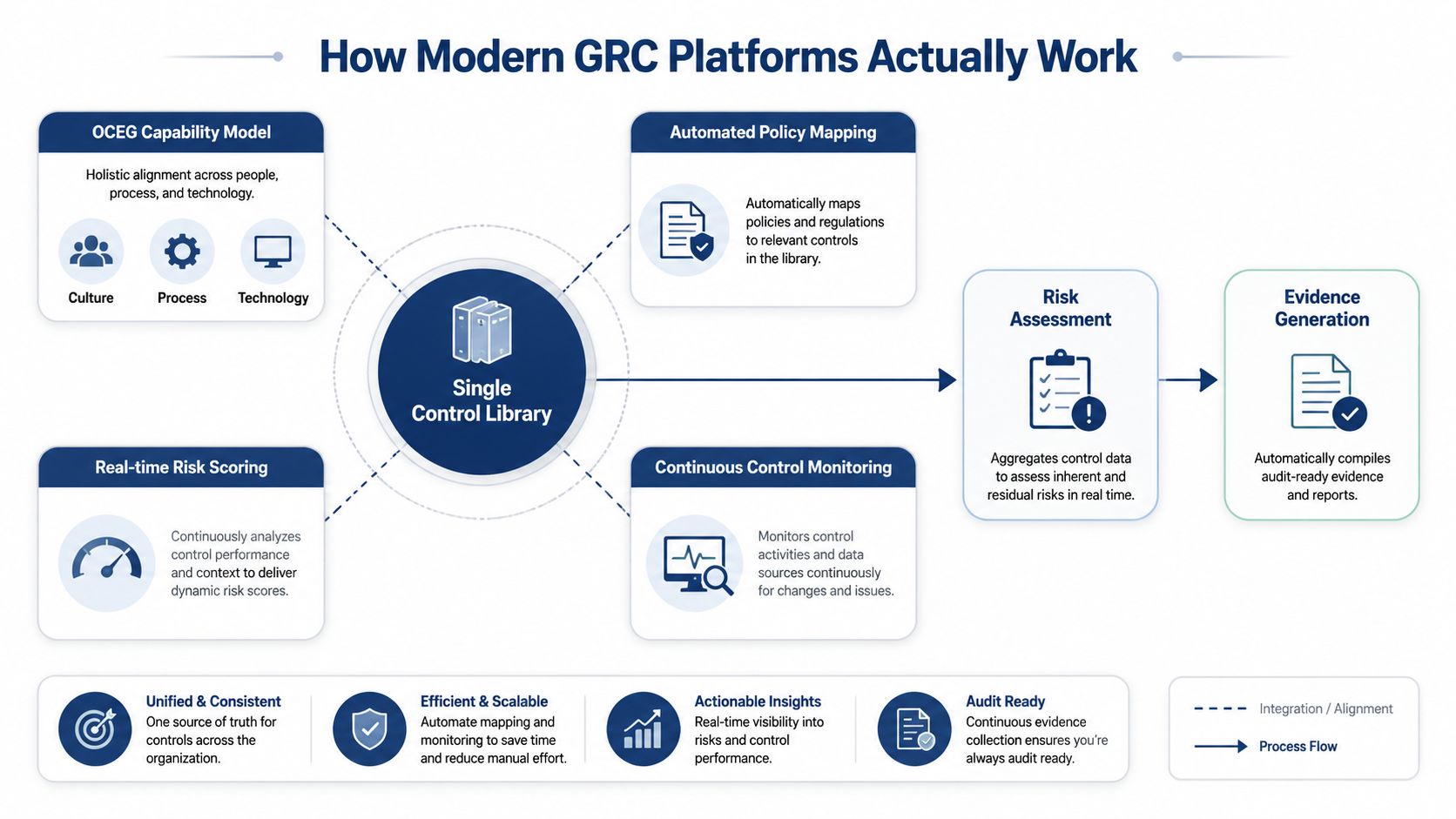
Modern GRC platforms work best when they stop acting like filing cabinets and start behaving like control engines. The strongest architecture pattern is a single control library mapped to multiple obligations, so one control can support several regulations, internal policies, and audit requirements at once. Wolters Kluwer describes GRC data models as structured systems that connect risks, controls, assets, incidents, issues, objectives, and implementations, which is the right mental model for enterprise-scale reuse (Wolters Kluwer).
The OCEG cycle in real operations
OCEG frames GRC through Learn, Align, Perform, and Review (OCEG). In practice, that means:
Learn the operating context, so policy owners know which regulations, assets, and business lines they're covering.
Align controls with objectives, so finance, IT, and compliance aren't working from separate definitions.
Perform the controls through day-to-day workflows, which is where monitoring and evidence collection should happen.
Review the results often enough to catch drift, not just audit findings.
A useful example is access control. One access policy can support multiple obligations if the platform maps it correctly, for example, internal audit expectations and external standards such as ISO 27001, while also fitting local governance requirements. The win isn't the policy text itself. The win is that the same control generates reusable evidence instead of separate test packs for every framework.
Platform versus framework
That distinction matters because buyers often confuse the GRC concept with the GRC product. The concept is the management discipline. The platform is the software that stores controls, routes approvals, records evidence, and produces reporting. If a vendor's modules don't share a common data model, you're usually looking at a bundle of separate tools with a unified skin, not an integrated control environment.
A real GRC platform reduces duplicate testing first. If it doesn't, it's probably just moving manual work into a prettier interface.
For teams evaluating implementation options, a practical internal reference is best GRC tools, but the deeper test is architectural. Can the vendor map one control to many obligations, keep a clean evidence chain, and support continuous review without forcing your team back into spreadsheets?
Choosing the Right Deployment Model for Your Enterprise
Cloud-first deployment is where the GRC market has been heading, but the better choice still depends on how your enterprise runs. For distributed GCC organisations, the decision is less about software preference and more about where control data lives, how quickly teams need to act, and how much infrastructure overhead they are willing to own. A key question is whether the platform can support control execution without becoming another isolated system.
Cloud, on-premise, and hybrid in context
Cloud-first works well when speed, standardisation, and lower operating overhead matter most. It suits banking, government, energy, and telecom environments where control data still needs governance, but the platform itself should not turn into another infrastructure project.
On-premise still has a place where data residency, latency, or internal hosting policy takes priority. The trade-off is straightforward. Your team owns more of the lifecycle, so patching, scaling, backup, and integration maintenance stay in-house.
Hybrid is usually a transition model. It fits organisations that cannot replace a legacy control environment in one move and need a path that keeps older systems running while reporting and workflow mature.
A practical buying filter helps narrow the choice.
Cloud-first: choose it when the business wants faster rollout, standard APIs, and lighter infrastructure demands.
On-premise: choose it when hosting constraints matter more than operating convenience.
Hybrid: choose it when integration with legacy platforms is the main blocker, not the GRC design itself.
The wrong decision usually comes from habit. Procurement teams often start with the infrastructure they already know, then try to force compliance workflows onto it. That creates delays in reporting, more admin work, and weaker links to the systems that generate evidence.
For GCC enterprises, the deployment discussion should also include integration effort and evidence quality. A platform that cannot fit the operating model will not produce reliable control data, whether it runs in the cloud, on site, or across both. The architecture has to support measurable control execution, not just host the software.
Integrating GRC with ITSM and Operational Platforms
The hardest part of GRC is rarely policy design. It's connecting control logic to the systems that already produce evidence. IBM's guidance is blunt on this point, GRC programmes should identify risky third parties, monitor regulatory reporting failures, and avoid relying on spreadsheets to reconstruct compliance reporting (IBM). That's exactly why operational integration matters more than feature checklists.
What continuous evidence really means
In a mature setup, regulatory change, supplier exposure, and reporting evidence become continuously monitored data objects. Change approvals sit in ITSM. Incident records sit in the service desk. Supplier attestations sit in vendor workflows. The GRC platform pulls those signals into control tests instead of asking teams to rebuild the audit trail after the fact.
That's the difference between audit preparation and audit reconstruction. Reconstruction is expensive, slow, and error-prone. Continuous evidence collection is cleaner because the evidence is generated during the work, not after it.
For GCC enterprises, the integration pattern usually includes these links:
Incident records feeding control exceptions.
Change approvals proving operational governance.
Supplier attestations supporting third-party risk review.
Operational logs validating control performance over time.
A practical integration layer should support ITSM and ITOM tools already in the environment, including ServiceNow, HaloITSM, Freshservice, and ManageEngine. The platform doesn't have to replace those systems. It has to make them useful for compliance without forcing duplicate entry.
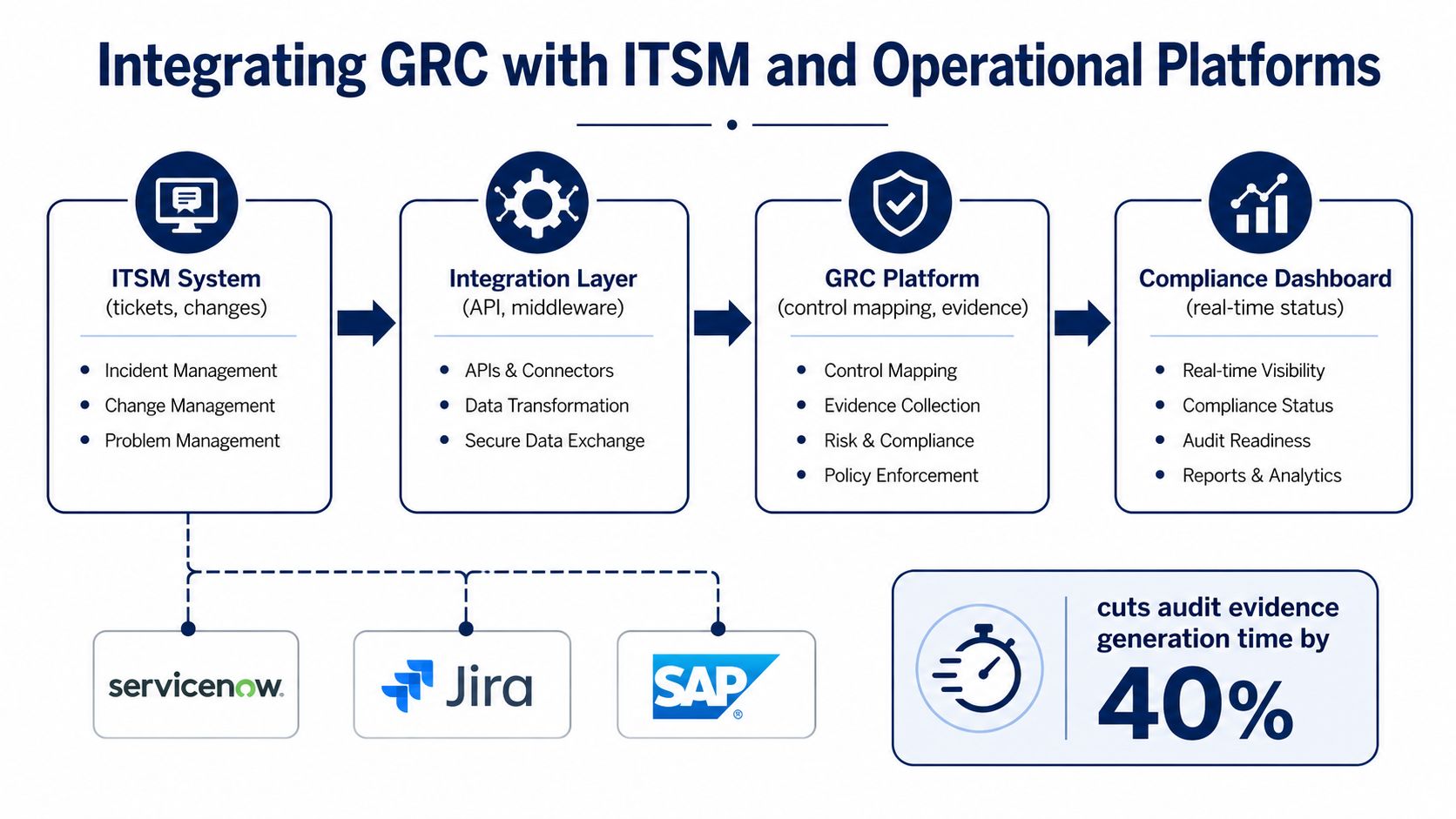
Integration rule: if the control owner has to copy data from one system into another every week, the architecture is already failing.
A regional implementation example is to treat service desk records as control evidence, not just support tickets. That's the point where GRC stops being a compliance annex and starts becoming part of operational governance. The internal reference on GRC in ServiceNow is useful here because it reflects the practical side of workflow-driven evidence collection. If you already use ServiceNow or a similar platform, your biggest gain may come from wiring evidence into live workflows rather than buying a new dashboard.
Where AI Automation Ends and Human Accountability Begins
AI can speed up GRC work, but it can also create false confidence if organisations don't redesign ownership around it. MetricStream's guidance on GRC frameworks highlights automation, workflows, and continuous review, but the hidden risk is obvious, automation can consolidate data silos without proving control effectiveness unless humans still own the decisions (MetricStream). That warning matters in the UAE, where AI adoption is moving fast and scrutiny around cyber resilience and data handling is tightening.
What AI should do, and what it should never own
AI is useful for summarising evidence, flagging anomalies, and routing tasks. It's less useful, and often dangerous, when it's allowed to infer compliance status without validated data or accountable review. If a model marks a control as effective, someone still needs to check whether the evidence is complete, current, and tied to the right obligation.
The most important questions for buyers are straightforward:
Can the system show why it marked a control as compliant?
Who approves AI-generated evidence before audit submission?
How are duplicate controls avoided when multiple workflows use the same data?
What happens when the model's output conflicts with an incident or exception record?
That last question is where accountability breaks down most often. If no one owns the override, the organisation ends up trusting automation more than its own process design.
For teams already exploring AI-assisted security workflows, an AI code security audit is a useful adjacent reference point because it shows how human review still anchors automated findings. The same principle applies to GRC. AI can accelerate review, but it can't replace traceable ownership across policy, risk, and control decisions.
The internal discussion on AI automation services fits here as well, but only as a reminder that automation should support governance, not bypass it. In practice, the safest operating model is simple. Let AI handle detection and routing. Let named owners handle approval, exception handling, and final accountability.
Your Six-Step GRC Implementation Roadmap
A credible rollout starts with sequence, not software. Diligent's implementation guidance sets out a six-step approach, assess the current state, select a framework, develop policies and controls, implement tools and technologies, train stakeholders, then monitor and improve continuously (Diligent). That order matters because most GRC failures come from skipping the discovery work and rushing into configuration.
The six steps that hold up in GCC enterprises
Assess the current state. Map existing policies, control owners, evidence sources, and manual workarounds. The goal is to find where duplication and risk already live.
Select the framework. Choose the standards and internal obligations that apply, then keep the scope tight enough to govern.
Develop policies and controls. Write controls so they can be tested, evidenced, and reused. If a control can't be measured, it'll be interpreted differently by every team.
Implement tools and technology. Fit the platform to your operating model, not the other way around.
Train stakeholders. The users who create evidence need to know why the workflow exists and what good evidence looks like.
Monitor and improve. Treat the rollout as a living programme, not a one-time installation.
The biggest mistake in implementation planning is assuming configuration equals adoption. It doesn't. Adoption comes from clear ownership, practical training, and change communication that reaches the people doing the work. For GCC enterprises, that often means involving service desk leaders, infrastructure teams, procurement, and compliance together, because the evidence chain crosses all of them.
You also need fit-gap analysis before the build starts. Ask which obligations can be mapped to existing ITSM workflows, which need new approvals, and which will stay manual for now. That avoids overpromising automation and underdelivering on reporting.
Measuring GRC ROI and Choosing the Right Delivery Partner
The ROI question is simpler than most vendors make it sound. Measure whether the platform reduces audit effort, speeds remediation, and expands control coverage across hybrid environments. If it doesn't change those three outcomes, the business case is weak.
DataLunix works in that space as an implementation and delivery partner, with service coverage that includes ITSM, ITOM, HRSD, CSM, ITAM, and ESM across platforms such as ServiceNow, HaloITSM, Freshservice, and ManageEngine. The practical value is in discovery workshops, fit-gap analysis, readiness assessment, and managed services after go-live, not just licence procurement. For a broader market lens, the internal note on Gartner GRC is a useful starting point for buyers comparing platform strategies.
If you want GRC to prove value in the UAE or wider GCC, anchor the programme to operational evidence, not document storage. DataLunix can help you design that operating model, connect it to live systems, and keep it governed after launch. Visit DataLunix to discuss how your GRC, ITSM, and operational workflows can be aligned into one auditable delivery model.