


Government Risk and Compliance Framework

Government risk and compliance in the UAE can't be managed as a document prepared for an annual audit. The practical requirement is continuous resilience, with named control owners, current evidence, monitored suppliers, governed data flows, and remediation that leadership can see. The most popular advice, “complete the checklist and archive the evidence”, is now too weak for public-sector and regulated environments.
The UAE regulatory environment connects cybersecurity, personal data, cybercrime, artificial intelligence, procurement, financial oversight, and third-party delivery. Dubai's Information Security Regulation, Federal Decree-Law No. 45 of 2021, Federal Decree-Law No. 34 of 2021, and evolving supervisory arrangements all point to the same operating model. You need to know what data and services you control, which obligations apply, who owns each safeguard, and how you'll prove that controls work in practice.
Why Compliance Is No Longer a Checklist Exercise
A completed policy pack doesn't prove that a supplier has closed an exposed vulnerability, that a service desk escalates a privacy incident, or that an AI workflow uses data for a documented purpose. It proves only that someone produced documentation. For UAE government suppliers and semi-government entities, the stronger question is whether the organisation can maintain essential services while detecting, escalating, and correcting control failures.
The UAE Cyber Security Council and CPX reported more than 223,800 exposed assets in the UAE, with half of critical vulnerabilities unaddressed for more than five years. The same reporting recorded a fall in DDoS attacks from 58,538 in the first half of 2023 to 2,301 in the first half of 2024. These figures support an uncomfortable conclusion: attack volume alone isn't a reliable proxy for compliance exposure. Long-lived weaknesses, poor ownership, and misconfiguration can matter more than a dramatic but short-lived event. (UAE Cyber Security Council and CPX reporting)

What continuous resilience looks like
A mid-sized supplier doesn't need to duplicate every control used by a federal ministry. It does need a defensible, risk-based baseline:
Control ownership: Assign an accountable owner for access, vulnerability management, incident response, supplier assurance, data handling, and business continuity.
Evidence freshness: Capture tickets, approvals, test results, exception records, and monitoring outputs as work happens, rather than reconstructing them before an audit.
Risk-based remediation: Prioritise vulnerabilities according to service criticality, exposure, exploitability, and data impact, not just the order in which scanners report them.
Exception discipline: Record why a control can't be implemented, who accepted the risk, what compensating measure exists, and when the decision will be reviewed.
Practical rule: If a control has no named owner, no operating evidence, and no escalation path, treat it as unimplemented.
The UAE's 2025–2031 national cybersecurity strategy, National Encryption Policy for government entities, and expanding economy-wide controls reinforce this direction, as described in the regional reporting cited above. Compliance teams should therefore design a recurring operating rhythm: control attestations, vulnerability reviews, supplier checks, incident exercises, and management reporting. The objective isn't to build the largest GRC programme. It's to make the right controls visible, repeatable, and proportionate to the services your organisation delivers.
Mapping the UAE Regulatory Landscape for Government Entities
Government risk and compliance starts with applicability mapping. Your organisation may face federal obligations, emirate-level requirements, sector rules, contractual controls, and procurement conditions at the same time. Treating these as separate folders creates duplicated testing and leaves gaps between legal, technical, and operational teams.
Dubai Government entities have a particularly concrete baseline. Dubai Government Information Security Regulation, ISR v3.1, is mandatory for Dubai Government entities under Dubai Law No. 11 of 2014. It extends to contractors, consultants, and employees handling sensitive government information and covers thirteen security domains, including governance, access control, risk management, incident response, and cloud security. The regulation therefore affects procurement and managed services, not only internal ministry operations. (Dubai Government ISR v3.1 overview)
Which federal obligations shape daily operations
The UAE Federal Decree-Law No. 45 of 2021, the Personal Data Protection Law, came into force on 2 January 2022 and applies to organisations processing personal data of UAE residents. Its practical requirements include data-subject rights, lawful bases for processing, and breach handling. A government department should map each processing purpose, the data involved, the system owner, the processor, the retention logic, and the relevant lawful basis. (UAE PDPL compliance overview)
The cybercrime framework, Federal Decree-Law No. 34 of 2021, also took effect on 2 January 2022 and criminalises offences including hacking and unauthorised access. That legal exposure means security governance can't sit only with the infrastructure team. Procurement, HR, investigations, legal, and service operations need clear handling and escalation procedures. (UAE cyber safety and digital security guidance)
The UAE's 2026 regulatory environment also includes a single federal AI and personal-data regulator that reportedly absorbs three prior entities and takes on direct private-sector PDPL enforcement. Organisations should respond by inventorying personal-data flows, documenting lawful basis by purpose, and aligning vendor contracts and transfer controls before enforcement activity makes weak governance an audit finding. (UAE federal AI and data compliance analysis)
For new entities and suppliers, regulatory mapping often sits alongside foundational commercial work. Organisations establishing an operating presence may find trade license setup assistance useful when clarifying the legal entity, activity, and jurisdiction that underpin compliance ownership.
The CBUAE Rulebook provides another governance pattern. It requires a Board-approved Risk Governance Framework using a three lines of defense model, comprising senior management, risk management and compliance, and independent internal audit. Non-financial government entities can adapt the same separation of duties, even where the CBUAE rulebook doesn't directly apply. (Dubai Electronic Security Center regulations and standards)
Building Your Implementation Roadmap from Assessment to Automation
A workable roadmap begins with the operating environment, not the software catalogue. Before selecting a GRC platform, establish which services are critical, where sensitive information moves, which suppliers support delivery, and how teams currently create evidence. That discovery prevents you from automating an unclear process.
Start with a defensible baseline
Use four connected phases:
Discovery and assessment: Run workshops with CIO, security, privacy, procurement, HR, service management, infrastructure, and internal audit stakeholders. Build an obligation register, asset and service inventory, data-flow map, supplier catalogue, and control-to-evidence matrix.
Strategy and planning: Perform a fit-gap assessment against applicable requirements. Rank gaps by service impact, legal exposure, data sensitivity, supplier dependency, and implementation effort. Produce an action plan with accountable owners and review dates.
Implementation and enablement: Deploy controls through existing workflows. Configure access reviews, change approvals, incident escalation, risk acceptance, supplier attestations, and evidence collection. Train the people who operate the process, not only the administrators who configure the tool.
Continuous monitoring: Connect compliance checks to operational data. Monitor overdue remediation, failed control tests, expiring attestations, unresolved exceptions, and material changes in suppliers or processing activities.
Integrate compliance with work people already do
A control should create or update an operational task wherever possible. A privileged-access review can generate assignments in ServiceNow, HaloITSM, or Freshservice. A failed configuration check can open a remediation ticket. A supplier review can create a renewal gate for procurement. This approach reduces the gap between policy and execution.
For organisations using ServiceNow, the compliance and ServiceNow integration approach offers a useful reference point for connecting risk, control, and service workflows. Other teams may evaluate Bidwell compliance coverage when comparing packaged compliance capabilities.
Change management determines whether the roadmap survives deployment. Set stakeholder communications around service outcomes, give each team a concise role definition, and provide enablement for onshore, offshore, and hybrid delivery groups. A control that interrupts service delivery without a documented business rationale will attract workarounds. A control embedded in the service workflow is more likely to be adopted and evidenced.
Where AI Governance Meets Third-Party Risk and Data Compliance
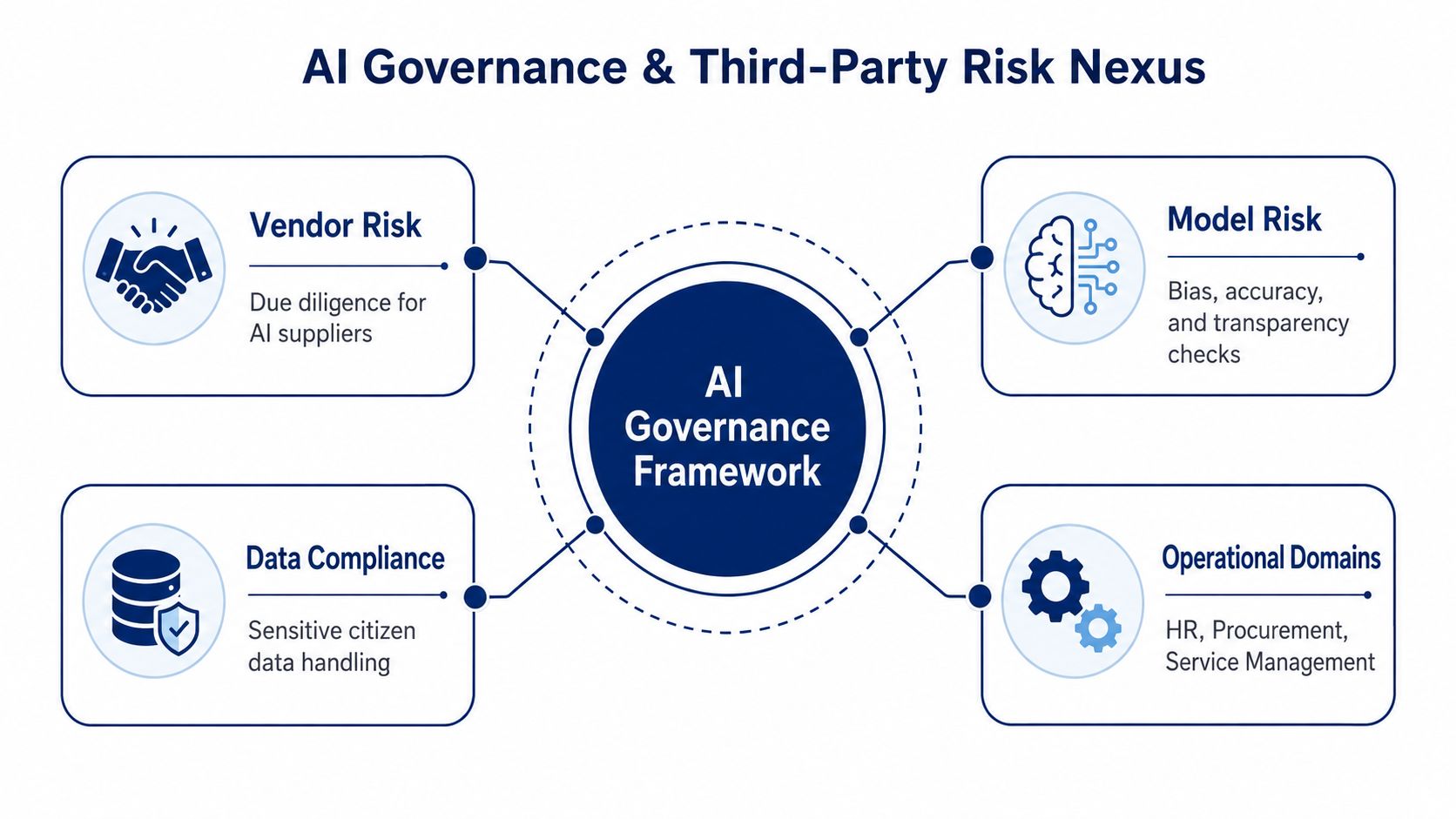
The hardest AI governance question for a government department isn't whether AI is permitted in the abstract. It's whether a particular vendor, model, data set, and workflow combination creates an acceptable operational and legal profile.
Consider an AI assistant connected to HR cases, procurement records, service tickets, or citizen data. The model may be technically accurate, yet the workflow can still fail because the supplier retains prompts, users receive excessive access, the department can't explain the processing purpose, or a transfer control is missing. For that reason, classify risk across the complete chain:
Vendor risk: Review ownership, subcontractors, hosting locations, incident obligations, access controls, deletion commitments, audit rights, and business continuity.
Model risk: Test accuracy, explainability, inappropriate output, human review, prompt manipulation, and change management.
Data compliance: Identify personal and sensitive data, document lawful basis for each purpose, minimise inputs, define retention, and restrict onward use.
Operational risk: Assess what happens when the model is unavailable, produces an unsafe recommendation, or changes behaviour after an update.
Why supplier compliance now multiplies exposure
Etihad Credit Bureau said in 2026 that it would add non-banking government data from the Ministry of Foreign Affairs, the Ministry of Human Resources and Emiratisation, and the Abu Dhabi Pension Fund to strengthen corporate risk assessment. The indicators include delayed government-related fees, administrative fines, Emiratisation non-compliance, non-payment of wages under the Wage Protection System, missed pension contributions, and the number of days payments remain overdue. (Etihad Credit Bureau expansion reporting)
This changes the supplier conversation. Compliance signals can influence counterparty and credit evaluation, so a government vendor's labour, payment, and pension obligations may become relevant to commercial due diligence. Departments should connect procurement risk, vendor monitoring, finance, HR compliance, and AI governance instead of reviewing each domain in isolation.
A department evaluating practical AI risk management software should still begin with workflow classification and contract review. Software can support evidence and monitoring, but it can't decide whether a citizen-data use is necessary or whether a human must approve a consequential action. For a broader supplier-control model, use the federal third-party risk management framework as a reference point.
Choosing Between Architectures and Managed-Service Models
Architecture decisions should follow control ownership and data sensitivity. An on-premise control plane can suit environments with strict sovereignty, integration, or operational constraints. A cloud-native GRC platform can provide faster workflow configuration and broader connectivity, but it requires careful identity, transfer, vendor, and exit planning. A hybrid managed-service model can combine local leadership with specialised delivery, provided accountability remains explicit.
Model Type | Best For | Cost Profile | Control Ownership | Time to Value |
|---|---|---|---|---|
Internal build | Large teams with established GRC capability and stable requirements | Higher internal staffing and platform effort | Owned directly by the organisation | Slower, dependent on internal capacity |
Cloud-native platform | Organisations needing connected workflows and scalable evidence collection | Subscription and integration costs, with implementation effort | Organisation owns policy and decisions, platform supports execution | Faster when processes are already defined |
Managed service | Teams with skills gaps or a need for ongoing optimisation | Recurring service cost, potentially lower internal overhead | Shared operational delivery, with the organisation retaining accountability | Faster for mobilisation, dependent on partner quality |
Hybrid model | GCC organisations balancing local engagement with specialist delivery | Blended cost across onshore and offshore resources | Governance retained locally, delivery distributed by workstream | Practical when phased carefully |
The trade-off isn't just price. Onshore UAE-based leadership helps with stakeholder alignment, regulatory interpretation, workshops, and executive decisions. Offshore India delivery centres can provide cost-efficient configuration, testing, documentation, and support. A sound engagement defines which activities require local presence and which can be delivered remotely, rather than treating geography as a proxy for quality.
DataLunix, for example, describes delivery through onshore, offshore, and hybrid models, with discovery workshops, fit-gap analysis, readiness assessments, implementation, enablement, and managed optimisation. Its service scope spans platforms including ServiceNow, HaloITSM, Freshservice, and ManageEngine. Organisations comparing options can also review enterprise GRC solution patterns before choosing between internal capability, a platform partner, or an outsourced operating model.
Discounted licensing can improve the commercial case, but licensing isn't the outcome. Require a clear implementation backlog, data model, integration plan, acceptance criteria, knowledge transfer, upgrade responsibility, and service-level ownership.
Prioritizing Controls That Address Long-Tail Exposure
Prioritise controls that keep failing without warning. Misconfiguration, stale access, unresolved vulnerabilities, unclear exceptions, and weak supplier ownership create persistent exposure because no single team sees the full chain.
For mid-sized UAE government suppliers and semi-government entities, the first control wave should usually include:
Identity and access: Replace broad standing access with role-based assignments, joiner-mover-leaver workflows, privileged-access review, and phishing-resistant authentication where the applicable sector requires it.
Vulnerability remediation: Link scanning to asset criticality and service ownership. Every material finding should have a due date, accountable owner, exception route, and verification step.
Incident response: Define severity, escalation, evidence preservation, communications, and recovery responsibilities. Test the handoffs between supplier, service desk, security, legal, and leadership.
Supplier assurance: Segment vendors by data access, service criticality, connectivity, and subcontracting. Make contract clauses operational through recurring attestations and review triggers.
Control governance: Adapt the three lines model so senior management accepts risk, compliance and risk teams challenge execution, and independent assurance tests effectiveness.
Financial institutions face a specific authentication deadline. A 2026 UAE banking mandate requires licensed financial institutions to eliminate SMS and email one-time passwords by 31 March 2026, moving towards app-based authentication, biometrics, passkeys, and real-time risk monitoring. The same source states that administrative penalties can reach AED 250,000 for significant violations. (UAE authentication compliance guidance)
Non-financial entities shouldn't copy the mandate blindly, but they should understand its direction. Authentication needs to resist phishing and respond to transaction risk, particularly where staff, suppliers, or citizens can initiate sensitive actions. Use a focused vendor risk assessment method to identify where stronger controls deliver the greatest reduction in operational exposure.
Measuring Success with KPIs That Demonstrate Compliance
A regulator or board needs evidence that controls operate, not a dashboard filled with activity counts. Select measures that connect ownership, exposure, remediation, and service impact.
A practical reporting set
Track the following indicators:
Ownership coverage: The proportion of in-scope controls with a named accountable owner, current procedure, evidence source, and escalation route.
Remediation discipline: The age and status of material vulnerabilities, overdue actions, accepted exceptions, and repeat findings.
Access effectiveness: Completion and quality of access reviews, privileged-access exceptions, and leaver removal evidence.
Supplier exposure: Review status by supplier tier, unresolved contractual gaps, subcontractor visibility, and high-risk service dependencies.
AI workflow governance: Approved use cases, data classifications, human-review points, model changes, incidents, and unresolved risk decisions.
Evidence quality: Whether an auditor can trace a control from requirement to owner, workflow record, test result, and management action.
CIO dashboards should show material risks, trend direction, service dependencies, and decisions required. Service desk leaders need actionable queues, such as overdue approvals and incidents lacking classification. Internal audit needs traceability and independence. Integrating these measures with digital transformation services can reduce duplicate reporting by drawing evidence from ITSM and ITOM workflows.
Don't measure automation for its own sake. A control check that produces thousands of alerts without ownership increases noise. Start with a small set of decision-useful measures, establish thresholds, review exceptions with leadership, and expand only when teams can act on the information.
The UAE's government risk and compliance environment rewards organisations that can demonstrate control in motion. Your roadmap should connect regulation to services, services to owners, and owners to evidence. That is how you prove resilience without overbuilding.
DataLunix helps GCC organisations translate regulatory obligations into ServiceNow, HaloITSM, Freshservice, and ManageEngine workflows, from discovery and fit-gap assessment through implementation, enablement, and managed optimisation. Visit DataLunix to discuss a practical government risk and compliance roadmap built around your services, suppliers, data flows, and control evidence.