


GRC 2020: Trends, Drivers, and Lessons for Modern IT Leaders

In the UAE's 2020 private-sector workforce, only 28,912 of 4,799,196 workers were Emirati, while 4,770,284 were non-Emirati, according to the GLMM UAE labour dataset. That ratio changes the meaning of GRC 2020. Governance wasn't only a policy problem. It was an operating-model problem involving distributed teams, expatriate delivery layers, remote access, suppliers, and evidence that often sat outside headquarters' view.
Why GRC 2020 Still Matters for Today's IT Leaders
GRC 2020 was the point at which governance, risk, and compliance became inseparable from daily technology operations. Pandemic-driven remote work, accelerated cloud adoption, and stronger regulatory expectations forced CIOs to connect policy with identity, change, incident, asset, and vendor workflows.
The UAE's population was estimated at 9,289,297 in 2020, including 5,984,973 males and 3,304,324 females, in the Federal Competitiveness and Statistics Centre data published through GLMM. The private-sector employment figures are even more important for control design. A workforce with such extensive expatriate participation requires governance that travels across locations, employers, shifts, languages, and delivery partners.
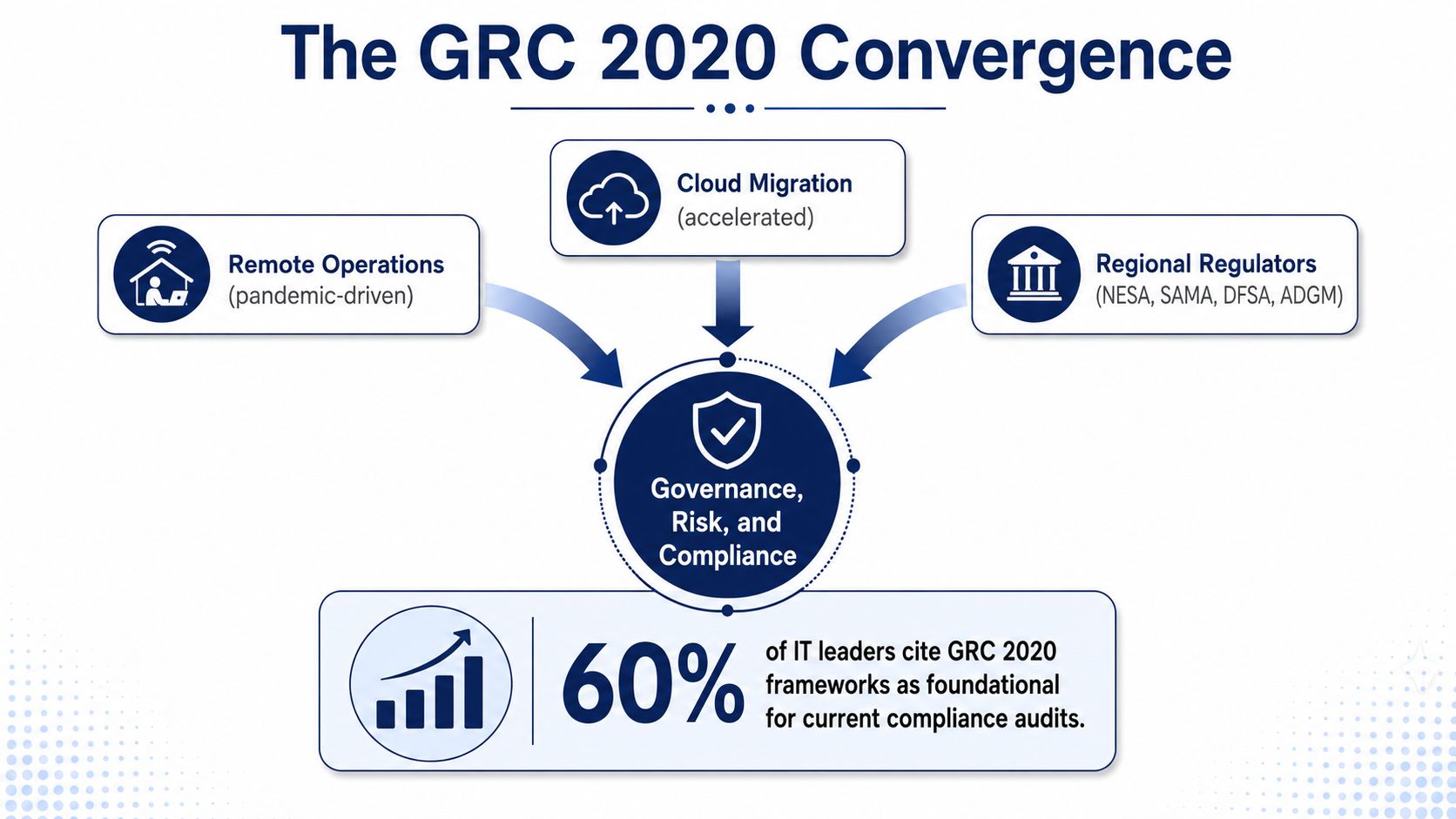
A 2020 control framework that assumed headquarters-based execution could appear complete on paper while missing privileged changes performed remotely, emergency access approved informally, or supplier activity recorded in separate systems. Those gaps now survive as technical debt in ITSM tickets, identity records, cloud logs, and audit workbooks.
The regional context changes the control objective
The Gulf Research Center's 20-year milestone record places its institutional origin in Dubai in June 2000 and identifies 2020 as the year marking two decades of operations in the UAE. That context matters because Dubai sits at the centre of regional policy, business, and research activity, while GRC's wider network addresses Gulf-wide questions rather than UAE-only concerns.
The GRC 20/20 Dubai summit listing shows that a G[P]RC Summit was scheduled for 29–30 January 2024, covering governance, performance, risk, and compliance in an in-person regional forum. The lesson for today's CIO is direct: GRC has moved from an annual compliance exercise to an operating capability spanning enterprise technology and regional institutions.
Practical rule: If a control can't identify the person, service, asset, supplier, and approval record involved in a change, it isn't operationally complete.
Control ownership also depends on workforce design. Your programme needs role-based training, clear escalation paths, and evidence that people understand their obligations. For a practical reference, review these best practices for compliance training before redesigning the human layer of your controls. DataLunix's governance, risk, and compliance perspective provides a related view of how those controls can connect to service operations.
The Real-World Forces That Shaped GRC 2020
A Dubai-based financial group decides to establish a 5,000-seat remote-work programme in nine days. The immediate objective is continuity. IT teams issue laptops, expand remote access, approve temporary firewall rules, and create exceptions in the ITSM queue. The less visible consequence is that privileged access exceptions begin multiplying faster than risk teams can review them.
The first failure mode is unlogged break-glass access. An engineer receives emergency permissions through an informal channel, resolves the operational issue, and closes the ticket without attaching approval evidence. The service may recover, but the control has no reliable chain from request to authorisation to revocation.
An Abu Dhabi industrial operator faces a different problem. Its vendors shift portions of delivery to offshore teams, and the third-party risk register expands as suppliers introduce new locations, subcontractors, and access paths. The issue isn't that expatriate or offshore delivery is unsafe. The issue is that the operator's original control design didn't model the full execution layer.
Where regulatory expectations met operational queues
Financial institutions had to reconcile regulator expectations with actual ServiceNow change queues, identity records, incident reviews, and configuration data. A control written in policy language became useful only when it could identify the affected service and confirm whether the required approval happened before implementation.
The UAE also introduced Cabinet Resolution No. 58 of 2020, effective 28 August 2020, regulating beneficial-owner procedures for mainland companies and non-financial free zones. The resolution analysis on beneficial-owner registers describes requirements for shareholder, beneficial-owner, and nominee-director registers, with changes notified to the Registrar within 15 days.
That's a useful governance pattern for technology leaders. A requirement becomes enforceable when the organisation defines the record, owner, update event, and evidence location. The same principle applies to access reviews, supplier attestations, and change approvals.
The pandemic also produced immediate labour-administration changes. Cabinet Resolution No. 21 of 2020 for the UAE Ministry of Human Resources and Emiratisation took effect on 5 April 2020, as documented in the GLMM record on MoHRE service fees and administrative fines. For CIOs, timing matters because regulatory change introduced during operational disruption must be embedded into live workflows, not filed for later interpretation.
A connected approach to strategy and enterprise risk, such as the one described in COSO enterprise risk management integration, helps prevent these requirements from becoming isolated compliance tasks.
GRC 2020 Meets ITSM and ITOM in Practice
The practical question is simple: where does control evidence come from? If the answer is a spreadsheet assembled before an audit, GRC remains detached from operations. If evidence is generated by ITSM and ITOM workflows as work occurs, the control becomes observable.
Take a quarterly access review. An effective workflow can:
Pull identity and employment data from ITSM user records.
Match each identity to an approved role record.
Identify conflicting or excessive permissions.
Route attestations to accountable managers.
Store the approval and exception evidence in the GRC application.
The value isn't the form. It's the traceability between the user, role, system, reviewer, decision, and remediation.
The operating workflow
ITOM discovery populates CMDB configuration items, which gives control testing a service and asset context. Event Management can identify a configuration drift and create a GRC issue when a monitored item no longer meets the required state.
Change Advisory Boards should record risk assessments inside standard change tickets rather than separate spreadsheets. A major incident review should create an audit observation when the review identifies a failed control, missing dependency, or untested recovery linkage.
ITSM/ITOM Record | GRC Control Domain | Evidence Generated |
|---|---|---|
Access request and approval | Identity governance | Approved role, reviewer decision, exception record |
Change ticket | Change management | Risk assessment, approver, implementation result |
CMDB configuration item | Asset and control scope | Service relationship, owner, technical state |
Event Management alert | Continuous monitoring | Drift notification, issue creation, remediation status |
Major incident record | Resilience and assurance | Root-cause review, control observation, corrective action |
This design also clarifies accountability. Operations owns the record, risk teams define the control, and audit receives evidence without rebuilding the story manually. The GRC in ServiceNow workflow model illustrates how a platform can connect these activities.
You shouldn't assume automation makes every control effective. A poorly maintained CMDB can produce automated evidence that is consistently wrong. Control automation must therefore include data-quality checks, ownership rules, exception handling, and periodic validation.
Where AI and Automation Actually Moved the Needle
AI delivered practical value in GRC 2020 when it reduced repetitive evidence work and improved pattern recognition. It was less convincing when vendors presented autonomous risk scoring as a substitute for explainable control judgement.
Service desks offered the clearest production use cases. Ticket classification could route control exceptions to the right queue. Automated evidence collection could gather change records, configuration data, and incident history. Natural-language processing could help teams identify obligations in policy and regulatory text, provided a human reviewed the interpretation.
Useful automation versus pilot theatre
Continuous control monitoring can consume ITSM event streams and flag changes that require review. Automated access campaigns can identify dormant accounts or role conflicts. Change-management anomaly detection can highlight unusual approval patterns, emergency changes, or repeated exceptions.
These capabilities support decision-makers. They don't decide whether residual risk is acceptable, whether a control is well designed, or whether a business owner should accept an exception.
Use Case | Where It Worked in 2020 | Where It Overpromised | Evidence Source |
|---|---|---|---|
Ticket classification | Routed exceptions and reduced manual triage | Misclassified tickets without reliable taxonomy | ITSM records and reviewed classification outcomes |
Evidence collection | Gathered CMDB, change, and incident records | Failed when source data was incomplete | Linked operational records |
Policy analysis | Identified likely obligations in text | Couldn't replace legal or compliance interpretation | Versioned policy reviews |
Access reviews | Launched campaigns and tracked attestations | Couldn't determine business necessity alone | Identity and approval records |
Risk scoring | Supported prioritisation using available signals | Lacked explainability when treated as autonomous | Documented scoring logic and owner decisions |
A useful design principle is consistent candidate risk scoring, where teams apply repeatable criteria without hiding the reasoning behind a score. Your audit trail should show the inputs, rule, reviewer, exception, and final decision.
AI can accelerate evidence aggregation. It can't carry accountability for risk acceptance.
The AI and automation examples from DataLunix are relevant to CIOs evaluating where automation belongs in service operations. Start with stable workflows and reliable records. Otherwise, AI just processes inconsistent data faster.
Platform and Vendor Choices CIOs Faced in 2020
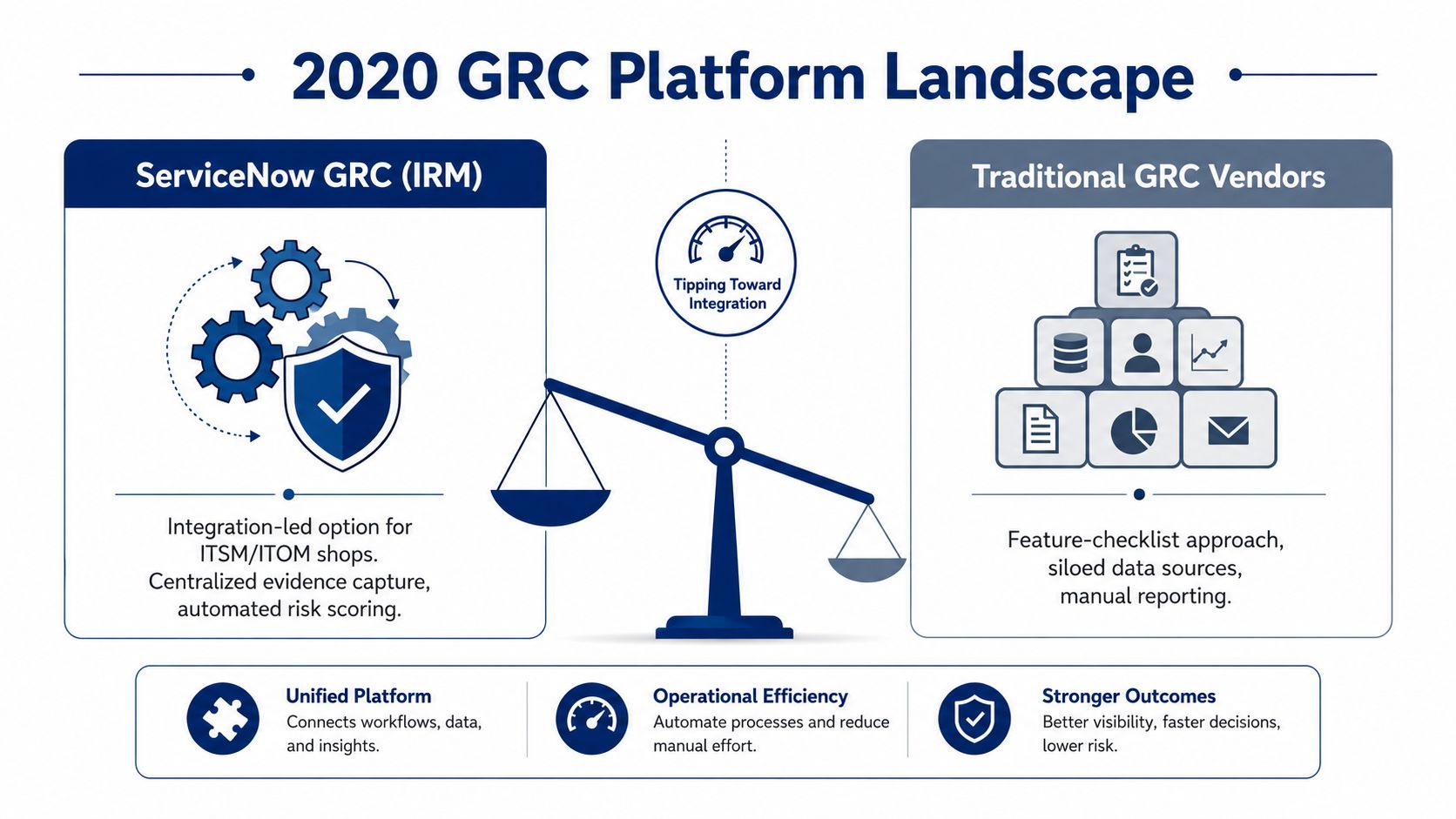
The 2020 platform decision wasn't primarily about the size of a control library. It was about how much operational context the platform could access without costly duplication.
ServiceNow GRC, now commonly discussed within Integrated Risk Management, appealed to organisations already using ServiceNow ITSM and ITOM because it could align risk and compliance workflows with service records, changes, incidents, and configuration items. Standalone options such as SAP, IBM OpenPages, and RSA Archer offered established risk and compliance capabilities, while other emerging platforms competed through specialised workflows and faster deployment models.
Integration density should outrank feature volume
A broad framework catalogue can't compensate for weak evidence connectivity. CIOs should score vendors against the systems that generate control evidence:
Native ITSM connectivity: Can changes, incidents, requests, and approvals feed controls without manual exports?
CMDB alignment: Can the platform associate controls with services, applications, infrastructure, and owners?
Monitoring hooks: Can events and configuration drift create issues or reassessments?
Framework mapping: Can teams map requirements across ISO 27001, NESA, SAMA, GDPR, and internal policies?
Implementation reality: What happens after the demo, when data quality, role design, and exceptions complicate the model?
The GCC comprises six countries, Saudi Arabia, the United Arab Emirates, Qatar, Kuwait, Oman, and Bahrain, and was established in 1981, according to Gulf Research Center GCC publications. That regional scope makes localisation, regulatory mapping, and cross-border operating assumptions important procurement considerations.
DataLunix offers ServiceNow GRC implementation and managed-service work alongside broader ITSM and ITOM delivery. Treat that as one option in a fit-gap assessment, not as a reason to skip architecture review. The ServiceNow governance, risk, and compliance platform overview sets out the integration-led approach.
A procurement team should test a real change record, real access data, and a real incident review during evaluation. A polished demonstration using clean sample data says little about production traceability.
Modernising a 2020-Era GRC Programme Without Rebuilding It
You don't need to discard a 2020-era programme to modernise it. Start by determining which controls still address current risks, which controls depend on obsolete processes, and which controls were never connected to operational evidence.
A controlled modernisation sequence
First, audit the control inventory. Identify duplicate controls, inactive owners, spreadsheet dependencies, unsupported assertions, and evidence that can't be reproduced. Preserve historical test results and audit findings. Regulators and auditors need continuity, even when the underlying workflow changes.
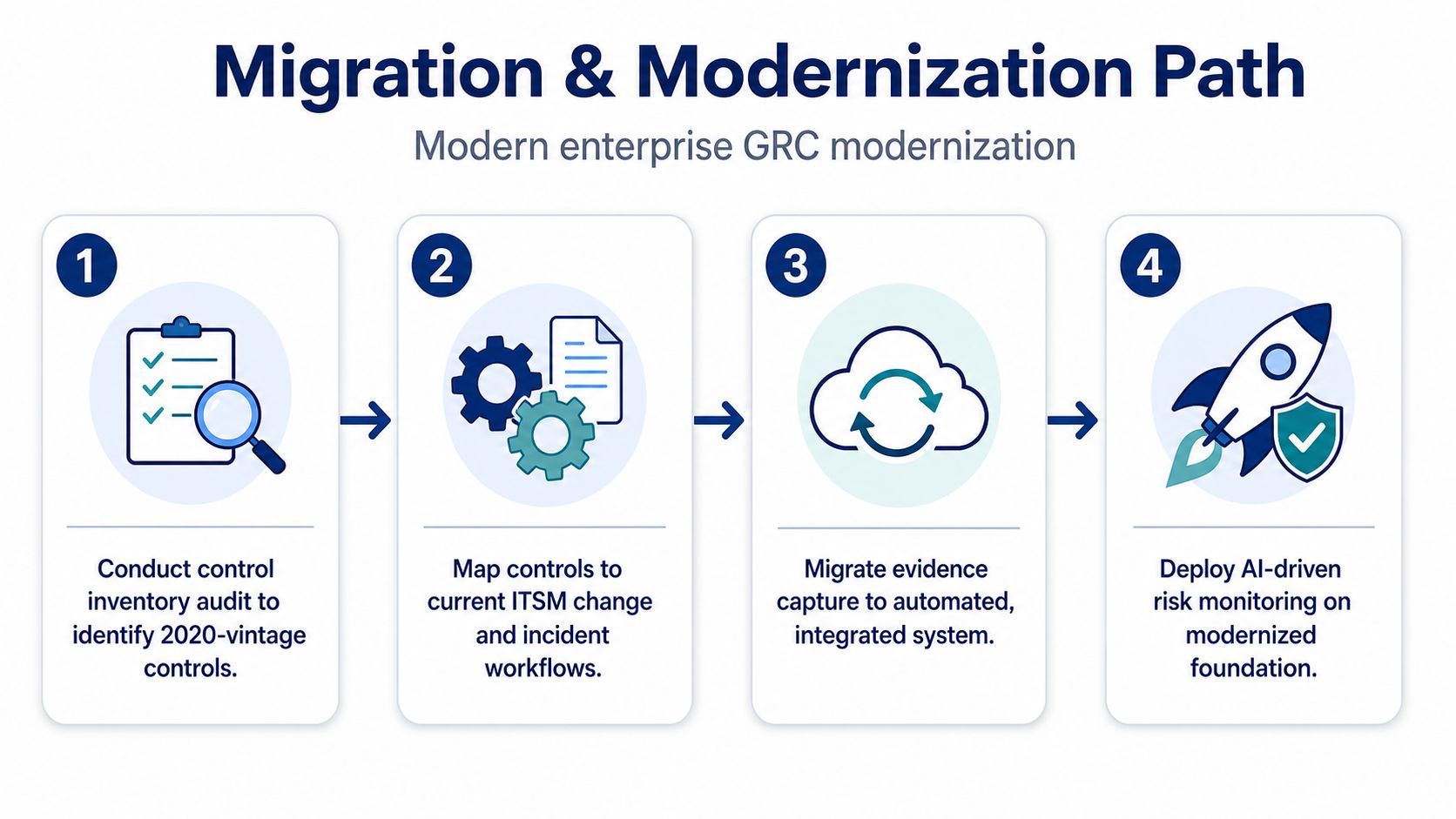
Next, map controls to live ITSM workflows. Link access controls to identity records, change controls to change tickets, resilience controls to service dependencies, and incident controls to post-incident reviews. This creates a practical boundary for automation.
Then, introduce machine-readable evidence. Version policies, requirements, control statements, owners, test procedures, and exceptions so systems can interpret them consistently. Don't add an AI layer while definitions remain ambiguous.
Finally, monitor continuously where the data is strongest. Start with high-volume change, access, incident, and configuration records. Add automated alerts only after owners understand what a meaningful exception looks like.
Preserve the audit trail first. Optimise the workflow second.
Avoid two common mistakes. Bolting on a new GRC tool before cleaning data creates a second system of record, while rewriting every control during a platform migration destroys comparability. Sequence GRC modernisation alongside cloud and zero-trust initiatives, but give it explicit ownership so it doesn't disappear behind larger transformation programmes.
A hybrid delivery model also needs named accountability. A UAE CIO can delegate evidence operations, campaign administration, and control follow-up to a qualified GRC operations lead, including a non-national team member. Executive sponsorship remains necessary for risk appetite, funding, policy exceptions, regulator engagement, and material residual-risk acceptance.
A CIO Roadmap and Checklist for Acting on GRC 2020
The right roadmap begins with control visibility, not a new licence. Use the following sequence to move from inherited 2020 controls to an operating model that can support continuous monitoring and AI-assisted analysis.
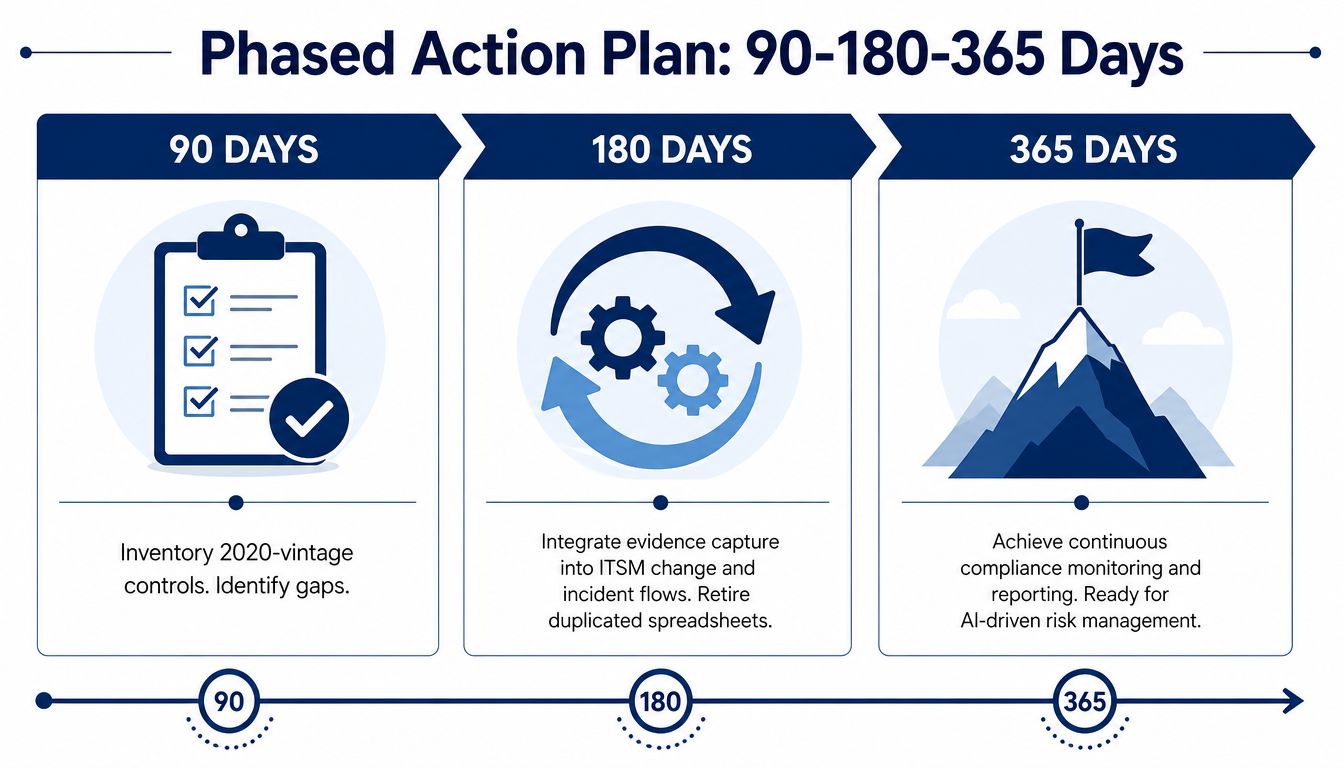
The first 90 days
Inventory the controls created or materially changed in 2020. Categorise each one as effective, duplicated, obsolete, manual, partially evidenced, or dependent on a missing data source.
The deliverable is a prioritised control register with an accountable owner, affected service, evidence source, test method, and known exception. The CIO should sponsor the inventory, while a GRC operations lead can coordinate interviews, record review, and evidence collection.
Track:
Audit cycle time: How long teams need to assemble a defensible evidence pack.
Control failure rate: Which controls fail testing and why.
Evidence completeness: Whether each test has an owner, source record, decision, and timestamp.
The first 180 days
Integrate evidence capture into ITSM change, incident, access, and request workflows. Retire duplicated spreadsheets only after the replacement workflow has passed user acceptance and produced evidence that audit can reproduce.
The CIO should require service owners to approve control-to-workflow mappings. The operations lead can manage campaign schedules, issue queues, and remediation follow-up. Procurement and architecture teams should validate vendor access, cloud dependencies, and data ownership.
Track:
Mean time to detect: How quickly the organisation identifies control drift.
Mean time to remediate: How quickly owners resolve verified exceptions.
Duplicate evidence volume: Which manual reports can be retired safely.
The first 365 days
Deploy AI-assisted monitoring only after workflows and data sources are stable. Use AI to aggregate evidence, classify exceptions, identify anomalous changes, and prepare management summaries. Keep control design, risk acceptance, and regulator-facing decisions with accountable humans.
The board cadence should be simple:
Review material risks and changes in exposure.
Examine recurring control failures and overdue remediation.
Confirm supplier and privileged-access exceptions.
Approve accepted residual risk.
Review progress against the modernisation roadmap.
GCC conditions also demand regional interpretation. The GCC labour-market dataset records non-national shares of employed people in 2020 at 75.6% in Saudi Arabia, 77.8% in Bahrain, 84.7% in Kuwait, 76.8% in Oman, and 94.8% in Qatar. UAE employment data weren't available in that source, which is itself an evidence gap. A CIO roadmap should therefore test whether controls work across distributed delivery teams, not just whether headquarters can produce a policy pack.
The broader regional context is economically significant. GRC publications record 7.3 percent GDP growth in the GCC in 2022, a data point that reinforces why governance must support operational scale rather than merely restrict it. Your objective is a single, credible risk posture that connects business services, technology evidence, people, suppliers, and decisions.
DataLunix helps GCC and European enterprises assess GRC maturity, connect ServiceNow ITSM and ITOM evidence to governance workflows, and modernise controls through implementation or managed services. Visit DataLunix to discuss a discovery workshop, fit-gap assessment, or phased roadmap for turning 2020-era control debt into measurable operational governance.