


10 GRC Automation Tools: Compare Enterprise Platforms

Updated: 7 hours ago
Which GRC Automation Tools Fit Your Operating Model?
The strongest GRC automation tools choice depends on your existing service-management estate, risk domains, hosting requirements, licensing model, and implementation capacity. There's no universal winner. This catalogue compares 10 enterprise platforms through the same buying lens, including automation depth, control content, workflow configuration, integration fit with ServiceNow, HaloITSM, Freshservice, and ManageEngine, deployment, licensing, and adoption.
The UAE market shows why selection deserves more than a feature checklist. Enterprise GRC was valued at $746.6 million in 2024 and is projected to reach $1.296 billion by 2029, with an implied 11.7% CAGR, according to this Middle East data security and compliance forecast. Demand is coming from public-sector compliance modernization and digitally intensive enterprises that need scalable controls, evidence, and policy enforcement.
A platform that looks strong in a demonstration may still fail your operating model. Validate current packaging, data residency, connector availability, participant licensing, implementation dependencies, and add-on requirements during procurement. Integration with ServiceNow, HaloITSM, Freshservice, and ManageEngine should be treated as a fit-gap question, not an assumption.
DataLunix is a Dubai-based digital transformation and staff augmentation company supporting discovery, fit-gap analysis, readiness assessment, implementation, change management, and managed optimisation across these service-management environments.
1. ServiceNow Integrated Risk Management
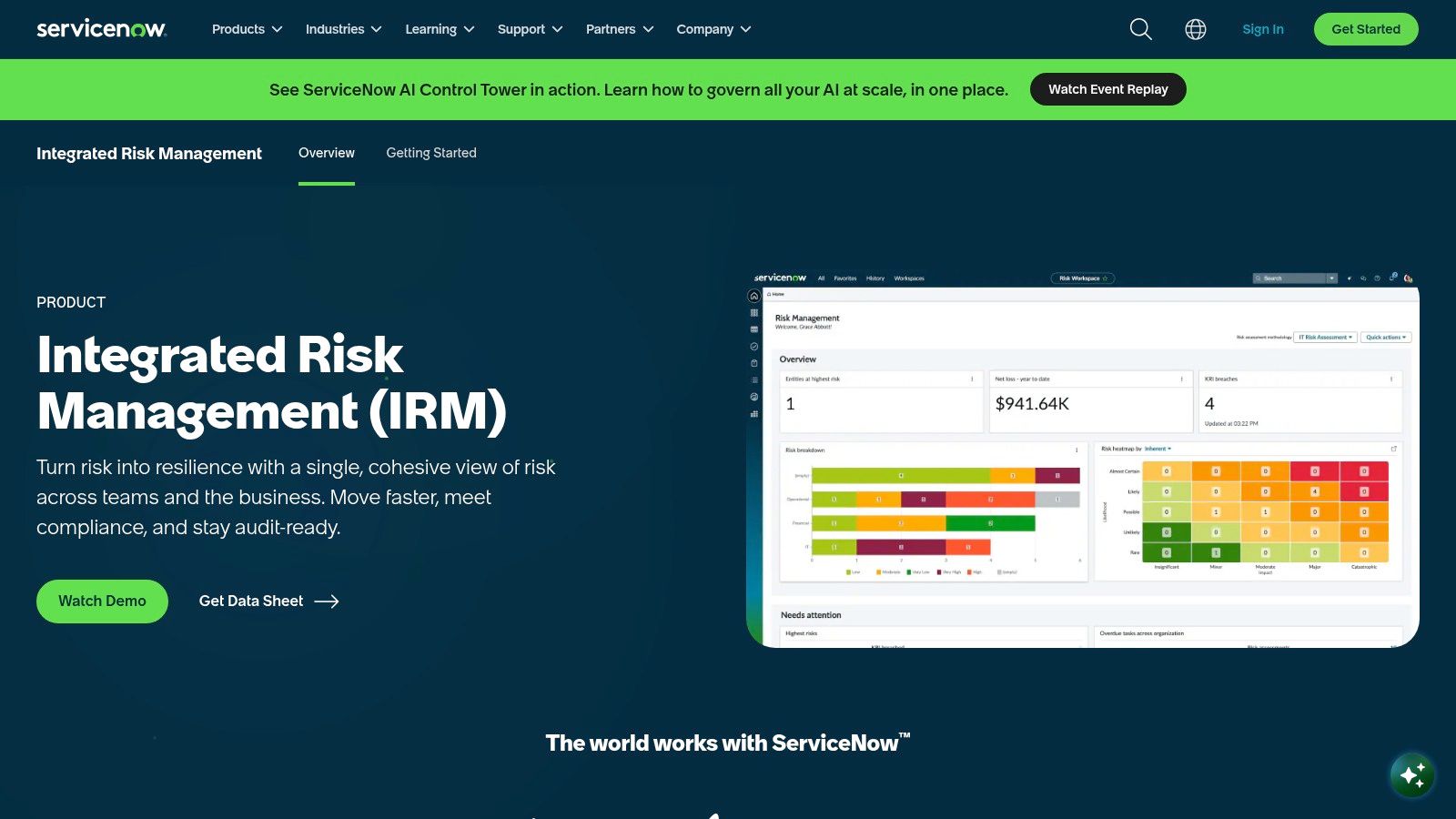
ServiceNow Integrated Risk Management is the most natural fit when your organisation already runs substantial workflows on the Now Platform. It connects policy and compliance, risk, audit, regulatory change, operational resilience, privacy, and vendor risk with the same platform used for IT, employee, customer, and operational workflows.
Its advantage isn't just having a GRC module. It's the ability to connect risk records to operational context, including the CMDB, incidents, changes, services, and business applications. That creates a practical route toward continuous control monitoring, automated remediation, and evidence collection when those underlying records are already reliable.
The platform also offers Now Assist for selected risk and compliance tasks. However, AI assistance doesn't remove the need for clear control ownership, structured data, or carefully designed approval paths.
Where ServiceNow IRM fits best
Existing ServiceNow estates: Native alignment with ITSM, ITOM, CSM, HRSD, and CMDB data can reduce platform fragmentation.
Cross-functional controls: Risk tasks can connect with operational work instead of remaining in a separate compliance queue.
UAE hosting requirements: ServiceNow's announced UAE Cloud hosted on Microsoft Azure may support local data-residency discussions, subject to current contractual and technical validation.
Pricing is bespoke and can increase as modules, users, integrations, and implementation scope expand. Third-party risk depth may also require additional capabilities beyond core IRM. Use the GRC in ServiceNow guide to frame the discussion around workflow reuse, not just module availability.
Practical rule: Choose ServiceNow IRM because it extends an operating platform you already govern, not because a standalone GRC feature list looks familiar.
2. IBM OpenPages
IBM OpenPages is a strong candidate for enterprises that need broad risk coverage without committing to a single hosting pattern. It supports SaaS, IBM Cloud-hosted, and on-premises deployment, giving regulated organisations more room to align platform architecture with security, residency, and procurement policies.
Its GRC Canvas helps teams visualise processes, risks, and controls. That matters when stakeholders need to understand how an obligation travels from a regulatory requirement to a control, evidence request, issue, and accountable owner. IBM also provides integration options through AppConnect and REST APIs, which can support connections with ITSM and enterprise systems.
The key procurement distinction is flexibility versus selection complexity. IBM OpenPages can serve operational risk, compliance, internal audit, and model risk programmes, but each additional edition or bundle can alter the cost and delivery profile.
What buyers should validate
Deployment fit: Confirm which capabilities are available in the selected SaaS, IBM Cloud, or on-premises arrangement.
Integration ownership: Establish whether your team, IBM, or a delivery partner will build and maintain API connections.
Edition boundaries: Published starting prices for SaaS editions can improve early comparison, but advanced bundles and add-ons still need detailed scoping.
IBM OpenPages can integrate with ServiceNow, HaloITSM, Freshservice, or ManageEngine through available APIs and integration architecture, but the quality of the result depends on data mapping and workflow design. The top GRC tools comparison provides a useful starting point for structuring that evaluation.
3. MetricStream ConnectedGRC
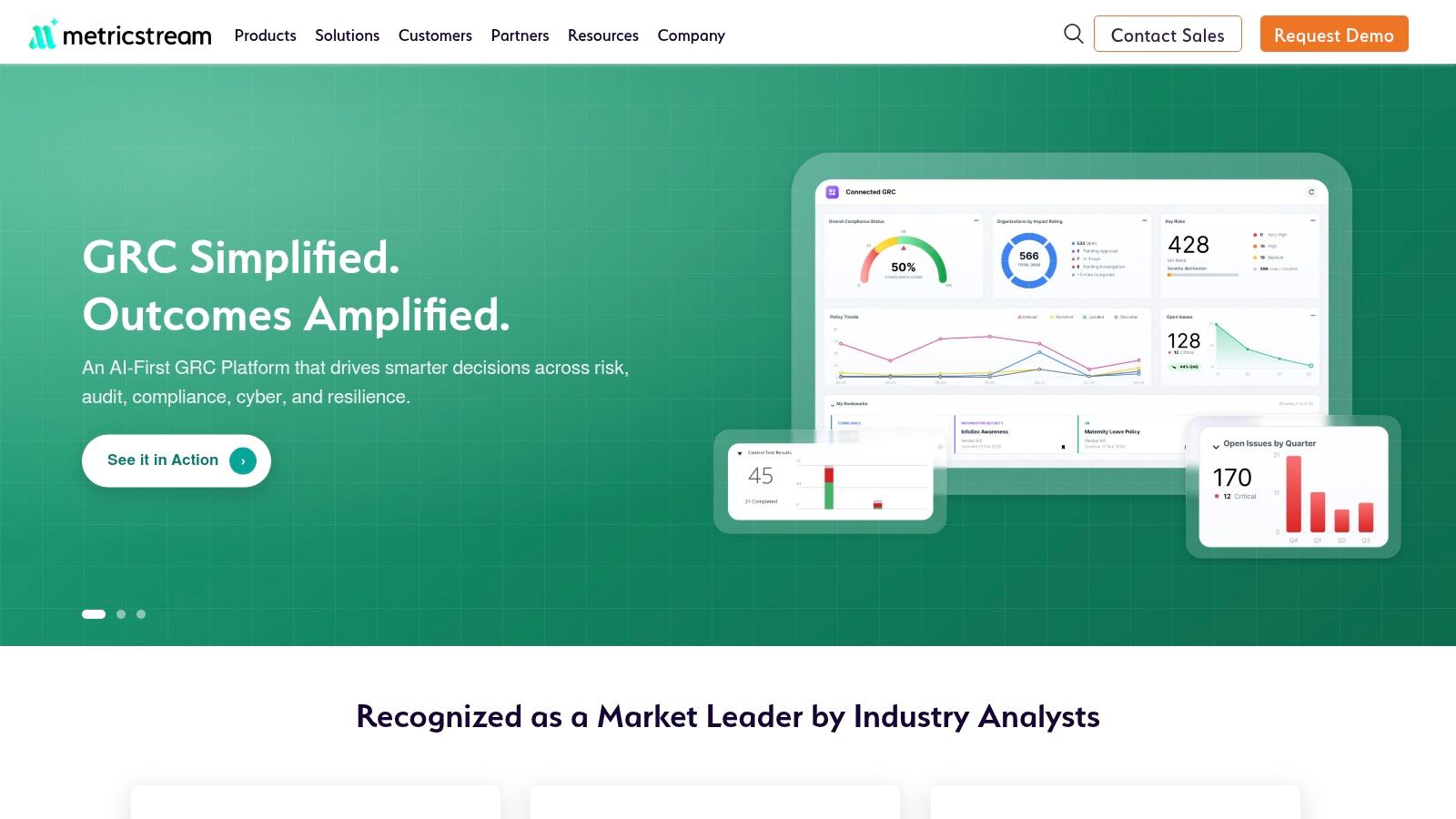
MetricStream ConnectedGRC is designed for enterprises that want a broad GRC programme on a shared data model. It brings together enterprise risk, compliance, audit, cyber and IT risk, third-party risk, and ESG, making it relevant when several functions need the same risk and control language.
The platform's federated data model supports localisation and multi-currency requirements. That's particularly relevant for groups operating across jurisdictions, business units, or reporting environments. AppStudio adds configuration and extension options, while Continuous Control Monitoring can automate evidence collection when source systems expose dependable data.
MetricStream's breadth is its main strength and its main implementation risk. A large programme can create value across multiple lines of defence, but it can also encourage organisations to activate too many modules before governance foundations are ready.
The enterprise buying lens
Automation depth: Continuous evidence collection and control monitoring can reduce recurring manual requests.
Content breadth: Built-in coverage across risk, compliance, audit, cyber, third-party risk, and ESG supports programme consolidation.
Configuration effort: AppStudio can accommodate local processes, but configuration still requires ownership, testing, and release governance.
Commercial visibility: Pricing isn't public, so the business case should include implementation, integration, administration, and ongoing optimisation.
MetricStream is better suited to a coordinated enterprise transformation than an isolated audit workflow. Integration with the four named service-management environments should be tested using real incident, asset, change, vendor, and evidence records. The governance, risk, and compliance platform overview can help stakeholders define those records before a demonstration.
4. Archer Integrated Risk Management
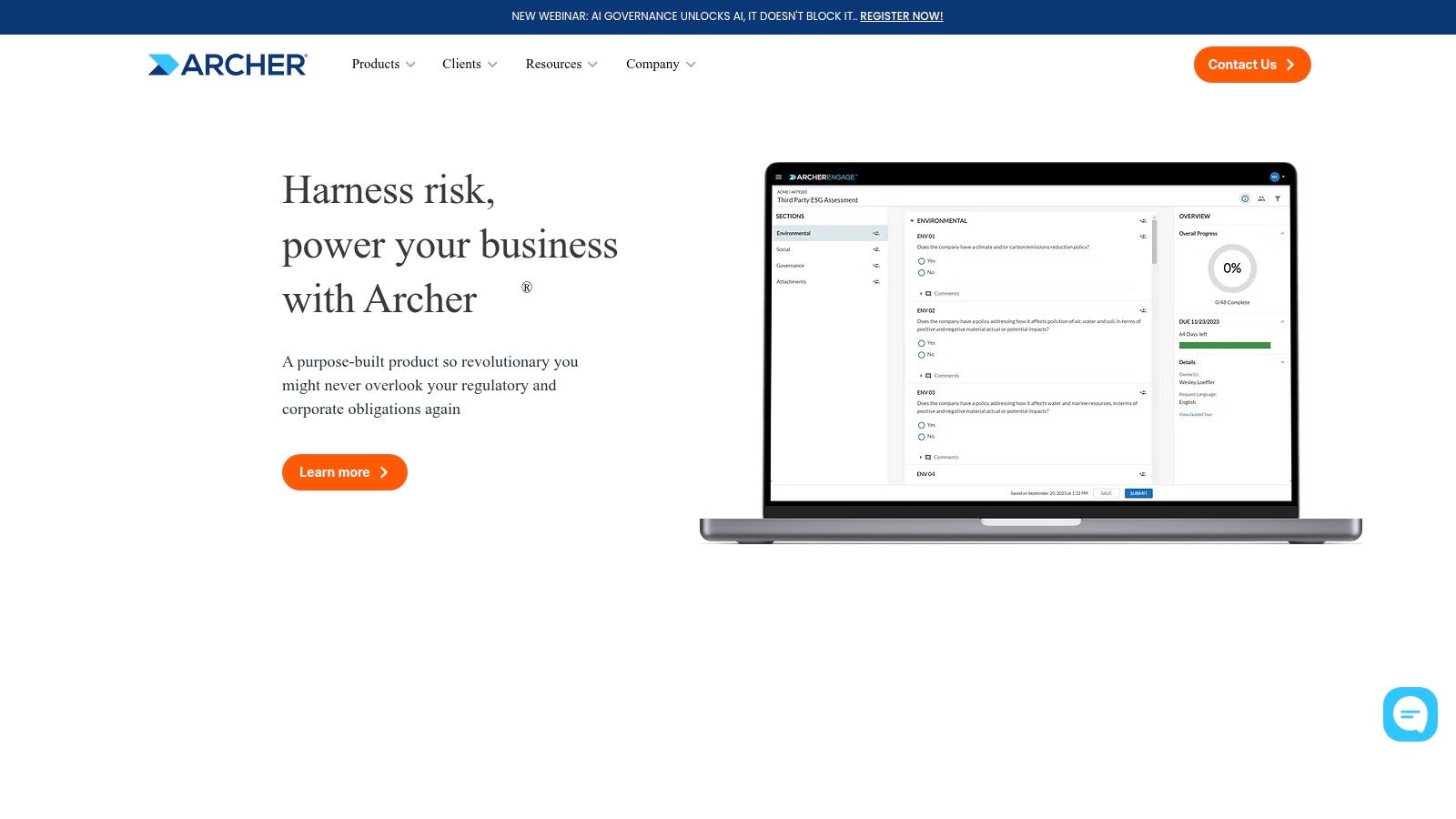
Archer Integrated Risk Management, formerly RSA Archer, remains relevant for highly regulated organisations that need configurable risk, compliance, audit, third-party risk, operational resilience, and business continuity processes. Its long history in regulated sectors means buyers often evaluate it against established taxonomies, workflows, and governance structures rather than starting from a blank page.
Archer's configurable data models and workflows support complex requirements. That's useful when standard processes don't reflect how your organisation handles risk acceptance, regulatory obligations, control exceptions, or resilience planning. Its regional hosting options, including a UAE SaaS data centre, can also support GCC data-residency conversations.
The trade-off is implementation weight. Archer may provide the necessary depth for a complex programme, but configuration, data migration, role design, and process rationalisation can demand substantial internal participation.
Archer's strongest alignment
Regulated operating models: Financial services, public-sector, energy, and other regulated environments can benefit from configurable control and resilience workflows.
Regional hosting: A UAE SaaS data centre may simplify part of the residency assessment, but contractual terms must be confirmed.
Complex process design: Detailed approval paths, exceptions, and risk relationships can be represented without forcing every team into a lightweight template.
Pricing and packaging require vendor engagement. If your organisation already runs Archer, migration risk and existing configuration should influence the decision. If you're a new buyer, compare the delivery effort with platforms that provide faster initial configuration. The audit GRC software resource can support an audit-led fit-gap discussion.
5. OneTrust Tech Risk and Compliance
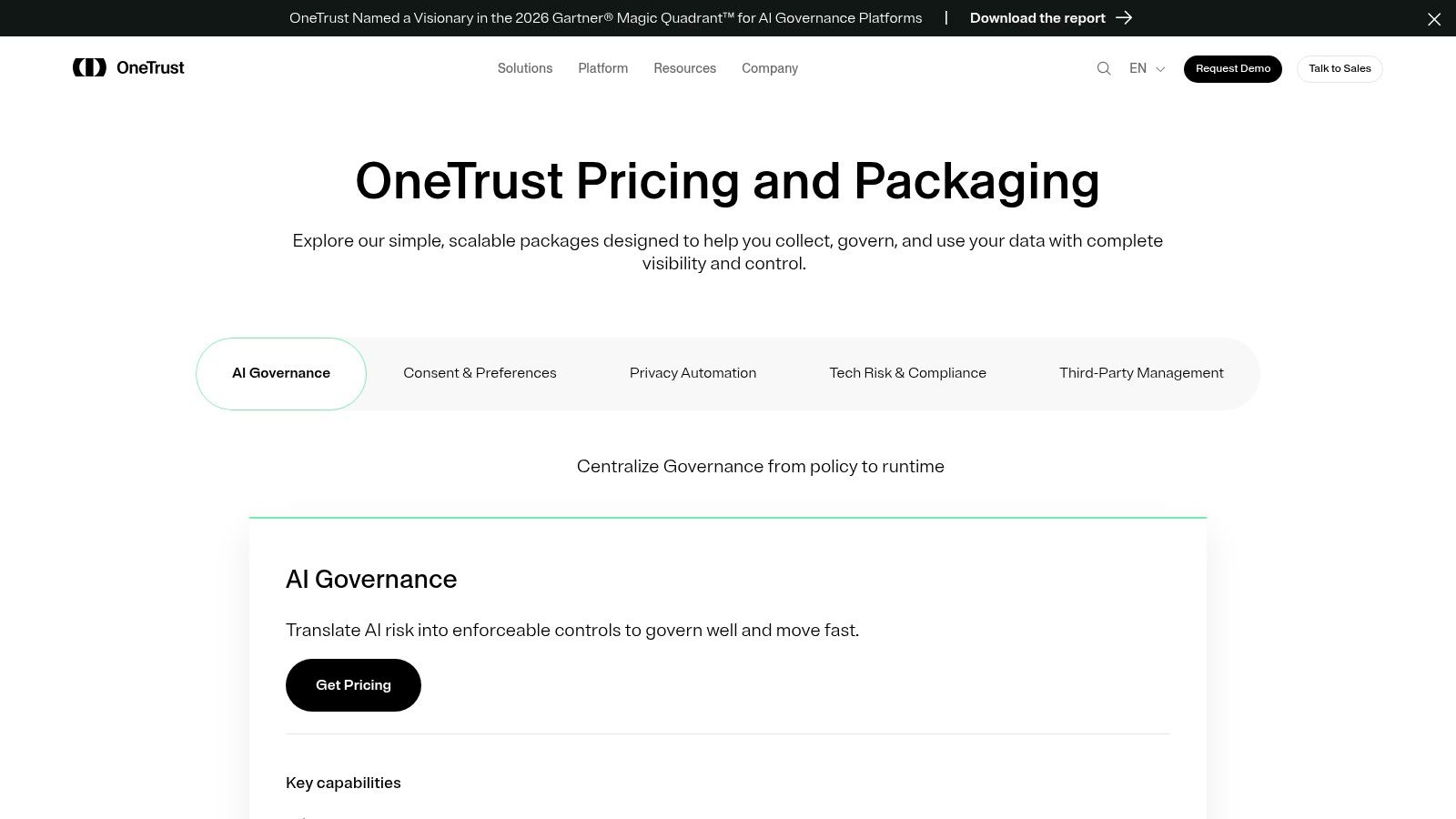
OneTrust Tech Risk and Compliance is particularly relevant when privacy, technology risk, third-party risk, and regulatory frameworks are closely connected. Its heritage in privacy and data subject rights gives it a different starting point from platforms built primarily around enterprise risk or internal audit.
OneTrust provides templates and guidance across 50+ standards and regulations, according to the vendor's product information. It also supports automated assessments, control management, and vendor lifecycle workflows. That content can reduce the manual effort involved in building an initial programme, but it doesn't replace local interpretation of UAE obligations or internal control ownership.
Its metered pricing model is based on admin users and inventory, including assets and vendors. This makes the commercial model different from a simple all-user subscription and requires procurement teams to forecast inventory growth carefully.
Why inventory assumptions matter
Privacy-led programmes: OneTrust can align well with organisations where privacy operations and technology risk share ownership.
Third-party workflows: Vendor assessments and lifecycle activities can become part of a wider control environment.
Metering exposure: More assets, vendors, administrators, or selected capabilities may change the commercial position.
Buyers should map OneTrust records to ServiceNow, HaloITSM, Freshservice, or ManageEngine before selecting a connector. Avoid duplicate inventories, especially where the service-management platform already owns configuration items, suppliers, or incidents. The third-party risk management software guide offers a useful lens for separating content coverage from workflow integration.
6. NAVEX One
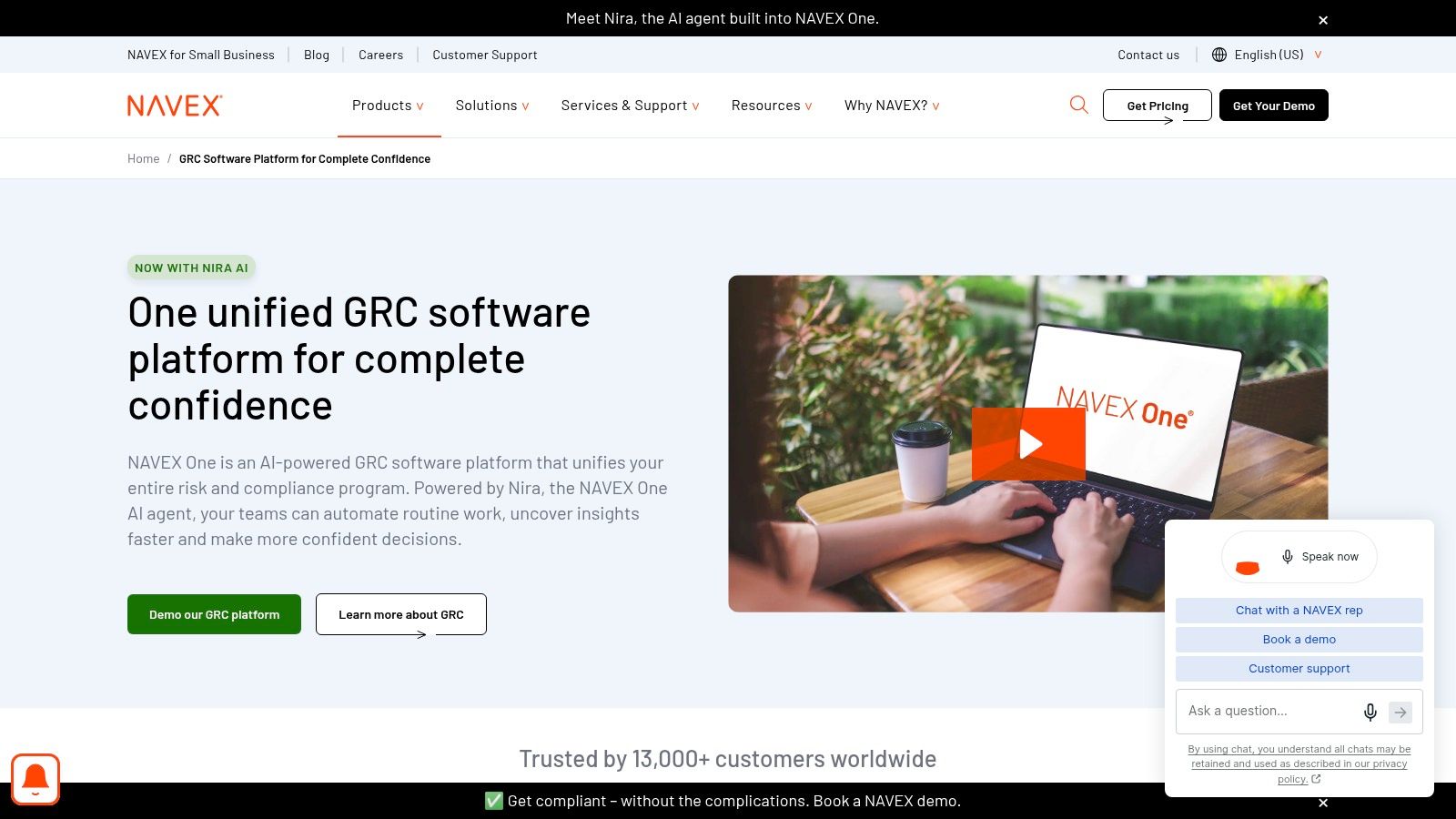
NAVEX One approaches GRC through ethics, compliance, people, and organisational behaviour as well as formal risk and control processes. Its scope includes speak-up and incident management, policy, training, disclosures, third-party risk, and risk management.
That combination makes NAVEX One a practical option when the programme needs to connect employee-facing compliance activities with management reporting. A speak-up report, policy acknowledgement, training requirement, or disclosure workflow can provide context that a purely control-centric platform may not capture as naturally.
The platform uses shared data, AI-assisted workflows, leadership dashboards, and pre-packaged suites to support deployment. Those packages can accelerate initial scope, but suite bundling may include capabilities your organisation isn't ready to govern.
Procurement questions for NAVEX One
Programme ownership: Is the buyer compliance, legal, HR, internal audit, risk, or a shared steering group?
Localisation: Confirm language, regional hosting, reporting, and case-handling requirements for GCC operations.
Suite boundaries: Ask which functions are included, optional, or dependent on separate implementation work.
ITSM integration: Define whether incidents and remediation tasks should remain in NAVEX One or move into ServiceNow, HaloITSM, Freshservice, or ManageEngine.
NAVEX One is most compelling when culture, reporting, training, and incident workflows belong in the same operating conversation. It's less suitable if your immediate priority is deep CMDB-linked control monitoring or highly technical infrastructure evidence.
7. Diligent HighBond
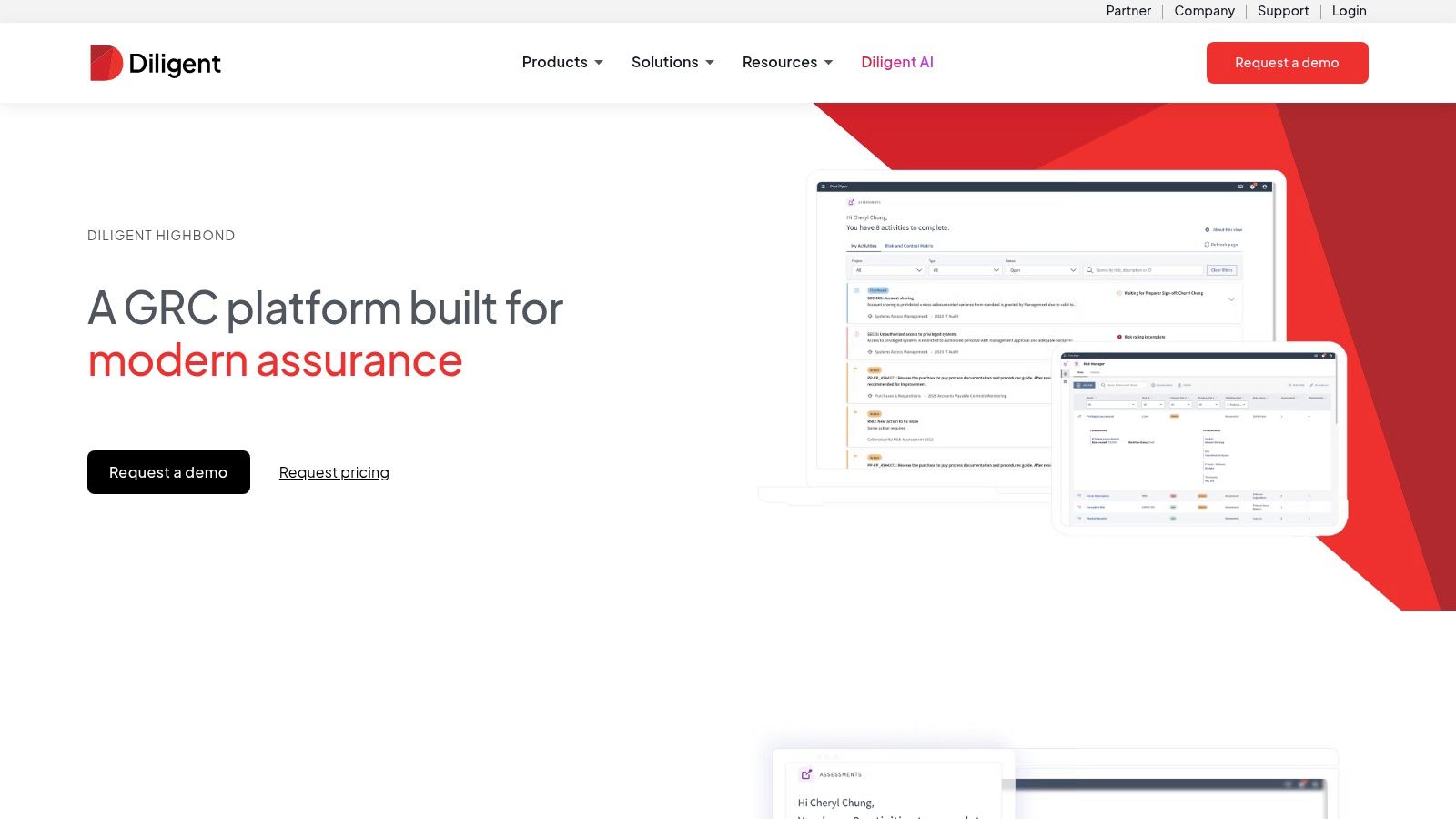
Diligent HighBond is an audit-first cloud GRC platform that centralises risk and control libraries, workpapers, testing, issues, and reporting. Its connection with Diligent's broader governance suite, including board and ESG capabilities, makes it relevant for organisations that want assurance work to reach senior governance audiences.
HighBond's strengths appear in the audit lifecycle. Audit teams can structure planning, testing, evidence, findings, remediation, and reporting in a connected environment. Modules also address compliance and IT risk, while APIs support automation and integration with surrounding systems.
The platform's history requires careful product scoping. Some components have evolved or been sunset, so buyers should confirm the current product map, migration implications, and roadmap for each intended use case.
When HighBond makes sense
HighBond fits an organisation where internal audit drives the GRC operating model and needs stronger connections to risk, compliance, and governance reporting. It may be less suitable when a CIO needs deep operational workflows tied directly to configuration items, changes, and service ownership.
Test integration with your service-management estate using a real audit scenario. For example, determine whether a failed control test can create a remediation task in ServiceNow, HaloITSM, Freshservice, or ManageEngine while preserving evidence, ownership, due dates, and closure approval. Pricing and packaging require direct vendor engagement.
8. LogicGate Risk Cloud
LogicGate Risk Cloud is built around configurable applications rather than one fixed GRC workflow. Its catalogue includes 30+ packaged applications for risk, compliance, and third-party risk, allowing organisations to add use cases incrementally, according to the vendor's platform information.
This application-based structure suits teams whose processes are evolving or differ across business units. Administrators can configure workflows around intake, assessment, approval, remediation, and reporting without treating every future requirement as a full transformation programme.
LogicGate's licensing model focuses on Power Users, meaning administrators and configurators, rather than all end users. That can help organisations with many occasional participants, but the contract definitions need close review.
The overlooked cost question
A Power User model can look attractive until your organisation needs more administrators, applications, environments, or advanced capabilities such as risk quantification. Exact per-application pricing isn't public and varies by scope, so compare:
Administration: Who will configure, test, document, and release workflows?
Participation: Which employees, suppliers, auditors, and control owners need access?
Integration: Which system remains authoritative for incidents, assets, and service records?
Expansion: What happens when a pilot becomes an enterprise programme?
LogicGate can be a strong fit for incremental adoption. Its value depends on keeping configuration disciplined, otherwise rapid flexibility can create inconsistent taxonomies and duplicate processes.
9. SAI360
SAI360 combines IT and cyber risk, policy and compliance, learning, third-party risk, operational resilience, ethics, and analytics. Its distinguishing angle is the connection between employee learning and formal GRC activity.
That combination can matter when policy effectiveness depends on whether people understand and follow the required behaviour. A policy can be mapped to controls and workflows, but training, ethics, and learning data may reveal whether the organisation has embedded the expected practice beyond documentation.
SAI360 supports automated workflows and integrations, with bundles for IT and cyber risk. The broad suite can create end-to-end visibility, but buyers should resist selecting every adjacent module before identifying accountable owners and measurable adoption outcomes.
A culture-led deployment path
Start with a workflow that connects policy, training, evidence, and exception handling. Then test whether incidents or service records from ServiceNow, HaloITSM, Freshservice, or ManageEngine can enter the risk process without forcing users to work in multiple queues.
SAI360's pricing isn't transparent and module selection can expand implementation scope. Treat learning and ethics capabilities as operating commitments, not decorative features. If business owners won't maintain content, assign training, or review exceptions, the platform may produce more records without improving control performance.
10. Riskonnect
Riskonnect is suited to organisations that need to connect insurable and non-insurable risk. Its platform covers enterprise and operational risk, compliance, internal controls, audit, third-party risk, ESG, policy, business continuity, and resilience.
The differentiator is its relationship with RMIS and claims processes. That can help finance and risk leaders view insurance-related exposure alongside operational, compliance, and enterprise risks instead of maintaining separate reporting conversations.
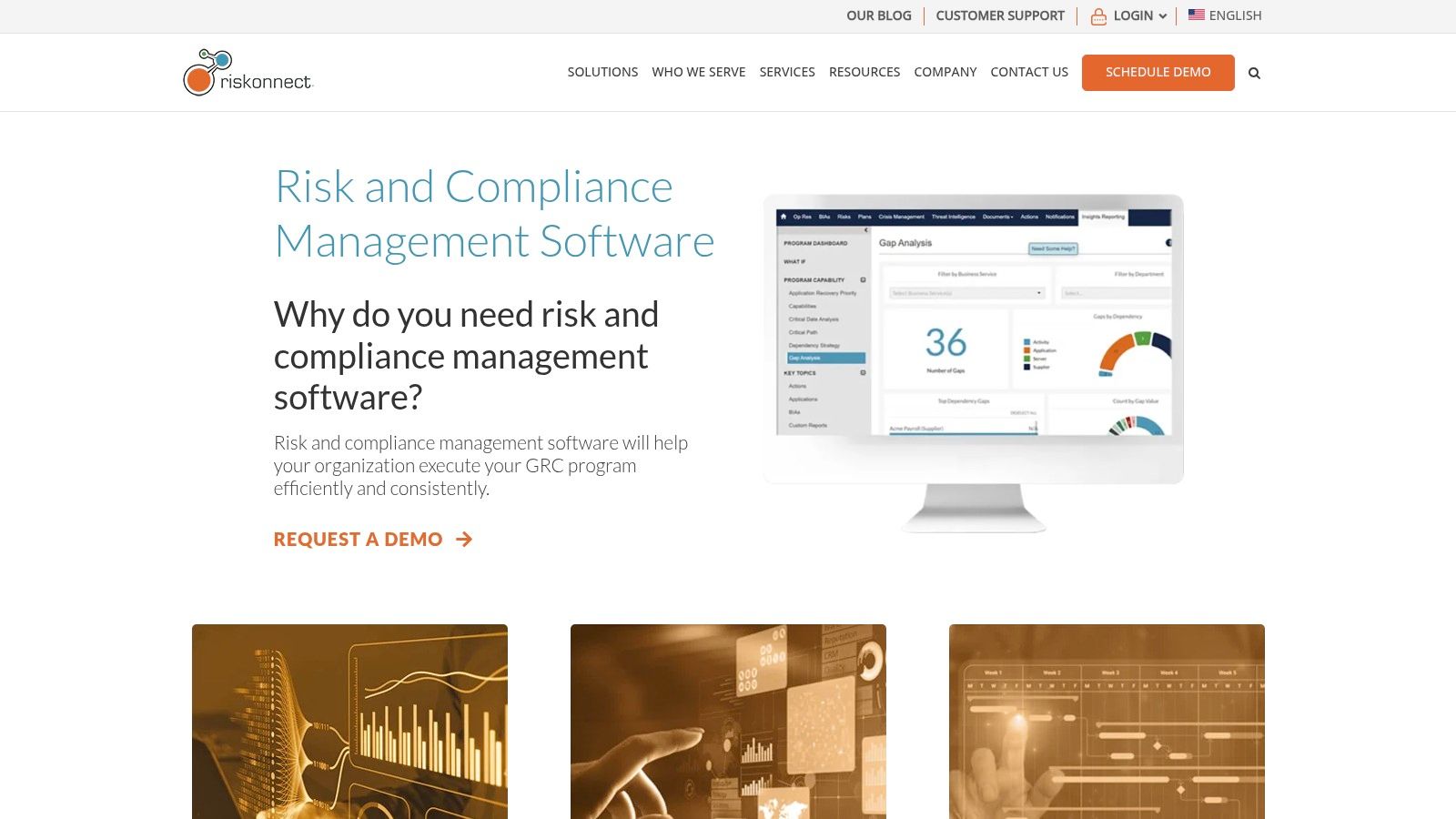
Riskonnect also presents a modern interface for occasional users. That matters when control owners, business continuity participants, or operational managers need to complete tasks without becoming full-time GRC specialists.
Where the platform can become complex
Riskonnect's breadth can extend discovery and implementation timelines, particularly when an organisation needs both insurable and non-insurable risk models. Confirm whether RMIS, claims, audit, resilience, and compliance data should share one taxonomy or remain federated.
The platform should also be assessed against your service-management architecture. ServiceNow, HaloITSM, Freshservice, or ManageEngine may already own incidents, assets, suppliers, or continuity-related work. A successful design will define the system of record for each object before integration begins.
Top 10 GRC Automation Tools, Feature Comparison
Product | Key capabilities | Integration & deployment | Unique selling points (value) | Target audience & pricing notes |
|---|---|---|---|---|
ServiceNow Integrated Risk Management (IRM) | Policy, Risk, Audit, Operational Resilience, Now Assist AI, CMDB-driven controls | Native Now Platform integration with ITSM/ITOM/CSM/HRSD; UAE Azure cloud option for data residency | Deep cross‑platform automation and continuous control monitoring; large partner ecosystem | Best for ServiceNow customers needing cross‑functional automation. Pricing: bespoke; costs rise with modules; TPRM may need add‑ons |
IBM OpenPages | Operational risk, compliance, audit, model risk, GRC Canvas, analytics | SaaS (AWS/IBM Cloud), on‑prem; REST APIs and integrations | Visual modelling and strong analytics; deployment flexibility | Best for orgs needing deployment choice and clear starting SaaS prices. Pricing: published starting SaaS tiers; add‑ons complicate TCO |
MetricStream ConnectedGRC | Federated single data model, AppStudio, Continuous Control Monitoring, ESG support | Enterprise SaaS with localization/multi‑currency; APIs for integration | Very broad module coverage and mature analytics/CCM | Best for large enterprises with multi‑domain GRC needs. Pricing: not public; enterprise implementations can be complex |
Archer Integrated Risk Management | Enterprise/operational risk, compliance, audit, resilience; highly configurable workflows | Regional hosting (including UAE SaaS), global partner delivery in ME | Proven at scale in regulated sectors; high configurability for complex requirements | Best for regulated industries (public sector, finance, energy) in GCC. Pricing: vendor engagement required; implementation-heavy |
OneTrust (Tech Risk & Compliance, TPRM, Privacy) | Privacy, TPRM, tech risk, templates for 50+ standards, automated assessments | Extensive integrations; meter‑based licensing tied to admin users and inventory | Privacy‑first heritage and large content library for fast program setup | Best for privacy‑centric organisations and heavy regulatory frameworks. Pricing: metered/custom; tiering complicates comparisons |
NAVEX One | Speak‑up/incident, policy, training, TPRM, AI workflows, dashboards | Global hosting and localization; pre‑packaged suites to accelerate rollout | People‑first UX and pre‑packaged suites for rapid deployment | Best for global organisations needing integrated ethics/compliance programs. Pricing: gated; suite bundling can add unwanted scope |
Diligent HighBond | Audit management, controls, centralized workpapers, testing, reporting | Cloud SaaS with APIs; integrates with Diligent governance/board/ESG suite | Audit‑first workflows linked to governance and board reporting | Best for organisations seeking audit‑centric GRC tied to governance/ESG. Pricing: vendor engagement required; some modules evolved |
LogicGate Risk Cloud | App‑based architecture, packaged GRC apps, optional risk quantification | Configurable apps; pricing centered on 'Power Users' (administrators) | Cost‑control model for many occasional users; fast time‑to‑value via apps | Best for orgs with many occasional users wanting economical admin‑centric licensing. Pricing: per‑app/admin pricing varies; review contracts carefully |
SAI360 | IT/cyber risk, policy/compliance, learning & ethics, analytics | Cloud SaaS with wide integrations; dynamic automated workflows | Combines learning/ethics with GRC to drive cultural change | Best for organisations wanting learning/ethics + GRC integration. Pricing: not transparent; careful packaging needed to avoid shelfware |
Riskonnect | ERM, TPRM, BCM/resilience, internal controls, RMIS/claims linkage | Cloud SaaS; connects RMIS/claims to IRM workflows | Links insurable and non‑insurable risk for CFO/CRO alignment; strong BCM capabilities | Best for organisations needing finance‑risk alignment and resilience. Pricing: not public; scoping may extend timelines |
How Should You Procure and Implement a GRC Platform?
Start with the risk domains that matter most to your operating model. Document priority areas such as privacy, cyber risk, third-party risk, internal audit, operational resilience, business continuity, financial controls, or regulatory change. Assign a control owner and evidence owner for each domain before inviting vendors to demonstrate features.
The UAE environment requires particular care. Organisations may need to align with Federal Decree-Law No. 45/2021, the DIFC Data Protection Law, Central Bank of the UAE guidelines, TRA cybersecurity standards, and ISO 27001, as described in this UAE GRC platform overview. The UAE Information Assurance Regulation, developed by the Telecommunications and Digital Government Regulatory Authority, sets a minimum protection level for information assets and supporting systems across UAE entities, according to the official UAE cyber safety platform.
A useful procurement sequence looks like this:
Document priority domains: Define risks, controls, owners, evidence, review frequency, and escalation paths.
Map current workflows: Identify where risk assessments, incidents, exceptions, approvals, audit evidence, and remediation work happen today.
Assess integration requirements: Test the required relationships with ServiceNow, HaloITSM, Freshservice, and ManageEngine, including assets, incidents, changes, suppliers, identities, and evidence.
Run a fit-gap workshop: Use real process scenarios rather than generic demonstrations. Ask each vendor to show intake, assessment, control testing, exception approval, remediation, reporting, and audit trails.
Validate hosting and residency: Confirm deployment locations, subcontractors, backup arrangements, encryption responsibilities, and data-export procedures.
Validate commercial assumptions: Check user types, administrator licences, inventory metering, modules, environments, connectors, add-ons, implementation services, support, and renewal terms.
Pilot one high-value workflow: Select a process with visible business value, such as audit evidence collection, risk registers, control testing, or incident reporting.
Prepare adoption activities: Create stakeholder communications, role-based training, administrator enablement, ownership matrices, and escalation procedures.
Measure operational outcomes: Track adoption, evidence cycle time, control-monitoring coverage, overdue remediation, data quality, and repeat manual effort.
Regional incident reporting deserves explicit design. A UAE cybersecurity regulation summary states that the UAE Cybersecurity Council was established by Cabinet resolution in November 2020, and that organisations must report cyber incidents promptly to the Council or the relevant sector regulator. That creates a specific incident workflow requirement that your selected platform and service-management integrations should demonstrate, as outlined in this UAE cybersecurity regulation summary.
Control content also needs verification. A UAE-focused GRC guide states that NESA Information Assurance Standards Version 2 contains 188 specific security controls, that Dubai-based entities and suppliers must comply with DESC Information Security Regulation Version 3, and that organisations have until January 1, 2027 to achieve full compliance with the PDPL. Treat these as requirements to validate with legal, compliance, and regulatory stakeholders, not as a substitute for interpretation, as explained in this UAE GRC framework guide.
Procurement principle: Compare total cost of ownership, not headline licensing. Include configuration, integration, data migration, content maintenance, training, administration, support, upgrades, managed optimisation, and the cost of duplicate systems.
The GCC adoption picture also supports a staged approach. In a 2025 survey of 649 tax, finance, and legal professionals, 29% said their organisations weren't adopting GenAI, compared with 52% in 2024. 23% prioritised AI for repetitive compliance tasks, while 19% reported scaled or enterprise-wide implementation and 18% remained in pilot mode. 26% of respondents were based in the UAE, according to the Everest Group GCC survey. The implication is practical: the region is moving toward operationalisation, but many compliance functions still need controlled pilots, governance, and adoption support.
DataLunix can support discovery workshops, readiness assessments, fit-gap analysis, implementation, change management, managed services, and staff augmentation across GCC and Europe. Its delivery model combines UAE-based leadership with onshore, offshore, or hybrid delivery through India-based delivery centres. For organisations using ServiceNow, HaloITSM, Freshservice, or ManageEngine, that support can include workflow alignment, integration planning, stakeholder communications, role-based enablement, optimisation, upgrades, and outsourced operations.
Confirm every vendor capability, price, hosting term, module boundary, inventory assumption, user definition, and add-on requirement directly before contracting. A strong platform still needs clean ownership, reliable source data, a realistic rollout path, and a service-management design that people will use.
DataLunix supports enterprise GRC discovery, fit-gap analysis, implementation, integration, change management, managed optimisation, and staff augmentation across ServiceNow, HaloITSM, Freshservice, and ManageEngine. Visit DataLunix to plan a readiness assessment and identify the first high-value GRC workflow for your organisation.